































Data Analytics for Government: Use Cases, Benefits and Implementation Strategy

 Share -



- 01Data Analytics for Government
- 02Why Data Analytics Matters for Government Agencies
- 03What Are the High-Impact Use Cases of Government Data Analytics?
- 04Data Analytics vs AI in Government: What's the Difference?
- 05What Are the Benefits of Data Analytics in Government?
- 06What Are The Big Data Analytics Challenges Faced by Government Agencies and How to Solve Them?
- 07Government Data Analytics Architecture: What Does the Technology Stack Look Like?
- 08How to Implement a Data Analytics Strategy in Government?
- 09Australian Government Data Analytics: Policy and Regulatory Considerations
- 10What Trends Will Shape Government Data Analytics Strategy in 2026 and Beyond?
- 11How Should Government Agencies Measure the ROI of Data Analytics?
- 12What Does a Government Data Analytics Maturity Model Look Like?
- 13How Appinventiv Helps Government Organisations Build Data Analytics Capabilities?
- 14FAQs

Key takeaways:
- Data analytics can help government move from reactive reporting to evidence-based, proactive decision-making.
- The highest-value use cases are those directly connected to public outcomes, resource efficiency and operational priorities.
- The next stage is AI-enabled and real-time government, where analytics, simulation and intelligent systems support faster and more anticipatory decisions.
Australian government agencies generate enormous volumes of data every day, from urban sensor networks and healthcare registries to transport grids, tax filings and case management systems. Turning that raw volume into usable, actionable public sector intelligence remains one of the hardest problems facing agency leadership, not because the data is missing but because it sits fragmented across legacy platforms, siloed departments and inconsistent governance models.
Public sector leaders are caught between two pressures that rarely move at the same pace. On one side sits legacy infrastructure, legacy procurement models and, in many agencies, a legacy mindset that still treats data as a compliance artefact rather than an operational asset. On the other side sits a community base that now expects government services to feel as fast, personalised and transparent as their banking app or their retailer’s loyalty programme.
Closing that gap requires agencies to move deliberately along a maturity curve: from raw data, to analytics, to prediction, to decision, to action. Each step depends on the one before it, and skipping ahead to prediction or AI without solid data foundations is one of the most common reasons public sector analytics programmes stall after the pilot stage.
The mandate for this shift is no longer optional. Australia’s Data and Digital Government Strategy sets a 2030 vision for simple, secure and connected public services built on world-class data and digital capabilities, and it is reinforced by the Data Availability and Transparency Act 2022, which pushes agencies toward safer, better-governed data sharing across the Commonwealth. Together, these instruments signal that data analytics in the public sector is now a whole-of-government expectation rather than a discretionary IT upgrade.
This piece sets out what data analytics in government actually involves, where it delivers measurable value across Australian public sector agencies, the barriers that most commonly derail programmes, and a practical, phased approach to implementation that CIOs, CDOs and department heads can take to their executive committees.
If your agency is weighing a move from fragmented reporting toward predictive, evidence-based decision-making, a structured data and analytics maturity assessment is usually the most useful starting point, and it is one Appinventiv runs regularly with government clients across Australia.
Identify the analytics capabilities your agency needs to make faster, evidence-based decisions.

Data Analytics for Government
Big data analytics for government is the discipline of collecting, integrating, analysing and interpreting data drawn from government systems and external sources to improve public services, resource allocation, policy decisions and community outcomes.
How Government Data Analytics Differs From Traditional Reporting
Traditional government reporting was built for accountability after the fact. Modern government analytics is built for decisions in the moment, and the difference shows up across every layer of the operating model.
| Dimension | Traditional Government Reporting | Modern Government Data Analytics |
|---|---|---|
| Data Scope | Departmental, siloed CSV/Excel files | Integrated, cross-agency data platforms |
| Latency | Monthly, quarterly, or annual batch cycles | Real-time streaming and event-driven updates |
| Analysis Depth | Historical aggregation (What happened?) | Predictive & Prescriptive modelling (What next?) |
| Architecture | Legacy SQL servers & manual exports | Cloud-native data meshes & automated ETL/ELT |
| Actionability | Passive oversight & audit compliance | Active workflow triggers & automated decisions |
The Four Levels of Government Analytics
- Descriptive analytics — establishes what happened, using historical service, transaction and case data.
- Diagnostic analytics — explains why it happened, correlating variables across programmes and cohorts.
- Predictive analytics — forecasts what is likely to happen next, using statistical and machine learning models.
- Prescriptive analytics — recommends what the agency should do next, weighing intervention options against constraints.
Artificial intelligence for Australian government sits above these four levels as an accelerant rather than a substitute. AI models extend prescriptive analytics by automating parts of the response. However, they still depend entirely on the descriptive and diagnostic layers beneath them for accuracy and defensibility.
Why Data Analytics Matters for Government Agencies
Public sector leaders navigate a complex operational landscape. Fiscal policy demands tighter spending, while the community expects digital service experiences comparable to commercial banking or logistics platforms. Meeting these standards requires agencies to move past legacy administrative models.
Increasing Demand for Better Public Services
Communities increasingly benchmark government services against private sector digital experiences rather than against other government agencies. That expectation gap drives pressure on case processing times, digital channel availability and the consistency of service across states, territories and local councils.
Budget Pressure and Competing Priorities
Analytics gives finance and operations leaders visibility into where resources are actually being consumed, where demand is rising fastest and which interventions produce measurable value per dollar. That evidence base matters more each budget cycle as agencies are asked to do more without proportional funding growth.
Fragmented Data Across Departments
Most agencies run a patchwork of platforms, data models and case management tools that were procured independently over successive years. Australia’s data strategies increasingly focus on discoverability and interoperability precisely because this fragmentation, not a lack of data, is the primary blocker to cross-agency insight.
Evidence-Based Policy Making
Ministers and central agencies are asking programme owners to demonstrate outcomes rather than activity. Analytics lets agencies evaluate programme effectiveness against actual results, replacing assumption-based reporting with evidence that can withstand audit and parliamentary scrutiny.
Anticipating Risks Earlier
Predictive analytics, geospatial modelling and sensor data allow agencies to intervene earlier, whether that is flagging a vulnerable household before a crisis escalates or identifying infrastructure at risk of failure before it disrupts a community.
What Are the High-Impact Use Cases of Government Data Analytics?
The strongest government data analytics use cases sit close to measurable public outcomes. Rather than beginning with a technology capability, agencies should start with a service, operational or policy problem where better information can materially improve timing, allocation, risk management or community outcomes.
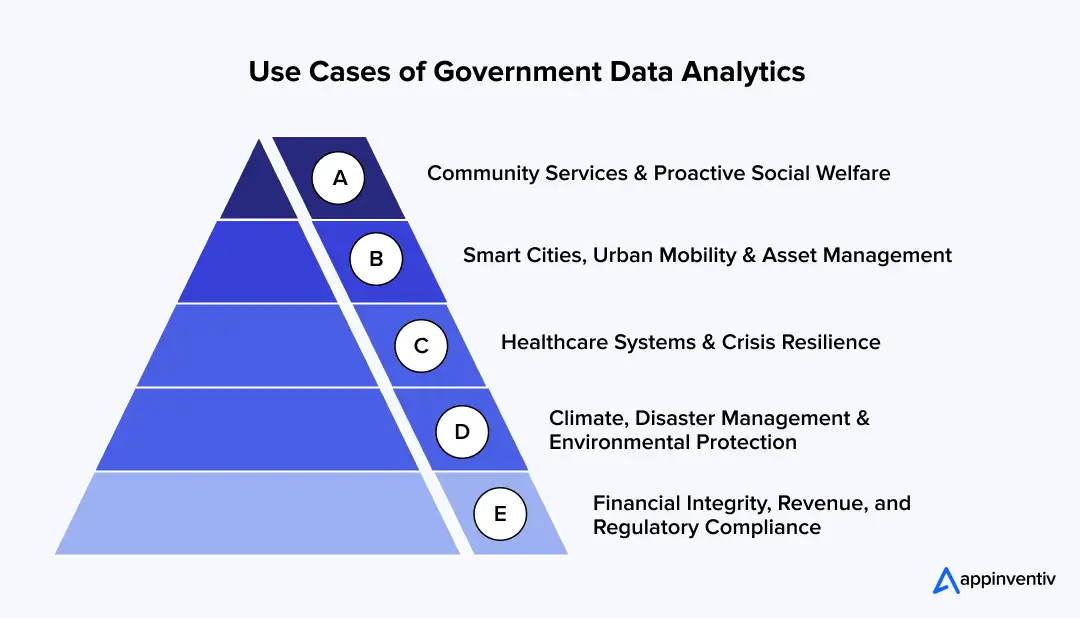
Community Services and Proactive Social Welfare
Analytics can combine service interactions, programme participation and demographic information to identify changing demand and potential gaps in service access.
Used appropriately, this can support earlier intervention and better targeting of services. Sensitive information requires strict controls, clear purpose limitations and human oversight.
Smart Cities, Urban Mobility and Asset Management
Transport networks, traffic systems, public facilities and other infrastructure generate continuous operational data.
Analytics can help agencies monitor asset condition, identify maintenance priorities, understand traffic patterns and forecast demand. Geospatial analytics can add another layer by showing how service pressure and infrastructure risks vary across locations.
Healthcare Systems and Crisis Resilience
Health agencies can use analytics to understand service demand, capacity, patient flows and emerging pressure points.
During major events, combining operational and environmental information can improve situational awareness. Any analytical architecture handling health information must be designed around appropriate privacy, security and access controls.
Climate, Disaster Management and Environmental Protection
Australia’s exposure to bushfires, floods, extreme weather and other environmental risks creates a strong case for predictive and geospatial analytics.
Agencies can combine weather, satellite, sensor, infrastructure and historical event data to improve risk mapping, response planning and resource allocation.
Financial Integrity, Revenue and Regulatory Compliance
Analytics can help agencies identify unusual transactions, investigate anomalies, monitor programme expenditure and improve compliance processes.
The strongest implementations focus on prioritising cases for investigation rather than assuming an analytical model can determine wrongdoing on its own.
Data Analytics vs AI in Government: What’s the Difference?
Treating AI and analytics as interchangeable leads to poorly scoped business cases. Analytics and AI solve related but different problems. Analytics provides the evidence layer for understanding performance and patterns, while AI can extend that capability through prediction, classification, generation and automation.
| Capability Tier | Core Purpose | Typical Government Architecture | Primary Operational Value |
|---|---|---|---|
| Business Intelligence (BI) | Operational visibility & performance tracking | Structured Data Warehouse + SQL + Reporting Dashboards | Evaluates historical performance against agency KPIs. |
| Data Analytics | Pattern identification & trend analysis | Data Lakehouse + Statistical Analysis Tools | Uncovers operational bottlenecks and policy impacts. |
| Predictive Analytics | Forecasting future operational events | ML Pipelines + Time-Series Regression Models | Anticipates resource demand and system failures. |
| Machine Learning (ML) | Complex pattern & anomaly detection | Feature Stores + Automated Model Training | Automates risk scoring and fraud identification. |
| Generative AI (Gen AI) | Unstructured context processing | LLMs + Vector Databases (RAG Architecture) | Summarises policy frameworks and assists document processing. |
| Agentic AI | Multi-step task execution | Autonomous AI Agents + API Orchestration | Executes multi-system workflow actions automatically based on policy rules. |
AI is only as useful as the data foundation underneath it. Capgemini’s public sector study found that fewer than one in four public sector organisations report high maturity in any aspect of data readiness, even as most agencies are actively piloting generative and agentic AI, which is precisely the gap that stalls AI initiatives before they scale beyond a proof of concept.
What Are the Benefits of Data Analytics in Government?
Adopting data analytics allows public sector agencies to transition from reactive administration to proactive, evidence-based governance. Here are some most common benefits of data analytics in government:
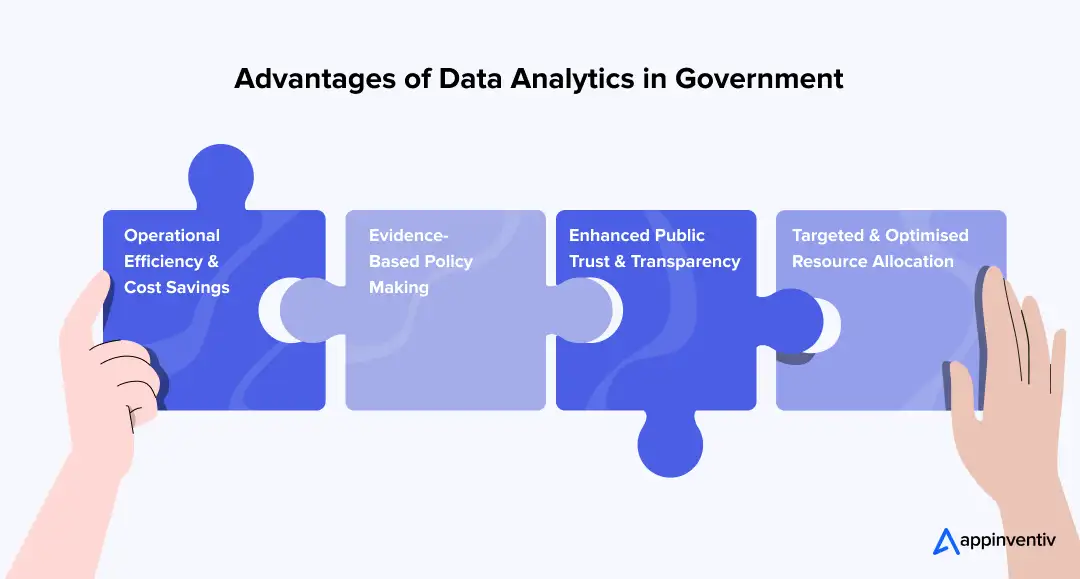
Operational Efficiency and Cost Control
Analytics can reveal bottlenecks, duplicated processes and changing demand. This gives operational leaders better information for workforce planning, service capacity and resource allocation.
Evidence-Based Policy Making
Policy teams can assess outcomes using actual programme and service data, improving the basis for policy adjustment and investment decisions.
Better Resource Allocation
Analytics allows agencies to position frontline staff, funding and infrastructure investment where need is rising fastest, rather than applying uniform allocation formulas across dissimilar regions.
Greater Transparency and Public Trust
Consistent, auditable reporting on programme outcomes supports public and parliamentary confidence, particularly where agencies publish performance data proactively rather than only on request.
What Are The Big Data Analytics Challenges Faced by Government Agencies and How to Solve Them?
Analytics programmes become sustainable when technical investment is tied to governance, operating processes and measurable outcomes. Agencies should treat data quality, interoperability, privacy and security as part of the analytical product itself. Solving these issues progressively is more practical than waiting for a perfect enterprise data environment before delivering value.
| Challenge | Practical Response |
|---|---|
| Fragmented data and legacy systems | Introduce an integration layer and canonical data model before attempting cross-agency analytics |
| Poor data quality | Establish data quality rules and stewardship roles at the point of capture, not downstream |
| Data silos and limited interoperability | Adopt shared metadata standards aligned to whole-of-government data strategies |
| Privacy and sensitive community information | Apply privacy-by-design, de-identification and role-based access from the outset |
| Data governance and accountability | Assign clear data ownership and a governance board with delegated authority |
| Cybersecurity and data sovereignty | Use accredited, sovereign-capable hosting with independently certified security controls |
Every government analytics programme needs a clear, traceable line running from
Data investment → analytical capability → operational decision → measurable outcome
Programmes that cannot draw that line struggle to justify continued funding beyond the first budget cycle.
Fragmented systems, poor data quality and governance constraints can limit the value of analytics. Identify the technical and operational gaps before investing in a larger transformation.

Government Data Analytics Architecture: What Does the Technology Stack Look Like?
A mature government analytics stack typically follows a consistent flow: data sources feed an integration layer, which populates a governed data platform, which is subject to governance and access controls, which feeds analytics and AI models, which surface through visualisation tools, which inform a decision, which drives an action back into the operating environment.
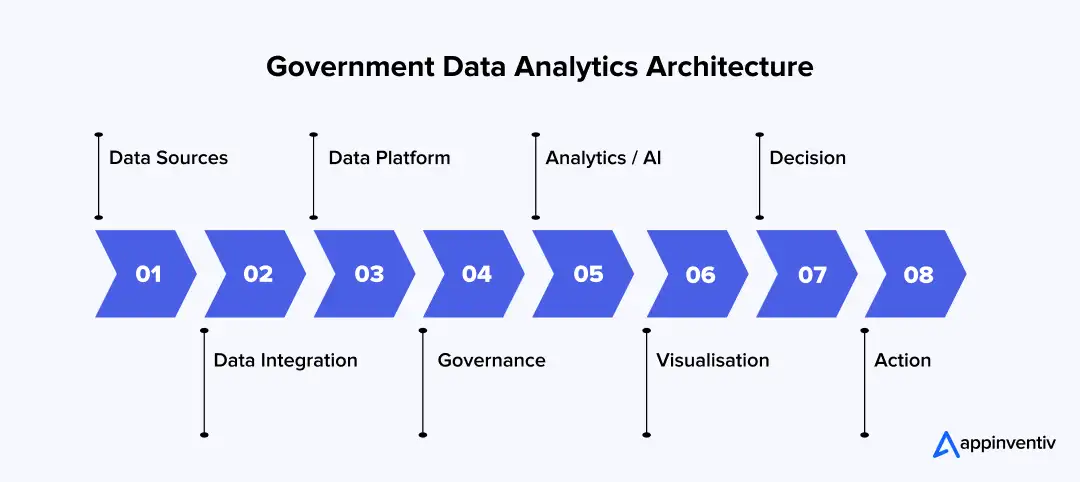
Each stage needs its own accountable owner. Agencies that treat governance as a single stage rather than a control applied at every layer tend to accumulate risk that surfaces only during an audit or a security incident.
How to Implement a Data Analytics Strategy in Government?
Sequencing matters more than technology choice in public sector analytics delivery, and agencies that skip the outcome and maturity steps below typically end up rebuilding their data platform within two to three years.
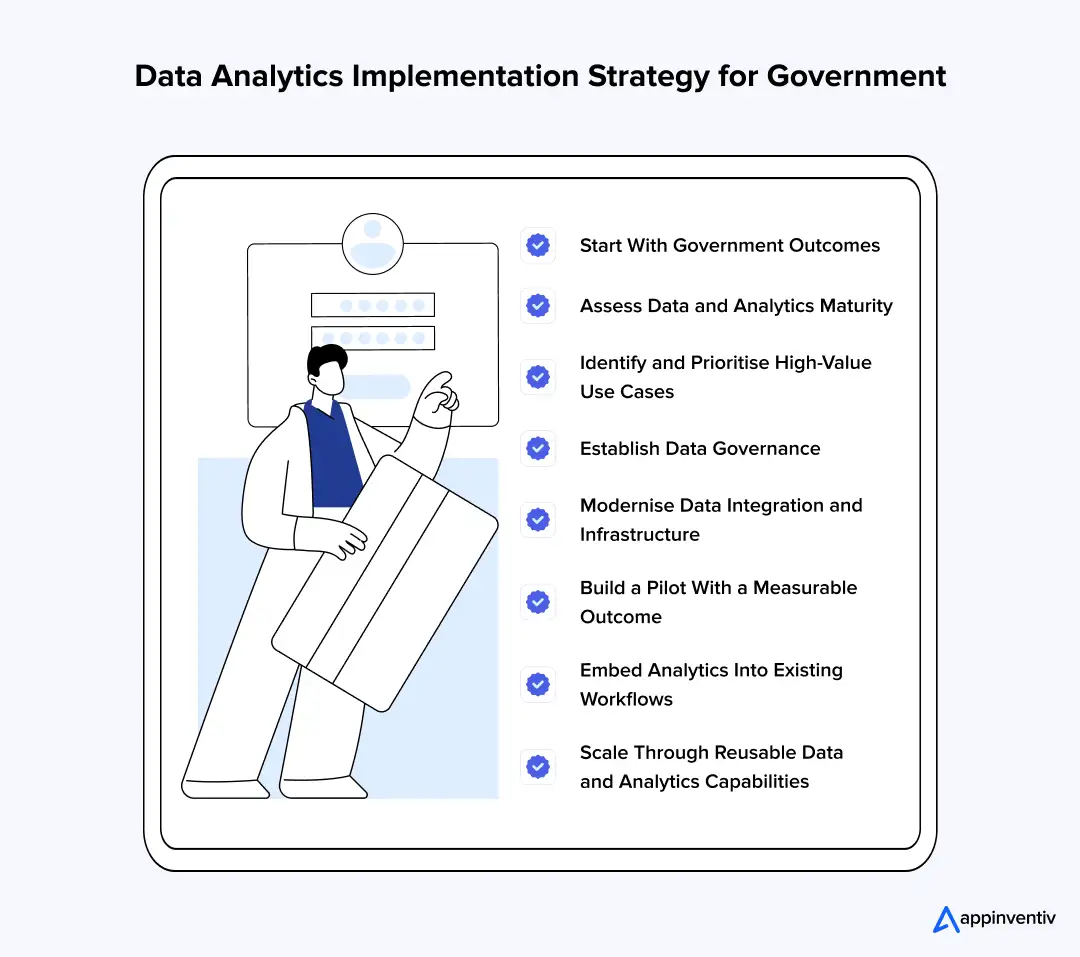
- Start With Defined Outcomes
Define the operational or policy problem first. For example, you can anchor the programme to a named public outcome, such as reduced wait times or earlier intervention rates.
- Assess Data and Analytics Maturity
Review existing systems, datasets, governance, skills, integration capability, security controls and analytical practices. The assessment should identify both technical gaps and organisational constraints.
- Prioritise High-Value Use Cases
Rank use case against factors such as public value, feasibility, data availability, risk, implementation effort and expected operational impact.
- Establish Data Governance
Set data ownership, access controls and quality standards before integration work begins, not as a remediation step afterward.
- Modernise Integration and Infrastructure
Build the integration layer and platform architecture to support the prioritised use cases, with room to extend to additional data domains later.
- Build a Measurable Pilot
Scope the pilot narrowly enough to deliver within one budget cycle, with a defined success metric agreed with the sponsoring executive in advance.
- Embed Analytics Into Existing Workflows
Insight that lives only in a dashboard rarely changes behaviour. Analytics needs to surface inside the case management or operational tools frontline staff already use.
- Scale Through Reusable Capabilities
Design the platform, governance model and integration patterns from the pilot to be reusable by the next use case, rather than rebuilding from scratch each time.
Australian Government Data Analytics: Policy and Regulatory Considerations
Government analytics in Australia operates within a policy environment where data sharing, privacy, security and digital investment are closely connected. Analytics architecture decisions made without reference to these instruments tend to require costly rework later. So, compliance needs to shape design choices from the outset rather than being retrofitted.
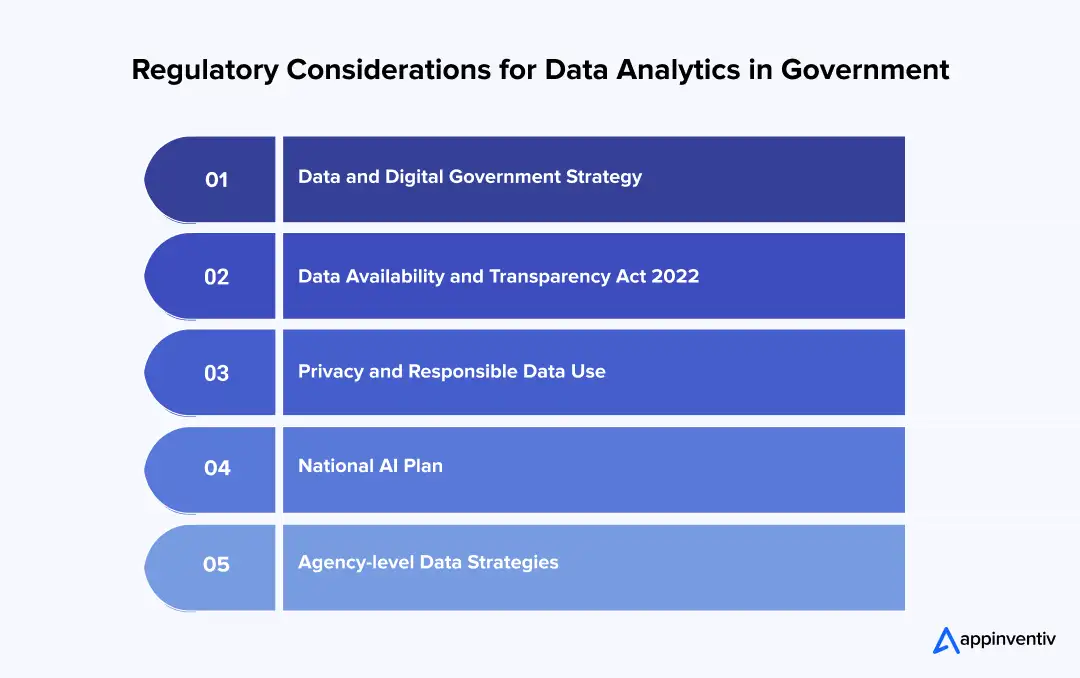
Data and Digital Government Strategy
The Data and Digital Government Strategy sets the Commonwealth’s 2030 vision for connected, secure public services and is the primary reference point agencies should align their own data strategies against.
Data Availability and Transparency Act 2022
The Data Availability and Transparency Act 2022 establishes an accredited pathway for safer data sharing between Commonwealth agencies, replacing the previous case-by-case authorisation approach with a consistent scheme.
Privacy and Responsible Data Use
Agencies remain bound by the Privacy Act and Australian Privacy Principles for any citizen data used in analytics. It means de-identification, consent and purpose limitation need to be designed into the pipeline rather than applied retrospectively.
National AI Plan
Emerging national AI policy settings are pushing agencies toward risk-tiered assurance for AI-enabled analytics, meaning higher-risk use cases such as welfare eligibility or risk scoring will face additional scrutiny before deployment.
Agency-Level Data Strategies
Individual departments are expected to align their own data strategies to the whole-of-government direction, which means procurement and architecture decisions increasingly need to demonstrate that alignment explicitly
What Trends Will Shape Government Data Analytics Strategy in 2026 and Beyond?
The next phase of government analytics will focus less on isolated dashboards and more on connected intelligence embedded within operational systems. AI, real-time data, edge processing and decentralised data ownership can expand analytical capability, but only where agencies maintain strong governance, security and human accountability.
Responsible Enterprise AI and Generative AI
Government agencies are moving beyond public AI models toward enterprise Retrieval-Augmented Generation (RAG) architectures.
By positioning Large Language Models over internal policy documents and databases within strict security boundaries, agencies allow staff to query complex policy repositories safely without risk of data exposure or hallucination.
Also Read: Responsible AI in Australia: Governance Frameworks for Enterprises
Unified Data Fabric and Data Mesh Architectures
Unified data fabric and data mesh architectures: decentralising data ownership across departments while keeping a centralised governance plane for consistency and audit.
Edge analytics for public infrastructure: processing traffic camera, water and sensor feeds locally for split-second operational decisions rather than routing everything to a central platform.
Zero Trust Data Governance
Traditional perimeter defense models are being replaced by Zero Trust data architecture.
Identity-centric access controls, cryptographic data validation, and automated micro-segmentation ensure that access to every data point is continuously authenticated, authorised, and logged, regardless of network location.
How Should Government Agencies Measure the ROI of Data Analytics?
Measuring ROI in the public sector requires evaluating a four-dimension KPI framework. This gives executives a defensible way to report analytics ROI to treasury and audit committees.
| Dimension | Example KPIs |
|---|---|
| Operational | Processing time, staff productivity, resource utilisation |
| Financial | Cost avoidance, budget variance, procurement efficiency |
| Community | Wait times, service accessibility, satisfaction scores |
| Policy | Programme outcomes, intervention effectiveness, risk reduction |
Build a Data Analytics Business Case
A defensible business case follows a single logic chain: investment leads to capability, capability improves decisions, better decisions change operational outcomes, and improved outcomes generate public value that can be reported back to funders.
Investment → Capability → Decision improvement → Operational outcome → Public value
Connect your proposed data investment with measurable operational improvements, resource efficiencies and public outcomes.

What Does a Government Data Analytics Maturity Model Look Like?
Maturity is not determined by how advanced an agency’s technology stack appears. It depends on whether data is connected, governed and consistently used to improve decisions. A maturity model helps leadership identify the next practical capability to build rather than attempting a large-scale transformation without a clear sequence.
| Level | Maturity | Characteristics |
|---|---|---|
| 1 | Siloed | Fragmented systems, manual reporting |
| 2 | Reporting-led | Central dashboards, historical reporting |
| 3 | Integrated | Connected datasets, common governance |
| 4 | Predictive | Forecasting, advanced analytics |
| 5 | Intelligent | AI-enabled, real-time, proactive decision support |
Moving between levels requires more than technology.
Level 1 → 2: Standardise reporting and establish consistent data definitions.
Level 2 → 3: Connect priority datasets and introduce common governance.
Level 3 → 4: Build reliable analytical models and forecasting capability.
Level 4 → 5: Integrate AI, real-time data and decision support into operational workflows with appropriate controls.
How Appinventiv Helps Government Organisations Build Data Analytics Capabilities?
AI-powered data analytics for government requires a combination of engineering, data architecture, security and delivery capability. The focus should remain on building an analytics environment that can operate withn public-sector governance requirements while supporting future modernisation.
Appinventiv works across this delivery lifecycle, from data foundations and platform engineering through to analytics-enabled applications. Our data analytics services support custom software development and digital transformation programmes, tailored to public sector environments.
Backed by 11+ years of APAC delivery experience and 3000+ digital assets deployed across the nation, our teams bridge the gap between legacy infrastructure and predictive intelligence.
Streamlined Procurement & Proven Execution across the Nation
To simplify engagement, Appinventiv is pre-approved on key procurement frameworks, including the Queensland Government ICTSS panel, Local Buy, and the DTA Digital Marketplace. These panel approvals allow federal, state, and local entities to engage our services without lengthy procurement delays.
Operating from 5+ agile delivery centres across Australia, our team of 1700+ tech experts engineer intelligent data analytic platforms designed for sovereignty, compliance, and performance:
We are also ISO 27001, ISO 9001 and SOC 2 certified, supported by a stated 99.50% security compliance SLA.
Recognition from Statista and the Financial Times as one of APAC’s High-Growth Companies for three consecutive years and 90% client retention rate demonstrate our excellence in delivery unmatched digital engineering services in Australia.
Ready to Move From Reporting to Predictive Decision-Making
We will help you assess your current data architecture, governance, integration capability and analytics maturity, then identify high-value opportunities for implementation.
Start Your Data & Analytics Readiness Assessment
FAQs
Q. What is the cost of implementing Data Analytics for Government?
A. The cost typically ranges from AUD 70,000 to AUD 700,000+, depending on the agency’s data maturity, number of legacy systems, integration complexity, security requirements and analytics scope. A focused dashboard or analytics pilot may cost less, while a whole-of-agency data platform involving cloud migration, data governance, real-time integration and advanced analytics requires significantly higher investment. Current government initiatives also emphasise data maturity, governance, security and interoperable foundations, which can materially affect project costs.
Q. How long does it take to implement government data analytics?
A. A focused analytics implementation typically takes 3 to 6 months, while an enterprise-wide government data platform can take 9 to 18 months or longer when legacy modernisation, multiple agency integrations and governance controls are involved. Most government programmes are delivered in phases, allowing agencies to establish priority analytics capabilities first and expand the platform as data maturity improves.
Q. What is data analytics for government?
A. Data analytics for government is the process of collecting, integrating and interpreting data from government and external sources to improve public services, resource allocation and policy outcomes. It ranges from basic performance dashboards through to predictive models that support frontline decision-making across departments.
Q. How does data analytics improve government decision-making?
A. Data analytics moves agencies through descriptive insight into diagnostic, predictive and prescriptive capability. Descriptive analytics shows what happened, diagnostic analytics explains why, predictive analytics forecasts what is likely to happen next, and prescriptive analytics recommends a course of action, giving decision-makers evidence rather than assumption at each stage.
Q. How can government agencies start implementing data analytics?
A. Agencies typically start with an honest maturity assessment, identify one or two high-value use cases tied to a named outcome, establish governance before integration begins, and run a narrowly scoped pilot with a measurable success metric agreed with the sponsoring executive before scaling further.
Q. What is the role of AI in government data analytics?
A. AI acts as an advanced layer above a strong data and analytics foundation, extending prescriptive analytics through automation and natural language interfaces. AI models are only as reliable as the data feeding them, so agencies that deploy AI without mature data governance typically see stalled pilots rather than scaled deployment.
Q. How does government protect community data when using analytics?
A. Data protection relies on privacy-by-design principles, role-based access controls, de-identification of sensitive fields, secure accredited hosting environments and clear governance accountability for who can access which datasets and for what purpose. These controls need to be embedded in the pipeline architecture rather than added as a compliance layer afterward.
Q. What is the difference between government data analytics and business intelligence?
A. Business intelligence typically focuses on understanding historical performance through dashboards and reporting. Data analytics extends further into identifying patterns, forecasting outcomes and recommending action, and increasingly incorporates machine learning and AI capabilities that BI tools alone do not provide.
Q. How can government agencies measure the ROI of data analytics?
A. ROI is best measured across operational, financial, community and policy dimensions rather than through dashboard usage alone, using a KPI framework that links data investment to analytical capability, improved decisions and measurable public outcomes that can be reported to funders and audit committees.
Q. What Is the Difference Between Data Governance and Data Analytics?
A. Data governance defines how government data is owned, managed, secured, accessed and used, while data analytics focuses on analysing that data to identify patterns, generate insights and support better decisions. In simple terms data governance vs data analytics can be defined as: governance sets the rules; analytics turns governed data into actionable intelligence.


Fast 2-minute response, fully NDA-protected.

How to Hire Data Engineers for Your Enterprise? All You Need to Know
Key takeaways: Hiring data engineers individually slows execution and increases delivery risk at enterprise scale. Partnerships give faster access to senior talent without long recruitment cycles or retention issues. Cost depends more on capability and responsibility than salary alone. The right hiring model directly affects business speed, stability, and ROI. Partnering with experienced teams converts…
How Data Analytics is Shaping the Future of UK Businesses Across Sectors
Key Takeaways Data has moved from support to strategy. UK companies no longer treat analytics as an add-on; it’s shaping how they forecast demand, design products, and compete for customers. Every sector is finding its own rhythm. From retail and healthcare to energy and education, organizations are using data differently, but the goal is the…
Is Your Business Model Compliant with the EU Data Act? A Checklist for C-Suite Executives
Data has quietly become the backbone of modern business. Whether it’s a retailer predicting what you’ll buy next week or a car maker tracking vehicle performance in real time, every decision today leans on streams of information. But with that power comes a tough question: who really owns the data, and who gets to use…