
































Responsible AI in Australia: The Governance Questions Business Leaders Can’t Ignore

 Share -



- 01What Does “Responsible AI in Australia” Actually Mean in an Enterprise Context?
- 02The Governance Questions Australian Business Leaders Can No Longer Delay
- 03Australia's AI Policy Shift Happened Faster Than Most Organisations Realised
- 04What Governance Obligations Actually Exist Right Now
- 05Questions Boards Should Be Asking Right Now
- 06How to Build A Responsible AI Framework That Works in Practice?
- 07Agentic AI: The Governance Challenge Emerging Faster Than Regulation
- 08Why Global AI Regulations Still Matter to Australian Businesses
- 09Building a Governance Architecture That Scales
- 10The AI Governance Roadmap: What to Prioritise and When
- 11How Appinventiv Supports Responsible AI Governance in Australia?
- 12FAQs

Key takeaways:
- AI governance is rapidly becoming a board-level accountability issue rather than a technology management issue.
- Australian organisations face growing pressure from privacy reforms, sector-specific obligations, procurement requirements, and emerging AI assurance expectations.
- The largest governance risk is not model failure. It is the absence of clear ownership, decision rights, auditability, and oversight.
- Enterprises that embed governance into architecture, procurement, and delivery processes are more likely to scale AI safely and realise measurable business value.
- Agentic AI introduces a new governance challenge where autonomous systems can take actions, not just generate outputs, requiring stronger control frameworks.
The situation Australian business leaders face today is genuinely uncomfortable. Enterprise leaders are increasingly aware of AI risks, governance obligations, and board accountability. Yet many organisations continue to struggle with converting AI investment into sustained productivity gains.
The issue is no longer whether artificial intelligence should be governed. The more pressing question is whether existing governance approaches are helping organisations deploy AI confidently or quietly slowing adoption through uncertainty, fragmented ownership, and inconsistent controls.
The policy landscape shifted considerably through late 2025 and into 2026. The National AI Plan, updated National AI Centre guidance, revised Digital Transformation Agency expectations, and incoming Privacy Act transparency requirements have collectively created a more structured operating environment for enterprise AI. While Australia has not adopted a comprehensive AI Act comparable to Europe, organisations should not mistake that position for regulatory absence.
For boards, Chief Risk Officers, CIOs, CTOs, and CFOs, the challenge is increasingly practical. Decisions about model accountability, procurement, explainability, automated decision-making and data sovereignty in Australia now influence risk profiles as directly as cybersecurity, privacy, and operational resilience.
At its core, responsible AI in Australia is becoming a governance discipline rather than a technology initiative. The organisations that recognise this shift early are likely to gain a meaningful advantage in trust, compliance readiness, and long-term AI adoption.
Assess your AI governance posture before new transparency, accountability, and assurance expectations get embedded across enterprise operations.

What Does “Responsible AI in Australia” Actually Mean in an Enterprise Context?
Responsible AI in Australia is becoming a governance discipline that influences regulatory exposure, operational resilience, customer trust, and long-term AI scalability. The focus is shifting from what AI can do to how organisations control, monitor, and account for its outcomes.
Many organisations still associate responsible AI with fairness, bias mitigation, or explainability. Those elements remain important, but they represent only part of the governance challenge facing Australian businesses today.
In practice, Responsible AI Governance considerations in Australia extend across accountability, privacy, security, data stewardship, human oversight, and audit readiness. The objective is not simply to ensure models behave appropriately. It is to ensure the organisation can demonstrate control over how AI systems are designed, deployed, monitored, and governed throughout their lifecycle.
The Core Pillars of Responsible AI Businesses Must Operationalise
The principles of responsible AI become meaningful only when they are operationalised through governance controls:
| Governance Pillar | Business Expectation |
|---|---|
| Accountability | Named ownership for every material AI use case |
| Transparency | Ability to explain significant AI-assisted decisions |
| Human Oversight | Defined intervention and escalation mechanisms |
| Security & Privacy | Protection of data, models, and AI infrastructure |
| Data Governance | Strong controls over data quality, provenance, and usage |
| Risk Monitoring | Continuous assessment of model and operational risk |
| Auditability | Evidence trails supporting review, assurance, and compliance |
Collectively, these capabilities form the foundation of safe and responsible AI in Australia and increasingly influence procurement decisions, risk assessments, and board reporting expectations.
The Governance Questions Australian Business Leaders Can No Longer Delay
The most consequential governance failures in AI tend to result not from technical errors but from unresolved accountability questions that organisations deferred until an incident forced the issue. The list below reflects what boards and executive teams should already have clear answers to.
Who owns AI accountability inside the enterprise?
The DTA’s updated AI in Government Policy requires agencies to designate accountability for each AI use case at a senior executive level. For private sector organisations, the Financial Accountability Regime imposes comparable obligations on APRA-regulated entities.
Beyond regulated sectors, the practical consequence of diffuse ownership is simple: when something goes wrong, no one is accountable, and the organisation’s regulatory and reputational position deteriorates faster.
Are you governing AI systems, or just governing vendors?
There is a material difference. A vendor contract with appropriate representations is not the same as understanding what an AI system actually does with your data, how it handles edge cases, and what the vendor’s update and disclosure obligations are.
The BuyICT.gov.au AI and Cyber Risk Model Clauses, released in March 2025, provide a contractual framework. Whether those clauses have been applied to existing and new vendor agreements is a different question, and one that most organisations have not yet answered systematically.
Can your organisation explain how critical AI decisions are made?
The Deloitte Australia incident involving an approximately AUD 440,000 government report containing fabricated citations and non-existent references is one of the clearest recent Australian examples of the governance risks surrounding enterprise AI deployment.
The mechanism of failure was not unusual: AI tools used without adequate review checkpoints, disclosure added retrospectively rather than by design. The episode reinforced a growing enterprise concern: AI governance failures often emerge not from model capability alone, but from gaps in review controls, accountability, and operational assurance.
Do your employees know where AI is already operating across the business?
The majority of enterprises running AI inventory exercises find more systems than expected, particularly where line-of-business teams have adopted SaaS tools with embedded AI capabilities outside of IT procurement channels.
The NAIC’s AI6 guidance treats use-case visibility as a foundation-level requirement. Without it, risk classification and accountability assignment are structurally impossible.
What happens when an AI system causes commercial, legal, or reputational harm?
This requires documented incident response procedures specific to AI, not general IT incident protocols adapted after the fact. It also requires clarity on whether the organisation’s existing insurance coverage extends to AI-related liability events.
Are your AI controls designed for autonomous agents?
Most enterprise governance frameworks were designed for systems with predictable, bounded behaviour. Agentic AI, systems capable of executing multi-step tasks, triggering downstream processes, or interacting with external services without per-transaction human review, presents a governance challenge that existing frameworks were not built to address.
This is an emerging issue, but one that requires proactive architectural thinking now, not after deployment.
Australia’s AI Policy Shift Happened Faster Than Most Organisations Realised
Between 2022 and 2025, Australia’s AI governance landscape moved from principles to partial enforcement. Understanding that trajectory is necessary for calibrating where voluntary frameworks end, and enforceable obligations begin.
From AI Principles to Practical Governance
For several years, Australia’s approach to AI centred on voluntary principles and industry guidance. That created flexibility, but it also left many organisations treating AI governance as an optional digital maturity initiative rather than an operational requirement.
That position has gradually changed.
Throughout 2024 and 2025, government agencies, regulators, and industry bodies shifted their focus from broad AI ethics discussions towards practical governance expectations. The conversation moved away from whether organisations should govern AI and towards how governance should be demonstrated.
| Period | Key Development | Key Impact |
|---|---|---|
| 2019–2023 | AI Ethics Principles introduced | Established baseline governance expectations |
| 2024 | Increased focus on high-risk AI use cases | Greater board and executive scrutiny |
| 2025 | National AI Plan and updated NAIC guidance | Stronger emphasis on accountability and assurance |
| 2026 | Privacy transparency obligations approaching | Increased focus on explainability and auditability |
For Aussie innovators, the significance lies less in individual policies and more in the direction of travel. Expectations are becoming more specific, governance standards more measurable, and accountability increasingly visible.
What “Voluntary” Actually Means for Enterprise
The word voluntary in the context of Australia’s national AI framework is technically accurate and operationally misleading. Voluntary AI Safety Standard (VAISS) frameworks have a well-documented tendency to become de facto mandatory through procurement requirements, regulatory guidance, and case law, often faster than organisations anticipate.
More practically, the AI6 governance practices – accountability, risk management, transparency, testing, human oversight, and incident response – are now explicitly referenced in government procurement guidance and are being incorporated into contract clauses and tender requirements.
An organisation that cannot demonstrate alignment with the AI6, even absent a legal mandate, faces procurement risk in an increasingly significant portion of the market.
What Governance Obligations Actually Exist Right Now
The distinction between aspirational and enforceable is the critical one for boards and risk functions. The analysis below maps current obligations against the legal instruments that create them.
The Privacy Act and Core Current Obligations
The Privacy Act 1988 and the Australian Privacy Principles apply directly to most AI systems processing personal information, which in practice means most enterprise AI. This includes systems used in customer segmentation, employee assessment, fraud detection, and personalisation.
The notifiable data breaches scheme applies to AI-related breaches. APP 1 amendments confirmed for December 2026 will require organisations to disclose automated decision-making in their privacy policies.
Under the Financial Accountability Regime, APRA-regulated entities face accountability obligations attached to named senior managers. An AI system causing significant consumer harm creates direct liability for the accountable person, not just the organisation.
The Security of Critical Infrastructure Act 2018 brings AI governance into scope for enterprises operating in or supplying to critical infrastructure sectors, covering data sovereignty, supply chain risk, and incident reporting obligations.
Sector-Specific Obligations: A Snapshot
Different industries face distinct regulatory scrutiny layers based on their core operations. You must map your current and planned deployments against this sector-specific matrix to ensure robust responsible AI governance in Australia.
| Sector | Primary Regulatory Layer | Industry Wise Use Cases for Responsible AI in Australia | Enforcement Body |
|---|---|---|---|
| Financial Services | FAR + Privacy Act 1988 | Accountable person liability; automated decision transparency | APRA / ASIC |
| Healthcare | Privacy Act + TGA Guidance | Sensitive data governance; clinical AI safety | TGA / OAIC |
| Construction & Infrastructure | Security of Critical Infrastructure Act | Data sovereignty; supply chain AI risk | ASD / CISC |
| Retail & Consumer | Australian Consumer Law + Privacy Act | Anti-deceptive AI use; consumer data rights | ACCC / OAIC |
| Government Contractors | DTA Policy v2.0 | Transparency declarations; use case accountability | DTA / AusTender |
Questions Boards Should Be Asking Right Now
Board-level AI governance questions have changed. The right questions for 2025 and 2026 are specific, accountability-focused, and tied to enforceable obligations.
The following questions define whether an enterprise’s AI programme can withstand external scrutiny, from a regulator, a court, or a major client.
- Which AI systems make or materially influence decisions about individuals, including customers, employees, or members of the public?
- Does the organisation maintain a model registry covering third-party and vendor-supplied AI tools, not only internally developed systems?
- Who is the named accountable person for each high-risk AI use case, and is that accountability formally documented?
- Can any AI-generated decision affecting an individual be explained to a customer, regulator, or court within 48 hours?
- Has the organisation mapped its AI supply chain, including data provenance, subprocessors, and offshore processing locations?
- What human oversight mechanisms exist for high-risk AI systems, and are those mechanisms tested and evidenced?
- Have AI systems been assessed for bias against protected attributes under Australian anti-discrimination legislation?
- Is the organisation positioned for the APP 1 automated decision-making transparency obligations commencing December 2026?
The absence of clear answers to any of these questions is a governance gap, and gaps of this kind tend to become visible at the worst possible time.
How to Build A Responsible AI Framework That Works in Practice?
The steps below reflect the governance framework architecture used in mature enterprise AI deployments. They are sequential because each step creates the conditions for the next.
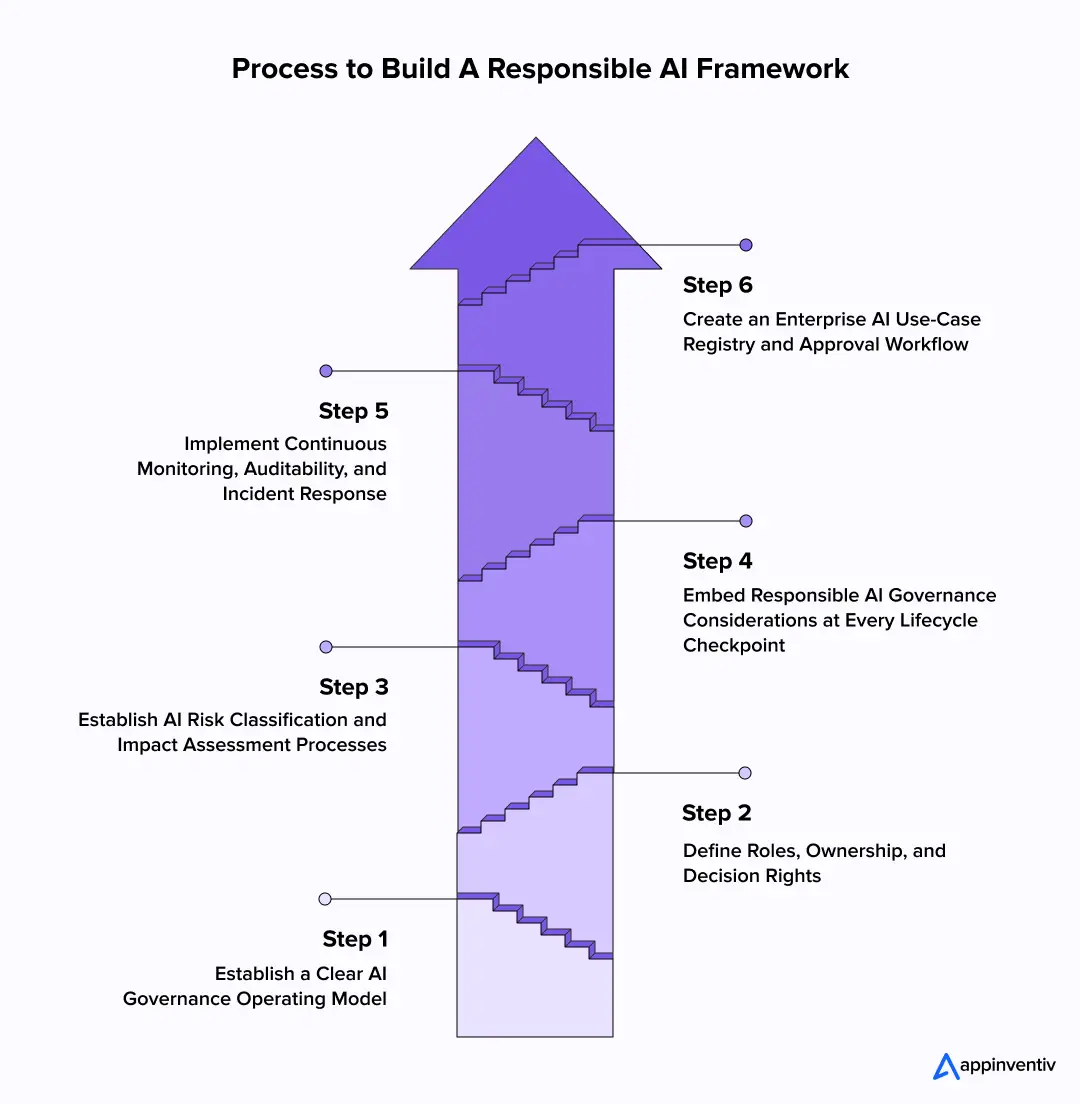
Step 1: Establish a clear AI governance operating model
Define what the governance function is responsible for, who it reports to, and what authority it holds. An advisory function without enforcement capability is not a governance function.
Step 2: Define roles, ownership, and decision rights
Name accountable owners for each AI use case. Specify who can approve a high-risk deployment, who can suspend one, and who is responsible for ongoing monitoring.
Step 3: Establish AI risk classification and impact assessment processes
Build and apply a classification methodology at intake. Use it consistently. Documented rationale for classification decisions matters when governance decisions are later scrutinised.
Step 4: Embed responsible AI governance considerations at every lifecycle checkpoint.
Governance review should be a gate, not a review-after-the-fact. This applies equally to internally built systems and to vendor-supplied tools procured through standard commercial channels.
Step 5: Implement continuous monitoring, auditability, and incident response
Define monitoring thresholds. Document what constitutes an AI incident. Test the incident response protocol before it is needed.
Step 6: Create an enterprise AI use-case registry and approval workflow
The registry is both an operational tool and a governance artefact. It provides the inventory that regulators, auditors, and procurement counterparts expect to see when they ask what AI the organisation is running.
Agentic AI: The Governance Challenge Emerging Faster Than Regulation
The next governance debate is unlikely to focus on chatbots. It will focus on AI agents. Unlike traditional GenAI tools that produce outputs for human review, agentic AI systems in Australia can interact with applications, trigger workflows, access multiple data sources, and complete tasks autonomously. In effect, they move from assisting decisions to participating in them.
Why Existing Controls May Not Be Enough
Many governance controls currently assume a human remains at the centre of every critical decision.
Agentic AI changes that assumption.
An autonomous procurement agent, for example, may evaluate suppliers, recommend vendors, initiate approvals, and trigger transactions across connected systems. While each action may appear low risk in isolation, the cumulative impact can become significant.
This is where safe and responsible AI in Australia starts to intersect with operational risk, accountability, and governance architecture.
The New Human Oversight Challenge
The question is no longer whether humans are involved. The question is where they should be involved.
Organisations deploying AI agents need clear boundaries around decision authority, escalation thresholds, approval requirements, and intervention rights. Without these controls, accountability can become increasingly difficult to establish when outcomes are challenged.
What Leaders Should Do Before Deploying AI Agents
Before introducing agentic AI into operations, leadership teams should ensure:
- Decision-making boundaries are clearly defined.
- Human approval requirements are documented.
- Audit trails capture actions as well as outputs.
- AI agents are included within risk and governance frameworks.
- Accountability remains assigned to named business owners.
The organisations that establish these controls early will be better positioned to scale autonomous AI capabilities without introducing governance risks that are far harder to unwind later.
Why Global AI Regulations Still Matter to Australian Businesses
A common assumption is that Aussie businesses only need to comply with Australian expectations. In practice, that is rarely the case. An organisation headquartered in Brisbane, Melbourne, or Sydney may process European customer data, provide services to UK clients, rely on US-based AI platforms, or operate across multiple APAC markets.
AI governance therefore becomes an international risk management issue rather than a domestic compliance exercise.
Australia Regulatory Positioning Comparison
| Jurisdiction | Approach | Binding Obligations | Key Risk for AU Enterprises |
|---|---|---|---|
| Australia | Principles-based, voluntary with sectoral enforcement | Privacy Act, FAR, ACL, SCICA | Compliance gap in multi-jurisdictional operations |
| EU | Risk-based, mandatory (EU AI Act, Aug 2024) | Conformity assessments for high-risk AI; prohibited uses | Applies to any AU firm with EU customers or EU data |
| United States | Deregulatory (federal); state-level variation | No dedicated federal AI law | FTC, EEOC, and state-level rules still apply |
| Singapore | Voluntary + Model AI Governance Framework | Sector guidance; AI Verify testing | Regional benchmark for APAC multinationals |
| United Kingdom | Principles-based, sector-led | ICO + FCA guidance, no dedicated AI Act | GDPR-equivalent applies to AU firms with UK customers |
Strategic Implication for Australian Enterprises
An Australian enterprise with EU customers or EU-resident data is already subject to EU AI Act obligations for high-risk AI systems. That is not a future consideration. The responsible AI importance for Australian businesses operating globally is therefore greater than a purely domestic compliance analysis would suggest.
No organisation can build its AI governance architecture around the lightest-touch jurisdiction in which it operates. The responsible AI for enterprise transformation agenda must account for the full range of jurisdictions where data flows and customers reside.
Building a Governance Architecture That Scales
Governance architecture for AI is not a policy exercise. It is an engineering and operating model decision that needs to be designed for scalability, auditability, and regulatory change from the outset, not retrofitted after the first incident.
The Four Layers of Enterprise AI Governance
Effective enterprise AI governance operates across four interdependent layers.
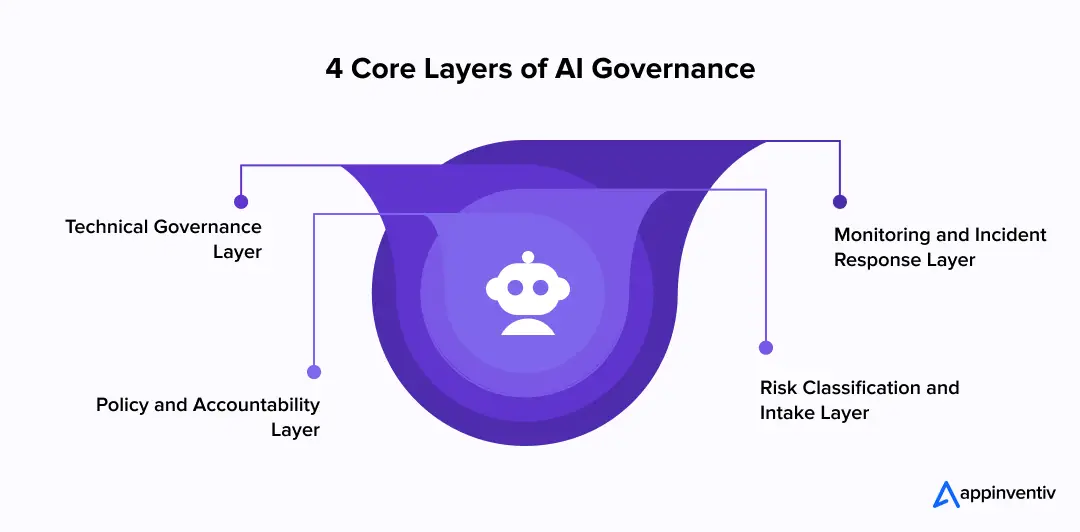
Policy and Accountability Layer
This covers the governance operating model, ownership assignments, decision rights, and board reporting cadence. It is where the AI ethics principles adopted by the organisation are translated into role-level accountabilities. Without clarity at this layer, every other governance investment becomes optional in practice, because there is no accountable party to enforce it.
Risk Classification and Intake Layer
This is where AI systems and use cases are assessed before they enter the development lifecycle or are procured from vendors. A working classification methodology distinguishes high-risk use cases from lower-risk ones based on the nature of the decision, the population affected, the data involved, and the reversibility of outcomes. Classification determines what governance checkpoints apply downstream.
Technical Governance Layer
This covers audit logging architecture, model versioning and documentation, bias testing protocols, access controls, and the data lineage infrastructure required to answer questions about model inputs and outputs.
Monitoring and Incident Response Layer
Governance does not end at deployment. AI systems exhibit performance degradation, data drift, and unexpected failure modes over time. Continuous monitoring, with escalation thresholds defined in advance, and documented incident response procedures specific to AI are the operating requirements at this layer.
What “Governance-Ready” AI Infrastructure Looks Like
Governance-ready AI infrastructure includes a centralised model registry covering all AI systems in production, including vendor-supplied tools embedded in broader platforms. It includes audit logging at the granularity needed to reconstruct the inputs and outputs of any AI decision. And it includes a defined, tested process for identifying, investigating, and reporting AI-related incidents.
Building responsible AI frameworks for enterprises begins with inventory. Most organisations have AI systems operating across multiple business units, procured through multiple channels, with no central catalogue. That inventory is the foundation for everything else. Without it, the governance posture presented to a regulator is not defensible.
Build governance structures designed for accountability, auditability, and scalable AI delivery.

The AI Governance Roadmap: What to Prioritise and When
AI governance maturity is not achieved through a single framework rollout. It develops through a series of practical decisions that improve visibility, accountability, and control over time. The following framework maps practical actions to the obligations already in place and those arriving in the near term.
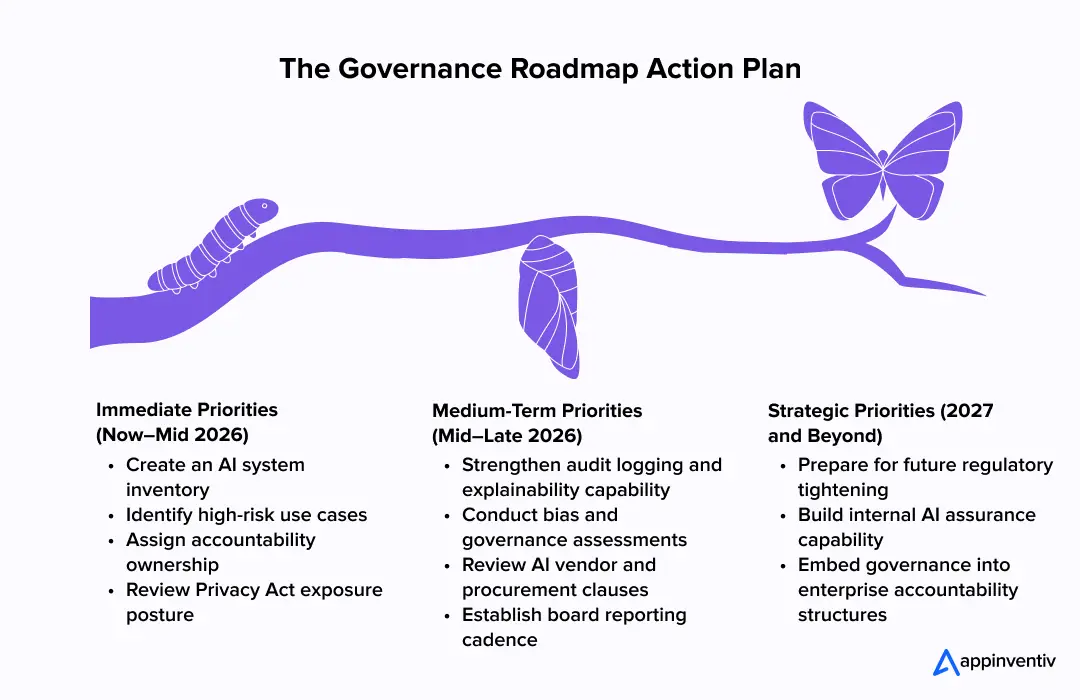
Immediate Priorities (Now through June 2026)
- Conduct a full AI system inventory covering everything in production or under development, including vendor-supplied tools embedded in broader platforms.
- Identify which systems qualify as high-risk under NAIC criteria.
- Assign named accountability for each high-risk use case.
- Review Privacy Act compliance posture for any system processing personal information in automated decisions.
Medium-Term Priorities (July 2026 through December 2026)
- Build or upgrade audit logging infrastructure to support APP 1 transparency obligations taking effect December 2026.
- Conduct bias audits on customer-facing AI systems used in hiring, credit, insurance, or service eligibility contexts.
- Review AI-related contractual clauses in vendor agreements against the BuyICT.gov.au AI and Cyber Risk Model Clauses released March 2025.
- Establish board-level AI governance reporting at a cadence appropriate to the enterprise’s risk profile.
Strategic Priorities (2027 and Beyond)
- Monitor and prepare for mandatory guardrail legislation, which remains a live policy question following the government’s 2025 consultation.
- Build internal AI assurance capability aligned to the NAIC’s national assurance framework as it develops.
- For APRA-regulated entities, embed AI governance explicitly into FAR accountability mapping with named senior manager ownership.
How Appinventiv Supports Responsible AI Governance in Australia?
Governance credibility starts with delivery credibility. Appinventiv’s position across Australian government procurement panels gives our clients a trusted tech partner that can translate governance requirements into production-grade AI systems.
We hold pre-qualified status on the Local Buy panel, are an Approved ICT Supplier to the Australian Digital Transformation Agency, listed as an approved QLD Government ICTSS.1303B Panel Member (Q-7218) and active on the ICTSS.2403 ICT Professional Services arrangement.
For government-adjacent enterprises and public sector organisations, that procurement standing removes onboarding friction and confirms alignment with the DTA’s AI transparency and accountability expectations from day one.
In our 11+ years of APAC delivery experience, we have deployed 3000+ digital assets, maintained a 96% client retention rate, and driven an average 35% efficiency gain across 35+ industries spanning financial services, healthcare, infrastructure, and government.
Organisations including Rapid Teachers, Multinail, Lite n’ Easy, Vyrb, JobGet, Flynas and MyExec have relied on us to outsource artificial intelligence development services in Australia to build intelligent systems that are designed for audit readiness and regulatory durability, not just functional performance.
Our 5+ agile delivery centres across the country support the pace and proximity that complex AI governance programmes demand. Also, our ISO 27001, ISO 9001, and SOC2 certifications underpin a 99.5% security compliance SLA, which means the infrastructure supporting responsible AI implementation carries the same governance rigour as the AI systems themselves.
Ranked among APAC’s High-Growth Companies by Statista and the Financial Times for two consecutive years, we bring both delivery scale and regional accountability that offshore-first vendors cannot match.
The architecture of responsible AI in Australia is only as strong as the organisation that builds and sustains it. If your enterprise is preparing for the December 2026 APP 1 obligations, conducting an AI system inventory, or building the board-level governance reporting your risk function needs, we are here to help. Our AI advisory team runs a structured governance readiness diagnostic scoped to your sector and technology environment. Contact Appinventiv to begin.
FAQs
Q. What is responsible AI in Australia?
A. Responsible AI in Australia refers to the design, deployment, and ongoing governance of AI systems in a manner consistent with Australia’s AI Ethics Principles, applicable regulatory obligations, and community expectations around fairness, transparency, privacy, and accountability.
The importance of responsible AI for Australian business has grown considerably as sector regulators have made clear that existing law applies to AI systems regardless of whether dedicated AI legislation exists.
Q. How do you implement responsible AI governance?
A. Responsible AI implementation in Australia typically follows a structured sequence:
- Establish an AI governance operating model with defined decision rights
- Conduct a full inventory of AI systems, including vendor-supplied tools
- Classify systems by risk level against NAIC criteria
- Embed governance checkpoints into the development and procurement lifecycle
- Implement continuous monitoring and auditability
- Create a centralised AI use-case registry.
Organisations beginning from a low governance maturity baseline should prioritise inventory and accountability assignment before attempting to build technical control architecture.
Q. Why do Australian enterprises need responsible AI governance?
A. The considerations for responsible AI in enterprise settings are grounded in regulatory exposure, not ethical preference alone. The Privacy Act, Financial Accountability Regime, Australian Consumer Law, and Security of Critical Infrastructure Act already apply to AI systems in ways that create direct liability. The December 2026 APP 1 amendments will add mandatory transparency disclosure requirements. Enterprises without governance architecture in place ahead of those obligations will face compressed delivery timelines and elevated risk.
Q. What are the key responsible AI governance considerations in Australia?
A. Key governance considerations include: accountability assignment for AI systems and their outputs; explainability and transparency for automated decisions; Privacy Act compliance for systems processing personal information; sector-specific obligations under FAR, TGA guidance, ACL, or SCICA; supply chain and vendor governance; bias assessment against protected attributes; human oversight mechanisms; and audit logging sufficient to support regulatory and legal review.
Q. How does Responsible AI improve enterprise trust?
A. Responsible AI improves enterprise trust by increasing transparency, accountability, and oversight across AI systems. When organisations can explain AI decisions, protect data, manage risk, and maintain human oversight, they strengthen confidence among customers, regulators, employees, and business stakeholders.
Q. What is the Voluntary AI Safety Standard in Australia?
A. The Voluntary AI Safety Standard (VAISS) is a set of practices developed as part of Australia’s AI governance framework, translating the AI Ethics Principles into concrete organisational guidance. While voluntary at the national level, alignment with the VAISS has become an expected baseline in government procurement and is increasingly referenced in regulatory guidance as the standard against which enterprise AI governance posture will be assessed. Building responsible AI frameworks for enterprises that aspire to government work or operate in regulated sectors should treat the VAISS as effectively mandatory.
Q. What are common responsible AI examples?
A. Common responsible AI examples include explainable AI in banking, privacy-aware healthcare AI, monitored customer service automation, and enterprise AI systems designed with human oversight, accountability, and auditability.


Fast 2-minute response, fully NDA-protected.

AI Data Integration: How to Connect, Clean and Prepare Data for AI
Key takeaways: AI initiatives fail when fragmented, poor-quality data reaches models without sufficient context, controls or ownership. AI-ready pipelines must connect, clean, enrich, govern and continuously monitor data across its lifecycle. Real-time processing matters when AI decisions depend on current transactions, events, inventory or operational conditions. Data architecture should follow the AI use case, balancing…

AI-Native SDLC: Foundational 90-Day, 5R AI SDLC Adoption Playbook
Key takeaways: Why AI coding tools accelerate coding and software delivery How AI-native SDLC shifts engineering from code to intent, context, and outcomes The role of specifications, AI agents, and continuous verification in enterprise delivery How to redesign engineering teams for human–agent collaboration The platform, governance, and guardrails required to scale AI-native development A practical…

AI Agent Governance: How to Govern Autonomous AI Across Business Systems
Key takeaways: AI agents require controls at the action, identity, data, tool, and workflow levels. Every enterprise agent should have a registered owner, an approved purpose, and a defined risk tier. Access must be based on the agent’s task rather than inherited from a human user or shared service account. High-impact actions need real-time policy…