






























Creating a Digital Transformation Strategy in the UK: From Vision to Execution

 Share -


- 01Key Differences Between Digitisation, Digitalisation and Digital Transformation
- 02Why Digital Transformation Strategy for UK Enterprises Fail?
- 03When Does Your Business Need a New Digital Transformation Strategy?
- 04How to Assess Your Digital Transformation Maturity
- 05Is Your Business Ready for Digital Transformation?
- 06The Business Case for Digital Transformation in the UK
- 07Which Technology Approach Fits Your Business?
- 08The 9 Building Blocks of a Successful Digital Transformation Strategy in the UK
- 09How to Develop a Digital Transformation Strategy Roadmap
- 10The Appinventiv 90-Day Enterprise Modernisation Framework
- 11Digital Transformation Operating Model for Your Business Expansion
- 12How Much Does A Digital Transformation Strategy Cost In The UK?
- 13How AI Is Reshaping Digital Transformation Strategies
- 14Common Digital Transformation Challenges UK Businesses Face and Strategies to Solve Them
- 15UK Compliance Considerations That Should Shape Your Strategy
- 16How to Measure the Success of Your Digital Transformation Strategy
- 17Key Digital Transformation Trends Shaping UK Businesses Beyond 2026
- 18Why Appinventiv Is a Strong Fit for Enterprise Digital Transformation Programs?
- 19FAQs

Key takeaways:
- A digital transformation strategy succeeds for UK businesses when it is governed as a single programme, not a portfolio of disconnected technology purchases.
- UK transformation budgets should prioritise modernising legacy systems and strengthening data foundation before scaling advanced capabilities.
- AI delivers return only when built on governed data and a change-ready operating model, not as a strategy in its own right.
- Partner selection should be treated as a governance decision, evaluated against delivery depth, security posture and post-launch support.
Many UK enterprises have already poured millions into cloud infrastructure, artificial intelligence, automation, ERP modernisation, and customer experience platforms. Yet despite this massive spending, numerous programmes fail to deliver measurable business value. Technology initiatives frequently remain completely disconnected from business strategy, governance, operating models, and the people expected to use them.
The UK economic landscape currently presents intense pressures for executive boards. Post-Brexit market realities, mandatory Net Zero commitments, and strict regulatory oversight demand maximum operational efficiency.
Formulating a digital transformation strategy in the UK is no longer just a competitive advantage. It functions as a fundamental survival mechanism. A digital transformation strategy for UK businesses must move away from abstract boardroom visions. It needs to focus on solving documented, real-world pain points supported by a highly scalable operating model.
Achieving this transition requires more than software licences. It demands a tech-driven engineering partner capable of bridging the vast gap between high-level management consulting and ground-level software execution.
This article sets out how UK enterprises move a digital transformation strategy from executive vision to measurable execution. It covers what the term actually means, why programmes stall inside large organisations, the building blocks that hold a strategy together, how to sequence delivery, and the governance lens UK boards cannot afford to treat as an afterthought.
Evaluate your business goals, technology landscape, legacy systems, data maturity, and AI readiness before investing in new platforms.

Key Differences Between Digitisation, Digitalisation and Digital Transformation
To get an in-depth understanding of digital transformation strategies, it is important to first know the differences between the similar terms like Digitisation, Digitalisation and Digital Transformation:
Boards frequently use these three terms interchangeably, which causes confusion at the point of budget approval.
| Term | What It Means | Business Impact |
|---|---|---|
| Digitisation | Converting analogue records or processes into digital format | Reduces paper handling; limited strategic value on its own |
| Digitalisation | Using digital data to improve or automate an existing process | Improves efficiency inside the current operating model |
| Digital Transformation | Redesigning business model, operating model and customer experience around digital capability | Changes how value is created, priced and delivered |
The Four Types of Digital Transformation
- Process Transformation: Redesigning workflows, often through automation or low-code platforms, to remove friction and manual handling
- Business Model Transformation: Changing how the enterprise generates revenue, such as moving from product sale to subscription or platform economics
- Domain Transformation: Entering adjacent markets or value chains that a new digital capability makes accessible
- Cultural or Organisational Transformation: Shifting decision rights, skills and ways of working so change holds after go-live
Why Digital Transformation Strategy for UK Enterprises Fail?
Failure in UK transformation programmes is rarely a pure technology problem. It surfaces months after go-live as a sequencing, ownership and governance problem, once the budget has already been committed. Here are the core reasons why digital transformation strategy for UK businesses often fail:
- Technology led rather than business led, with platforms selected before the underlying problem is documented
- No single accountable owner spanning both business and technology functions
- Poor data foundations that undermine analytics and AI use cases before they start
- Legacy system entanglement that blocks integration and stretches delivery timelines
- Weak governance and unclear decision rights between the steering committee and delivery teams
- Low employee adoption, where change management is treated as a training exercise rather than a workstream
- Lack of measurable KPIs tied to business outcomes rather than delivery milestones
- Overly ambitious “big bang” programmes that defer value for eighteen months or longer
The Cost of Inaction
The cost of inaction rarely shows up as a single line item. It spreads across the business functions. For instance, a mid-sized UK retailer that delays consolidating its order management systems does not fail outright. It absorbs rising cost to serve, slower product launches and a widening gap against competitors already running on composable architecture, until the gap becomes the board’s most pressing agenda item.
When Does Your Business Need a New Digital Transformation Strategy?
A digital transformation strategy for UK businesses becomes critical when fragmented systems force employees to duplicate data entry constantly. Rising operating costs start to appear disproportionate to revenue growth. Customer journeys turn slow and cumbersome, leading to high abandonment rates.
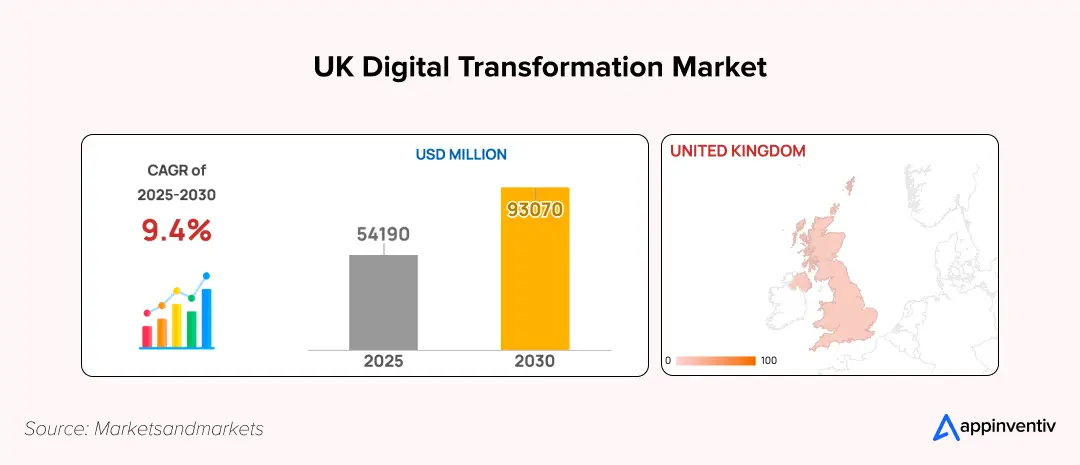
The urgency for UK enterprises to modernise is reflected directly in current capital expenditure. The UK digital transformation market is valued at $54.19 billion in 2025 and is projected to scale to $93.07 billion by 2030, representing a compound annual growth rate (CAGR) of 9.4%, a pace that currently outstrips the global average as British firms aggressively modernise their IT infrastructure. Capturing a return on this investment requires tying capital outlay directly to the metrics your board monitors daily.
Consider this diagnostic checklist to evaluate your current standing. If you answer yes to three or more of the following scenarios, you need a new approach.
- Are routine business decisions delayed by poor data visibility across fragmented systems?
- Are you experiencing rising IT maintenance costs without corresponding productivity gains?
- Do customer journeys require manual intervention or suffer from high drop-off rates?
- Are security and compliance requirements becoming increasingly difficult and expensive to manage?
- Have recent AI or automation pilots failed to scale beyond a single department?
- Is legacy technical debt preventing the launch of new digital products or services?
How to Assess Your Digital Transformation Maturity
No two organisations start their transformation journey from the same place. Before defining priorities or investing in new technologies, leaders need a clear understanding of their organisation’s current digital maturity.
This helps identify capability gaps, set realistic expectations, and build a roadmap that matches business readiness rather than chasing industry trends.
| Maturity Level | Characteristics | Primary Focus |
|---|---|---|
| Level 1: Digitised | Manual processes, disconnected applications, limited automation | Replace paper-based workflows and digitise core operations |
| Level 2: Connected | Basic cloud adoption, integrated business systems, shared data | Improve collaboration and eliminate operational silos |
| Level 3: Data-Driven | Centralised data, business intelligence, process automation | Use analytics to improve decision-making and operational efficiency |
| Level 4: Intelligent Enterprise | AI-powered automation, predictive analytics, enterprise-wide governance | Scale innovation while improving agility and customer experience |
| Level 5: AI-Native Organisation | Autonomous workflows, continuous optimisation, embedded AI across business functions | Drive innovation through adaptive, data-led operating models |
Expert Tip: Most UK enterprises operate between Levels 2 and 3. Moving directly to advanced AI initiatives without strengthening data governance, integration, and operational processes often leads to expensive transformation failures.
Is Your Business Ready for Digital Transformation?
Before committing to a large-scale programme, evaluate your organisation against the following questions:
✔ Executive leadership supports transformation across business functions.
✔ Core business processes have been documented.
✔ Critical data sources are identified and governed.
✔ Legacy systems can integrate with modern platforms.
✔ Clear business outcomes and KPIs have been defined.
✔ Teams are prepared for organisational change.
✔ Cybersecurity and compliance requirements have been considered.
If you answered “No” to three or more questions, your organisation should address these foundational gaps before investing heavily in new technology.
The Business Case for Digital Transformation in the UK
Transformation initiatives must tie directly to board-level objectives. A compelling business case demonstrates exactly how technology investments will accelerate revenue growth, reduce operating costs, and improve the overall customer experience. The benefits of digital transformation for UK businesses only materialise when execution aligns with strict commercial realities.
Successful business cases rely on tracking common enterprise KPIs. These metrics provide the exact financial justification required for major capital expenditure.
Cost-to-serve: Lowering the expense associated with supporting customers through self-service portals and automated workflows.
Onboarding time: Reducing the time it takes to activate a new client or employee.
Customer churn: Improving service reliability and personalisation to retain valuable market share.
Productivity: Automating repetitive administrative tasks to free up human capital for complex problem-solving.
Service uptime: Ensuring digital platforms remain resilient and available in highly regulated environments.
Time to market: Accelerating the delivery pipeline for new digital products and features.

Which Technology Approach Fits Your Business?
No single technology stack suits every enterprise. The right approach depends on your business objectives, legacy landscape, regulatory requirements, and long-term growth plans. Rather than selecting technologies based on market trends, organisations should evaluate which approach best addresses their current challenges while supporting future scalability.
| Business Scenario | Recommended Approach |
|---|---|
| Legacy ERP nearing end of life | Modernise or replace |
| Disconnected enterprise applications | API-led integration |
| Fast-growing digital business | Cloud-native architecture |
| High regulatory requirements | Custom enterprise platform |
| Rapid internal workflow automation | Low-code automation |
| AI-driven customer experiences | Data platform + AI integration |
The 9 Building Blocks of a Successful Digital Transformation Strategy in the UK
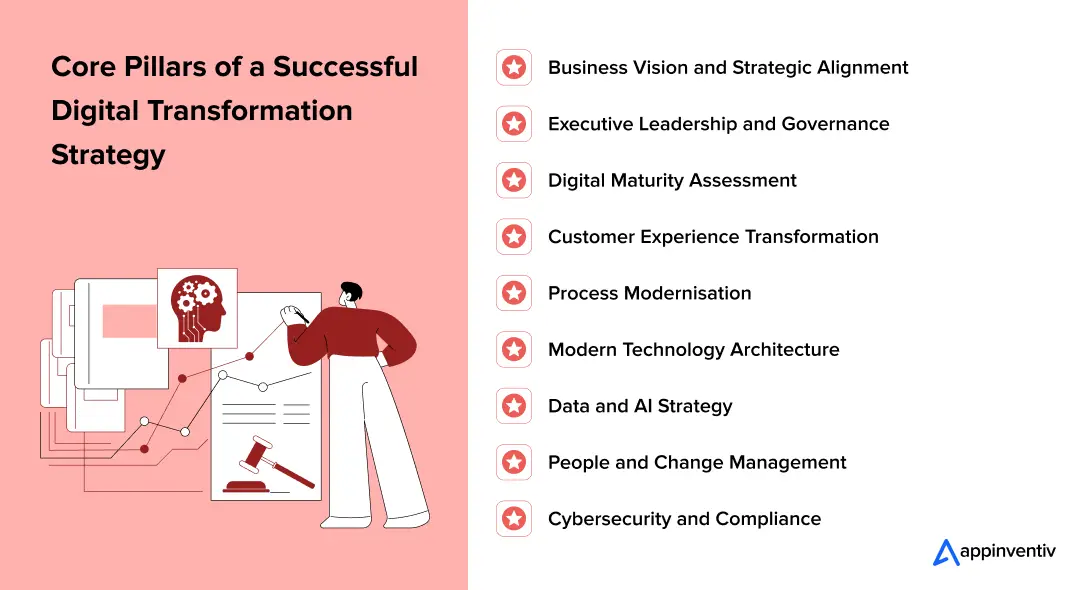
Implementing a solid enterprise digital transformation framework requires rigorous attention to nine distinct pillars. Missing even one of these elements can compromise the entire programme. Here is how leading enterprises structure that execution across nine non-negotiable areas.
Business Vision and Strategic Alignment
You cannot buy your way to a better operating model. Software must solve documented commercial bottlenecks, whether that means cutting customer onboarding times or stripping out manual backend processing.
- Why it matters: Stops the board from approving software that looks impressive but fixes nothing.
- Common mistake: Buying a platform for its technical specifications instead of its business outcome.
- Practical action: Map exactly which commercial metric the technology will improve before starting procurement.
Executive Leadership and Governance
A successful rollout requires unified direction from the C-suite. Shared ownership establishes decision rights, steers committees, and enforces transformation governance.
- Why it matters: Forces different departments to share budgets and prevents isolated, rogue IT projects.
- Common mistake: Handing the entire modernisation agenda to the IT director while operations teams step back.
- Practical action: Build a cross-functional steering group that reviews weekly deployment progress against strict commercial targets.
Digital Maturity Assessment
You must know exactly how broken your current setup is. This means auditing existing technical debt, undocumented workarounds, and staff capabilities.
- Why it matters: Exposes hidden integration barriers before you start paying for cloud consumption.
- Common mistake: Assuming legacy on-premise databases will easily plug into modern microservices.
- Practical action: Document every single legacy data flow to spot where the new architecture will face resistance.
Customer Experience Transformation
Digital programmes must prioritise omnichannel service delivery, deep personalisation, and self-service capabilities. Faster journeys result in better customer insight.
- Why it matters: Directly impacts top-line revenue and market competitiveness.
- Common mistake: Digitising a broken customer journey instead of redesigning it for user friction reduction.
- Practical action: Map the end-to-end customer journey and eliminate steps that add no value to the user.
Process Modernisation
Workflow redesign unlocks true efficiency. Businesses in the UK must leverage process mining, RPA, and low-code platforms to eliminate manual bottlenecks.
- Why it matters: Reduces human error and drives down the baseline cost of operations.
- Common mistake: Automating a highly inefficient legacy process without optimising it first.
- Practical action: Use process mining tools to identify exactly where operational delays occur before applying automation.
Modern Technology Architecture
A robust foundation requires cloud-native platforms, API-led integration, and composable architecture. Microservices ensure scalability while security-by-design protects enterprise assets.
- Why it matters: Provides the agility needed to swap out failing components without disrupting the entire system.
- Common mistake: Building monolithic custom applications that become impossible to upgrade.
- Practical action: Adopt an API-first mindset for all new software development to ensure future interoperability.
Data and AI Strategy
Effective AI deployment in the UK enterprises depends entirely on data governance and master data management. Responsible AI governance protects the organisation from compliance breaches.
- Why it matters: Feeding an AI tool fragmented data guarantees inaccurate, potentially damaging business insights.
- Common mistake: Paying for advanced generative AI pilots while customer records remain trapped in separate departmental silos.
- Practical action: Create a strict master data framework so there is only one accepted source of truth across the company.
People and Change Management
The best architecture in the world fails if your workforce ignores it. Managing the cultural shift requires targeted upskilling and clear communication from day one.
- Why it matters: Prevents the massive productivity dip that happens when staff refuse to abandon their legacy spreadsheets.
- Common mistake: Treating employee training as a minor tick-box exercise just before the go-live date.
- Practical action: Find respected employees in each department and train them early so they can push adoption among their peers.
Cybersecurity and Compliance
Security is an architectural foundation, not an optional add-on. UK regulatory bodies expect auditability and privacy controls baked directly into the code.
- Why it matters: Shields the board from regulatory fines and prevents deployments from stalling at the final compliance check.
- Common mistake: Leaving security penetration testing until the software is completely built.
- Practical action: Embed automated security and compliance checks directly into your daily software development lifecycle.
How to Develop a Digital Transformation Strategy Roadmap
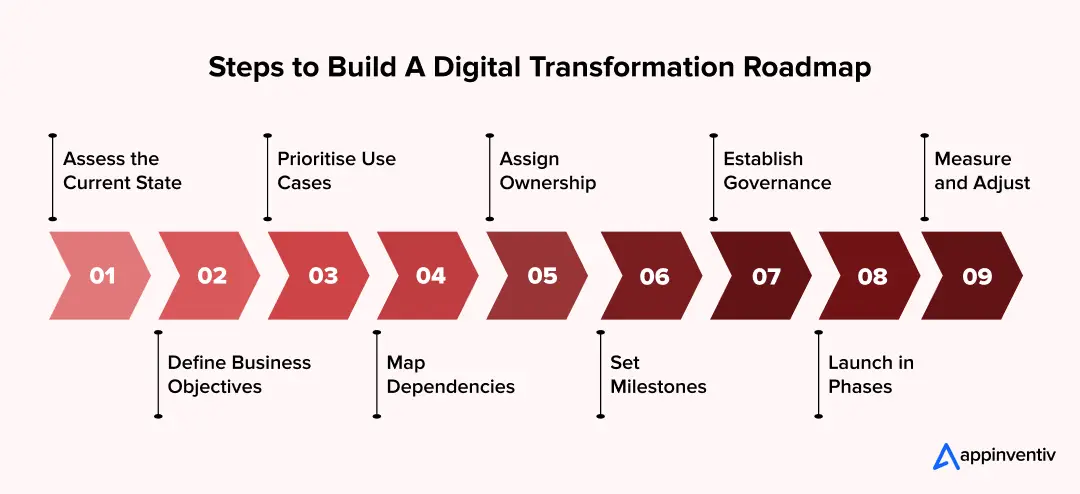
Moving from boardroom theory to ground-level execution requires a tightly sequenced delivery plan. You cannot simply buy software and expect operations to improve. Execution requires a structured timeline and sequenced steps that control technical debt and manage internal friction.
Assess the Current State
Audit existing systems and baseline data quality first. You need documented evidence of your operational maturity, not assumptions carried over from previous failed IT projects.
Define Business Objectives
Translate board ambitions into two or three hard operational outcomes. Target reduced cost-to-serve or faster client onboarding. Every subsequent workstream must tie directly to these commercial results.
Prioritise Use Cases
Rank potential initiatives by actual commercial value and technical feasibility. Avoid chasing technological novelty. Early delivery phases must fund and justify the capital required for later complex integrations.
Map System Dependencies
Identify exactly how legacy systems, vendor platforms, and enterprise data flows interact. Sequencing errors at this stage remain the primary cause of severe delivery delays once a rollout begins.
Assign Clear Ownership
Name a specific accountable owner for each delivery phase across both business and technology functions. Critical decisions cannot stall mid-programme while waiting for cross-departmental consensus.
Set Commercial Milestones
Attach delivery milestones to business metrics the executive board already monitors. Technical completion alone means nothing if the progress reporting fails to resonate with the C-suite.
Establish Strict Governance
Agree on the steering committee structure and escalation paths before writing any code. You cannot improvise enterprise governance when the first major architectural trade-off inevitably arises.
Launch in Managed Phases
Release new capabilities in strict stages rather than attempting a massive monolithic deployment. This approach makes financial value visible early and contains technical risk within isolated delivery cycles.
Measure and Adjust
Review outcomes against your agreed metrics after every single release. Use those hard findings to reprioritise the scope for the next phase instead of blindly following the original plan.
A practical digital transformation roadmap in the UK breaks delivery into structured timeframes.
| Horizon | Focus | Typical Output |
|---|---|---|
| 0 to 90 days | Diagnostic, governance setup, quick wins | Current-state assessment, steering committee, first automated process |
| 3 to 6 months | Core platform and data foundation build | Integrated data layer, first customer-facing journey live |
| 6 to 12 months | Scale across business units, AI use cases | Multiple journeys live, AI pilots moved into production |
The Appinventiv 90-Day Enterprise Modernisation Framework
You cannot simply buy software and expect daily operations to improve. True execution requires a structured, proprietary timeline. We deploy the Appinventiv 90-Day Enterprise Modernisation Framework to help UK boards map system dependencies, secure rapid technical wins, and transition to product-centric delivery without causing massive service disruption.
Phase 1: Diagnostic and Technical Discovery (Days 1–30)
We audit your existing tech stack to uncover hidden integration barriers before cloud consumption begins. This phase focuses on mapping legacy data flows, evaluating G-Cloud 14 compliance readiness, and identifying the specific manual workflows costing you the most capital.
Phase 2: Architectural Design and Governance (Days 31–60)
We establish strict escalation paths and steering committee structures so enterprise governance is never improvised. We design the target state architecture, shifting away from monolithic systems toward composable microservices orchestrated via Kubernetes, ensuring your new environment is secure by design.
Phase 3: The Pilot Build and Deployment (Days 61–90)
We isolate a high-value, low-risk business bottleneck and deploy an automated solution. By releasing new capabilities in strict stages rather than attempting a massive big-bang deployment, we make financial value visible to the C-suite early and contain technical risk within an isolated delivery cycle.
To customize this roadmap for your company, we first evaluate your specific context.
- What industry do you operate in?
- What is the primary goal of your transformation (e.g., cutting costs, improving customer experience)?
- What legacy systems or bottlenecks are currently slowing you down?
Digital Transformation Operating Model for Your Business Expansion
Many transformations fail simply because the underlying operating model remains unchanged. If an enterprise continues to fund and manage technology as isolated, short-term projects, innovation stalls the moment the project concludes.
To achieve enterprise scale, organisations must move from project-based delivery to product-based delivery. This shift requires establishing:
- Cross-functional teams that combine business, data and engineering ownership
- Platform thinking, where a capability is owned and improved continuously
- Continuous improvement built into the operating rhythm, not scheduled as a separate project
- Clear accountability for outcomes, not just for delivery milestones
- Faster decision-making through delegated authority at the product level
Enterprises that skip this step often see technology delivered successfully and still fail to capture value, because the organisation around the platform was never redesigned to sustain it.
How Much Does A Digital Transformation Strategy Cost In The UK?
There is no single, credible figure for what a digital transformation strategy costs in the UK, and any estimate given without a current-state assessment first should be treated with caution. As a rough indicator only, enterprise programmes in this space tend to cost somewhere between £40,000 and £500,000 or more.
Though this is a broad average and actual cost depends entirely on scope, legacy complexity and the number of systems involved. What is consistent across enterprise programmes is where cost concentrates: legacy complexity and data foundation work absorb a disproportionate share of budget in the early phases, while customer-facing features, which tend to dominate board conversations, are usually a smaller line item than expected.
Here are key cost drives that impact your digital transformation project budget:
| Cost Driver | What It Covers | Typical Impact on Budget |
|---|---|---|
| Legacy system complexity | Integration, data migration, technical debt remediation | Often the largest single driver, particularly in phase one |
| Data foundation work | Governance, quality remediation, master data management | Front-loaded, before AI or analytics use cases can scale |
| Change management | Training, communication, adoption support | Most frequently underfunded, and the biggest source of hidden cost later |
| Security and compliance | Audit readiness, controls, sector-specific certification | Non-negotiable, and rises with exposure to regulated sectors |
| Ongoing platform ownership | Continuous improvement, support, product team retention | Recurring rather than one-off, replacing traditional project close-out |
How AI Is Reshaping Digital Transformation Strategies
AI capability in the UK, from copilots to autonomous agents, is an accelerant inside a transformation strategy rather than a replacement for one, and treating it as the strategy itself is a common and costly mistake.
Generative AI, AI copilots, and autonomous AI agents are rapidly becoming standard enterprise capabilities. These tools power intelligent automation, predictive operations, advanced enterprise search, and comprehensive knowledge management.
However, scaling these technologies demands rigorous AI readiness, which depends on:
- Data quality and governance mature enough to support automated decisions
- An operating model able to absorb continuous AI-driven change
- Skills across both technical and business teams
- Governance that assigns accountability for AI outcomes, not just AI outputs
- Use-case prioritisation based on data readiness and business value, rather than novelty
As PwC UK’s CTO Consulting lead has noted, capturing lasting AI value will require what he calls “a complete boardroom effort” spanning skills, governance and infrastructure.
Also Read: 10 Ways AI Is Transforming the Healthcare Sector in the UK
- Modernise legacy systems
- Improve customer experience
- Scale AI responsibly
- Strengthen governance
- Increase operational efficiency

Common Digital Transformation Challenges UK Businesses Face and Strategies to Solve Them
Most delivery risk in UK transformation programmes is predictable and repeats across sectors. Anticipating these hurdles allows leadership teams to deploy pre-planned mitigation strategies, ensuring momentum continues despite legacy system entanglement or internal friction.
| Challenge | Strategies to Resolve |
|---|---|
| Transformation fatigue | Sequence delivery in phases with visible wins every 90 days |
| Legacy system entanglement | Wrap legacy systems with APIs before attempting full replacement |
| Data silos | Establish a single data governance model before scaling AI use cases |
| Skills gaps | Blend internal upskilling with a delivery partner for specialist capability |
| Budget constraints | Prioritise use cases by ROI and sequence spend across horizons |
| Security concerns | Build security controls into architecture decisions, not as a later gate |
| Regulatory complexity | Involve compliance and legal functions from strategy stage, not pre-launch |
| Resistance to change | Assign change champions and communicate outcomes before communicating process |
UK Compliance Considerations That Should Shape Your Strategy
UK GDPR and data protection obligations should inform data architecture decisions from the design stage, particularly where customer or employee data moves between cloud regions or third-party platforms.
Cyber resilience expectations have hardened, with UK businesses reporting sharply increased cyber budgets for the year ahead as boards treat security as a growth enabler rather than a cost centre.
Sector-specific regulation adds further weight to architecture and vendor decisions. For instance:
- Financial services firms need to weigh FCA expectations around operational resilience and third-party risk alongside any platform choice.
- Healthcare organisations delivering NHS-adjacent services need to evidence alignment with the NHS Data Security and Protection Toolkit before systems touching patient data go live.
- Public sector and public-sector-adjacent organisations face procurement and security standards that shape vendor selection well before a build begins.
AI governance now sits alongside these obligations rather than apart from them, since AI use cases inherit the same data protection and auditability requirements as the systems feeding them.
Building these considerations into the transformation strategy from the outset, rather than treating them as a pre-launch compliance gate, materially reduces delivery risk and rework later in the programme.
How to Measure the Success of Your Digital Transformation Strategy
Defining precise metrics across multiple business domains prevents transformation programmes from becoming perpetual cost centres. Tracking operational, customer, and technological KPIs ensures continuous alignment with the original business case and provides leadership with the data needed to adjust course.
| KPI Category | Example Metrics |
|---|---|
| Business KPIs | Revenue growth, cost to serve, return on investment |
| Customer KPIs | Retention, satisfaction, onboarding time |
| Operational KPIs | Cycle time, productivity, service uptime |
| Technology KPIs | System availability, integration reliability, deployment frequency |
| AI KPIs | Model accuracy, use-case adoption, decision cycle time |
Key Digital Transformation Trends Shaping UK Businesses Beyond 2026
Future-proofing digital infrastructure requires tracking emerging technologies that will redefine industry standards. Understanding agentic AI, composable architectures, and sustainable IT enables enterprises to architect flexible systems that absorb future innovations without requiring disruptive, ground-up rebuilds.
- Agentic AI and AI-native enterprises: AI agents handling multi-step tasks with human oversight rather than isolated copilots
- Platform engineering and composable architecture: Internal platforms that let product teams ship without rebuilding infrastructure each time
- Industry clouds and digital twins: Sector-specific platforms and simulated environments that shorten testing and decision cycles
- Edge AI and sustainable IT: Processing closer to where data is generated, alongside growing pressure to account for IT’s energy footprint
- Human-AI collaboration and knowledge graphs: Connecting enterprise knowledge so both people and AI systems can reason over it
Each of these earns a place in a transformation roadmap only where it moves a business metric already tracked at board level.
Why Appinventiv Is a Strong Fit for Enterprise Digital Transformation Programs?
Appinventiv, a leading digital transformation partner in the UK, brings strategy-to-execution capability that spans consulting, engineering and long-term optimisation, rather than handing a strategy document to a separate delivery team.
With 11+ years of experience, we understand that technology must solve commercial problems. We have successfully deployed 300+ digital assets in the UK, driving significant operational improvements for our clients.
Our strategy-to-execution capability is backed by profound engineering depth and proven legacy modernisation experience. We maintain a 97% client retention rate because we focus on long-term optimisation rather than short-term deliverables. Across 35+ industries digitally transformed, we have generated up to 45% efficiency gains in UK enterprises.
With 5+ innovation hubs in London, Berlin & Amsterdam, we possess the scale required for enterprise deployments. We enforce enterprise-grade governance, holding ISO 27001, ISO 9001, and SOC2 certifications, backed by a strict 99.50% security compliance SLA.
Our team of 1700+ digital experts bridge the gap between advisory consulting and software engineering, ensuring your AI and automation delivery is secure, scalable, and built to drive business growth.
So, what are you still thinking of? Whether you need to decouple monolithic SAP/Oracle systems, scale AI capabilities securely, or align your infrastructure with Crown Commercial Service standards, our technical leads can map your exact route to value.
Book a Cloud & Architecture Readiness Assessment
FAQs
Q. What is a digital transformation strategy?
A. It is a comprehensive framework aligning an organisation’s technology investments with core business objectives. It outlines how a company will overhaul legacy systems, optimize internal processes, and shift its culture to improve customer experience and maintain market competitiveness.
Q. How long does digital transformation take for UK enterprises?
A. Enterprise transformation is a continuous process rather than a project with a fixed end date. However, initial phased rollouts typically yield measurable business value within 4 to 6 months. Comprehensive legacy modernisation programmes spanning multiple business units often require 1 to 2 years to reach full maturity.
Q. What role does AI play in digital transformation strategies for UK businesses?
A. AI acts as a powerful operational enabler. It shifts workflows from manual administrative processing to intelligent automation, predictive analytics, and autonomous decision support. Successful integration relies entirely on strong data governance and modern cloud infrastructure.
Q. What are the key components of a successful framework?
A. Core components of the enterprise digital transformation framework include executive strategic alignment, robust cloud architecture, comprehensive data governance, process automation, security compliance by design, and structured change management to drive employee adoption.
Q. How do you measure digital transformation success?
A. Success is measured by tracking operational, commercial, and technical KPIs. Common metrics include reduced cost-to-serve, increased system uptime, improved customer retention, accelerated deployment frequency, and direct revenue growth tied to digital channels.
Q. What should UK enterprises consider for compliance?
A. UK enterprises must integrate compliance into their architecture from day one. This includes adhering to UK GDPR for data privacy, FCA standards for financial operational resilience, NHS DSPT for healthcare data, and emerging AI governance frameworks ensuring algorithmic transparency.
Q. How do you choose the right digital transformation partner?
A. Select a partner demonstrating deep engineering expertise, proven legacy modernisation experience, and strict security compliance. Evaluate their track record of deploying complex enterprise solutions and their ability to bridge the gap between high-level business strategy and ground-level software execution.
Q. What are the benefits of digital transformation for UK businesses?
A. The primary benefits of digital transformation implementation for UK businesses go far beyond basic IT upgrades. For established enterprises, the commercial advantages include:
- Driving down operating costs: Using targeted automation to strip out manual, repetitive administrative tasks.
- Improving executive visibility: Breaking down isolated data silos to give the board real-time commercial metrics.
- Embedding strict compliance: Baking UK GDPR and sector-specific governance directly into daily workflows.
- Defending market share: Upgrading outdated legacy platforms to match the speed and customer experience of agile competitors.


Fast 2-minute response, fully NDA-protected.

Digital Transformation in Government: From Legacy Systems to Modern Services
Key takeaways: Government transformation is about improving services, not simply replacing technology. Legacy modernisation needs a phased approach that protects critical services. Cloud, APIs, data platforms, digital identity and AI create the foundation for connected government. Security, privacy, accessibility and measurable outcomes must be built in from the beginning. Digital transformation for government has shifted…

Smart Infrastructure for the Public Sector: Use Cases, Technologies and Implementation Strategy
Key takeaways: Smart infrastructure connects physical assets, data, technology and governance to improve public services and operational outcomes. Australia's $242 billion infrastructure pipeline and a shortfall of 300,000 workers makes asset-level intelligence a delivery necessity, not an innovation extra. Smart infrastructure use cases demonstrate how AI, IoT, digital twins and analytics can transform infrastructure management.…

Digital Twins for Government Infrastructure: Use Cases, Architecture and Implementation Strategy
Key takeaways: Digital twin use cases for government infrastructure span predictive maintenance, transport planning, disaster response, climate resilience and more. NSW, Victoria and Queensland are advancing digital twin initiatives, supporting a more connected approach to infrastructure planning. Digital twin implementation costs may start at AUD 70,000 and exceed AUD 700,000 as infrastructure, integrations and…