

































How to Build a Cybersecurity Strategy and Implementation Plan: A Complete Guide for CIOs in 2026

 Share -


- 01How Traditional Cybersecurity Approaches Are Failing in 2026
- 02Steps to Create a Cybersecurity Plan: A Step-by-Step Implementation Roadmap for Enterprises
- 03Enterprise Cybersecurity Architecture: What a Modern Security Stack Looks Like
- 04Cybersecurity Implementation Plan Best Practices for Enterprise Resilience in 2026
- 05Components of a Cybersecurity Implementation Plan and Strategy
- 06Types of Cyber Threats Enterprises Must Prepare for in 2026
- 07Cybersecurity Frameworks CIOs Should Consider in 2026
- 08Regulatory and Compliance Considerations in Enterprise Cybersecurity
- 09How CIOs Measure Cybersecurity Effectiveness
- 10Common Cyber Security Strategy and Implementation Mistakes Enterprises Still Make
- 11Cybersecurity Trends CIOs Should Prepare for Beyond 2026
- 12How Appinventiv Helps Enterprises Build Cybersecurity-First Digital Ecosystems
- 13Frequently Asked Questions

Key Takeaways
- Many recent enterprise breaches exposed gaps in the cybersecurity implementation plan through old credentials, exposed APIs, or weak vendor access, rather than with malware alone.
- CIOs now review cybersecurity alongside discussions on outage planning, compliance exposure, recovery readiness, and operational risk.
- Security teams spend more time monitoring identities, cloud workloads, APIs, and remote access activity across distributed systems.
- Large organizations still face problems with disconnected tools, incomplete logging, delayed patching cycles, and unmanaged permissions.
- Recovery testing, ransomware readiness, and third-party access reviews now receive much more executive attention than before.
Ten years ago, many enterprise security teams worked inside a clear boundary. Corporate devices sat inside company offices. Most applications live in on-premise data centers. Traffic passed through a small number of monitored gateways. Security teams built defenses around that structure.
That structure is gone.
A large enterprise now runs across AWS workloads, Azure tenants, SaaS platforms, employee-owned devices, vendor APIs, remote identities, and unmanaged endpoints spread across several regions. A finance employee logs into Workday from a home network. A developer pushes code through a CI/CD pipeline tied to GitHub and Kubernetes clusters. A supplier accesses procurement systems through federated identity services. Every connection creates another security checkpoint.
Attack methods changed just as fast. Ransomware operators now steal credentials weeks before deployment. AI-generated phishing emails copy internal tone and formatting closely enough to fool trained employees.
According to Splunk’s 2026 CISO Report, 95% of CISOs now rank attacker sophistication as their biggest cybersecurity challenge. Security teams also deal with exposed APIs, token theft, cloud misconfigurations, and supply chain compromise attempts linked to third-party software dependencies.
This pressure has pushed cybersecurity far beyond the IT department. CIOs now treat it as part of operational continuity, governance, risk control, and enterprise resilience. This guide explains how to build a cybersecurity strategy and implementation plan that fits modern enterprise infrastructure in 2026 and what a strong cybersecurity implementation plan looks like in practice.
Disconnected security tools continue to slow investigations and increase enterprise exposure to incident response during active attacks.
How Traditional Cybersecurity Approaches Are Failing in 2026
Most enterprise cybersecurity strategy programs were built for a different technology environment. Employees worked inside office networks. Business applications stayed inside company-owned data centers. Security teams monitored traffic through a limited number of gateways and firewalls.
That setup changed quickly.
Today, a single enterprise may run workloads across AWS, Azure, Google Cloud, hundreds of SaaS applications, remote devices, contractor systems, and third-party APIs. Security teams now monitor activity that moves across regions, clouds, identities, and platforms every minute of the day.
Older security models struggle inside this setup.
Reactive Security Models Cannot Keep Pace With Modern Threats
Many organizations still depend on alert-driven investigation workflows. The problem is timing. Modern attackers often move across environments before analysts finish the first review cycle. A compromised identity account can access cloud storage, internal applications, and privileged systems within minutes.
The Enterprise Attack Surface Has Expanded Dramatically
Security teams now protect far more than laptops and office networks.
Common enterprise exposure points now include:
- Multi-cloud environments
- SaaS platforms
- APIs and microservices
- Remote employee devices
- IoT and OT systems
- AI assistants and copilots
| Environment | Common Risk |
|---|---|
| APIs | Stolen tokens |
| SaaS platforms | Excess permissions |
| Remote devices | Unmanaged access |
| OT systems | Weak segmentation |
Security Tool Sprawl Is Creating Visibility Gaps
Many large enterprises use separate tools for endpoint security, identity monitoring, cloud protection, threat detection, and compliance reporting. Splunk found that 79% of security teams struggle with excessive security tooling and fragmented operational visibility during investigations. These systems often fail to share context properly. During active incidents, analysts switch between consoles instead of working from a unified view.
AI-Powered Cyberattacks Are Increasing In Sophistication
Attackers now use AI to write phishing emails that resemble internal communication styles. Splunk’s 2026 research shows that 91% of CISOs expect AI to increase the realism and effectiveness of social engineering attacks. Some campaigns imitate executives, vendors, or finance teams closely enough to bypass basic awareness training.
Attackers increasingly combine AI-generated content with AI-powered social engineering attacks to make phishing, impersonation, and other manipulation tactics harder for employees to recognize
Why Cybersecurity Is Now A Board-Level Business Priority
A major cyber incident now affects operations, legal exposure, compliance reporting, customer trust, and shareholder confidence. Splunk’s global CISO survey found that 78% of CISOs are now concerned about personal liability tied to cybersecurity incidents. Boards want measurable answers around resilience, recovery readiness, and enterprise risk exposure.
Steps to Create a Cybersecurity Plan: A Step-by-Step Implementation Roadmap for Enterprises
A cybersecurity implementation plan usually fails during execution, not procurement. Many enterprises already own endpoint protection platforms, SIEM tools, IAM systems, and cloud monitoring software. The issue starts later. Different teams configure controls differently. Old permissions remain active. Logging stays incomplete across certain environments. Small gaps like these often stay unnoticed until an incident exposes them.
The steps for effective implementation help security teams reduce those gaps over time.
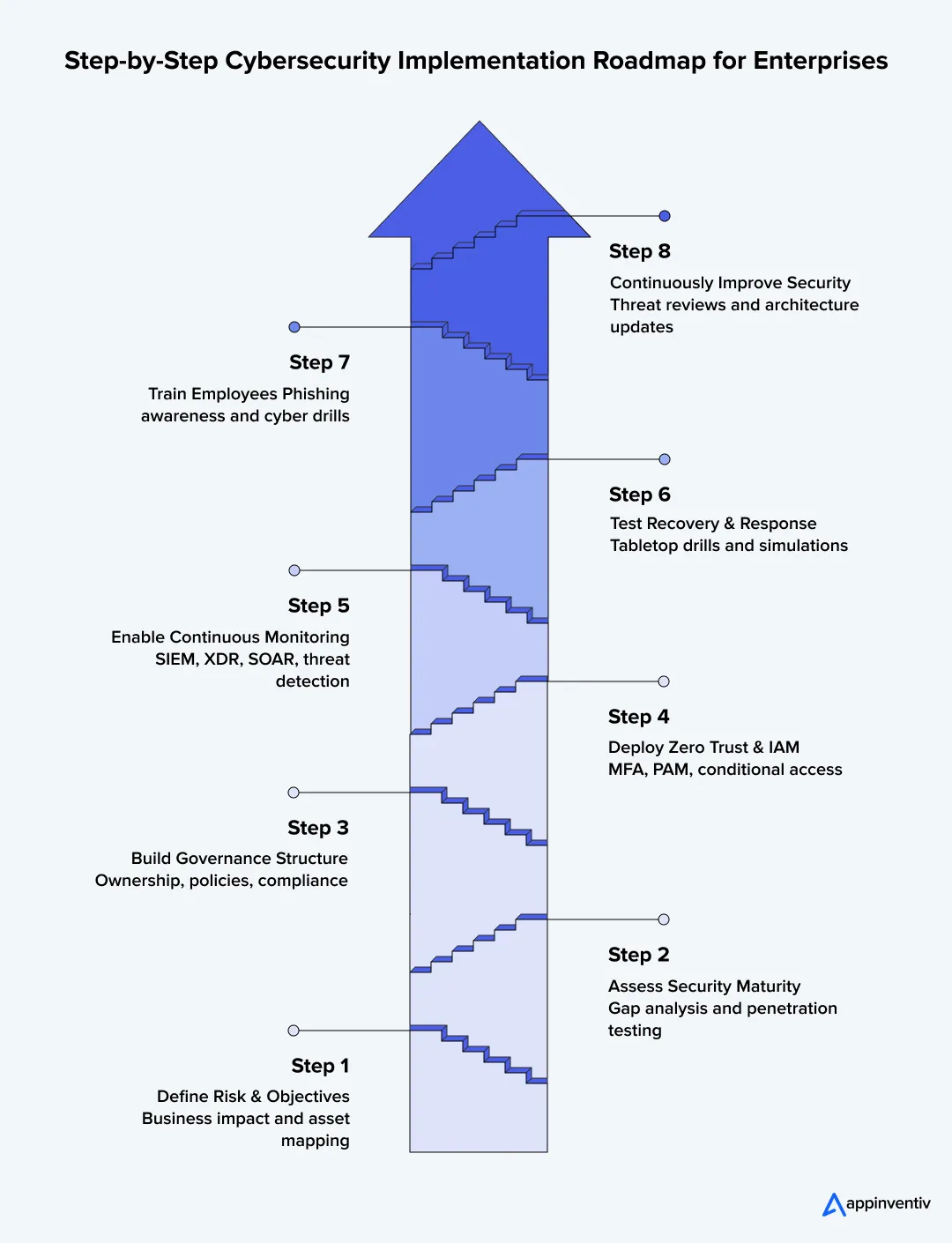
Step 1: Define business risk tolerance and cybersecurity objectives
A cyber risk management strategy starts with operational priorities. A manufacturing company, retail platform, and healthcare provider represent a common cybersecurity strategy example; each faces different outage risks and compliance exposure
This stage often includes:
- Business impact analysis
- Critical asset identification
- Recovery objectives
- Risk tolerance reviews
Many organizations rank systems based on downtime impact, regulatory exposure, and dependency across business operations.
Step 2: Conduct cybersecurity and maturity assessments
Most enterprises already run dozens of security controls across endpoints, cloud systems, and networks. Assessment work helps teams identify what still needs attention.
Security reviews often include:
- NIST CSF assessments
- Gap analysis
- Vulnerability scanning
- Penetration testing
- Active Directory reviews
- Cloud configuration audits
Many security teams now spend more time testing Kubernetes environments, identity systems, and API infrastructure than they did five years ago.
Step 3: Build a cybersecurity governance framework
Security ownership becomes difficult inside large organizations without a formal GRC implementation framework to anchor governance, risk, and compliance responsibilities. Different regions and departments often follow separate processes unless leadership standardizes them.
Governance models usually define:
- Executive accountability
- Reporting structures
- Escalation paths
- Risk review processes
- Compliance oversight
Step 4: Develop enterprise security policies and control baselines
Cybersecurity policies and procedures create consistency across endpoints, cloud platforms, applications, and remote access systems.
Common policy areas include:
- Access controls
- Endpoint hardening
- Encryption standards
- Vendor access requirements
- Data retention rules
- Regulatory alignment
Many enterprises map these baselines against NIST CSF 2.0, ISO 27001, and CIS Controls while also aligning them with cybersecurity compliance requirements for enterprises.
Step 5: Implement Zero Trust and IAM controls
Identity systems remain one of the most targeted areas inside enterprise infrastructure. Attackers often move laterally through exposed credentials and weak privilege management.
Core implementation areas include:
- MFA deployment
- Privileged access management
- Conditional access policies
- Identity federation
- Device trust verification
Step 6: Deploy continuous monitoring and threat detection systems
Enterprise systems generate large volumes of telemetry every day. Security teams monitor logs from endpoints, cloud services, APIs, identity systems, and containers continuously.
Most organizations deploy:
- SIEM platforms
- XDR tooling
- Threat intelligence feeds
- UEBA analytics
- SOAR workflows
Behavioral analytics now help analysts detect abnormal access activity and privilege escalation patterns faster.
Step 7: Establish incident response and cyber recovery workflows
Many organizations already maintain written response procedures. Real incidents often expose operational weaknesses inside those plans.
This stage usually covers:
- SOC escalation workflows
- Incident triage procedures
- Containment playbooks
- Recovery testing
- Business continuity coordination
Step 8: Conduct penetration testing and security simulations
Routine monitoring cannot expose every weakness. Security testing gives teams a clearer view of real attack paths.
Most enterprises now run:
- Red team exercises
- Breach simulations
- Tabletop drills
- Recovery validation tests
- Phishing assessments
Step 9: Train employees and operationalize security culture
Human error still contributes to many security incidents. Security training now covers more than suspicious emails alone.
Programs often include:
- Executive cyber drills
- Role-specific training
- Insider risk awareness
- Secure coding guidance for developers
- Phishing simulation tracking
- Privileged-user training reviews
- Training completion monitoring
Step 10: Monitor, review, and continuously improve security operations
Enterprise infrastructure changes constantly. New cloud workloads, AI tools, SaaS applications, and vendor integrations create fresh exposure points throughout the year.
Security teams regularly review:
- Threat intelligence feeds
- Detection rules
- Policy updates
- Infrastructure changes
- Validation testing results
Enterprise Cybersecurity Architecture: What a Modern Security Stack Looks Like
Enterprise security stacks look very different now than they did a few years ago. A firewall and endpoint antivirus platform are no longer enough for large environments running across cloud infrastructure, SaaS applications, APIs, remote devices, and third-party systems. Modern security architecture now focuses heavily on identity validation, continuous monitoring, workload visibility, and response automation.
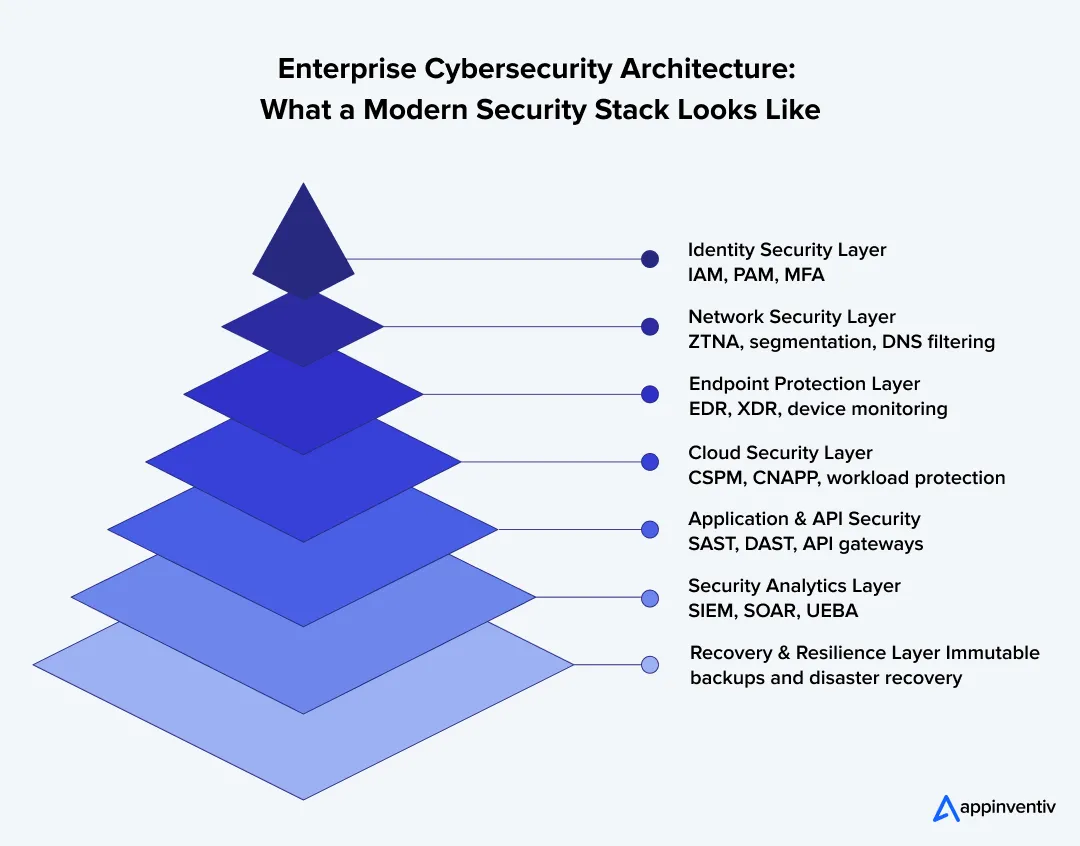
Identity Security Layer
Identity systems now sit at the center of enterprise security operations. Many attacks begin with stolen credentials, exposed session tokens, or excessive account privileges.
Most enterprises now deploy:
- IAM and PAM platforms
- MFA enforcement
- Identity federation
- Conditional access policies
- Privileged session monitoring
Security teams also monitor impossible travel events, privilege escalation activity, and unusual authentication behavior through UEBA systems.
Network Security And Segmentation Layer
Traditional flat networks create large lateral movement risks during breaches. Security teams now separate workloads, applications, and operational systems through microsegmentation and Zero Trust Network Access controls.
Common controls include:
- ZTNA platforms
- Network segmentation
- East-west traffic inspection
- DNS filtering
- Secure web gateways
Endpoint And Device Protection Layer
Endpoints remain a major attack target inside enterprise environments. Modern EDR and XDR systems monitor process execution, memory activity, PowerShell abuse, and suspicious persistence behavior in real time.
Security teams now protect:
- Employee laptops
- Mobile devices
- Virtual desktops
- Server workloads
- Container hosts
Cloud Security Architecture
Cloud environments create different security challenges than traditional infrastructure. Misconfigured storage buckets, exposed secrets, and weak IAM permissions are among the most persistent cloud security risks in enterprise environments.
Many enterprises now deploy:
- CSPM tooling
- CNAPP platforms
- Cloud workload protection
- Kubernetes runtime monitoring
- Infrastructure-as-code scanning
Application And Api Security Layer
Modern applications depend heavily on APIs and containerized services, making cloud application security a foundational requirement inside CI/CD pipelines.
Most enterprise programs include:
- Secure SDLC practices
- API gateway security
- Runtime application protection
- SAST and DAST testing
- Dependency scanning
Security Analytics And Automation Layer
Large enterprises generate massive telemetry volumes every day. SIEM platforms aggregate logs across cloud systems, endpoints, identity platforms, and network infrastructure. SOAR systems automate repetitive investigation and containment tasks during incidents.
Security operations teams also rely heavily on:
- Threat intelligence platforms
- Behavioral analytics
- UEBA systems
- Automated playbooks
- Detection engineering workflows
Also Read: AI Agents for Cybersecurity: Build, Integrate, Scale Guide
Backup, Disaster Recovery And Resilience Layer
Ransomware groups now target backup infrastructure directly. Many enterprises isolate backup environments from production systems and use immutable storage to reduce recovery risk.
Modern resilience planning often includes:
- Backup orchestration systems
- Air-gapped recovery environments
- Disaster recovery testing
- Recovery time objective validation
- Business continuity integration
Cybersecurity Implementation Plan Best Practices for Enterprise Resilience in 2026
Many enterprise breaches still come from routine security gaps that enterprise cybersecurity consulting services are specifically designed to address. Old credentials remain active for months. Cloud storage stays publicly exposed. Vendors keep unnecessary access long after projects end. Small issues like these often create larger problems later.
A few operational practices continue to make the biggest difference.
Strengthen Identity Controls
Many attackers now target user accounts rather than devices. Security teams usually focus on:
- Multi-factor authentication
- Least-privilege access
- Privileged account reviews
- Conditional access checks
Improve Visibility Across Systems
Large enterprises generate activity across endpoints, cloud platforms, APIs, and SaaS applications constantly. Security teams need centralized monitoring across those environments.
Common controls include:
- SIEM and XDR platforms
- Centralized logging
- Threat intelligence feeds
- Real-time alert monitoring
Build Security Into Development Workflows
Application security testing now starts much earlier inside CI/CD pipelines. Most engineering teams now run:
- SAST and DAST scans
- Dependency checks
- Infrastructure-as-code reviews
- Secrets scanning
Test Recovery Processes Regularly
Many organizations discover recovery gaps during real incidents, which is why building a digital immune system approach to cyber resilience has become a focus for mature security programs. Regular testing often includes:
- Tabletop exercises
- Backup restoration tests
- Ransomware simulations
- Red team exercises
Review Vendor Access Continuously
Third-party systems often create indirect access into enterprise environments. Many security teams now review vendor permissions and external integrations much more frequently.
Enterprise Security Best Practices at a Glance
- Enforce phishing-resistant MFA
- Segment critical workloads
- Centralize security telemetry
- Test backups regularly
- Review privileged accounts monthly
- Scan APIs continuously
- Monitor third-party access closely
- Validate recovery procedures quarterly
Also Read: Cyber Security Services Cost: Full Breakdown and ROI Guide
Misconfigured workloads, exposed secrets, and weak IAM policies continue creating preventable enterprise security incidents.

Components of a Cybersecurity Implementation Plan and Strategy
A cybersecurity implementation plan usually breaks down in execution, not planning. Many enterprises already have firewalls, endpoint agents, cloud monitoring tools, and identity platforms in place. The problem starts when these systems fail to work together during a real incident.
An analyst investigating suspicious login activity may need data from five separate consoles. Cloud teams may not see endpoint alerts. Identity teams may not know an API key was exposed inside a development environment. Small gaps like these create large problems during active attacks.
A workable cybersecurity program connects visibility, governance, response, and recovery into one structure.
| Cybersecurity Component | Primary Objective |
|---|---|
| IAM | Access control |
| Zero Trust | Continuous verification |
| SIEM/XDR | Threat visibility |
| DevSecOps | Secure development |
| Backup & Recovery | Operational resilience |
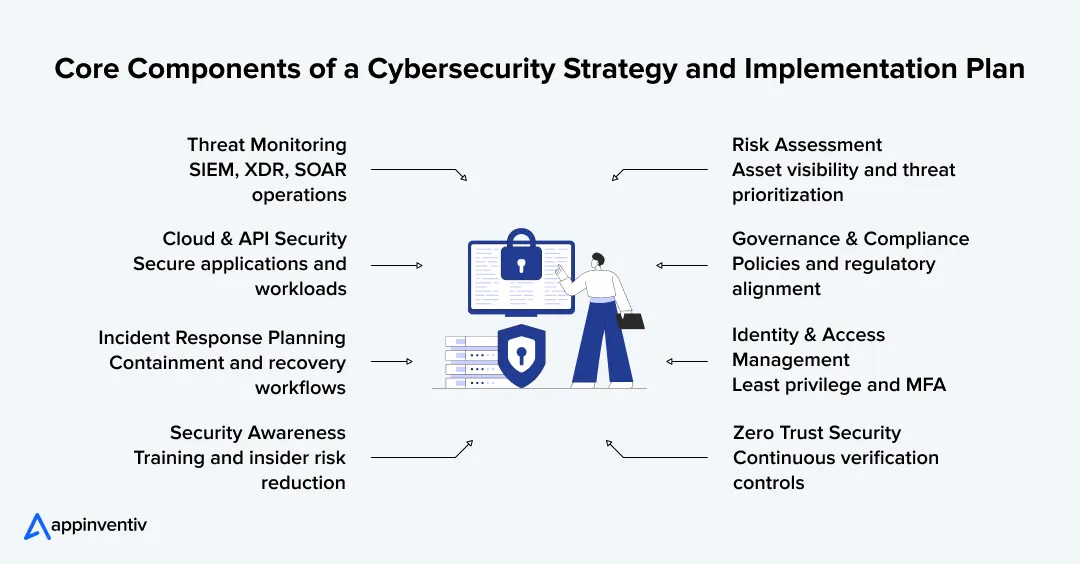
Asset Management And Enterprise-Wide Risk Assessment
Most enterprises cannot secure assets they do not track properly. Old virtual machines, inactive SaaS accounts, exposed APIs, forgotten admin credentials, and unmanaged devices often stay invisible for months.
Security teams usually focus on:
- Asset inventory
- Exposure mapping
- Vulnerability tracking
- Risk scoring tied to business impact
Governance, Compliance And Cybersecurity Policies
Security policies need ownership. Without it, every business unit handles access, reporting, and compliance differently.
Most governance programs define:
- Reporting structures
- Security responsibilities
- Compliance workflows
- Policy review cycles
Identity And Access Management (IAM)
A large number of breaches now start with compromised credentials. That shift pushed identity systems into the center of enterprise security programs.
Common IAM controls include:
- Multi-factor authentication
- Role-based access
- Least privilege policies
- Privileged account monitoring
Zero Trust Architecture Implementation
Older security models trusted users after network entry. Zero Trust systems check identity, device posture, access patterns, and session behavior continuously.
Security Operations, SIEM, Soar and XDR
Enterprise environments generate huge volumes of telemetry every day. Security teams use SIEM and XDR systems to connect suspicious activity across endpoints, cloud systems, identities, and network traffic. SOAR platforms automate repetitive response tasks during active incidents.
Cloud, Application And Api Security
Modern applications change constantly through CI/CD deployments. Security teams now use DevSecOps in cloud security to scan infrastructure-as-code templates, monitor runtime behavior, and inspect API traffic much earlier in the development cycle.
Data Protection, Encryption And Backup Resilience
Ransomware groups increasingly target backup environments before encryption begins. Many enterprises now isolate recovery environments and deploy immutable backup storage to reduce operational downtime.
Incident Response And Cyber Recovery Planning
Written response plans alone are not enough. Security teams now run tabletop exercises, breach simulations, and recovery drills to test containment speed and escalation paths.
Third-Party And Supply Chain Security Management
A vendor system with weak controls can expose internal environments quickly. Many enterprises now monitor supplier access, software dependencies, and external integrations more aggressively.
Security Awareness And Human Risk Management
Employees still remain a major attack target. Splunk’s 2026 CISO research also found that nearly two-thirds of security teams report moderate or severe burnout, making human-focused security operations and training even more important. Security programs now include phishing simulations, executive response drills, and insider threat monitoring across high-risk departments.
Core Cybersecurity Strategies Enterprises Should Prioritize
- Zero Trust Architecture (ZTA) for identity-first access control
- Phishing-resistant MFA for privileged accounts
- Network segmentation to reduce lateral movement
- Continuous vulnerability scanning and patch management
- Encrypted offline backups and disaster recovery planning
- 24/7 monitoring and centralized log management
- Incident response playbooks and breach containment workflows
- Security awareness training for employees and contractors
Types of Cyber Threats Enterprises Must Prepare for in 2026
The types of cyber attacks enterprises face look very different now than they did a few years back. Security teams no longer deal only with malware sitting on employee laptops.
Current attacks involve cloud accounts, APIs, remote access systems, vendor platforms, and identity infrastructure, which is why cybersecurity measures for businesses now span far beyond endpoint protection.
| Threat Type | Business Impact | Common Attack Vector |
|---|---|---|
| Ransomware and double-extortion attacks | Business interruption, locked systems and recovery costs | Phishing messages, stolen logins |
| AI-generated phishing and deepfake attacks | Fraud, unauthorized payments, fake executive requests | AI-written emails, cloned audio |
| Identity-based attacks and credential theft | Unauthorized access to enterprise systems | Weak passwords, exposed tokens |
| API and cloud-native attacks | Application disruption, exposed customer data | Poor API security, cloud misconfigurations |
| Insider threats and privileged misuse | Internal data leaks and misuse | Excessive account permissions |
| Supply chain and third-party compromises | Breaches through vendor ecosystems | Third-party access connections |
| IoT and OT infrastructure attacks | Downtime across manufacturing and operational systems | Legacy devices, weak segmentation |
Cybersecurity Frameworks CIOs Should Consider in 2026
Most large enterprises now use a cybersecurity strategy framework to organize policies, access controls, monitoring, compliance work, and incident response processes. Understanding the benefits of adopting a cybersecurity framework starts with recognizing that different frameworks solve different problems. Some focus on governance. Others focus more on detection, operational controls, or attack analysis.
| Framework | Best For | Primary Focus |
|---|---|---|
| NIST Cybersecurity Framework (CSF 2.0) | Large enterprise security programs | Risk management and governance |
| ISO/IEC 27001 | Regulated organizations | Information security management processes |
| CIS Controls | Security operations teams | Practical security control implementation |
| MITRE ATT&CK Framework | SOC and threat hunting teams | Mapping attacker behavior and tactics |
| Zero Trust security model | Hybrid and cloud-heavy environments | Continuous identity and access validation |
Regulatory and Compliance Considerations in Enterprise Cybersecurity
Security teams now build a cybersecurity and compliance strategy to deal with stricter reporting and data protection requirements across most industries. Healthcare providers, financial companies dealing with fintech cybersecurity requirements, retailers, and SaaS businesses all face different compliance obligations tied to customer and operational data.
| Regulation or Standard | Primary Focus |
|---|---|
| HIPAA | Healthcare data protection |
| PCI-DSS | Payment system security |
| NIST CSF | Security risk management |
| CISA Guidance | Threat response planning |
| ISO 27001 | Information security management |
Most enterprise compliance programs focus on:
- User access controls
- Audit trails
- Incident reporting processes
- Data retention policies
- Backup and recovery procedures
Good compliance practices help organizations reduce regulatory exposure and improve security governance across cloud systems, applications, and internal infrastructure.
How CIOs Measure Cybersecurity Effectiveness
Most CIOs no longer rely on broad IT security strategy status reports alone. Splunk’s research found that 41% of CISOs still struggle to directly connect cybersecurity spending with measurable risk reduction outcomes.
They track operational numbers tied to incident response, recovery speed, patching cycles, and enterprise risk management outcomes, including vendor exposure and resilience scores. These metrics help security teams spot weak areas before they turn into larger problems.
| KPI | What It Measures |
|---|---|
| Mean Time to Detect (MTTD) | Time needed to identify suspicious activity |
| Mean Time to Respond (MTTR) | Time needed to contain a security incident |
| Security incident reduction metrics | Change in successful attacks over a fixed period |
| Patch management SLA | Speed of fixing known security flaws |
| Third-party risk exposure metrics | Risk linked to external vendors and partners |
| Compliance and audit readiness scores | Readiness for security audits and regulatory checks |
| RTO/RPO metrics | Recovery readiness after downtime or ransomware attacks |
Common Cyber Security Strategy and Implementation Mistakes Enterprises Still Make
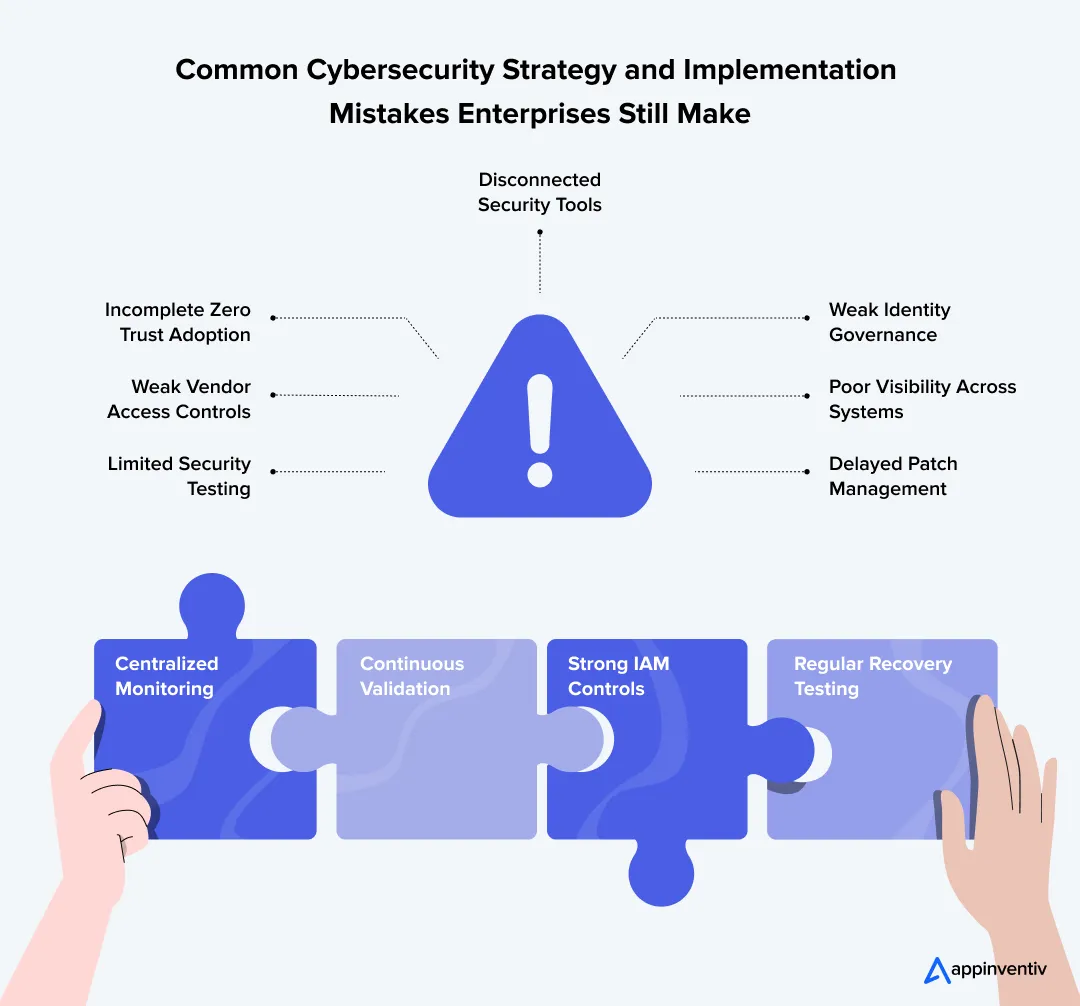
Many enterprise cybersecurity programs already have mature tooling, dedicated budgets, and experienced security teams in place. Yet challenges in cybersecurity implementation usually appear during execution. Security controls become inconsistent across regions, integrations remain incomplete, and governance gaps create visibility issues during active incidents.
Treating compliance as cybersecurity
Passing an audit does not automatically reduce security risk. Many organizations still leave exposed APIs, inactive accounts, and weak access controls inside production systems.
Common fix:
- Run continuous risk assessments
- Test controls regularly
- Review production environments continuously
Overinvesting in disconnected security tools
Large enterprises often deploy multiple security platforms that fail to share telemetry properly. Analysts then investigate incidents across separate dashboards with incomplete context.
Common fix:
- Consolidate overlapping tooling
- Improve SIEM, XDR, and SOAR integration
- Centralize logging and telemetry
Ignoring identity governance and access sprawl
Old service accounts, inactive SaaS credentials, and excessive permissions remain common exposure points.
Common fix:
- Enforce least-privilege access
- Remove dormant accounts quickly
- Review privileged access continuously
Delayed patching and incomplete visibility across environments
Large organizations often struggle to patch endpoints, cloud workloads, and third-party systems consistently across regions.
Common fix:
- Automate asset discovery
- Centralize vulnerability management
- Track patch SLAs closely
Failing to operationalize Zero Trust
Some enterprises adopt Zero Trust policies formally but fail to apply continuous verification across workloads, endpoints, APIs, and identity systems.
Common fix:
- Apply adaptive access controls
- Segment critical systems
- Validate device posture continuously
Also Read: AI Agent Security for Business: Top Risks and How to Prevent Them
Underestimating insider and supply chain risks
A compromised vendor account or careless employee can expose sensitive systems quickly.
Common fix:
- Monitor third-party access continuously
- Review software dependencies
- Run insider risk monitoring programs
Neglecting continuous monitoring and testing
Enterprise environments change constantly. New SaaS platforms, APIs, cloud workloads, and vendor integrations introduce fresh exposure points every month.
Common fix:
- Conduct regular penetration testing
- Tune detection rules frequently
- Review telemetry continuously
Manual investigations and fragmented telemetry continue to slow enterprise detection and containment workflows during active incidents.
Cybersecurity Trends CIOs Should Prepare for Beyond 2026
Enterprise cybersecurity strategy planning is changing fast. Security teams now spend less time thinking about perimeter defense alone and more time preparing for identity attacks, AI misuse, cloud exposure, and operational recovery.
Several trends are already influencing enterprise security programs:
- AI inside SOC operations
Analysts now use AI in cybersecurity tools to review alerts, group related events, and reduce investigation time during active incidents. Splunk’s 2026 report found that 92% of CISOs already see measurable productivity improvements from AI-assisted security operations. - Security mesh architecture
Enterprises now distribute security controls across endpoints, cloud systems, applications, APIs, and user identities. - Continuous trust verification
Many access systems now continuously evaluate login behavior, device posture, geolocation, and session activity. - AI system protection
Enterprises have started protecting LLM infrastructure, training datasets, and vector databases from prompt injection and data exposure. - Quantum-safe encryption planning
Some industries are already preparing for post-quantum cryptography standards. - Behavioral threat detection
Security teams increasingly monitor unusual account activity and abnormal privilege usage patterns. - Cyber resilience programs
Recovery testing, backup isolation, and operational continuity planning now receive stronger executive focus.
Also Read: Claude Mythos and Cybersecurity Risk in Enterprise AI
How Appinventiv Helps Enterprises Build Cybersecurity-First Digital Ecosystems
Many enterprises struggle to build a cohesive enterprise cybersecurity strategy due to fragmented security operations, inconsistent governance, weak visibility across cloud environments, and delayed incident response workflows. Appinventiv, a trusted cybersecurity development company, helps enterprises address these gaps through security-focused consulting, engineering, modernization, and long-term operational support.
| Capability Area | Appinventiv Focus |
|---|---|
| Cybersecurity consulting | Risk assessments, governance, and cybersecurity strategy and implementation plan delivery |
| DevSecOps practices | Secure CI/CD pipelines, code scanning and runtime security |
| Cloud security modernization | IAM hardening, CSPM, cloud workload protection |
| AI security readiness | LLM security, AI governance, access control |
| Cyber resilience engineering | Monitoring, backup recovery and incident response support |
Appinventiv supports enterprises across:
- Multi-cloud security architecture
- Secure application development
- Identity and access management
- Threat monitoring and response workflows
- Compliance alignment for GDPR, HIPAA, PCI-DSS, ISO 27001, and SOC 2
| Enterprise Experience Snapshot | Numbers |
|---|---|
| Industries mastered | 35+ |
| Solutions designed and delivered | 3000+ |
| Years of experience | 10+ |
| Industry certifications | 10+ |
| Client satisfaction rate | 95% |
| Repeat clientele | 90% |
Our teams build secure-by-design systems backed by a structured cybersecurity implementation plan that aligns cybersecurity, operational resilience, and enterprise growth objectives together.
Let’s connect and secure your multi-cloud environment before visibility gaps lead to compliance and recovery failures.
Frequently Asked Questions
Q. What is an enterprise cybersecurity strategy?
A. An enterprise cybersecurity strategy and cybersecurity implementation plan outline how a company protects business systems, employee accounts, applications, and sensitive data from cyber attacks. It usually includes access management, monitoring, governance, backup planning, and incident response processes. Large organizations often build these programs around operational risk and recovery requirements.
Q. How to build a cybersecurity strategy?
A. Most organizations begin building a cybersecurity strategy with asset reviews and risk assessments. Security teams then define policies, monitoring controls, access rules, and recovery procedures. Many enterprises use NIST CSF, ISO 27001, or Zero Trust principles as a cybersecurity plan example to improve governance and long-term security management.
Q. How CIOs should prepare for cyber threats in 2026?
A. Many CIOs are focusing heavily on identity protection, cloud monitoring, ransomware recovery, and third-party access controls. Enterprises are also strengthening MFA deployment, API security, backup isolation, and threat detection systems across cloud and hybrid infrastructure environments.
Q. What are the key components of an enterprise cybersecurity strategy?
A. Most enterprise security programs include identity management, endpoint protection, cloud security controls, incident response planning, backup systems, and monitoring platforms. Governance policies, vendor risk reviews, vulnerability management, and employee security training also remain important parts of day-to-day operations.
Q. How much should enterprises spend on cybersecurity?
A. Security spending varies across industries and infrastructure size. Financial institutions, healthcare providers, and critical infrastructure operators usually spend more than in standard business environments. Most enterprise budgets now include cloud security, monitoring systems, recovery planning, identity controls, and compliance management activities.
Q. What are common cybersecurity implementation failures?
A. Many implementation issues start with poor visibility across systems, weak identity controls, or outdated user permissions. Some enterprises also deploy too many disconnected tools without proper integration. Weak backup testing and inconsistent vendor access reviews remain common operational problems.
Q. Why are security policies and frameworks important in enterprise cybersecurity?
A. Security policies and frameworks help enterprises standardize security controls across firewalls, intrusion detection systems, VPNs, multifactor authentication, password policies, and encryption of sensitive data. They also support security audits, improve security posture, and create consistent implementation standards across enterprise environments.
Q. Why are defined cybersecurity roles and responsibilities important in enterprises?
A. Clear roles and responsibilities improve accountability across IT security, networking, cloud computing, database administration, and enterprise applications. Many organizations build dedicated cybersecurity teams that include in-house IT staff, outsourced cybersecurity professionals, and key stakeholders with defined communication channels during implementation and incident response activities.
Q. Why are regulatory and compliance requirements important in cybersecurity implementation?
A. Regulatory requirements and industry standards such as HIPAA, PCI-DSS, NIST, and CISA guidance help enterprises protect sensitive data and reduce data breach risks. Strong security policies and procedures also support business continuity, improve customer trust, and strengthen compliance with data-safety regulations across enterprise environments.
Q. Why is incident response planning important in enterprise cybersecurity?
A. An incident response plan helps enterprises prepare for cyber incidents through structured detection, containment, recovery, and communication processes. Most incident response strategies include identifying affected systems, assessing the damage, containing and eradicating the threat, restoring systems and data, communicating with stakeholders, and reviewing security audits, retention policies, and data protection procedures afterward.
Q. How do enterprises implement cybersecurity controls and technologies effectively?
`A. Enterprises usually deploy layered defenses across tech assets and devices through firewalls, MFA, encryption, SIEM platforms, backups, and smart access management systems. Many organizations also use artificial intelligence (AI) to strengthen security controls, improve monitoring accuracy, and support faster threat detection across enterprise frameworks and infrastructure.


Fast 2-minute response, fully NDA-protected.
Ecommerce Security: A Guide to Protecting Your Commerce Stack From Modern Cyber Threats
Key takeaways: Modern commerce stacks expand attack surfaces across APIs, cloud systems, third parties, payments, and customer identities. PCI DSS 4.0.1 compliance mandates strict client-side monitoring to prevent modern web-skimming and Magecart attacks. Strong ecommerce cyber security requires layered controls across architecture, identity, data, transactions, infrastructure, and integrations. Continuous testing, threat monitoring, AI-aware controls, and…
How to Hire the Right Cybersecurity Expert for Your Business
Key Takeaways Define the business risk before choosing a security title or engagement model. Match the role to the environment, whether the priority is cloud, application, compliance, incident response, or network defense. Evaluate cybersecurity professionals through relevant scenarios, practical tasks, evidence, and references. Compare permanent, consulting, managed, and hybrid models against the coverage the business…

How to Prevent Social Engineering Attacks in the Enterprise: Types, Examples, and Defense Strategies
Key takeaways: Social engineering attacks exploit human trust, making even well-secured enterprises vulnerable to a single convincing interaction. AI is making phishing, vishing, and impersonation attacks faster to launch, harder to detect, and easier to scale. Strong verification processes are essential, especially for credential resets, financial requests, and other high-risk actions. Phishing-resistant authentication, least-privilege access,…