

































Threat Intelligence Platform Development in Australia: Benefits, Process, and Best Practices

 Share -


- 01What Is a Threat Intelligence Platform?
- 02Why Australian Businesses Need a Custom TIP?
- 03Importance of Threat Intelligence Platform Architecture
- 04What Are the Essential Features Every Enterprise Threat Intelligence Platform Should Include
- 05What Are the Benefits of Threat Intelligence Platform Development for Australian Enterprises in 2026?
- 06How to Build a Cyber Threat Intelligence Platform: Step-by-Step Development Process
- 07Best Practices for Building a Future-Ready Threat Intelligence Platform
- 08How Much Does Threat Intelligence Platform Development Cost in Australia?
- 09Why Appinventiv Is Your Premier TIP Development Partner
- 10FAQs

Key takeaways:
- A custom threat intelligence platform helps Australian organisations detect, prioritise, and respond to cyber threats faster.
- AI-powered threat correlation, automation, and contextual risk scoring reduce alert fatigue and improve security operations efficiency.
- Success of TIP depends on integrating the platform with SIEM, SOAR, EDR, identity systems, cloud workloads, and external intelligence feeds.
- The right development approach balances scalability, governance, interoperability, and operational resilience from day one.
Australian technology and security leaders are managing unprecedented pressure. Alert queues stretch into the thousands, analysts triage noise rather than genuine threats, and boards that once treated cyber security as an IT line item now expect weekly briefings on exposure. That fatigue is not anecdotal. It shows up in staffing gaps, in delayed detection, and in the growing number of incidents that organisations learn about from a regulator rather than their own monitoring stack.
The data confirms this escalation. According to the ASD Annual Cyber Threat Report 2024-2025, the Australian Signals Directorate responded to over 1,200 cyber security incidents, marking an 11% increase from the previous year. For large businesses, the average cost of a cybercrime report surged by 219% to reach $202,700. State-sponsored actors and financially motivated ransomware groups are systematically targeting Australian networks with growing sophistication.
Regulation has caught up with that reality. The 2023-2030 Australian Cyber Security Strategy set the direction, the Cyber Security Act 2024 introduced mandatory ransomware payment reporting, and amendments to the SOCI Act pulled more sectors under critical infrastructure obligations with tighter incident reporting windows. Boards are now personally accountable for whether their organisation can detect, report, and respond within these timeframes, not just whether they own security tools.
This is where a threat intelligence platform development in Australia earns its place as infrastructure rather than an add-on. It is the layer that turns scattered signals, external feeds, internal logs, dark web chatter, into decisions a SOC can act on before damage spreads.
This blog examines how threat intelligence platforms work, why Australian enterprises increasingly prefer custom development, and the architectural, operational, and governance considerations required to build a resilient platform.
Whether you’re modernising an existing SOC or planning a new security capability, Appinventiv helps design threat intelligence platforms that accelerate incident response and support long-term cyber resilience.
What Is a Threat Intelligence Platform?
A Threat Intelligence Platform (TIP) is an enterprise security system that serves as the central cognitive engine for enterprise security operations. At a functional level, a platform acts as an automated decision-support system for high-throughput networks. It deduplicates data points across various global and regional streams to establish a single source of truth for threat analytics.
Australia’s Cyber Threat Landscape in 2026
To understand the necessity of a modern defence platform, Aussie business leaders must examine the specific threats impacting local enterprises. The ASD 2024-2025 report highlights several dominant attack vectors:
- Ransomware: Representing 11% of all responded incidents, ransomware continues to cause massive operational disruption and financial loss.
- Denial-of-Service (DoS/DDoS): Incidents surged by 280%, heavily impacting critical infrastructure.
- Phishing and Business Email Compromise: These remain the primary entry points for financial fraud and credential theft.
- Nation-State Attacks: Geopolitical tensions drive state-sponsored espionage targeting Australian intellectual property and government supply chains.
- Identity-Based Attacks: Threat actors increasingly focus on compromising valid credentials rather than exploiting software vulnerabilities, making identity fraud the top reported crime type.
- Cloud and Supply-Chain Compromise: Interconnected digital ecosystems mean that a breach in a third-party vendor often cascades into enterprise networks.
Core Components of a Threat Intelligence Platform
A functional platform relies on several interconnected modules working simultaneously to process and operationalise vast amounts of security telemetry.
| Component | Business Purpose |
|---|---|
| Threat feeds | Collect intelligence from commercial, open-source, government, and industry sources |
| IOC Management | Track malicious IPs, domains, URLs, hashes, and indicators |
| TTP Mapping | Map adversary behaviour using the MITRE ATT&CK framework |
| Threat Scoring | Prioritise threats according to organisational risk |
| Risk Engine | Evaluate business impact using contextual intelligence |
| Threat Intelligence Database | Store historical intelligence for long-term analysis |
| AI Analytics | Detect patterns that traditional rules may overlook |
| API Integrations | Exchange intelligence across enterprise security tools |
| Automation Engine | Trigger response playbooks automatically |
| Dashboards | Provide operational and executive visibility |
| Reporting | Support governance, compliance, and board reporting |
Types of Threat Intelligence
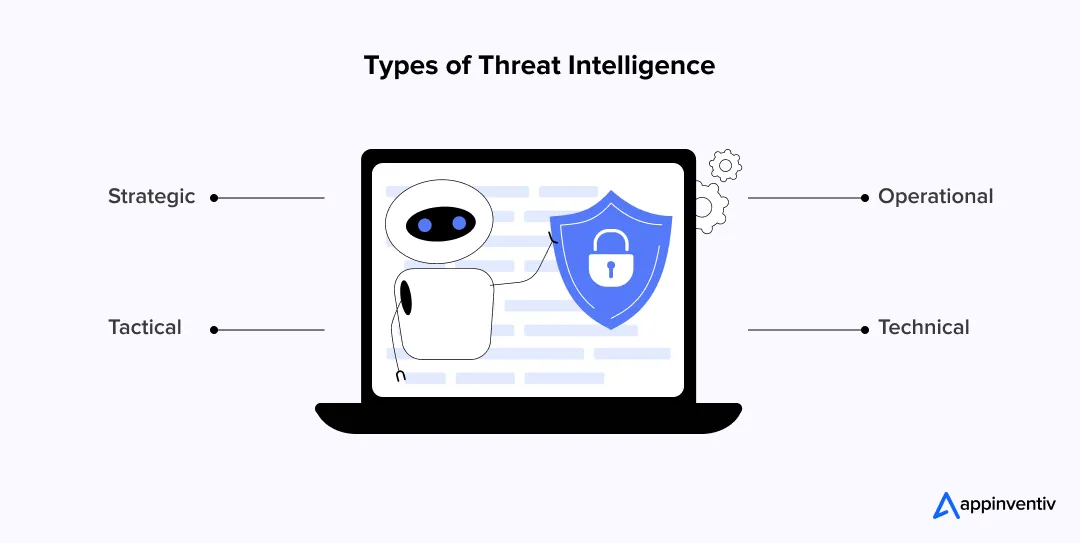
Effective threat intelligence platform use cases cover four distinct intelligence categories, serving entirely different audiences within the business.
Strategic Intelligence
Supports executive decision-making by analysing geopolitical risks, emerging threat actors, regulatory developments, and industry trends.
Tactical Intelligence
Helps security teams understand attacker tactics, techniques, and procedures (TTPs), enabling better defensive planning.
Operational Intelligence
Provides near real-time intelligence on active campaigns targeting similar organisations or sectors.
Technical Intelligence
Focuses on indicators such as malicious domains, IP addresses, malware hashes, and exploit signatures that security controls can immediately consume.
For example, a financial firm in Australia may use strategic intelligence to assess geopolitical cyber risks while simultaneously utilise technical intelligence to automatically block newly identified malicious infrastructure.
How Threat Intelligence Platforms Work
The system operates on a continuous, highly automated lifecycle designed to turn raw external data into immediate defensive action.
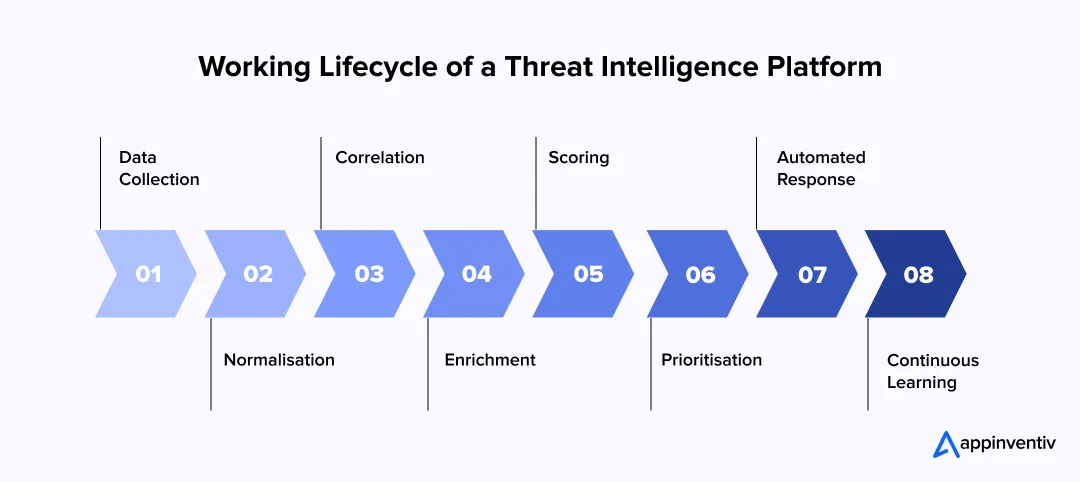
- Data Collection: The platform constantly pulls in vast amounts of raw material. This includes everything from unstructured dark web chatter and external intelligence feeds to internal firewall logs across your network.
- Normalisation: The system takes thousands of conflicting vendor formats and translates them. It forces all incoming telemetry into a single baseline language so the core analytics engine can actually process the information.
- Correlation: Isolated alerts rarely tell the whole story. The platform actively connects seemingly unrelated network anomalies to expose broader, coordinated campaigns targeting your specific sector.
- Enrichment: A raw IP address lacks context. The system automatically attaches historical tracking, registry data, and known vulnerability profiles to the alert before an analyst ever opens the ticket.
- Scoring: Not every vulnerability warrants a midnight phone call. The platform assigns hard risk metrics based directly on how a specific exploit would impact core commercial operations.
- Prioritisation: The platform silences the background noise. It pushes only verified, critical threats to the top of the queue so your lean security team focuses strictly on events requiring immediate human judgment.
- Automated Response: Speed is critical at this stage. The system executes pre-approved orchestration playbooks to block hostile traffic or quarantine compromised endpoints without waiting for manual approval.
- Continuous Learning: Security environments are never static. Every time your team resolves an incident, the platform feeds that technical outcome back into the machine learning models to sharpen future detection baselines.
Also Read: How Much Does a Cybersecurity Breach Really Cost Australian Enterprises in 2026
Why Australian Businesses Need a Custom TIP?
Global commercial software frequently falls short of rigorous local regulatory expectations. Developing a custom platform resolves critical pain points of Australian enterprises, ensuring perfect alignment with national defensive frameworks.
Navigating the SOCI Act and Mandatory Reporting
Under recent amendments to the Security of Critical Infrastructure Act, specific entities must report significant cyber incidents within just 12 hours of becoming aware of the event. Legacy SIEM systems typically require hours or even days to consolidate logs, determine the blast radius, and confirm the actual severity of a breach.
A bespoke intelligence platform automates the contextualisation of alerts, providing the definitive, verifiable evidence required to meet aggressive compliance timelines without risking false regulatory escalation.
The Data Sovereignty Mandate
Off-the-shelf, cloud-based global TIPs routinely route intelligence data through offshore data centres for processing and storage. With strict government procurement guidelines and tightening privacy laws, maintaining absolute data sovereignty is no longer optional for large enterprises.
A locally developed solution ensures that sensitive network intelligence, proprietary vulnerability data, and user identities remain firmly on Australian soil at all times. This drastically reduces legal risk.
The Cybersecurity Skills Shortage
Australia continues to experience a severe, ongoing shortage of Tier 3 SOC analysts and senior forensic investigators. A custom system actively addresses this talent gap through advanced, machine-led automation. By integrating machine learning models tuned specifically to your unique network architecture, the platform filters out benign anomalies and false positives.
This massive reduction in alert fatigue allows lean security teams to dedicate their limited resources exclusively to high-priority threat hunting.
Hyper-Targeted Regional Threats
Global threat intelligence platforms often dilute their focus across worldwide events, and they occasionally miss subtle indicators of compromise from APAC-specific threat actors like APT40. When enterprises decide to build a threat intelligence platform in Australia, they can engineer the system to prioritise regional intelligence sharing hubs.
Custom platforms seamlessly integrate confidential government advisories directly from the ACSC and sector-specific feeds that reflect the exact geopolitical reality of local operations.
Importance of Threat Intelligence Platform Architecture
Architecture determines whether a platform scales with the business or becomes a maintenance burden within months. A sound threat intelligence platform architecture separates ingestion, processing, and action layers cleanly, which is what allows it to integrate with an evolving security stack rather than being replaced by one.
| Layer | Function | Typical Technology |
|---|---|---|
| Collection | Ingests external feeds and internal logs | API connectors, log forwarders |
| Normalisation | Converts disparate formats into a common schema | STIX/TAXII parsers, ETL pipelines |
| Correlation & Scoring | Applies TTP mapping and risk weighting | AI/ML models, MITRE ATT&CK engine |
| Automation | Triggers enrichment or containment actions | SOAR playbooks |
| Presentation | Surfaces prioritised intelligence to analysts and executives | SOC dashboards, reporting modules |
Our cybersecurity architects design scalable, AI-powered platforms that integrate seamlessly with SIEM, SOAR, EDR, cloud environments, and existing enterprise security investments.
What Are the Essential Features Every Enterprise Threat Intelligence Platform Should Include
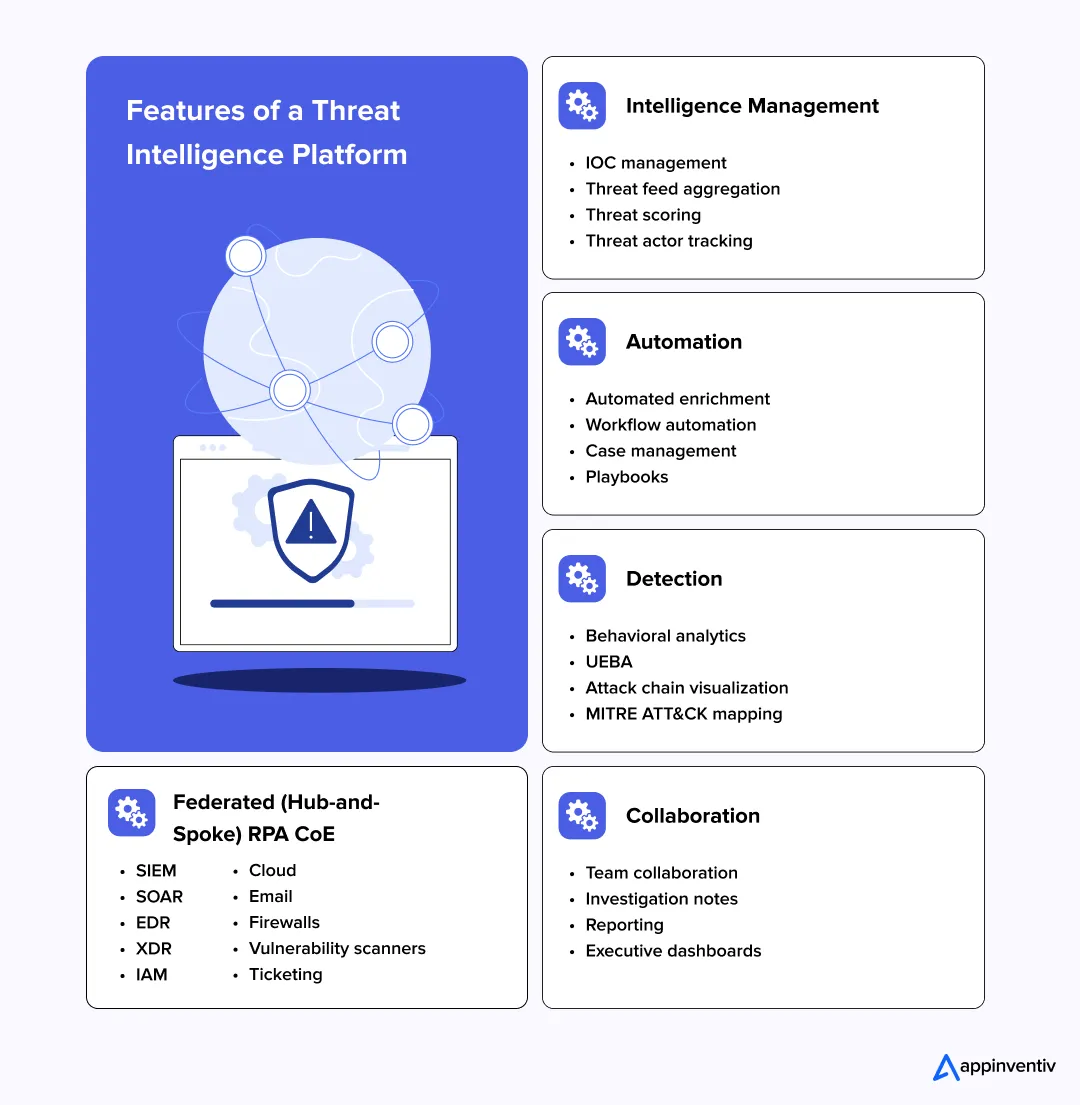
A modern threat intelligence solution must move well beyond simple feed aggregation. To drive genuine operational efficiency, the platform requires advanced functional modules. These core modules empower security teams to detect and neutralise threats with extreme precision.
Intelligence Management
Effective intelligence handling forms the bedrock of proactive security operations. The platform requires centralised tracking of IP addresses, hashes, and malicious URLs through comprehensive IOC management. Furthermore, threat feed aggregation ensures deduplication of overlapping data from multiple expensive subscription services. Customisable threat scoring ranks risks based on enterprise relevance, while threat actor tracking builds deep profiles of adversary groups, their motivations, and historic targeting patterns against the sector.
Automation
Manual intervention severely slows down incident response times, so robust automation features are non-negotiable to accelerate containment. Automated enrichment instantly queries external databases to add context to a new IP address before an analyst even opens the alert. Workflow automation intelligently routes specific types of complex alerts to designated specialist teams. Case management neatly groups related alerts into a single actionable incident file, and executable playbooks automatically respond to common, low-level threat scenarios without human prompting.
Detection
Proactive threat identification requires deep analytical capabilities that extend beyond basic rules. Behavioural analytics move beyond static signatures to identify highly unusual patterns of network activity. User and Entity Behavior Analytics (UEBA) tracks baseline user actions to spot compromised credentials or malicious insider threats. Attack chain visualisation provides graphical, step-by-step representations of how an attacker moved laterally through the environment, while MITRE ATT&CK mapping aligns detected tactics with the industry-standard framework to expose defensive gaps.
Collaboration and Reporting
Security incident response is a team discipline requiring perfectly clear communication channels. Team collaboration features provide secure chat and shared virtual workspaces directly within the platform. Investigation notes enable mandatory time-stamped auditing of analyst actions for post-incident review and legal compliance. Finally, executive dashboards deliver high-level metrics, cleanly translating deep technical risks into understandable business impacts for the board.
Integrations
An intelligence platform is practically useless if it cannot influence the tools doing the actual blocking. Essential integrations must include SIEM (Security Information and Event Management) for deep monitoring and SOAR (Security Orchestration, Automation and Response) for playbook execution. The system must also connect directly to EDR and XDR agents, Identity and Access Management (IAM) tools, cloud infrastructure logs, email security gateways, next-generation firewalls, vulnerability scanners, and corporate ticketing systems.
What Are the Benefits of Threat Intelligence Platform Development for Australian Enterprises in 2026?
Investing in custom platform engineering delivers highly quantifiable business value. Beyond merely detecting attacks, a tailored system drastically reduces incident response times, lowers operational costs, and provides board-level visibility into systemic risks.
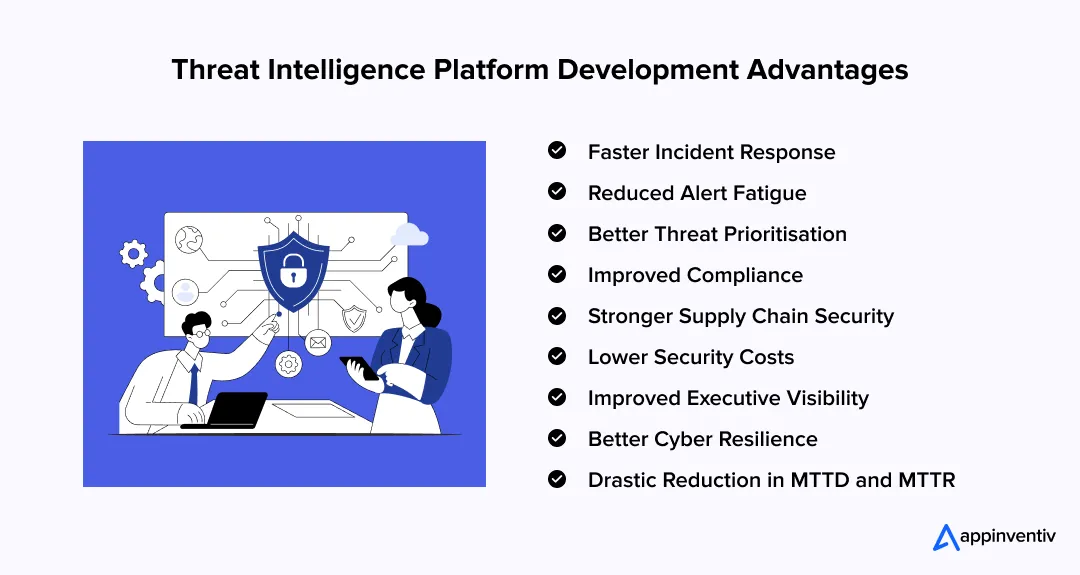
Faster Incident Response
Speed is the primary metric of measuring success during a cyber attack.
By providing analysts with pre-enriched data and automated containment options, the platform facilitates immediate action. Catching an adversary in the reconnaissance phase prevents data exfiltration, widespread operational downtime, and public brand damage.
Reduced Alert Fatigue
Security teams are frequently buried under thousands of low-level alerts generated by isolated perimeter tools.
The intelligence platform contextualises these alerts, grouping related events and discarding benign anomalies. This targeted focus prevents analyst burnout and ensures critical warnings are not missed in the daily noise.
Better Threat Prioritisation
Not all vulnerabilities pose the same level of risk to a business.
An intelligence platform maps external threat chatter against internal asset criticality. If a zero-day vulnerability exists on a segmented, internal test server, it receives a lower priority than a minor flaw on a public-facing customer database currently targeted by active exploit kits.
Improved Compliance
Meeting cybersecurity compliance requirements in Australia necessitates comprehensive, immutable audit trails.
A custom platform automatically logs every detection, investigation, and response action. This capability streamlines regulatory reporting obligations to bodies like APRA and the ACSC, significantly reducing the administrative burden on security leadership.
Stronger Supply Chain Security
Third-party risk is a growing concern for boards.
The TIP can monitor the digital footprint of critical vendors, alerting the business if a partner infrastructure shows signs of compromise. This early warning system allows organisations to sever API connections or isolate shared environments before a supply chain attack reaches the core network.
Lower Security Costs
Consolidating overlapping threat feeds and automating manual triage tasks reduces overall operational expenditure.
Instead of continuously expanding headcount to manage rising alert volumes, enterprises can scale their defensive capabilities through software efficiency and targeted intelligence.
Improved Executive Visibility
Translating technical security metrics into business risk remains a challenge for tech leaders.
A properly configured platform provides intuitive, high-level reporting that allows the C-suite to understand exactly which threat actors are targeting the business and how defensive investments are mitigating those specific risks.
Better Cyber Resilience
A mature intelligence capability shifts an organisation from a reactive posture to a proactive one.
By understanding the TTPs of likely attackers, security architects can reinforce defences before an attack occurs. This ensures the business remains operational even during sustained regional cyber campaigns.
Drastic Reduction in MTTD and MTTR
Mean Time to Detect (MTTD) and Mean Time to Respond (MTTR) are critical operational metrics.
Automated alert enrichment and playbook execution compress these timelines from days down to minutes, drastically reducing the window of opportunity for threat actors to establish persistence.
Appinventiv’s Case in Action
When developing a custom TIP for a mid-tier Australian financial institution, our engineering team reduced their MTTD from 48 hours to 15 minutes by correlating ASD feeds directly with their legacy SIEM.
How to Build a Cyber Threat Intelligence Platform: Step-by-Step Development Process
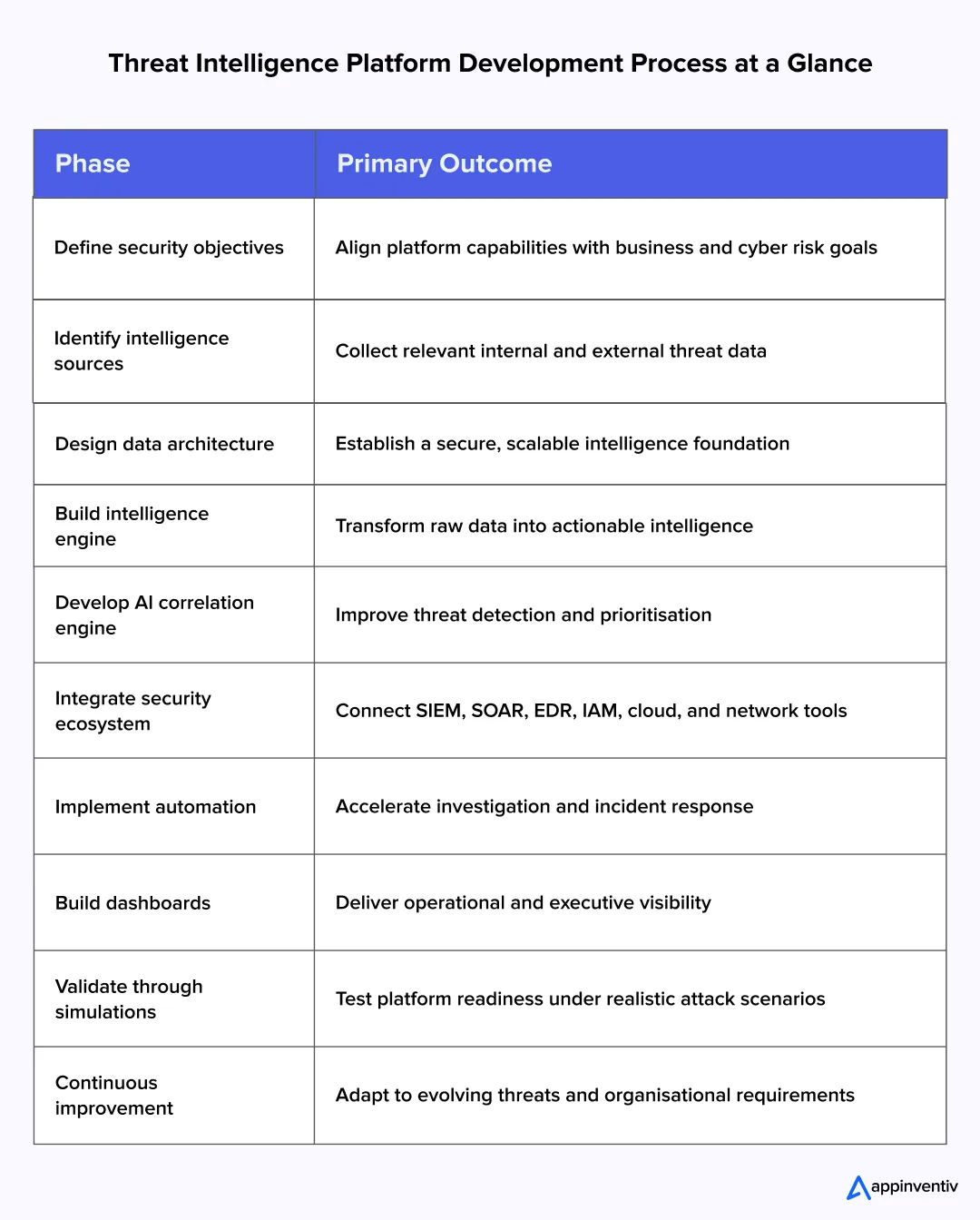
Sequencing determines whether the platform matches operational reality or becomes shelfware. A disciplined threat intelligence platform development process treats data architecture and integration planning as the foundation, not an afterthought bolted on after dashboards are built.
Organisations asking how to build a threat intelligence platform in Australia typically move through ten stages:
Step 1: Define Security Objectives
The first step is to figure out the business outcomes you want your TIP to achieve. These objectives should align with organisational risk appetite, industry regulations, and security maturity. Common objectives include:
- Improving threat visibility
- Reducing incident response time
- Supporting regulatory reporting
- Protecting critical assets
- Strengthening supply chain security
- Automating repetitive SOC tasks
Step 2: Identify Threat Intelligence Sources
The effectiveness of any platform depends on the quality and diversity of its intelligence sources. Here, the objective is to combine external intelligence with internal security data to create meaningful operational context. Typical sources include:
- Commercial threat intelligence feeds
- Open-source intelligence (OSINT)
- Australian Cyber Security Centre advisories
- Industry Information Sharing and Analysis Centres (ISACs)
- Dark web monitoring
- Internal security logs
- Cloud security telemetry
- Endpoint detection platforms
- Vulnerability databases
Step 3: Design the Data Architecture
A scalable architecture ensures intelligence flows efficiently across the platform while maintaining security and governance. Key architectural considerations include:
- Data ingestion pipelines
- Secure data storage
- Data normalisation
- Encryption at rest and in transit
- API management
- High availability
- Disaster recovery
- Australian data residency where required
This architectural foundation supports future growth without major redesigns.
Step 4: Develop the Intelligence Processing Engine
The processing engine converts raw security data into structured intelligence. At this stage, raw events begin transforming into actionable intelligence. Its responsibilities include:
- Parsing incoming data
- Removing duplicates
- Correlating indicators
- Mapping attack techniques
- Enriching intelligence with contextual information
- Maintaining threat repositories
Step 5: Build an AI-Based Correlation Engine
Artificial intelligence in Australian TIP enhances detection by identifying relationships that traditional rule-based systems often miss. AI capabilities may include:
- Behavioural analytics
- Threat clustering
- Predictive risk analysis
- Threat actor profiling
- IOC correlation
- Confidence scoring
- Automated anomaly detection
These capabilities help security teams prioritise genuine threats while reducing false positives.
Step 6: Integrate the Existing Security Ecosystem
The platform should become the intelligence layer connecting existing security investments rather than replacing them. Typical integrations include:
- SIEM
- SOAR
- EDR
- XDR
- Identity and Access Management (IAM)
- Firewalls
- Cloud security platforms
- Email security gateways
- Vulnerability management tools
- IT service management systems
Strong interoperability enables intelligence to move seamlessly across the security environment.
Step 7: Implement Security Automation
Automation improves operational efficiency by reducing manual investigation and response activities. Common automated workflows include:
- Threat enrichment
- IOC blocking
- Ticket generation
- Alert prioritisation
- Incident escalation
- Notification workflows
- Playbook execution
Step 8: Develop Executive and Operational Dashboards
Different stakeholders require different views of cyber risk. Dashboards should focus on business risk, operational metrics, and actionable intelligence rather than raw security data. The platform should provide dashboards tailored for:
- Security analysts
- SOC managers
- CISOs
- Compliance teams
- Executive leadership
- Board reporting
Step 9: Validate Through Threat Simulations
Before deployment, the platform should be tested under realistic attack scenarios. These exercises confirm that intelligence workflows operate as expected during real-world incidents. Validation activities include:
- Red team exercises
- Threat emulation
- Penetration testing
- Detection rule validation
- Incident response simulations
- Performance testing
- Integration testing
Step 10: Continuously Improve the Intelligence Platform
Threat intelligence is not a one-time implementation. It requires continuous improvement which ensures the platform remains effective as the threat landscape changes. The platform should evolve continuously by:
- Updating threat feeds
- Refining AI models
- Reviewing detection rules
- Incorporating analyst feedback
- Monitoring emerging attack techniques
- Optimising automation workflows
- Measuring operational performance
Best Practices for Building a Future-Ready Threat Intelligence Platform
Developing a future-ready platform requires balancing technology, governance, and operational efficiency. The following best practices help maximise the long-term value of threat intelligence platform development in Australia while reducing implementation risks.
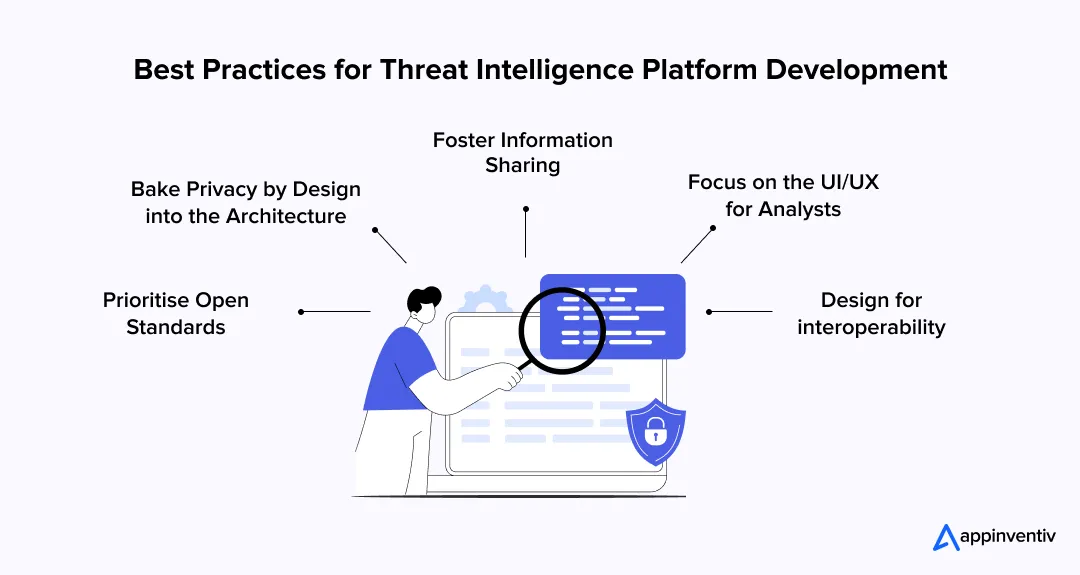
Prioritise Open Standards
Threat intelligence becomes significantly more valuable when it can be shared across multiple security technologies. Best practices include:
- Support STIX and TAXII standards for threat intelligence sharing.
- Use RESTful APIs for third-party integrations.
- Adopt MITRE ATT&CK for threat mapping.
- Design modular microservices that can evolve independently.
An open architecture improves interoperability and simplifies future integrations.
Bake Privacy by Design into the Architecture
Australian organisations must consider privacy, governance, and data residency from the earliest design stages rather than addressing them after deployment. Privacy-focused design should include:
- Role-based access controls
- End-to-end encryption
- Comprehensive audit logging
- Data minimisation practices
- Secure API authentication
- Data residency controls where required
- Automated data retention policies
Embedding these controls early helps support cybersecurity compliance requirements in Australia while reducing future remediation costs.
Foster Information Sharing
Threat intelligence delivers greater value when it extends beyond internal security operations. Organisations should establish controlled mechanisms to exchange intelligence with:
- Government agencies
- Industry Information Sharing and Analysis Centres (ISACs)
- Trusted commercial intelligence providers
- Supply chain partners
- Internal business units
Sharing timely intelligence strengthens both organisational resilience and broader industry preparedness.
Focus on the User Experience for Security Analysts
Even highly advanced platforms can become underutilised if analysts struggle to navigate complex interfaces. An effective platform should provide:
- Clear investigation workflows
- Customisable dashboards
- Context-rich alert views
- Intelligent search capabilities
- Minimal manual data entry
- Automated case creation
- Consistent reporting formats
Improving usability enables analysts to make faster, more informed decisions under pressure
Design for Interoperability
Threat intelligence platforms should strengthen existing cybersecurity investments rather than replacing them. You need to ensure seamless integration with:
- SIEM platforms
- SOAR solutions
- EDR and XDR tools
- Identity and Access Management (IAM)
- Cloud-native security services
- Email security gateways
- Vulnerability management platforms
- IT service management systems
Interoperability enables intelligence to move freely across the security ecosystem, reducing operational silos and duplicate investigations.
Future-Ready Threat Intelligence Platform Checklist
| Best Practice | Business Value |
|---|---|
| Use open standards (STIX/TAXII, APIs) | Simplifies integrations and avoids vendor lock-in |
| Build privacy into the architecture | Strengthens governance and supports Australian compliance expectations |
| Share trusted intelligence | Improves situational awareness across the organisation and industry |
| Optimise analyst experience | Reduces investigation time and improves productivity |
| Ensure interoperability | Maximises value from existing cybersecurity investments |
| Adopt modular architecture | Supports future expansion without major redevelopment |
| Continuously refine AI models | Improves detection accuracy as threats evolve |
How Much Does Threat Intelligence Platform Development Cost in Australia?
Capital allocation for custom threat intelligence platform development in Australia varies based on the complexity of integrations, data ingestion volumes, and required AI capabilities. On average, threat intelligence platform software development cost in Australia ranges from AUD 70,000 to over AUD 700,000.
To provide a clear perspective on the custom threat intelligence platform development cost in Australia, the following table outlines the estimated investment required across different scales of implementation.
| Platform Tier | Indicative Cost (AUD) | Typical Scope |
|---|---|---|
| Foundational | $70,000 – $300,000 | Single-source feeds, basic dashboard, one SIEM integration |
| Mid-Enterprise | $300,000 – $500,000 | Multi-feed correlation, SOAR automation, executive reporting |
| Enterprise-Grade | $500,000 – $700,000+ | Full stack integration, AI correlation engine, sovereign data architecture, continuous tuning |
Custom threat intelligence platform development cost in Australia also varies with how much legacy integration work is required, since connecting a platform to ageing SIEM or ticketing infrastructure often adds more effort than building the correlation engine itself.
Every threat intelligence platform is different. Receive a tailored cost estimate based on your integration requirements, AI capabilities, compliance needs, and business objectives.

Why Appinventiv Is Your Premier TIP Development Partner
Appinventiv, a trusted Cyber Security Services Company with 11+ years of APAC delivery experience, provides the specialised engineering depth required to build sovereign, high-performance security platforms for the local market. Our approach bridges the gap between complex regulatory mandates and technical execution. Our team of 1600+ tech experts designs custom ecosystems that integrate seamlessly with your existing infrastructure, ensuring robust protection and unwavering compliance.
Our Edge
Building a proactive defence mechanism requires more than standard software engineering. It demands an acute understanding of adversary behaviour and local regulatory frameworks. Effective threat intelligence in Australia relies heavily on context, and at Appinventiv, we engineer solutions that provide precisely that.
Our Track Record
We have successfully deployed more than 3000+ digital assets in Australia, driving a 90% client retention rate and transforming operations across 35+ industries. Operating from 5+ agile delivery centres across the country, we are deeply embedded in local market realities.
Customisation
We do not offer cookie-cutter templates. Our commitment to operational excellence is validated by our 99.50% security compliance SLA, adhering strictly to ISO 27001, ISO 9001, and SOC2 standards. Recognised among APAC’s High-Growth Companies by both Statista and the Financial Times for three consecutive years, we focus entirely on generating measurable business impact. Our enterprise clients routinely report up to 35% efficiency gains in their security operations following our strategic interventions.
If you are evaluating threat intelligence platform development in Australia to mature your security posture, reduce vendor risk, and ensure total data sovereignty, share your vision with us. Our cyber security experts are ready to architect a secure and scalable solution tailored to your operational realities.
FAQs
Q. What is a threat intelligence platform?
A. A Threat Intelligence Platform is an enterprise security system that aggregates, normalises, and analyses data from various internal and external sources. It provides actionable context regarding potential cyber threats, allowing security teams to automate responses and prioritise critical risks efficiently.
Q. How to build a threat intelligence platform in Australia?
A. To build a threat intelligence platform in Australia, organisations must define their specific security objectives, select relevant regional and global threat feeds, and design a scalable data architecture. The development process involves integrating AI correlation engines, ensuring seamless API connections with existing security tools, and maintaining strict alignment with data sovereignty and compliance mandates.
Q. How long does it take to develop a custom threat intelligence platform?
A. The timeline for custom threat intelligence platform software development generally ranges from 4 to 12+ months. This duration accounts for initial architecture design, complex data integrations, machine learning model training, and rigorous security testing before production deployment.
Q. How do threat intelligence platforms integrate with SIEM, SOAR, and EDR?
A. These platforms integrate via secure APIs. The TIP acts as the analytical brain, pushing high-fidelity threat indicators into the SIEM for monitoring, instructing the SOAR to execute automated containment playbooks, and updating the EDR with new malicious file hashes to block endpoint execution.
Q. How is AI used in threat intelligence platform development?
A. AI is fundamental to modern threat intelligence platform development in Australia. Machine learning models automate the triage of massive data sets, identifying subtle behavioural anomalies and reducing false positives. AI enables predictive analytics, forecasting potential attack vectors based on historical adversary patterns.
Q. What is the ROI of implementing a threat intelligence platform?
A. The ROI typically shows up as reduced MTTD and MTTR, lower incident response costs, fewer escalations requiring external forensic support, and defensible compliance evidence that reduces regulatory exposure.
Q. What are the primary threat intelligence platform use cases?
A. The primary threat intelligence platform use cases include automated incident response, proactive threat hunting, vulnerability prioritisation, and executive risk reporting. These use cases allow security teams to operate strategically rather than constantly reacting to low-level alerts.


Fast 2-minute response, fully NDA-protected.

Ecommerce Security: A Guide to Protecting Your Commerce Stack From Modern Cyber Threats
Key takeaways: Modern commerce stacks expand attack surfaces across APIs, cloud systems, third parties, payments, and customer identities. PCI DSS 4.0.1 compliance mandates strict client-side monitoring to prevent modern web-skimming and Magecart attacks. Strong ecommerce cyber security requires layered controls across architecture, identity, data, transactions, infrastructure, and integrations. Continuous testing, threat monitoring, AI-aware controls, and…
How to Hire the Right Cybersecurity Expert for Your Business
Key Takeaways Define the business risk before choosing a security title or engagement model. Match the role to the environment, whether the priority is cloud, application, compliance, incident response, or network defense. Evaluate cybersecurity professionals through relevant scenarios, practical tasks, evidence, and references. Compare permanent, consulting, managed, and hybrid models against the coverage the business…

How to Prevent Social Engineering Attacks in the Enterprise: Types, Examples, and Defense Strategies
Key takeaways: Social engineering attacks exploit human trust, making even well-secured enterprises vulnerable to a single convincing interaction. AI is making phishing, vishing, and impersonation attacks faster to launch, harder to detect, and easier to scale. Strong verification processes are essential, especially for credential resets, financial requests, and other high-risk actions. Phishing-resistant authentication, least-privilege access,…