




































How to Achieve DORA Compliance in the UK: Key Requirements, Challenges, and Best Practices

 Share -



- 01The UK vs. EU Landscape: Navigating Dual Frameworks
- 02The 5 Core Pillars of DORA: Key Requirements for UK Firms
- 03How to Achieve DORA Compliance in the UK: A Step-by-Step Framework
- 04Major DORA Compliance Challenges Facing UK Organisations and Their Solutions
- 05Best Practices for Building a Sustainable DORA Compliance Program
- 06Measuring ROI from DORA Compliance Investments
- 07How Appinventiv Can Help Financial Organisations Build DORA-Ready Digital Operations?
- 08FAQs

Key takeaways:
- DORA applies to UK firms with EU operations, EU-regulated clients, or roles in critical ICT supply chains, regardless of Brexit status.
- The most efficient path to compliance maps existing FCA/PRA resilience programmes to DORA’s requirements, creating a unified evidence base across frameworks.
- Third-party risk management is the most significant gap for most UK institutions, with only 14% operating continuous vendor risk monitoring programmes.
- Incident reporting timelines of four hours demand automated detection, pre-built classification logic, and documented escalation procedures, not manual processes.
- Firms that treat DORA as an operational resilience investment rather than a compliance exercise achieve measurable reductions in incident frequency, downtime, and vendor-related exposure.
The Digital Operational Resilience Act became fully applicable across the EU on 17 January 2025. It established a unified operational resilience framework for financial institutions and their critical technology vendors. While this is an EU regulation, it carries massive implications for UK-based banks, insurers, payment providers, and investment firms. If your organisation operates within the EU or provides services to EU-regulated entities, you must adhere to these rigorous standards.
For many enterprise leaders, DORA compliance in the UK signals a structural shift from passive cybersecurity checklists towards verifiable operational resilience. The challenge for UK organisations is compounded by the fact that DORA does not operate in isolation. FCA and PRA operational resilience requirements under PS21/3, NIS2 obligations and emerging AI Implementation expectations for governance – all converge at roughly the same point. Managing these in parallel, without a coherent cross-framework strategy, drives compliance costs upward and delivery timelines out.
This means you must now mathematically prove your architecture can prevent, withstand, respond to, and recover from severe information and communication technology disruptions.
This blog covers the regulatory landscape UK firms are actually navigating, breaks down the five DORA pillars in practical terms, and provides a structured implementation pathway. For organisations evaluating DORA compliance in the UK for the first time, the goal is not to recount what the regulation says, but to help decision-makers understand what it costs, where it breaks existing operating models, and how to close the gap efficiently.
Evaluate your ICT governance, third-party dependencies, and operational resilience posture before compliance gaps become business risks.

The UK vs. EU Landscape: Navigating Dual Frameworks
The UK regime is outcome led. Under PS21/3 and the PRA’s SS1/21, firms had to identify important business services, set impact tolerances, and prove they could stay within them. DORA is more granular. It prescribes specific ICT controls, incident classifications, testing regimes and contractual terms.
For UK leadership, the upside of doing this well is not only avoiding penalties. A clean mapping gives the board one view of operational risk across borders, lowers the cost of every future audit, and makes the firm easier to deal with for EU counterparties who now ask pointed questions about resilience before they sign.
That difference shapes strategy. The UK regime asks whether a service can keep running through severe but plausible disruption. The Digital Operational Resilience Act compliance in the UK conversation adds a second question: can you evidence the controls, registers and tests that sit underneath that answer? Firms that treat these as one exercise, rather than two, avoid building parallel governance.
A practical starting point is a single mapping table that links each UK requirement to its DORA equivalent, then flags the gaps. That mapping becomes the backbone of a DORA compliance checklist that both sets of regulators recognise. It also highlights where the DORA regulation introduces genuinely new obligations for UK banks, particularly around third-party registers and threat-led testing.
| Dimension | UK FCA/PRA regime | DORA |
|---|---|---|
| Core unit | Important business services | ICT systems supporting critical or important functions |
| Emphasis | Impact tolerances and outcomes | Prescriptive ICT controls and evidence |
| Testing | Scenario testing | Threat-led penetration testing (TLPT) |
| Third parties | Outsourcing oversight (SS2/21) | Register of Information, mandatory contract clauses |
| Key date | Full compliance by 31 March 2025 | Applicable from 17 January 2025 |
The practical change for most firms sits in two places.
- The first is the Register of Information, which must capture every ICT contract supporting a critical or important function, including the subcontractors behind the named supplier.
- The second is testing depth. Where the UK regime accepted scenario analysis, DORA expects firms to prove recovery under realistic attack conditions.
Neither is conceptually new to a mature risk function, but both demand cleaner data and closer supplier cooperation than many firms hold today.
The 5 Core Pillars of DORA: Key Requirements for UK Firms
DORA’s obligations resolve into five linked areas. Treating them as a connected operating model, rather than five separate compliance projects, is what separates firms that pass audit from those that scramble before it. Across these five channels, the DORA regulation that UK firms must satisfy is detailed but not unfamiliar. Most institutions already hold parts of each.
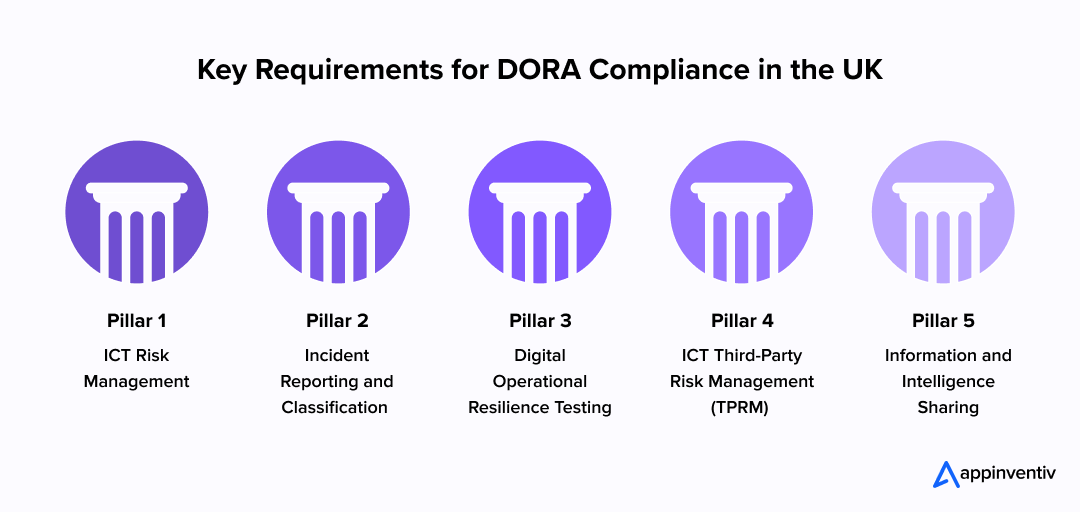
ICT Risk Management
This goes beyond static policy. It calls for a continuous inventory of ICT assets, mapped dependencies, and a move towards zero trust. Meeting the DORA ICT risk management requirements means knowing, at any moment, what you run and what it depends on. In practice, that means an asset register that updates itself, dependency maps showing how a payment flow actually crosses systems, and access controls that assume breach rather than trust the perimeter.
Incident Reporting and Classification
Firms need automated detection, predefined severity thresholds, and reporting workflows that can reach regulators inside tight windows. Manual triage rarely keeps pace. The harder part is classification: deciding in minutes whether an incident is major, and to which authority it must be reported, needs rules agreed in advance and rehearsed, not argued over mid-crisis.
Digital Operational Resilience Testing
Annual penetration tests are no longer enough. DORA expects threat-led penetration testing, which UK firms can align with existing CBEST or TIBER-EU engagements rather than commissioning separate exercises. Firms with a CBEST history can often extend that work instead of funding a parallel programme, provided the scope widens to the systems DORA cares about.
ICT Third-Party Risk Management (TPRM)
DORA third-party risk management centres on a Register of Information covering every ICT contract, resilience clauses written into agreements, and exit plans that have been tested, not just drafted. Nth-party concentration is a specific concern, since a subcontractor failure can surface as your outage. Exit plans deserve particular attention. A plan that has never been tested is an assumption, and regulators increasingly want evidence that a firm could move off a critical provider without halting a service.
Information and Intelligence sharing
Firms are encouraged to join threat intelligence communities and sector ISACs so defensive insight moves faster than the threats do. This pillar is lighter on prescription, but firms that take part tend to spot emerging threats earlier and shape testing around real attacker behaviour.
How to Achieve DORA Compliance in the UK: A Step-by-Step Framework
Knowing the regulations is only the baseline. You need concrete steps to implement DORA compliance successfully across complex, legacy-heavy enterprise environments.
The seven steps below move from assessment to continuous monitoring, building governance and asset visibility first so that testing, third party reform and reporting rest on something stable rather than on assumptions.
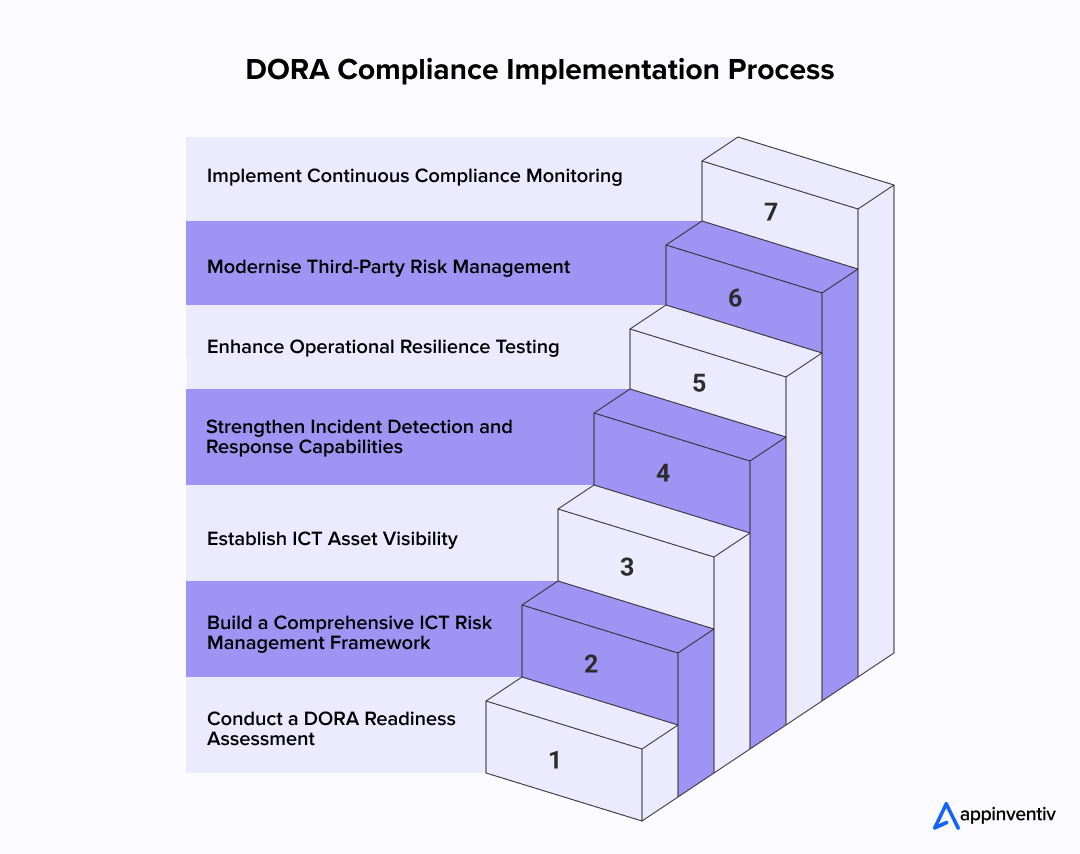
Step 1: DORA Readiness Assessment
Before committing to a build programme, conduct a structured gap analysis against all five pillars. This should include a current-state maturity evaluation mapped to DORA’s regulatory technical standards, risk prioritisation based on likelihood of enforcement exposure, and a realistic estimate of cost and timeline. This assessment becomes the business case for board-level investment approval.
Step 2: Governance and ICT Risk Framework
Establish a DORA governance structure with clear ownership at the board and executive level. This includes formalised policies for ICT risk, incident response, and third-party management, with accountability assigned to named individuals. Regulators will look for evidence of board engagement, not just IT team activity. The governance framework must also define how DORA obligations interact with existing FCA/PRA reporting structures.
Step 3: ICT Asset Visibility
Map every ICT asset across infrastructure, applications, cloud services, APIs, and third-party dependencies. Shadow IT discovery is essential here. Any asset not in the register is an unmanaged risk, and DORA audits will look for completeness. Automated asset discovery tooling is typically required at scale, particularly in firms with complex multi-cloud or acquired-technology environments.
Step 4: Incident Detection and Response
Build automated incident detection pipelines with predefined severity thresholds aligned to DORA classification requirements. Establish escalation procedures that can trigger a regulator-facing incident report within the required four-hour window. Security Operations Centre capability, whether in-house or managed, must be calibrated to DORA’s detection and reporting expectations, not just general cyber best practice.
Step 5: Resilience Testing Programme
Move from annual pen testing to a continuous testing model. For firms in scope for TLPT, engage qualified testing providers and ensure production environment testing is contractually and operationally feasible. Recovery validation exercises, not just attack simulations, must demonstrate that RTO and RCO objectives are achievable under realistic stress conditions.
Step 6: Third-Party Risk Programme Modernisation
Conduct a full vendor inventory and criticality assessment. Review all ICT contracts against DORA’s mandatory clause requirements. Implement ongoing monitoring for critical and important third parties, including sub-contractor visibility where feasible. Build exit strategy documentation for each critical dependency and test it.
Step 7: Continuous Compliance Monitoring
DORA compliance is not a state that is achieved and maintained passively. Build a metrics and KPI framework that provides ongoing evidence of control effectiveness, incident trends, and vendor risk posture. Executive-level reporting should translate technical compliance data into board-digestible risk intelligence, supporting both regulatory evidence collection and strategic decision-making.
Share your project vision with us to scope your DORA readiness programme.

Major DORA Compliance Challenges Facing UK Organisations and Their Solutions
The pattern across UK firms is consistent. The hard parts are not the controls themselves but the conditions around them: data that is incomplete, suppliers that resist scrutiny, and budgets approved for visible projects rather than quiet resilience work. Naming these factors affecting DORA compliance readiness early changes how a programme is scoped and funded.
Limited ICT Asset Visibility
Many firms still lack a single, current inventory. Continuous discovery tooling and a maintained configuration database close the gap faster than periodic manual audits.
Third-Party and Fourth-Party Risk Complexity
Risk rarely stops at the direct supplier. Mapping subcontractors and tracking concentration inside the Register of Information is now essential, not optional.
Legacy Infrastructure and Technical Debt
Older core systems were not built for continuous monitoring or rapid recovery. The trap is treating every old system as a rewrite candidate. Wrapping a stable core with monitoring and resilient interfaces often delivers more, sooner, for less.
Incident Reporting Readiness
Tight regulatory windows expose slow, manual processes. Automated classification and pre-approved templates make the timelines achievable.
Compliance Fatigue Across Multiple Regulations
Only 57% of UK financial institutions were ready to meet the DORA compliance deadline as of January 2025. A significant factor is the resource burden of managing DORA alongside NIS2, FCA/PRA expectations, and emerging AI governance obligations. The practical solution is a unified compliance architecture, where a single evidence base satisfies multiple frameworks, reducing duplication and compliance fatigue across technology and risk teams.
The cost of getting this wrong is not abstract. When a faulty CrowdStrike update took 8.5 million Windows devices offline on 19 July 2024, Parametrix estimated banking-sector losses among Fortune 500 firms at around $1.15 billion. A single supplier fault, felt across an entire sector, is precisely the concentration risk that the UK’s critical third party regime and DORA both target.
Best Practices for Building a Sustainable DORA Compliance Program
Firms achieving the strongest outcomes are not treating DORA as a discrete compliance project. They are using it as the catalyst for a broader operational resilience transformation, one that reduces risk, improves vendor governance, and creates measurable business continuity value beyond the regulatory requirement.
- Tie compliance to business resilience goals, not just regulatory sign-off.
- Treat DORA as a board level initiative with a named accountable owner.
- Replace annual audits with continuous monitoring.
- Embed security into the SDLC through DevSecOps, so controls ship with the code.
- Maintain a single source of truth for ICT assets.
- Define resilience metrics and KPIs that the board actually reviews.
- Fold third party risk into enterprise risk management.
- Run executive level resilience exercises, not just technical drills.
As industry bodies have warned, localised outages can lead to contagion to other institutions, which is why these practices focus on the whole chain, not one firm in isolation. The common thread is ownership. A programme with a named board sponsor, a funded roadmap, and metrics that reach the risk committee tends to hold its shape long after the launch energy fades.
Measuring ROI from DORA Compliance Investments
DORA compliance also delivers a return beyond the avoidance of regulatory penalty. Quantifying both sides of that equation is essential for securing sustained investment and for demonstrating the programme’s value to boards and shareholders.
Business Benefits Beyond Regulatory Compliance
Reduced operational downtime and faster incident recovery translate directly into service availability improvements that matter to customers and counterparties. Stronger vendor governance reduces concentration risk and supply chain exposure. Improved audit readiness shortens regulatory review cycles. Firms that invest in continuous monitoring typically see measurable reductions in the frequency and business impact of ICT incidents, not just better compliance scores.
Penalties under DORA reach up to 2% of global annual turnover for financial entities and 1% of average daily worldwide turnover per day for critical ICT providers. The commercial case for proactive investment is straightforward.
DORA Compliance KPIs
| KPI Category | Example Metrics |
|---|---|
| Resilience | Recovery time objective (RTO), system availability % |
| Security | Mean time to detect (MTTD), mean time to respond (MTTR) |
| Vendors | Third-party risk scores, critical supplier audit pass rate |
| Compliance | Audit findings resolved, control effectiveness rating |
| Operations | Incident frequency, business impact severity, downtime cost |
How Appinventiv Can Help Financial Organisations Build DORA-Ready Digital Operations?
As an experienced FinTech software development company in the UK, we partner with financial firms, and C-suite executives to build DORA governance frameworks, modernise ICT risk management infrastructure, and implement third-party risk programmes that satisfy regulatory requirements without creating operational overhead.
Our software development services in the UK cover the full compliance engineering lifecycle: readiness assessment, gap remediation, resilience testing capability, and continuous monitoring architecture.
With ISO 27001, ISO 9001, and SOC2 certifications and a 99.5% security compliance SLA, we bring the governance standards that regulated clients require.
Across 3000+ digital assets delivered globally, our delivery model is built for UK enterprise decision-makers who need execution depth, not advisory frameworks. Whether the requirement is legacy modernisation, ICT asset architecture, or a full DORA compliance strategy implementation, we structure engagements around measurable outcomes and defined delivery accountability.
Ready to close your gap of DORA compliance in the UK? Speak with Appinventiv’s UK enterprise team about a structured readiness assessment.
FAQs
Q. How long does DORA compliance implementation take?
A. The implementation timelines for DORA compliance vary significantly by organisation size, ICT complexity, and existing compliance maturity. Firms with strong FCA/PRA operational resilience foundations and mature vendor management programmes may achieve substantive compliance within 4 to 12 months or more. Institutions with significant ICT debt, fragmented asset visibility, or limited third-party governance programmes should plan for 12 to 24 months, with phased delivery across the five pillars.
Q. How can a technology partner help achieve DORA compliance?
A. A qualified technology partner supports DORA compliance through readiness assessment and gap analysis, governance framework design, ICT asset discovery and management architecture, security operations and incident response capability, resilience testing programme delivery, and third-party risk management platform implementation. The value is in the combination of regulatory knowledge, technical execution capability, and the ability to maintain delivery momentum across a complex multi-workstream programme.
Q. What technologies help UK firms meet DORA requirements?
A. There is no single DORA platform. Firms typically combine asset discovery and configuration management tooling, SIEM and SOAR for detection and response, GRC systems for the Register of Information and control mapping, and threat-led testing services. Achieving DORA compliance in the UK depends less on any one product and more on how these are integrated and governed.
Q. Who needs to comply with DORA?
A. The regulation applies to over 22,000 financial entities operating within the European Union, including banks, insurance companies, payment service providers, investment firms, and crypto-asset service providers. Crucially for international markets, the mandate extends directly to Information and Communication Technology (ICT) third-party service providers that support these EU entities.
If your firm provides critical software, cloud computing, data analytics, or network infrastructure to an EU financial institution, even if your business is headquartered entirely within the UK or overseas, you fall squarely under the regulatory scope and must prove your operational resilience to European Supervisory Authorities.


Fast 2-minute response, fully NDA-protected.

Ecommerce Security: A Guide to Protecting Your Commerce Stack From Modern Cyber Threats
Key takeaways: Modern commerce stacks expand attack surfaces across APIs, cloud systems, third parties, payments, and customer identities. PCI DSS 4.0.1 compliance mandates strict client-side monitoring to prevent modern web-skimming and Magecart attacks. Strong ecommerce cyber security requires layered controls across architecture, identity, data, transactions, infrastructure, and integrations. Continuous testing, threat monitoring, AI-aware controls, and…

How to Hire the Right Cybersecurity Expert for Your Business
Key Takeaways Define the business risk before choosing a security title or engagement model. Match the role to the environment, whether the priority is cloud, application, compliance, incident response, or network defense. Evaluate cybersecurity professionals through relevant scenarios, practical tasks, evidence, and references. Compare permanent, consulting, managed, and hybrid models against the coverage the business…

How to Prevent Social Engineering Attacks in the Enterprise: Types, Examples, and Defense Strategies
Key takeaways: Social engineering attacks exploit human trust, making even well-secured enterprises vulnerable to a single convincing interaction. AI is making phishing, vishing, and impersonation attacks faster to launch, harder to detect, and easier to scale. Strong verification processes are essential, especially for credential resets, financial requests, and other high-risk actions. Phishing-resistant authentication, least-privilege access,…














