



























How to Hire Software Developers in 2026: An Enterprise Roadmap for Talent, Risk, and Scalable Delivery

 Share -


- 01Step 1: Define Business-Critical Outcomes (Not Roles)
- 02Step 2: Architect Your Talent Strategy Model
- 03Step 3: Define Technical Competency Framework
- 04Step 4: Evaluate Global Talent Markets Strategically
- 05Step 5: Establish a Multi-Layered Hiring Process
- 06Step 6: Validate Engineering Maturity Before Hiring
- 07Step 7: Build Governance, SLAs, and Delivery Controls
- 08Step 8: Onboarding and Integration at Scale
- 09Why Enterprises Invest in Software Developers
- 10Red Flags to Avoid While Hiring Software Developers
- 11Build vs Buy vs Partner: What Should Enterprises Choose?
- 12How Can Appinventiv Support End-to-End Engineering Beyond Hiring Developers?
- 13Frequently Asked Questions

Key Takeaways
- Start with business goals, not roles. Define what the system must achieve before deciding who to hire.
- Choose the right hiring mix. Combine in-house teams, partners, and vendors based on speed, control, and system needs.
- Hire for system thinking. Focus on design, scalability, and real-world problem-solving, not just on tools or languages.
- Set clear processes and controls. Use structured hiring, governance, and metrics to maintain stable, predictable delivery.
- Plan integration early. Strong onboarding, ownership, and alignment turn new hires into productive contributors faster.
Hiring software developers in 2026 feels very different from even two years ago. It is no longer just about filling open roles. Each hiring decision now shapes how systems scale, how fast teams ship, and how much risk the business carries.
The shift is already visible in how software gets built. Around 40% of enterprise applications are expected to include AI agents by the end of 2026, up from less than 5% last year.
At the same time, AI-driven development is pushing 30% to 35% productivity gains across the software lifecycle. Teams are smaller, faster, and more dependent on system design than ever before.
Work no longer sits in one office. It spreads across regions, vendors, and time zones. Regulations such as GDPR, PDPL, HIPAA, and SOC 2 now sit close to the development process, not outside it. Engineering teams are expected to ship fast, keep systems stable, and track performance in real time.
Many enterprises still follow old hiring habits. They post roles, screen candidates, and hope strong engineers will fix delivery gaps. That rarely works. Misaligned hires slow teams down. They create rework and push costs up over time.
The real challenge is not access to talent. It is hiring in a way that fits your architecture, your delivery model, and your governance needs.
This guide breaks that down step by step. It explains how to plan hiring, how to evaluate engineers, and where most enterprises get it wrong.
Your hiring model is already behind if it is not built for AI-driven systems and scalable engineering delivery.

Step 1: Define Business-Critical Outcomes (Not Roles)
Start with what the business needs to achieve. Do not start with job titles.
Many enterprises still open roles like “Senior Backend Developer” or “React Engineer.” That creates activity, not results. Every decision to hire software developers must link to measurable business outcomes. Each role should exist for a clear reason tied to growth, cost, or system performance.
What Should Hiring Decisions Map To?
Each hiring plan should connect to one or more outcomes:
- Revenue growth through faster feature releases
- Cost control by reducing rework and manual effort
- Platform stability under peak load
- Faster release cycles across teams
A simple check helps here. If a role cannot be tied to a metric, pause the hiring decision.
Enterprises still hire across common roles:
- Frontend developers (UI and experience layers)
- Backend developers (APIs and business logic)
- Full-stack engineers (end-to-end delivery)
- DevOps and SRE (infrastructure and reliability)
- Data engineers (pipelines and analytics systems)
These roles only work when mapped to system-level outcomes
Also Read: How to Hire Data Engineer Teams for Enterprise Success
Distinguish The Type Of Engineering Work
Not all engineering needs are the same. Understanding the difference between a developer vs engineer helps avoid role confusion and hiring delays.
| Engineering Type | Focus Area | Typical Hiring Need |
|---|---|---|
| Product Engineering | Customer-facing features | Frontend, backend, mobile engineers |
| Platform Engineering | Internal systems and infrastructure | DevOps, SRE, cloud engineers |
| Transformation Programs | Legacy system upgrades | Integration, data and architecture roles |
Each category needs a different skill set and hiring pace.
Example: Role vs Outcome Mismatch
Hiring backend engineers sounds correct on paper. The real need may be different.
Business goal: Real-time payment processing
Actual requirement:
- Event-driven architecture (Kafka, RabbitMQ)
- Low-latency APIs (sub-200 ms response time)
- Fault tolerance and retry mechanisms
In this case, system design skills matter more than basic backend coding.
Outcome-To-Capability Mapping Framework
Translate business goals into technical capabilities before hiring.
- Define the outcome (example: reduce checkout failure rate by 30%)
- Identify system gaps (latency, error handling, scaling limits)
- Map required capabilities (distributed systems, API design, monitoring)
- Hire for those capabilities, not generic roles
This step sets the foundation. If done right, every hire contributes to a clear business result.
Also Read: Embedded Software Development: A Comprehensive Guide
Step 2: Architect Your Talent Strategy Model
Large enterprises rarely succeed with a single hiring model. They build a mix that fits delivery needs, risk tolerance, and system complexity.
Why One Model Is Not Enough
Each hiring model solves a different problem. Relying on one creates gaps in speed, control, or knowledge continuity.
Common Talent Hiring Models
Each model has a clear use case and a clear trade-off.
| Model | Best Use Case | Strength | Risk |
|---|---|---|---|
| In-house teams | Core systems, proprietary IP | High control, deep system knowledge | Slow hiring, high fixed cost |
| Staff augmentation | Short-term workload spikes | Quick ramp-up | Context loss, dependency on individuals |
| Dedicated development team | Long-term product or platform builds | Stable delivery, aligned goals | Vendor reliance over time |
| Full outsourcing | Non-core systems, cost-driven projects | Lower cost, external expertise | Limited control, knowledge silos |
What Changed In 2026
Enterprises now run systems that span cloud platforms, APIs, and multiple services. A single team cannot manage all layers. Around 72% of organizations now rely on software development outsourcing to access talent and improve delivery speed. This has pushed companies toward hybrid models.
Hybrid Talent Architecture As The Default
Most high-performing enterprises now combine models:
- Core architecture and critical services stay in-house
- Feature development and software product development use a dedicated external team or a software developer for hire.
- Short-term gaps are filled through staff augmentation
- Commodity work moves to outsourcing partners
This structure allows teams to scale without losing control over key systems.
When you hire dedicated developers, they work well for:
- Long-term product development
- Stable delivery cycles
- Clear ownership of systems
Key Decision Factors
Choose the mix based on real constraints, not preference:
- IP sensitivity: Keep critical algorithms, data pipelines, and core services in-house
- Speed vs control: External teams increase speed but reduce direct oversight
- Cost vs long-term value: Lower hourly cost can lead to higher rework and maintenance costs
What Enterprises Are Doing Differently
Enterprises no longer think in terms of “team size.” They design engineering ecosystems.
- Multiple vendors contribute to the same system
- Internal teams focus on architecture and governance
- External teams execute within defined boundaries
This shift changes hiring from a headcount exercise to a system design decision.
Step 3: Define Technical Competency Framework
Set clear technical standards before you start hiring. Tool names alone do not predict delivery quality.
Why Language-Based Hiring Breaks At Scale
A resume filled with Java or Python says little about how someone designs systems. Enterprise systems fail at the edges. They fail under load, during partial outages, or when data contracts break.
Around 45% of teams report concerns about AI-generated code reliability, and 44% struggle to integrate AI into development workflows. Tool knowledge alone does not solve these problems.
What To Evaluate Instead
Focus on how engineers think, design, and recover from failure.
| Capability | What to Check | Practical Signal |
|---|---|---|
| System design | Can they design for scale and failure? | Uses caching, queues and load balancing |
| Cloud-native engineering | Do they build for distributed environments? | Works with Kubernetes, containers and IaC |
| Security-first development | Do they protect data and services by default? | Applies OWASP Top 10, handles auth flows |
| Observability | Can they detect and debug issues in production? | Uses logs, metrics, tracing tools |
Test With Real System Problems
Skip abstract puzzles. Use scenarios that reflect your production setup.
- Design a service that handles 500K requests per hour
- Model an event pipeline using Kafka or similar queues
- Show how retries and idempotency work during failure
- Define acceptable latency and error rates
These exercises expose gaps fast.
Domain Context Reduces Ramp Time
Engineers who know the domain ask better questions from day one.
- Fintech: settlement flows, reconciliation, fraud patterns
- Healthcare: patient records, audit trails, access control
- Retail: inventory sync, pricing rules, peak traffic handling
This cuts onboarding time and lowers error rates.
T-Shaped Engineers As The Baseline
Specialists who only code in one layer struggle in modern systems.
- Deep skill in one area, such as backend or data
- Working knowledge of APIs, cloud services, and security basics
- Ability to see how one service affects another
Build A Shared Competency Matrix
Create a simple scoring system across teams.
- Core: coding, system design, debugging
- Platform: cloud, CI/CD pipelines, infrastructure
- Reliability: monitoring, alerts and incident handling
- Security: authentication, encryption, access control
Key skills to prioritize:
- System design under load
- Cloud-native architecture (Kubernetes, containers)
- Secure coding practices
- Observability and debugging
- Domain-specific knowledge
This keeps hiring consistent across regions and vendors.
Step 4: Evaluate Global Talent Markets Strategically
When you bring a software developer for hire on board, location affects delivery speed, cost, and system ownership. Treat geography as part of system design, not a hiring afterthought.
Compare Major Talent Markets
Each region brings a different mix of skills, cost, and regulatory context.
| Region | Strengths | Watchpoints |
|---|---|---|
| US | Strong system design, deep cloud and AI expertise | High cost, intense competition for senior talent |
| AUS | Mature engineering practices, strong governance culture | Smaller talent pool, higher hiring cost |
| ME | Growing tech hubs, strong enterprise demand | Skill gaps in deep system design roles |
| EUROPE | Strong backend and distributed systems expertise | Fragmented markets, varying labor regulations |
Regional Hourly Rate Comparison
Typical hourly rates vary by region and reflect talent maturity, demand, and cost structures.
| Region | Average Hourly Rate (USD) |
|---|---|
| US | $100 – $180 |
| AUS | $90 – $150 |
| ME | $60 – $120 |
| EUROPE | $70 – $140 |
How To Evaluate A Region
Use consistent criteria across all regions.
- Talent density and specialization: Check the availability of engineers skilled in microservices, distributed systems, and data platforms
- Cost vs productivity: Measure output, not hourly rate, track delivery metrics like deployment frequency and defect rates
- Time zone overlap: Plan for daily coordination, release windows, and incident response
- Regulatory alignment: Review local data laws and cross-border transfer rules, check readiness for GDPR, PDPL, HIPAA, and SOC 2 requirements
What Has Changed In Recent Years
Enterprises that hire remote software developers no longer pick a region based on cost alone. Complex systems need stable and well-coordinated teams.
Work now spreads across regions:
- Core architecture often stays in high-expertise regions like the US or parts of Europe
- Delivery teams operate across ME and AUS for regional coverage
- Support and monitoring follow continuous coverage models
Build For Resilience, Not Just Cost
Relying on a single offshore software development team or one region increases risk during outages, hiring slowdowns, or policy shifts.
A stronger setup includes:
- Multiple regions for critical workloads
- Clear ownership across teams and services
- Shared engineering standards for code, security, and deployment
Global hiring now supports continuity and system stability. Cost still matters, but it no longer drives the decision alone.
Step 5: Establish a Multi-Layered Hiring Process
Simple interviews do not reveal how engineers perform in real systems. Enterprise hiring needs multiple layers that test design, execution, and risk awareness.
Why Single-Round Interviews Fall Short
For any software developer for hire, a coding test or resume review shows only a small part of their capabilities. Production systems fail under load, during outages, or when teams miscommunicate. Hiring must test for those conditions.
Layered Evaluation Model
Each stage should capture a different signal.
| Stage | What to Test | Tools or Methods |
|---|---|---|
| AI-assisted screening | Baseline coding and problem-solving | Automated code tests, Git-based tasks |
| System design interviews | Architecture thinking and trade-offs | Whiteboard design, case-based discussions |
| Pair programming | Real-time coding and debugging | Live coding sessions, repo-based tasks |
| Collaboration assessment | Communication and teamwork | Scenario discussions, async tasks |
| Security and compliance check | Awareness of data and access controls | Case questions on auth, encryption, logs |
AI-Assisted Technical Screening
Use automated tools to filter at scale. Focus on correctness, edge case handling, and code clarity. This step reduces manual effort and keeps the pipeline fast.
System Design And Architecture Interviews
Ask candidates to design systems that mirror your stack.
- Design a microservices system with service discovery
- Handle scaling with load balancers and caching layers
- Define data flow using APIs and message queues
Look for trade-offs, not perfect answers.
Pair Programming And Real-World Simulations
Observe how candidates work under constraints.
- Debug a failing service.
- Add a feature to an existing codebase
- Write tests for edge cases
This step shows coding habits and problem-solving style.
Collaboration And Communication Assessment
Modern systems rely on team coordination.
- Explain a design to a non-technical stakeholder
- Review a peer’s code and give feedback
- Work through an async task with clear documentation
Security And Compliance Validation
Check if candidates understand risk.
- Handle authentication flows such as OAuth or JWT
- Protect sensitive data with encryption
- Maintain audit logs for critical actions
Shift To Signal-Based Hiring
Move away from resume-heavy decisions.
- Evaluate observed behavior, not claimed experience
- Use consistent scoring across all stages
- Record decisions with clear technical reasoning
This structure builds a hiring pipeline that reflects real delivery conditions.
Without strong pipelines, governance, and architecture, even senior hires struggle to deliver meaningful outcomes.

Step 6: Validate Engineering Maturity Before Hiring
New hires magnify what already exists. Strong systems help them ship fast while weak systems slow them down.
Why Maturity Checks Matter
Many teams hire first and fix systems later. That order creates friction from day one. Engineers spend time setting up the basics instead of building features.
What To Assess Before Hiring
Run a quick internal check across core engineering layers.
| Area | What to Look For | Practical Signals |
|---|---|---|
| CI/CD pipelines | Automated build, test, and deploy flows | Git-based workflows, build times under 10 mins |
| DevSecOps practices | Security integrated into the development lifecycle | Static scans, dependency checks, secret scans |
| Documentation | Clear system and code-level documentation | API docs, runbooks and onboarding guides |
| API governance | Consistent API standards and version control | OpenAPI specs, versioning strategy, gateways |
CI/CD And Deployment Flow
Check if the code moves from commit to production without manual steps. A strong DevOps pipeline is what makes this repeatable at scale.
- Automated testing for unit and integration layers
- Rollback strategy for failed releases
- Environment parity across dev, staging, and production
Devsecops Readiness
Security should sit inside the pipeline, not outside it. The DevOps development journey shows how teams embed this from the start.
- Static and dynamic code analysis tools
- Dependency vulnerability scanning
- Access control for repositories and pipelines
Documentation And Knowledge Access
Engineers should not depend on tribal knowledge.
- System diagrams and service maps
- Runbooks for incidents and deployments
- Clear ownership of services and components
API Governance And Service Boundaries
APIs act as contracts between teams.
- Standard request and response formats
- Versioning without breaking existing consumers
- Central API gateway or service mesh
Risks Of Immature Environments
Hiring into weak systems leads to predictable outcomes:
- Slow onboarding and low output
- Frustration and higher attrition
- Quick fixes that create long-term system debt
Run An Engineering Readiness Audit
Before opening roles, assess current gaps.
- Map tools, processes, and ownership
- Identify blockers that affect new hires
- Fix critical gaps before scaling the team
This step sets the ground for productive hiring. Without it, even strong engineers struggle to deliver.
Step 7: Build Governance, SLAs, and Delivery Controls
Hiring adds capacity. Governance keeps that capacity reliable and accountable.
Why Governance Must Come First
More engineers can increase output, but they can also increase the failure rate. Around 51% of technology leaders now rank security as their biggest engineering challenge. Without clear controls, teams ship faster and break more.
Define SLAs And Delivery KPIs
Set measurable targets before work starts. Track them at the team and service level.
| Metric | What It Measures | Target Range (Enterprise Baseline) |
|---|---|---|
| Deployment frequency | How often does code reach production | Daily to weekly releases |
| Lead time for changes | Time from commit to production | < 24–48 hours for standard changes |
| Defect leakage rate | Bugs reaching production | < 5% of total defects |
| MTTR | Time to recover from incidents | < 1–2 hours for critical services |
These metrics show delivery health in real time.
Set Governance Layers
Define clear control points across code, access, and compliance.
- Code ownership
- Assign owners for each service or repository
- Enforce code reviews and approval workflows
- Access control
- Limit repository and infrastructure access
- Use role-based access control and audit logs
- Compliance adherence
- Align development with GDPR, PDPL, HIPAA, or SOC 2
- Track data access and processing paths
- Auditability
- Maintain logs for deployments, access, and changes
- Keep traceability from commit to production
Establish Delivery Controls
Standardize how code moves through the system.
- Pull request workflows with mandatory reviews
- Automated testing gates before merge
- Staging validation before production release
- Rollback and incident response procedures
Add Contractual Safeguards
External teams require clear legal and operational boundaries, and knowing how to manage offshore teams makes that structure work in practice.
- IP ownership clarity: Define who owns code, data, and artifacts
- Exit and transition plans
- Document handover steps and knowledge transfer
- Avoid dependency on individuals or single vendors
What This Prevents
Clear governance reduces:
- Production incidents caused by uncontrolled changes
- Security risks from unmanaged access
- Delivery delays due to unclear ownership
This structure turns hiring into controlled execution, not uncontrolled expansion.
Step 8: Onboarding and Integration at Scale
Hiring does not end with an offer letter. It ends when new engineers deliver value inside your systems.
Why Integration Decides Success
Strong hires fail in weak onboarding setups. They spend weeks finding context, access, and ownership. That delay shows up in missed deadlines and rising costs.
Structure The First 90 Days
Use a clear ramp plan with defined outputs at each stage.
| Phase | Focus Area | Expected Output |
|---|---|---|
| 0–30 days | System understanding and setup | Local setup, first small code changes |
| 30–60 days | Active contribution | Feature work, bug fixes, code reviews |
| 60–90 days | Ownership and accountability | Own modules, handle releases and issues |
This removes guesswork and sets clear expectations.
Build Strong Knowledge Transfer Systems
Engineers should not depend on informal guidance.
- Documentation
- Service architecture diagrams
- API contracts using OpenAPI or similar formats
- Deployment and rollback guides
- Internal playbooks
- Incident response steps
- Release checklists
- Coding and review standards
Define A Clear Transition Model
Move engineers through defined stages of ownership.
- Shadow: Observe workflows, attend reviews and understand system behavior
- Contributor: Deliver scoped tasks with review support
- Owner: Manage services, handle incidents and approve changes
This model builds confidence and reduces errors.
Align Access And Tooling Early
Delays in access slow down onboarding.
- Repository and environment access from day one
- Pre-configured development environments and onboarding software help new engineers get productive from day one.
- Monitoring and logging dashboards are available upfront
What Poor Onboarding Leads To
Weak integration creates predictable issues:
- Slow ramp-up and low output
- Frustration among new hires
- Increased risk of early attrition
A structured onboarding system turns hiring into measurable delivery within the first quarter.
Why Enterprises Invest in Software Developers
Most enterprises already run on software. Orders, payments, reporting, customer data, all of it depends on systems that need constant care. That is where developers come in. Not just to build new features, but to understand what software development actually demands and keep things working over time.
- Build products that customers actually use and return to
- Replace old systems that slow teams down
- Cut manual work across operations
- Open up new ways to earn through digital services
- Keep data safe and stay within regulatory limits
These are not one-time efforts. Systems grow, traffic changes, and risks increase. What worked last year often breaks under new demand. So the decision to hire software developers is not about adding more hands. It is about making sure the systems behind the business can keep up.
Red Flags to Avoid While Hiring Software Developers
Most failures when you hire software developers do not come from a lack of talent. They come from poor decisions made early in the process.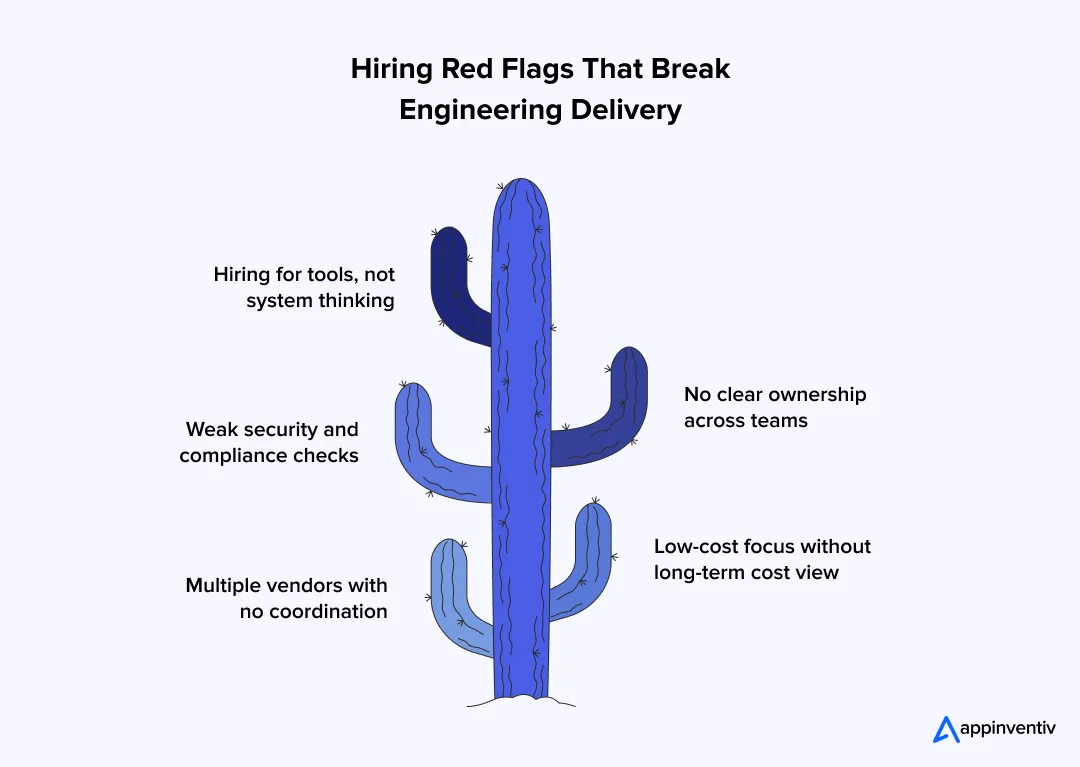
Hiring Based On Tools, Not Systems Thinking
Tool familiarity does not equal system capability.
- A candidate may know React or Node.js, but struggle with scaling or failure handling
- Weak system design leads to tight coupling, poor performance, and hard-to-debug services
- Look for experience with:
- Distributed systems
- Event-driven design
- Caching, load balancing, and failover
Over-Reliance On Vendors Without Governance
External teams can speed up delivery. They can also create blind spots.
- No clear ownership of code or services
- Limited visibility into development practices
- Knowledge stays with the vendor, not the enterprise
Set clear controls before engagement. Define ownership, review processes, and reporting structures.
Ignoring Compliance And Data Security Alignment
Security gaps often surface late, during audits or incidents. About 41% of organizations now report data privacy as a major concern in software development.
- Engineers may not follow secure coding practices
- Data may move across regions without proper controls
- Lack of audit logs makes tracing difficult
Check for familiarity with:
- Authentication flows such as OAuth and JWT
- Data encryption at rest and in transit
- Compliance standards like GDPR, PDPL, HIPAA and SOC 2
Choosing The Lowest-Cost Talent Without TCO Analysis
Low hourly rates can hide long-term costs.
| Cost Factor | Hidden Impact |
|---|---|
| Rework | Poor code quality leads to repeated fixes |
| Delays | Slower delivery increases time-to-market |
| Maintenance | Fragile systems need constant attention |
| Attrition | Frequent exits disrupt continuity |
Understanding software development cost across the full lifecycle matters more than the hourly rate alone.
Fragmented Multi-Vendor Ecosystems Without Orchestration
Multiple vendors working without coordination create chaos.
- Conflicting coding standards and deployment practices
- Lack of shared documentation and ownership
- Delays in integration and release cycles
Introduce a central layer:
- Defined service ownership
- Shared CI/CD pipelines
- Common security and coding standards
Enterprise Hiring Risk Checklist
Use this checklist before finalizing any software developer for hire or vendor engagement.
- Does the candidate show system design capability?
- Are governance and ownership clearly defined?
- Do they understand security and compliance basics?
- Is cost evaluated across the full lifecycle?
- Are all teams aligned on tools, processes, and standards?
These checks reduce failure risk and improve long-term delivery stability.
Without alignment across architecture, teams, and delivery models, scaling engineering creates instability instead of growth.

Build vs Buy vs Partner: What Should Enterprises Choose?
Choosing to hire software developers is one option. It is not always the right one. Enterprises need a clear model that balances control, speed, and long-term system ownership. Enterprise software already accounts for over 60% of the market, which increases the impact of each build, buy, or partner decision.
Model Comparison Overview
Each model serves a different purpose based on system criticality and delivery needs.
| Option | Best Fit Use Case | Control Level | Speed to Delivery | Cost Profile | Risk Areas |
|---|---|---|---|---|---|
| Build | Core IP, proprietary platforms | High | Slow | High fixed cost | Hiring delays, skill gaps |
| Buy | Standard tools, non-core capabilities | Low | Fast | Subscription-based | Vendor lock-in, limited flexibility |
| Partner | Complex builds, scaling engineering teams | Medium | Fast to moderate | Variable | Dependency without governance |
Also Read: Build vs Buy Software: How to Make the Right Choice for Your Business
Decision Framework
Use this table to evaluate trade-offs based on business priorities.
| Decision Factor | Build | Buy | Partner |
|---|---|---|---|
| Innovation vs execution | Strong for new system design | Focus on execution | Supports both |
| Control vs velocity | High control, slower delivery | Low control, faster setup | Balanced |
| Talent availability | Depends on internal hiring | Not required | Provided externally |
| Time-to-market | Longer timelines | Immediate deployment | Faster than an in-house build |
How Can Appinventiv Support End-to-End Engineering Beyond Hiring Developers?
Hiring adds developers. Unlike a typical software development company, Appinventiv does not stop there; it fixes gaps in system design, delivery flow, and platform stability. Our team delivers enterprise software development services at that deeper layer.
The focus stays on building engineering capability across architecture, data, and delivery.
- End-to-end product engineering from idea to production
- Dedicated teams aligned with your system architecture
- AI, cloud, and data systems built for real usage
- Global delivery with strong compliance and control
What this looks like in practice
| Metric | Value |
|---|---|
| Software products delivered | 2000+ |
| On-time delivery | 95% |
| Client satisfaction | 95% |
| Tech specialists | 1600+ |
| Industries served | 35+ |
| Security compliance | 99.50% |
Ility – Real Estate SaaS Platform Built by Appinventiv
A large real estate portfolio needed a unified platform to replace disconnected tools and manual workflows across properties.
- Unified billing, tenant engagement, and analytics into one system
- Delivered 40% higher occupancy rates and 2% increase in landlord ROI
- Automated infrastructure operations and reduced system fragmentation
The shift here is clear. The problem was not hiring more developers. It was fixing fragmented systems and building a scalable platform.
Enterprises that focus only on hiring keep solving the same problems over and over. The real shift happens when hiring aligns with system design and delivery capability. Teams that invest in architecture and delivery capability build systems that scale without constant rework.
Ready to hire software developers who deliver at that level? Let’s connect and assess your engineering gaps.
Frequently Asked Questions
Q. How should we structure our engineering teams to scale systems without increasing risk?
A. When you hire software developers, begin with ownership. Decide which systems the company cannot risk losing control over. Keep those inside. For everything else, bring in outside teams where speed is needed. Do not mix responsibilities. One team owns one service. Keep rules simple. Who approves code, who deploys, who responds to issues. Track how often you release and how quickly you recover. That tells you if the structure works.
Q. What is the most effective way to hire software developers for enterprise-scale systems?
A. Start with the system, not the role. What needs to be built or fixed? That answer should guide hiring. Look for people who can think through real problems. Give them a scenario from your own setup. See how they break it down. Avoid long theory rounds. Keep it practical. If they can handle your system in discussion, they will likely handle it in production.
Q. How do we balance in-house teams, vendors, and partners in software development?
A. Keep a simple rule. Core stays inside. Everything else can move. Internal teams should know the system end-to-end. Partners help you move faster. Vendors handle routine work. Problems start when lines blur. Two teams working on the same thing slows everything down. Set clear boundaries early. Agree on how code is written, reviewed, and released. That keeps work moving.
Q. What are the biggest risks when hiring software developers at enterprise scale?
A. The biggest issues show up later, not during hiring. People are hired for tools, not thinking. Teams grow without clear ownership. Security is treated as an afterthought. Cheap hiring leads to more fixes later. These problems build slowly. Then they hit all at once. A few checks early can avoid this. Ask how they design, not what they know.
Q. How do we ensure engineering hires actually improve delivery speed and system performance?
A. New hires need a working setup. If the system is unclear, they slow down. Give them access on day one. Show how code moves to production. Assign small tasks first. Let them learn by doing. Watch how quickly changes go live. Watch how often things break. If both stay steady, hiring is working. If not, the issue is not the people.
Q. What does it cost to hire software developers in 2026?
A. Hiring costs range from $60 to $200 per hour, based on region, seniority, and system scope. Salary is only one part of the total cost. Rework, delays, and weak system design can increase spend over time. Teams that focus only on low hourly rates often face higher long-term costs due to slower delivery and maintenance issues.


Fast 2-minute response, fully NDA-protected.

The Ultimate Guide to CRM for Insurance: Features, Cost, Top Platforms, Integration & More
Key takeaways: CRM for insurance connects sales, service, and claims into one governed system, distinct from the policy administration system. Core features span pipeline management, policy visibility, claims tracking, commission management, AI analytics, and compliance controls. Cost ranges from roughly USD 15,000 for configuration to USD 150,000 and beyond for custom development at enterprise scale.…

How to Choose a Technology Partner for Government Software Development
Key takeaways: Evaluate the partner across five layers: procurement eligibility, assurance, engineering, delivery and long-term ownership. Choose a government technology partner on evidence, governance and delivery depth, not development capability alone. Match partner evaluation criteria to the security, integration and operational risks of the programme. Treat data sovereignty, privacy, accessibility and security as architecture decisions…

Distributed Energy Resource Management System: Use Cases, Development and Implementation Costs
Key takeaways: Australian grids require robust software to manage minimum system load events effectively. DER integration software aggregates, monitors, and dispatches varied grid edge hardware securely. CSIP-Aus and AEMO compliance dictate strict architectural and cybersecurity software foundations. DERM development and implementation costs typically range from AUD 70,000 to 700,000 +. Successful DER programmes start with…