


































A Complete Guide to Compliance Management Software Development in Australia: Features, Cost & More

 Share -



- 01What Are the Different Types of Compliance Management Software?
- 02What Is Driving Compliance Software Adoption Across Australia in 2026?
- 03How Compliance Management Software Works: A Practical Enterprise Breakdown
- 04What Are the Core Features of Compliance Management Software in Australia?
- 05Key Advantages of Compliance Automation Software for Australian Organisations
- 06How Different Australian Sectors Use Compliance Management Software
- 07Common Compliance Challenges Australian Enterprises Face and How Custom Software Solves Them
- 08Compliance Management Software vs Manual Compliance: What’s the Real Cost Difference?
- 09Build vs Buy: Should Australian Enterprises Develop Custom Compliance Management Software From Scratch?
- 10How Much Does It Cost to Build Compliance Management Software?
- 11How Long Does It Take To Build Custom Compliance Management Software?
- 12Emerging Trends Shaping the Future of Compliance Management Software Development in Australia
- 13Case Studies: Enterprise Implementations Driving Regulatory Resilience
- 14How Appinventiv Helps Businesses Build Future-Ready Compliance Management Software in Australia
- 15FAQs

Key takeaways:
- Australia’s regulatory landscape is becoming more complex across privacy, cyber, ESG, workforce, financial, and critical infrastructure compliance.
- Compliance management software is moving from document tracking to AI-enabled operational risk management.
- Industries such as healthcare, BFSI, mining, government, retail, and critical infrastructure are accelerating adoption.
- New Australian regulations and reforms are reshaping enterprise compliance technology priorities in 2026.
For many Australian businesses, compliance has quietly shifted from a governance function to an operational pressure point. Regulatory obligations are expanding. Cyber expectations are tightening. Boards want stronger oversight, cleaner reporting, and fewer surprises during audits or incident reviews.
The problem is not a lack of policies. Most organisations already have those. The friction sits elsewhere. Requirements live across spreadsheets, legacy systems, emails, vendor portals, disconnected risk registers, and institutional knowledge held by a handful of teams.
That model is becoming harder to sustain.
Changes across privacy reform, operational resilience, cybersecurity expectations, critical infrastructure obligations, and sector-specific governance requirements are forcing organisations to rethink how compliance is managed day to day. In parallel, regulators are showing less appetite for reactive governance and greater interest in evidence, accountability, and continuous control visibility.
Compliance management software development in Australia has emerged as part of that response. It functions less as a tracking tool and more as a structured operating layer for managing obligations, controls, audits, policies, and regulatory change at scale.
This guide examines what is driving adoption in 2026, the features enterprises prioritise, where sector demand is growing, and what businesses should evaluate when building or modernising compliance platforms.
Explore what a custom-built compliance platform could look like for your business.

What Are the Different Types of Compliance Management Software?
Enterprise compliance management has evolved far beyond its origins as a digital repository for policy documents and annual audit checklists. Today, an effective system must function as an active, integrated component of an organisation’s core technology infrastructure.
A modern compliance software typically works across three moving layers:
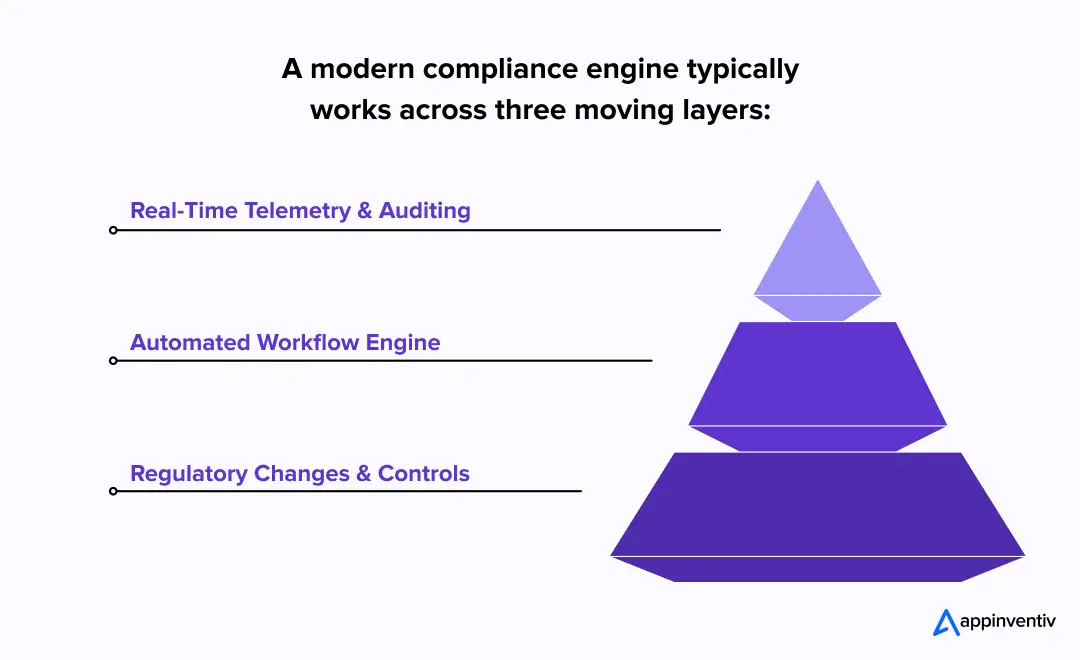
Types of Compliance Management Software
One of the more frustrating parts of software evaluation is terminology. Vendors often package similar capabilities under different labels. Procurement teams end up comparing tools that sound distinct but overlap heavily in practice.
The distinctions matter. This section draws those lines so you can scope requirements without investing in three systems that do one job.
- Compliance Management Software: Focuses on tracking, executing, and proving adherence to regulatory obligations, implementing controls, and collecting evidence across specific frameworks like APRA, Privacy Act 1988, ISO, WHS, and similar.
- Governance, Risk & Compliance (GRC) Platforms: Broad enterprise systems designed to align corporate IT strategy with business goals while managing top-tier risk structures.
- Risk Management Software: Specifically engineered to identify, analyse, model, and mitigate operational, financial, and strategic uncertainties.
- Audit Management Tools: Applications designed to plan, execute, and document formal independent reviews of internal systems and processes.
- ESG Compliance Systems: Dedicated platforms built to track sustainability metrics, carbon emissions, labour practices, and supply chain governance.
- Cyber Compliance Platforms: It maps cybersecurity controls against frameworks such as the ACSC Essential Eight ISO 27001, CPS 234, and NIST, generating continuous assurance evidence for security audits.
What Is Driving Compliance Software Adoption Across Australia in 2026?
Something has changed in the Australian compliance landscape. Regulatory pressure no longer arrives as a periodic disruption tied to one reform cycle or one industry inquiry. For many organisations, it has become part of normal operating conditions. Here are major adoption drivers:
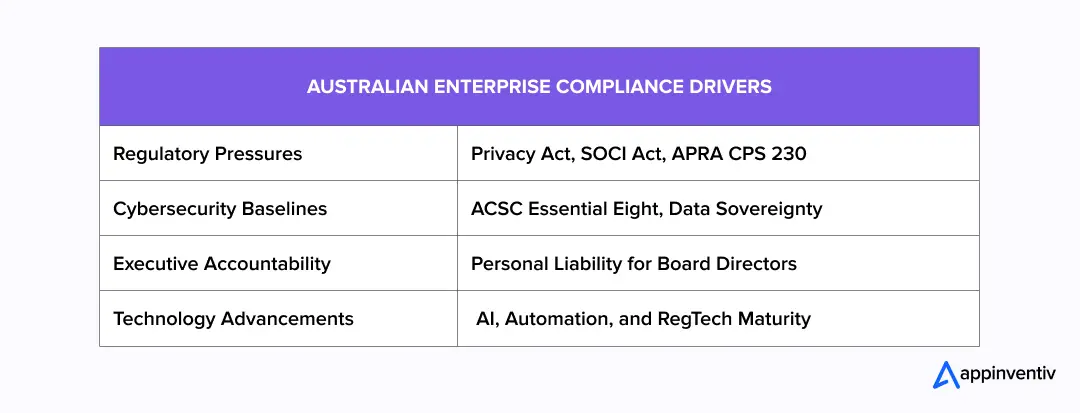
Regulatory Pressure Is Intensifying
Australian authorities are actively modernising and strengthening oversight across all major sectors of the economy:
- Privacy Act Reforms & APPs: Ongoing updates to the Privacy Act and the Australian Privacy Principles have significantly increased financial penalties for data breaches while introducing strict requirements around consumer data control.
- SOCI Act Obligations: The Security of Critical Infrastructure Act places demanding cyber security and operational reporting mandates on assets across energy, water, transport, and logistics sectors.
- APRA Expectations & CPS 230: The Australian Prudential Regulation Authority has introduced the new CPS 230 operational risk management framework, which requires financial institutions to demonstrate complete visibility over operational risks, service continuity, and third-party service providers.
- ESG Disclosure Requirements: New mandatory climate-related financial reporting rules mean enterprise organisations must implement transparent, auditable tracking systems for environmental and sustainability metrics.
- WHS Obligations: Workplace Health and Safety regulations require continuous, verifiable tracking of operational incidents, contractor certifications, and on-site risk mitigation procedures.
- AML/CTF Reforms: Stricter Anti-Money Laundering and Counter-Terrorism Financing rules have expanded compliance requirements across extended financial and professional service networks.
- Modern Slavery Reporting: Large enterprises must maintain deep visibility into their global supply chains to verify ethical sourcing and clear accountability at every level of production.
Cybersecurity and Compliance Are Converging
The ACSC Essential Eight has effectively become the de facto cybersecurity baseline for both government and regulated private sector organisations. Compliance with the Essential Eight now requires documented evidence of control implementation, maturity level assessment, and gap remediation tracking. It is exactly the kind of structured, ongoing work that manual spreadsheet approaches cannot support at scale.
The convergence of cybersecurity posture management and regulatory compliance is driving interest in platforms that can span both domains from a single evidence and reporting layer.
Also Read: Cybersecurity Breach Cost in Australia 2026
Board-Level Accountability Is Reshaping Buying Decisions
In three to five years, compliance ownership has shifted from general counsel and compliance officers to a shared accountability model involving CEOs, CIOs, CISOs, CROs, and board risk committees. This shift has changed the requirements that compliance software must meet.
AI, Automation, and RegTech Maturity Are Changing Expectations
The rapid maturation of regulatory technology has redefined how enterprises approach compliance operations. Advanced analytics, intelligent automation, and machine learning models allow platforms to ingest large volumes of unstructured regulatory updates, cross-reference them with internal workflows, and flag gaps without requiring manual human review.
How Compliance Management Software Works: A Practical Enterprise Breakdown
Modern compliance management system software development in Australia increasingly follows a seven-stage operational model. Each stage represents a distinct functional layer that, when combined, produces continuous compliance assurance rather than point-in-time reporting.
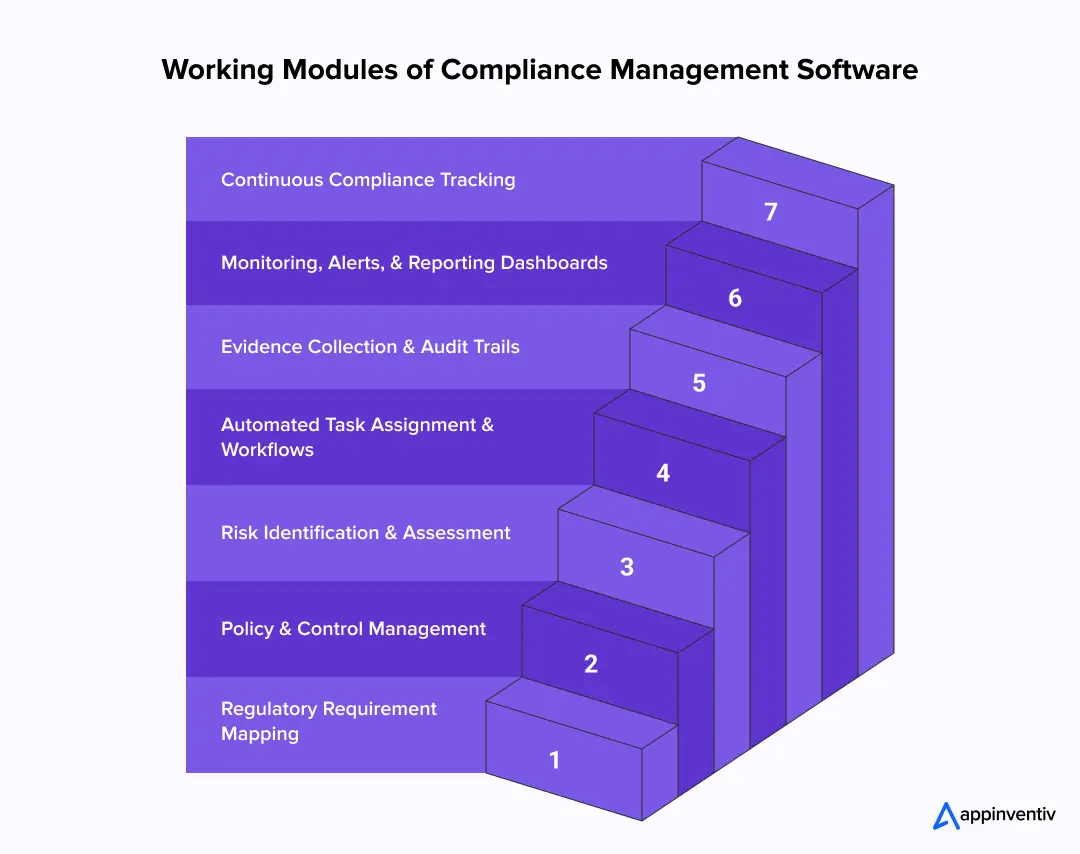
Stage 1 — Regulatory Requirement Mapping
The system ingests your applicable frameworks, including the Privacy Act, APRA standards, ISO controls, WHS regulations, and ESG reporting requirements, and maps each obligation directly to the organisational units, processes, and controls that own it. Automated regulatory change feeds update these structural mappings immediately whenever legislation or official guidance shifts.
Stage 2 — Policy and Control Management
Teams author, version, and publish corporate policies directly from within the platform. The system explicitly links each document to the exact regulatory obligations it addresses and the operational controls that enforce it. Automated engines handle all employee acknowledgment tracking and periodic review workflows.
Stage 3 — Risk Identification and Assessment
Risk teams run inherent and residual risk assessments directly against the active control environment. The platform pipes these risk ratings into prioritisation queues and exception workflows. Mature platforms now deploy AI-assisted scoring, combining external threat intelligence with internal control evidence to evaluate exposures.
Stage 4 — Automated Task Assignment and Workflow
The workflow engine automatically routes control testing tasks, evidence requests, and remediation actions to control owners based on calendars, risk ratings, or specific trigger events. Built-in escalation rules and deadline management eliminate the need for compliance teams to manually coordinate follow-ups.
Stage 5 — Evidence Collection and Audit Trails
The platform collects, timestamps, and links evidence directly to the specific control or obligation it supports, creating immutable audit trails. When an auditor or regulator requests proof, the system compiles a structured, traceable package, saving teams from manually reconstructing documentation from scattered sources.
Stage 6 — Monitoring, Alerts, and Reporting Dashboards
Live dashboards deliver instant visibility into your compliance posture across all frameworks, business units, and risk categories. Exception alerts flag control failures or overdue tasks before they escalate into regulatory breaches. Configurable templates quickly generate reports for both internal governance and external regulatory filings.
Stage 7 — Continuous Compliance Tracking
The platform maintains a live compliance record instead of treating governance as an annual audit chore. Control testing schedules run continuously while framework mapping updates automatically as regulators publish updates. This approach ensures your compliance posture remains a real-time measurement, not an extrapolation from a past audit.
We help organisations design and engineer compliance systems built around these operating conditions

What Are the Core Features of Compliance Management Software in Australia?
The features of compliance management software that matter most are the ones tied to a real obligation or a real cost. The features listed here represent the functional requirements that Australian enterprise environments consistently surface during scoping engagements.
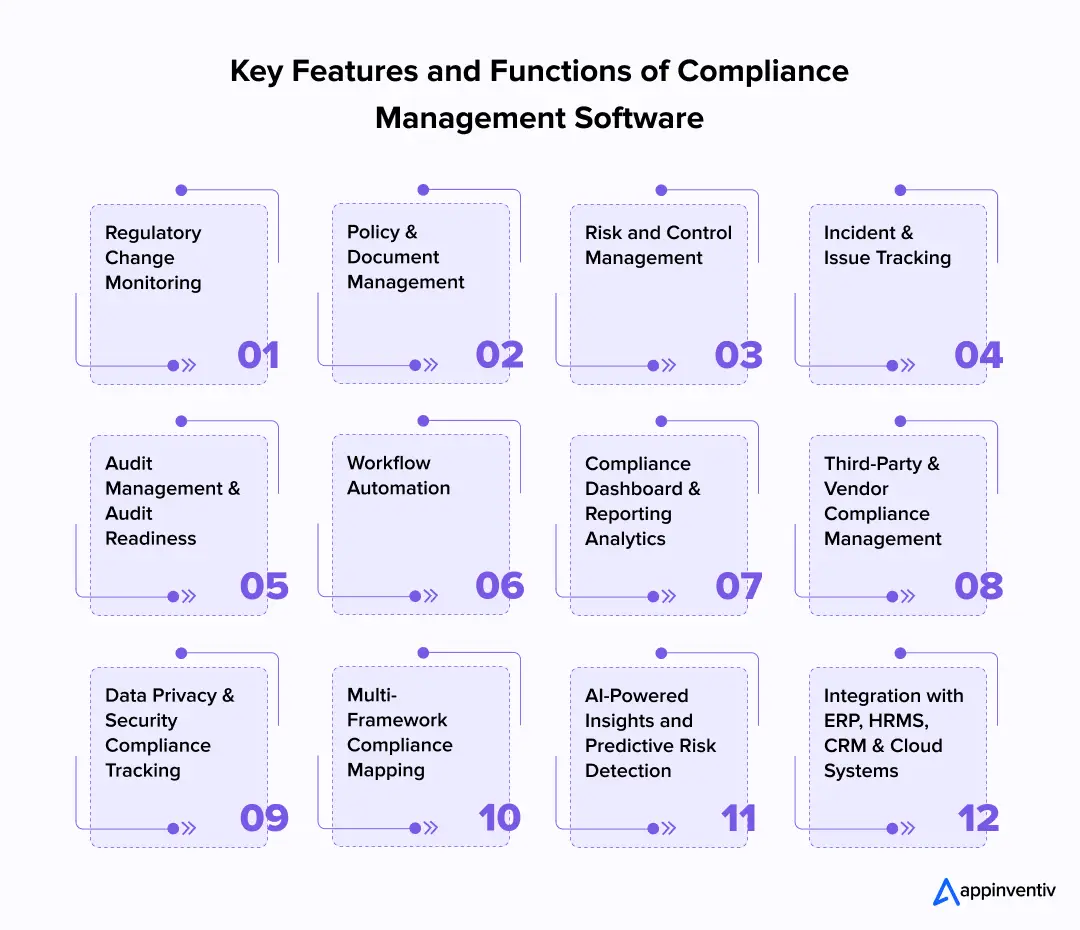
Regulatory Change Monitoring
Automated feeds that track changes to Australian legislation, APRA standards, ASIC guidance, and other relevant frameworks, with obligation mapping updates triggered automatically.
Policy and Document Management
Centralised policy authoring, versioning, approval workflows, and attestation tracking. Includes the ability to link policy documents directly to the regulatory obligations they address.
Risk and Control Management
Structured risk registers with inherent and residual risk ratings, control libraries, and testing schedules. The features of compliance management software in this category should include multi-framework control mapping to avoid duplicating effort across overlapping obligations.
Incident and Issue Tracking
Structured capture of compliance incidents, near-misses, and control failures. Root cause analysis workflows, remediation assignment, and regulatory notification management where required.
Audit Management and Audit Readiness
Audit planning, fieldwork management, and finding resolution workflows. Continuous audit readiness features, including evidence libraries and testing automation, reduce the cost and disruption of both internal and external audits.
Workflow Automation
Configurable workflows for control testing, evidence requests, exception approvals, and regulatory reporting. Automation reduces manual coordination and error rates across high-volume compliance processes.
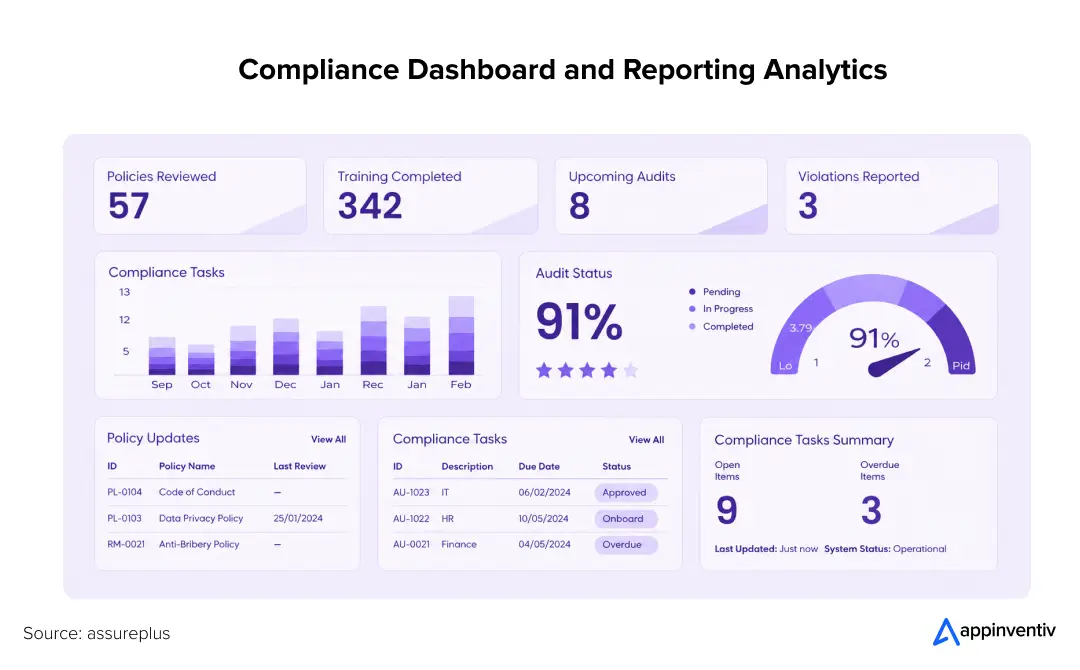
Compliance Dashboard and Reporting Analytics
Executive and operational dashboards with configurable views by framework, business unit, risk category, and time period. Board-ready reporting formats that translate technical compliance data into governance narratives.
Third-Party and Vendor Compliance Management
Vendor risk assessments, contract compliance tracking, and supplier attestation management. Given the supply chain exposure created by SOCI obligations and modern slavery reporting requirements, this module is increasingly non-negotiable for Australian enterprises.
Data Privacy and Security Compliance Tracking
Specific functionality for Privacy Act compliance, data inventory management, subject access request workflows, and breach notification management aligned with the Notifiable Data Breaches scheme.
Multi-Framework Compliance Mapping
The ability to map a single control to multiple frameworks simultaneously, so an access control that addresses both CPS 234 and ISO 27001 is tested once, with evidence credited against both obligations.
AI-Powered Compliance Insights and Predictive Risk Detection
Intelligent risk scoring, anomaly detection in control testing data, natural-language regulatory interpretation, and predictive indicators of control failure before incidents occur.
Integration with ERP, HRMS, CRM, Security, and Cloud Systems
Bidirectional integration with existing enterprise systems ensures that compliance data reflects operational reality rather than self-reported status. This is a critical capability for Australian businesses with complex legacy environments.
Key Advantages of Compliance Automation Software for Australian Organisations
The commercial case for enterprise compliance software in Australia is no longer built on efficiency savings alone. The more significant value is in risk reduction, governance quality, and the organisational capacity to absorb ongoing regulatory change without disproportionate cost. Some key benefits include:
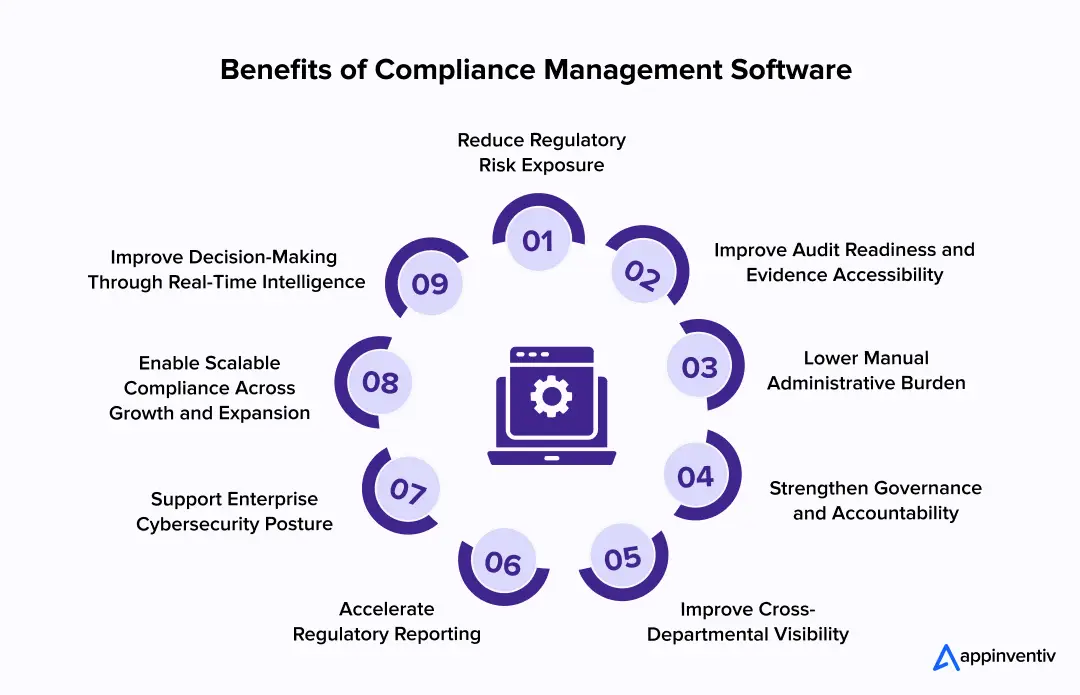
Reduce Regulatory Risk Exposure
Automated obligation tracking and control testing reduce the gap between regulatory expectation and demonstrated compliance. For Australian organisations operating under APRA, Privacy Act, or SOCI frameworks, this directly reduces the probability of enforcement action and the severity of findings when audits occur.
Improve Audit Readiness and Evidence Accessibility
One of the highest-cost elements of compliance in complex enterprises is audit preparation, like gathering evidence, reconstructing timelines, and assembling documentation that demonstrates control effectiveness. Compliance management software effectively eliminates the majority of this preparation work by maintaining continuous evidence libraries.
Lower Manual Administrative Burden
Control testing, evidence requests, policy acknowledgements, and regulatory reporting are all high-volume, low-judgement tasks when performed manually. Automation frees compliance professionals to focus on interpretation, risk assessment, and remediation, where human judgement adds actual value.
Strengthen Governance and Accountability
When compliance obligations, control ownership, and evidence trails are maintained in a single system, accountability is transparent and traceable. This matters particularly in the current Australian environment, where board-level accountability for compliance failures is enforceable.
Improve Cross-Departmental Visibility
Compliance failures rarely originate in the compliance function. They originate in operations, technology, procurement, and people functions where controls break down without anyone noticing. A well-implemented platform surfaces these failures early, before they become regulatory events.
Accelerate Regulatory Reporting
The advantages of compliance automation software in reporting contexts are measurable. Structured evidence, automated data aggregation, and configurable report templates reduce regulatory reporting cycle times from weeks to days in most enterprise implementations.
Support Enterprise Cybersecurity Posture
As the Essential Eight and CPS 234 demand continuous evidence of cybersecurity control effectiveness, compliance platforms that integrate with security tooling provide the only scalable path to sustained cyber governance. Manual approaches break down at the control testing frequency these frameworks require.
Enable Scalable Compliance Across Growth and Expansion
As Australian enterprises expand across states, sectors, or geographies, their compliance obligation maps expand with them. Custom compliance management software solutions in Australia can be architected to scale with organisational complexity, incorporating new frameworks and jurisdictions without requiring platform replacement.
Improve Decision-Making Through Real-Time Compliance Intelligence
Real-time dashboards transform compliance posture from a periodic audit finding to a live governance signal. CIOs, CISOs, and board risk committees can make resource allocation and risk acceptance decisions on current data rather than six-month-old audit reports.
How Different Australian Sectors Use Compliance Management Software
Compliance priorities differ sharply across Australian industries. The value of compliance management software often lies in how well it adapts to sector-specific obligations, governance models, reporting demands, and operational risk exposure.
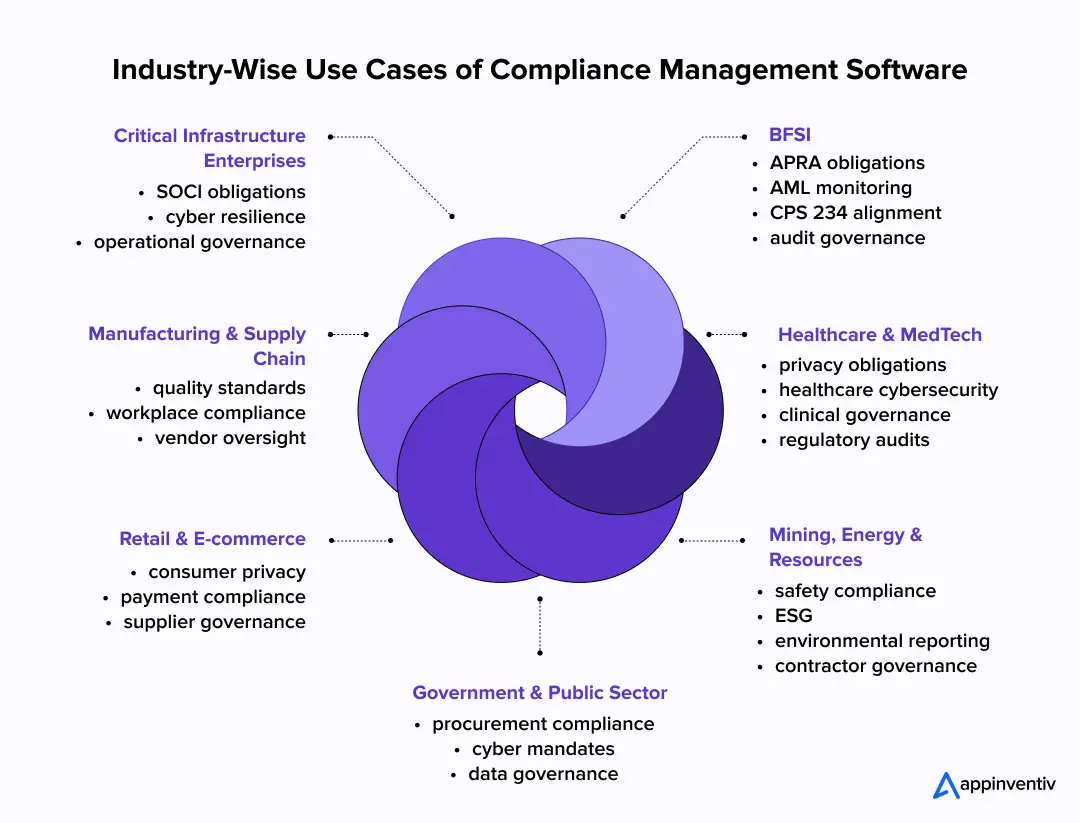
| Industry | Compliance Management Software Use Cases |
|---|---|
| BFSI | Tracks APRA obligations, strengthens AML monitoring, supports CPS 234 alignment, and centralises audit governance workflows. |
| Healthcare & MedTech | Manages privacy obligations, healthcare cybersecurity controls, clinical governance evidence, and regulatory audit preparedness. |
| Mining, Energy & Resources | Supports safety compliance, ESG reporting, environmental disclosures, and contractor governance across distributed operations. |
| Government & Public Sector | Improves procurement compliance, cyber mandate adherence, data governance oversight, and accountability reporting. |
| Retail & E-commerce | Monitors consumer privacy compliance, payment obligations, supplier governance, and multi-channel operational controls. |
| Manufacturing & Supply Chain | Strengthens quality compliance, workplace obligations, vendor oversight, and traceability across supplier ecosystems. |
| Critical Infrastructure Enterprises | Supports SOCI obligations, cyber resilience monitoring, operational governance, and incident response accountability. |
Common Compliance Challenges Australian Enterprises Face and How Custom Software Solves Them
Aussie risk teams frequently encounter complex operational challenges when navigating modern compliance requirements. Implementing targeted software features allows companies to systematically eliminate these vulnerabilities.
Regulatory Change Overload
With local and international regulations updating constantly, manual tracking makes it difficult for risk teams to stay ahead. This continuous change creates a higher risk of non-compliance due to outdated processes.
Custom compliance systems solve this by integrating automated legislative tracking feeds that flag updates and alert relevant business units immediately.
Manual Evidence Collection
Relying on manual processes means compliance teams must spend weeks searching through emails, shared drives, and paper files to prepare for audits. This leads to costly operational delays and an increased risk of missing documentation.
Digital platforms solve this challenge by automatically gathering and indexing evidence from connected systems in real time, ensuring a secure, continuous audit trail.
Fragmented Legacy Systems
Many large enterprises run their compliance operations across disconnected software tools, spreadsheets, and departments. This fragmentation makes it difficult for leadership to get a clear view of overall compliance and leaves dangerous gaps unaddressed.
An integrated compliance platform solves this by pulling data from ERP, HRMS, and security tools into a single, unified workflow engine.
Third-Party Oversight Issues
As enterprises work with more external service providers, manual vendor management makes it incredibly difficult to verify compliance across the extended supply chain. This leaves organisations exposed to third-party security and operational failures.
Specialised software modules fix this by automating vendor risk assessments, tracking certifications, and monitoring third-party performance against contractual agreements.
Internal Compliance Silos
When legal, IT, finance, and operations teams manage risk using isolated tools, communication breaks down and executive reporting becomes slow and unreliable.
A centralised compliance system breaks down these barriers by providing a shared platform with unified data models, giving all departments a single source of truth for risk management.
Compliance Management Software vs Manual Compliance: What’s the Real Cost Difference?
The direct cost comparison between software-enabled and manual compliance is rarely the right frame for executive decision-making. The more relevant comparison is risk-adjusted cost, factoring in regulatory penalty exposure, audit preparation inefficiency, staff allocation, and the scalability ceiling that manual approaches hit as regulatory complexity grows.
Staffing and Labour
Manual compliance operations require dedicated headcount for evidence collection, policy tracking, vendor assessments, and regulatory monitoring. In a mid-sized Australian financial services firm operating across four regulatory frameworks, this translates to multiple full-time roles performing high-volume, low-judgement work that automated systems handle at near-zero marginal cost.
Error Rates and Audit Findings
Manual evidence collection and control testing introduce error rates that software-based systems largely eliminate. Missed obligations, inconsistent documentation, and version control failures in policy management are common contributors to adverse audit findings. Each finding carries remediation cost, regulatory attention, and reputational exposure.
Audit Preparation Costs
Enterprise audit preparation in complex regulatory environments typically runs three to six weeks of intensive effort. Compliance management platforms that maintain continuous evidence libraries reduce preparation to hours, not weeks. At partner-rate professional services costs, that cycle time reduction has material commercial value in every audit cycle.
Regulatory Responsiveness
When a regulatory change occurs, a manual compliance programme must identify the impact, update policies, retrain affected staff, and update control frameworks, often over months. Software-enabled compliance environments with automated change feeds and integrated workflow management compress this cycle materially.
Scalability
Manual approaches hit organisational capacity limits as regulatory complexity grows. Adding a new framework, entering a new jurisdiction, or acquiring a business with different compliance obligations requires proportional headcount increases. Compliance management software businesses in Australia have deployed scales with organisational complexity without proportional cost increases.
Build vs Buy: Should Australian Enterprises Develop Custom Compliance Management Software From Scratch?
Selecting the right deployment strategy is a critical decision for technology leaders. While commercial off-the-shelf (COTS) software offers quick initial setup, it frequently falls short when faced with complex enterprise requirements and strict local data regulations.
On the other hand, custom software gives enterprises full control over their workflows, data security, and long-term costs, but drives up the implementation costs and timeline.
When Off-the-Shelf Platforms Make Sense
Pre-built platforms suit organisations with standard framework requirements, limited integration complexity, modest data sovereignty constraints, and compliance programmes that do not yet require deep customisation. For smaller enterprises or those operating in a single, well-supported regulatory framework, a configured SaaS platform can deliver adequate coverage at manageable cost.
When Custom Development Delivers Greater Value
| Consideration | Off-the-Shelf | Custom Development |
|---|---|---|
| Australian regulatory alignment | Partial – frameworks often lag Australian updates | Full – obligation mapping built to current requirements |
| Integration with existing enterprise systems | Standard connectors, limited depth | Bidirectional integration designed for existing architecture |
| Data sovereignty | Cloud residency often configurable but not guaranteed | Architecture designed for Australian data residency from outset |
| Multi-framework mapping | Supported but generic | Designed around the organisation’s specific obligation map |
| Vendor dependency | High – platform changes affect compliance operations | Owned infrastructure with full configuration control |
| Long-term cost of ownership | Licensing growth follows user and module expansion | Fixed development cost, variable hosting and maintenance |
| Scalability with regulatory change | Dependent on vendor roadmap | Configurable without vendor change request cycles |
| Board and executive reporting | Template-based, limited customisation | Designed to meet specific governance reporting requirements |
For Australian enterprises with layered regulatory obligations, complex legacy system environments, or board-level reporting requirements, custom compliance management software solutions in Australia consistently deliver better long-term value.
The initial development investment is offset within two to three years by the elimination of licensing escalation, the avoidance of costly workarounds, and the ability to respond to regulatory change without vendor dependency.
Explore how tailored compliance software can reduce operational risk and improve audit readiness.

How Much Does It Cost to Build Compliance Management Software?
On average, custom compliance management software development costs in Australia range between AUD 70,000 and AUD 700,000 or more. However, this is just a rough estimate.
The actual cost for compliance management software development in Australia varies heavily depending on the project’s complexity, integration requirements, and security baselines.
Cost Factors Influencing Custom Compliance Software Development
- Integration Scope: The number and complexity of external systems, such as legacy databases, modern ERP platforms, and cloud environments, that the software must securely connect to via APIs.
- Security & Compliance Standards: Implementing advanced security architecture like end-to-end data encryption, role-based access controls, and multi-factor authentication to meet strict frameworks like SOC2 or the ACSC Essential Eight.
- Data Architecture & Analytics: The complexity of the underlying database design, automated data ingestion pipelines, and real-time reporting dashboards.
- AI & Machine Learning Features: Integrating advanced capabilities like automated regulatory text processing, predictive risk scoring, or intelligent control verification.
How Long Does It Take To Build Custom Compliance Management Software?
The steps to build compliance management software in Australia typically progress through four consecutive phases, which determine the entire timeline. On average, the entire timeline for compliance management system software development in Australia ranges between 4 to 18+ months.
Discovery and Planning (3–4 Weeks)
Our specialists collaborate with your risk officers to map out explicit regulatory obligations and isolate operational bottlenecks. This initial phase defines the functional scope, matching technical capabilities directly against your legal mandates.
Core Engineering and Database Design (4–6 Weeks)
Architects draft the system blueprints and data storage models required to secure complete local data sovereignty. Developers construct the underlying database schemas to support intricate regulatory relationships, user permissions, and unalterable tracking logs.
Feature Integration (8–10 Weeks)
Engineers write the central business logic, construct live dashboards, and deploy the automated workflow engines. This structural phase connects your business tools via custom APIs, linking the software with active corporate ERP, HRMS, and identity infrastructure.
Security and Compliance Testing (4–6 Weeks)
The team executes rigorous source-code audits, automated control checks, and penetration tests. This final verification process proves the platform satisfies local security baselines like the ACSC Essential Eight and SOC2 before user sign-off.
Here is an estimated breakdown of compliance management software development in Australia based on different project complexities:
| Platform Tier | Scope | Estimated Timeline | Approximate Cost Range (AUD) |
|---|---|---|---|
| Basic | Single framework, core workflows, standard dashboards | 4–6 months | 70,000 – 150,000 |
| Mid-tier | Multi-framework, ERP integration, automated reporting | 6–9 months | 150,000 – 350,000 |
| Enterprise | Full GRC scope, AI features, deep integrations, multi-entity | 9–18+ months | 350,000 – 700,000+ |
A Practical ROI Perspective for Australian Enterprises
When modelling the return on investment for compliance management software, the relevant inputs are: annual regulatory penalty exposure (probability-adjusted), audit preparation cost per cycle, compliance staff time redirected to higher-value activity, and incident response costs avoided through earlier detection.
Emerging Trends Shaping the Future of Compliance Management Software Development in Australia
The compliance technology landscape is changing faster. Understanding where capability is heading matters as much as understanding where it is today, particularly for organisations making build-versus-buy decisions with five-year horizons.
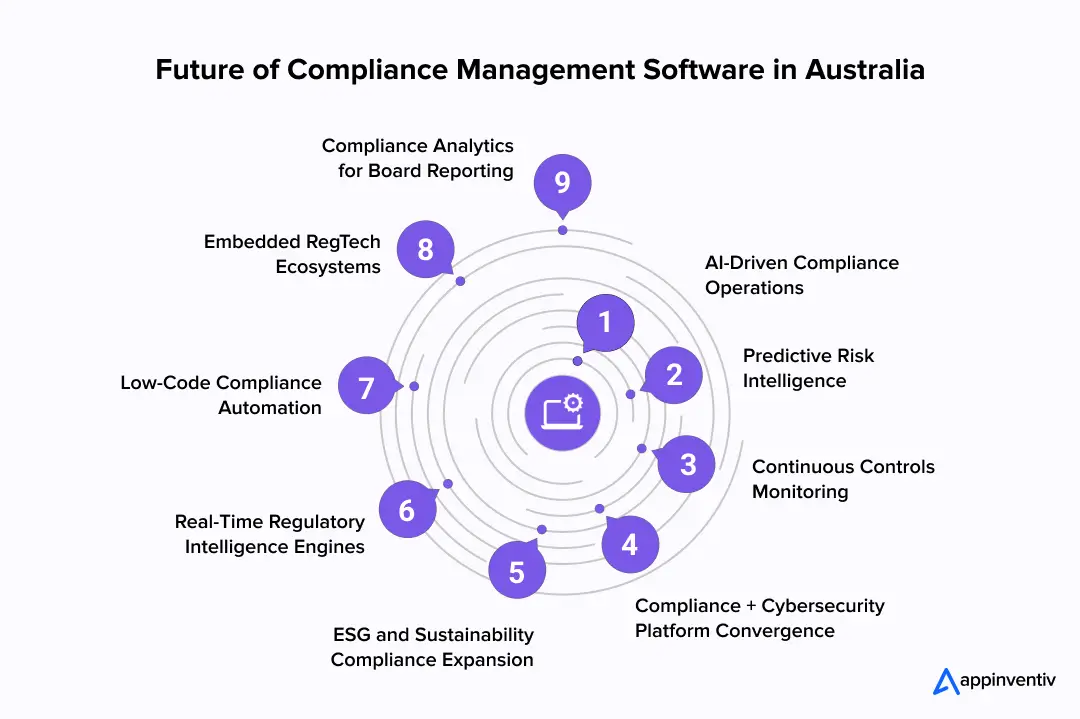
AI-Driven Compliance Operations
Generative AI use cases are increasingly embedded in compliance platforms for regulatory interpretation, policy drafting, and risk narrative generation. The most mature implementations use large language models trained on specific regulatory corpora to interpret new obligations and surface impacts on existing control frameworks automatically.
Predictive Risk Intelligence
Rather than reporting on compliance failures after they occur, next-generation platforms identify leading indicators of control deterioration, declining testing completion rates, increasing exception volumes, or changes in control owner activity patterns; and surface these as predictive risk signals before incidents occur.
Continuous Controls Monitoring
Automated, near-real-time testing of key controls is replacing periodic manual testing in organisations with sufficient technical maturity. For Australian businesses subject to APRA or Essential Eight continuous assurance expectations, this represents both a compliance requirement and a significant operational efficiency improvement.
Compliance and Cybersecurity Platform Convergence
The boundary between enterprise compliance management software in Australia and security operations platforms is dissolving. Unified platforms that manage both regulatory compliance posture and cybersecurity control effectiveness from a single evidence layer are gaining adoption, particularly in APRA-regulated and critical infrastructure environments.
ESG and Sustainability Compliance Expansion
Mandatory climate disclosure obligations under the Australian Sustainability Reporting Standards (ASRS) are creating demand for compliance platforms that can manage emissions data, scope reporting, and assurance evidence at the same standard as financial compliance. This is a rapidly expanding module category within enterprise GRC platforms.
Real-Time Regulatory Intelligence Engines
Automated monitoring of legislative updates, APRA guidance releases, ASIC consultation papers, and ACSC advisories with impact analysis and obligation update triggers is becoming a standard platform capability rather than a premium feature.
Low-Code Compliance Automation
Configurable workflow engines that allow compliance teams to build and modify compliance processes without developer involvement are reducing the dependency on IT for day-to-day platform management. This is particularly valuable in environments where regulatory change requires rapid workflow adaptation.
Compliance Analytics for Board Reporting
Sophisticated analytics layers that translate compliance posture data into board-level governance narratives with trend analysis, peer benchmarking, and forward-looking risk indicators are closing the gap between operational compliance data and board-level decision-making.
Case Studies: Enterprise Implementations Driving Regulatory Resilience
Deploying compliance management software systems in Australia requires moving beyond theoretical frameworks and focusing on actual operational execution. The following case studies illustrate how Australian enterprises partner with specialised engineering teams to solve complex regulatory and architectural challenges.
Tier-1 Australian Retail Banking Institution
A major financial provider struggled to align its distributed architecture with strict APRA CPS 230 and CPS 234 mandates using legacy GRC tools.
We engineered a bespoke platform integrating core identity systems with vendor databases. Utilising automated API telemetry, the system continuously verifies access controls and maps supplier performance.
This deployment eliminated manual evidence gathering, enabling the bank to generate auditable trails in minutes, lowering operational risk, and reducing compliance administration by 37%.
National Critical Infrastructure Provider
A multi-state transport and logistics provider needed to update its security posture to comply with the heightened reporting obligations mandated by the ACSC Essential Eight and SOCI Act.
Our tech architects engineered a custom compliance management system software that unifies physical security logs with IT infrastructure monitoring across forty distribution centres.
The platform maps operational data against the SOCI and Essential Eight in real time. When an anomaly occurs, the system automatically triggers incident workflows, assigns mitigation tasks, and pre-populates federal notification documents to ensure continuous compliance.
ASX-Listed Resources Corporation
An energy enterprise operating multiple mining assets across Western Australia and Queensland required a unified system to manage complex WHS incident tracking alongside mandatory corporate ESG climate disclosures.
We developed an enterprise compliance software solution with an offline-capable mobile field engine, tailored specifically to heavy industrial operating environments.
This helps site supervisors log safety events, contractor credentials, and environmental metrics directly into a secure repository. The system automatically processes this data for state safety regulators and international sustainability frameworks, eliminating corporate data silos.
Different industries. Different pressure points. The common requirement was not simply compliance tracking, but building systems capable of supporting governance at operational scale.
How Appinventiv Helps Businesses Build Future-Ready Compliance Management Software in Australia
Most compliance projects do not break down because a platform lacks features. They run into trouble because the system cannot keep pace with the business using it.
A bank acquires new reporting obligations. A healthcare provider expands vendor networks. A mining operator needs contractor controls across multiple sites. Suddenly, what looked workable inside a packaged platform starts creating workarounds, duplicated checks, and reporting friction.
That is usually where customisation becomes a critical business discussion.
At Appinventiv, we work with organisations building or modernising software development solutions in Australia around actual operating conditions, not generic workflow assumptions. The focus is broader than policy libraries or audit logs. It often involves integrating compliance processes with ERP systems, security environments, operational reporting, internal approvals, and regulatory evidence trails.
Australian enterprises also tend to ask harder questions early. Where will sensitive data sit? How will access controls work across departments? Can the system adapt when obligations change? What happens when new frameworks, acquisitions, or audits enter the picture?
Those questions shape architecture decisions from day one. They also tend to separate straightforward software projects from enterprise compliance platforms that need to survive audits, organisational growth, changing regulations, and shifting operational priorities.
That kind of work demands more than engineering capacity. It requires experience working inside regulated, high-accountability environments where governance, security, and business operations intersect.
In our 11+ years of APAC delivery experience, we have delivered 3000+ digital assets spanning 35+ industries, supporting programmes where integration complexity, compliance readiness, and long-term maintainability mattered as much as functionality.
Our team of 1600+ tech experts helped several Australian organisations such as Rapid Teachers, Multinail, and Lite N’ Easy, navigate legacy platform modernisation, enterprise workflow transformation, and large-scale software delivery.
Operating through 5+ agile delivery centres across Australia, we boast 96% client retention rate, supported by governance practices aligned with ISO 27001, ISO 9001, and SOC2 standards. For organisations investing in custom compliance management software solutions in Australia, those delivery foundations become important when the requirement extends beyond building software to creating systems that remain reliable under regulatory scrutiny and operational change.
In short, our industry experience and proven methodologies ensure that you get a future-ready custom solution that not only meets today’s needs but also addresses tomorrow’s challenges. Whether you are an emerging startup, a growing SME or an established enterprise, Appinventiv is your partner in building a secure, scalable software.
Talk to Appinventiv about your requirements of compliance management software development in Australia today.
FAQs
Q. What is compliance management software and why are Australian businesses investing in it?
A. Compliance management software is an operational system that links regulatory obligations to policies, controls, evidence, and reporting in one place. Australian businesses are investing because breach volumes hit record highs in 2024 and regulators now enforce penalties, so demonstrable, continuous compliance has become a board-level requirement rather than an annual exercise.
Q. How does compliance automation software streamline enterprise compliance processes?
A. The streamlining capabilities of compliance automation software in enterprise environments include automated regulatory change monitoring, scheduled control testing with evidence collection, workflow-driven task assignment and escalation, continuous audit trail maintenance, and configurable executive reporting.
Across these functions, automation eliminates the manual coordination overhead that consumes significant compliance team capacity in organisations operating multiple frameworks simultaneously.
Q. Can compliance management software integrate with existing ERP systems in Australia?
A. Yes. Mature platforms integrate with ERP, HRMS, CRM, cloud, and security systems so that evidence is pulled from live systems of record rather than re-entered by hand. Integration depth is one of the clearest dividing lines between serious enterprise compliance software and a basic policy register.
Q. How is AI being used in compliance management software in Australia?
A. AI applications in enterprise compliance management software development in Australia include natural-language regulatory interpretation, predictive risk scoring based on control testing patterns, automated obligation impact analysis when regulatory changes are published, anomaly detection in audit evidence, and AI-assisted policy drafting.
The most advanced implementations use models trained on Australian regulatory corpora to reduce the manual interpretation burden on compliance teams and surface obligation changes faster than human monitoring allows.


Fast 2-minute response, fully NDA-protected.

Beyond Customer Portal Development: Building Connected Digital Services
Key takeaways: A portal without CRM, ERP and billing integration leaves your staff doing the connecting. Start with customer tasks, then integrate only the systems those tasks actually need. Name one system of record for each data type before choosing APIs or middleware. Plan integration, security and privacy obligations at the start, not after the…

CRM Software for Local Government: From Community Requests to Better Service Delivery
Key takeaways: A council CRM should sit around existing systems as a service layer, not replace them. Integration with ERP, rates, property and GIS systems prevents another data silo and duplicate entry. Start with one high-volume service, pilot it with residents, then scale on measured results. Track resolution time, SLA compliance, self-service rates and cost…

The Ultimate Guide to CRM for Insurance: Features, Cost, Top Platforms, Integration & More
Key takeaways: CRM for insurance connects sales, service, and claims into one governed system, distinct from the policy administration system. Core features span pipeline management, policy visibility, claims tracking, commission management, AI analytics, and compliance controls. Cost ranges from roughly USD 15,000 for configuration to USD 150,000 and beyond for custom development at enterprise scale.…