



























AI Agent Security: Risks, Solutions & Business Benefits

 Share -


- 01How AI Agents Work
- 02Types of AI Agents and Their Security Risk Profiles
- 03Key Security Risks for AI Agents
- 04Security Gaps That Expand the AI Agent Attack Surface
- 05Core Principles for Agent Security
- 06Leading AI Agent Security Frameworks and Standards
- 07Strategic Benefits of AI Agent Security
- 08MCP and AI Gateway Security
- 09Microsegmentation for Multi-Agent Environments
- 10AI Agent Security and Compliance: GDPR, HIPAA, and SOC 2
- 11Best Practices For Securing AI Agents
- 125 Most Pressing AI Agent Security Challenges and Solutions to Overcome Those
- 13Implement AI Agents for Ensuring Robust Security with Appinventiv's Experts
- 14FAQs

Key takeaways:
- AI agents provide significant operational advantages, but their integration introduces unique security challenges that must be addressed strategically.
- Designing AI systems with modular security layers allows organizations to adapt quickly to emerging threats without disrupting ongoing operations.
- Regular audits, scenario testing, and resilience drills help identify weaknesses early and ensure AI agents behave as intended under diverse conditions.
- Collaboration between security, IT, and business teams is crucial to balance innovation, compliance, and practical usability of AI agents.
- A holistic approach to enterprise AI security not only mitigates risks but also supports scalability, smoother workflows, and long-term organizational agility.
In 2019, a UK-based energy company found out the hard way just how dangerous AI-driven fraud can be. Scammers used voice cloning software to copy the speech patterns of the CEO from the parent company. The fake voice was so real that the UK CEO approved a transfer of $243,000 to what he thought was a real supplier.
The money disappeared in minutes, and the attackers had shown everyone just how powerful deepfake technology could be when you mix it with old-school social engineering tricks. (Source: The Wall Street Journal)
That incident isn’t unusual anymore. AI agents are moving fast, taking over everything from customer support to business decision-making. As AI adoption accelerates, so do the opportunities for cybercriminals to exploit its reach, from routine customer interactions to high-stakes business decisions. What used to need technical know-how can now be automated, scaled up, and hidden with AI tools that make it nearly impossible to tell what’s real and what’s fake.
Jump ahead to today, and the stakes are way higher. AI agents are now built into customer service, operations, and decision-making systems. Their growing usage makes them absolutely essential for getting things done efficiently, but it also makes them perfect targets for cybercriminals who want to exploit weak spots on a massive scale.
The numbers tell the story of both the risks and the opportunities. IBM’s 2025 Cost of a Data Breach Report found that AI-related breaches are going up, but AI-powered defenses are actually working pretty well. Average global breach costs dropped to $4.44 million, down 9% from the year before, as organizations got faster at spotting problems and responding to them. The average time to identify and contain a breach is now 241 days, the lowest it’s been in almost ten years.
The lesson couldn’t be clearer: AI agents can either make your defenses stronger or create dangerous weak spots. The future of security will depend on how well organizations secure their agents.
In this blog, we will explore how AI agents work, examine the key security risks they face, and outline the core principles for agent security. We will also highlight the benefits of AI agent security, share best practices for securing AI agents, and discuss the most pressing challenges along with practical solutions to overcome them. Let’s dive in.
Secure your AI agent before it’s too late

How AI Agents Work
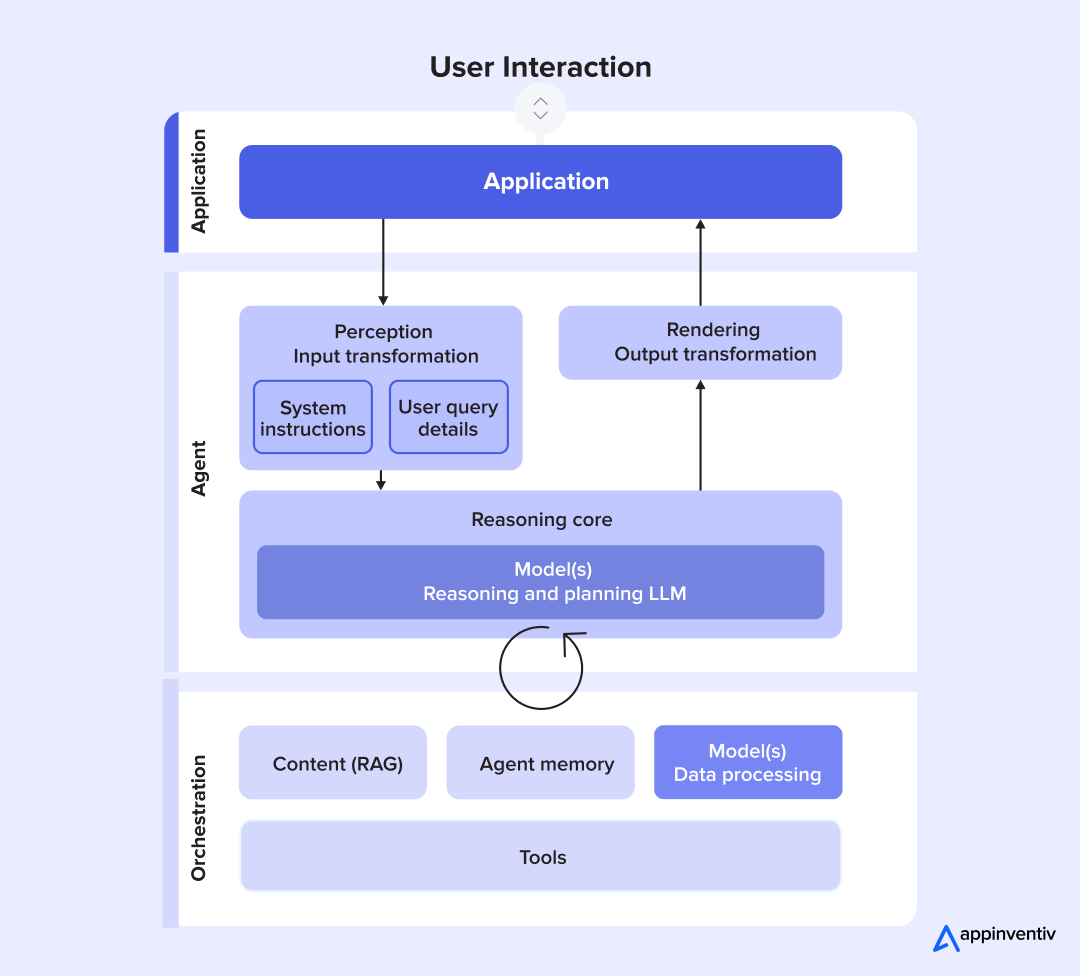
AI agents get built to act for users or systems, making choices and handling tasks on their own. At their core, they operate through a cycle of seeing, thinking, and acting, which enables them to adapt to changing situations and produce effective results. Getting this cycle is important for understanding what they can do and what kind of security they need.
Enterprises deploying autonomous agents also need a wider security for AI approach that protects prompts, models, APIs, data pipelines, retrieval systems, and downstream actions from intelligent attacks.
1. Perception
AI agents start by collecting data from whatever environment they’re working in. This might be text, pictures, voice commands, system logs, or sensor readings. The data gets cleaned up and interpreted using algorithms that help the agent figure out what’s going on. By securing AI agents during the data gathering phase, businesses can cut down on risks that come from corrupted inputs.
2. Reasoning and Decision Making
Once the agent has its input, it uses machine learning algorithms to weigh different possible actions. This analysis process enables the agent to make choices, solve problems, and adjust its approach based on what it has learned. Strong oversight and the implementation of AI agent security make sure that decision-making processes stay clear, dependable, and aligned with what the company actually wants to accomplish.
3. Action Execution
After the agent decides what to do, it actually carries out that action. This might mean sending a message, running a system command, approving a transaction, or getting a human operator’s attention.
Building in safety rails and monitoring systems during this phase is crucial for AI agent safety because even tiny mistakes in execution can cause major business problems. Many of those mistakes trace back to the build phase rather than the runtime. As for the development method, vibe coding vs traditional coding produce very different baselines for access control, input validation, and audit logging in the agent itself.
4. Learning and Adaptation
As time goes on, AI agents get better at what they do by learning from what happens. Reinforcement learning, supervised feedback, or pattern recognition help them adapt and improve their decision-making skills, which makes them more useful the more you use them. This ongoing process should also include AI-powered cybersecurity, so agents can develop better defenses just as fast as attackers come up with new ways to cause trouble.
5. Interaction with Other Agents and Systems
In most companies, AI agents don’t work by themselves. They often team up with other agents or connect with bigger IT systems. This multi-agent communication enables complex workflows but also introduces unique security challenges. Without proper safeguards, these interactions can expose AI agent security vulnerabilities, giving attackers fresh opportunities to break in and cause damage.
Also Read: A Guide to Generative AI Security- What Every C-Suite Executive Needs to Know
Types of AI Agents and Their Security Risk Profiles
Security controls should reflect what an agent can access and what it can change. A customer-facing assistant that only retrieves approved answers does not carry the same risk as an agent that can issue refunds, update records, or execute code. Enterprises should therefore classify agents by autonomy, data sensitivity, tool access, and the reversibility of their actions.
| AI agent type | Common enterprise role | Primary security exposure | Controls that matter most |
|---|---|---|---|
| Customer service agents | Answer questions, retrieve account details, and initiate service requests | Prompt injection, personal-data leakage, account impersonation, and unauthorized refunds | Identity verification, retrieval filters, transaction limits, and human approval for sensitive actions |
| Workflow and operations agents | Update records, route cases, reconcile data, and coordinate tasks across systems | Excessive permissions, malicious tool calls, workflow manipulation, and lateral movement | Least-privilege access, scoped service identities, action allowlists, and complete audit trails |
| Coding and IT agents | Generate code, open pull requests, execute commands, or manage infrastructure | Secret exposure, insecure code, supply-chain compromise, and destructive execution | Sandboxed environments, secret isolation, code scanning, branch protection, and approval gates |
| Financial and decision agents | Assess risk, recommend decisions, process claims, or approve transactions | Fraud, model manipulation, biased decisions, and regulatory exposure | Explainable decision records, transaction ceilings, dual approval, drift monitoring, and regular model validation |
This classification should be updated whenever an agent receives a new tool, data source, or level of autonomy. A low-risk assistant can become a high-risk operational identity after one integration change.
Key Security Risks for AI Agents
AI agents can be powerful tools, but they also bring special risks. From unauthorized access and data breaches to tampering with automated choices, these dangers increase as AI systems become more woven into business operations. Recognizing them is the first step toward good protection. Let’s have a look at some of the top security risks for AI agents:
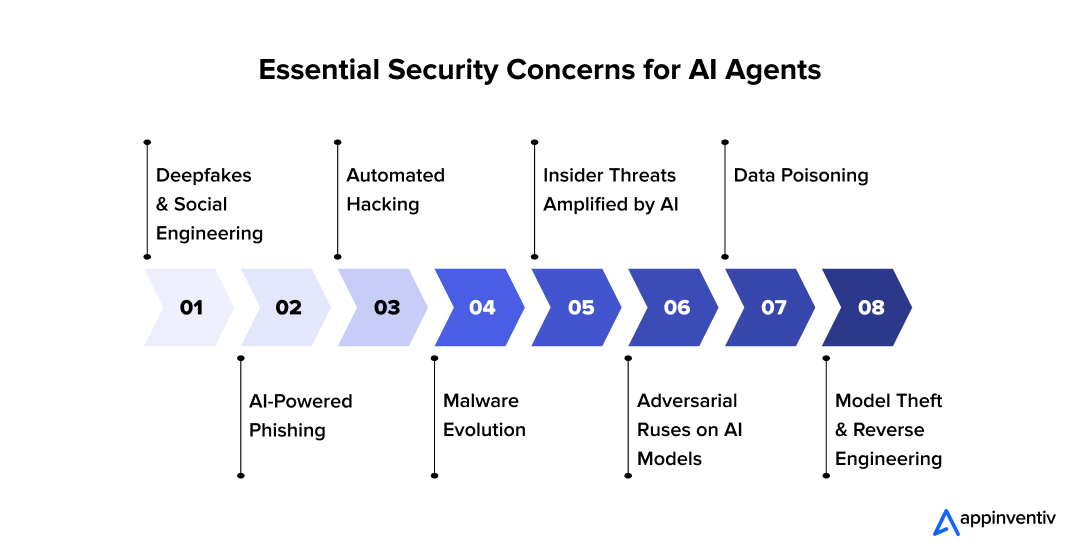
Deepfakes and Social Engineering: AI now creates realistic fake videos, images, and voices. Criminals use these deepfakes to impersonate executives or partners for fraud, data theft, and reputational harm. Strong AI agent security is needed to block these identity tricks.
AI-Powered Phishing: With AI, phishing looks professional and personalized, pulling data from social media and company sites. Messages mimic the style, tone, and timing of real communications. An AI agent for security can analyze fraud by detecting patterns and preventing these attempts early.
Automated Hacking: AI tools scan systems, apps, and networks at speed, exploiting weaknesses through automated attacks. Companies must secure AI systems to resist this constant probing and prevent security gaps.
Malware Evolution: AI-powered malware adapts by learning how defenses respond, making it harder to stop. Strong AI agent security for business provides layered protection against these evolving threats.
Insider Threats Amplified by AI: Employees with access may knowingly or unknowingly misuse AI tools to gather data or mimic normal behavior. Companies need procedures and monitoring to ensure only authentic AI agents operate without breaking trust.
Adversarial Ruses on AI Models: Hackers manipulate data or images to trigger false AI outputs. A robust enterprise AI security agent model helps detect these distortions and safeguard decision-making systems.
Data Poisoning: Attackers can poison training data, leading to biased or flawed AI models. Through AI agent safety, businesses can secure pipelines and ensure only trusted data sources are used.
Model Theft and Reverse Engineering: Attackers can replicate proprietary AI models by analyzing inputs and outputs, leading to theft or misuse. AI-based threat mitigation tools like query tracking and access limits protect against this.
Deepfakes and social engineering are among the top threats facing AI agents today — and the risk is amplified when those agents operate through voice. Enterprises deploying voice AI should consult our dedicated guide on secure conversational AI systems for voice interfaces to understand how layered architecture, speech-to-text vulnerabilities, and compliance controls work together to reduce exposure.
Security Gaps That Expand the AI Agent Attack Surface
AI agent security risks do not begin and end with the underlying model. They also arise from the instructions agents receive, the way businesses deploy them, and the identities used to access enterprise systems.
An approved agent with excessive permissions can be as dangerous as an unsanctioned one. Similarly, strong access controls may offer limited protection if malicious instructions can manipulate how the agent uses those permissions.
Enterprises must therefore protect three connected layers:
- The instructions influencing an agent’s decisions
- The agents operating across the organization
- The identities and permissions attached to those agents
The following security gaps deserve particular attention as businesses move from controlled AI experiments to agents capable of taking independent action.
Prompt Injection Can Turn Agent Access Against the Business
Prompt injection targets the instructions an AI agent follows. In a direct attack, a user submits a malicious request intended to override the agent’s rules. In an indirect attack, the instruction is concealed inside content the agent later retrieves, such as an email, webpage, document, support ticket, or database entry.
Indirect attacks are particularly difficult to detect. The employee using the agent may never see the malicious instruction. The agent may encounter it while summarizing a document, processing a customer request, conducting research, or retrieving information from an external source.
The consequences also extend beyond an inaccurate response. An agent connected to business tools may use a successful injection to:
- Retrieve restricted customer or employee information
- Send confidential data to an external destination
- Execute an unauthorized API request
- Alter a customer, payment, or inventory record
- Send a message under an employee’s identity
- Introduce malicious instructions into another agent’s workflow
Input filtering alone cannot address these risks. Attackers can encode instructions, divide them across several interactions, hide them in retrieved content, or phrase them in ways that evade simple detection rules.
A stronger design assumes that external content may contain hostile instructions. The architecture must restrict what an agent can access and what it can do, even when its reasoning has been manipulated.
Controls for prompt injection defense include:
- Separating system instructions, user requests, retrieved content, and tool outputs
- Treating instructions found in external content as untrusted data
- Allowlisting the tools available to each agent
- Validating tool names, parameters, destinations, and expected outcomes
- Requiring approval for payments, deletions, external messages, and permission changes
- Preventing the same agent session from combining sensitive data access with unrestricted external communication
- Testing direct, indirect, encoded, multilingual, and multi-stage injection attempts
- Recording the prompt, retrieved source, tool call, policy decision, and completed action
These controls strengthen prompt injection defense at the application layer. However, prompt-level safeguards cannot compensate for an agent with unrestricted credentials. This makes agent discovery and identity management equally important.
Shadow AI Leaves Security Teams Blind to Active Agents
Even well-designed security controls cannot protect agents the organization does not know exist.
Shadow AI appears when employees or business teams use unapproved models, copilots, browser extensions, or autonomous agents with company information. Agent sprawl develops when teams create numerous pilots and task-specific agents without maintaining ownership, access records, or retirement procedures.
The problem extends beyond the use of an unapproved application. Every unsupervised agent may introduce a new combination of data access, external integrations, credentials, and autonomous actions.
For example, an employee may connect an agent to a company email account to organize messages. Another team may give an experimental agent access to source code, customer records, or project-management tools. The applications may appear harmless individually, but security teams cannot assess their collective exposure without visibility into where they operate and what they can reach.
Abandoned agents create an additional risk. A pilot may end while its API keys, OAuth grants, service accounts, or tool permissions remain active. Attackers can exploit these forgotten access paths without immediately attracting attention.
Enterprises need a central inventory covering production agents, pilots, employee-created agents, and third-party copilots. Each record should include:
- Accountable business and technical owners
- Model and agent framework
- Intended business purpose
- Connected systems and data sources
- Available tools and permitted actions
- Service identity and credential type
- Permission scope
- Deployment environment
- Risk classification
- Last review and expected retirement date
Discovery controls should also identify unapproved model API traffic, unusual service-account activity, unknown OAuth grants, browser extensions, and agents connecting to enterprise data outside authorized environments.
Governance should not make adoption unnecessarily difficult. If approval takes weeks, employees may continue bypassing the process. Businesses need a clear route for proposing, testing, approving, monitoring, and retiring agents based on their level of risk.
An enterprise AI data security platform can support this process by bringing agent discovery, data-access monitoring, runtime policy enforcement, and incident evidence into one control layer.
Once an agent is discovered and approved, it must receive its own verifiable identity. Otherwise, the organization may know that an action occurred but remain unable to determine which agent performed it.
AI Agents Must Be Governed as Non-Human Identities
AI agents should not operate through shared user accounts, permanent API keys, or credentials copied from their developers. Each agent must be governed as a non-human identity with a defined owner, purpose, authority, and lifecycle.
A unique identity allows the organization to determine:
- Which agent initiated an action
- Which user or system delegated the task
- What resources the agent accessed
- Which policy authorized the action
- Whether the action remained within the approved scope
- When the agent’s access should expire
Static API keys and shared credentials weaken this chain of accountability. If several agents use the same credentials, security teams may see that an account accessed a record but not which agent initiated the request or why.
A stronger identity architecture uses workload identities, short-lived tokens, narrowly scoped permissions, regular credential rotation, and explicit delegation. It should also distinguish between the model, agent, application, connected tool, and end user. These components participate in the same transaction but should not inherit identical authority.
The identity system must account for changing tasks as well. An agent may require temporary access to a specific record or tool to complete one request. That access should not become a permanent entitlement. Permissions should be issued for the smallest required scope and revoked once the task or session ends.
The NIST concept paper on software and AI agent identity raises important questions about proving an agent’s authority, communicating its intent, and maintaining least privilege when agent behaviour is not completely predictable.
Before an AI agent reaches production, enterprises should be able to:
- Authenticate the agent independently
- Verify the person or system represented by the agent
- Restrict permissions according to the current task
- Prevent agents from sharing or borrowing credentials
- Revoke access immediately
- Trace every delegated action
- Detect deviations from approved behaviour
- Disable inactive or compromised identities automatically
Prompt injection, shadow AI, and weak non-human identities reinforce one another. An undiscovered agent may retain excessive access, while a poorly protected identity can increase the damage caused by a malicious instruction. Treating these as connected security concerns gives enterprises better control over which agents operate, what influences their decisions, and how far their authority extends.
Core Principles for Agent Security
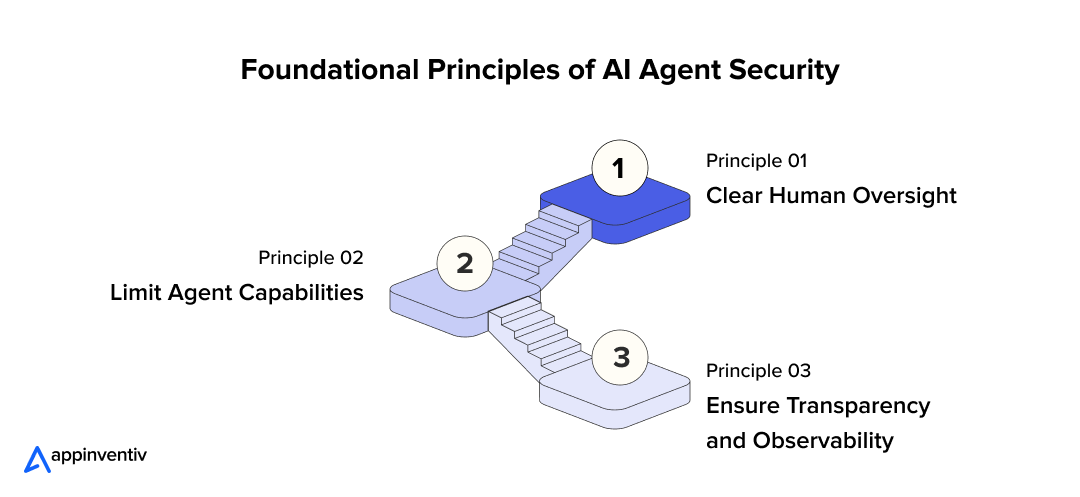
AI agents can really boost how efficiently your business runs, but they also bring some pretty unique risks to the table. To use their power safely, companies should stick to core principles that guarantee accountability, controlled operation, and transparency. Here are three basic principles for securing AI agents, plus practical steps you can take to put them into action.
Principle 1: Clear Human Oversight
AI agents work as extensions of human users, so every single agent needs to have someone specific in charge of it. This ensures that important decisions, such as approving transactions, changing sensitive systems, or taking actions that cannot be undone, will not occur without deliberate human approval.
In situations where multiple users or multiple agents are working together, you absolutely have to keep separate identities and access boundaries for each agent. Companies that use multi-AI agent security technology can handle these interactions much better, stopping conflicts or unauthorized data access before they start. Users should be able to assign permissions in detail, keep an eye on shared settings, and know exactly how their agent is going to behave.
Implementation Measures:
- Set up explicit human controllers for each agent.
- Secure input channels to double-check user commands.
- Turn on detailed permission management and shared configuration transparency.
Principle 2: Limit Agent Capabilities
AI agents should only get access to the resources and actions they actually need for their specific job. You need to restrict what they can do based on whatever task they’re working on right now. For example, an agent that’s supposed to do research should never be able to mess with financial records.
This principle takes the standard “least privilege” approach and tweaks it for AI systems that work across wide, potentially unlimited environments. Permissions need to be enforceable, you have to stop privilege escalation from happening, and users should be able to take away authority whenever they want. Using this principle supports AI agent security for business by making sure agents work safely within whatever limits your company sets.
Capability limits also carry most of the weight in defending against prompt injection, because an agent that reads untrusted content, reaches sensitive data, and can communicate outward in the same session is the exact combination an injected instruction needs.
Implementation Measures:
- Use context-aware permission controls that change based on tasks.
- Put sandboxing in place to stop unauthorized actions.
- Use strong multi-factor authentication, authorization, and auditing (AAA) frameworks.
Principle 3: Ensure Transparency and Observability
Trust in AI agents depends on being able to understand and audit what they’re actually doing. All important operations like inputs, reasoning steps, tools they use, and outputs should be logged securely. Being able to observe everything lets security teams catch weird behavior and helps users verify that things are working correctly.
Information describing what agents do, like whether they’re just reading data or messing with sensitive stuff, should be available for both automated monitoring and human review. Strong AI agent threat detection capabilities help identify suspicious activity as it occurs. User interfaces should give people insights into how the agent is planning and making decisions, especially for risky or complicated tasks.
Implementation Measures:
- Centralized, secure logging of inputs, outputs, and intermediate reasoning steps.
- APIs or dashboards that clearly show agent actions and related risks.
- Clear interfaces that help users understand agent decisions and authenticate AI agents.
Leading AI Agent Security Frameworks and Standards
AI agents create risks that conventional application security frameworks were not designed to address fully. They can interpret goals, access tools, retain information, communicate with other agents, and perform actions across connected systems. A compromised agent may therefore do more than expose data. It could misuse permissions, alter a workflow, initiate an unauthorized transaction, or spread malicious instructions to other agents.
No single framework covers this entire risk surface. Enterprises need to combine governance standards, application security guidance, threat intelligence, and architecture-level controls. The following AI agent security frameworks provide a practical foundation.
NIST AI Risk Management Framework
The NIST AI Risk Management Framework helps organizations manage AI risks throughout the system lifecycle. Its core is structured around four functions:
- Govern: Establish policies, responsibilities, accountability, and oversight.
- Map: Understand the agent’s purpose, operating environment, users, dependencies, and potential impact.
- Measure: Assess security, privacy, reliability, bias, and performance risks.
- Manage: Prioritize risks, apply controls, monitor outcomes, and respond to incidents.
For AI agents, businesses can use the framework to document which systems an agent can access, what decisions it can make, and when human authorization is required. It is particularly useful for building an enterprise-wide governance model rather than securing one application in isolation.
However, NIST AI RMF is not a technical control checklist. Security teams must translate its outcomes into access policies, testing requirements, monitoring rules, and incident-response procedures.
OWASP Top 10 for Agentic Applications
The OWASP Top 10 for Agentic Applications focuses directly on the risks created by autonomous and tool-using AI agents. It covers threats such as:
- Agent goal hijacking
- Tool misuse and exploitation
- Identity and privilege abuse
- Agentic supply chain vulnerabilities
- Unexpected code execution
- Memory and context poisoning
- Insecure inter-agent communication
- Cascading failures
- Human-agent trust exploitation
- Rogue agents
This framework is valuable during application design, code review, security testing, and deployment. For example, teams can use it to examine whether an agent accepts untrusted instructions, invokes tools without sufficient validation, or carries poisoned context into later tasks.
The OWASP guidance should influence concrete controls. These may include allowlisted tools, input validation, isolated execution, short-lived credentials, approval gates, memory verification, and strict limits on consequential actions.
MITRE ATLAS
MITRE ATLAS is a living knowledge base of adversarial tactics and techniques used against AI-enabled systems. It gives security teams a shared language for understanding how attackers may target models, data pipelines, agent tools, credentials, and connected infrastructure.
Its matrix covers areas such as reconnaissance, initial access, AI model access, persistence, privilege escalation, credential theft, data collection, exfiltration, and operational impact. MITRE ATLAS also includes techniques relevant to predictive, generative, and agentic AI.
Enterprises can use the framework to build threat models and red-team scenarios. A security team might simulate an attacker who injects malicious instructions into an external document, causes an agent to retrieve it, and attempts to trigger a privileged tool call. The team can then test whether validation, isolation, logging, and authorization controls stop the attack.
While OWASP identifies common risk categories, MITRE ATLAS helps teams examine how an adversary could carry out an attack across several stages.
ISO/IEC 42001
ISO/IEC 42001 specifies the requirements for establishing and continually improving an Artificial Intelligence Management System. It helps organizations assign ownership, create policies, document controls, assess impacts, and govern AI use across departments.
For businesses operating AI agents, the standard can support:
- Defined ownership for every deployed agent
- Approved development and deployment procedures
- Agent inventories and risk classifications
- Supplier and third-party assessments
- Monitoring and incident-management responsibilities
- Periodic reviews of agent performance and risk
- Records demonstrating responsible AI governance
ISO/IEC 42001 is especially relevant for enterprises that need a formal and auditable management structure. However, it does not prescribe every technical protection required for agentic systems. Businesses still need application-level controls based on frameworks such as OWASP and threat models based on MITRE ATLAS.
ISO/IEC 23894
ISO/IEC 23894 provides guidance for managing risks associated with AI systems. It helps organizations incorporate AI risk management into existing business functions rather than treating it as a separate technical exercise.
The standard can guide teams in assessing the likelihood and impact of agent failures. For instance, an internal knowledge agent and an autonomous payment agent should not receive the same risk rating. The payment agent can influence financial records and initiate consequential actions, so it requires stronger authentication, transaction limits, approval requirements, and monitoring.
ISO/IEC 23894 complements ISO/IEC 42001. The former supports the risk-management process, while the latter establishes the broader organizational management system.
Google Secure AI Framework
Google’s Secure AI Framework provides practical guidance for protecting the data, infrastructure, models, and applications involved in AI development. It treats AI security as a lifecycle concern instead of focusing only on the deployed model.
For AI agents, this approach is useful because vulnerabilities may arise anywhere in the operating chain. An agent could rely on poisoned data, a compromised model, an insecure plugin, an exposed orchestration layer, or a poorly protected tool connection.
The framework helps teams evaluate controls across:
- Data sources and preparation pipelines
- Model development and access
- Infrastructure and deployment environments
- Agent applications and connected tools
- Logging, monitoring, and incident response
It can therefore support secure architecture decisions while NIST and ISO standards guide governance and risk ownership.
How Enterprises Should Combine These Frameworks
Selecting one framework does not eliminate the need for the others. Each addresses a different layer of AI agent security:
| Security requirement | Relevant framework |
|---|---|
| Enterprise governance and accountability | NIST AI RMF and ISO/IEC 42001 |
| AI risk identification and treatment | NIST AI RMF and ISO/IEC 23894 |
| Agent-specific application risks | OWASP Top 10 for Agentic Applications |
| Adversarial threat modelling and red teaming | MITRE ATLAS |
| Secure AI architecture and lifecycle controls | Google Secure AI Framework |
An enterprise can begin with NIST AI RMF or ISO/IEC 42001 to establish ownership and governance. Security and development teams can then use OWASP to identify agent-specific weaknesses, MITRE ATLAS to model attack paths, and Google’s framework to apply controls across the technical architecture.
These frameworks must eventually translate into enforceable protections. Every agent should have a verified identity, limited permissions, approved tools, isolated execution boundaries, and complete activity logs. High-impact actions should require deterministic policy checks or human approval. Teams must also test agents for prompt injection, memory poisoning, tool misuse, privilege escalation, insecure inter-agent communication, and unintended autonomous behaviour.
A layered approach makes AI agent security frameworks operational. It connects board-level governance with the technical controls needed to keep agents within their intended purpose, even when inputs, integrations, or operating conditions change.
Strategic Benefits of AI Agent Security
Most companies now use AI for daily business tasks, so protecting these systems has become absolutely essential. The benefits of AI agent security go far beyond basic system protection. They help build real customer trust, keep you ready for regulatory audits, and make your whole operation tougher in the long run. Here’s what companies actually get when they put secure AI environments first:
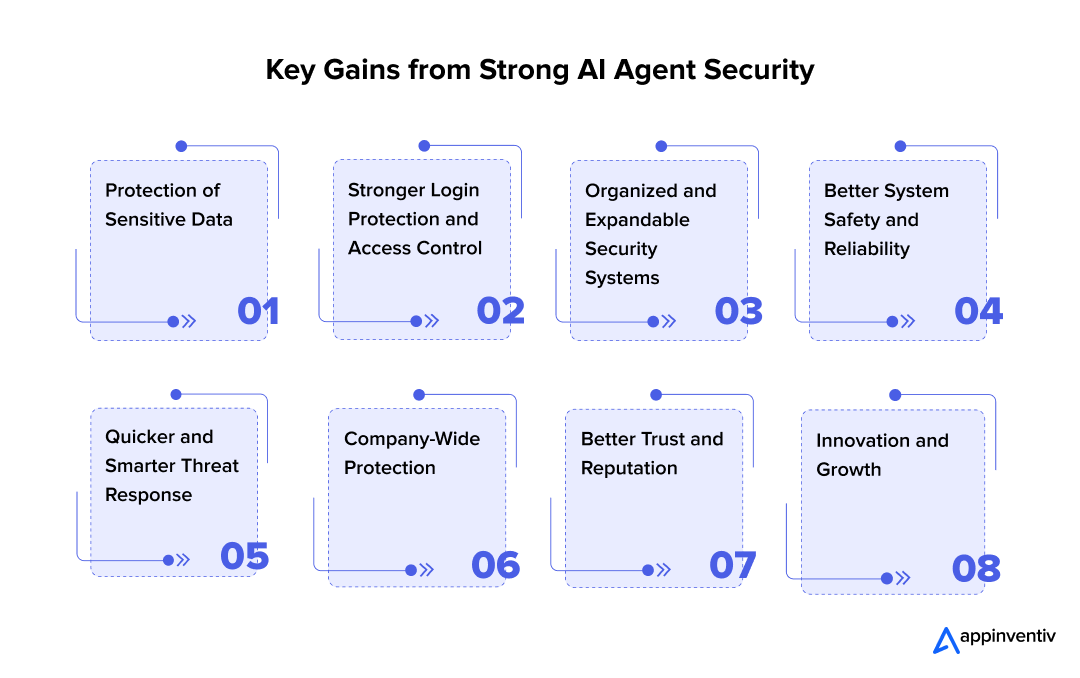
Protection of Sensitive Data
AI agents work with really sensitive information like financial transactions, health records, and customer details. Good security makes it much harder for this data to get stolen or misused, which saves your business from expensive breaches.
When you put an AI agent for security in place, you can watch everything automatically and block unauthorized access way better than the old methods. This keeps your risks low while all your important business information keeps moving like it should.
Stronger Login Protection and Access Control
When hackers break into systems, they usually get in through weak login security. Today’s security systems let companies authenticate AI agents using better methods like fingerprint scanning, digital certificates, and ongoing identity checks.
Strong login protection makes sure only the right people and systems can access your data, which cuts down on fake identity attacks and problems from people inside your company. This approach gives everyone more confidence when machines talk to other machines or when people work with AI systems.
Organized and Expandable Security Systems
Companies do much better when security gets built in from the start instead of being added later. An AI security agent framework gives you a solid structure for watching, catching problems, and responding across all your different systems.
This makes it way easier to add more AI tools without creating new security holes. With this kind of setup, organizations can weave security features right into their daily work processes, so they can grow with confidence as their operations get bigger.
Better System Safety and Reliability
When AI runs important stuff in banks, hospitals, and major infrastructure, you need systems that work right every single time, not just systems that work fast. Investing in AI agent safety makes sure your systems actually do what you built them to do, even when things get crazy or someone’s trying to break in.
Safe AI agents stop your operations from falling apart, keep your users safe, and make sure your business doesn’t grind to a halt. These safety steps also help you earn trust from government regulators, customers, and business partners who really need your services to keep working no matter what.
Quicker and Smarter Threat Response
Old security methods usually can’t keep up with what the bad guys are doing, but AI security completely changes that game. With AI-powered threat mitigation, your systems can catch suspicious stuff the moment it starts happening and shut it down before anything bad actually occurs.
These tools change tactics fast when brand new threats pop up, so you get way less downtime and your wallet doesn’t take such a big hit. Companies get ahead of the game by preventing problems instead of just picking up the pieces after everything goes wrong.
Company-Wide Protection
Today’s businesses run on connected digital systems where one weak spot can expose your whole network. Enterprise AI protection lets companies secure every department and process using one consistent approach.
Whether it’s your supply chain operations or customer service chatbots, having the same strong safeguards everywhere keeps all your AI contact points solid. This complete coverage stops weak areas from bringing down your entire security setup.
Better Trust and Reputation
Customers, business partners, and government agencies want to work with companies that can prove their AI systems are actually secure. When people can see you’re putting real money into AI agent safety and company-wide controls, it builds confidence and makes your brand look better.
Over time, this trust turns into customers who stick around, easier compliance checkups, and better chances to work with other businesses.
Innovation and Growth
When companies are assured that their AI implementations are safe, it gives them more courage to implement new tools and applications. By integrating an AI security agent framework into the operations, it becomes easier to experiment, innovate, and scale in a responsible manner.
Organizations have an advantage in their security-backed innovation, as it enables them to dominate the digital transformation with minimal risk exposure.
Also Read: AI Agents in Enterprise: Real-World Impact & Use Cases
MCP and AI Gateway Security
The Model Context Protocol (MCP) gives agents a standard way to discover and use tools, data sources, and services. That consistency can simplify integration, but it also creates a high-value control point. A compromised or misconfigured MCP server may expose powerful tools, return poisoned context, misuse credentials, or persuade an agent to call an unsafe function.
Every MCP server and tool should therefore be treated as an external dependency, even when another internal team operates it. Enterprises should verify server identity, approve tools before discovery, pin trusted versions, validate schemas, scan tool descriptions for malicious instructions, and isolate credentials from the model context. Tokens should be short-lived and scoped to one user, agent, task, and destination wherever possible.
An AI gateway adds enforcement between the agent and its models or tools. It can authenticate requests, apply rate and spending limits, inspect inputs and outputs, redact sensitive data, enforce model and tool allowlists, and generate a consistent audit record. The gateway should not become a single unrestricted super-credential. Its own administrative access, policy changes, logs, and failover routes require strict protection.
OWASP’s work on MCP security treats the protocol as a distinct agentic attack surface. A sound design secures the entire chain: user to agent, agent to gateway, gateway to MCP server, and MCP server to the underlying system.
Microsegmentation for Multi-Agent Environments
Multi-agent systems introduce trust relationships that conventional network rules rarely capture. A planning agent may delegate work to a research agent, which then invokes a data agent or an execution agent. If every participant can communicate freely, compromising one agent can create a path to sensitive tools and systems.
Microsegmentation divides that environment into small, policy-controlled zones. Each agent receives a distinct workload identity, and communication is allowed only for approved agent pairs, tools, destinations, protocols, and tasks. A customer-support agent, for example, may read a limited customer profile but should not connect directly to payroll, source-code repositories, or infrastructure controls.
Strong multi-AI agent security technology should enforce:
- Default-deny communication between agents and services.
- Mutual authentication for every agent-to-agent connection.
- Task-specific authorization, not broad network access.
- Separate memory, context, and credentials for each agent.
- Egress restrictions that block unapproved external destinations.
- Runtime monitoring for unusual delegation chains and lateral movement.
- Immediate isolation of a compromised agent without stopping the complete workflow.
This is where interaction with other agents becomes a security boundary, not merely a product capability. Teams should test forged messages, recursive delegation, confused-deputy scenarios, compromised peers, and attempts to pass sensitive context into a lower-trust agent.
AI Agent Security and Compliance: GDPR, HIPAA, and SOC 2
Compliance does not come from choosing a compliant model provider. It depends on how the full agentic workflow collects data, retrieves records, makes decisions, invokes tools, retains memory, and records actions.
GDPR: Organizations need a lawful basis for processing personal data, data minimization, defined retention, security controls, and mechanisms that support data-subject rights. Teams should document where prompts, retrieved context, outputs, memory, and logs are stored. High-impact automated decisions may require added transparency, human intervention, and a way for an individual to contest the outcome.
HIPAA: Agents that create, receive, maintain, or transmit protected health information need safeguards appropriate to that data and the surrounding healthcare workflow. Access should follow the minimum-necessary principle. Organizations also need audit controls, secure transmission and storage, incident procedures, and appropriate business associate agreements with relevant vendors.
SOC 2: SOC 2 is an assurance framework rather than a law. For agent deployments, evidence may include access reviews, change approvals, monitoring records, incident response, vendor assessments, availability measures, and proof that security policies operate consistently over time. Salesforce’s data compliance guide similarly describes SOC 2 as a voluntary auditing standard used by cloud providers to demonstrate control over security and availability.
Security testing should map each control to evidence. Salesforce’s AI agent testing guidance specifically connects agent testing with frameworks such as GDPR, HIPAA, and SOC 2 while checking for prompt injection, data leakage, and unauthorized access.
Before deployment, enterprises should complete a data-flow map, risk assessment, vendor review, access-control matrix, retention schedule, incident-response plan, and test record for the agent. Legal and compliance teams should validate the final obligations for the organization, jurisdiction, and use case.
Best Practices For Securing AI Agents
Securing AI systems needs powerful technology and well-disciplined procedures. The following AI agent security best practices assist organizations in enhancing resilience, reducing vulnerabilities, and preserving trust as they increase their adoption of intelligent systems.
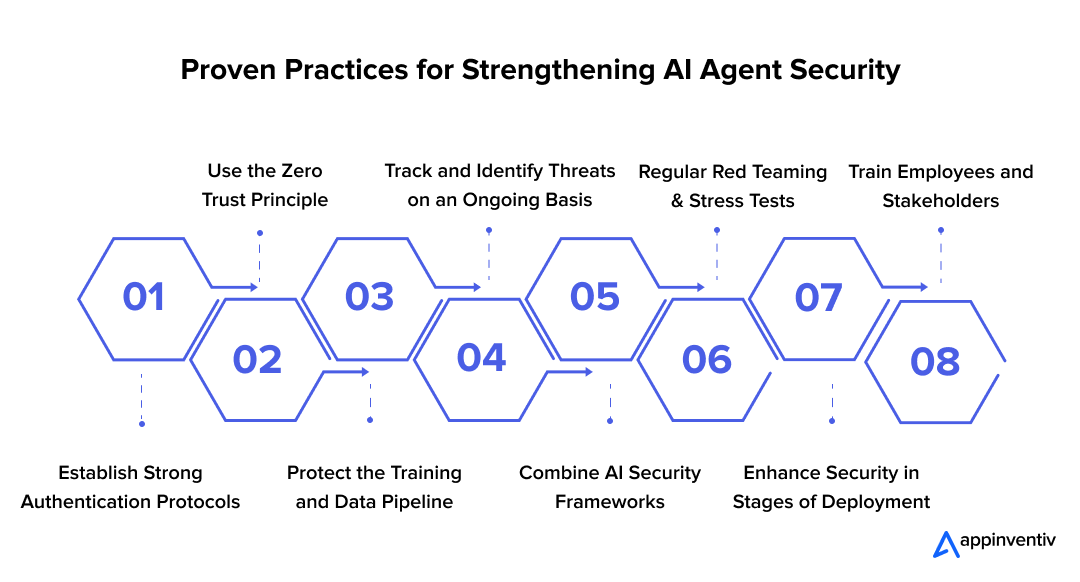
Establish Strong Authentication Protocols
All AI agents should be authenticated, and then they should be prohibited from dealing with sensitive data or any other business systems. Multi-factor authentication, cryptographic, and ongoing identity verification make them reliable at all levels.
This eliminates hackers impersonating systems and the introduction of fake agents to workflows. An AI agent for security works best when it is designed with authentication capabilities, and organizations are assured that only authorized agents are executing within the network.
Use the Zero Trust Principle
The concept of zero-trust security assumes that no system or user is trusted by default. Every request, be it by an employee, application, or AI, is verified continuously prior to being allowed access. This will reduce the chances of abuse of power or abuse of inside knowledge.
By using zero-trust models, businesses can regulate access to data by the agents, minimize potential exposure in case one account is compromised, and create more resistance against unauthorized activity.
Organizations deploying AI agents across workflows benefit from pairing agent-level controls with a broader enterprise AI data security platform that monitors runtime behavior, data access, and inference activity across the full stack.
Protect the Training and Data Pipeline
AI models rely on training information to come up with correct decisions. In case that information is altered, poisoned, or revealed, the performance of an AI agent is not reliable or exploitable. Encryption of datasets, source verification, and access controls help to maintain the model integrity.
In the context of AI agent security for business, this implies that sensitive datasets must be trustworthy, and it is essential in cases of high stakes, such as the finance or healthcare industry, where a mistake can be disastrous.
Track and Identify Threats on an Ongoing Basis
Even well-planned AI systems are under threat after operating in real-life scenarios. Constant monitoring will identify the abnormalities in agent activity, including uncharacteristic data requests, system overloads, or abnormal interactions.
Threat detection with real-time AI agents helps companies identify problems before they turn into full-blown ones. Following the best practices for securing AI agents will guarantee long-term visibility and prompt and effective response to the emerging threats.
Align Security Controls With Recognised Frameworks
The security is enhanced when it is done in a systematic manner instead of ad hoc. A framework of an AI security agent defines the detection, response, and governance standards so that all departments use the same protection. Such a structure is easy to scale with more agents being added to the enterprise.
By securing AI agents under a single model, businesses can achieve transparency and efficiency, as well as mitigate the risks associated with the fragmented defense strategies.
Regular Red Teaming and Stress Tests
The weak areas are brought to light through attack simulations and stress testing before the actual attackers are able to use them. Red teaming reveals the behavior of AI models to adversarial input, manipulated queries, or targeted overloads.
These exercises are most effective when they follow a structured methodology, such as jailbreak, Crescendo, and encoding-based AI red teaming, to expose weaknesses that can be used to probe enterprise AI systems.
Enhance Security in Stages of Deployment
Hasty deployments augment the likelihood of vulnerabilities going uncapped. The implementation of AI should be done in a sandbox, with progressive releases and constant updates to achieve reliability. This gradual process aids in the identification of defects in the initial stages, and it also alleviates the exposure of live systems.
As multi-AI agent security technology has emerged, organizations also have to test the interaction between various agents and how they will cooperate without introducing new security gaps.
Train Employees and Stakeholders
Technology cannot exist in isolation as it requires knowledgeable human supervision. It is necessary that employees and other stakeholders know how to be aware of suspicious behavior, how to manage data, and how to report as soon as possible.
Frequent training ensures the creation of awareness and accountability throughout the organization. Through integrating a spirit of vigilance and keeping pace with the most appropriate standards of protection of AI agent, businesses enhance their technical and human protection.
We follow expert strategies that strengthen resilience, close security gaps, and ensure your intelligent systems remain reliable at every step

5 Most Pressing AI Agent Security Challenges and Solutions to Overcome Those
As AI agents handle important business tasks, they encounter changing security problems like data breaches and hostile attacks. Spotting these threats and putting strong protections in place, such as access controls and ongoing monitoring, is necessary to stay ahead of possible risks. Let’s check those out.
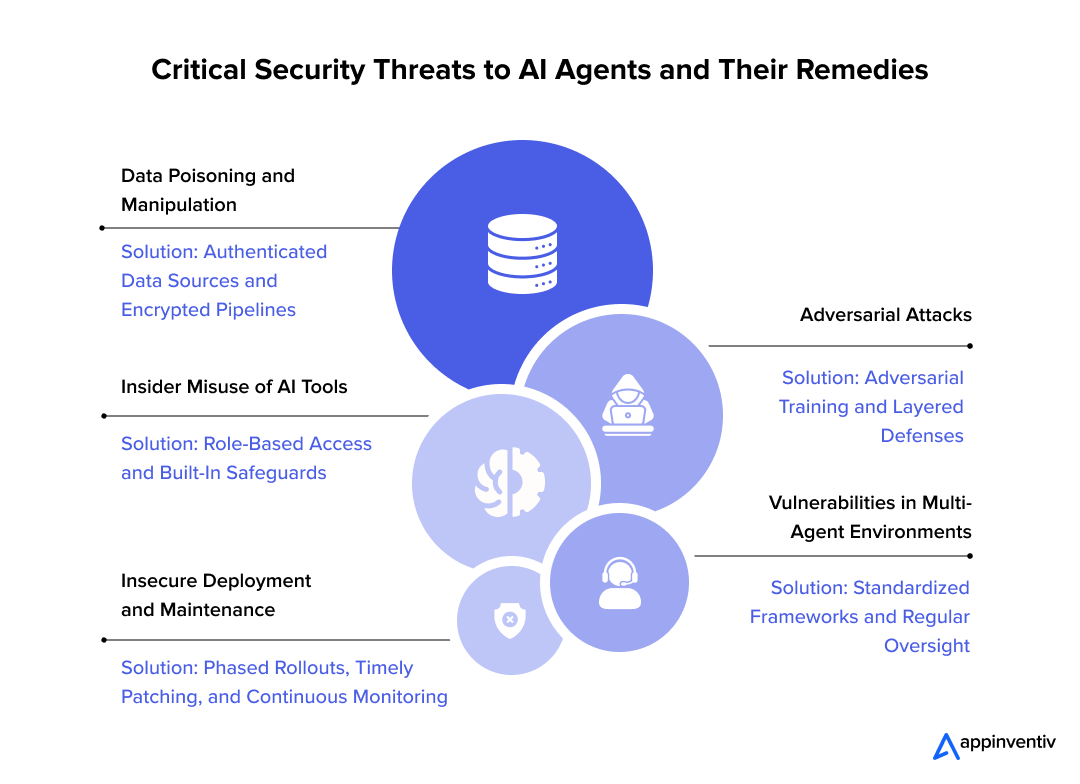
1. Data Poisoning and Manipulation
Attackers may intervene with training data and introduce malicious and misleading inputs to AI systems. This will result in faulty model output, bias ,or even unauthorised access. The magnitude of this issue renders it challenging to detect.
Solution: Companies should authenticate data sources, store and transfer the information using encryption, and perform anomaly detection to identify the presence of unusual behavior. The first step towards AI agent security risks is to ensure that the data pipeline is uncompromised.
2. Adversarial Attacks
Minor, precisely calculated manipulations in input information can deceive AI models and cause them to make the wrong classification. As an example, a facial recognition system can be defeated by an image with slight manipulations. Such AI agent security vulnerabilities are particularly hazardous in businesses such as healthcare or financial systems, where mistakes can be extremely expensive.
Solution: The continuous model testing, adversarial training, and red-teaming exercises are used to expose the weaknesses. Layered defenses should also be used by the enterprises to check both the inputs and outputs of the enterprises in order to know whether they are being manipulated.
3. Insider Misuse of AI Tools
Employees and business partners sometimes abuse AI tools on purpose or by mistake. When AI boosts what people can do, insiders might misuse company data, create fake messages, or skip around normal business processes. Watching for this kind of abuse gets tricky without breaking down trust in the workplace.
Solution: Companies need role-based access controls, activity logs, and behavior tracking to keep tabs on what insiders are doing. Building strong security features into AI agent systems means these safeguards are built in from the start, rather than being added later.
4. Vulnerabilities in Multi-Agent Environments
When companies put several AI agents to work together, setup mistakes or bad configuration choices can expose sensitive company information. Not having clear communication rules or proper oversight can also create weak spots that hackers love to target.
Solution: Standardized frameworks, tight access controls, and regular checkups should guide how you roll these systems out. Using secure AI solutions makes sure your agents don’t just work well on their own but also play nice together within your bigger business systems.
5. Insecure Deployment and Maintenance
Even the most advanced AI agent can get completely undermined by sloppy rollout practices. Slow security patching, rushed updates, and untested deployment environments basically hand attackers easy ways in. This means security is something you continually need to work on, not just a one-time check.
Solution: Businesses should stick to step-by-step release strategies, apply updates regularly, and watch their systems around the clock. When you line up with proven methods for tackling AI agent security challenges, your organization can stay protected against new threats that show up long after you’ve successfully deployed.
Implement AI Agents for Ensuring Robust Security with Appinventiv’s Experts
The future of AI agent security depends on proactive, intelligent, and adaptive systems. As AI agents become more independent and woven into business operations, the spotlight will increasingly be on securing AI agents, putting multi-agent monitoring into place, and making sure there’s transparency and accountability. Companies that grab onto these strategies today will be in a much better spot to stop data breaches, handle AI-powered threats, and keep operations running smoothly in our increasingly digital and AI-driven world.
When businesses adopt core principles like clear human oversight, dynamic permissioning, and complete transparency of actions, they can dramatically cut down on weak spots. Implementing multi-agent security frameworks, continuous monitoring, and threat detection further enhances resilience against AI-powered attacks.
Appinventiv is an AI agent development company with deep expertise in building AI-powered applications while putting security, scalability, and enterprise compliance first. Our experts help organizations not only deploy AI agents but also secure them against evolving threats, ensuring that businesses can utilize automation without compromising sensitive data or operational integrity.
Key Highlights of Our Expertise:
Notable AI Projects: Americana ALMP, MyExec, MUDRA, Vyrb, Flynas
Enterprise Grade Security: We implement authentication protocols, dynamic permissions, and logging frameworks to protect AI agents and enterprise data.
Award Winning Company: Recognized globally for innovation, including App Development Company of the Year by Entrepreneur.com, Deloitte Tech Fast 50, Clutch Global Spring Award 2024, and by The Economic Times as “The Leader in AI Product Engineering & Digital Transformation”, showcasing its leadership in delivering secure, scalable AI solutions.
Continuous Improvement: AI systems are constantly changing, and we make sure that agents keep operating securely through updates, retraining, and adaptive threat mitigation strategies.
Customer Centric Design: Beyond technical excellence, Appinventiv puts user experience first, making AI agents intuitive, actionable, and aligned with organizational goals.
Connect with our experts today to build secure AI agents that operate safely and effectively, giving businesses innovation, efficiency, and enterprise-grade protection.
FAQs
Q. What makes securing AI agents so difficult?
A. Securing AI agents gets tricky because they work on their own, interact with multiple systems, and often handle sensitive data on a huge scale. Their ability to learn and change can create unexpected weak spots, while environments with multiple agents make everything more complicated. Together, these factors make traditional security methods fall short, so you need specialized AI agent frameworks and monitoring strategies.
Q. Why do AI agents pose different security challenges?
A. Unlike regular software, AI agents make choices based on patterns, training data, and what’s happening around them. This brings unique risks like adversarial attacks, data poisoning, and malware that can adapt. On top of that, AI agents can make human mistakes or insider threats way worse, which makes AI agent security for business absolutely critical for companies using intelligent systems.
Q. How can I protect my business from AI-powered threats?
A. Protecting your business takes a mix of technology, processes, and good governance. Put in place strong authentication to verify agent identity, continuous monitoring to catch suspicious behavior, layered access controls, and secure training pipelines. Adding AI-powered threat mitigation solutions ensures that threats are spotted early and responses occur automatically when possible, thereby reducing your risk exposure.
Q. What are the top security risks facing AI agents?
A. Major risks include deepfakes and social engineering, AI-powered phishing, automated hacking, adaptive malware, insider misuse, adversarial attacks on models, data poisoning, and model theft. Tackling these threats requires solid AI agent threat detection systems and careful management of permissions, inputs, and outputs.
Q. What security controls should every enterprise AI agent have?
A. Every enterprise AI agent needs a unique identity, limited permissions, approved tool access, input and output validation, and complete activity logs. Agents handling sensitive or irreversible actions should also have human approval checkpoints.
At a minimum, the security setup should include:
- Short-lived credentials
- Role- and task-based permissions
- Tool and API allowlists
- Prompt injection safeguards
- Data-access restrictions
- Runtime monitoring
- Emergency access revocation
- Regular security testing
The controls should reflect what the agent can do. An internal research agent does not need the same protection as one that processes payments or updates customer records.
Q. How do you prevent prompt injection attacks in AI agents?
A. Prompt injection cannot be addressed through input filtering alone. Businesses must assume that webpages, documents, emails, and other external sources may contain malicious instructions.
The agent should treat retrieved instructions as untrusted data. Its access to tools, sensitive information, and external communication must remain restricted. High-impact actions such as payments, deletions, data transfers, or permission changes should require additional validation or human approval.
Teams undertaking secure AI agent development process should also test direct, indirect, encoded, multilingual, and multi-step attacks before deployment and after every major system change.
Q. How can AI agents securely access enterprise systems without exposing sensitive data?
A. AI agents should access enterprise systems through controlled APIs rather than receiving unrestricted database or application access. Each request should be authenticated, authorized, logged, and limited to the information required for the current task.
Sensitive fields can be masked, filtered, or tokenized before the data reaches the model. Businesses should also separate data retrieval from action execution. An agent allowed to read confidential records should not automatically receive permission to export, modify, or transmit them.
Encryption, network segmentation, data-loss prevention rules, and strict retention policies add further protection.
Q. How do you implement identity, permissions, and least-privilege access for AI agents?
A. Give every agent its own non-human identity instead of using shared accounts or an employee’s permanent credentials. This makes it possible to trace what the agent did, whose request it followed, and which policy authorized the action.
Permissions should be based on the agent’s purpose and the task currently being performed. Use short-lived tokens, narrowly scoped access, credential rotation, and explicit delegation. Temporary access should expire as soon as the task ends.
Businesses should also be able to revoke an agent’s access immediately and prevent one agent from using another agent’s credentials.
Q. Should enterprises build custom AI agent security controls or use third-party security platforms?
A. The right choice depends on the agent’s risk level and the systems it touches. Third-party platforms can provide useful capabilities such as agent discovery, activity monitoring, policy enforcement, and threat detection. They are often suitable for common security requirements.
However, standard platforms may not understand proprietary workflows, internal approval rules, or industry-specific obligations. Enterprises deploying agents across payments, healthcare, insurance, banking, or critical operations may require custom controls around permissions, tool use, data movement, and human authorization.
A hybrid approach often works best. The business can use established platforms for common protection while building custom controls for workflows that create material financial, regulatory, or operational risk.
Q. How do businesses monitor and audit AI agent actions for compliance?
A. Businesses need to record the complete chain of activity, not only the agent’s final response. Logs should capture the initiating user, agent identity, prompt, retrieved sources, accessed data, tool calls, policy checks, approvals, outputs, and completed actions.
Security teams should monitor these records for unusual data access, repeated policy failures, unexpected tool use, privilege escalation, and transfers to unfamiliar destinations.
Audit records must be tamper-resistant and retained according to applicable legal and industry requirements. Regular reviews should confirm that each agent still has a valid owner, approved purpose, suitable permissions, and current risk classification.
Q. How much does it cost to secure AI agents in an enterprise environment?
A. The cost depends on the number of agents, their autonomy, the sensitivity of the data, existing security infrastructure, and applicable compliance requirements. A limited internal agent will cost far less to secure than a multi-agent system connected to financial, healthcare, or customer platforms.
The budget may cover:
- Security architecture and threat modelling
- Identity and access management
- Data protection and network controls
- Agent monitoring and audit infrastructure
- Guardrails and approval workflows
- Penetration testing and red teaming
- Compliance documentation
- Ongoing incident response and maintenance
Businesses should estimate security costs during the design stage rather than treating them as a post-development expense. The most reliable estimate comes from assessing each agent’s permissions, integrations, possible impact, and regulatory exposure.


Fast 2-minute response, fully NDA-protected.
AI Data Integration: How to Connect, Clean and Prepare Data for AI
Key takeaways: AI initiatives fail when fragmented, poor-quality data reaches models without sufficient context, controls or ownership. AI-ready pipelines must connect, clean, enrich, govern and continuously monitor data across its lifecycle. Real-time processing matters when AI decisions depend on current transactions, events, inventory or operational conditions. Data architecture should follow the AI use case, balancing…
AI Agent Governance: How to Govern Autonomous AI Across Business Systems
Key takeaways: AI agents require controls at the action, identity, data, tool, and workflow levels. Every enterprise agent should have a registered owner, an approved purpose, and a defined risk tier. Access must be based on the agent’s task rather than inherited from a human user or shared service account. High-impact actions need real-time policy…
'I.D.E.A.S.' - The Five Pillar Framework to Ace AI-Native Enterprise Apps in 2027
Key takeaways: AI-native enterprise apps are moving beyond AI agents toward intelligent, adaptive, autonomous and context-aware digital capabilities that can operate across mobile, web, voice, wearables and emerging interfaces. The I.D.E.A.S. framework for AI enterprise apps in 2027 - Interactive Intent, Decisioning Autonomously, Experiential System Design, Adaptive Execution, and Security Layered. Context intelligence and reusable…