
































Cost of Penetration Testing: How Scope, Infrastructure, and Compliance Drive Enterprise Pricing

 Share -



- 01Why Should You Invest in Penetration Testing Services?
- 02A Comprehensive View of the Costs Involved in Penetration Testing
- 03The Fundamental Factors Affecting Penetration Testing Costs
- 04Overlooked or Hidden Costs in Penetration Testing Engagements
- 05How to Optimize Penetration Testing Costs
- 06When Should You Do Penetration Testing
- 07Begin Your Security Validation Journey with Appinventiv
- 08FAQs

Key takeaways:
- Penetration testing costs range from $5,000 to $150,000+, depending on scope and depth.
- Scope definition is the primary cost driver, especially across applications, networks, and APIs.
- Complex infrastructure, such as hybrid cloud and distributed systems, significantly increases effort and pricing.
- Compliance requirements like PCI-DSS, HIPAA, and ISO 27001 introduce additional validation and reporting costs.
- Continuous testing and retesting cycles can raise long-term spend beyond initial engagement costs.
- A phased testing approach helps control the budget while maintaining security coverage.
Penetration testing is frequently positioned as a planned security expense, yet in real-world environments, it functions more like an adversarial simulation mapped to operational exposure. When teams evaluate how much does penetration testing costs, the range is broad. Entry-level scoped assessments may begin near $5,000, while enterprise-grade engagements can exceed $150,000 when including multi-stage exploitation, manual validation, and compliance reporting. The difference comes from how deeply the test replicates real adversary movement across systems.
The underlying challenge is system complexity. Most organizations now operate hybrid environments spanning cloud workloads, APIs, internal networks, and third-party services. Security boundaries are inconsistent, and identity permissions often drift over time. A single application test may take only a few days, but once lateral movement analysis, API exploitation scenarios, and privilege escalation checks are included, timelines expand significantly.
Regulatory frameworks add further depth. Standards such as PCI DSS, HIPAA, and ISO 27001 require structured documentation, verified remediation, and repeat testing cycles. This increases both reporting effort and engagement scope.
In reality, penetration testing is not a fixed deliverable. It is a scoped security exercise defined by architecture, integration density, and acceptable risk levels. This blog explores detailed cost breakdowns, hidden pricing factors, and optimization techniques.
Let’s review your systems and define the exact scope and cost.
Why Should You Invest in Penetration Testing Services?
Penetration testing is one of the few security practices that actually justifies how your attacker would move within your system, in fact. This is where the importance of penetration testing becomes evident. In practical cybersecurity tests, over 60% of breaches are associated with known but unpatched or misconfigured vulnerabilities, which are the subject of structured penetration testing, so that they can be revealed before they are exploited.
The attack surfaces are also growing with modernity. The cloud has led to an increase in APIs and third-party integrations, allowing organizations to handle 3x to 5x more entry points than traditional on-premises systems. These exposure points are often not visible without controlled testing until an incident response occurs.
AI-driven development and vibe coding practices are now exacerbating this baseline risk. Applications are being created more and more with AI-assisted tools, with haste frequently substituting a review of security. Insecure logic patterns, weak authentication flows, and exposed keys are presented directly into production in most instances without being carefully validated. It is not a single vulnerability, but a systematic recurrence of security vulnerabilities on a codebase-wide basis.
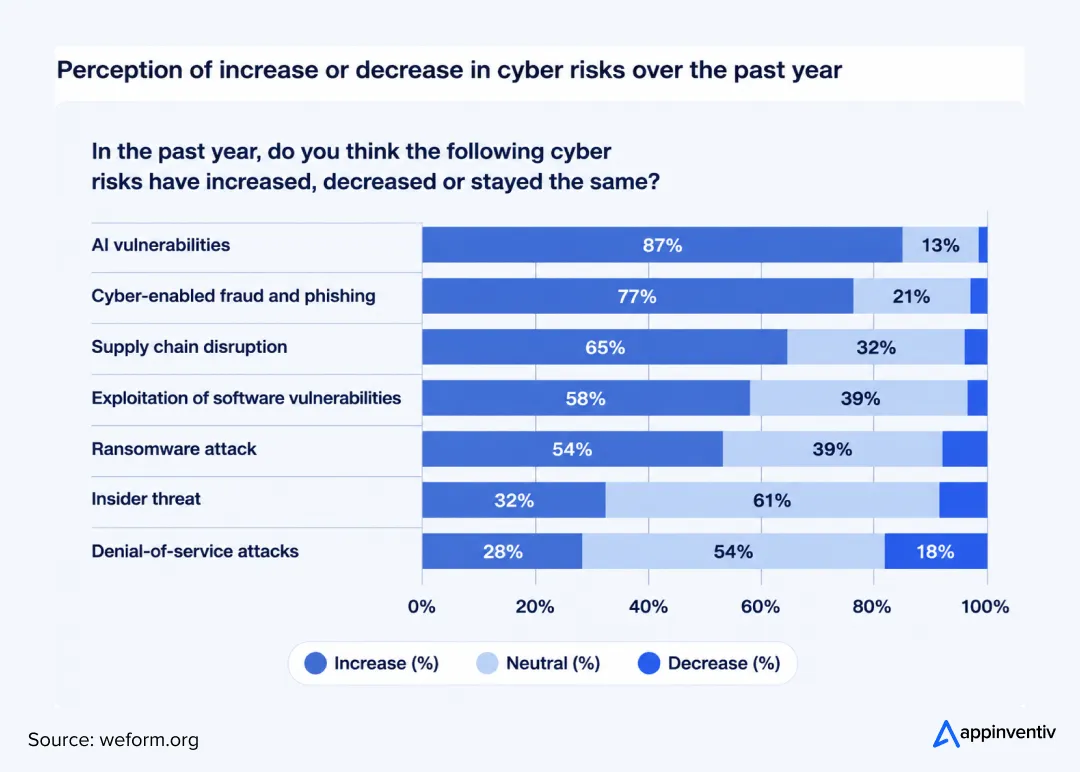
This change is also represented in the industry statistics. The WEF Global Cybersecurity Outlook 2026 states that 87% of respondents identified AI-related vulnerabilities as the fastest-growing cyber risk over 2025, highlighting how rapidly this new attack surface is expanding.
Penetration testing can be used to fill this gap by pretending to be adversarial in both conventional systems and AI-powered applications. It discovers exploit chains through APIs, authentication levels and infrastructure settings before they can be weaponized in the real world.
A Comprehensive View of the Costs Involved in Penetration Testing
It takes more than one number to make a realistic estimate. The penetration testing price is influenced by the complexity of the system, the extent of testing, the engagement model and the post-assessment work. This is divided into structured layers of costs as discussed in the sections below.
Breakdown of Costs by Level of Complexity/ Scope
Complexity is defined by the number of assets under test, connections between assets, and the amount of effort needed to test risks in environments.
| Level of Complexity/ Scope | Scope Description | Estimated Cost |
|---|---|---|
| Low | Single web application or minimal external surface | $5,000 – $10,000 |
| Moderate | Web + APIs + simple cloud or internal network | $10,000 – $30,000 |
| High | Several applications, cloud-based infrastructure, integrations, role-based access control systems | $30,000 – $75,000 |
| Enterprise | Distributed systems, hybrid cloud, microservices, third-party dependencies | $75,000 to $150,000 and above |
With the growth of complexity, coverage and validation depth grow directly, increasing the cost of penetration testing.
Breakdown of Costs by Stages of Testing
Penetration testing has a lifecycle. The stages add up to the total effort and the allocation of costs.
| Test Stage | Activity Description | Cost Contribution |
|---|---|---|
| Reconnaissance | Asset discovery, information gathering, attack surface mapping | 15% -25% |
| Scanning | Automated and manual vulnerability detection | 20% -30% |
| Exploitation | Trying to prove vulnerabilities and exploit them | 25% -35% |
| Post-Exploitation | Privilege escalation, lateral movement and impact validation | 10% -20% |
| Reporting | Reporting, risk analysis and remediation guidance | 10% -20% |
Companies considering the actual cost of penetration testing shouldn’t ignore the distribution of effort between these steps.
Standard Estimation Formula
In most cases, pricing is tied directly to effort, measured in person-days.
Total Cost = (Total Testing Days × Daily Rate) + Additional Cost Factors
Here is how each part is interpreted:
- Testing days are based on scope, system complexity, and the chosen testing approach
- Daily rate varies depending on the tester’s experience, location, and specialization
- Additional factors usually include compliance needs, retesting cycles, reporting requirements, and any tooling involved
Expanded Calculation Model
For more detailed estimates, teams often rely on a weighted approach that accounts for scale and efficiency.
Total Cost = [(Assets × Base Effort per Asset × Complexity Multiplier) ÷ Efficiency Factor] × Daily Rate + Add-ons
Breakdown of components:
- Assets refer to the number of applications, APIs, networks, or systems included in scope
- Base effort per asset is typically in the range of 1 to 5 days, depending on the type of asset
- Complexity multiplier adjusts effort based on environment difficulty
- Low: 1.0
- Moderate: 1.5 – 2.0
- High: 2.0 – 3.0+
- Efficiency factor reflects how prepared the environment is, including automation or prior knowledge, usually between 0.7 and 1.0
- Daily rate generally falls between $800 and $2,500 or more, depending on expertise
This approach is commonly used to form an initial estimate of the cost of penetration testing during early discussions.
Industry-Wise Penetration Testing Cost Breakdown
Prices for penetration testing vary across industries due to differing regulatory pressures, data sensitivity, and system architecture. Financial data, healthcare records, or other major digital platforms are such industries that demand more validation, which makes them more costly and labor-intensive.
| Industry | Scope Focus | Cost Estimate |
|---|---|---|
| Financial Services | Payment systems, banking apps, APIs, fraud vectors, compliance-heavy systems | $20,000 – $120,000+ |
| Healthcare | EHR, patient data systems, connected devices, compliance tests | $15,000- $70,000+. |
| eCommerce and Retail | E-commerce web platforms, APIs, payment gateways and integrations with third parties | $10,000- $60,000+. |
| SaaS & Technology | Cloud infrastructure, multi-tenant applications, APIs and access control systems | $15,000- $100,000+. |
| Government | Public systems, internal networks, critical infrastructure, legacy systems | $20,000 – $150,000+ |
The most common example to be found of penetration testing cost is financial services because of its high risk exposure and compliance. The healthcare sector is second as a result of regulatory demands and sensitive patient information. The cost of SaaS and e-commerce is different based on the extent of integration and the scale of the platform itself, which directly influences the cost of penetration testing services.
External penetration testing costs tend to be high in industries that have a large interdependence on third parties, since the testing should go beyond their systems. In general, the differences by industry justify why many organizations will tend to question how much does penetration testing costs because the response will largely rely on the industry-related risk and complexity.
Compliance-Wise Penetration Testing Cost Breakdown
Penetration testing costs are greatly influenced by IT compliance requirements. The most regulated settings need well-organized tests, evidence gathering, and reporting that are in compliance with audit standards. This adds work, time to document, and expert involvement.
| Compliance Domain | Scope Focus | Estimate of Cost Impact |
|---|---|---|
| Financial Compliance (PCI DSS, SOX, RBI requirements) | Payment systems, transaction flows, cardholder data environments and fraud controls | $20,000 – $100,000+ |
| Healthcare Compliance (HIPAA, HL7, GDPR in health systems) | Patient records, EHR systems, API security, data privacy validation | $15,000 – $80,000+ |
| Data Privacy Regulations (GDPR, CCPA, DPDP Act India) | Personal data processing systems, consent flows, data storage and access layers | $12,000 – $70,000+ |
| Enterprise Security Standards (ISO 27001, SOC 2 audits) | System-wide security controls, access management and audit compliance | $18,000 – $90,000+ |
| Government & Public Sector Compliance | Critical infrastructure systems, classified networks, controlled access environment | $25,000 – $120,000+ |
The scope rigidity and overhead of compliance-driven testing tend to drive the cost of engagement upwards explicitly, which can be attributed to the reporting overhead and its direct effect on engagement costs.
Infrastructure-Wise Penetration Testing Cost Breakdown
Infrastructure testing typically happens in terms of the systems that are behind applications. This encompasses servers, networks, cloud configurations and internal environments. The costs are dependent on the complexity and spread of the infrastructure, and the intensity with which testing should be carried out.
| Type of Infrastructure | Scoping Focus | Estimate of Cost Impact |
|---|---|---|
| On-Premise Network Infrastructure | Internal network, firewalls, routers, switches, segmentation tests, lateral movement tests | $15,000 – $80,000 |
| Cloud Infrastructure (AWS, Azure, GCP) | Cloud setup, IAM, storage security, misconfiguration, attack surface, review | $18,000 – $90,000+ |
| Hybrid Infrastructure Environments | Combined on-prem + cloud environments, interfaces, data flow security and inter-environment access | $25,000 – $120,000+ |
| Data Center Infrastructure | Physical and virtual servers, hypervisors, virtualization layers and internal network isolation | $20,000 to $100,000 and above |
| Zero Trust / Modern Enterprise Networks | Identity-based access control, micro-segmentation, continuous authentication layers and endpoint exposure | $22,000 – $110,000+ |
When the environments are poorly documented or distributed, infrastructure costs are likely to increase. Even basic misconfigurations may necessitate more validation cycles, further testing time and effort.
Also Read: Cost to Develop a Penetration Testing Tool Like Kali Linux
The Fundamental Factors Affecting Penetration Testing Costs
Penetration testing cost is never driven by a single variable. It is shaped by how large the attack surface is, how complex the system architecture has become, and how deeply the testing needs to simulate real-world adversarial behavior. Let’s have a look at the key factors affecting pentest cost:
Scope of Testing
The extent of the engagement is outlined in the scope. It is the only variable of cost that matters.
A small scope test of one web application needs a small amount of reconnaissance, exploitation, and reporting. Enterprise environments seldom do work alone, though. As soon as APIs, mobile applications, internal networks and third-party integrations are added, the attack surface grows exponentially.
Common objects of scope are:
- Web and mobile apps
- APIs and microservices
- Internet and intranet
- Storage and cloud infrastructure
- Access management and identity management
Estimated cost impact: $5,000- $100,000+ based on coverage.
Lack of a clear scope can result in either under-testing or later cost increases in the engagement.
Infrastructure Complexity
Infrastructure complexity reflects how systems are structured and interconnected. It has a direct influence on the overall penetration testing cost.
Simple environments with one application do not need much validation. Contemporary systems cut across hybrid cloud, containers, and distributed services, though. The more layers there are, the less it can be seen and the larger the attack surface.
Common complexity aspects entail:
- Hybrid and multi-cloud environments
- Containerized workloads and Kubernetes clusters
- Lateral movement paths and segmentation of the network
- Cross-environment authentication systems
Estimated cost impact: +20 to +80% of base testing costs.
The highly distributed environments make it more difficult to work on since they have wider validation requirements.
Compliance and Regulatory Requirements
Penetration testing is brought forward through the introduction of structured rigor brought about by compliance. It directly influences the price of penetration testing.
A simple test can concentrate solely on risk identification. Regulated industries require testing to be consistent with frameworks, must collect evidence, and facilitate audits.
Common compliance frameworks are:
- PCI-DSS for payment systems
- HIPAA for healthcare data
- ISO 27001 for information security management
- SOC 2 for service organizations
Estimated cost impact: $10,000 to $60,000 or more when it comes to requirements.
Compliance adds to the scope and reporting effort, and is, therefore, a necessary cost.
Testing Methodology
Testing methodology determines the level of engagement and direction. It has an effect on the price of penetration testing services.
With different testing approaches, simulated attacks are carried out across multiple real-world vectors. Some methods focus on external threats with no prior access, while others replicate insider risks or advanced persistent attacks that move across systems over time.
Typical testing methodologies include:
- Black-box testing
- Grey-box testing
- White-box testing
- Red team engagements
Estimated cost impact:
- Standard testing: standard pricing
- Red teaming: +50% to +200% increase
The sophisticated methodologies are more time-consuming, coordinated, and skillful.
Remediation Support and Reporting
Reporting specifies the way in which findings are presented and implemented. It has a direct impact on the cost of external penetration testing.
Simple reports provide limited context on vulnerabilities. Advanced vulnerability reporting involves both comprehensive analysis and reproduction instructions and guidelines on how to remediate.
Common reporting components are:
- Risk scoring and impact analysis
- Step-by-step reproduction details
- Remediation recommendations
- Stakeholder executive summaries
Estimated cost impact: $5,000 – $20,000+
The fixes, which are retested afterwards, add additional cost but guarantee closure.
Testing Frequency and Engagement Model
Testing frequency defines the frequency of conducting security testing. It is an important factor in determining the estimated network penetration testing cost.
One-time test gives us a real picture of vulnerabilities, whereas continuous or periodic testing ensures that systems are continuously validated as systems change and new threats arise.
Common engagement models are:
- One-time assessments
- Biannual or semi-annual testing
- Continuous security testing programs
- Major release testing on demand
Estimated cost impact: $8,000- $50,000+ per year based on the frequency.
Regular testing raises the total expenditure but enhances the security posture in the long run.
Team Expertise and Tooling
The effectiveness of testing is dependent on the level of experience of testers and tools. This has a direct impact on the total penetration testing cost.
Simple interactions can be based on automated solutions with less human verification. High-level teams are a combination of automation, extensive hand-testing, and domain knowledge.
Common expertise and tooling factors are:
- Certified hackers and security experts
- Use of automated scanning tools
- Hand exploitation and validation methods
- Availability of proprietary testing structures
Estimated cost impact: +15% to +70% depending on level of expertise.
Very experienced teams are more expensive initially but provide more in-depth and precise findings.
We have supported 300+ organizations across cybersecurity initiatives, delivering structured penetration testing and security assessments.

Overlooked or Hidden Costs in Penetration Testing Engagements
The majority of the estimates revolve around scope, assets and methodology. Practically, the penetration testing cost is not just the initial quote because there are other related activities that become apparent during the implementation. Knowing these hidden pen testing costs can prevent budget shortfall and late delivery.
Retest and Validation Cycles
Remediation is not always seen as a mandatory retest, yet in practice, this is how effective cybersecurity measures are validated. The vulnerabilities are not corrected once. The updates are implemented in phases, and a check must be performed after each phase to ensure that all risks are fully closed.
Retesting is not optional in controlled settings. It has to be with audit evidence and official closure of findings. This adds another cost layer, which is often overlooked in initial estimations.
| Retesting Scenario | Estimated Cost |
|---|---|
| Single application retest | $3,000 – $7,000 |
| Partial infrastructure retest | $5,000 – $12,000 |
| Full-scope retesting | $10,000 – $20,000+ |
Redoing is a major consideration in determining the extent of the cost of penetration testing because a series of validation tests is usual.
Internal Effort and Coordination
There is an unconscious expense in terms of internal participation. Penetration testing is not totally outsourced. The internal teams should be able to provide access, track activity, respond to the alerts, and to validate the findings.
Such initiatives are usually unplanned and operated alongside the normal functioning. Slow approvals, providing access, or interdepartmental coordination may lengthen engagement and raise indirect costs.
| Activity | Effort Impact |
|---|---|
| Access setup and environment prep | Medium |
| Live monitoring during testing | Medium to High |
| Post-test validation and triage | High |
This is an internal cost that is not often externally priced but is of direct consequence to the total cost of penetration testing.
Tooling and Environment Set-Up
The standard tools cannot be adequate to test. Sophisticated settings, authorized platforms and restricted access arrangements add more layers of costs that are not necessarily represented in early estimates.
In most situations, production systems are not testable. To ensure the authenticity of staging conditions, organizations need to develop environments as close to real life as possible, which adds complexity and expense to setup.
| Requirement | Estimated Cost |
|---|---|
| Commercial security tools | $2,000 – $8,000 |
| Staging or test environments | $3,000 – $10,000 |
| Secure access setup (VPN, jump) | $1,000 – $5,000 |
Such latent factors slowly add to the pentest cost, particularly in enterprise settings.
Third-Party and Integration Testing
External dependencies are complex, and they are usually underestimated. Applications are now based on APIs, SaaS services, and third-party systems, which cannot be directly controlled.
These integrations need more approvals, restricted testing periods and liaison with external vendors. These restraints augment time and labor.
| Integration Type | Cost Impact |
|---|---|
| External APIs and microservices | +10% to +25% |
| Payment gateways | +15% to +30% |
| SaaS and vendor platforms | +20% to +40% |
These drive up the average cost of penetration testing, especially when it comes to systems that are heavy in integration.
Remediation and Engineering Fixes
One of the highest hidden costs is remediation. Although testing is used to point out weaknesses, these weaknesses need to be corrected by engineering, which can cost as much as the testing itself.
Vulnerabilities do not exist in isolation in complex systems. A single issue may necessitate modifications to several services, configurations, or access controls.
| Fix Type | Estimated Cost |
|---|---|
| Minor configuration fixes | $2,000 – $8,000 |
| Application-level issues | $5,000 – $25,000 |
| Critical multi-system fixes | $20,000 – $50,000+ |
This step greatly raises the cost of penetration testing services, particularly when the critical risks are established.
Security Maturity Gaps
The other cost driver that is not very visible but significant is the security maturity of the organization. Poorly-visibility, weakly-controlled, and undocumented environments need further research.
There is more time spent by testing teams in mapping systems, determining dependencies and validating not clearly defined controls. This prolongs engagement periods and requires hard work.
| Gap Area | Cost Impact |
|---|---|
| Limited asset visibility | +15% to +30% |
| Weak access controls | +20% to +40% |
| Inadequate logging systems | +25% to +60% |
Such maturity gaps have a direct impact on the ultimate cost of penetration testing, and can make preliminary estimates seem lower than the reality.
How to Optimize Penetration Testing Costs
Optimizing penetration testing costs starts with clear scope definition and cyber risk management. By focusing on critical assets, removing redundant coverage, and aligning testing with actual threat exposure, organizations can control effort without reducing depth. Here’s a deeper look:
Define Scope Precisely
Having a distinct scope avoids wasteful work and uncovering. Testing is also focused and efficient when the assets, environments, and access levels have been determined in advance.
The ineffective scoping can result in reworking or mid-way project expansion at a higher cost. This is one of the key factors that influences how much does penetration testing costs in real scenarios.
Adopt Phased Testing
Phased testing enables organizations to spread the load across critical and non-critical systems rather than testing them all simultaneously. High-risk assets are evaluated first, providing early insight into significant weaknesses.
This will facilitate management of budget allocation in the long run and prevent excessive expenses at the outset. It can be very handy when it comes to controlling the overall cost of penetration testing services in a large environment.
Leverage Automation Where Appropriate
AI-powered automation aids in lessening human work during the initial stages of testing, particularly in scanning and baseline testing. Nevertheless, it must be used in addition to manual testing and not used instead because more profound validation needs to be done by a human.
Moderate stance enhances effectiveness without interfering with precision. This directly contributes to the external penetration testing cost control in complex systems.
Align Testing with Business Risk
The testing should be aligned with the most business-impactful systems. High-risk assets should not be prioritized at the expense of applications managing sensitive data or financial transactions, or core operations.
This will make sure that there is expenditure on areas where risk is the greatest. A risk-oriented strategy can be used to optimize the pentest cost without compromising its effectiveness.
Remediate Early
The initial budgeting process should incorporate remediation planning as opposed to an afterthought. Remediation of vulnerabilities can be coordinated between development and infrastructure teams, and may take longer to fix unless coordinated early in the process.
Timely resource allocation saves time and eliminates the repetition of testing cycles. This methodology makes the total cost structure predictable and eliminates increases beyond the starting penetration testing cost.
When Should You Do Penetration Testing
Penetration testing cannot be a one-off exercise. It is best fitted at certain stages of the system lifecycle, particularly when there is a risk change, or introduction of a new exposure. The test is not as important as the time.
| Situation | Why It Matters |
|---|---|
| Prior to a major product release | Hidden vulnerabilities in the code additions and changes are the norm and cannot be found by normal QA. |
| Following major code modifications or system enhancements | Application, API, or infrastructure updates may end up creating security holes unintentionally. |
| Prior to compliance audits or certifications | Most standards (e.g., PCI DSS, ISO 27001, or SOC 2) demand documented and verified evidence of security testing. |
| Misconfigurations in clouds after migration into clouds or hybrid environments | There are typical cloud misconfigurations that require specific verification. |
| Following security events or suspected attacks | Assists with determining the manner in which the attack took place and the existence of similar vulnerabilities. |
| Periodically (annually or quarterly) | Systems change constantly, and thus periodic testing is necessary, so that security does not decay with time. |
| External integrations before going live | There is usually an increase in the attack surface, which should be validated. |
As a matter of fact, penetration testing is effective when it is change-related. When changes happen in the environment, the risk profile changes accordingly, so should the testing.
We prioritize critical applications, APIs, and infrastructure layers instead of blanket coverage models.

Begin Your Security Validation Journey with Appinventiv
Cybersecurity is now an engineering control surface and not a perimeter control. The current distributed systems need continuous security verification using cyber security services, which exist in application layers, infrastructure structure, and data plane connections.
Penetration testing is a simulated adversarial emulation of exploitation paths, including attack surface enumeration, threat modeling, vulnerability chaining, and privilege escalation, as well as post-exploitation impact analysis. When configuration drift, dependency vulnerabilities and insecure deployment artifacts pose systemic risk, it is particularly concerning in CI/CD-driven environments.
Appinventiv conducts penetration testing as a comprehensive offensive security test in accordance with actual TTPs (tactics, techniques and procedures). During a single engagement, we fixed a breached Vibe-coded marketplace application developed with AI-assisted development pipelines, with insecure defaults being directly advanced into production without security gating.
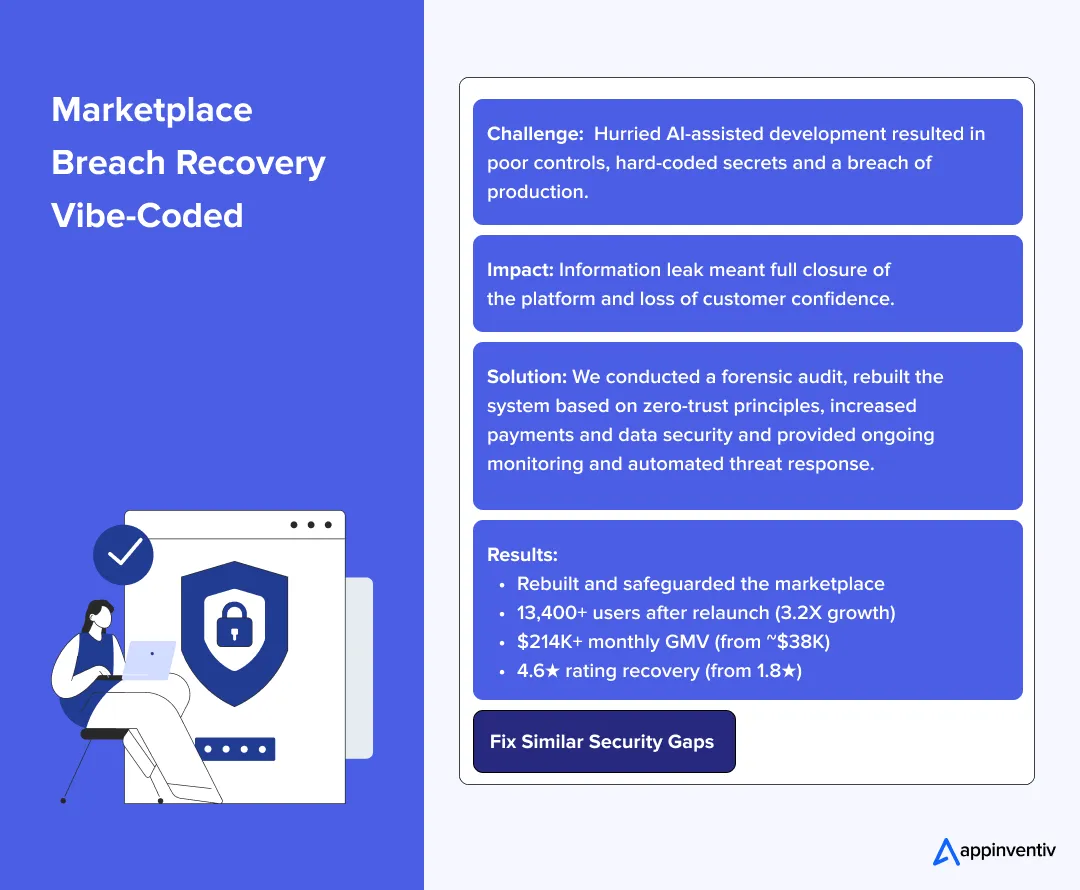
This is applied penetration testing that consists of exploit path discovery, authorization bypass detection, infrastructure hardening, and post-exploitation impact containment, as opposed to single vulnerability reporting.
For engineering-led organizations, penetration testing is a mandatory security control integrated into SDLC governance. Most enterprises engage a cybersecurity consulting company like Appinventiv to institutionalize adversarial testing frameworks, continuous security validation pipelines, and architecture-level threat resistance across evolving distributed systems.
FAQs
Q. What are some of the top penetration testing pricing models?
A. Some of the top penetration testing pricing models include:
- Fixed price model – An agreed cost is set with a well-defined scope and deliverables.
- Time and material model – Billing is calculated by actual hours and resources that are used in the process of testing.
- Subscription or retainer-based model – Continuous monthly or quarterly testing services with a fixed contract.
- Price based on scope of work – Cost would be determined based on the number of applications, APIs, and infrastructure components that are going to be tested.
- Asset-based pricing model – The pricing is determined on a per-asset basis, such as servers, endpoints, or IP ranges.
- Continuous penetration testing model – Recurring or real-time targeted testing that is part of development pipelines.
Q. How long does a penetration test take?
A. The duration of a penetration test is normally 3 to 15 business days, depending on the extent of the test, the complexity of the system and the level of test coverage. Small web applications can be developed in a matter of a few days, whereas enterprise environments that have networks, APIs, and cloud infrastructure have a longer cycle.
Reporting and validation also increase timelines, particularly where remediation verification and re-testing are a part of the engagement.
Q. What is the process for optimizing penetration testing costs?
A. Here’s how you can optimize network penetration testing cost:
- Decide scope accurately beforehand – Clearly specify assets, environments, and exclusions to reduce unwarranted testing overhead.
- Prioritize high-risk assets first – It is important to prioritize areas of critical systems, such as payment flows, authentication levels, and other data stores containing sensitive information.
- Avoid redundant testing cycles – Re-test components (not full-scope re-tests) that have been affected.
- Use staged testing strategy – Divide big environments into phases rather than testing all at the same time.
- Perform asset-based scoping – Testing should be based on major servers, APIs, and endpoints rather than have blanket coverage.
- Implement security as part of CI/CD pipelines – The earlier the security is identified by using automated scan the less time is wasted in doing penetration testing.
- Integrate compliance and security testing – Use penetration testing to match audit requirements to prevent redundant testing.
- Keep up-to-date system documentation – Accurate architecture maps save on discovery time and testing ambiguity.


Fast 2-minute response, fully NDA-protected.

Ecommerce Security: A Guide to Protecting Your Commerce Stack From Modern Cyber Threats
Key takeaways: Modern commerce stacks expand attack surfaces across APIs, cloud systems, third parties, payments, and customer identities. PCI DSS 4.0.1 compliance mandates strict client-side monitoring to prevent modern web-skimming and Magecart attacks. Strong ecommerce cyber security requires layered controls across architecture, identity, data, transactions, infrastructure, and integrations. Continuous testing, threat monitoring, AI-aware controls, and…

How to Hire the Right Cybersecurity Expert for Your Business
Key Takeaways Define the business risk before choosing a security title or engagement model. Match the role to the environment, whether the priority is cloud, application, compliance, incident response, or network defense. Evaluate cybersecurity professionals through relevant scenarios, practical tasks, evidence, and references. Compare permanent, consulting, managed, and hybrid models against the coverage the business…

How to Prevent Social Engineering Attacks in the Enterprise: Types, Examples, and Defense Strategies
Key takeaways: Social engineering attacks exploit human trust, making even well-secured enterprises vulnerable to a single convincing interaction. AI is making phishing, vishing, and impersonation attacks faster to launch, harder to detect, and easier to scale. Strong verification processes are essential, especially for credential resets, financial requests, and other high-risk actions. Phishing-resistant authentication, least-privilege access,…