

































CRM for the Automotive Industry: Key Features, Benefits, Use Cases & Best Platforms in 2026

 Share -



- 01How CRM for Automotive Is Changing Customer Management
- 02Automotive CRM Use Cases
- 03Key Features of Automotive CRM Software
- 04AI in Automotive CRM
- 05Automotive CRM Architecture and Integrations
- 06Benefits of CRM for the Automotive Industry
- 07Automotive CRM for Enterprise Stakeholders
- 08Best Automotive CRM Platforms in 2026
- 09How to Choose the Right Automotive CRM
- 10Automotive CRM Development and Implementation
- 11Automotive CRM Security and Compliance
- 12KPIs to Measure Automotive CRM Success
- 13Cost of Implementing an Automotive CRM
- 14Future of Automotive CRM
- 15Automotive CRM Services by Appinventiv
- 16Frequently Asked Questions

Key takeaways:
- Modern automotive CRM integrates VIN codes, vehicle ownership, sales activity, repair histories, finance logs, and telematics into a single profile.
- Consistent service department visits directly drive repeat vehicle purchases and protect ongoing dealership revenue.
- Artificial intelligence ranks sales leads, predicts repurchase schedules, identifies repair needs, and automates daily customer follow-ups.
- Core CRM systems link DMS, ERP, CDP, live inventory, finance tools, service bays, telematics feeds, and digital sales portals.
- Vehicle manufacturers, large dealer groups, and local showrooms require distinct software features based on their specific operating structures.
A vehicle sale is no longer an end transaction; it’s the beginning of a multi-year relationship that an automotive company builds with a customer. The journey of the buyer from researching and financing online to delivery, maintenance, connectivity and future renewals.
These customer moments are handled by automotive companies at dealerships, on their websites, in their mobile apps, through call centers, and across service networks.
This expanded customer cycle changes what leadership teams expect from customer relationship management software. A modern CRM for automotive businesses connects customer profiles with vehicle identification numbers (VIN), dealer activity, sales leads, and service history. The software links financial records and app usage data to provide a complete picture of each owner.
In 2026, Deloitte surveyed 28,500 buyers across 27 national markets. The study showed shifting brand loyalty and strong interest in customized features. The study also found strong interest in AI-driven personalization and connected vehicle features, alongside growing concern about data sharing. Enterprise CRM systems now unite sales teams, service centers, and retention programs around real customer data.
Service relationships directly influence repurchase potential, making connected CRM data a revenue priority.

How CRM for Automotive Is Changing Customer Management
Dealership revenues depend heavily on connecting post-purchase service directly to future vehicle sales. Cox Automotive found that 74% of buyers who returned for service bought their next vehicle from the same location.
That number dropped to 44% among buyers who took their cars to outside repair shops. The study showed that 88% of drivers base their next car purchase on their experience with the service department. These metrics prove that customer software must track ownership details long after the initial sale closes.
Dealerships must unite sales records, service logs, warranty claims, and finance agreements within a single database. Connected databases then automatically trigger service reminders, lease renewal offers, and targeted repurchase messages based on real vehicle usage.
Automotive CRM vs Traditional CRM
Standard CRM platforms manage basic contact lists, sales leads, user accounts, and direct email communications. CRM in Automotive systems extend beyond contact records by tracking vehicle identification numbers alongside specific dealership operations. These specialized platforms link buyer profiles directly to vehicle history, repair schedules, warranty coverage, and real-time telematics.
Automotive CRM vs DMS, CDP, ERP and Customer Service Platforms
Automotive companies use several software tools, including customer relationship management platforms, to manage distinct operational and technical responsibilities.
| System | Primary Role |
|---|---|
| CRM | Customer relationships, sales, service, and engagement |
| DMS | Dealer operations and transactions |
| CDP | Customer data unification |
| ERP | Finance and enterprise operations |
| Customer Service Platform | Support and case management |
Also Read: Automotive Digital Transformation – Benefits, Use Cases and Challenges for Modern Businesses
Automotive CRM Use Cases
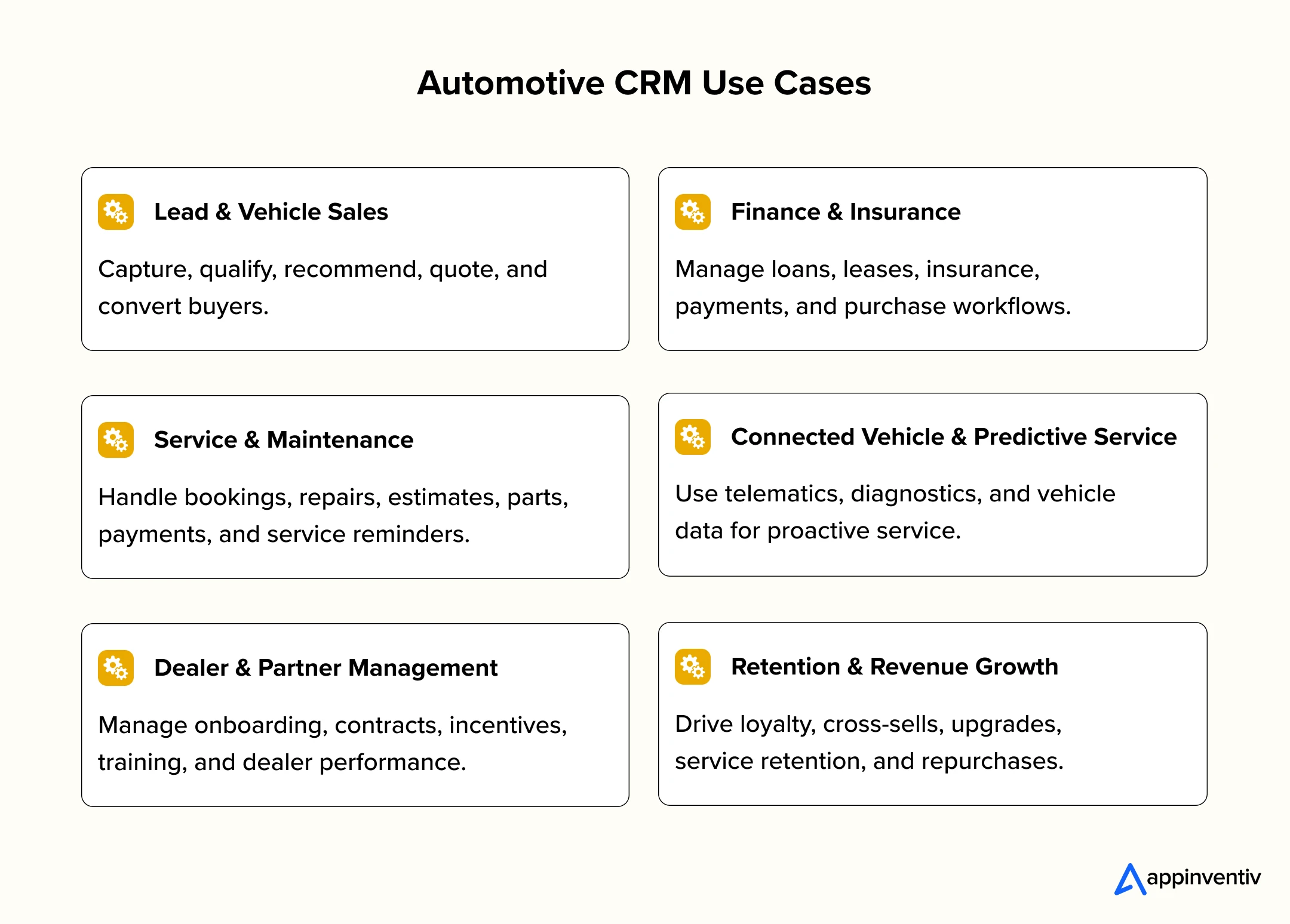
Automotive CRMs support buyers across the entire ownership journey, from early online research through repeat showroom visits.
Lead Management and Vehicle Sales
Automotive CRMs collect buyer leads across websites, campaigns, social channels, industry events, and showrooms. Sales teams qualify prospects, rank high-value buyers, recommend vehicles, schedule test drives, build quotes, and compare deal structures. Deal desking tools can present vehicle prices, financing terms, trade-in values, and monthly payment options during negotiations. Automated follow-ups handle routine outreach, while sales teams focus on active opportunities.
Finance, Insurance, and Purchase Management
CRMs connect car sales directly to financing and insurance tasks within single customer records. Staff monitor loan applications, credit approvals, payment histories, lease terms, and insurance policies on a single screen. Sales and finance departments can easily track purchase stages, speeding up loan processing and cross-selling relevant offers.
Vehicle Service and Maintenance
Service teams manage appointments, mechanic schedules, work orders, estimates, approvals, and payments using auto repair CRM software. Customers can use self-service portals to book appointments, review estimates, approve repairs, check service status, and make payments. The system tracks bay availability and sends service reminders through email, SMS, or other connected channels. It can manage parts inventory, loaner vehicles, transport schedules, and technician workflows from the same service environment.
Connected Vehicles, Diagnostics, and Predictive Service
Telematics integrations, often powered by digital twin technology, pull live vehicle health metrics directly into customer profiles. Systems process fault codes, mileage data, and diagnostic alerts to generate early maintenance reminders. Repair teams spot mechanical problems before drivers call for help. Past bookings, driving habits, and maintenance cycles help managers accurately predict upcoming service demand.
Dealer and Partner Management
Manufacturers manage dealership networks across territories using enterprise platforms. Corporate teams handle partner onboarding, licensing, contracts, training, pricing rules, incentives, and dealer support in a single platform. Executives compare sales volume, employee productivity, customer satisfaction, service quality, and network performance across locations while tracking dealer inventory.
Customer Retention, Loyalty, and Revenue Growth
Retention tools keep buyers connected long after their initial purchase. Marketing teams run loyalty rewards programs, send service notices, and promote extended warranties, insurance, or vehicle trade-ins. Direct customer feedback pinpoints operational problems, while vehicle ownership timelines highlight buyers nearing their next purchase.
Key Features of Automotive CRM Software
Automotive customer relationship management platforms consolidate customer profiles, vehicle histories, sales metrics, service logs, and dealer data into a single database.
- Customer and Vehicle 360: Among the core features of automotive CRM software, Customer and Vehicle 360 pairs buyer profiles directly with VIN records, ownership history, warranty terms, and repair orders.
- Lead and Opportunity Management: Software captures buyer inquiries, scores leads, assigns sales reps, schedules test drives, and tracks active deals.
- Dealer and Territory Management: Executives manage franchise networks, set sales targets, organize partner incentives, and monitor regional dealer performance.
- Inventory and Digital Retailing: Live vehicle inventory feeds online showrooms, vehicle configurators, price quotes, financing tools, and digital checkout workflows.
- Omnichannel Communication, Marketing and Customer Service: Integrated tools manage email, SMS, phone, chat, campaigns, customer requests, automated follow-ups, and service communications across connected channels.
- Customer Segmentation and Personalization: Data tools analyze buyer behavior, vehicle telemetry, and service records to develop personalized marketing messages.
- Service, Maintenance, Warranty and Parts Management: Service departments handle repair bookings, technician schedules, work orders, cost estimates, warranty claims, parts availability, and payments.
- Loyalty and Retention Management: Retention programs manage driver loyalty rewards, encourage service visits, offer vehicle upgrades, and drive repeat purchases.
- Workflow Automation: Powered by RPA in automotive, automated rules assign incoming leads, route approvals, trigger task reminders, escalate urgent issues, and process daily tasks.
- Analytics and Executive Dashboards: Powered by automotive analytics, dashboards track sales conversions, pipeline value, revenue forecasts, service retention, dealership performance, and key operational metrics.
- Mobile CRM and AI Capabilities: Field teams access data on mobile devices, and AI models score leads, predict maintenance, and analyze churn risks.
- Enterprise Security and Global Support: Security controls manage user permissions, encrypt sensitive data, track audit logs, and support global multi-currency operations.
AI in Automotive CRM
AI in Automotive adds predictive analysis and task automation to CRM in automotive software platforms. These tools help dealership teams act on buyer and vehicle data quickly.
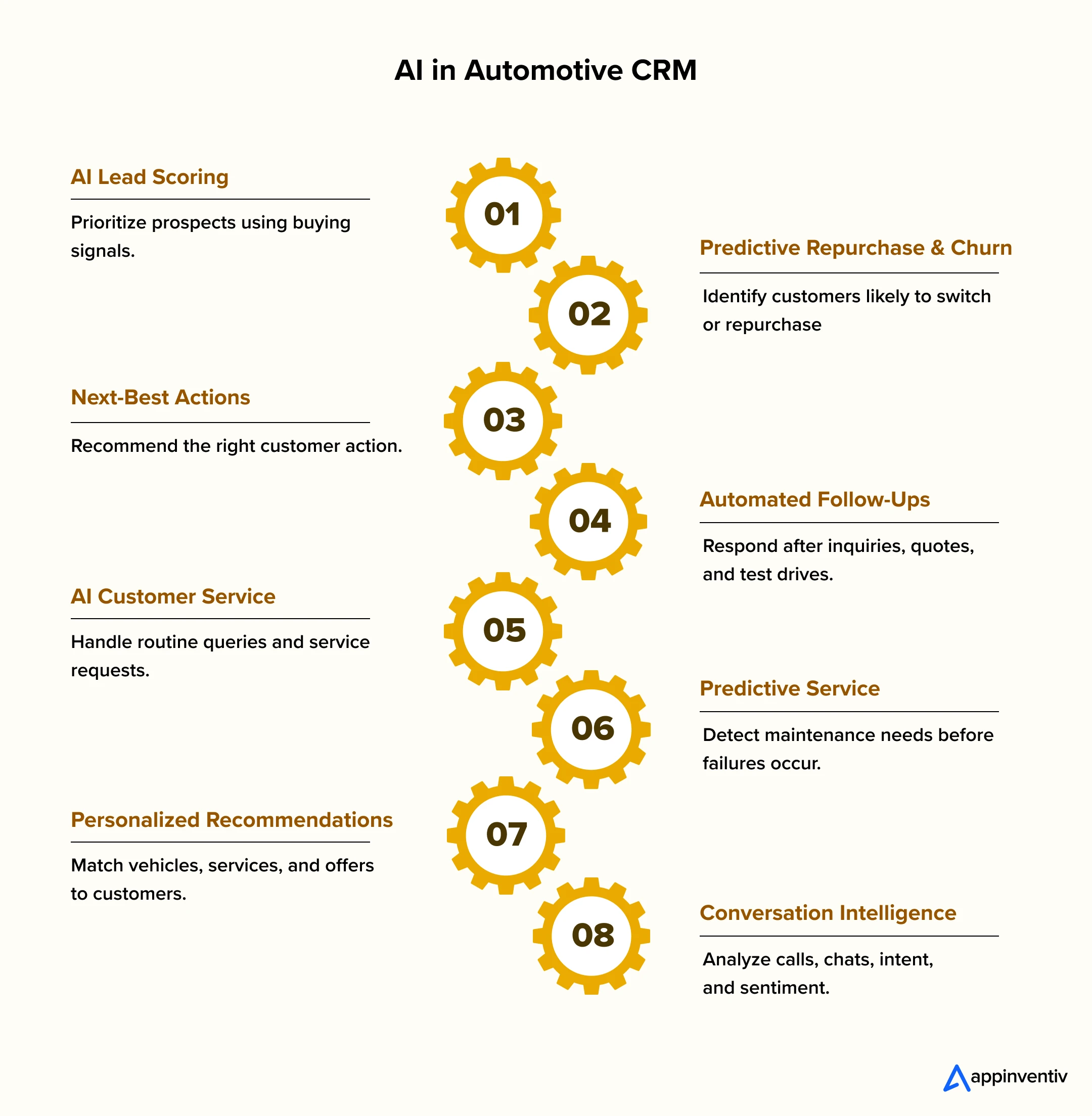
AI Lead Scoring
Systems rank prospects by evaluating website visits, vehicle preferences, and direct communications. Sales representatives prioritize prospective buyers displaying clear purchase intent.
Predictive Repurchase and Churn
Algorithms forecast when drivers will trade in vehicles or switch to competing brands. Retention teams use these timelines to launch targeted repurchase campaigns.
Next-Best Action Recommendations
Software guides daily staff activities by recommending specific follow-ups based on ownership tenure and recent service visits.
Automated Lead Follow-Ups
Automated workflows send immediate responses after test drives, missed calls, or online price quotes. The software automatically routes high-value prospects directly to senior representatives.
AI Customer Service Agents
Virtual assistants resolve routine questions about service appointments, repair statuses, and warranty details. The system transfers complex issues to human agents alongside full interaction records.
Predictive Service Outreach
AI-powered CRM optimization for automotive evaluates mileage logs, engine codes, and repair history to identify required maintenance. Software sends automated service invitations to vehicle owners before mechanical issues worsen.
Personalized Offers and Recommendations
Matching engines pair individual buyer profiles with suitable vehicle models, protection plans, and accessory packages.
Conversation Intelligence
Speech tools analyze recorded phone calls and chat logs to identify customer objections and buyer sentiment. Managers review these summaries to refine sales scripts and customer support.
AI Governance and Human Oversight
AI-driven CRM optimization for the automotive industry relies on system rules that enforce strict data permissions, audit tracking, and management approvals across automated workflows. Human managers review final pricing, financing terms, and sensitive customer decisions.
Automotive CRM Architecture and Integrations
Enterprise CRM in automotive is built around a single, secure data architecture that links customers, vehicles, dealerships, sales, service bays, finance, and digital channels. The software in modern cars receives live telematics data streams, connects sensor data to owner data files and automates tasks based on vehicle events.
Core Automotive CRM Architecture
Customer & Vehicle Data → CRM → Integration Layer → DMS / ERP / CDP / Marketing / Service / Finance / Connected Vehicle → Analytics & AI
The CRM manages customer-facing functions, while the integration layer communicates information between the dealer management systems, enterprise resource planning, telematics and finance applications. The integrated data layer brings together buyer data, vehicle assets and service history to power reporting solutions and machine learning applications.
Pre-built data structures from Salesforce Automotive Cloud include vehicle histories, extended warranties, sales leads, fleet records, insurance claims, and dealership networks.
Essential Automotive CRM Integrations
CRM integration for automotive systems keeps customer, vehicle, sales, finance, and service data synchronized across core platforms.
- DMS: Syncs dealership sales leads, active customer accounts, technician repair orders, and physical vehicle inventory.
- ERP: Connects accounting records via automotive ERP development, parts procurement tracking, supply chain metrics, and back-office enterprise operations.
- CDP and Data Platforms: Aggregates buyer profiles, vehicle telematics, financial transactions, and digital user behavior for customer segmentation.
- Inventory Systems: Pushes live vehicle availability, option packages, pricing tiers, and physical lot locations straight into sales workflows.
- Digital Retailing: Connects online vehicle search tools, custom build options, price quotes, credit applications, and dealership handoffs.
- Online Marketplaces and Lead Portals: Connect third-party automotive marketplaces and lead sources with CRM records, lead routing, attribution, and follow-up workflows.
- Telephony and VoIP: Connect calls, call logs, recordings, caller identity, and agent activity with customer and lead records.
- Finance and Insurance: Transfers loan applications, lease terms, monthly payment schedules, and active insurance coverage statuses between platforms.
- Marketing Platforms: Synchronizes audience groups, promotional campaigns, buyer journeys, privacy consent tracking, and engagement metrics across channels.
- Contact Centers: Combines phone calls, live chat transcripts, customer support tickets, and complete communication histories in unified screens.
- Service Systems: Tracks repair appointments, workshop work orders, mechanic schedules, warranty claims, and historical maintenance records.
- Connected Vehicle and IoT Platforms: IoT in automotive platforms ingests live telemetry, engine fault codes, dashboard diagnostics, mileage counts, and vehicle status changes to trigger immediate service notifications.
APIs, Data Exchange and Middleware
APIs and middleware link CRM software to external platforms using different data schemas, network protocols, and integration patterns. REST APIs manage standard web service requests, and event-driven messaging handles immediate vehicle triggers and buyer actions.
Middleware translates data structures across CRM, DMS, ERP, CDP, and connected telematics databases. Partnering with an experienced software development company cuts down custom programming work across complex software environments. Salesforce Automotive Cloud supports the STAR APIs for exchanging retail data, including buyer files, repair work orders, sales leads, dealer inventory, and vehicle specifications.
Benefits of CRM for the Automotive Industry
CRM for automotive connects customer records to dealership workflows, driving higher enterprise revenue, customer retention, and staff performance.
Higher Lead Conversion
Software captures inquiries across digital channels, rates buyer interest, and assigns leads to local sales reps. Swift follow-up communications convert digital inquiries into active showroom visits.
Better Customer Retention
Automotive CRM adoption benefits include centralized records tracking vehicle ownership terms, repair histories, owner preferences, and past communications. Dealership staff run targeted service notices and timely vehicle trade-in campaigns.
More Service Revenue
Service departments identify upcoming repair needs, suggest relevant maintenance options, and follow up after customer visits. Proactive communication increases repeated workshop visits and boosts service department earnings.
Higher Customer Lifetime Value
Unified systems connect vehicle sales, financing terms, repair history, accessories, warranties, and trade-in deals. Comprehensive records help teams cross-sell product upgrades and push vehicle repurchases.
Greater Dealer and Business Visibility
Executive dashboards monitor active sales pipelines, service volume, retention rates, and franchise performance scores, showing why CRM for the automotive industry matters at the enterprise level.
Automotive CRM for Enterprise Stakeholders
A single CRM for automotive enterprises must serve the different priorities of leadership, sales, marketing, technology, customer experience, and dealer operations.
| Stakeholder | CRM value |
|---|---|
| CEO | Revenue, retention, customer lifetime value |
| CMO | Customer data, campaigns, personalization |
| CSO | Pipeline, conversion, forecasting |
| Chief Customer Officer | Experience, loyalty, service |
| CIO / CTO | Integration, security, scalability, data governance |
| Dealer Leadership | Leads, sales, service, network performance |
Also Read: Enterprise CRM – Benefits, Features, Platforms, and Implementation Process
Best Automotive CRM Platforms in 2026
Choosing the right CRM software for the automotive industry depends on your operational model, existing software stack, network structure, and customization requirements. These six top automotive CRM software options serve vehicle manufacturers, enterprise dealer groups, and retail locations.
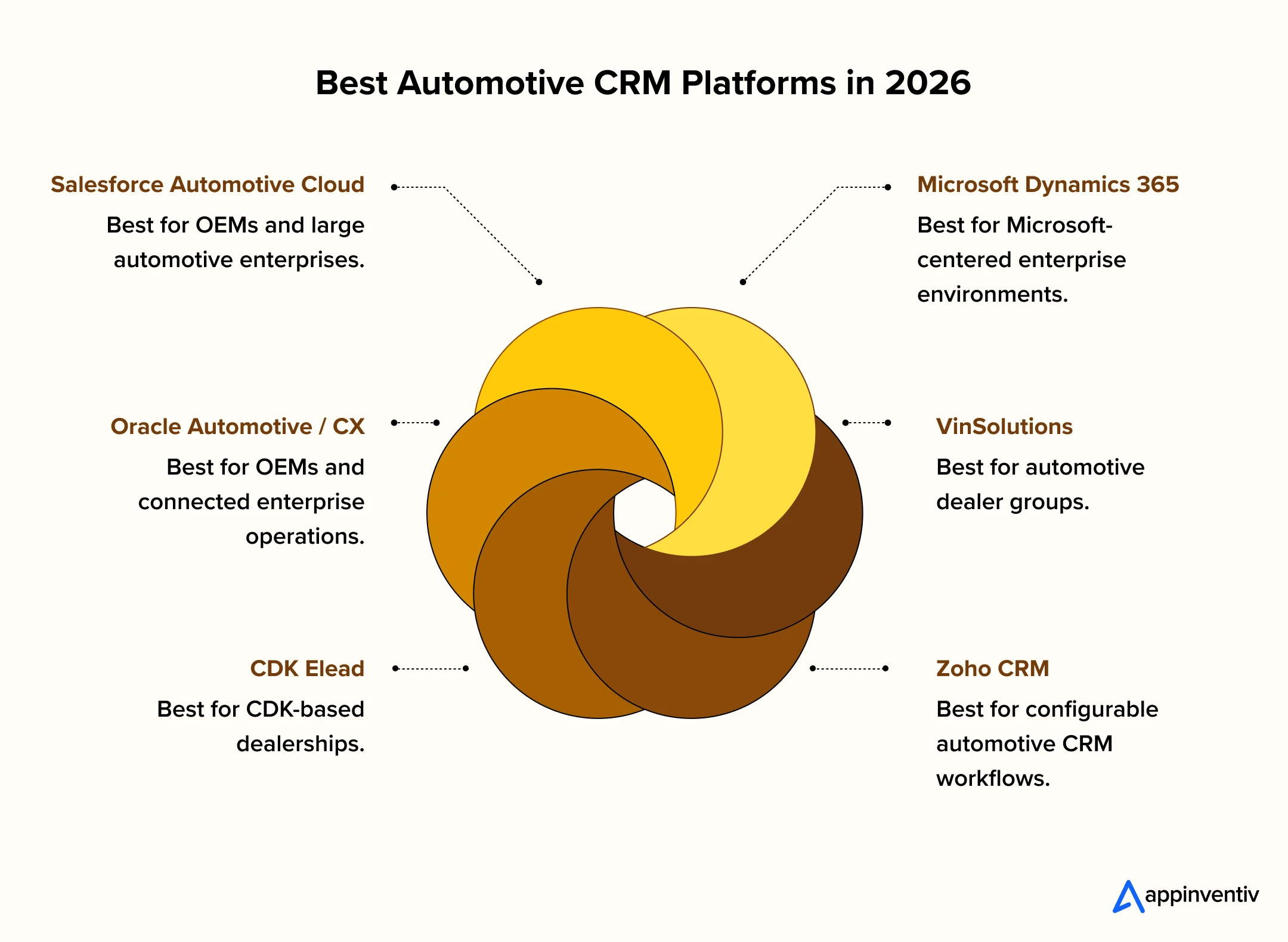
Salesforce Automotive Cloud
Salesforce Automotive Cloud serves manufacturers, retailers, dealership networks, and captive finance operations. The system combines driver profiles and vehicle records into central files covering sales, repairs, warranties, claims, and subscriptions. Built-in software agents process warranty claims, generate sales quotes, and handle lease renewals.
Pre-packaged data models manage vehicle assets, warranty coverage, claim records, and partner relations. Enterprise clients use MuleSoft tools to connect external databases and industry data standards. Its broad feature set suits complex enterprises, but implementation and integration costs can be higher than lighter CRM platforms.
Microsoft Dynamics 365
Microsoft Dynamics 365 targets companies that already run Microsoft business applications and cloud infrastructure. The software links buyer records and business operations across connected corporate applications.
Automotive groups select Dynamics 365 when core software requires direct connections to enterprise tools rather than isolated sales databases. It is particularly practical for enterprises already invested in Microsoft business applications and Azure services.
Oracle Automotive / Oracle CX
Oracle targets vehicle manufacturers and component suppliers with tools for sales, marketing, service, finance, and telematics. The software manages lead processing, warranty steps, customer loyalty programs, connected car messaging, and specialized buyer offers.
This architecture suits organizations connecting front-office sales tools with back-office accounting, supply chain, and factory databases. Its value is strongest for organizations that want CRM closely connected to Oracle’s wider enterprise software stack.
VinSolutions
VinSolutions focuses on retail dealerships and regional automotive sales networks. The platform connects sales profiles, repair logs, vehicle inventory, automated customer follow-ups, and Cox Automotive software tools.
Built-in analytical models identify active shoppers showing high purchase intent based on digital engagement patterns. Its focus on automotive retail makes it more relevant to dealer operations than broad enterprise CRM deployments.
CDK Elead
CDK Elead connects dealership customer databases with sales pipelines, service bays, marketing tools, and finance systems. The platform includes automated lead routing, communication summaries, central messaging tools, and direct video outreach.
Its Fortellis API network exchanges real-time buyer records and vehicle updates across third-party dealership software. Its strongest fit is with dealerships that already rely on CDK’s dealer technology ecosystem.
Zoho CRM
Zoho CRM offers configurable software combined with specialized automotive business workflows. Features include vehicle sales tracking, finance processing, repair scheduling, mechanic task lists, and telematics integrations.
The platform fits growing auto businesses wanting tailored industry workflows without the cost and complexity of a larger enterprise platform.
Automotive CRM Platforms Comparison
| Platform | Best Fit | Automotive Focus | Enterprise Scale | AI | Key Strength |
|---|---|---|---|---|---|
| Salesforce Automotive Cloud | OEMs, large automotive groups | High | Very high | Advanced | Customer and vehicle 360 |
| Microsoft Dynamics 365 | Large enterprises | High | Very high | Advanced | Microsoft integration |
| Oracle Automotive/CX | OEMs, suppliers, enterprise | High | Very high | Advanced | Enterprise CX and operations |
| VinSolutions | Dealer groups | Very high | High | Advanced | Automotive retail |
| CDK Elead | Dealers and dealer groups | Very high | High | Advanced | Dealer network tools |
| Zoho CRM | Automotive businesses seeking configuration flexibility | High | High | Advanced | Configurable CRM workflows |
Integrating Automotive CRM Platforms With Enterprise Systems
Software selection represents only one part of broader enterprise technology decisions. Automotive brands must link new CRM software to existing dealer systems, accounting software, customer databases, and telematics feeds.
Appinventiv builds these connections using custom API development, data translation, middleware layers, and real-time data sync. These technical services link new sales platforms to corporate databases while preserving existing business operations.
Build the APIs, middleware, data flows, and integrations needed to make your selected CRM work across the enterprise.

How to Choose the Right Automotive CRM
Knowing how to choose the right CRM requires aligning with corporate operational needs, existing software infrastructure, data requirements, and long-term expansion goals.
- Define Business and Customer Journeys: Map complete sales, repair, financial, ownership, and trade-in operations before software evaluation.
- Map Existing Systems and Data: Catalog active dealer management systems, enterprise databases, customer platforms, inventory feeds, and legacy tools requiring platform connections.
- Evaluate Automotive-Specific Capabilities: Verify native automotive CRM capabilities including VIN records, vehicle asset histories, dealership workflows, repair orders, warranty terms, and telematics feeds.
- Check Integration and API Support: Review application programming interfaces, pre-built connectors, middleware options, data protocols, and real-time synchronization capabilities.
- Assess AI and Analytics: Analyze lead ranking tools, predictive maintenance alerts, customer intelligence dashboards, automated recommendations, and data control policies.
- Evaluate Security and Compliance: Examine access permissions, data encryption, audit trails, privacy consent tracking, local data hosting, and regional regulatory compliance.
- Check Scalability Across Markets and Business Units: Confirm multi-country operational support across local currencies, regional languages, subsidiary brands, dealer networks, and permission tiers.
- Compare Total Cost of Ownership: Calculate expenses covering software licenses, custom coding, system integrations, data migration, user training, cloud hosting, and technical support.
- Run a Proof of Concept: These automotive CRM platform selection guidelines end with testing candidate software using actual customer profiles, live workflows, integrated databases, and user roles before enterprise deployment.
Automotive CRM Development and Implementation
Implementing CRM software for the automotive industry configures commercial software around business processes, user roles, and data flows. Custom development builds tailored features when native platform capabilities fall short of specific operational demands.
Automotive CRM Development Process
Structured execution builds system architecture, connects corporate software, validates workflows, and deploys software without disturbing daily operations.
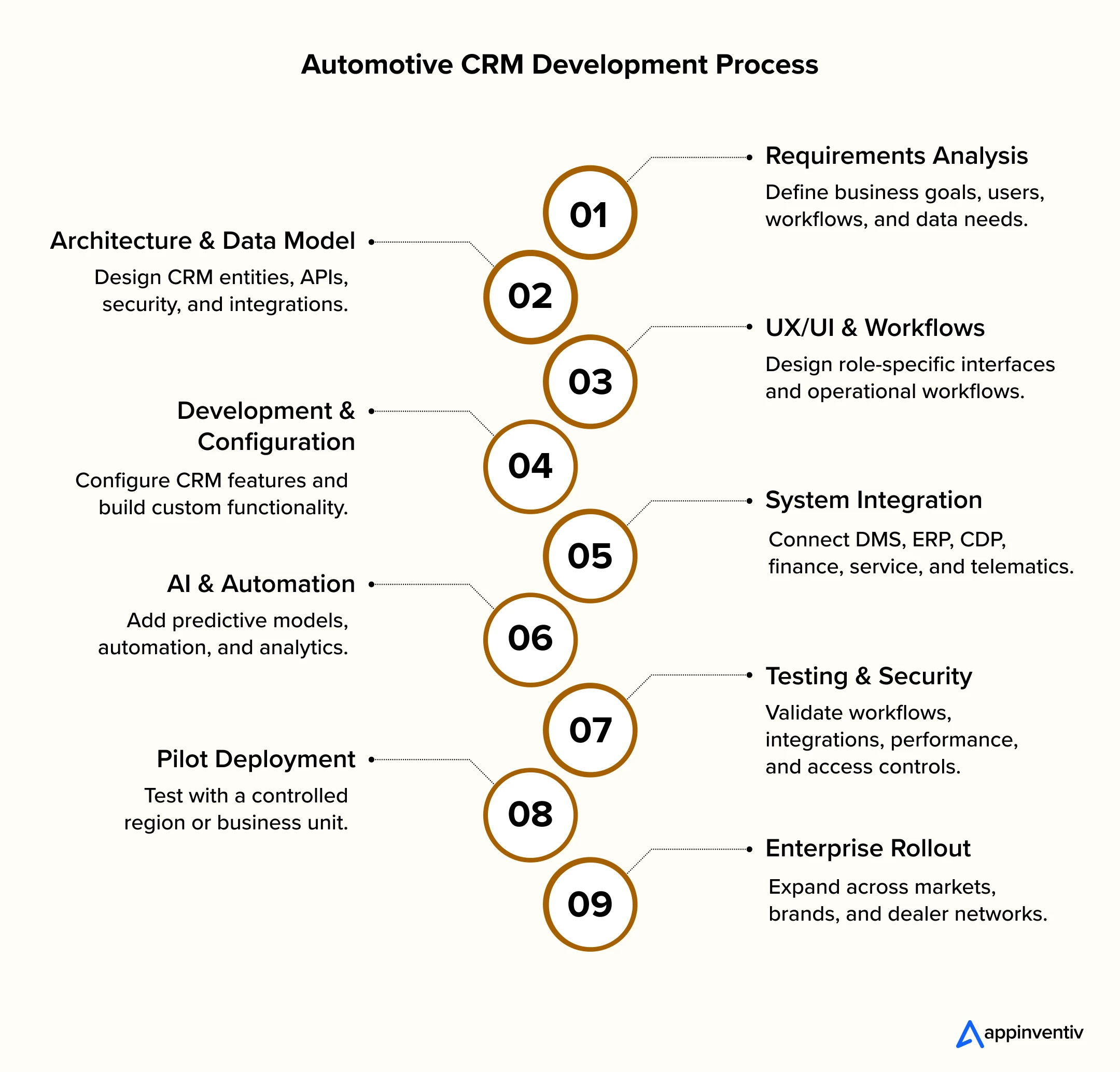
Step 1. Business and Requirements Analysis
Implementation teams define business goals, buyer journeys, and daily operations across sales, service, finance, dealer management, marketing, warranty, and customer retention. Project managers map current workflows, identify manual tasks, pinpoint gaps in functional software, and list technical requirements.
Step 2. Data Model and CRM Architecture
Engineers structure system data models around buyers, vehicle records, VINs, dealerships, active leads, repair histories, warranty contracts, insurance claims, and finance accounts. Technical leads define application architecture, database schemas, API layers, security authentication, cloud hosting, and integration boundaries.
Step 3. UX/UI and Workflow Design
Designers build tailored interfaces for sales reps, service advisors, dealership teams, marketers, and executive leaders. Product teams map step-by-step paths for lead routing, test drives, price quotes, service bookings, management approvals, urgent alerts, and buyer communications.
Step 4. CRM Configuration and Custom Development
Developers set up standard software modules before writing custom code for unique business needs. Businesses often hire CRM developers to create specialized data objects, dealer web portals, buyer portals, reporting dashboards, service management tools, mobile applications, and proprietary business logic.
Step 5. Enterprise System Integration
Engineers link CRM databases with DMS, ERP, CDP, inventory feeds, finance systems, contact centers, payment gateways, and telematics platforms. Systems exchange records through REST APIs, webhooks, middleware, event pipelines, or scheduled data feeds. Developers establish clear data ownership, sync schedules, error logging, and reconciliation rules for every connected application.
Step 6. AI, Automation and Analytics
Teams add intelligent capabilities after stabilizing core data structures and daily workflows. Platforms process lead ranking, predictive maintenance alerts, customer churn metrics, call transcripts, and automated messaging. Developers build executive dashboards to track sales velocity, repair-bay productivity, dealership rankings, and customer retention rates.
Step 7. Testing and Security Validation
QA specialists test operational workflows, software integrations, API performance, data migration scripts, permission tiers, and mobile displays. Security engineers verify user authentication protocols, data encryption standards, API access controls, audit logs, and driver privacy protection.
Step 8. Data Migration and Quality Checks
Data teams clean and align legacy customer files, vehicle records, sales pipelines, repair orders, warranty terms, and dealer directories. Technicians run duplicate removal, field validation checks, record reconciliation, and test migrations to match new database schemas against legacy files.
Step 9. Pilot Deployment
Engineering teams launch software in a single geographic region, selected dealership network, or specific business division. System administrators monitor platform speed, user activity rates, data accuracy, completed tasks, and integration bugs to resolve issues before full launch.
Step 10. Enterprise Rollout and Continuous Improvement
Operations teams deploy software across remaining territories, corporate brands, and dealership networks in scheduled phases. Leadership tracks software adoption rates, system health, conversion statistics, repair volume, and platform performance to continuously refine workflows, automated rules, and reporting tools.
When to Customize an Existing CRM
Tailoring commercial platforms to organizations whose operational needs align with core software features. Engineering teams build custom fields, specialized data objects, business rules, dashboards, integrations, and web portals without having to build platform architecture from scratch. This strategy suits enterprise groups deploying Salesforce, Microsoft Dynamics 365, Oracle, or Zoho while retaining active DMS, ERP, finance, and telematics systems.
When to Build a Custom Automotive CRM
Choosing to build custom CRM software serves organizations operating unique business models, multi-brand portfolios, extensive dealer networks, complex service structures, or legacy infrastructure. Custom platforms give companies complete ownership over database schemas, internal workflows, software integrations, user experiences, and hosting environments. Proprietary development requires higher financial capital and ongoing resources for programming, testing, security updates, and server maintenance.
| Requirement | Configure Existing CRM | Custom Development |
|---|---|---|
| Standard sales workflows | ✓ | |
| DMS and ERP integration | ✓ | ✓ |
| Proprietary workflows | ✓ | |
| Custom customer or dealer portal | ✓ | |
| Unique data model | ✓ | |
| Standard reporting | ✓ | |
| Highly specialized automation | ✓ |
Automotive CRM Security and Compliance
Automotive software centralizes buyer files, VIN records, financial contracts, repair histories, and live telematics streams. Enterprise platforms require technical controls that protect proprietary records across users, connected systems, international territories, and automated workflows.
Customer and Vehicle Data Protection
Data policies safeguard owner profiles, VIN records, repair histories, loan terms, and telemetry feeds during storage and network transmission. IT teams apply strict classification schemes, network safeguards, and database permissions matched to data sensitivity levels.
Role-Based Access and Identity Management
Security policies restrict file access by job title, business division, dealership location, geographic territory, and file category. Systems enforce single sign-on, multi-factor authentication, federated identity tools, and least-privilege user permissions across corporate teams.
Data Encryption and Audit Trails
Security protocols encrypt sensitive files at rest in databases and in transit across network channels. System logs track record requests, database modifications, administrator commands, API calls, and security incidents.
Consent and Privacy Management
Central software records customer permissions for marketing messages, direct calls, GPS tracking, and connected car features. Operational workflows process consent updates, communication preference changes, driver data requests, and mandatory record destruction schedules.
Regional Compliance and Data Residency
Global vehicle brands comply with distinct international privacy laws and regional data protection mandates. System architecture enforces local data residency rules, regional access restrictions, required retention windows, and controlled cross-border data transfers.
AI and Connected-Vehicle Data Governance
Governance rules determine which buyer profiles and vehicle feeds machine learning tools process. Security teams establish model access parameters, track logs, conduct human reviews of automated decisions, and implement explicit controls over telematics and diagnostic streams.
KPIs to Measure Automotive CRM Success
Automotive enterprises should track CRM for automotive performance across sales, marketing, service, customer retention, operations, and revenue.
| Area | Key KPIs |
|---|---|
| Sales | Lead conversion rate, lead response time, sales cycle length |
| Marketing | Customer acquisition cost, campaign conversion rate, marketing ROI |
| Service | Service retention rate, repeat visits, service revenue |
| Customer | Customer retention, churn rate, customer lifetime value, NPS, CSAT |
| Operations | CRM adoption rate, workflow automation rate, data completeness |
| Executive | Revenue per customer, repurchase rate, CRM ROI |
Cost of Implementing an Automotive CRM
Platform licensing, total seat counts, custom software engineering, and deployment scale drive overall investments in CRM in automotive. The provided financial estimates offer baseline planning figures rather than binding estimates.
| Cost Component | What Affects the Cost | Typical Cost Range |
|---|---|---|
| CRM Licensing | Users, modules, platform, subscription tier | $5,000–$100,000+ per year |
| Configuration | Workflows, roles, business processes | $5,000–$30,000 |
| Custom Development | Custom features, modules, portals, applications | $20,000–$150,000+ |
| Integrations | DMS, ERP, CDP, finance, service, telematics | $10,000–$100,000+ |
| Data Migration | Data volume, cleansing, mapping, legacy systems | $5,000–$50,000+ |
| AI and Analytics | Models, automation, dashboards, data processing | $10,000–$100,000+ |
| Security | Identity, compliance, encryption, audit controls | $5,000–$40,000+ |
| Training | User count, roles, regions, rollout scope | $3,000–$20,000+ |
| Support and Maintenance | Monitoring, updates, support, ongoing development | $10,000–$50,000+ per year |
Also Read: How to Build Automotive Software? Types, Features, Process, Costs
Custom enterprise automotive CRMs require budget commitments ranging from $100,000 to over $500,000 depending on active market territories, user seats, and system connections.
Standard software benchmarks show basic custom builds starting at around $15,000, yet complex automotive implementations that require real-time DMS, ERP, telematics, and multi-region capabilities demand larger financial investments.
Enterprise software budgets depend far more on integration depth, custom code requirements, data migration, security protocols, and operational scale than basic software subscription fees alone.
Build a technical roadmap covering data, APIs, workflows, AI, security, integrations, and enterprise deployment.

Future of Automotive CRM
Automotive platforms will connect real-time telematics, buyer behavior, automated AI features, and evolving sales channels. Industry focus moves from static database entries toward immediate action based on active vehicle signals.
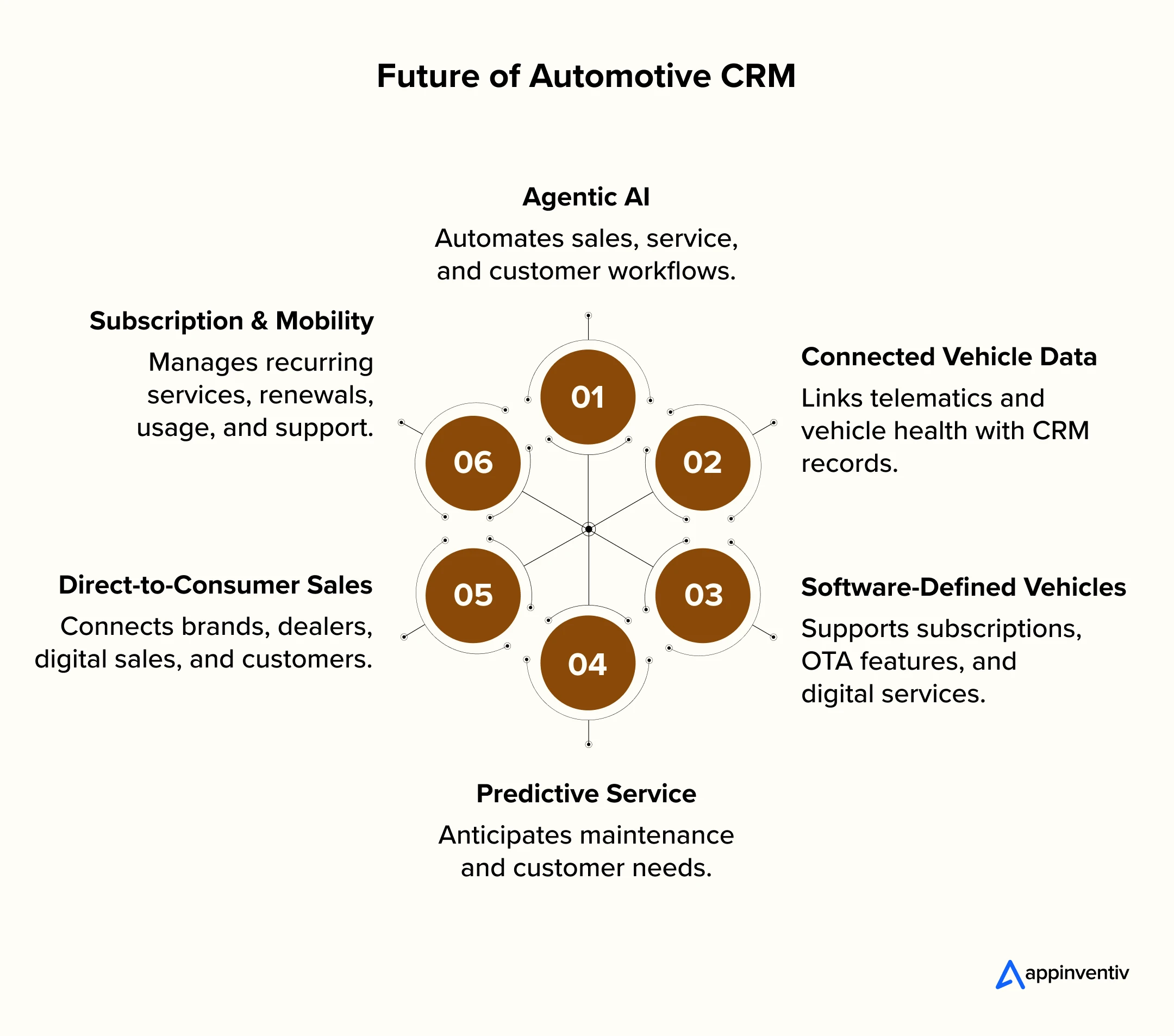
Agentic AI and Autonomous CRM Workflows
Automated AI agents handle initial prospect qualification, routine outreach messages, appointment bookings, and standard service requests. Staff members concentrate on high-value sales negotiations and complex customer decisions.
Connected Vehicle Data and Customer 360
CRM tools merge buyer profiles with live telematics feeds, engine diagnostics, mileage data, and ownership records. This combined view drives timely communication across all ownership stages.
Software-Defined Vehicle Experiences
Modern vehicles rely heavily on software functions and over-the-air performance updates. As part of a broader software-defined vehicle strategy, CRMs link driver feature usage to recurring software subscriptions, accessory purchases, technical support, and driver preferences.
Predictive Service and Personalization
Predictive software forecasts upcoming maintenance windows, customer defection risks, vehicle replacement timing, and product interests. The system then automatically launches repair reminders, trade-in campaigns, and targeted purchasing offers.
Direct-to-Consumer and Agency Models
Automotive manufacturers are managing direct buyer relationships and online ordering channels. CRMs coordinate direct sales channels, dealer commission structures, vehicle pricing, customer notifications, and order processing.
Subscription and Mobility Services
Vehicle subscription plans, connected feature packages, and shared mobility options demand specialized CRM structures. These systems handle recurring membership contracts, renewal cycles, usage tracking, monthly billing, and driver support.
Automotive CRM Services by Appinventiv
Automotive companies require technical services beyond basic software licenses to unify sales, service bays, dealership networks, and buyer touchpoints. Appinventiv designs, builds, connects, migrates, deploys, and automates CRM infrastructure around existing enterprise software architectures, backed by custom CRM development services tailored to each client’s operational needs.
Our teams have modernized more than 150 vehicle platforms and delivered over 800 over-the-air updates. Engineering work includes 80 CAN Bus and AUTOSAR integrations, 65 battery management systems, 80 connected fleet deployments, and 40 automotive AI models running in live production environments.
| Appinventiv CRM Service | Focus |
|---|---|
| CRM Consulting & Strategy | Define technical software roadmaps, evaluate platforms, map dealership workflows, and design system architectures. |
| Custom CRM Development | Build specialized data modules, dealer portals, buyer interfaces, reporting dashboards, and tailored software workflows. |
| CRM Integration Services | Link platforms such as Salesforce, Dynamics 365, Oracle, Zoho, VinSolutions, and CDK to core DMS, ERP, CDP, finance, and marketing systems. |
| CRM Migration & Data Cleanup | Transfer customer, vehicle, sales, repair, and dealer records while running data mapping, cleaning, deduplication, and validation. |
| CRM Implementation Services | Configure selected software, establish permission tiers, connect operational databases, conduct system testing, and manage deployment. |
| Mobile CRM Solutions | Deliver secure mobile access to customer profiles and vehicle histories for sales staff, repair advisors, and field teams. |
| CRM Workflow Automation | Automate lead distribution, prospect follow-ups, management approvals, maintenance reminders, urgent alerts, and daily tasks. |
Appinventiv enhances active software investments without requiring complete system replacements. Automotive companies upgrade existing setups, link isolated databases, and build specialized features when standard platforms meet technical limits.
Let’s connect and move from CRM records to automated automotive sales and service workflows.
Frequently Asked Questions
Q. How can automotive CRM software help improve customer retention?
A. CRM for the automotive industry combines customer, vehicle, sales, and service records into a single profile. This unified data helps dealerships track maintenance needs, dispatch service alerts, and launch trade-in campaigns. Marketing teams categorize owners using vehicle age, repair history, purchase records, and brand engagement. Unified records guide sales and service personnel to timely outreach throughout the ownership lifecycle.
Q. What is the typical timeframe for implementing CRM software?
A. Implementation schedules for CRM software for the automotive industry range from several weeks to many months depending on technical scope. Standard deployments using native features complete quickly. Enterprise builds require extended timelines due to DMS integrations, ERP connections, legacy data migration, security checks, and multi-region rollouts. Phased launch schedules allow companies to deploy core features while technical teams build advanced capabilities.
Q. What is the cost of implementing an automotive CRM?
A. Total investment levels depend on user counts, custom software requirements, database connections, data migration, and rollout scope. Standard software setups cost tens of thousands of dollars, whereas complex enterprise deployments exceed several hundred thousand dollars. Custom software builds require larger budgets when projects include proprietary workflows, custom mobile tools, predictive models, and international operations.
Q. Can CRM integrate with DMS and ERP systems?
A. Automotive platforms integrate with DMS and ERP systems via application programming interfaces, middleware layers, webhooks, and data pipelines. System connections synchronize customer files, vehicle records, physical inventory, sales activity, repair histories, and accounting data. Integration designs define clear data ownership, update frequencies, error protocols, security authentication, and reconciliation rules across connected applications.
Q. How is AI used in automotive CRM?
A. Artificial intelligence processes lead scoring, product recommendations, predictive maintenance, customer defection risks, repurchase timing, and automated communications. Machine learning models analyze buyer activity, vehicle records, and repair histories to direct immediate staff actions. Automated virtual agents field routine customer inquiries, while predictive models pinpoint mechanical service needs and drivers nearing trade-in windows.


Fast 2-minute response, fully NDA-protected.

The Ultimate Guide to CRM for Insurance: Features, Cost, Top Platforms, Integration & More
Key takeaways: CRM for insurance connects sales, service, and claims into one governed system, distinct from the policy administration system. Core features span pipeline management, policy visibility, claims tracking, commission management, AI analytics, and compliance controls. Cost ranges from roughly USD 15,000 for configuration to USD 150,000 and beyond for custom development at enterprise scale.…

How to Choose a Technology Partner for Government Software Development
Key takeaways: Evaluate the partner across five layers: procurement eligibility, assurance, engineering, delivery and long-term ownership. Choose a government technology partner on evidence, governance and delivery depth, not development capability alone. Match partner evaluation criteria to the security, integration and operational risks of the programme. Treat data sovereignty, privacy, accessibility and security as architecture decisions…

Distributed Energy Resource Management System: Use Cases, Development and Implementation Costs
Key takeaways: Australian grids require robust software to manage minimum system load events effectively. DER integration software aggregates, monitors, and dispatches varied grid edge hardware securely. CSIP-Aus and AEMO compliance dictate strict architectural and cybersecurity software foundations. DERM development and implementation costs typically range from AUD 70,000 to 700,000 +. Successful DER programmes start with…