



















API Integration in Australia: Connect ERP, CRM and Legacy Systems

 Share -


- 01The API Types Behind Enterprise Integration: REST, SOAP, GraphQL and Events
- 02Which Systems Should Enterprises Connect Through APIs?
- 03API Integration Architecture: Which Approach Fits Your Enterprise?
- 04What Enterprises Gain When Their Systems Finally Talk to Each Other
- 05How to Integrate ERP, CRM and Legacy Systems Through APIs
- 06Where API Integration Projects Face Challenges and How to Overcome Them?
- 07API Security, Privacy and Compliance in Australia
- 08How Much Does API Integration Cost in Australia?
- 09Emerging API Integration Trends in 2027 and Beyond
- 10How Appinventiv Approaches API Integration
- 11FAQs

Key takeaways:
- API integration lets legacy, ERP and CRM systems share data without a risky full replacement.
- A seven-step roadmap, from system audit to ongoing API management, keeps delivery controlled and maintainable.
- Privacy Act reforms, APRA CPS 230 and SOCI Act shape integration design early.
- API integration cost ranges between AUD 70,000 and AUD 700,000 or more.
Your finance team is closing the month using one system’s numbers. Sales is forecasting from another, while customer contracts sit in a legacy platform that neither team can easily access. Employees fill the gaps with spreadsheets, repeated data entry and manual checks.
Sound familiar? The biggest pain point for most organisations today is that nobody has a current map of what talks to what. This is what disconnected enterprise systems look like in practice. The problem becomes more difficult when organisations introduce cloud applications, analytics or AI without fixing the underlying data flows.
This is exactly where custom API development and integration comes in. API integration in Australia connects your existing business applications so that data and processes can move between systems with far less manual intervention. For enterprises, this offers a practical route to modernisation without replacing every core platform at once.
Ready to sort out your tech stack? Let’s get started.
Identify where disconnected ERP, CRM and legacy systems are creating delays, duplicate data and unnecessary manual work.
The API Types Behind Enterprise Integration: REST, SOAP, GraphQL and Events
The right API type depends on who consumes it and how fast data must move. So, before you invest, it is essential to understand the types of APIs doing the heavy lifting behind the scenes.
| API type | Best suited to | Typical use |
|---|---|---|
| REST APIs | Web and mobile services | To connect web apps, CRMs, ERPs and cloud services |
| SOAP APIs | Regulated, contract-heavy transactions | Older ERP and banking interfaces |
| GraphQL | Flexible queries across sources | Apps that need information from multiple related records. |
| Event and webhook | Real-time notifications | Order or payment status triggers |
Which Systems Should Enterprises Connect Through APIs?
Not everything needs to be connected, but certain core systems are absolutely critical for operational flow. You should start where manual effort and risk are highest, usually finance, customer and payment systems, then bring legacy platforms in once the pattern is proven.
ERP integration
Think SAP, Oracle, Microsoft Dynamics 365, or TechnologyOne for the public sector. Integrating your ERPs ensures that finance, procurement, inventory, and payroll flows happen automatically. No more manual invoice matching.
CRM integration
Platforms like Salesforce, Dynamics, and HubSpot hold the keys to your customer relationships. Connecting your CRMs gives your team a true customer 360 view, smoothing out the quote-to-cash process and ensuring clean service handoffs.
Data platforms and analytics
Your data warehouse or data lake is useless if it’s starved of information. APIs feed real-time or batched data from operational tools into your analytics platforms, giving leadership actual, up-to-date business intelligence.
Payment Gateways
Whether it’s Stripe, PayPal, or institutional bank feeds, integrating payment gateways is essential for real-time transaction processing, automated receipts, and end-of-day ledger reconciliation.
Legacy and mainframe integration
This is where things get tricky. We’re talking about COBOL systems, on-premise databases, flat-file and batch interfaces, and old applications that have no API at all. Getting data out of these requires clever middleware or custom wrappers.
| System type | Typical integration challenge | Recommended pattern | Example flow |
|---|---|---|---|
| ERP | Complex business rules | REST API or middleware | CRM order to ERP |
| CRM | Duplicate customer records | API with data mapping | Customer update to service desk |
| Data platform | Different data formats | APIs or event pipelines | ERP data to analytics |
| Payment gateway | Asynchronous status updates | API and webhooks | Payment confirmation to order system |
| Legacy platform | No native API | Adapter or middleware | Legacy contract lookup to portal |
API Integration Architecture: Which Approach Fits Your Enterprise?
How you connect your systems matters just as much as what you are connecting. No single architecture suits every estate. The choice turns on transaction volumes, latency tolerance and how your teams actually run systems day to day.
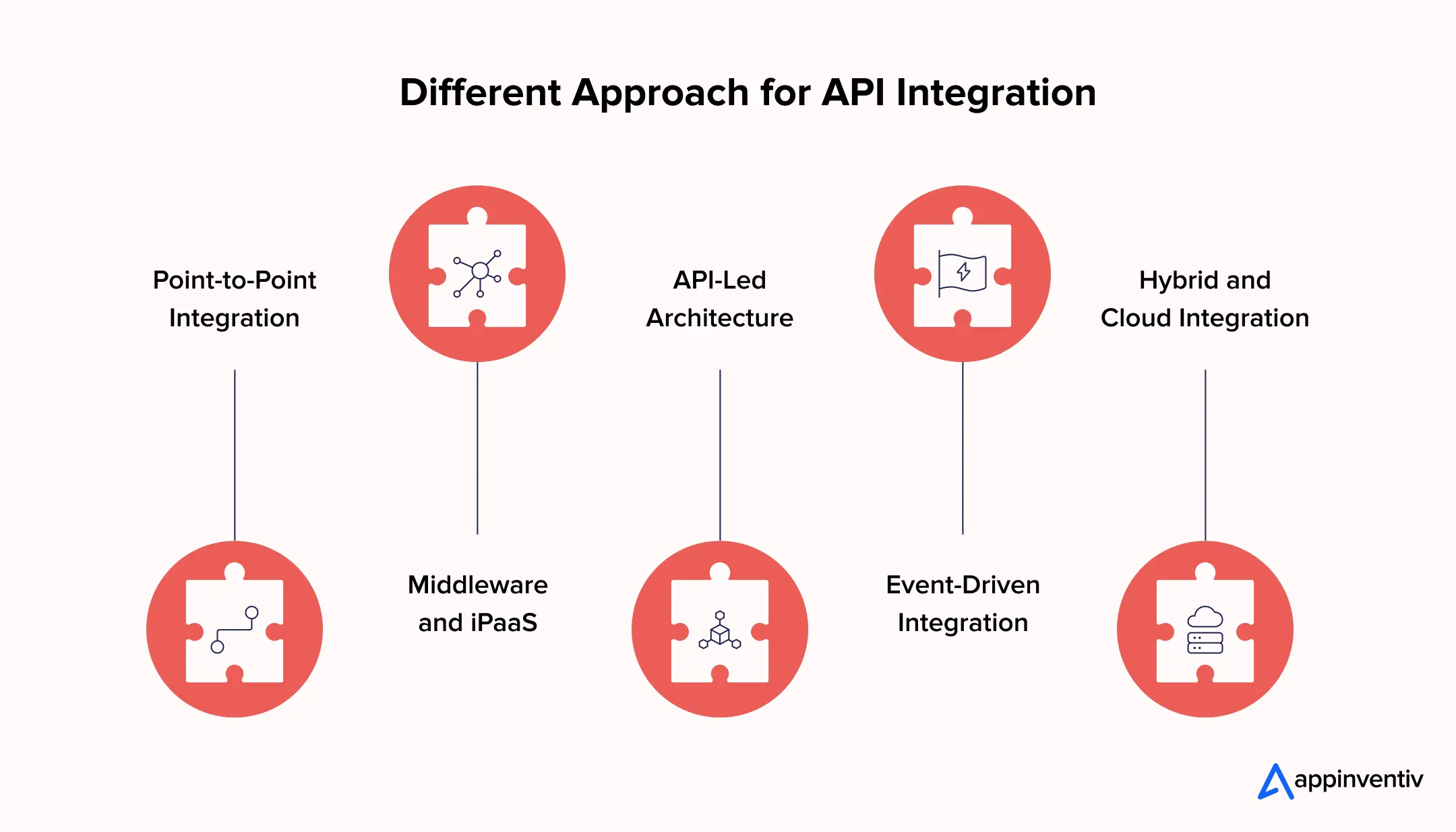
Point-to-Point Integration
This is a direct, custom-coded link between two specific applications. It’s fast to build for a single project, but if you try to scale it across an entire enterprise, it creates a brittle, tangled mess that is a nightmare to maintain.
Middleware and Integration Platform as a Service (iPaaS)
This approach drops a smart translation layer (like MuleSoft, Boomi, or Workato) between your applications. It handles the data translation, routing, and error handling centrally, taking the pressure off the individual endpoints.
API-Led Architecture
A highly structured approach that breaks things down into three distinct layers. System APIs unlock the raw data, Process APIs combine that data to perform a specific business function, and Experience APIs deliver that combined data to the end user (like a mobile app). It’s highly reusable.
Event-Driven Integration
Instead of systems asking “did anything change?” every few minutes, an event-driven architecture uses message brokers (like Kafka). Systems publish an event the exact second something happens, making it perfect for real-time inventory or fraud detection.
Hybrid and Cloud Integration
Most large businesses aren’t purely in the cloud. They run a hybrid mix of on-premises and cloud platforms. Hybrid patterns bridge both without forcing an early migration.
How to choose the right API approach: Select architecture based on transaction volumes, latency, system capabilities, security requirements, existing infrastructure and your operating model, rather than a preference for one technology.
What Enterprises Gain When Their Systems Finally Talk to Each Other
Implementing strong enterprise API integration solutions brings several tangible advantages to the business.
- First, it drastically reduces human error. When machines pass data to machines, you don’t get the typos associated with manual data entry.
- Second, it accelerates time-to-market for new products. If a mobile app developer can simply call an existing API rather than write a custom database query from scratch, the app launches weeks earlier.
- Finally, it creates a unified employee experience. Your staff shouldn’t have to juggle five different logins just to resolve one customer support ticket.
How to Integrate ERP, CRM and Legacy Systems Through APIs
Treat this as a staged programme, not a single build. Each step reduces risk for the next, and each produces something the business can review.
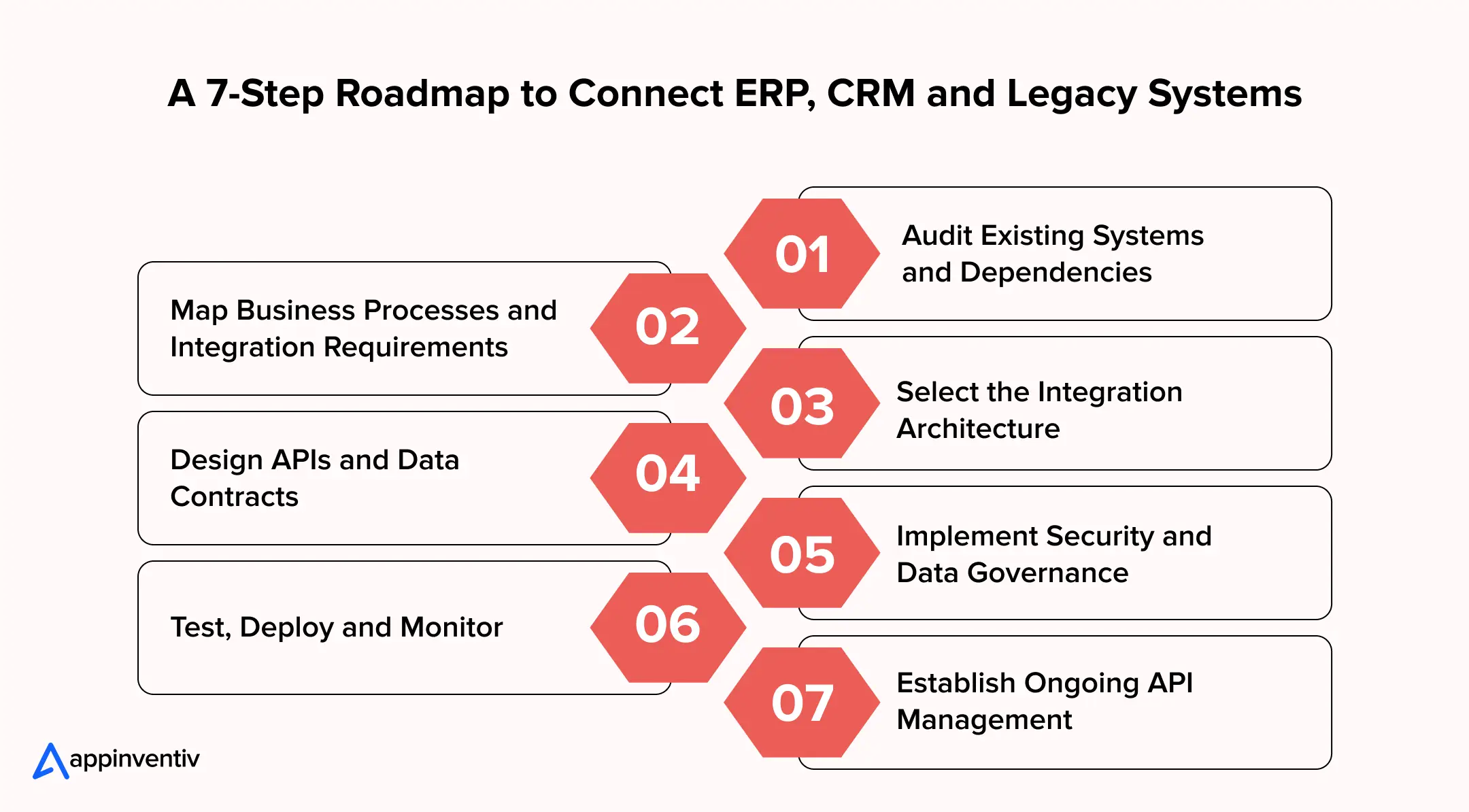
Step 1. Audit Existing Systems and Dependencies
Before you write a single line of code, you need to map out what you actually have. Document the legacy systems, data formats, API limitations, and importantly, the informal manual workarounds your staff are currently using to get their jobs done.
Step 2. Map Business Processes and Integration Requirements
Don’t just integrate data fields; integrate the actual flow of work. Figure out the exact journey an order takes from the eCommerce website, through the CRM, into the ERP, and out to the warehouse floor.
Step 3. Select the Integration Architecture
Based on your audit, decide if you need a robust iPaaS, a real-time event-driven mesh, or a hybrid approach. This core decision decides the tools you buy and the app developers you hire.
Step 4. Design APIs and Data Contracts
Define how data will be structured before connecting things. A solid data contract ensures that when the CRM sends a “customer” record, the legacy ERP actually understands what those specific fields mean.
Step 5. Implement Security and Data Governance
Bake in OAuth 2.0, strict rate limiting, and payload encryption from day one. You need very clear governance rules on which internal systems (and which external partners) are allowed to access what data.
Step 6. Test, Deploy and Monitor
Run extensive load tests. You need to see how the integration handles peak seasonal traffic or a sudden API outage in a downstream system. Always deploy in phased rollouts rather than big-bang launches.
Step 7. Establish Ongoing API Management
APIs aren’t something you set and forget. You need dedicated lifecycle management to handle versioning, monitor response times, track usage analytics, and eventually deprecate old endpoints safely.
Get custom API integration support to connect existing applications, reduce manual data handling and improve cross-system workflows.
Where API Integration Projects Face Challenges and How to Overcome Them?
API integration in Australia does not always go as planned. Older systems may be difficult to understand, different applications may store data differently, and security gaps can appear when APIs are not managed properly. Here are four common challenges, why they occur and how you can address them.
| Challenge | Why it happens | How to fix it |
|---|---|---|
| Difficult-to-understand legacy systems | Old systems may have limited documentation, and the original developers may no longer be available. | Study how the system works and use adapters to connect it with newer applications. |
| Different data across systems | Applications may store customer details in different formats. | Agree on a common data format and rules for sharing information. |
| API security risks | Some APIs may lack proper access controls or regular security checks. | Set clear access rules, use API gateways where appropriate, and review security regularly. |
| Dependence on one vendor | Integration may rely too heavily on a single platform’s tools and features. | Use widely supported standards and design integrations that are easier to move or change. |
API Security, Privacy and Compliance in Australia
Every integration widens your attack surface and your regulatory footprint. So security and compliance have to be your top priority.
Protect APIs Across the Integration Lifecycle
Security is not an afterthought you bolt on at the end. You need API gateways to control traffic, robust authentication protocols (like OAuth and OpenID Connect), and continuous threat monitoring to prevent data exposure or DDoS attacks.
Apply National Privacy and Data Protection Requirements
When moving customer information between systems, you must comply strictly with the APPs and the Privacy Act. From 10 December 2026, APP 1.7 requires privacy policies to disclose automated decision-making, so know which integrations feed those decisions.
The NDB scheme may also apply when an eligible data breach occurs. Thus, organisations should establish incident response and escalation procedures rather than assume that a secure connection alone satisfies privacy obligations.
Account for Sector-Specific Obligations
| Sector | Key obligation |
|---|---|
| Financial services | APRA CPS 230 and CPS 234 |
| Government | Protective Security Policy Framework and ISM controls |
| Healthcare | My Health Records Act and state health privacy laws |
| eCommerce | PCI DSS and Australian Consumer Law |
| Critical infrastructure | SOCI Act risk management duties |
Address Data Residency and Third-Party Access
Document where data is stored and processed, which vendors and subcontractors can reach it, and how access is revoked. Many enterprises mandate local data residency to avoid overseas legal complications.
How Much Does API Integration Cost in Australia?
On average, API integration cost ranges between AUD 70,000 and AUD 700,000+. For instance, a simple or mid-scale point-to-point connection between two modern SaaS tools might cost between AUD 70,000 and 350,000. However, an enterprise-wide transformation involving legacy mainframes, custom middleware, and complex data mapping can run anywhere from AUD 350,000 to well over AUD 700,000.
The final figure varies, depending on the number of systems involved, the quality of their existing interfaces, the complexity of data mapping and the security and availability requirements.
The table below outlines an estimated cost range for different complexities of API integration;
| Scope | Indicative range (AUD) |
|---|---|
| Focused: two systems, one process | 70,000 to 150,000 |
| Mid-scale: Data platform, ERP, CRM software | 150,000 to 350,000 |
| Enterprise programme with legacy and middleware | 350,000 to 700,000 |
Emerging API Integration Trends in 2027 and Beyond
API integration is moving beyond basic data exchange. Several developments are shaping how organisations design connected systems. There is a massive rise in AI-augmented integration, where machine learning tools automatically map data fields between two disparate systems, cutting integration time in half.
GraphQL is also seeing wider enterprise adoption, replacing clunky REST APIs in scenarios where mobile apps need to pull data efficiently over slow networks. Finally, internal zero-trust security is becoming the standard. Just because two APIs are inside the corporate firewall doesn’t mean they trust each other by default anymore.
How Appinventiv Approaches API Integration
Appinventiv, as a trusted provider of custom software development services in Australia, helps organisations connect applications while preparing for future digital initiatives. We don’t believe in ripping out software that still serves a business purpose just for the sake of an upgrade.
Our API integration services focus heavily on business outcomes and delivery governance. Here is how we approach the work:
- Integration discovery and architecture planning: We map your current mess of systems and design a scalable path forward.
- Custom API development and middleware integration: If an off-the-shelf connector doesn’t exist, our engineering teams build a secure, robust solution.
- ERP, CRM, cloud and legacy application connectivity: We connect the major platforms (SAP, Salesforce, Dynamics) alongside your niche, on-premise legacy tools.
- Data mapping, testing, security and API lifecycle management: We ensure the data flows correctly, securely, and is easily maintainable over the long term.
- Phased modernisation that limits unnecessary disruption to core operations: We deploy in carefully managed slices, ensuring your business keeps running while the plumbing gets upgraded.
When it comes to API Integration in Australia, maintainability is everything. We ensure you own the code, understand the architecture, and have the tools to manage it moving forward. The goal is to create maintainable connections that support reliable information flows, clearer system ownership and future application changes.
That approach rests on our 11+ years of APAC delivery experience across 35+ industries where we have successfully delivered 3000+ digital products and transformed 500+ legacy processes, including regional and remote contexts.
Don’t delay anymore to connect what you already own? Assess your integration architecture, legacy constraints and delivery priorities before planning the next phase of modernisation. Discuss your project today.
FAQs
Q. What is API integration?
A. API integration in Australia connects separate software applications through defined interfaces so they can exchange data and trigger actions automatically. For enterprises, it is the foundation for connected reporting, automation and AI.
Q. Can APIs connect a legacy ERP system to a modern CRM?
A. Yes. Where the legacy system lacks an API, teams add an adapter or middleware layer that exposes its data safely. This avoids replacing the ERP while still delivering a shared customer and finance view.
Q. What is the difference between API software integration and middleware?
A. An API is the interface a system offers for others to use. Middleware is the software layer that routes, transforms and orchestrates traffic between those interfaces. Most enterprise programmes use both, with middleware managing the connections that APIs expose.
Q. How Much Does It Cost to Integrate an API?
A. API integration typically costs between AUD 70,000 and AUD 700,000+. A simple, single-system connection and mid-complexity projects often cost between AUD 70,000 and 350,000. Enterprise-wide integration involving legacy systems, middleware and strict security or compliance requirements can range anywhere from AUD 350,000 to over AUD 700,000.
Q. How long does API integration take?
A. A focused connection between two systems can take 2 – 4 months. A multi-system programme with legacy platforms usually takes 4 months to 1 year or more, delivered in phases. The exact timelines vary, depending on the documentation quality, data cleanliness, security reviews and testing scope.
Q. Is API system integration secure for businesses?
A. Yes, provided it is designed correctly. Secure API integration relies on strong authentication protocols, data payload encryption, strict rate limiting, and continuous gateway monitoring to ensure only authorised systems can access your business data.
Q. Should a business replace legacy systems or integrate them?
A. Often the answer is both. It depends on the system’s business value. If the legacy system is functionally broken or costs a fortune to host, replacement is wise. But if the system works perfectly fine and just suffers from being disconnected, using APIs to integrate it is a much more cost-effective and lower-risk strategy.
Q. How does API integration work?
A. Secure API integration works by allowing two or more applications to exchange data through defined interfaces. One system sends a request, and the other processes it and returns the required information or triggers an action. Authentication and data validation help keep the exchange secure and accurate.


Fast 2-minute response, fully NDA-protected.

Beyond Customer Portal Development: Building Connected Digital Services
Key takeaways: A portal without CRM, ERP and billing integration leaves your staff doing the connecting. Start with customer tasks, then integrate only the systems those tasks actually need. Name one system of record for each data type before choosing APIs or middleware. Plan integration, security and privacy obligations at the start, not after the…
CRM Software for Local Government: From Community Requests to Better Service Delivery
Key takeaways: A council CRM should sit around existing systems as a service layer, not replace them. Integration with ERP, rates, property and GIS systems prevents another data silo and duplicate entry. Start with one high-volume service, pilot it with residents, then scale on measured results. Track resolution time, SLA compliance, self-service rates and cost…

The Ultimate Guide to CRM for Insurance: Features, Cost, Top Platforms, Integration & More
Key takeaways: CRM for insurance connects sales, service, and claims into one governed system, distinct from the policy administration system. Core features span pipeline management, policy visibility, claims tracking, commission management, AI analytics, and compliance controls. Cost ranges from roughly USD 15,000 for configuration to USD 150,000 and beyond for custom development at enterprise scale.…