
































Shariah-Compliant Platform Development: How to Build, Integrate, and Scale Islamic Fintech Platforms in 2026

 Share -



- 01What is Shariah-Compliant Platform Development?
- 02How Does Shariah Compliance Work Inside a Fintech Platform?
- 03What Are the Key Features of Islamic Finance Mobile Platforms?
- 04How Are Islamic Banking Platforms Different From Conventional Banking Platforms?
- 05What Does the Shariah-Compliant Development Process Look Like?
- 06What is the Compliance Architecture of an Islamic Fintech Platform?
- 07What Does Shariah-Compliant Platform Development Actually Cost?
- 08What Are the Business Benefits and ROI of Halal Fintech Platforms?
- 09How Do You Integrate Islamic Fintech Platforms With Other Systems?
- 10How Do You Select the Right Vendor for Shariah-Compliant Platform Development?
- 11What Do Support, Maintenance, and Post-Launch Services Look Like?
- 12What Trending Technologies Are Reshaping Islamic Fintech in 2026?
- 13What Are the Challenges in Shariah-Compliant Platform Development, and How Do You Solve Them?
- 14What Are the UAE Fintech Regulations for Islamic Platforms?
- 15How Is the Future of Islamic Finance Shaping Digital Products?
- 16How Can Appinventiv Help You Build a Shariah-Compliant Platform?
- 17FAQs

Key takeaways:
- You don’t “add” Shariah later. In Shariah-Compliant platform development, the ledger, screening engine, and contracts are the product—not the UI.
- Start with scholars, not screens. Lock AAOIFI-aligned logic + SSB workflows before writing core APIs, or you’ll rebuild half the system.
- Build compliance as infrastructure. Product layer, screening layer, ledger, and governance all need to talk to each other in real time—no patchwork fixes later.
- A serious build isn’t cheap. Expect AED 294K–2.57M+ (USD 80,000–700,000+) depending on scope, integrations, and multi-jurisdiction compliance.
- Compliance is a cost center—and a moat. Shariah governance, screening engines, and regulator integrations can add 15–25% to total build cost, but that’s what makes the platform defensible.
- UAE changes the equation. Working under CBUAE, ADGM, or DIFC means stricter builds, higher upfront cost, but faster trust and market entry.
Shariah-Compliant platform development has moved from a niche competency to a boardroom priority. The global Islamic fintech market reached AED 727 billion (USD 198 billion) in transaction volume in 2024/25 and is on track to hit AED 1.25 trillion (USD 341 billion) by 2029 at an 11.5% CAGR, per the GIFT Report 2025/26, a pace that comfortably outruns the 11% growth of conventional fintech.
What makes this category technically demanding is not the math. It is that every product decision carries a compliance consequence. You cannot retrofit Shariah into a conventional core later. Riba-free logic, contract structures, the screening engine, zakat calculation, and purification rules all have to sit in the architecture before the first user signs in.
This guide is written for product leaders, CIOs, and founders evaluating a halal fintech platform development roadmap, an Islamic banking platform RFP, or a Shariah-Compliant BNPL build, and now need a clear-eyed view of how to build, integrate, and scale one.
Before you commit, validate your architecture, contract logic, and regulatory path.

What is Shariah-Compliant Platform Development?
Shariah-Compliant platform development is the process of designing, engineering, and operating digital financial platforms like apps, core banking software, wealth, payments, or lending systems, whose every product, workflow, and ledger entry adheres to Shariah principles as certified by qualified scholars.
At a practical level, that means five things must be enforced at the code level, not in marketing copy:
- No riba (interest) in any lending, deposit, or rewards logic.
- No gharar (excessive uncertainty) in contracts, derivatives, or underwriting models.
- No maysir (gambling or speculative instruments).
- No haram sectors in investment screening (alcohol, pork, conventional banking, adult, weapons, gambling).
- Profit-and-loss sharing, asset-backing, and real-economy linkage in financing.
This is the difference between an Islamic banking software build and a conventional one: your compliance architecture is the product. The UX wrapper comes later.
How Does Shariah Compliance Work Inside a Fintech Platform?
Compliance is enforced across four layers. Weakness in any one of them breaks the certification case.
| Layer | What It Enforces | Example Components |
|---|---|---|
| Product Layer | Only Shariah-approved contracts are exposed | Murabaha, Ijara, Musharaka, Mudaraba, Sukuk, Takaful, Qard Hasan |
| Screening Layer | Real-time halal/haram classification | AAOIFI-aligned stock filters, sector blacklists and AI compliance screening |
| Ledger Layer | No interest accrual; profit-share calculation | Double-entry systems with dedicated profit-pool ledgers, purification accounts |
| Governance Layer | Scholar review, audit trails, fatwa versioning | Shariah Supervisory Board (SSB) workflow, fatwa registry, immutable logs |
When architecting these systems, we insist that every financial event emit a compliance metadata tag: contract type, underlying asset, scholar approval ID and purification status before it ever hits the general ledger.
This engineering habit is also central to avoiding the compliance pitfalls that break most fintech builds, and it is what separates a defensible Islamic banking platform from a cosmetic one.
What Are the Key Features of Islamic Finance Mobile Platforms?
Below is the feature stack we recommend for a market-ready Islamic fintech solution, based on what has actually worked for enterprise and fast-scaling clients.
Core user features
- Shariah-Compliant account opening with eKYC and biometric onboarding
- Halal investment portfolios with real-time screening
- Zakat calculator and automated zakat disbursement
- Sukuk marketplace and tokenized real-world asset access
- Shariah-Compliant BNPL systems based on Murabaha or Tawarruq structures
- Qard Hasan (interest-free loan) workflows for community and SME finance
- Takaful (Islamic insurance) integration
- Qibla, prayer-time, and Islamic calendar utilities (for retail apps)
Compliance and admin features
- AI-driven Shariah screening engine for equities, crypto, and businesses
- Scholar/SSB approval console with fatwa versioning
- Purification (tathir) engine for non-compliant income removal
- Audit-ready reporting dashboards for CBUAE, ADGM, DIFC, SAMA, or SEC
- Multi-fatwa engine (to handle jurisdictional differences across MENA, SEA, and the West)
Infrastructure features
- Biometric authentication (face, palm, fingerprint)
- Multi-currency wallet with AED, USD, SAR, MYR, and stablecoin rails
- Open banking and instant payment integrations
- Blockchain-backed asset provenance (optional for sukuk/tokenization)
Build intent matters here. An investment-heavy platform will overweight the screening engine and research tooling. A halal fintech platform development focused on everyday banking will overweight payments, BNPL, and takaful. Map features to revenue before writing a single line of code.
How Are Islamic Banking Platforms Different From Conventional Banking Platforms?
The misconception we hear most often from conventional banking CTOs is “It’s just a skin on top of our core.” It is not. Here is where the real divergence happens.
| Dimension | Conventional Banking Platform | Islamic Digital Banking Platform |
|---|---|---|
| Revenue logic | Interest margin (NIM) | Profit-share, fee-based, rent-based (Ijara), mark-up (Murabaha) |
| Product catalog | Loans, credit cards, fixed deposits | Murabaha finance, Sukuk, Mudaraba, Takaful, Qard Hasan |
| Ledger design | Single interest-accrual engine | Separate profit-pool ledger per contract type |
| Screening | AML/KYC only | AML/KYC plus Shariah screening, sector filters, purification |
| Governance | Internal risk and compliance team | Internal team plus external Shariah Supervisory Board (SSB) |
| Late payments | Compound interest penalty | Charity-donation penalty (non-revenue to the bank) |
| Investment products | Any listed instrument | Only AAOIFI/scholar-approved instruments |
If you are a conventional bank adding an Islamic window, do not try to fork your existing core. Build a parallel Shariah-native service with its own ledger, its own scholar workflow, and its own API surface, and expose a unified front end.
This pattern mirrors the scalability playbook we use across fintech platforms; decouple compliance-critical services from the monolith early, or pay for it later.
What Does the Shariah-Compliant Development Process Look Like?
Below is the phased methodology we use for Shariah-Compliant platform development. It is opinionated because the cost of doing this out of order is painful.
- Phase 1, Shariah Product Engineering (Weeks 1–4): Engage the Shariah Supervisory Board before the sprint zero kickoff, not after. Decide which Islamic contracts the platform will support (Murabaha, Ijara, Musharaka, Mudaraba, Wakala). Document the fatwa basis for each.
- Phase 2, Compliance Architecture Design (Weeks 4–8): Design the ledger, screening engine, and governance console first. UI wireframes come after. This is where we define the compliance metadata schema that every transaction will carry.
- Phase 3, Regulatory Mapping (Weeks 6–10, parallel): Map the platform to the regulator’s actual rulebook: CBUAE, ADGM FSRA, DIFC DFSA, SAMA, Bank Negara, or, in the US context, state money-transmitter rules plus any OCC fintech charter requirements.
- Phase 4, Core Build and Integrations (Weeks 8–24): Engineer the core banking module, screening engine, scholar console, and customer-facing apps in parallel tracks. Integrate with payment rails, eKYC, and open banking APIs.
- Phase 5, Shariah Audit and Penetration Testing (Weeks 22–28): Dual audit. A Shariah audit by the SSB and a security audit by an independent firm. Both must pass before going live.
- Phase 6, Pilot, Certification, and Launch (Weeks 26–32): Soft launch with a closed user group, secure the Shariah compliance certificate, then graduate to public release.
- Phase 7, Continuous Compliance (post-launch): Shariah compliance is not a launch milestone. Fatwas evolve, new products are added, and regulators update rules. Plan for a quarterly SSB review cycle and a dedicated compliance engineering squad post-launch.
A common mistake we see from first-time builders is treating Phase 1 and Phase 4 as sequential when they must overlap. If scholars enter the room only after the API contracts are signed off, you will rewrite half the ledger.
What is the Compliance Architecture of an Islamic Fintech Platform?
Here is the reference architecture we deploy. Treat it as a starting template, not a fixed spec.
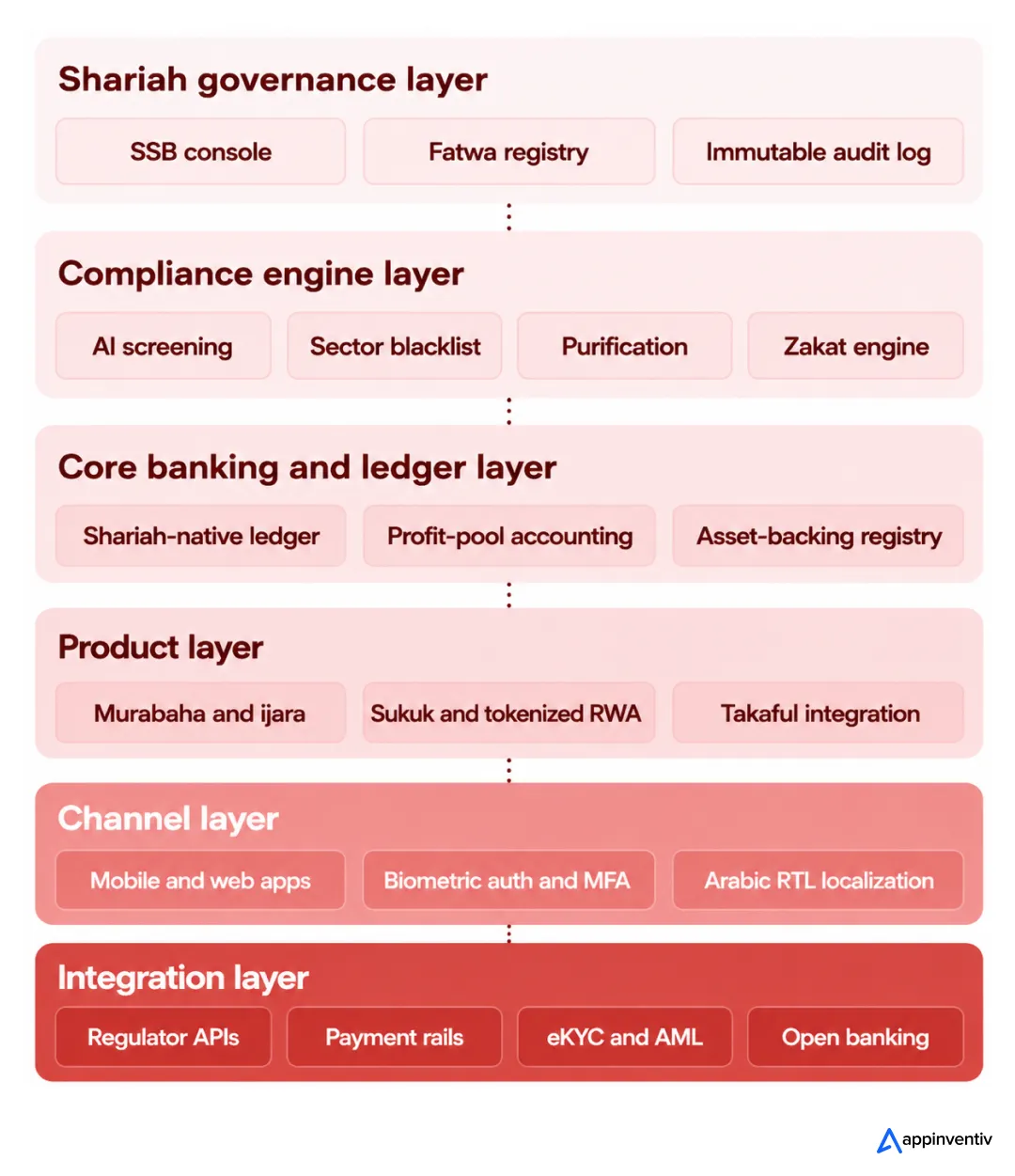
At the time of architecting these Islamic fintech solutions, the ledger layer and compliance engine layer should be built by a team that is well in sync with in-house experts. The channel and integration layers can lean on off-the-shelf SDKs. That split usually determines whether a build is defensible or brittle.
What Does Shariah-Compliant Platform Development Actually Cost?
This is the question every board asks. Here is a realistic range based on the builds delivered and benchmarked across 2024 to 2026.
| Build Type | Cost Range (AED / USD) | Timeline | Typical Use Case |
|---|---|---|---|
| Basic halal investment app | AED 294K–551K (USD 80,000–150,000) | 4–6 months | Single-country launch, 1–2 contract types |
| Mid-tier Islamic fintech platform | AED 551K–1.1M (USD 150,000–300,000) | 6–10 months | Banking + investment + zakat, multi-currency |
| Enterprise Shariah-Compliant fintech platform | AED 1.1M–2.57M+ (USD 300,000–700,000+) | 10–18 months | Full core banking, multi-jurisdiction, SSB workflow, sukuk marketplace |
| Shariah-Compliant BNPL systems | AED 330K–808K (USD 90,000–220,000) | 5–8 months | Murabaha/Tawarruq-based consumer finance |
| Zakat platform development | AED 147K–404K (USD 40,000–110,000) | 3–5 months | Calculator, NGO disbursement, reporting |
What Drives the Cost of Shariah-Compliant Platform Development in the UAE?
Building UAE-anchored platforms introduces distinct financial realities. Structural factors fundamentally dictate the baseline capital required to launch as well as scale these highly regulated ecosystems that help the fintech industry here run.
- Regulatory regime: Operating under the CBUAE, ADGM FSRA, or DIFC DFSA drastically alters mandatory capital, reporting rhythms, and core technology requirements.
- Shariah governance overhead: Retaining a qualified SSB introduces an unavoidable recurring cost, routinely pulling AED 147,000 to AED 441,000 (USD 40,000 to USD 120,000) annually.
- Biometric and payments integration: The aggressive national push toward face and palm biometric payments forces new builds to embed advanced authentication from day one.
- Arabic-first UX: Authentic right-to-left design architecture, intensive Arabic content QA, and dual-language SSB dashboards consistently inflate the initial design budget by 10–15%.
- Third-party licensing: Essential AAOIFI-aligned screening data feeds, live sukuk data, and specialized takaful APIs command expensive annual subscription fees.
Multiple internal benchmarkings show costs between AED 147K–1.47M (USD 40,000–400,000), depending on modules, compliance, and integrations. Backend architecture, compliance, and third-party APIs are the biggest cost drivers in any app build, and for Shariah-Compliant apps, the compliance layer alone can add 15–25% on top of conventional equivalents.
Pricing Models You Can Choose
| Model | Best For | Trade-off |
|---|---|---|
| Fixed-price | Well-defined basic apps | Rigid; scope changes cost extra |
| Time and materials (T&M) | Mid-to-large builds with evolving scope | Needs strong vendor governance |
| Dedicated team | 12+ month programs, multi-product roadmaps | Best velocity; requires commitment |
| Hybrid (fixed MVP + T&M scale) | Most enterprise builds | Balances predictability with flexibility |
For any serious Islamic banking platform development effort, a hybrid model almost always wins. Lock scope and cost for the compliance core, then run T&M for the expanding product catalog.
What Are the Business Benefits and ROI of Halal Fintech Platforms?
Leadership teams do not fund compliance for its own sake. They fund platforms that return capital. Here is where the ROI actually shows up:
- Expanded addressable market: The Muslim population is ~2 billion globally, yet only around 10 countries currently use Islamic financial services. That is a structural underpenetration, not a saturation story.
- Higher user trust and retention: Faith-aligned financial products generate stickier customers. Churn rates in Islamic digital banking are consistently below conventional benchmarks in the GCC.
- Regulatory tailwind: UAE, Saudi Arabia, and Malaysia are actively subsidizing Shariah-Compliant digital infrastructure. New entrants get licensing fast-tracks.
- Cross-sell economics: A user who opens a halal savings account converts to takaful, sukuk, and BNPL at materially higher rates than a conventional user converts across products.
- ESG alignment: ESG-aligned Islamic products increased by 29%, making Shariah finance a natural fit for institutional ESG mandates in the US and EU.
- Non-Muslim uptake: Islamic banking penetration increased by 18% in non-Muslim markets, driven by ethical investors.
For a mid-tier Islamic fintech platform with 100,000 monthly active users, the economics typically deliver payback inside 24 to 30 months, largely on the strength of retention and cross-sell.
How Do You Integrate Islamic Fintech Platforms With Other Systems?
Integration is where most Islamic banking software projects stall. You are not just integrating with payment rails, you are integrating with compliance infrastructure.
Must-have integrations
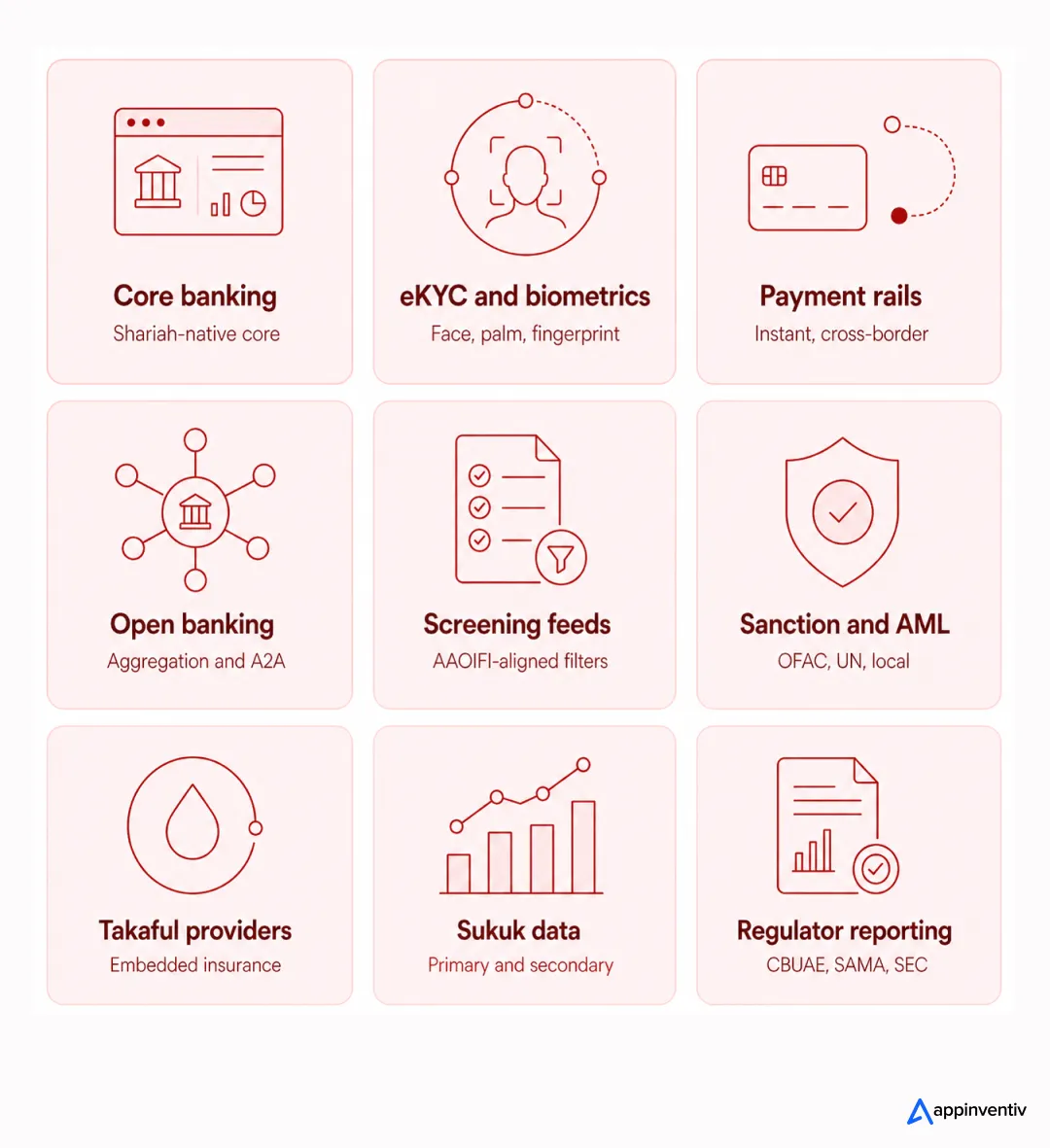
- Core banking: Either a Shariah-native core (Path Solutions, ICS BANKS Islamic) or a customized build
- eKYC and biometric ID: Face, palm, and fingerprint biometrics are increasingly mandatory in the UAE; plan for them even if your launch market is elsewhere
- Payment rails: Card networks, UAE IPP, SAMA instant payments, SWIFT gpi, and stablecoin settlement
- Open banking APIs: For aggregation and account-to-account transfers
- AAOIFI-aligned screening feeds: For real-time halal stock and crypto filtering
- Sanction and AML screening: OFAC, UN, and local regulator lists
- Takaful providers: For embedded insurance
- Sukuk data providers: For primary and secondary market access
- Regulator reporting APIs: CBUAE, SAMA, BNM, MAS, or SEC filings
Integration pattern we recommend
Use an API gateway with a compliance-event bus behind it. Every external integration emits events into the bus, which the compliance engine processes in real time. That way, when a new fatwa or sanction rule lands, you update one service, not forty.
Recent UAE developments reinforce this. Abu Dhabi Islamic Bank (ADIB) now enables account opening via facial recognition within its mobile app; no branch visit required.
That is the new baseline, and it is the same direction the broader Middle East fintech app development market is heading: biometric-first, compliance-native, and built for mobile from the ground up. Any Islamic banking platform shipping in 2026 without biometric onboarding looks dated on day one.
How Do You Select the Right Vendor for Shariah-Compliant Platform Development?
Vendor selection is where most programs go right or wrong. Here is the shortlist of evaluation criteria we hand to enterprise clients when they are benchmarking a custom mobile app development company:
| Criterion | What to Look For | Red Flag |
|---|---|---|
| Shariah domain depth | Portfolio of live Islamic fintech builds, relationships with AAOIFI-aligned scholars | Only generic fintech credentials |
| Regulatory experience | Delivered builds under CBUAE, ADGM, DIFC, or SAMA | Never filed with a regulator |
| Security certifications | ISO 27001, SOC 2, PCI-DSS compliant engineering | No formal security posture |
| Compliance-by-design track record | Examples of ledger-level compliance, not just UI | “We’ll add compliance later” |
| Scalability evidence | Proven handling of transaction volume spikes | Only pilot-scale deliveries |
| Post-launch model | Dedicated SRE and compliance engineering pods | One-time delivery, then handoff |
| Cultural fit with MENA | On-ground presence or strong GCC client base | No regional delivery history |
A useful internal test: ask the vendor to walk you through their last Islamic banking platform development project’s ledger design decision log. If they cannot show it, they built a conventional app with an Islamic wrapper.
What Do Support, Maintenance, and Post-Launch Services Look Like?
Shariah-Compliant platforms have a different post-launch rhythm than conventional ones. Budget for five recurring cost buckets:
- Standard SRE and DevOps: 15–20% of build cost per year.
- Shariah compliance engineering: A small, dedicated squad that updates screening rules, fatwa logic, and purification engines every quarter.
- Scholar review fees: Retainer plus transaction-based review for new products and annual audits.
- Regulator updates: CBUAE, ADGM, and DIFC push new technical standards roughly every 12–18 months. Build this into the backlog.
- Localization and content: Fatwas, prayer times, and zakat rules vary by jurisdiction and must be kept current.
The platforms that pull away from the pack in year two are the ones with a compliance engineering team embedded in the product organization, not sitting in legal.
What Trending Technologies Are Reshaping Islamic Fintech in 2026?
Five technology vectors are materially shifting how Shariah-Compliant platforms are built.
1. AI-driven Shariah screening
AI-powered Shariah screening tools increased usage by 17%, allowing financial institutions to verify compliance across 12,000+ listed global equities. This is replacing manual scholar review for equity and crypto classification, freeing the SSB to focus on novel product design.
The same thinking underpins how AI is reshaping banking software development — compliance checks that used to be manual are increasingly model-driven, with scholars reviewing exceptions rather than every record.
2. Biometric payments and authentication
The UAE has begun piloting face and palm biometric payments at a national level, and Islamic banking apps are expected to match. Plan for liveness detection, anti-spoofing, and offline biometric fallback.
3. Tokenized real-world assets and sukuk
Shariah is structurally a good fit for tokenization because Islamic finance already demands asset-backing. Platforms are starting to launch tokenized sukuk and tokenized commodity Murabaha rails—a shift increasingly shaping how crypto payment gateway development in the UAE is evolving as traditional settlement converges with digital asset infrastructure.
4. Stablecoins and CBDCs for halal settlement
Shariah-approved stablecoins, typically gold-backed or fully reserved, are entering settlement flows, particularly for cross-border remittance corridors in the GCC and Southeast Asia.
5. Generative AI for customer-facing advisory
Islamic financial literacy is a massive gap. Chat-based halal finance assistants trained on vetted scholarly content are becoming a category of their own. Appinventiv built Mudra, a budgeting assistant that launched in 12+ countries. That same architecture adapts well to halal wealth advisory with the right compliance guardrails.
6. Vault22’s Hafiq launch
In the UAE, an AI-based Shariah compliance screening platform with zakat calculation and halal wealth management confirms the market direction: compliance automation plus Gen Z-native UX is where new entrants are positioning. If you are building in this space, design for that user from the first wireframe.
What Are the Challenges in Shariah-Compliant Platform Development, and How Do You Solve Them?
Every Islamic fintech build runs into the same structural challenges. The table below summarizes the seven we see most often and the engineering-led solutions we deploy against them.
| Challenge | Why Solving It Is Critical | How We Solve It |
|---|---|---|
| Fatwa divergence across jurisdictions | A product approved in Malaysia may not pass a GCC SSB review | Build a multi-fatwa engine that branches contract logic by jurisdiction, paired with a jurisdictional product catalog |
| Scarcity of Shariah-aware engineers | Engineers fluent in both distributed systems and Islamic contract law are rare | Pair a core engineering team with a Shariah product manager who translates between scholars and developers |
| Regulatory complexity | 58% face compliance costs, 52% deal with fragmented regulations, 45% report legal ambiguity in the Islamic finance industry | Adopt compliance-by-design: map regulator rules to automated checks so audits become evidence-retrieval exercises, not scrambles |
| Balancing innovation with scholarly approval | Product teams want to ship fast; SSBs review on their own cycle | Run a parallel sandbox track where new ideas are prototyped against a dummy ledger for scholar review before production code is written |
| User trust and education | Retail users often do not understand the difference between Islamic and conventional products | Ship in-app explainer UX, fatwa transparency, and plain-language disclosures to lift activation and retention |
| Scaling without breaking compliance | Screening latency becomes a real problem as transaction volume grows | Share the compliance engine by asset class and use event-driven processing to keep per-transaction screening under 200ms at scale |
| Access to capital | Funding, consumer education, regulation, talent, and geographic expansion are the most cited hurdles in Islamic fintech | Build modularly so you can scale in stages against proven product-market fit rather than waiting for a full ecosystem launch |
What Are the UAE Fintech Regulations for Islamic Platforms?
If the UAE is on your roadmap, and for most global Islamic fintech programs, it is, you are operating under one of three regulatory tracks.
| Regulator | Scope | What It Covers |
|---|---|---|
| Central Bank of the UAE (CBUAE) | Onshore UAE | Banking, payments, stored value, digital assets |
| ADGM FSRA | Abu Dhabi Global Market | Fintech, capital markets, virtual assets, innovation testing |
| DIFC DFSA | Dubai International Financial Centre | Banking, asset management, Islamic finance, fintech innovation testing license |
Every one of these regulators supports a Higher Shariah Authority (HSA) framework for Islamic finance, with product-level approvals mandatory before go-live. Practical requirements:
- Licensing: Pick a license that matches your product mix; most Islamic fintech startups begin with an Innovation Testing License in ADGM or DFSA before a full banking license.
- Data residency: Customer data must be stored within the UAE borders for regulated activities.
- Shariah governance: A registered SSB with HSA-approved scholars is mandatory.
- Cybersecurity: Alignment with the NESA (UAE Information Assurance) standards.
- KYC/AML: Full compliance with UAE AML/CFT regulations and FATF guidance.
- Consumer protection: Transparent disclosures, cooling-off periods, and complaint mechanisms.
The UAE’s position as a global Islamic fintech hub is real and measurable. It is now the operational epicenter for Shariah-Compliant digital finance in the GCC, which is why partnering with a custom mobile app development company in Dubai, with on-ground regulatory familiarity, can compress your time-to-license by months.
How Is the Future of Islamic Finance Shaping Digital Products?
These vectors are worth watching if you are setting a 3- to 5-year product strategy.
- Convergence of ethical finance and Islamic finance: Younger investors globally are buying into ESG, and Shariah’s prohibitions on extractive or harmful industries overlap meaningfully with ESG exclusion lists. Expect hybrid products positioned as “ethical by construction.”
- Digital assets entering the mainstream: Islamic finance is getting its digital assets moment with stablecoins and tokenization converging with Shariah governance as an operating system. This will drive a new generation of halal crypto, tokenized sukuk, and Shariah-aware DeFi products.
- Embedded Islamic finance: Non-bank platforms: e-commerce, ride-hailing, edtech will embed halal BNPL, takaful, and savings. If you are a non-financial platform serving Muslim users, embedded Shariah products are the single highest-leverage revenue expansion you can ship in 2026.
- Hyper-personalization via AI: Customer segmentation, risk scoring (within Shariah bounds), and advisory will become AI-native. The winners will have their data infrastructure in order before they chase the models.
How Can Appinventiv Help You Build a Shariah-Compliant Platform?
- KFC Middle East
- IKEA UAE
- JobGet
- Adidas Middle East
Food Delivery Ecosystem • UAE & GCC
Eliminated heavy aggregator dependence by launching 7 localized mobile apps across GCC markets, driving direct orders, improving retention, and scaling digital revenue across regions.
50% Direct Order Surge
Retail ERP Ecosystem • In-Store Digitization
Transformed in-store onboarding with a kiosk-based ERP system, enabling real-time product discovery, data capture, and scalable retail experiences across multiple UAE locations.
Primary Source of ROI Measurement
AI Recruitment Platform • Blue-Collar Hiring
Rebuilt hiring workflows with AI-powered matching and in-app interviews, reducing job fulfillment time from months to minutes while scaling a category-leading recruitment platform.
150K+ Jobseekers Placed
eCommerce Mobile Expansion • KSA & Qatar
Transformed a web-first retail presence into a high-performance mobile commerce experience, unlocking new user acquisition and driving engagement across Middle Eastern markets.
500K+ New Users Acquired
This is where our team’s 10+ years of hands-on experience actually shows up. We’ve built and shipped enterprise-grade digital products across the US, UAE, UK, and Southeast Asia some messy, some complex, all real.
Not theory execution. The kind that shows up in outcomes.
- For KFC (Americana Group), we launched 7 mobile apps across GCC markets and helped bring aggregator dependency down from ~90% to under 50%, while pushing more than 50% of orders through owned channels.
- With Adidas, we took a web-heavy presence and turned it into a mobile-first commerce experience—driving 2M+ downloads and adding over 500K new users across Saudi Arabia and Qatar.
- For JobGet, we rebuilt hiring into a mobile, chat-first flow, cutting job search time from months to minutes, helping scale to 2M+ downloads, 150K+ job placements, and ultimately supporting a $52M raise.
- And with IKEA UAE, we designed a kiosk-led ERP system that now runs across 7+ stores, giving walk-in customers real-time product access while turning in-store interactions into measurable ROI.
Different industries. Same pattern: build something that actually works once users hit it.
When you engage us for Shariah-compliant platform development, you’re not just building features; you’re structuring a system that can pass scrutiny across markets. This is where most platform development efforts fail: they treat compliance as a layer, not a foundation.
- A focused Islamic fintech architecture team. People who’ve worked through compliance-first ledger logic, scholar workflows, and AAOIFI-aligned screening engines. This is the backbone of serious Islamic finance platform development, especially when scaling across jurisdictions.
- On-ground UAE delivery via our Dubai team. As a custom mobile app development company in Dubai, we’ve shipped products while navigating CBUAE, ADGM, and DIFC expectations, so compliance isn’t bolted on later.
- End-to-end involvement: product thinking, Shariah architecture, regulator mapping, payments + biometrics integration, UI/UX, build, audit, launch, and then the part most teams avoid: ongoing compliance engineering.
As an app development company, we build systems that hold up under real usage; cloud-native, API-first, with GDPR, PCI-DSS, and AML/KYC handled from day one. This becomes critical when platforms expand into halal investment platform development or adjacent financial products.
Scale-wise, we’ve delivered 3,000+ digital products with a team of 1,600+ specialists, and while Deloitte Tech Fast 50 recognition is great, what matters more is that clients come back with harder problems.
Teams working on this often extend into our banking software development services; core banking, lending, and payments modernization under the same compliance-first discipline.
If you’re evaluating a halal fintech platform development program, working on an Islamic banking platform development RFP, or exploring a Shariah-Compliant BNPL or zakat platform, we can map a realistic architecture—not just a polished pitch.
FAQs
Q. How does Shariah compliance work in fintech platforms?
A. It’s hardcoded across four layers: product (approved contracts only), screening (filtering haram sectors), ledger (profit-share over interest), and governance (SSB approvals). Every transaction carries compliance metadata tied to a scholar-approved fatwa. No shortcuts.
Q. What factors affect the cost of Islamic fintech platform development?
A. Compliance eats the budget. AAOIFI-aligned screening, multi-jurisdiction fatwa handling, and custom SSB workflows add up fast. Expect an MVP to run around AED 294,000 (USD 80,000), while scaling an enterprise-grade platform easily pushes north of AED 2.57 million (USD 700,000).
Q. What are the business benefits of halal fintech platforms?
A. The unit economics are undeniably strong. You unlock a massively underserved market, lock in higher user retention, and ride regulatory GCC tailwinds. Plus, strict ESG alignment grabs serious non-Muslim market share in the US, UK, and Germany.
Q. How long does it take to build a Shariah-Compliant fintech platform?
A. 4 to 6 months for a bare-bones MVP. A competitive mid-tier platform takes 6 to 10 months. A multi-jurisdiction enterprise built and loaded with full SSB workflows lands in the 10 to 18 month range.
Q. Can a conventional bank add an Islamic window without rebuilding its core?
A. Yes, but do not fork your existing core, that’s a recipe for disaster. Stand up a parallel, Shariah-native ledger with its own scholar workflow. Retrofitting Shariah rules into a conventional ledger triggers compliance contamination; your SSB will instantly shut down.
Q. What technologies are used to build a Shariah-Compliant platform?
A. Legacy tech fails here. Deploy cloud-native microservices, event-driven architectures, and Shariah-native core banking modules. Add in AI screening engines, blockchain for audit trails, and lightning-fast frameworks like React Native or Flutter.
Q. Do I need a Shariah Supervisory Board from day one?
A. Absolutely. If you aren’t engaging scholars before Sprint Zero, you are already failing. Waiting until after you’ve finalized your database schema guarantees an expensive ledger rewrite down the line. Get them in the room immediately.
Q. Is the UAE the best market to launch a Shariah-Compliant platform first?
A. Yes. The UAE boasts three mature, innovation-friendly regulators and sits comfortably in the global top three for Islamic fintech ecosystems. It’s the ultimate launchpad to aggressively tap the GCC and South Asia.


Fast 2-minute response, fully NDA-protected.

How Much Does It Cost to Develop a Remote Patient Monitoring App in the UAE?
Key takeaways: Feature scope and system integrations, not the app itself, determine your final development cost. DHA, DOH, and MOHAP compliance must be built into your architecture from day one. Wearables, EHRs, and health information exchanges are the biggest technical cost drivers. A successful RPM platform combines continuous monitoring, clinical workflows, and secure interoperability. Early…

How Much Does It Cost to Develop an App Like Herfy in 2026?
Key takeaways: Herfy-like app development costs SAR 150,000 to SAR 1,500,000 ($40,000 to $400,000). Costs rise with rider tracking, POS sync, kitchen displays, loyalty, and branch controls. Saudi apps need Arabic UX, Mada, STC Pay, VAT, and ZATCA-ready invoice flows. Peak loads during Ramadan, Eid, and weekends need strong backend and load testing. A phased…

Key takeaways: The operating model determines survival. The code does not. Compliance under PDPL in the UAE and SDAIA in Saudi Arabia must be engineered into architecture, not added before launch. A serious build costs between AED 147,000 and AED 1,470,000 (USD 40,000 to USD 400,000), depending on scope. The single largest cost most operators…