



























Personalization at Scale: How AI in CRM is Transforming Customer Engagement

 Share -


- 01The Significance of Customer Engagement in CRM
- 02Core Benefits of an AI-Enabled CRM
- 03Challenges With Deploying an AI CRM System
- 04Ethical Considerations in AI-Powered Personalization
- 05Artificial Intelligence in CRM Examples
- 06Commercial AI CRM Platforms vs. Custom Architecture
- 07The Future of AI in CRM
- 08How Can Appinventiv Build Your Custom AI in a CRM System?
- 09Frequently Asked Questions

Key takeaways:
- AI-powered CRM enables personalized customer engagement at scale.
- Predictive insights help businesses improve conversions and reduce churn.
- Automation streamlines CRM operations and boosts team efficiency.
- Generative AI enhances customer experiences with smarter interactions.
- Ethical AI adoption requires transparency, privacy, and fairness.
In a world driven by data and customer-centric approaches, mastering the art of personalized engagement is no longer just a bonus but a necessity. But how do you manage this on a large scale without compromising quality or efficiency? The answer lies in the convergence of AI in CRM. This groundbreaking synergy is reshaping the way businesses interact with their customers, offering unprecedented levels of customization. A report suggests that the market for generative AI in CRM will grow to $119.9 million by 2032.

In this blog, we will explore the game-changing impact of an AI-powered CRM, diving deep into how these technologies are revolutionizing customer engagement and creating opportunities for personalization at scale.
Early adopters deploy intelligent tracking tools this quarter. Stop losing high-value contract pipelines to faster automated market alternatives.

The Significance of Customer Engagement in CRM
Customer engagement has long been a cornerstone of Customer Relationship Management (CRM). However, the advent of AI in CRM has fundamentally changed how businesses interact with their clients. Here are some key transformations:
Data-Driven Insights: AI-powered CRM systems can analyze massive volumes of data to provide real-time insights into customer behavior, preferences, and needs. This allows for more personalized interactions at an unprecedented scale.
Efficiency and Automation: The use of AI for CRM is not just about data analysis. It automates routine tasks and streamlines communication, enabling human teams to focus on more complex customer needs.
Predictive Modeling: AI in CRM goes a step further by offering predictive models of future customer behavior. This enables companies to proactively address issues or identify upsell opportunities.
AI has not only transformed CRM into a more powerful tool but has also elevated the level of customer engagement, leading to improved customer satisfaction and robust business performance.
Also Read: Customer Experience Management Software Development
Core Benefits of an AI-Enabled CRM
How does AI improve CRM outcomes for large corporations? The answer lies in data unification. An AI-enabled CRM turns raw consumer data into clear sales actions. Replacing manual work with automated logic lowers operating costs. Understanding AI in business more broadly reveals why these CRM gains are part of a larger enterprise transformation. Leaders use an AI CRM system to build predictable revenue paths and stop client churn.
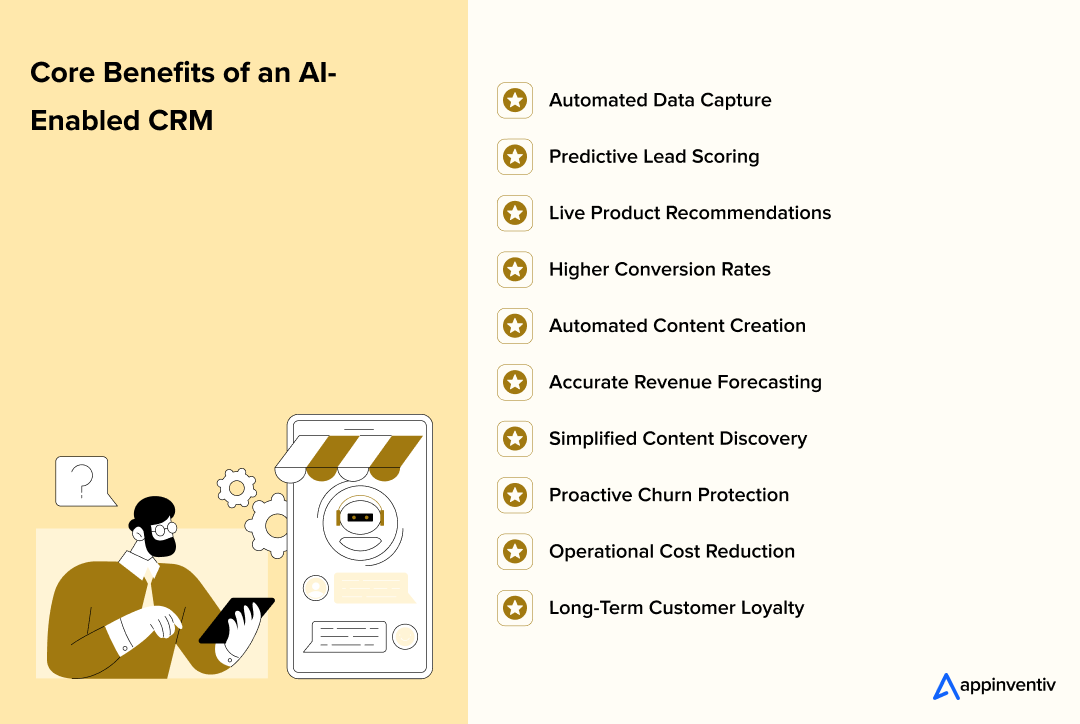
Automated Data Entry and Capture
Sales representatives spend too many hours on manual documentation. Modern CRM software with AI completely fixes this issue. The system automatically records emails, phone calls, and text messages. This use of AI in CRM stops data entry errors and saves real labor hours.
Predictive Lead Scoring
Sales teams often struggle to find the best prospects in a massive database. Machine learning models within an AI-based CRM rank new buyers by purchase history. This application of AI in CRM scores leads by their likelihood to convert. Representatives skip cold accounts and focus on deals that close quickly. These are among the many enterprise CRM benefits that drive large-scale adoption.
Hyper-Personalized Product Recommendations
Modern AI-based CRM software reviews web histories, previous orders, and physical location data. The platform creates a clear profile of consumer needs. The system uses this profile to change product suggestions in real time. Buyers see relevant products, and sales teams secure more cross-selling orders. This capability is especially transformative in ecommerce CRM environments, where product discovery drives revenue at scale. These features highlight the clear AI benefits in CRM deployment.
Accelerated Conversion Rates
Static rule-based platforms lag behind live market changes. An AI-driven CRM tracks real-time consumer interaction to push immediate incentives. A buyer browses a specific product category, and the platform sends a targeted discount code to close the sale. This strategy improves metrics across all AI CRM use cases.
Automated Outreach and Content Generation
Generative AI CRM tools instantly draft targeted email follow-ups. The tool uses past message histories to match the buyer’s exact preferences. Conversational tools go even further, with chatbot CRM integration enabling real-time engagement without human involvement. This automated communication speeds up response times. It keeps buyers engaged without burning out your sales staff. Many examples of artificial intelligence in CRM prove that this keeps pipeline velocity high.
Precision Pipeline Forecasting
Vague sales projections damage corporate planning. Modern CRM and AI setups track client sentiment data to project exact future revenue. The software flags at-risk deals early. Then managers can save the accounts before contracts collapse. This clarity shows how AI impacts CRM forecasting metrics. For companies looking to go deeper, AI analytics for businesses explains how these forecasting models are built and applied across functions
Advanced Content Discovery
Buyers want direct answers during their product research. Intelligent CRM with AI capabilities filters corporate articles, videos, and documentation for every website visitor. This automated curation helps clients find relevant data fast. Visitors spend more time on your platform, and bounce rates drop.
Strategic Protection Against Churn
Losing clients cuts directly into corporate revenue. An AI-powered CRM tracks changes in user login frequency and in support tickets. The platform identifies unhappy clients before they cancel contracts. In high-stakes sectors like insurance, insurance CRM software is purpose-built to handle these churn signals with greater precision. Teams use this early warning to deploy direct retention offers, proving the value of generative AI for CRM software.
Measurable Cost Savings
Implementing an AI-assisted CRM minimizes human capital costs. Predictive analytics allows companies to purchase exactly the right inventory levels and reduce waste. For retail businesses, a customer data platform works alongside AI CRM to centralize shopper data and sharpen these inventory decisions. Businesses run targeted marketing campaigns on smaller budgets, which protects bottom-line profits.
Sustainable Competitive Advantage
Large corporations win markets by acting on trend data ahead of rivals. The future of AI in CRM rests on predictive modeling. Advanced algorithms identify emerging buyer preferences early. This data gives executives the speed needed to launch new products before competitors react.
Higher Financial Return on Investment
The integration of AI into CRM acts as a direct profit multiplier. Generative models adjust pricing structures based on live market demand. Automated campaign creation allows your business to scale operations while keeping customer acquisition expenses low. Choosing the right AI development company helps secure these returns.
Also Read: AI Development Cost: A Complete Breakdown for Businesses
Deepened Customer Loyalty
Personal attention builds long-term brand buyers. High-performing AI in CRM solutions anticipates upcoming client demands and sends automated support updates. This proactive communication creates deep trust and keeps corporate accounts profitable for years.
Challenges With Deploying an AI CRM System
Large corporations face distinct structural bottlenecks when rolling out an AI CRM system. Leaders must navigate technical debt, ballooning CRM implementation expenses, and corporate change management to capture value.
Quality Control and Model Hallucinations
Recent data reveals that 78 percent of business leaders have a strategy for scaling generative AI into customer experiences. Yet more than half of these enterprises lack a process for reviewing automated outputs or resolving errors. This deficit leads to inaccurate messaging and lost consumer trust.
The Remedy: Establish manual oversight protocols before launching automated client workflows. Create explicit guidelines that restrict automated content creation to low-risk customer communications.
Cybersecurity and Sensitive Data Protection
Integrating machine learning models into customer relationship management exposes massive volumes of personal client data to new vulnerabilities. Businesses must protect internal records and external entry points from data leaks. Failure to contain this data leads to severe legal penalties.
The Remedy: Restrict data ingestion to isolated, private networks that prevent information leaks into public training models. Build strict user access permissions directly into the software architecture.
Fragmented Information and Data Availability
The accuracy of an AI-based CRM software system depends entirely on the records it parses. Many legacy enterprises store customer files across isolated databases, creating deep data silos. Healthcare organizations face a version of this with EHR systems, where EHR CRM integration becomes critical to breaking down those silos. Outdated files and duplicate entries cause machine learning tools to generate flawed predictions.
The Remedy: Dedicate an early pilot phase to data cleaning and deduplication. Ask your software provider to demonstrate platform performance using a secure sample of your actual data.
High Capital Allocation and Licensing Costs
Deploying CRM software with AI capabilities demands a heavy financial investment. Custom software development requires long engineering cycles and extensive technical labor. Standard software vendors frequently reserve advanced tools for their premium pricing tiers.
The Remedy: Launch a narrow proof of concept with a single department to test financial feasibility. This testing validates the business case before you purchase licenses for the entire enterprise.
Also Read: White Label Mortgage CRM Software Development Cost
Overreliance and the Loss of Human Touch
How can a business scale automation without losing the empathy needed for client retention? Relying too heavily on automated bots frustrates customers during complex disputes. AI tools lack the emotional reasoning required for high-stakes business negotiations.
The Remedy: Implement a human-in-the-loop mechanism that routes escalated issues to human teams. Set up automatic triggers to alert account managers when text tools detect buyer frustration.
Organizational Change and Team Training
Nearly 87 percent of executives expect machine learning to alter employee roles rather than replace them. Large enterprises face intense internal resistance when introducing new tools to non-technical sales departments. Poor team adoption stretches implementation timelines and delays project returns.
The Remedy: Include frontline sales representatives in the software’s early design phase. Provide training programs that demonstrate how the tools reduce daily administrative burdens.
Stop letting team resistance freeze your software timeline. Request a department pilot setup before your rivals win the market.

Ethical Considerations in AI-Powered Personalization
While AI-powered personalization brings a host of advantages for customer engagement and business efficiency, it’s crucial to be aware of the ethical implications that come with it. Here are the top ethical considerations that organizations should rigorously examine and address when deploying AI-driven personalization features in their CRM systems.

Privacy Concerns
One of the most significant ethical issues in using AI-powered CRM systems is the matter of privacy. These platforms often require extensive data collection to function effectively, gathering information from customer interactions, preferences, and behaviors.
While this data enables highly personalized experiences, it also poses a risk to individual privacy. Businesses must ensure that they have clear and transparent data collection and usage policies to maintain customer trust.
Hence, the implementation of AI for CRM should adhere to strict data privacy regulations such as GDPR, CCPA, or other relevant local laws. Companies need to adopt robust encryption methods and secure data storage solutions to safeguard customer information.
Bias and Fairness
Another critical ethical consideration is the potential for bias within AI-powered CRM systems. Machine learning algorithms learn from existing data, and if that data contains biases, the AI will inevitably replicate them. This could lead to unfair or discriminatory treatment of certain customer groups.
Businesses should continuously monitor and update their AI models to ensure that they are as fair and unbiased as possible.
For a bright future of AI in CRM, it’s vital that companies invest in developing algorithms that are not just intelligent but also ethical. This includes incorporating fairness metrics and conducting regular audits to identify and rectify any biases.
Transparency
Transparency is a cornerstone of ethical AI in CRM implementations. Customers have a right to know how their data is being used, especially when AI algorithms are making decisions that affect them. Whether it’s recommending a product or customizing an offer, the processes behind these decisions need to be transparent and understandable.
Businesses should provide clear explanations for how AI and CRM operates together, what data it uses, and how decisions are made. Offering a “transparent AI” feature within the CRM can also allow customers to understand why certain recommendations or decisions were made, bolstering trust and ethical integrity.
Artificial Intelligence in CRM Examples
The integration of artificial intelligence in Customer Relationship Management (CRM) systems has been a game-changing development across various industries. The synergy of AI and CRM offers real-world benefits, as demonstrated by numerous artificial intelligence in CRM examples.
One of the most well-known CRM AI use cases is Salesforce’s Einstein GPT. This generative AI CRM enhances the capabilities of the CRM platform significantly. It performs over 1 trillion predictive analyses each week and continually refines its understanding from real-time data. Einstein GPT can also integrate with platforms like OpenAI, providing businesses with robust tools for improving their consumer engagement strategies.
Also Read: Salesforce Integration Solutions – Key Benefits, Features, and Approaches
Another compelling example comes from IBM Consulting’s partnership with Bouygues Telecom. The mobile phone company initially had difficulties gaining comprehensive insights from its CRM system. IBM utilized generative AI to optimize call center operations, offering automatic call summarization and topic extraction.
This intelligent addition updated the CRM with more precise and actionable insights, leading to savings of over $5 million and a 30% reduction in call operations, making it one of the most effective CRM AI use cases.
Even specialized industries are adopting AI in CRM systems. Healthcare is another vertical where healthcare CRM development involves unique compliance and cost considerations. Northrop & Johnson, a leading superyacht brokerage company, employed a CRM solution built on Microsoft’s Dynamics 365. The solution offers AI-powered functionalities such as behavioral data analysis, customer segmentation, lead scoring, and brand affinity assessment. The implementation led to targeted marketing efforts that boosted conversion rates and reduced days on the market by 20%.
Kantar, a London-based analytics and brand consulting firm, automated its CRM operations using a bot powered by SAP Conversational AI. This led to faster query resolution and decreased call center costs. The AI-enabled system managed to reduce inbound calls by 10%, enhancing both user satisfaction and operational efficiency.
These artificial intelligence in CRM examples highlight the expansive potential and versatility of AI technologies in creating and enhancing CRM platforms. The financial sector mirrors this trend, where banking CRM systems are using AI to personalize loan offers and reduce churn. Whether it’s operational efficiencies, advanced analytics, or automated customer interactions, AI is making an immediate impact on how businesses engage with their customers.
Competitors use automated tracking to score and engage buyers instantly. Connect with prospects before faster market tools steal conversions.
Commercial AI CRM Platforms vs. Custom Architecture
Enterprise leaders must choose between pre-built vendor packages and custom setups, and the custom AI vs off-the-shelf debate goes beyond just cost. Standard software packages offer quick setup but create long-term vendor lock-in. This breakdown evaluates popular choices alongside the distinct advantages of custom architecture.
Off-the-Shelf AI CRM Tools Evaluated
Salesforce
This platform remains a common choice for large enterprise data management. It features Einstein AI to automate complex sales workflows and build predictive customer metrics. The tool structures customer data points well but requires premium-tier licenses for advanced features.
HubSpot CRM
This system focuses on aligning corporate marketing and sales departments. It provides conversational AI agents and automated content generation tools. Sales teams use their predictive lead scoring to track valuable buyers.
Creatio
This platform offers a no-code system architecture for standard business operations. It provides visual builders to modify operational workflows without manual programming. Teams adjust scheduling paths easily.
Pipedrive
This software centers on visual pipeline tracking for smaller deal matrices. It includes a basic sales assistant that reviews ongoing deal performance. The tool provides clear suggestions to increase the team’s win rate.
Monday CRM
This customizable database tool focuses on lead tracking. The system uses automation to manage inbound inquiries and customer follow-ups. It helps save employee time on basic records management.
Platform Comparison Matrix
| Platform Selection | Core Focus Area | Technical Constraint |
|---|---|---|
| Salesforce | Workflow automation | High recurring user fees |
| HubSpot CRM | Marketing alignment | Restricted data model control |
| Creatio | No-code process building | Hard to modify legacy integrations |
| Pipedrive | Visual pipeline tracking | Lacks enterprise scaling power |
| Monday CRM | Automated customer follow-ups | Limited private network security |
The Enterprise Alternative: Custom AI CRM Engineering
Why do large enterprises outgrow commercial tools? Standard software requires businesses to pay permanent monthly licensing fees for every employee. Public cloud setups can also expose proprietary corporate records to external data leaks.
Building a custom CRM software with a dedicated AI development company offers clear operational advantages:
- Your corporate information stays inside private servers. No data ever leaks into public model training pools.
- Your organization owns the software code entirely. You can add thousands of users without increasing monthly vendor expenses.
- Custom architecture connects your legacy networks into one single dashboard.
Our team builds private, highly secure machine learning systems tailored to enterprise workflows. We help companies remove vendor dependency and secure their data architecture.
If you are still weighing your options, a deeper look at choosing the right CRM can help you align features with your business goals.
The Future of AI in CRM
Machine learning is rapidly updating database systems. These new market movements alter how corporate teams handle records. Enterprise leaders tracking AI trends closely will be better positioned to protect their market share.
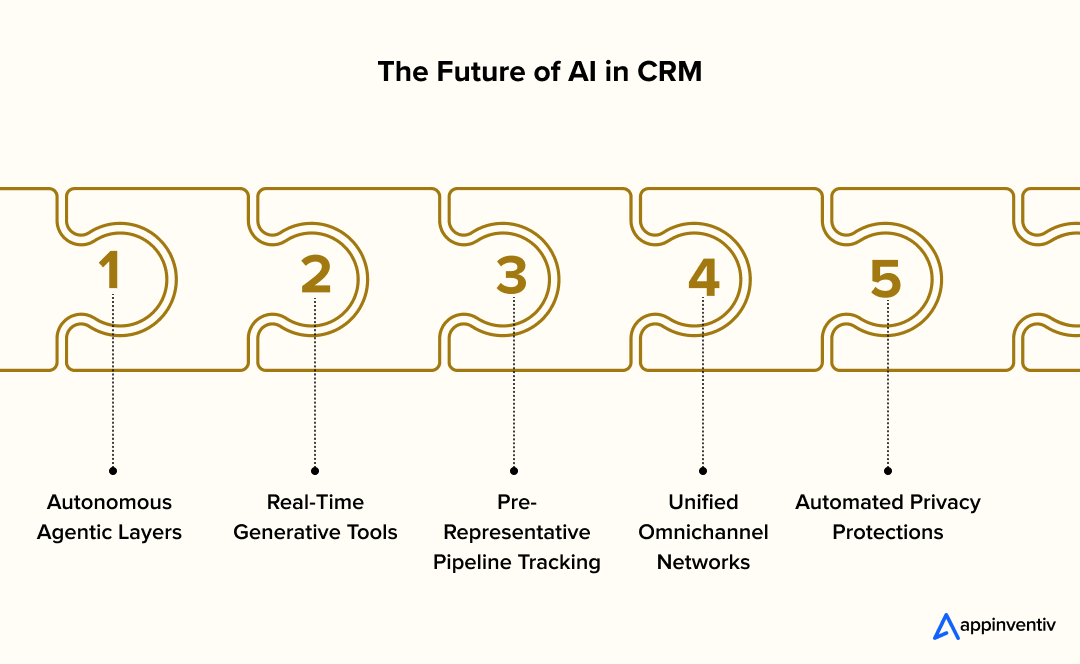
Agentic Layers in an AI CRM System
Corporate software tools shift from basic data storage to autonomous action. Data shows that 86 percent of C-level decision-makers view AI agents as important to their strategic goals. These software layers run workflows and independently handle client text and voice exchanges, much like AI voice assistant tools already integrated with CRM platforms. This shift defines the direct use of AI in CRM systems.
Autonomous Real-Time Generative AI CRM Tools
Upcoming platforms instantly build unique marketing collateral. A generative AI CRM reviews live search records and previous purchases to draft custom text messages. The system creates tailored emails for client accounts without human staff support. This capability accelerates standard AI CRM use cases. Next-generation systems are pushing further with multimodal AI applications that process voice, image, and text inputs simultaneously for richer personalization.
Pre-Representative Automated Pipeline Management
Smarter logic updates early-stage pipeline tracking. An AI-enabled CRM ranks incoming leads immediately based on live buyer actions. The software initiates automated outreach to high-value prospects before a human representative opens the file. This speed improves overall AI in customer relationship management metrics.
Unified Omnichannel AI-Driven CRM Networks
Future systems integrate separate physical and digital channels into a single repository. An AI-driven CRM tracks client interactions across social applications, support centers, and connected hardware. Mobile is a key channel in this mix, and understanding CRM mobile app features is essential for building a truly omnichannel strategy. This comprehensive collection provides a consistent user experience across corporate branches.
Security Tools for an AI-Powered CRM
Data protection remains a top priority for corporate operations. Upcoming applications maintain client record safety through live system tracking. These tools detect suspicious database activity and immediately isolate compromised files. This protective layer helps companies handle global data privacy laws.
How Can Appinventiv Build Your Custom AI in a CRM System?
Commercial AI CRM tools create security risks and lock businesses into expensive subscription models. Appinventiv serves as a specialized AI development company to overcome these technical limitations. We engineer private AI-based CRM software that secures your proprietary records on isolated networks. This architecture stops data leaks during the integration of AI to CRM platforms. We remove data silos by consolidating your legacy systems into a single dashboard.
Our engineering delivers measurable operational returns for large enterprise teams:
- Achieve 98% prediction accuracy and a 40% average reduction in operational costs.
- Accelerate corporate decision-making by 75% with a 10x faster time-to-market.
- Access a dedicated team of 200+ data scientists and AI engineers.
- Deploy proven software with 300+ custom builds, 150+ models, and 75+ enterprise integrations completed.
Contact our technical engineering team today to review your database architecture and deploy a secure AI-powered CRM.
Frequently Asked Questions
Q. How does AI improve CRM?
A. AI significantly enhances CRM systems by automating repetitive tasks, offering predictive analytics, and facilitating more meaningful interactions with customers. With AI, CRM systems can better analyze customer data, assess buying behaviors, and even predict future customer needs.
Q. How to implement AI in CRM?
A. Implementing AI in your CRM starts with defining clear objectives: what problems are you trying to solve, or what processes do you aim to optimize? The next step is data preparation, ensuring that your existing data is clean and structured. Once ready, you can choose from various AI tools or platforms to integrate with your CRM system. This could range from AI-powered chatbots for customer service to predictive analytics tools for sales forecasting.
Q. Can Small Businesses Also Benefit from AI-enhanced CRM Solutions?
A. Absolutely, small businesses can also reap the benefits of AI in CRM. While it’s true that AI implementations can be resource-intensive, there are scalable solutions designed to fit smaller budgets. AI can help small businesses automate customer interactions, analyze data for actionable insights, and improve operational efficiency, allowing them to compete more effectively with larger corporations.
Q. What are the top AI CRM use cases for large enterprises?
A. Large companies use an AI CRM system for predictive lead scoring and automated pipeline tracking. The software tracks live customer sentiment to spot risk factors early. Teams prevent account cancellations and protect corporate revenue lines using these real-time database assessments.
Q. Can custom CRM software with AI lower software expenses?
A. Yes, custom tools drop operational costs by removing monthly user licensing fees entirely. Your business owns the software code. You can scale your user numbers without paying premium subscription fees to outside vendors. Private architecture also secures your customer records completely.
Q. Why choose Appinventiv to build your AI-powered CRM?
A. Appinventiv acts as a specialized AI development company with a team of 200-plus engineers. We build custom ai based crm software tailored to your exact corporate workflows. Our private models protect proprietary data and remove expensive monthly seat licensing fees. Contact us to start your secure database upgrade.


Fast 2-minute response, fully NDA-protected.
AI Data Integration: How to Connect, Clean and Prepare Data for AI
Key takeaways: AI initiatives fail when fragmented, poor-quality data reaches models without sufficient context, controls or ownership. AI-ready pipelines must connect, clean, enrich, govern and continuously monitor data across its lifecycle. Real-time processing matters when AI decisions depend on current transactions, events, inventory or operational conditions. Data architecture should follow the AI use case, balancing…
AI Agent Governance: How to Govern Autonomous AI Across Business Systems
Key takeaways: AI agents require controls at the action, identity, data, tool, and workflow levels. Every enterprise agent should have a registered owner, an approved purpose, and a defined risk tier. Access must be based on the agent’s task rather than inherited from a human user or shared service account. High-impact actions need real-time policy…

'I.D.E.A.S.' - The Five Pillar Framework to Ace AI-Native Enterprise Apps in 2027
Key takeaways: AI-native enterprise apps are moving beyond AI agents toward intelligent, adaptive, autonomous and context-aware digital capabilities that can operate across mobile, web, voice, wearables and emerging interfaces. The I.D.E.A.S. framework for AI enterprise apps in 2027 - Interactive Intent, Decisioning Autonomously, Experiential System Design, Adaptive Execution, and Security Layered. Context intelligence and reusable…