






























eCommerce Integration: Connecting ERP, CRM, PIM, and Other Core Business Systems

 Share -



- 01eCommerce ERP Integration
- 02eCommerce CRM Integration
- 03eCommerce PIM Integration
- 04eCommerce OMS Integration
- 05eCommerce Payment Gateway Integration
- 06eCommerce WMS and Logistics Integration
- 07eCommerce Accounting and Tax Integration
- 08eCommerce POS Integration
- 09eCommerce Inventory Integration
- 10eCommerce Shipping Integration
- 11eCommerce Marketplace Integration
- 12Best Practices for eCommerce System Integration
- 13How Much Does eCommerce Integration Cost?
- 14How Appinventiv Can Help With eCommerce Integration
- 15FAQs

Key takeaways:
- Centralized eCommerce architecture distributes accurate product data simultaneously across all your global sales channels.
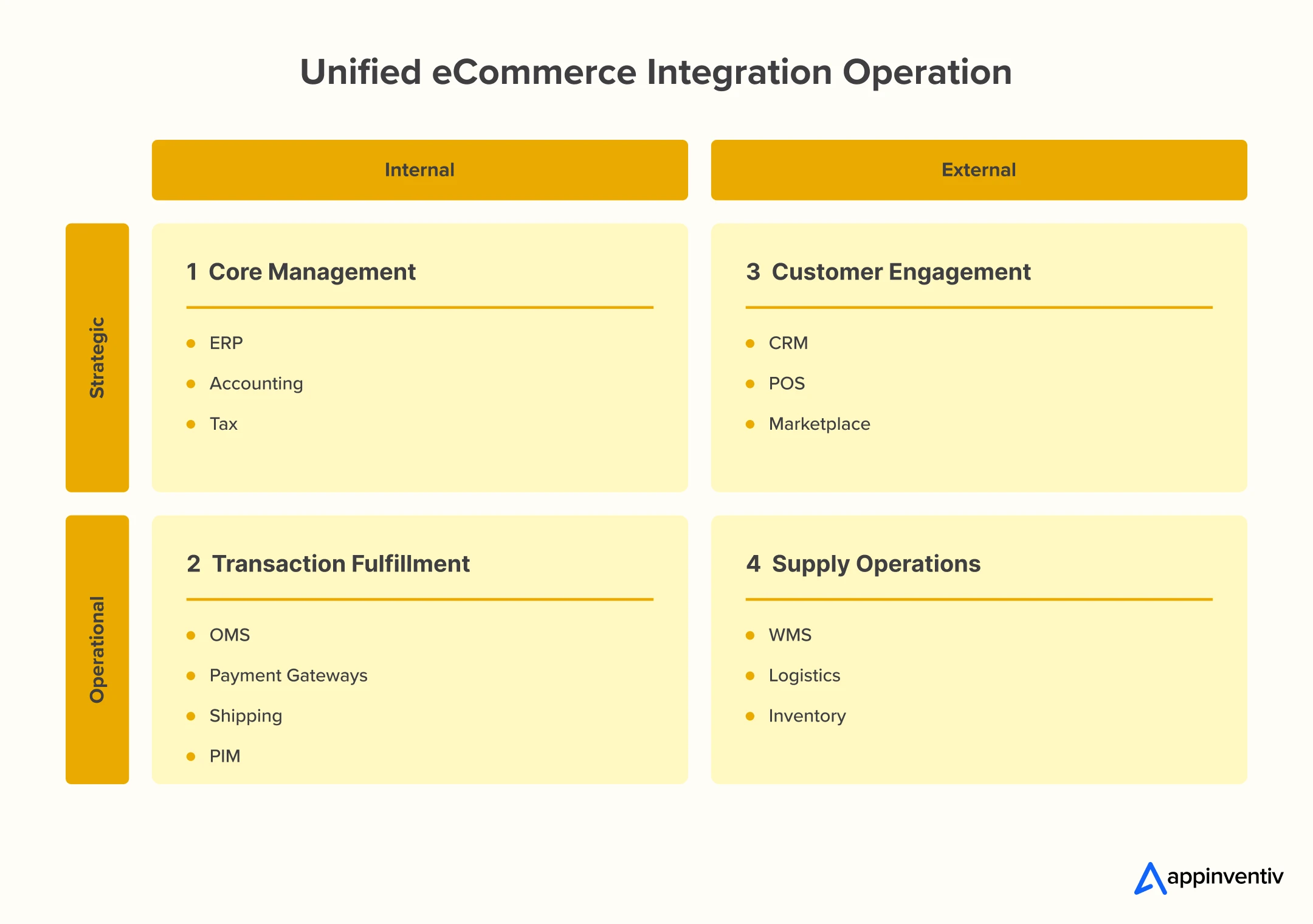
- ERP, CRM, PIM, OMS, POS, etc. are the core integration types forming your eCommerce architecture.
- Security and compliance must anchor your payment architecture when operating across multiple regulatory jurisdictions.
- The cost of eCommerce platform integration ranges between $40,000 and $500,000 or more.
A modern eCommerce operation rarely runs on a single platform. The storefront may handle the customer experience, while ERP manages finance and inventory, PIM controls product information, CRM stores customer data, OMS orchestrates orders, and WMS and logistics systems manage fulfillment.
The problem starts when these systems operate in isolation. Data gets duplicated. Inventory becomes difficult to trust. Orders require manual intervention. Product information falls out of sync. Finance teams spend time reconciling transactions that should already match.
eCommerce integration creates the connective layer between these systems. Orders can move into ERP, product information can flow from PIM, customer activity can reach CRM, and fulfillment updates can return to the storefront without constant manual handling.
According to a 2025 Gartner report, 75% of B2B organizations will complete their highest revenue deals via digital channels by 2028. However, taking advantage of this shift requires resolving operational bottlenecks. This means data must flow predictably across unified environments.
The objective is not to connect every application simply because an integration is technically possible. It is to create reliable business flows across the systems that control revenue, customers, inventory, fulfillment, and financial operations.
This blog details the core types of eCommerce platform integration and what businesses should consider when connecting them.
Create reliable data flows across core business systems without disrupting existing ecommerce operations.

eCommerce ERP Integration
Connecting your digital storefront with enterprise resource planning (ERP) software establishes a central nervous system for your business. This bridge automates the flow of financial and order data. By removing manual touchpoints, eCommerce ERP integration gives businesses absolute visibility into supply chain health, cash flow, and operational efficiency across all sales channels.
What Does ERP Connect?
- Orders and transaction data
- Inventory and product data
- Customer and pricing information
- Invoices, payments, and financial records
Why Integrate eCommerce with ERP?
Operating a high volume commerce platform alongside an isolated ERP creates massive operational drag. But with ERP integration, your finance team experiences reduced manual data entry. Furthermore, establishing stable eCommerce accounting integration ensures financial ledgers reflect recognized revenue instantly upon order completion.
Common Use Cases of ERP Integration
- Automated order synchronization from checkout to fulfillment
- Returns and refund processing with instant ledger updates
- Multi-store and multi-warehouse management
- Financial reporting and reconciliation
Architecture and Technology Stack
The technology footprint typically includes the storefront, the ERP, and a middleware layer. Developers rely on REST or GraphQL APIs, webhooks, and asynchronous data pipelines to ensure robust connectivity.
Key Challenges and Solutions
| Challenge | Solution |
|---|---|
| Legacy ERP compatibility | Use middleware or API layers to connect legacy systems without disrupting core operations. |
| Data mapping and synchronization | Establish standard data models and clear rules for how information moves between environments. |
| Application failures | Use retry mechanisms and active monitoring to manage inconsistent data flows. |
| Security and scalability | Apply secure authentication, access controls, and scalable infrastructure across endpoints. |
Implementing resilient ERP data pipelines requires configuring custom middleware layers and retry logic that protect legacy mainframes from traffic spikes. An experienced software integration firm establishes unified data schemas to keep financial ledgers and stock levels strictly aligned across enterprise architectures.
eCommerce CRM Integration
Linking commerce platforms to CRM (customer relationship management) systems aligns sales, marketing, and support around a single customer view. This setup ensures every interaction relies on accurate purchase histories and behavioral data. Businesses can thereby forecast demand accurately and optimize the lifetime value of every acquired customer account.
What Does CRM Integration Connect?
- Customer profiles and contact information
- Purchase and order history
- Customer interactions and support data
- Browsing and behavioral data
Why Integrate eCommerce with CRM?
Disconnected customer data prevents targeted marketing and efficient support. Unifying these systems yields complete customer profiles and highly personalized experiences. Also, sales teams achieve better customer segmentation. These improvements directly drive retention and customer lifetime value.
Common Use Cases
- Abandoned cart and post purchase campaigns triggered by real time events
- Personalized product recommendations based on historical buying patterns
- Customer segmentation for targeted marketing rollouts
- Loyalty and retention programs active across multiple channels
Architecture and Technology Stack
Modern setups combine the storefront with the CRM and often a Customer Data Platform. Information moves through APIs, webhooks, and bidirectional synchronization pipelines.
Key Challenges and Solutions
| Challenge | Solution |
|---|---|
| Duplicate customer records | Apply identity resolution and deduplication rules across platforms. |
| Data privacy and consent | Build consent management and controlled data access into automated workflows. |
| Identity matching | Use consistent customer identifiers across all active databases. |
| Inconsistent customer data | Establish validation rules before information enters the CRM. |
Connecting customer touchpoints at scale demands robust identity resolution frameworks and automated consent controls embedded directly into the API architecture. Integration experts structure these pipelines to process real-time events without duplicating customer records or exposing sensitive data.
eCommerce PIM Integration
Scaling global sales channels requires flawless product information management (PIM). Centralizing thousands of product attributes ensures consistency across regional storefronts, mobile applications, and partner sites. This centralized repository accelerates time to market for new catalogs while eliminating the brand risk associated with fragmented, inaccurate, or outdated product specifications.
What Does PIM Architecture Connect?
- Product descriptions and core attributes
- Product specifications and variants
- Product images and digital assets
- Categories and channel specific data
Why Integrate eCommerce with PIM?
Managing product information directly within the frontend backend becomes unmanageable as your catalog grows. A dedicated PIM ensures consistent data across every touchpoint. This leads to faster catalog updates and drastically reduced specification errors.
Common Use Cases
- Global product publishing across web, mobile, and social
- Marketplace catalog synchronization for third party platforms
- Bulk updates during seasonal transitions
- Localized catalog management for international markets
Architecture and Technology Stack
The ecosystem consists of the storefront, the PIM, and Digital Asset Management software. Connectivity relies heavily on APIs, webhooks, and scheduled batch synchronization.
Key Challenges and Solutions
| Challenge | Solution |
|---|---|
| Poor quality product data | Establish validation, enrichment, and governance processes. |
| Complex product structures | Create standard schemas for attributes, variants, and relationships. |
| Large product catalogs | Use scalable infrastructure and asynchronous processing for bulk updates. |
| Different channel requirements | Transform payloads according to each channel format and requirement. |
The data layer must account for product hierarchy, transformation, and channel requirements so catalog updates remain consistent as the business expands. Technology experts build scalable asynchronous processing pipelines that push complex product hierarchies to global sales channels without latency or errors.
eCommerce OMS Integration
Order management system (OMS) integration dictates fulfillment profitability. Decoupling fulfillment logic from the storefront allows operations teams to route orders intelligently based on stock proximity and shipping costs. The resulting architecture handles massive transaction spikes gracefully while maintaining rigorous delivery service level agreements across diverse geographic regions.
What Does OMS Orchestration Connect?
- Online orders and current status
- Inventory availability across all locations
- Warehouses and physical stores
- Returns and cancellations
Why Integrate eCommerce with OMS?
Relying on the frontend for complex routing often breaks down at scale. An independent OMS provides centralized orchestration and accurate inventory visibility. The business benefits from faster, more flexible fulfillment, delivering consistent omnichannel experiences.
Common Use Cases
- Buy online, pick up in store routing
- Ship from store fulfillment logic
- Split order fulfillment for multi item carts
- Cross channel returns and reintegration
Architecture and Technology Stack
The architecture connects the frontend to OMS, ERP, and logistics networks. This setup heavily utilizes event driven architecture to broadcast state changes instantly.
Key Challenges and Solutions
| Challenge | Solution |
|---|---|
| Real time inventory synchronization | Use event driven updates and defined synchronization rules. |
| Complex fulfillment rules | Configure an orchestration layer based on location, stock, and delivery priorities. |
| Multiple warehouses and stores | Maintain a unified inventory view across all nodes. |
| High order volumes and exceptions | Use scalable queues and automated exception handling. |
Designing decoupled order management layers requires event-driven architectures that evaluate inventory availability across multiple nodes in milliseconds. A digital engineering expert configures custom orchestration logic to handle peak volume spikes while maintaining strict delivery service level agreements.
eCommerce Payment Gateway Integration
Financial compliance and transaction security form the bedrock of enterprise commerce. Connecting checkout interfaces with global gateways and fraud detection engines minimizes checkout friction. This configuration enforces strict payment card industry standards, ensuring revenue flows securely into your core financial and accounting platforms across varying jurisdictions.
In short, deploying secure eCommerce payment gateway integration links the digital checkout experience with external processors and fraud platforms.
What Do Payment Systems Connect?
- Checkout interfaces and payment gateways
- Payment processors and acquiring banks
- Fraud detection platforms
- Corporate accounting systems
Why Integrate eCommerce with Payment Gateways?
Fragmented financial data creates reconciliation nightmares and massive compliance risks. Deep technical alignment ensures a faster checkout while providing support for alternative payment methods globally. It also enables automated refunds and highly accurate financial reconciliation in the corporate ledger.
Common Use Cases
- Multiple payment methods tailored to regional preferences
- Recurring and subscription payments for continuous revenue
- Automated refunds tied directly to the OMS
- Fraud detection using behavioral scoring
Architecture and Technology Stack
The technical foundation involves the storefront, external gateways, and fraud detection layers. The connections rely on secure APIs, payload tokenization, and webhooks for asynchronous status updates.
Key Challenges and Solutions
| Challenge | Solution |
|---|---|
| Payment security | Use tokenization, encryption, and secure authentication mechanisms. |
| Failed or declined transactions | Build retry, fallback, and clear status workflows. |
| PCI DSS v4.x compliance | Minimize sensitive data exposure and use compliant external providers. |
| Payment reconciliation | Synchronize transaction, refund, and settlement data with finance tools. |
Financial architecture must prioritize security and resilience from the beginning, particularly when multiple providers or global markets are involved. Experienced integration consultants build secure and resilient payment pipelines that minimize token exposure, streamline PCI compliance, and simplify automated ledger reconciliation.
eCommerce WMS and Logistics Integration
Supply chain volatility demands absolute precision in warehouse operations. Connecting eCommerce platforms to warehouse management and shipping systems automates the journey from order capture to doorstep delivery. This data continuity prevents bottlenecks, accelerates pick and pack workflows, and provides end customers with transparent, real time shipment tracking.
What Does WMS and Logistics Automation Connect?
- Verified orders and warehouse systems
- Inventory and fulfillment data
- Shipping carriers and 3PL providers
- Shipment tracking and delivery details
Why Integrate eCommerce with WMS and Logistics?
Disconnected fulfillment data creates dispatch bottlenecks and massive inventory discrepancies. Deep technical alignment ensures faster order processing while providing support for dynamic carrier selection globally. It also enables automated label generation and highly accurate real time shipment tracking across the supply chain.
Common Use Cases
- Automated order fulfillment assignment
- Pick and pack workflows triggered by priority
- Carrier selection and shipping label generation
- Shipment tracking and returns processing
Architecture and Technology Stack
This setup links the storefront with the WMS, OMS, and carrier APIs. The technology relies on REST APIs, webhooks, and legacy EDI protocols where older logistics partners require it.
Key Challenges and Solutions
| Challenge | Solution |
|---|---|
| Inventory discrepancies | Synchronize stock movements across frontend, WMS, and other databases. |
| Multiple fulfillment centers | Use centralized fulfillment rules and location aware management. |
| Different carrier APIs | Use middleware or a unified shipping layer. |
| High volume processing | Design for asynchronous processing, queues, and elastic infrastructure. |
The right technical architecture keeps warehouse and delivery operations connected to the storefront without making the frontend responsible for every fulfillment process. An integration expert deploys elastic queuing mechanisms to ensure real-time inventory updates and automated shipping label generation.
Also Read: Custom Warehouse Management System Development
eCommerce Accounting and Tax Integration
Financial compliance requires absolute data precision. Integrating eCommerce platforms with corporate accounting software automates revenue recognition and tax calculation. This infrastructure removes manual ledger entries, accelerates month end closing cycles, and ensures executive teams have immediate access to accurate cash flow metrics across all digital sales channels.
What Does It Connect?
- Daily transaction and settlement data
- Tax calculation and compliance records
- Refunds, chargebacks, and financial adjustments
- Payment gateway payouts and bank feeds
Why Integrate eCommerce with Accounting and Tax Systems?
Disconnecting sales data from financial ledgers creates massive compliance risks and delays reporting. Proper eCommerce accounting integration automates the flow of revenue data directly into your corporate ledger. Finance teams eliminate hours of manual reconciliation while gaining real time visibility into profitability and channel performance.
Common Use Cases
- Automated daily revenue recognition
- Cross border tax calculation and reporting
- Multi currency transaction reconciliation
- Automated invoice and receipt generation
Architecture and Technology Stack
Enterprise setups connect the digital storefront with platforms like NetSuite or SAP using API middleware. Data flows rely on secure REST APIs and batch processing for end of day financial reconciliation.
Key Challenges and Solutions
| Challenge | Solution |
|---|---|
| High transaction volumes | Use batch processing to prevent API rate limits and system crashes. |
| Tax compliance variations | Implement dedicated tax calculation engines alongside the integration layer. |
| Handling partial refunds | Map complex order states directly to specific ledger adjustments. |
| Data formatting mismatches | Standardize financial data models before payloads enter the accounting software. |
Building compliant accounting pipelines requires deploying intelligent batch processing layers that convert complex transactional payloads into structured ledger entries. Technical leads configure these workflows to handle cross-border tax logic, multi-currency settlements, and daily reconciliation automatically.
eCommerce POS Integration
Omnichannel retail demands unified physical and digital operations. Connecting your point of sale (POS) system with the eCommerce backend synchronizes offline and online stock instantly. This architecture prevents digital stockouts caused by physical store purchases, enabling complex operational workflows like buy online pick up in store effortlessly.
What Does it Connect?
- Physical store registers and digital storefronts
- Offline and online transaction records
- Store level and warehouse inventory
- Unified customer purchase histories
Why Integrate eCommerce with POS?
Operating physical stores and digital channels in silos leads to split inventory pools and disjointed customer experiences. Implementing seamless eCommerce POS integration bridges these environments. Store associates gain visibility into online orders, while digital customers can accurately view localized stock availability before visiting a physical location.
Common Use Cases
- Buy online, pick up in store (BOPIS)
- In store returns for online purchases
- Unified customer loyalty program synchronization
- Real time store level inventory display
Architecture and Technology Stack
This architecture connects physical POS terminals, the commerce backend, and the central inventory database. Connectivity typically requires cloud based middleware, event webhooks, and secure API endpoints.
Key Challenges and Solutions
| Challenge | Solution |
|---|---|
| Offline terminal syncing | Build local caching mechanisms that synchronize data immediately upon network restoration. |
| High concurrency during peak hours | Use event driven architecture to handle simultaneous online and offline transactions. |
| Inconsistent product identifiers | Standardize SKUs and barcodes across physical and digital catalogs. |
| Complex return workflows | Map offline returns accurately to digital payment gateways and inventory pools. |
Bridging physical and digital touchpoints establishes a truly unified retail operation that maximizes inventory turnover and elevates the customer experience. Integration teams construct these low-latency pipelines to ensure store terminals remain fully operational offline and instantly synchronize inventory levels once connectivity resumes.
eCommerce Inventory Integration
Scaling digital operations requires absolute certainty regarding stock levels. Integrating your storefront directly with eCommerce inventory databases prevents overselling and lost revenue. This structural alignment ensures that digital displays match physical reality, allowing supply chain teams to optimize purchasing decisions based on real time consumption data.
What Does it Connect?
- Available stock levels across all nodes
- Safety stock buffers and thresholds
- Purchase orders and supplier feeds
- Multi warehouse stock allocation
Why Integrate eCommerce with Inventory Systems?
Displaying phantom inventory destroys brand trust and inflates customer service costs. Deploying robust eCommerce inventory integration ensures your digital storefront reflects actual physical stock availability down to the millisecond. Operations teams can maintain optimal safety buffers while automatically routing orders to the nearest fulfillment center.
Common Use Cases
- Real time stock availability updates
- Automated low stock alerts and reordering
- Safety stock buffer management
- Multi location inventory routing
Architecture and Technology Stack
The integration layer links the digital application, the central inventory repository, and regional warehouse databases. Developers implement event driven webhooks to push stock updates instantly rather than relying on delayed polling.
Key Challenges and Solutions
| Challenge | Solution |
|---|---|
| High frequency stock updates | Utilize delta syncs to transmit only modified stock levels rather than full catalogs. |
| Flash sale concurrency | Implement inventory reservation systems that lock stock during the checkout process. |
| Multi node complex routing | Establish clear hierarchical rules for prioritizing specific warehouse locations. |
| Data latency | Replace batch processing with real time event streaming for critical stock updates. |
Accurate inventory data serves as the foundation for digital commerce profitability, ensuring businesses never sell products they cannot physically fulfill. Experienced delivery teams engineer real-time event streams that eliminate stock polling latency, keeping digital storefront displays precisely synchronized with physical warehouse shelves.
eCommerce Shipping Integration
Fulfillment speed directly impacts customer retention and operational margins. Connecting the eCommerce platform with global carrier networks automates label generation and rate calculation. This infrastructure removes manual logistics bottlenecks, enabling warehouses to dispatch orders faster while providing customers with granular, real time package tracking visibility.
What Does it Connect?
- Order data and carrier rating engines
- Automated label generation systems
- Real time shipment tracking APIs
- Customs documentation for international logistics
Why Integrate eCommerce with Shipping Systems?
Manual logistics processing crumbles under high order volumes. Implementing direct eCommerce shipping integration automates carrier selection based on weight, dimensions, and delivery speed requirements. Warehouse teams eliminate manual data entry for shipping labels, and customers receive immediate, automated updates regarding their package trajectory.
Common Use Cases
- Dynamic checkout rate calculation
- Automated carrier selection and routing
- Instant shipping label and manifest generation
- Automated customer tracking notifications
Architecture and Technology Stack
This setup connects the fulfillment backend with third party carrier APIs like FedEx, UPS, or regional logistics providers. The architecture relies on RESTful APIs and middleware to standardize distinct carrier payload requirements.
Key Challenges and Solutions
| Challenge | Solution |
|---|---|
| Varying carrier API structures | Deploy a unified shipping API layer to normalize data across all logistics partners. |
| Downtime from carrier networks | Build fallback mechanisms that automatically route to secondary carriers during outages. |
| Complex dimensional weight calculation | Pass accurate product dimensions directly from the PIM to the shipping engine. |
| International customs compliance | Automate commercial invoice generation alongside standard shipping labels. |
Scaling shipping operations involves constructing unified API abstraction layers that normalize multi-carrier requirements and automate rate calculations. Specialized engineering partners build failover protocols that switch logistics routes seamlessly during carrier service disruptions.
eCommerce Marketplace Integration
Expanding revenue streams requires maintaining presence across dominant third party channels. Integrating your core systems with external marketplaces synchronizes product listings and consolidates order flows. This architecture prevents channel conflict, allowing your enterprise to manage sales across Amazon, eBay, and native storefronts from one centralized dashboard.
What Does it Connect?
- Central product catalogs and marketplace listings
- Third party orders and internal fulfillment systems
- Multi channel pricing and promotional engines
- Marketplace specific customer communication tools
Why Integrate eCommerce with Marketplace?
Managing disparate sales channels manually leads to overselling and fractured brand presentations. Executing secure eCommerce marketplace integration consolidates all external channel data into your primary ERP and OMS. This centralization allows operations teams to fulfill marketplace orders using standard internal workflows without logging into separate portals.
Common Use Cases
- Centralized multi channel order aggregation
- Automated listing and catalog syndication
- Dynamic pricing synchronization across platforms
- Consolidated inventory depletion updates
Architecture and Technology Stack
This infrastructure links your central ERP, PIM, and OMS with external marketplace APIs. Middleware handles the translation of proprietary marketplace data formats into your standardized internal enterprise architecture.
Key Challenges and Solutions
| Challenge | Solution |
|---|---|
| Strict marketplace API rate limits | Use intelligent queuing to space out catalog updates and avoid throttling. |
| Unique listing requirements per channel | Map central PIM attributes dynamically to specific marketplace category requirements. |
| Order acknowledgment latency | Implement high priority webhook listeners to accept and confirm marketplace orders instantly. |
| Pricing conflicts | Deploy centralized pricing rules that automatically calculate marketplace commissions and fees. |
Managing third-party marketplace syndication requires configuring intelligent queuing mechanisms to navigate strict external API rate limits. Enterprise architects construct dynamic mapping rules that transform core catalog attributes into marketplace-compliant schemas while centralizing multi-channel order streams.
Unify critical commerce data across systems to improve visibility, automation, fulfillment, and decision-making.

Best Practices for eCommerce System Integration
Seamless integration of eCommerce systems demands strict architectural governance. Successful deployments share common operational disciplines that prevent critical system failures at scale.
- Define strict data ownership: Establish clear source of truth rules. Never allow multiple systems to compete for authority over inventory or pricing records.
- Standardize enterprise data models: Create a unified schema defining exactly how customers, transactions, and product catalogs map across the entire ecosystem.
- Build resilient error handling: Implement dead letter queues and automated alerting immediately to catch, isolate, and resolve failed payloads without manual intervention.
- Prioritize by business impact: Sequence your connectivity roadmap by connecting systems that eliminate the heaviest manual operational bottlenecks and drive immediate ROI.
- Design for peak concurrency: Ensure your middleware throttles incoming API requests to protect vulnerable legacy mainframes from crashing during high traffic flash sales.
- Enforce rigorous security protocols: Secure data across every endpoint using strict OAuth standards, API gateways, and payload encryption through secure eCommerce API integration.
- Test real-world edge cases: Validate automated workflows rigorously for complex scenarios like failed payments, partial refunds, unexpected order cancellations, and severe inventory mismatches.
How Much Does eCommerce Integration Cost?
On average, the cost of eCommerce platform integration ranges from $40,000 to $500,000+. However, this is just a rough estimate. The actual cost varies, depending on the number of systems, integration complexity, and level of customization required.
For instance, simple API connections sit at the lower end, while enterprise programs involving legacy platforms, multiple channels, custom workflows, and large-scale data migration can exceed $500,000.
Here is a table outlining eCommerce integration solutions cost based on the project complexity:
| Integration level | Estimated cost | Typical scope |
|---|---|---|
| Low complexity | $40,000–$100,000 | 1–2 systems, standard APIs, limited data transformation, straightforward workflows |
| Medium complexity | $100,000–$250,000 | Multiple enterprise systems, custom mappings, middleware, moderate business logic, data migration |
| High complexity | $250,000–$500,000 | ERP, CRM, PIM, OMS, WMS, payment, POS, or marketplace integrations with significant customization |
| Enterprise scale | $500,000+ | Large legacy environments, multiple regions or channels, high transaction volumes, complex orchestration, extensive migration, security, and governance |
Understand the likely investment based on your systems, integration complexity, customization, data migration, and scalability requirements.

How Appinventiv Can Help With eCommerce Integration
A connected eCommerce environment requires more than API connections. The architecture has to work with existing ERP, CRM, PIM, OMS, WMS, payment, POS, accounting, logistics and other core systems while remaining adaptable as channels and transaction volumes change.
Appinventiv, an experienced eCommerce development company, engineers high performance digital commerce architectures that resolve complex enterprise challenges.
Our focus remains on building integration layers that are reliable today, adaptable as systems evolve, and capable of supporting increasing transaction volumes and new commerce channels.
Our team of 1700+ tech architects specialize in API connectivity, legacy system modernization, and cloud middleware deployment. In our 11+ years of eCommerce transformation, we have delivered 400+ eCommerce platforms for 30+ enterprise retailers and brands, including Adidas, Edamama, 6th Street, Body Shop, IKEA and so on.
We boast 25+ payment gateway partnerships, a 96% client satisfaction rate, and a stated 99.50% SLA for transaction reliability.
For instance, we developed an ERP solution for IKEA that enabled in-store customer onboarding while providing real-time product availability and capturing customer information through the backend.
The solution was deployed across 7+ IKEA stores, with each store operating through its own server environment and private IP requirements. This required the integration architecture to account for both centralized data needs and store-level infrastructure.
Ready to scale your eCommerce like IKEA and other retail giants. Connect your core commerce systems with an architecture built to support multi-store operations and growing transaction volumes. Talk to our integration experts today.
FAQs
Q. Why is eCommerce integration important for online businesses?
A. Multi channel eCommerce integration eliminates data silos and manual data entry. Connecting internal tools directly to the storefront ensures real time inventory accuracy, faster fulfillment, and synchronized financial reporting. This operational maturity prevents overselling and protects the brand experience.
Q. What is the difference between custom eCommerce integration and pre-built connectors?
A. Pre-built connectors offer rapid deployment for standard data flows between popular SaaS platforms. A true custom eCommerce integration involves engineering bespoke APIs, middleware routing, and specific business logic to accommodate unique legacy systems and highly specialized operational workflows.
Q. How long does it take to integrate an eCommerce platform with other business systems?
A. Timelines for eCommerce integration ranges between 4 to 12+ months, depending on the project complexity. Connecting modern platforms via an iPaaS might take a few weeks. Complex enterprise deployments involving legacy on premise ERPs, custom data mapping, and rigorous security compliance auditing often require several months of development and testing.
Q. How can commerce platforms prepare for AI agent-driven purchases?
A. Preparing for AI agents requires exposing clean, structured product and inventory data via highly performant endpoints. AI agents rely on machine readable APIs rather than human user interfaces. Standardizing your PIM data and ensuring real time OMS accuracy allows autonomous agents to negotiate, query, and transact seamlessly.
Q. How can AI-powered fraud detection be integrated into eCommerce systems?
A. AI fraud detection connects between the checkout interface and the payment gateway. By utilizing webhooks and APIs, the system analyzes behavioral biometrics, device fingerprints, and historical transaction data in milliseconds. It then scores the risk and instructs the gateway to authorize, challenge, or decline the payment autonomously.


Fast 2-minute response, fully NDA-protected.

Why Australian Retailers Are Investing in Unified Commerce Platforms in 2026
Key takeaways: Unified commerce platform development in Australia is now central to peak trading resilience, not a discretionary upgrade. The Australian unified commerce opportunity is valued at AUD 44 billion, with early adopters seeing revenue growth of 20% or more. Real-time inventory and customer data are prerequisites for reliable AI deployment in retail. Addressing governance…

How Much Does It Cost to Build an eCommerce Marketplace App Like Poshmark?
Key takeaways: Poshmark-like marketplaces enable unlocking new sources of revenue through transforming social interaction into low-capital-intensity repeat purchases. A marketplace app would cost between $40,000 and $400,000 to develop, depending on its features, platform and enterprise scalability needs. Special implementation, beginning with tests or single categories, confirms supply, demand, and monetization in 6-12 months. Trust,…

How Much Does It Cost to Build a Fashion Marketplace App Like Depop in the UK?
Key takeaways: A Depop-style fashion marketplace in the UK usually costs £32,000 to £320,000, depending on how simple or advanced you want the app to be. The UK’s resale-fashion scene is growing quickly, so demand for social, pre-loved fashion apps is only going up. Costs increase when you add things like AI recommendations, logistics integrations,…