






























AI Red Teaming Attack Strategies: Jailbreak, Crescendo, Base64 & More Explained

 Share -


- 01What Are AI Red Teaming Attack Strategies?
- 02AI Red Teaming Attack Strategies You Need to Know
- 03How to Execute AI Red Teaming Attack Strategies
- 04How Attack Strategies Apply to RAG, AI Agents, and Enterprise Workflows
- 05AI Red Teaming Tools for Testing These Attack Strategies
- 06How Enterprises Measure AI Red Teaming Results
- 07Frameworks and Standards for AI Red Teaming
- 08Challenges, Limitations, and Conceptual Scope
- 09Enterprise Best Practices for AI Red Teaming
- 10Build, Test, and Secure Enterprise AI With Appinventiv
- 11Frequently Asked Questions

Key takeaways:
- Jailbreak testing must follow the full execution path from prompt and context to retrieval, tools, and enterprise APIs.
- Crescendo and adaptive attacks expose failures that single-turn testing misses by exploiting conversation history and model feedback loops.
- Base64 and Unicode tests probe gaps in normalization, tokenization, filtering, and decoding before adversarial input reaches model inference.
- RAG and agent red teaming tests whether poisoned context can become unauthorized retrieval, tool calls, or workflow actions.
- Enterprise teams should convert confirmed attacks into regression tests across model, prompt, retrieval, permission, and tool changes.
The attack surface of an AI system no longer ends at the model endpoint. A user prompt can shape retrieved context, influence the model, affect memory, trigger a tool call, and reach an enterprise system. That chain creates failure points that a single jailbreak test cannot cover.
The risk is already visible across enterprise security teams. The World Economic Forum reported that 87% of respondents identified AI-related vulnerabilities as the fastest-growing cyber risk during 2025.
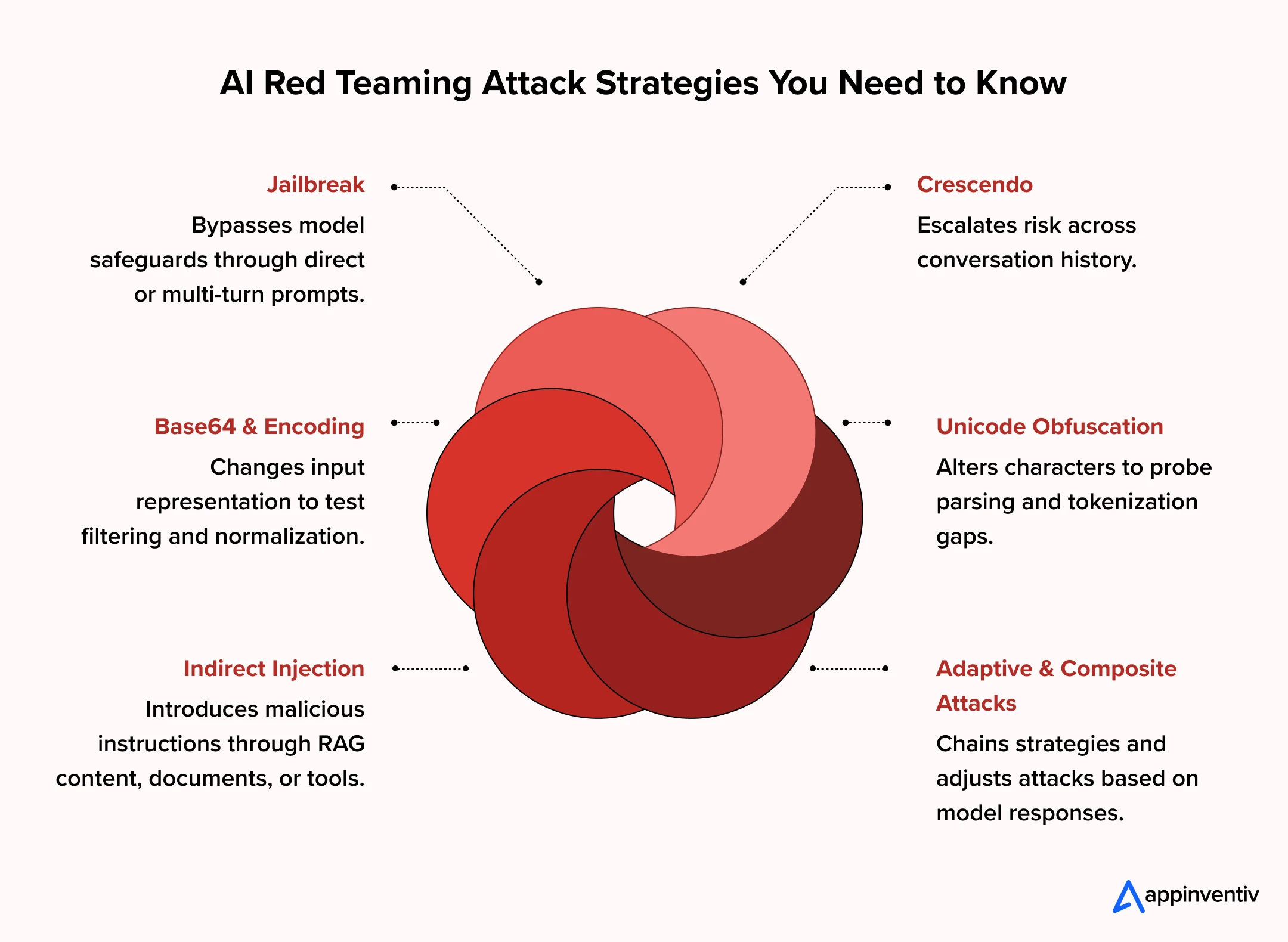
AI red-teaming attack strategies help security and development teams probe failure points through controlled adversarial scenarios. These strategies include jailbreaks, multi-turn escalation such as Crescendo, encoding tricks such as Base64, Unicode obfuscation, indirect prompt injection, and adaptive attack generation. Each strategy probes a different weakness in how an AI system interprets input, processes context, follows policy, or takes action.
For enterprises, the real test is not just whether an attacker can bypass a safeguard. The bigger question is what happens after the bypass. Can the model expose RAG content? Can an agent access restricted data? Can a compromised instruction trigger an unauthorized API call?
This article breaks down these attack strategies, how they work, where they fit in modern AI architectures, and how teams can test them across LLMs, RAG applications, and autonomous agents.
The World Economic Forum puts AI risk among top enterprise cyber concerns. Is your AI stack tested against adversarial attacks?
What Are AI Red Teaming Attack Strategies?
AI red teaming attack strategies are structured methods used to probe an AI system for specific security, safety, or behavioral weaknesses. A test can target the model itself, yet the strategy can act through prompts, conversation history, retrieved content, or connected tools. This distinction matters in enterprise systems, where effective AI security testing depends on knowing which component influenced the final response or action.
Attack Objective vs Attack Strategy vs Attack Technique
Attack Objective: The result the tester wants to trigger. An objective can involve extracting restricted information, bypassing a policy, producing prohibited content, or causing an agent to perform an unauthorized action, each tied to a broader category of AI risks that enterprises must account for.
Attack Strategy: The interaction pattern used to pursue that objective. A jailbreak can attempt a direct bypass, while Crescendo uses gradual escalation across multiple turns. The strategy defines how the test unfolds.
Transformation/Converter: The method used to alter the input before it reaches the target. Base64, ROT13, Unicode substitution, binary encoding, and character manipulation can change the input surface without changing its intended meaning.
Evaluator/Scorer: The mechanism that determines whether the attack worked. It can assess policy violations, exposure of sensitive data, unsafe tool calls, task deviations, and other predefined outcomes. Attack Success Rate (ASR) is a common metric, but enterprise testing often tracks several measures.
| Term | What it defines | Example |
|---|---|---|
| Attack objective | Desired outcome | Extract restricted data |
| Attack strategy | Interaction pattern | Jailbreak or Crescendo |
| Transformation/converter | Input modification | Base64 or Unicode |
| Evaluator/scorer | Test outcome | Policy violation or ASR |
Keeping these layers separate makes test cases easier to reproduce and compare. It helps development teams identify the right control to fix, whether that control sits in input processing, model policy, retrieval, access control, or agent execution.
AI Red Teaming Attack Strategies You Need to Know
Red teaming AI models and the systems around them defines how a tester interacts with a target AI system to pursue a defined security or safety objective. Current red-teaming frameworks separate the attack objective from the attack technique, converters, target, and scorer. Microsoft PyRIT, for example, models these parts as reusable components that can be combined inside a scenario.
That structure matters in enterprise testing. A single attack can change several parts of the input path before the model sees it. Another can keep the same objective but alter the conversation strategy, encoding, context, or execution path.
Jailbreak Attacks
A jailbreak attempts to make a model ignore or bypass restrictions applied through system instructions, safety policies, refusal training, classifiers, or runtime guardrails. The red team defines an objective first, then tests whether different interaction patterns can push the model outside those controls.
A single-turn jailbreak attempts the jailbreak in a single request. A multi-turn jailbreak spreads the same objective across several interactions. The second pattern matters for systems that preserve conversation history. The model sees the latest request alongside earlier turns, so the combined context can influence its next response.
Safety controls can fail at different points in this chain. An input classifier can miss the intent. A system prompt can lose priority inside a long context. A response filter can catch generated text but never inspect a tool call. The red-team test should record the failure point rather than label every failure as a model defect.
A 2026 Microsoft Research study evaluated 79 models across 24 providers and detected jailbreak susceptibility with about 98% fewer probes than full evaluation.
Useful measurements include:
- Attack Success Rate, or ASR
- Number of turns before a successful bypass
- Refusal consistency across repeated trials
- Type of policy violation
- Sensitive content exposed
- Whether the failure remains after remediation
- Whether the same attack succeeds across model versions
For an enterprise application, severity rises when the bypass reaches another system. A model-only failure produces unsafe text. A connected agent can turn the same failure into a data access request, API call, or workflow action.
Also Read: AI Hallucinations in Enterprise Apps: Real Costs, Root Causes, and How to Fix Them
Crescendo and Other Multi-Turn Attacks
Crescendo tests whether a model can maintain its safety boundary across a growing conversation. The strategy starts with a relatively harmless interaction and raises the pressure over several turns. Each response becomes part of the next context window. PyRIT’s implementation can use an adversarial model to generate the next step, assess the target response, and backtrack when a path fails.
The key weakness under test is stateful behavior. A model can reject an isolated request yet respond differently after several turns. The test therefore needs to retain conversation history, intermediate responses, and the exact model configuration used for the run.
Linear and tree-based multi-turn attacks explore this space differently. A linear attack follows one evolving path. A tree-based strategy creates several candidate paths and prunes weaker branches as testing continues. TAP, or Tree of Attacks with Pruning, uses this search pattern to refine attack candidates against a target model.
This matters even more for agents. The red team should inspect changes in memory, retrieved context, tool selection, and action requests after each turn. A successful attack is not only a bad final response. It can be a gradual change in what the agent believes it is allowed to do.
Also Read: How to Prevent Social Engineering Attacks in the Enterprise: Types, Examples, and Defense Strategies
Base64 and Other Encoding-Based Attacks
Base64 is an encoding scheme, not a security flaw. In red-team testing, it works as a converter that changes the representation of an input before the target processes it. The underlying intent can remain similar even after the text is encoded.
This creates a useful test for the input security pipeline:
Raw input → normalization → decoding or transformation → tokenization → policy check → model inference
A control can fail when one layer sees encoded text while another interprets the decoded meaning. The gap can appear in input validation, decoder placement, content classification, tokenizer behavior, or guardrail ordering.
PyRIT currently includes Base64, Binary, Caesar, Morse, ROT13, URL encoding, Leetspeak, and other converters. Its scenario model can run these independently or combine them with larger attack strategies.
A sound red-team test compares the security decision across representations. The team can check whether the same policy applies to plain, encoded, and transformed inputs. The goal is not to block Base64. The goal is to identify cases in which changes to representation alter the security outcome.
Unicode and Character Obfuscation
Character-level attacks probe how an application handles text that looks different to a parser or filter but remains interpretable by the model.
Common strategies include:
- Unicode confusables that replace characters with visually similar symbols
- Character spacing that inserts gaps between characters
- Character substitution that changes individual characters
- Diacritics that alter character forms
- Character swapping that changes character order
- ASCII manipulation that changes the input representation
These tests reach deeper into the preprocessing stack. Applications often normalize or transform text before sending it to an LLM. Unicode normalization forms such as NFC or NFKC can change how equivalent character sequences are represented. Tokenizers can split transformed text into different token sequences. A classifier placed before normalization can then receive a different representation from the model.
That creates several test points:
Input normalization → canonical representation → security classification → tokenization → inference
PyRIT lists Unicode confusables, Unicode substitution, character spacing, diacritics, character swapping, and related transformations in its current red-team catalog.
The useful finding is a mismatch between these layers. A security control should make a consistent decision across equivalent representations of the same intent.
Indirect Prompt Injection Attacks
Indirect prompt injection places the malicious instruction outside the user’s direct message. The AI system receives that instruction through content it retrieves, reads, or processes during normal operation.
A common enterprise path looks like this:
External content → retrieval or tool → model context → agent action
The external source can be a document, an email, a webpage, a knowledge base entry or a tool response. RAG applications create a clear example. A retrieval pipeline can select external text, add it to the model’s context, and ask the model to use that material in its answer. The application may treat the retrieved text as data. The model can still interpret embedded instructions as commands.
Check Point Research recorded a roughly fivefold rise in detections of longer malicious prompt-injection payloads between March and May 2026, with detections approaching 1% of observed prompts in May.
The security boundary therefore sits between trusted instructions and untrusted context, which is why prompt injection defense must occur before a tool call executes. Red teams should verify whether the application separates the two classes of content and whether authorization checks occur before a tool call.
Agentic systems raise the impact further. An indirect injection can affect tool selection, data retrieval, workflow state, or downstream actions. Microsoft includes indirect attack testing for agentic risks such as sensitive-data leakage, prohibited actions, and task adherence.
A useful test should capture the complete execution trace:
Source content → retrieved chunk → context assembly → model response → tool request → tool result → final action
That trace shows where the attack entered and which control failed.
Adaptive, Automated, and Composite Attacks
Static prompt libraries provide baseline coverage. Adaptive attacks adjust subsequent attempts based on the target’s responses. This turns red teaming into a search process rather than a fixed list of prompts.
PAIR, or Prompt Automatic Iterative Refinement, uses repeated interactions between the attacker and the model to refine candidate attacks. TAP applies a tree structure and prunes weaker candidates during the search. These strategies use the target’s responses as feedback, allowing each round to differ from the previous one.
The next step is composite testing, where one attack strategy is paired with one or more converters or interaction methods. PyRIT supports combinations such as Crescendo with Base64 encoding. Its current scenario framework separates the strategy from the converter, allowing teams to reuse the same attack logic with different input transformations.
This matters for enterprise systems with multiple defensive layers. A test can combine:
- Multi-turn escalation
- Prompt injection
- Encoding
- Character obfuscation
- Tool manipulation
The purpose is to test interaction effects between controls. A model can pass a direct jailbreak test and still fail when the same objective is introduced through a multi-turn sequence with transformed input. A RAG agent can resist direct injection and still process hostile instructions from retrieved content.
That is why realistic red teaming measures attack chains, not only isolated prompts. The test should record the strategy used, input transformation, model version, system prompt version, conversation state, tool calls, and evaluator result. This makes each finding reproducible and suitable for later regression testing.
| Strategy | Mechanism | Typical target | What it tests |
|---|---|---|---|
| Jailbreak | Safeguard bypass | LLM/application | Policy enforcement |
| Crescendo | Gradual escalation | Conversational AI | Multi-turn robustness |
| Base64 | Encoding | LLM/input layer | Input normalization |
| Unicode Obfuscation | Character manipulation | LLM/input layer | Filter/tokenization weakness |
| Indirect Injection | Malicious external context | RAG/agents | Trust-boundary failures |
| PAIR/TAP | Automated attack generation | LLMs | Adaptive robustness |
| Composite Attack | Chained strategies | AI applications/agents | Defense-in-depth |
How to Execute AI Red Teaming Attack Strategies
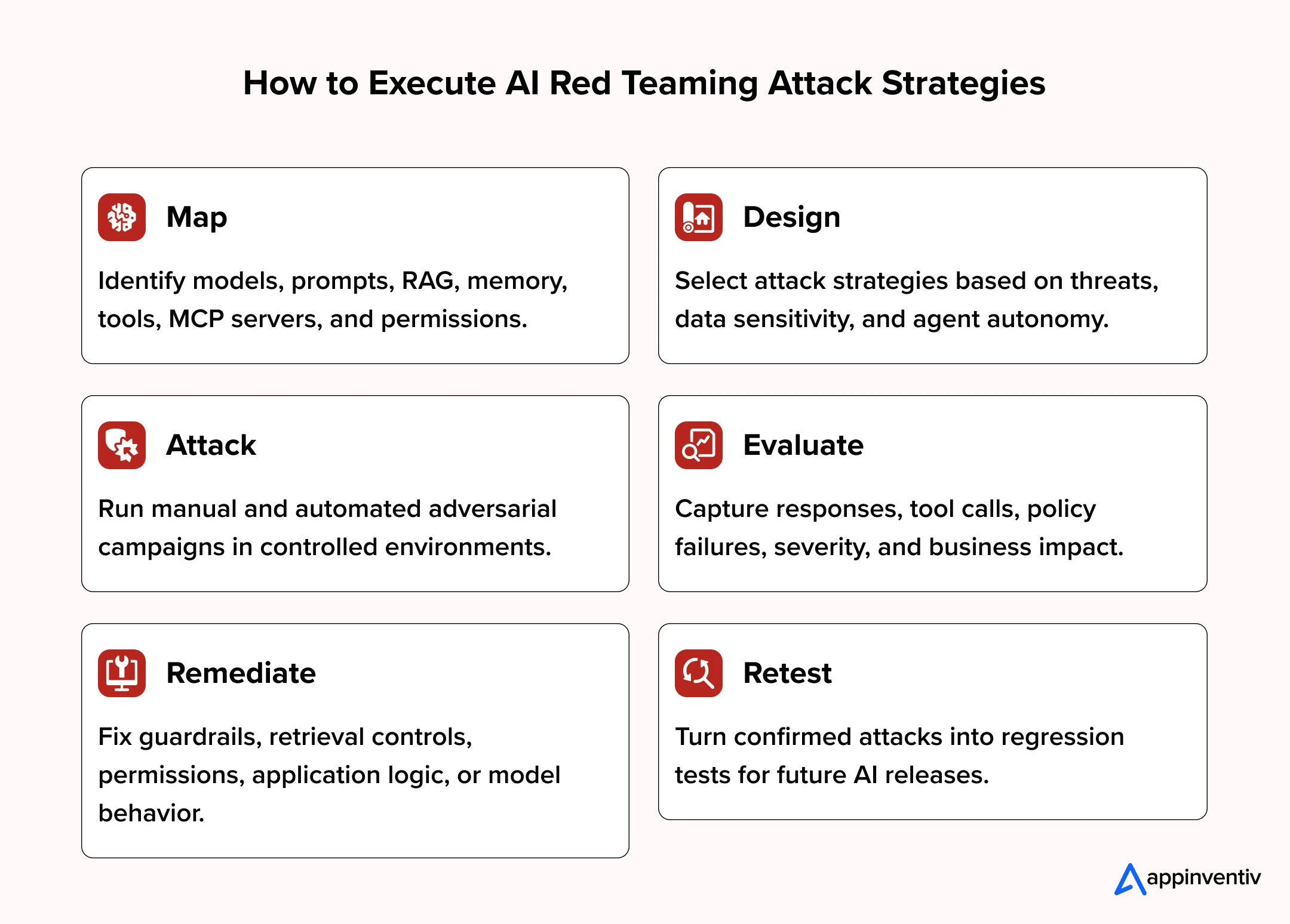
A red-team exercise starts with the AI system’s architecture, not a collection of attack prompts. Teams first identify where untrusted input enters, where context is stored or retrieved, and where the AI can take action, forming the basis of the AI red-teaming roadmap, which is distinct from a conventional vulnerability assessment and penetration testing engagement.
The shift toward structured testing is measurable. The World Economic Forum found that the share of organizations assessing AI tool security rose from 37% in 2025 to 64% in 2026.
Scope the AI Attack Surface
Map every component that can influence a response or action:
- Foundation model or model endpoint
- System prompts and policy instructions
- APIs and application middleware
- RAG pipeline and retrieval logic
- Vector database and access controls
- Conversation memory and state
- External documents, emails, and web content
- Function tools, APIs, and MCP servers
- Agent permissions and execution policies
- Authentication and authorization controls
This mapping exposes trust boundaries. A RAG pipeline can ingest external content. An agent can access CRM records, internal APIs, or other enterprise systems. Each connection adds another point for adversarial testing.
Record the model version, system prompt, retrieval configuration, tool definitions, permission scopes, and relevant data sources. These details make failed tests reproducible across builds.
Also Read: AI Agent Security: Risks, Solutions & Business Benefits
Design and Run Attack Campaigns
Select AI red teaming strategies from the threat model rather than testing every technique against every system. A customer support agent with CRM access needs different coverage than a standalone text-generation model.
Data sensitivity determines the potential impact of leakage. Agent autonomy determines how far an instruction can propagate. Tool access defines which actions the system can perform. User exposure shapes the attacker model. Regulatory requirements determine which controls need documented evidence.
Use both manual and automated testing. Human testers can adapt to unusual responses and test business-specific rules. Automated scanners can repeat large attack sets across models, attack categories, and application builds. Microsoft’s current AI Red Teaming Agent supports automated adversarial probing across defined risk categories and attack strategies.
Run campaigns in a controlled environment that mirrors production architecture. Use synthetic data and test endpoints for connected tools. An agent should not be able to trigger a real payment, delete production data, or modify live customer records during an adversarial test.
Evaluate, Remediate, and Retest
Every finding should follow a clear chain:
Attack → evidence → severity → remediation → regression
Capture the attack strategy, transformation, model response, retrieved context, tool calls, policy decision, and application state. The final response alone rarely identifies the failed control.
Remediation can occur at several layers:
- Guardrails and policy filters
- Input normalization and validation
- Retrieval and document-access controls
- Authorization and access policies
- Tool permissions and action limits
- Application logic and workflow controls
- Model configuration and system prompts
- Fine-tuning for recurring model-level failures
Retest the original attack and related variants after each material change. Add confirmed failures to the regression suite, then rerun them after model updates, prompt changes, RAG data changes, new tools, permission changes, or workflow updates. This turns red-team findings into repeatable security tests within the AI red-teaming process and broader AI development lifecycle.
Also Read: AI Governance Consulting: How to Build Guardrails, Observability, and Responsible AI Pipelines
How Attack Strategies Apply to RAG, AI Agents, and Enterprise Workflows
Attack strategies behave differently once an AI system can retrieve data or take actions. A red-team test must inspect those downstream paths, not just the model response.
RAG Applications
Retrieval-Augmented Generation, a core part of RAG in AI development, introduces another trust boundary between user requests and model context across modern AI services and solutions. The retrieval layer selects content from a knowledge base, vector database, document store, or external source and then places it into the model’s context window.
Red teams can test this layer for:
- Document poisoning: Malicious or misleading content is introduced into a source used for retrieval.
- Retrieved-context injection: Instructions hidden inside retrieved content influence model behavior.
- Sensitive information exposure: Retrieval returns data outside the user’s permitted scope.
- Retrieval manipulation: Crafted content changes which documents or chunks rank for a query.
- Authorization failures: The retrieval service returns information without enforcing the application’s identity and access rules.
These tests should inspect retrieval scores, selected chunks, metadata filters, tenant boundaries, and access-control decisions. A secure RAG design should treat retrieved content as untrusted data rather than privileged instructions.
AI Agents
Once AI agents in enterprise settings add an execution layer after inference, the model can select a function, construct tool arguments, retrieve more information, or trigger an external API. OWASP identifies excessive functionality, excessive permissions, and excessive autonomy as core causes of excessive agency.
Red teams should test:
- Tool misuse: The agent invokes a legitimate tool for an unintended purpose.
- Excessive permissions: A tool or service identity has access beyond the task requirement.
- Unauthorized actions: The agent operates without the required approval.
- Goal hijacking: Malicious instructions redirect the agent from its original task.
- Memory manipulation: Poisoned context influences later decisions across sessions.
- Unsafe API calls: The model generates tool arguments that trigger risky operations.
The access-control gap is substantial. IBM found that 97% of organizations reporting an AI-related security incident lacked proper AI access controls, while 63% lacked AI governance policies.
Memory deserves separate attention in agentic systems. OWASP’s 2026 guidance defines memory and context poisoning as the corruption of stored or retrievable information that can alter subsequent reasoning, planning, or tool use.
Multi-Agent and Tool-Connected Workflows
A single agent can create one failure path. Multiple agents can create several dependent paths.
Governance is trailing agent deployment. Deloitte’s 2026 survey of 3,235 business and IT leaders across 24 countries found that only 21% reported a mature governance model for agentic AI.
An upstream agent may pass manipulated context to another agent. A shared memory store can carry poisoned information between tasks. A compromised tool, carrying its own API security risks, can affect every workflow that trusts its output. MCP-connected tools add another integration point that needs identity, permission, input validation, and provenance checks. OWASP’s agentic security guidance identifies tool misuse, identity and privilege abuse, supply chain risk and cascading failures as distinct concerns.
The resulting test path can look like:
User input → agent → retrieved context → tool → second agent → enterprise API
Each handoff can change the security context.
A successful attack against a chatbot may alter an answer. A successful attack against an agent can trigger an action. That difference makes tool permissions, approval gates, audit logs, and runtime controls part of the red-team scope for enterprise AI.
Also Read: Vibe Coding Security Risks: Why Your AI-Generated App is a Ticking Time Bomb
AI Red Teaming Tools for Testing These Attack Strategies
AI red teaming tools differ in attack generation, application coverage, evaluation, and integration with development. The right choice depends on the AI architecture and testing scope.
Open-Source and Developer Tools
Microsoft PyRIT provides reusable components for attack strategies, converters, evaluators, and multi-turn scenarios. Its current tooling supports techniques such as Crescendo and composite attacks, making it useful for custom red-team campaigns.
NVIDIA Garak acts as an LLM vulnerability scanner. Its probes, generators, detectors, and evaluators can test for prompt injection, jailbreaks, data leakage, hallucinations, and toxicity.
Promptfoo focuses on application-level testing across APIs, RAG pipelines, and agent workflows. Its red-team features support automated vulnerability testing, custom policies, and CI/CD reporting.
Enterprise Platforms and Managed Red Teaming
Commercial platforms help teams manage large testing programs across multiple applications, models, and environments. Common capabilities include attack orchestration, centralized reporting, recurring campaigns, and policy-based evaluation.
Human red teams add application-specific attack design and expert analysis. Working with an experienced AI cybersecurity consultant can support independent assessments for high-risk deployments or major architectural changes.
Integrating Red Teaming Into CI/CD
Red-team findings become more useful when successful attacks are added to the regression suite. A typical workflow is:
Build → test → attack → remediate → regression → release
The attack stage runs selected strategies against the release candidate. Failed cases then become reusable tests for later changes to the model, prompt, RAG, or agent. Promptfoo supports CI/CD execution for automated red-team and evaluation workflows.
This makes AI security testing part of the software delivery process rather than a separate assessment performed after development.
Subheading: Model, prompt, retrieval, tool, or permission changes can reopen fixed attack paths before your next deployment.
How Enterprises Measure AI Red Teaming Results
A red-team report needs more than failed prompts. Enterprise teams need evidence showing attack frequency, failure type, business impact, and remediation status.
Attack Success Rate and Its Limitations
Attack Success Rate (ASR) measures how often an attack achieves its defined objective.
ASR = Successful attacks ÷ Total attacks × 100
Microsoft uses ASR across defined AI risk categories and reports results by attack type and complexity.
ASR alone cannot reliably compare systems. Sample size, model version, attack strategy, evaluator, risk category, and test conditions all affect the result. Recent research has raised similar concerns about using ASR as a standalone safety measure.
Metrics That Matter Beyond ASR
Enterprise programs should track:
- Policy violation rate: Frequency of defined policy breaches.
- Sensitive-data exposure rate: Frequency of protected data appearing in outputs or tool results.
- Unsafe tool-call rate: Frequency of risky tool requests or executions.
- Unauthorized-action rate: Frequency of actions outside approved permissions.
- Severity: Technical and business impact of each finding.
- Reproducibility: Whether the attack succeeds across repeated runs.
- Regression failure rate: Frequency of previously fixed attacks returning.
- Mean remediation time: Time required to close confirmed findings.
Microsoft’s agent evaluations cover prohibited actions, sensitive data leakage and task adherence, showing why output quality alone cannot measure agent risk.
Turning Findings Into Executive Risk
Executive reporting should translate:
Attack → affected asset → business impact → remediation → residual risk
A successful jailbreak against a test model differs from an attack that reaches customer records or triggers an enterprise API. Reports should identify the affected component, the failed control, the corrective action, and the remaining risk.
This connects red-team results to security ownership, release decisions, and ongoing cybersecurity risk management.
Frameworks and Standards for AI Red Teaming
There is no single, universal AI red teaming framework. Different frameworks cover different parts of GenAI red teaming, security, risk management, and governance.
OWASP, MITRE ATLAS, and NIST AI RMF
- OWASP: The OWASP GenAI Security Project documents application-level risks for LLM and generative AI systems. Its 2026 Top 10 for LLM Applications adds updated threat coverage based on thousands of real-world AI security incidents. OWASP now maintains separate guidance for agentic applications as well.
- MITRE ATLAS: ATLAS maps adversarial tactics and techniques against AI-enabled systems. Red teams can use it to structure threat scenarios and relate findings to known adversary behaviors.
- NIST AI RMF: The AI Risk Management Framework provides a structured approach to designing, developing, deploying, and evaluating AI systems. Its four functions are Govern, Map, Measure, and Manage, which can help teams connect red-team findings with broader AI risk processes.
ISO/IEC 42001 and Regulatory Context
ISO/IEC 42001 defines requirements for an Artificial Intelligence Management System, including processes for managing AI risks, accountability, and continual improvement. Red-team evidence can support these management processes, but the standard does not define individual attack strategies.
Regulatory obligations vary by application, sector, and jurisdiction. Enterprises should map red-team findings to the controls and documentation required for each applicable regime rather than treating a framework as proof of compliance.
Challenges, Limitations, and Conceptual Scope
AI red teaming can expose serious weaknesses, but it does not provide complete coverage of AI risk. Its results depend on the attack scenarios, model version, application design, data quality, and testing depth.
One challenge is scope ambiguity. AI red teaming can refer to model testing, application security, adversarial ML, prompt engineering, or agent behavior. Teams should define the target system and attack objectives before testing starts.
Resource constraints create another challenge. Skilled red teams need knowledge of AI security, application architecture, data pipelines, model behavior, and adversarial testing. Automated tools can expand coverage, but they do not replace expert review of unusual failures or business impact.
Data hygiene matters too. Poorly governed training or retrieval data can create vulnerabilities that prompt testing alone will not fix. Data poisoning, unsafe model APIs, weak toxicity filters, and flawed prompt handling can each require different controls.
Multimodal AI adds further complexity. Text, image, audio, and video inputs can create separate attack paths across preprocessing and model inference.
Red teaming should therefore sit within a wider security program that covers data pipelines, model APIs, application controls, access policies, and ongoing monitoring.
Also Read: Cybersecurity Compliance Requirements Every Enterprise Needs in 2026
As agents gain broader permissions, adversarial testing must cover identity, memory, tools, APIs, approvals, and downstream actions.
Enterprise Best Practices for AI Red Teaming
Enterprise AI red teaming strategies work best when testing, remediation, and release processes share the same evidence. Four practices help prevent narrow test coverage and recurring failures.
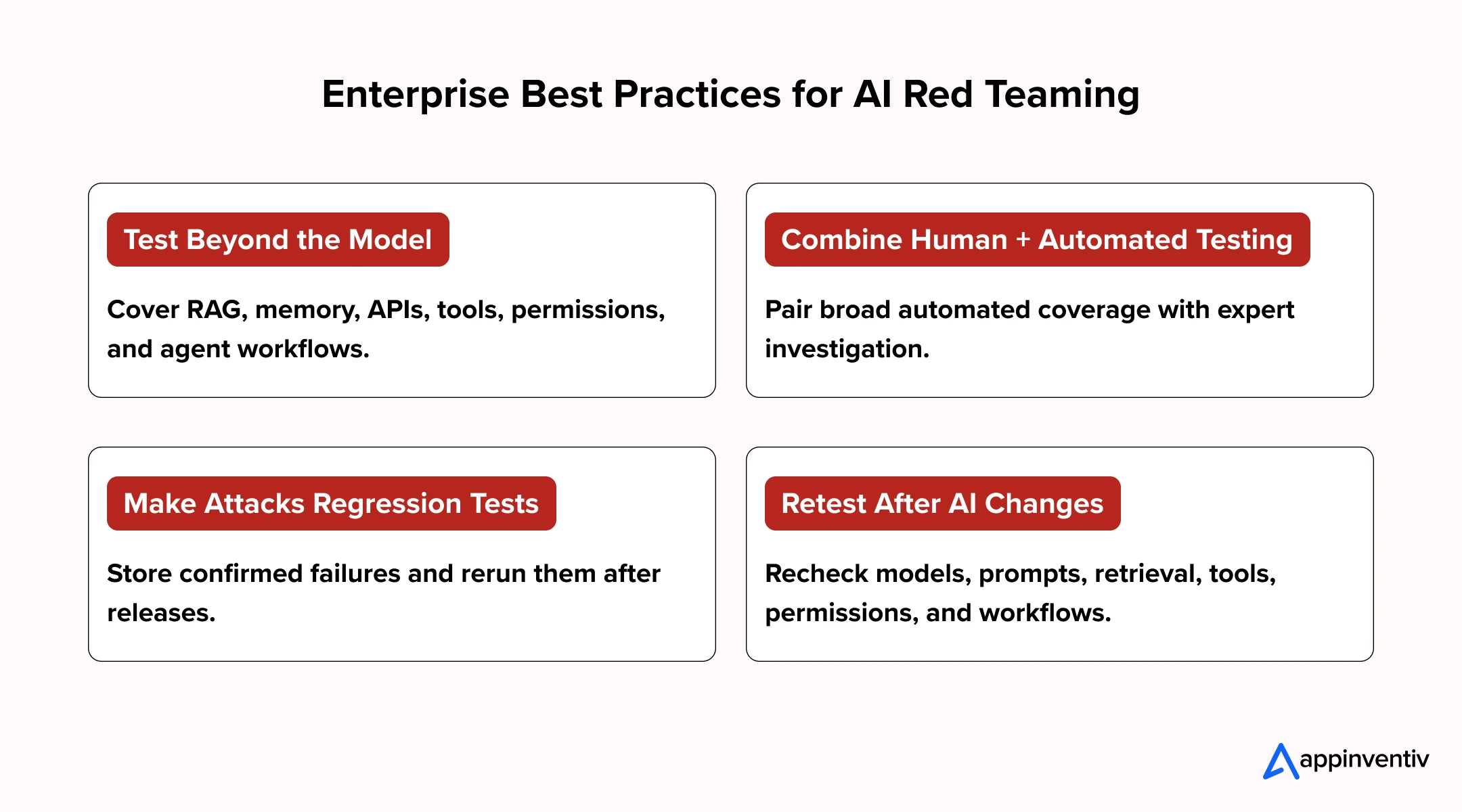
Test the Entire AI System, Not Just the Model
Model-only testing can miss weaknesses in the surrounding application. Test the model alongside RAG pipelines, vector stores, memory, APIs, tools, permissions, and agent workflows. This exposes failures that appear only after the model interacts with enterprise data or systems.
Combine Human and Automated Testing
Automated scanners provide repeatable coverage across large attack sets and model versions. Human testers can investigate unusual behavior, create application-specific attack paths, and judge business impact. A strong program uses both rather than treating automation as a replacement for expert review.
Treat Findings as Regression Tests
A confirmed attack should be made into a reusable test case. Store the attack strategy, target configuration, expected control, observed failure, and evaluation result. Run these cases against later releases to detect regressions early.
Test After Material AI Changes
AI behavior can change after updates outside the model itself. Re-run relevant attack suites after changes to:
- Models
- Prompts
- Retrieval sources
- Tools
- Permissions
- Agent workflows
This practice is especially important for production agents. A new tool, broader permission scope, or changed retrieval source can create a failure path that did not exist in the previous release.
Build, Test, and Secure Enterprise AI With Appinventiv
AI red teaming practice works best when security is integrated into the engineering process early. Appinventiv helps enterprises build AI systems with enterprise AI red-teaming solutions across models, LLM applications, RAG pipelines, and autonomous agents.
Our AI engineering work includes 300+ AI-powered solutions delivered, 200+ data scientists and AI engineers, and 150+ custom AI models trained and deployed. We have deployed 100+ autonomous AI agents, fine-tuned 50+ bespoke LLMs, and worked across 35+ industries.
That experience matters for red teaming. Enterprise AI rarely ends at model inference. Our teams can assess prompt handling, retrieval paths, vector database access, agent memory, API permissions, tool calls, and workflow controls within the same engineering cycle.
The goal is clear: find attack paths before they become production incidents, then turn confirmed findings into repeatable security tests.
Appinventiv can help your enterprise:
- Assess LLMs, RAG applications, and AI agents against targeted attack strategies through dedicated AI security testing services.
- Build custom red-team campaigns around business risks and data sensitivity
- Integrate adversarial testing into AI development and CI/CD workflows, backed by AI governance consulting services
- Harden retrieval, access control, guardrails, tool permissions, and agent workflows
- Create regression suites for recurring security validation
Let’s connect and build AI that can withstand adversarial testing.
Frequently Asked Questions
Q. How to implement AI red teaming in enterprise security?
A. Start with an inventory of AI models, applications, RAG pipelines, agents, tools, data sources, and permission scopes. Define threat scenarios based on business impact and applicable controls. Run adversarial tests in a controlled environment, record evidence, remediate the failed control, and add confirmed attacks to the regression suite.
Q. How do companies conduct adversarial testing for large language models?
A. Teams define attack objectives, select strategies, and run repeated tests against a fixed model and application configuration. Testing can include jailbreaks, multi-turn attacks, encoding, indirect prompt injection, and automated attack generation. Each run should capture the model version, system prompt, attack path, response, evaluator result, and remediation status.
Q. How much does AI red teaming cost for businesses?
A. There is no standard enterprise price for AI red teaming. Cost varies with model count, RAG complexity, agent autonomy, connected tools, data sensitivity, testing depth, manual review, compliance requirements, and testing frequency. A single-model assessment costs far less than continuous testing across multi-agent workflows and enterprise APIs.
Q. How do businesses test AI applications against jailbreak and prompt injection attacks?
A. Use separate test paths for direct jailbreaks, multi-turn escalation, and indirect prompt injection. RAG applications need tests against retrieved documents and external content, while agents need action-level checks for tool calls and permission boundaries. Teams should run multiple variants rather than relying on a single known prompt.
Q. How can businesses choose an AI red teaming company?
A. Evaluate the provider against your actual architecture. Check coverage for LLMs, RAG, vector databases, agents, APIs, tools, MCP servers, and identity controls. Review its testing methodology, evidence collection, data-handling practices, human expertise, framework mapping, retesting process, and ability to integrate findings into development workflows.
Q. What is the difference between AI red teaming and penetration testing?
A. Penetration testing focuses on technical weaknesses across applications, APIs, infrastructure, and networks. AI red teaming tests model behavior, prompts, retrieved context, agent decisions, tool calls, and AI-specific failure modes. Enterprise programs often use both practices since an AI application can contain conventional software flaws alongside model-specific risks.
Q. Does red teaming work on multimodal AI (images, voice, video)?
A. Yes. Multimodal red teaming can test image inputs, audio, video, OCR, speech-to-text pipelines, and cross-modal instructions. The test design should match each processing stage. Teams can examine whether harmful or hidden instructions survive transcription, image parsing, frame analysis, modality conversion, or context assembly before reaching the model.
Q. Is AI red teaming the same as jailbreaking?
A. No. Jailbreaking is one attack strategy used during AI red teaming. Red teaming encompasses a broader range of tests, including prompt injection, data leakage, encoding, indirect attacks, agent misuse, retrieval risks, and unsafe tool actions. Jailbreak testing in AI red teaming asks whether safeguards can be bypassed. Red teaming asks where the wider AI system can fail under adversarial pressure.
Q. What can real-world AI red teaming examples from OpenAI, Google, Microsoft, and Meta reveal?
A. Real-world programs from OpenAI, Google, Microsoft, and Meta demonstrate how AI red teaming can examine adversarial interactions, attack techniques, behavioral analysis, and context-specific risks across different AI systems. Their work also highlights risks such as injection flaws and memory exploits in prompt-based applications. Tools and research such as AutoRedTeamer, BlackICE, adversarial research, adversarial cybersecurity testing, and model monitoring can support broader testing coverage. These examples show why enterprise teams need testing that examines both model behavior and the surrounding application components.


Fast 2-minute response, fully NDA-protected.

Automated Decision-Making in Australia: Benefits, Cost and Implementation
Key takeaways: Automated decision-making combines rules, algorithms, AI and human oversight to improve high-volume decisions. ADM programmes require privacy, security, auditability and accountability to be designed into architecture. ADM implementation costs typically range from AUD 70,000 to AUD 700,000 or more. Implementation starts with decision mapping, then moves through development, testing, controlled pilots and monitoring.…

AI Agent Protocols: MCP, A2A, ACP & More Explained
Key takeaways: MCP connects agents to enterprise tools, while A2A lets independent agents delegate tasks without exposing internal logic. The protocol stack now spans agent access, collaboration, UI interaction, open networking, commerce, and machine-to-machine payments. A2A had support from 150+ organizations by April 2026, with 22,000+ GitHub stars and five production-ready SDK languages. Enterprise agent…
Jev Explained: Enterprise Use Cases, Limitations and How to Adopt
Key takeaways: What it is: Jev is a System One model from TypeSafe AI. It returns typed choices, scores and true-or-false probabilities instead of text. Where it wins: The strongest Jev use cases are high-volume, narrow decisions such as triage, routing, scoring and guardrails. Where it stops: It cannot generate text. It struggles with math…














