
















AI Agent Protocols: MCP, A2A, ACP & More Explained

 Share -



- 01What Are AI Agent Protocols?
- 02MCP Explained: Model Context Protocol
- 03A2A Explained: Agent2Agent Protocol
- 04What Happened to ACP?
- 05Other Important AI Agent Protocols and Standards
- 06MCP vs A2A vs ACP vs ANP vs AG-UI vs Commerce Protocols
- 07End-to-End AI Agent Protocol Architecture
- 08How to Build an AI Agent Protocol Stack
- 09Performance, Scalability and Reliability Considerations
- 10Security Challenges in AI Agent Protocols
- 11When to Use an Agent Protocol vs a Conventional API
- 12AI Agent Protocol Use Cases Across Industries
- 13Common AI Agent Protocol Development Mistakes
- 14AI Agent Protocol Development Cost and Timeline
- 15Future of AI Agent Protocols
- 16Build an Enterprise-Ready AI Agent Architecture With Appinventiv
- 17Frequently Asked Questions

- MCP connects agents to enterprise tools, while A2A lets independent agents delegate tasks without exposing internal logic.
- The protocol stack now spans agent access, collaboration, UI interaction, open networking, commerce, and machine-to-machine payments.
- A2A had support from 150+ organizations by April 2026, with 22,000+ GitHub stars and five production-ready SDK languages.
- Enterprise agent systems need protocol contracts, least-privilege access, failure handling, observability, version control, and clear trust boundaries.
- Protocol choice should follow the workflow boundary, with conventional APIs continuing to handle deterministic enterprise operations.
An AI agent rarely delivers value by working alone. In production, it needs access to CRM records, databases, APIs, files, and business applications. It often needs to hand off work to another agent, stream updates to a user interface, or complete a transaction through a commerce system. That creates a hard engineering problem.
Each connection can require a custom API wrapper, authentication flow, data schema, session model, and error-handling logic. Add more agents or vendors, and integration work grows quickly. Protocol changes can create another round of testing and maintenance.
This is where agent communication protocols fit into the architecture. They define common rules for capability discovery, context exchange, task delegation, message handling, identity, and tool execution. Protocols such as MCP and A2A address different parts of this stack, while newer standards cover agent interfaces, commerce, and payments.
PwC’s 2025 survey found that 79% of executives said AI agents were already being adopted in their companies. AI agent protocols are standardized interfaces that govern how agents access capabilities, communicate with other agents, interact with applications, and perform specialized transactions.
Enterprise teams are moving from isolated pilots toward connected agent ecosystems. Build your protocol strategy before integration debt compounds.
What Are AI Agent Protocols?
AI agent protocols define how agents exchange information, discover capabilities, delegate tasks, and access external systems. They provide shared rules that reduce the need for custom connections across an agentic system, forming the basis of modern agent communication protocols.
How Do AI Agent Protocols Differ From APIs?
An API exposes a defined service interface. It accepts a known request and returns a defined response. An agent protocol covers a broader interaction model. It can describe capabilities, exchange context, create tasks, track state, return artifacts, and support agent delegation. Protocols do not replace APIs. They often sit atop existing APIs and provide agents with a standard way to use them. An MCP server, for example, can expose a business API as an agent-accessible tool.
Why AI Agents Need Standardized Protocols?
Production agents connect to databases, SaaS platforms, internal services, other agents, and user interfaces. Standard protocols reduce custom integration work and support capability discovery, security boundaries, task lifecycles, streaming, and observability. They also improve portability. Teams can change models, frameworks, or agent providers without rebuilding every connection.
Also Read: Business Process Automation: Top Use Cases And Benefits
What Problem Do Agent Protocols Solve?
Consider N agents and M external systems. A custom integration model can create an N × M set of possible connections. This is a conceptual model, not a fixed engineering formula. Standard protocols reduce that coupling by giving systems common interfaces. Developers maintain fewer bespoke contracts, clearer trust boundaries, and fewer integration dependencies.
MCP Explained: Model Context Protocol
Model Context Protocol, or MCP, is an open standard for connecting AI applications to external tools, resources, and data. Anthropic introduced MCP in 2024, and the protocol now supports agentic applications that need controlled access to business systems. MCP does not replace a CRM, ERP, database, API, or file system. It provides a common interface for discovering and using those capabilities through structured messages.
A typical MCP setup includes a host, one or more clients, and servers that expose tools, resources, and prompts. OpenAI added remote MCP server support to its Responses API in May 2025, giving developers a direct way to connect models with MCP servers. The current 2026-07-28 specification adds a stateless protocol core, updated HTTP behavior, multi-round-trip requests, and stronger authorization controls.
How MCP Works
- The host is the AI application, such as an enterprise agent platform, IDE, or assistant.
- The client maintains the connection to an MCP server. A host can run several clients for different systems.
- The server exposes capabilities and handles the connection to the underlying service. This keeps system-specific API logic outside the model layer.
The basic flow is:
AI application → MCP client → MCP server → Enterprise system
After initialization, the client can discover available capabilities and request tools, resources, or prompts.
- Tools perform actions such as creating a support ticket or querying a service.
- Resources provide information such as documents, files, records, or knowledge sources.
- Prompts expose reusable instructions for specific tasks.
MCP also supported sampling, which allows servers to request model completions via clients. The July 2026 specification now marks sampling as deprecated, so new implementations should not depend on it.
MCP Architecture
A practical enterprise setup can look like this:
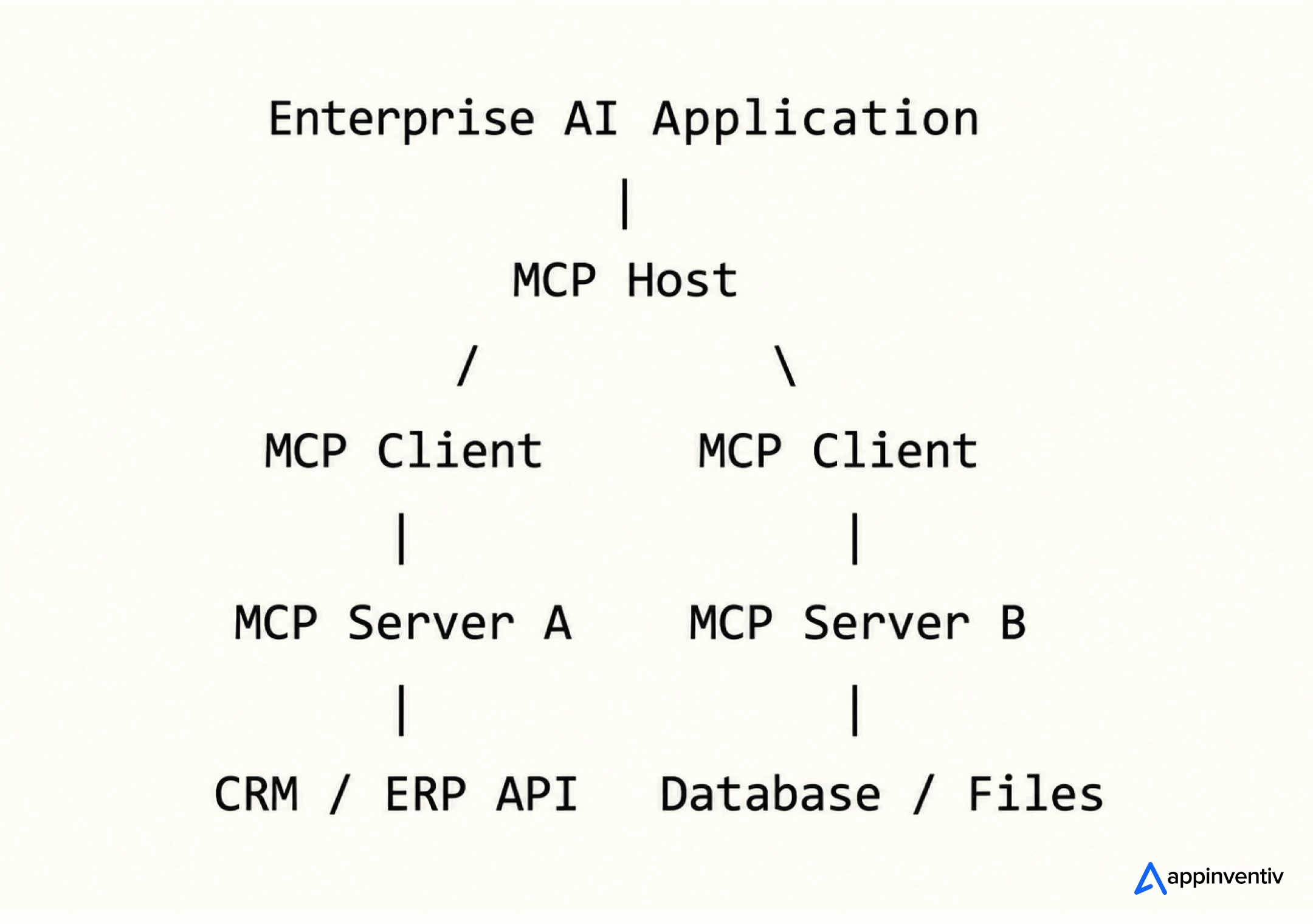
Each server creates a controlled boundary around its capabilities. One server can expose CRM actions, another can expose database access, and another can connect to internal documents.
MCP can support local deployments and remote enterprise services. Remote deployments can run behind standard HTTP infrastructure and load balancers.
MCP Transport and Protocol Mechanics
Older MCP articles often describe remote MCP as HTTP with Server-Sent Events. That no longer reflects the current specification.
The 2026-07-28 release introduced a stateless protocol core and updated Streamable HTTP behavior. Remote servers can operate behind ordinary load balancers without protocol-level sticky sessions or shared session storage.
The update adds:
- HTTP headers for routing and policy checks
- capability-list caching hints
- Multi-Round-Trip Requests for multi-step interactions
- extensions for features such as Tasks and MCP Apps
- stronger OAuth and authorization controls
The protocol can remain stateless even when the business application keeps its own state. That separation makes horizontal scaling easier.
MCP Security and Authorization
The MCP protocol provides mechanisms for authentication and authorization, but enterprises still need broader security controls around each integration. Access should follow least-privilege rules, with separate permissions for sensitive tools and operations.
Use scoped credentials to limit access, and restrict write or administrative tools more tightly than read-only tools. Treat third-party MCP servers as separate trust boundaries, and validate their identities and authorization requirements before connecting to them.
Current MCP releases have strengthened HTTP authorization, including issuer validation and updated client registration mechanisms. Enterprise-Managed Authorization can support centralized MCP access through an identity provider.
MCP Use Cases
MCP is useful wherever an AI application needs controlled access to existing enterprise capabilities.
- CRM: Retrieve customers, review account history, or create service cases.
- ERP: Check inventory, purchase orders, invoices, and operational records.
- Databases: Expose approved queries or business operations without giving the model unrestricted database access, a foundation for agentic AI in data engineering.
- Document repositories: Retrieve policies, contracts, manuals, and internal reports.
- DevOps: Connect agents to repositories, issue trackers, build systems, deployments, and monitoring platforms.
- Internal tools: Expose proprietary workflows through MCP without rebuilding the underlying services.
This makes MCP useful for agentic AI transforming SaaS operations. Teams can preserve existing APIs and add an agent-ready interface around selected capabilities.
MCP Limitations
MCP standardizes access to tools and resources, but it does not turn those tools into autonomous agents. The agent still needs separate reasoning, planning, and workflow logic. Tool design also affects results. Poor tool names, vague descriptions, weak schemas, and unclear outputs can lead to incorrect tool selection. Large tool catalogs create another challenge. Exposing too many capabilities can increase discovery overhead and make it harder for the model to select the right tool.
A2A Explained: Agent2Agent Protocol
Agent2Agent, or A2A, is an open protocol for agent-to-agent communication and collaboration between independent AI agents. Google introduced A2A to support AI agent interoperability, letting agents built with different frameworks, languages, and vendors exchange messages, delegate tasks, and return results without exposing their internal logic. An interaction can be a simple message exchange or a stateful task that runs for a longer period.
A2A defines common objects for messages, tasks, artifacts, contexts, capabilities, and status updates. This gives multi-agent systems a shared interface for agent-to-agent communication without requiring access to another agent’s prompts, tools, model, or internal orchestration.
By April 2026, more than 150 organizations supported A2A. Its repository had surpassed 22,000 GitHub stars, and its SDK ecosystem had expanded to five production-ready languages.
How A2A Works
A typical interaction starts with discovery. The client finds an Agent Card, which describes the agent’s identity, endpoint, skills, supported interfaces, and authentication requirements. The client then sends a message to that agent.
That message can create a Task, which tracks work through states such as working, input-required, completed, canceled, rejected, or failed. A contextId can link related messages and tasks. Agents can return artifacts containing text, files, or structured data.
Clients can receive updates through:
- Polling: The client checks the task’s current state.
- Streaming: Server-Sent Events deliver status and artifact updates in real time.
- Push notifications: A webhook is triggered by updates for long-running tasks.
The remote agent can remain opaque. The calling agent needs only the declared interface, capabilities, and protocol rules. It does not need access to the remote agent’s internal reasoning or implementation.
A2A Protocol Bindings and Transport
The current A2A specification separates its interaction model from its transport. It defines three standard bindings:
- JSON-RPC
- gRPC
- HTTP+JSON/REST
This gives enterprises flexibility to fit A2A into existing service infrastructure. JSON-RPC and HTTP+JSON/REST use SSE for streaming, while gRPC uses server-streaming RPCs. Custom bindings are possible when the Agent Card declares the supported interface.
A2A Agent Cards Explained
An Agent Card is the discovery document for an A2A agent. It tells clients what the agent does, where to reach it, which interfaces it supports, and what authentication it requires.
This reduces hard-coded dependencies. A procurement system, for example, can discover an agent that supports supplier quotation requests rather than being tied to a single implementation.
Agent Cards can describe multiple interfaces and protocol versions. Signed cards can help verify that discovery metadata has not been altered.
A2A Task Lifecycle
The A2A protocol supports both immediate responses and longer-running work.
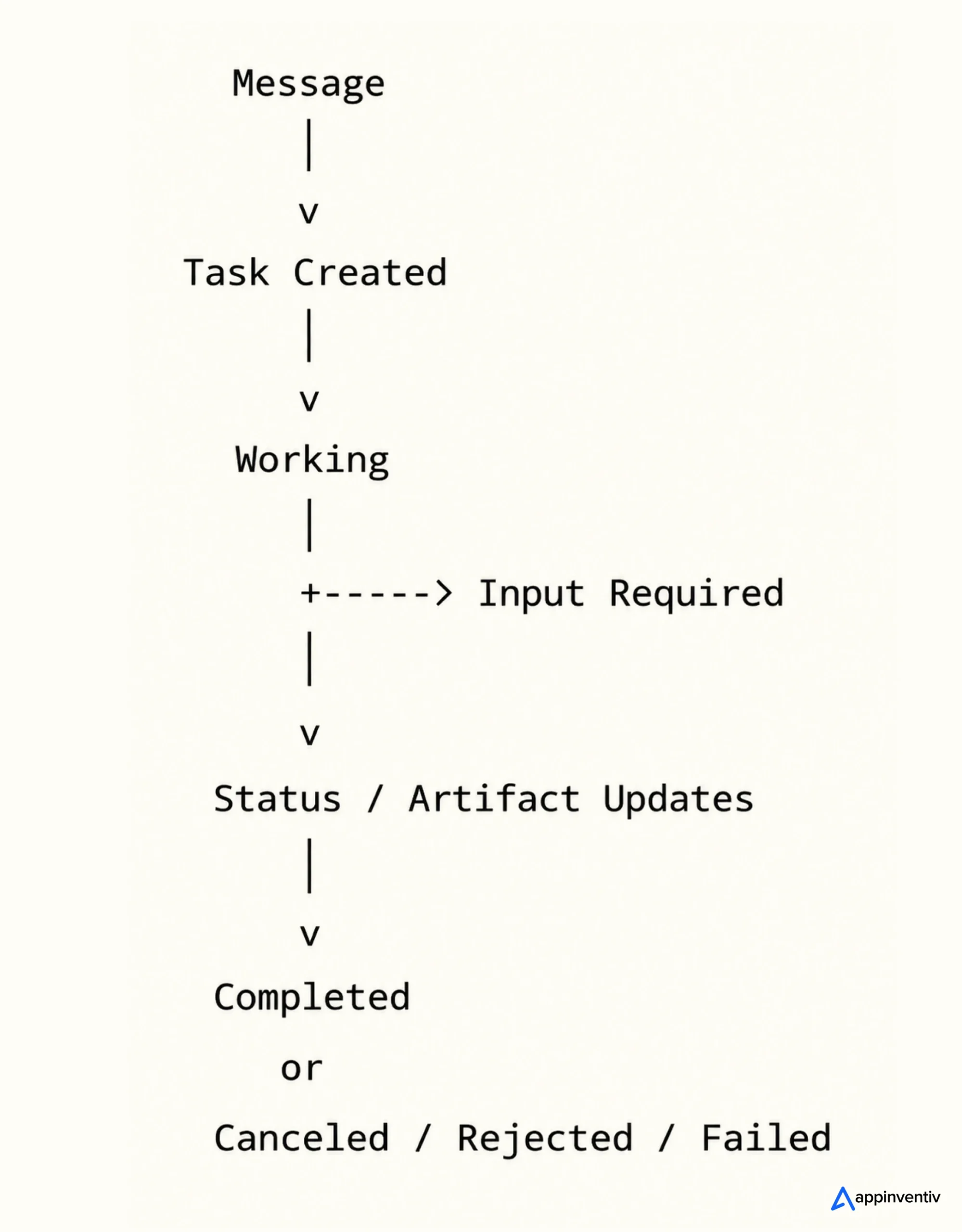
Clients can poll the task, stream updates, or receive webhook notifications. This model suits research, procurement, document processing, and logistics workflows that cannot be completed in a single request.
A2A Security Model
The A2A protocol uses standard authentication and authorization mechanisms to control communication between agents. The Agent Card can specify the authentication methods supported by an agent, providing clients with the information needed before establishing a task.
Enterprises should verify Agent Card metadata and remote endpoints before trusting an agent. Authenticated extended Agent Cards can expose additional capabilities after authorization. Callback and push notification endpoints should require authentication and validate incoming requests.
Each remote agent should remain a separate trust boundary. A successful connection should not grant unrestricted access to the agent’s systems, data, or tools.
A2A Use Cases
A2A is useful when an agent needs another agent’s capabilities without accessing that agent’s internal systems.
- Customer service: A support agent can delegate a billing dispute to a finance agent.
- Procurement: A purchasing agent can request and compare quotations from supplier agents.
- Financial analysis: A research agent can delegate specialist analysis and combine returned artifacts.
- Logistics: A logistics agent can request shipment updates and process asynchronous responses.
- Enterprise research: A lead agent can divide a research task among specialist agents.
- Cross-vendor workflows: Agents from different products can exchange tasks without exposing their internal prompts, models, or tools.
A2A Limitations
A2A adds distributed-system complexity. Each remote agent introduces another dependency that teams must manage across discovery, networking, authentication, task state, and availability. Multi-agent workflows can become harder to govern when agents belong to different teams or organizations. Data-sharing rules, trust policies, and clear ownership become necessary at each boundary. A2A also increases coordination overhead as the number of participating agents grows. Poorly defined task ownership or handoff rules can create unnecessary agent calls and complicated workflows.
What Happened to ACP?
The ACP protocol is one of the most confusing terms in the current discussion of agent protocols. The reason is simple: ACP refers to two different technologies with different purposes. IBM’s BeeAI project developed the original Agent Communication Protocol for agent interoperability. That project later merged into A2A. OpenAI and Stripe now use ACP, the Agentic Commerce Protocol, for AI-driven purchases.
IBM/BeeAI Agent Communication Protocol
The Agent Communication Protocol (ACP) came from IBM’s BeeAI project. It provided REST-based communication between AI agents, applications, and users, with support for structured and multimodal messages. BeeAI used it to connect agents built with different frameworks and technology stacks.
Why Was ACP Merged Into A2A?
IBM/BeeAI ACP is no longer a separate active protocol. The project joined the A2A ecosystem under Linux Foundation governance in 2025, and its repository was archived on August 27, 2025. The repository now directs developers toward A2A and its migration path.
The merger reduced overlap between two standards addressing agent interoperability. A2A now provides the main open protocol for agent discovery, task delegation, messaging, and long-running collaboration. The Linux Foundation reported more than 150 organizations supporting A2A by April 2026.
ACP vs Agentic Commerce Protocol
Agentic Commerce Protocol (ACP) is a separate protocol developed by OpenAI and Stripe. It supports interactions among people, AI agents, and businesses during purchasing workflows. OpenAI introduced it with Instant Checkout in September 2025 and released the protocol as an open standard for merchants and developers, part of the wider move toward agentic commerce development.
The two versions of the ACP protocol address different problems:
| ACP Reference | Purpose | Current Status |
|---|---|---|
| IBM/BeeAI Agent Communication Protocol | General agent interoperability | Merged into A2A |
| OpenAI/Stripe Agentic Commerce Protocol | Agent-driven commerce and purchasing | Active |
Why the ACP Acronym Causes Confusion
Search results and technical articles often use ACP without specifying which protocol they refer to. That creates a real problem for developers researching architecture or comparing standards.
For current enterprise systems, treat IBM/BeeAI ACP as a historical protocol that merged into A2A. Treat OpenAI/Stripe ACP as a commerce protocol. They are not interchangeable, and neither should be presented as the same technology.
Other Important AI Agent Protocols and Standards
MCP and A2A cover major parts of an agent system, but other standards address networking, user interfaces, commerce, payments, and agent execution. Their maturity varies, so enterprises should distinguish among established protocols, emerging projects and historical projects.
1. Agent Network Protocol (ANP)
The Agent Network Protocol (ANP) focuses on communication between agents across network boundaries. It covers agent identity, naming, discovery, secure messaging, and collaboration. ANP uses Decentralized Identifiers (DIDs) for verifiable identity and JSON-LD for structured capability descriptions. Its discovery model supports well-known endpoints and registration-based discovery.
ANP targets open, internet-scale agent networks where agents need to discover systems they do not already know, a core requirement for AI agent interoperability.
2. Agent Protocol
Agent Protocol defines a standard API for interacting with autonomous agents. Its focus is agent execution rather than agent discovery or tool access. Clients can start runs, track tasks and steps, and retrieve generated artifacts.
It fits the client-to-agent API layer rather than the core agent-to-agent layer.
3. AG-UI
AG-UI, or Agent-User Interaction Protocol, connects agent backends with user-facing applications through an event-driven model. It handles messages, tool calls, state changes, and other agent events, allowing frontends to reflect agent activity in real time.
AG-UI complements MCP and A2A. MCP connects agents to tools and data, A2A connects agents to other agents, and AG-UI connects those workflows to the user interface.
4. A2UI
A2UI, or Agent2UI, focuses on agent-generated interfaces. It lets agents describe components such as forms, cards, and approval screens in a structured format that client applications can render.
It is not a general agent-to-agent protocol. A2UI remains an evolving specification, with current releases still developing.
5. Universal Commerce Protocol (UCP)
The Universal Commerce Protocol (UCP) supports agent-driven commerce between consumer applications, businesses, and payment providers. Its capabilities include product discovery, checkout, order handling, and commerce capability discovery.
UCP can work with existing APIs and integrate with MCP and A2A inside a wider commerce workflow.
6. Agent Payments Protocol (AP2)
The Agent Payments Protocol (AP2) focuses on payment authorization for agentic AI in payments. It uses cryptographic mandates to define what an agent can purchase and under which conditions.
IntentMandates can establish approved spending conditions, while PaymentMandates bind authorization to a transaction. These records support auditability and payment verification. AP2 can complement UCP in agentic commerce
7. x402
x402 adds payment handling to HTTP requests. Agents can pay programmatically for APIs, digital resources, or other services as part of an execution flow.
This model suits machine-to-machine payments in which access to a service depends on a successful payment.
8. Natural Language Interaction Protocol (NLIP)
The Natural Language Interaction Protocol (NLIP) standardizes application-level communication between AI agents and between humans and agents. ECMA published ECMA-430 in December 2025.
NLIP is part of the broader effort to standardize agent interaction, but its ecosystem is still developing.
9. FIPA ACL and Other Legacy Standards
The FIPA Agent Communication Language (ACL) predates LLM-based agents, representing one of the earliest agent communication protocols, and defined structured messages for software-agent communication. It provides useful historical context, but it was not designed for today’s web-native agents, tool calling, or cloud systems.
Projects such as Agora represent newer work around decentralized and agent-oriented communication. They are worth tracking but should not be presented as equivalent to mature standards.
MCP vs A2A vs ACP vs ANP vs AG-UI vs Commerce Protocols
These protocols solve different problems within an AI agent system. MCP handles tools and data, A2A handles agent collaboration, ANP focuses on network discovery and identity, and AG-UI connects agents with frontends. UCP, ACP, AP2, and x402 cover commerce and payments. None of them replaces the underlying APIs that power enterprise systems.
| Protocol | Problem Solved | Communication Boundary | Core abstraction | Discovery | State/Task Model | Typical Transport | Best Use | Maturity/Status | Replaces APIs? |
|---|---|---|---|---|---|---|---|---|---|
| MCP | Tool, data, and context access | Agent ↔ Tool/Data | Tools, resources, prompts | Server capability discovery | Requests and task support | JSON-RPC, stdio, Streamable HTTP | Databases, CRM, ERP, SaaS, files | Mature | No |
| A2A | Agent-to-agent communication and delegation | Agent ↔ Agent | Messages, tasks, artifacts | Agent Cards | Stateful tasks and messages | JSON-RPC, gRPC, HTTP+JSON/REST | Multi-agent workflows | Mature | No |
| ANP | Agent discovery, identity, and networking | Agent ↔ Network | DIDs, metadata, messages | DID-based discovery | Application-defined | HTTP-based | Open agent networks | Developing | No |
| AG-UI | Agent-to-frontend communication | Agent ↔ UI | Events and state updates | Client-defined | Event/state based | HTTP/SSE | Agentic applications | Developing | No |
| A2UI | Agent-generated interfaces | Agent ↔ UI | UI components | Client capabilities | UI interaction state | Application transport | Forms, cards, approvals | Emerging | No |
| UCP | Agent-driven commerce | Agent ↔ Business | Commerce capabilities, checkout | Capability profiles | Commerce state | APIs, A2A, MCP | Product discovery and checkout | Emerging | No |
| Agentic Commerce Protocol (ACP) | Agent-driven purchasing | Agent ↔ Merchant | Commerce and checkout | Commerce discovery | Purchase state | Web/API integrations | AI shopping | Active | No |
| AP2 | Agent payment authorization | Agent ↔ Payment system | Cryptographic mandates | Payment capabilities | Mandate/transaction state | Protocol-dependent | Authorized agent payments | Active | No |
| x402 | Programmatic HTTP payments | Agent ↔ Service | HTTP payment requests | Service-defined | Per-request payment | HTTP | Paid APIs and digital services | Emerging | No |
The simple rule: MCP connects agents to capabilities, A2A connects agents to other agents, AG-UI connects agents to users, and commerce protocols handle transactions. These standards work alongside existing APIs rather than replacing them.
How to Choose the Right AI Agent Protocol for Your Enterprise
Choosing among protocols for AI agent interoperability should start with the workflow and its interaction boundary. A fixed service call may need only an API, while agent collaboration, tool access, UI interaction, or payments call for different standards.
| Requirement | Recommended Approach |
|---|---|
| Agent needs structured tools or data | MCP |
| Independent agents need collaboration | A2A |
| Open agent-network discovery | ANP |
| Agent needs rich frontend interaction | AG-UI |
| Agent needs declarative generated UI | A2UI |
| Agent needs commerce capabilities | UCP / Commerce Protocol |
| Agent needs payment authorization | AP2 |
| Agent needs programmatic HTTP payments | x402 |
| Deterministic service call | Conventional API |
Protocol selection should follow the interaction boundary rather than vendor popularity. A strong enterprise architecture can use several protocols together, provided each one has a defined role and clear security boundaries.
End-to-End AI Agent Protocol Architecture
A production agent system rarely relies on one protocol. Different protocols handle different interaction points, while identity, policy, monitoring, and governance apply across the entire architecture.
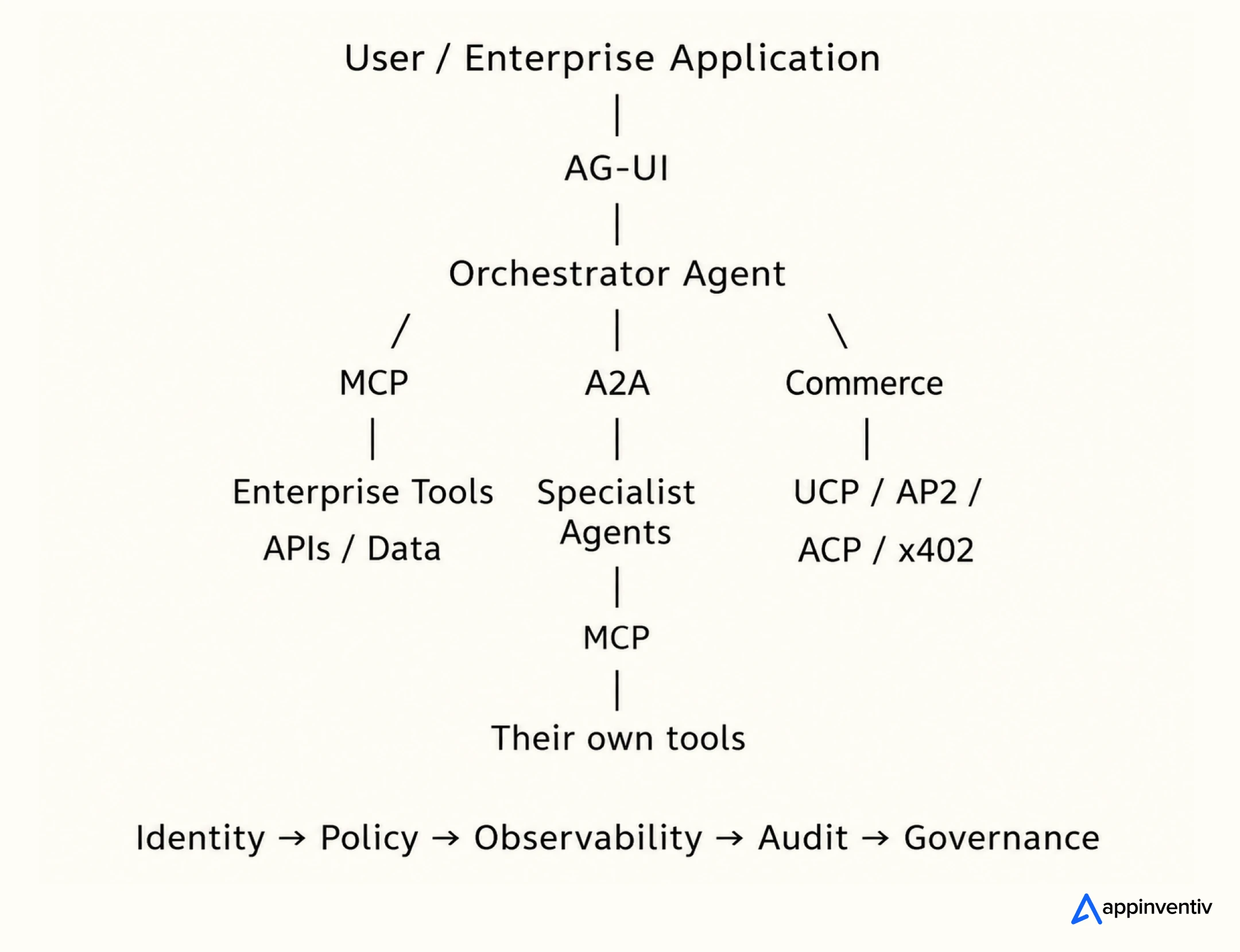
How the Architecture Works
AG-UI connects the agent backend with the user-facing application. It carries agent events, messages, tool activity, and state updates.
The orchestrator manages the main workflow. It can use MCP to access enterprise systems, including CRM, ERP, databases, and internal APIs.
The orchestrator can use A2A to delegate work to specialist agents. Each specialist agent can use its own MCP connections and operate within its assigned permissions.
The commerce layer handles transactions that require specialized protocols. UCP can manage commerce interactions, while AP2 or x402 can support payment workflows.
Cross-Cutting Enterprise Controls
These controls should apply across every layer:
- Identity: Establish which users, applications, and agents are making requests.
- Policy: Define what each agent can access, execute, or delegate.
- Observability: Track requests, tool calls, agent tasks, latency, failures, and handoffs.
- Audit: Record actions, approvals, transactions, and security events.
- Governance: Control protocol versions, data handling, permissions, compliance, and agent lifecycle management, the core focus of an agentic AI governance framework.
This architecture separates interaction, capability access, agent collaboration, and transactions. That separation gives enterprise teams clearer boundaries for development, security, and operations.
How MCP and A2A Work Together
MCP handles system and tool access, while A2A handles agent collaboration. This lets an orchestrator delegate work without exposing another agent’s internal tools, model, or logic.
Example: Enterprise Procurement Workflow
A procurement agent can use MCP to check inventory, approved vendors, and purchasing rules. It can then use A2A to request quotations from supplier agents. Those agents return prices and delivery details. The procurement agent compares the results, checks the ERP through MCP, and submits the approved order.
A2A coordinates the work. MCP provides the system access needed to complete it.
How to Build an AI Agent Protocol Stack
Building a protocol stack starts with the business workflow, not the protocol name. The goal is to define only the interfaces the workflow actually needs. McKinsey found that 62% of organizations were experimenting with AI agents in 2025, while 23% were already scaling an agentic AI system somewhere in the enterprise,echoing the broader trend covered in how intelligent automation revolutionizes business processes.
Step 1: Identify the Business Workflow
Map the process from trigger to outcome. Mark the decisions, system calls, human approvals, and long-running tasks involved.
Step 2: Map Agents, Tools, and Trust Boundaries
Decide which functions require an agent and which can remain conventional services. Mark every system that stores sensitive data or performs high-impact actions.
Step 3: Decide Where a Protocol Is Necessary
Use a protocol only where standardization adds value. A conventional API is often enough for a fixed service call. MCP, A2A, or another protocol makes sense when discovery, interoperability, delegation, or agent-specific interaction is required.
Step 4: Design the Protocol Contracts
Define the interface before implementation. Cover:
- Capability descriptions and input/output schemas
- Task states and expected results
- Protocol and schema versioning
- Error codes and retry behavior
- Timeouts and idempotency rules
Clear contracts reduce ambiguity between services and agents.
Step 5: Implement Authentication and Authorization
Define identities, credential flows, scopes, and approval rules. Apply least-privilege access to every tool and agent connection.
Step 6: Build MCP Integrations
Expose approved enterprise capabilities through MCP servers as part of a broader custom AI agent development effort. Keep business logic inside existing services, and expose only the operations an agent actually needs.
Step 7: Add A2A for Agent Delegation
Introduce A2A where an independent agent needs to perform a task. Define discovery, task ownership, response handling, and timeout rules before adding more agents.
Step 8: Add UI, Commerce, or Payment Protocols
Add AG-UI or A2UI for user-facing workflows. Add UCP, Agentic Commerce Protocol, AP2, or x402 only where commerce or payment functions require them.
Step 9: Add Observability and Audit Trails
Capture agent IDs, task IDs, tool calls, latency, failures, approvals, and transaction events. Connect these records to existing logging and monitoring systems.
Step 10: Test Failure and Adversarial Scenarios
Test expired credentials, unavailable tools, failed agents, malformed payloads, duplicate requests, prompt injection, excessive tool calls, and interrupted tasks. Test recovery paths before production deployment.
The protocol stack should be built around the workflow and its actual requirements. This is where the right protocol choices can reduce integration effort and keep the architecture easier to manage.
Map protocols, trust boundaries, integrations, governance, and production risks with an enterprise AI consulting team before implementation expands.
Performance, Scalability and Reliability Considerations
Protocol calls add network traffic, processing time, and model overhead. Multi-agent workflows can add several sequential steps, so keep critical paths short and run independent tasks in parallel. Use streaming for long responses and asynchronous execution for longer-running tasks. Set clear timeouts and bounded retries for temporary failures.
Use idempotency keys for actions such as orders, payments, and ticket creation. Set limits on agent steps, tool calls, delegation depth, token usage, and execution time to control runaway workflows. Remote protocol services can use connection pooling, load balancing, and horizontal scaling. Stateful workflows need durable task storage and consistent identifiers.
Design for partial failures with defined retry, fallback, cancellation, and recovery paths. Track request IDs, task IDs, agent handoffs, tool calls, latency, token usage, retries, and failures to identify bottlenecks and production issues.
Security Challenges in AI Agent Protocols
AI agent protocols create new access paths across enterprise systems. A secure design must control who can call an agent, what it can access, what data it can pass, and which actions it can perform, the same discipline explored in business security automation.
Deloitte’s 2026 research found that only 21% of organizations reported a mature governance model for agentic AI. That gap makes identity, authorization, monitoring, and containment important parts of enterprise architecture.
- Agent Identity and Authentication: Every agent and client needs a verifiable identity. Use approved authentication methods, TLS, and trusted discovery metadata for remote connections.
- Least-Privilege Authorization: Give each agent only the tools and data needed for its assigned task. Separate read, write, administrative, and payment permissions.
- Tool and Agent Trust: Treat remote agents and third-party tools as separate trust boundaries. Validate their identity, endpoints, capabilities, and input or output schemas before use.
- Prompt Injection and Malicious Tool Outputs: Attackers can place instructions inside prompts, documents, websites, or tool responses, a pattern covered in depth in prompt injection defense. Treat external content as untrusted, limit tool permissions, and require approval for sensitive actions.
- Data Leakage Across Agent Boundaries: Agent handoffs can expose more information than the next task requires. Pass only the required fields and apply authorization checks at each handoff.
- Credential and Token Security: Keep credentials outside model-visible content. Use managed secret stores, short-lived tokens, narrow scopes, and regular rotation.
- Human Approval for High-Impact Actions: Require approval before making payments, deleting records, changing permissions, or sending sensitive external communications. Agents can prepare these actions without receiving unrestricted execution rights.
- Audit Logging and Non-Repudiation: Record the action chain from user request to final result. Include user identity, agent identity, task IDs, tool calls, approvals, and outcomes.
- Kill Switches, Revocation and Containment: Provide controls to revoke credentials, disable tools, cancel tasks, quarantine agents, and stop execution. These controls limit damage when a compromised agent affects other parts of the workflow, the same containment logic behind AI agents for cybersecurity.
When to Use an Agent Protocol vs a Conventional API
Not every enterprise workflow needs an agent protocol. Use the technology that best matches the interaction, level of autonomy, and systems involved.
| Requirement | Recommended approach |
|---|---|
| Fixed, deterministic service call | Conventional API |
| Agent needs access to tools, data, or files | MCP Protocol |
| One agent needs to delegate work to another | A2A Protocol |
| Multiple agents need tools and agent collaboration | MCP + A2A |
| Agent needs frontend interaction | AG-UI / A2UI |
| Agent needs product discovery or checkout | UCP / Agentic Commerce Protocol |
| Agent needs payment authorization | AP2 |
| Agent needs programmatic payments over HTTP | x402 |
| Open agent discovery and network communication | ANP |
AI Agent Protocol Use Cases Across Industries
The strongest enterprise use cases combine agents with existing business systems. The protocol handles the connection or handoff, while the underlying systems perform the business operation.
Financial Services
A fraud detection agent can use MCP to access transaction data, risk engines, and compliance records, the kind of use case covered in agentic AI in banking. It can use A2A to send complex cases to specialist compliance or investigation agents.The resulting action can include transaction review, case creation, or human escalation, part of the broader shift covered in agentic AI in finance.
Healthcare
A care coordination agent, the kind of system detailed in agentic AI in healthcare, can use MCP to access approved clinical systems, patient records, scheduling tools, and administrative services. A2A can connect it with specialist agents for referrals, billing, or care planning. The workflow can then schedule appointments, prepare records, or route cases for review.
Retail and eCommerce
A shopping agent, similar to the ones covered in agentic RAG in eCommerce, can use MCP to query product catalogs and inventory systems. UCP or another commerce protocol can handle product discovery and checkout, while AP2 can support payment authorization. The result can be a completed purchase, return, or customer service action.
Supply Chain and Logistics
A procurement agent can use MCP to access ERP, inventory, and supplier records. A2A can connect it with supplier or logistics agents to request quotations, confirm availability, and track shipments. The business result is faster purchasing and better coordination across suppliers.
Manufacturing
A plant operations agent can use MCP to access production data, maintenance systems, and equipment APIs. It can use A2A to delegate diagnostics or maintenance planning to specialist agents. The workflow can create work orders, schedule maintenance, or flag production risks.
Enterprise IT
A service desk agent can use MCP to access ticketing, monitoring, identity, and deployment systems. A2A can hand incidents to specialist agents for infrastructure, security, or application analysis. The resulting action can include ticket updates, automated remediation, or escalation.
Reduce exposure across agents, tools, data, and vendors by building a production architecture around identity, permissions, auditability, and containment.
Common AI Agent Protocol Development Mistakes
Agent protocol projects often fail from poor architecture rather than protocol limitations. The same mistakes can increase cost, weaken security, and make production systems harder to operate.
Treating Protocols as Competitors
MCP, A2A, AG-UI, and commerce protocols address different interaction boundaries. Treating them as alternatives creates poor architecture.
How to mitigate: Map each workflow boundary first. Use each protocol only where its capabilities fit the requirement.
Turning Every Function Into an Agent
Not every business function needs planning, memory, or autonomous decision-making. Extra agents introduce latency, model costs, state management overhead, and failure points.
How to mitigate: Keep deterministic operations as services or tools. Introduce an agent only where reasoning or delegation adds measurable value.
Wrapping Every API in MCP
MCP is useful for agent-facing capabilities, but exposing every internal API creates large tool catalogs and unnecessary maintenance.
How to mitigate: Expose only functions that agents need. Group related operations into clear tools with strict input and output schemas.
Trusting Discovery Metadata Automatically
Agent Cards, capability descriptions, and server metadata help discovery, but they are not proof that a remote agent is trustworthy.
How to mitigate: Validate identity, signatures where supported, endpoints, capabilities, and authorization before allowing access.
Giving Agents Excessive Permissions
Broad access lets an agent read sensitive data or perform actions beyond its business role.
How to mitigate: Apply least-privilege scopes, separate read and write permissions, and require approval for high-impact actions.
Ignoring Deterministic Failure Handling
Agent workflows still depend on ordinary systems that can time out, reject requests, or return invalid data.
How to mitigate: Define timeouts, retries, idempotency keys, fallback paths, and explicit failure states for every critical operation.
Logging Only the Final Answer
The final response does not explain what led the agent to its decision.
How to mitigate: Log agent IDs, task IDs, tool calls, inputs, outputs, approvals, retries, and errors. Correlate events across the complete workflow.
Building Directly Against Unstable Protocol Features
Agent protocols evolve quickly. A feature available in a development release can change or become deprecated.
How to mitigate: Build an abstraction layer around protocol-specific code. Track official specifications and isolate experimental features from core business logic.
Skipping Protocol Version Management
Different agents can run different protocol or schema versions. Undocumented differences can break task handoffs.
How to mitigate: Declare supported versions, validate compatibility during connection setup, and maintain clear migration and deprecation policies.
AI Agent Protocol Development Cost and Timeline
AI agent protocol development does not have a fixed price. The budget depends on the number of systems, agents, tools, protocols, security controls, and deployment requirements. Protocol implementation also differs from agent development. The protocol layer defines how systems communicate, while agent development covers reasoning, workflows, memory, tools, and business logic.
What Determines Implementation Cost?
Key cost drivers include system and tool count, number of agents, protocol complexity, authentication, compliance, API readiness, UI requirements, observability, and cloud deployment.
Typical Implementation Phases
A typical enterprise engagement progresses through POC → controlled pilot → production → multi-agent scale. Each phase adds integrations, security controls, testing, monitoring, and operational requirements.
| Project scope | Typical cost (USD) | Typical timeline |
|---|---|---|
| Proof of Concept | $40K–$75K | 6–10 weeks |
| Controlled Pilot | $75K–$150K | 10–16 weeks |
| Production System | $150K–$300K | 4–7 months |
| Enterprise Multi-Agent Platform | $300K–$500K+ | 7–12+ months |
These ranges are planning estimates, not fixed quotes. Complex compliance requirements, legacy systems, multiple agents, and custom protocol work can push both cost and timeline higher.
Future of AI Agent Protocols
AI agent protocols are still developing. No single standard handles every interaction, so enterprises should expect several agent communication protocols to coexist across different parts of an agent system. Gartner forecasts that 40% of enterprise applications would include task-specific AI agents by the end of 2026, up from less than 5% in 2025, reflecting the fast evolution of AI agent communication protocols.
Protocol Convergence and Governance
MCP, A2A, AG-UI, and commerce standards are increasingly designed to work together. Open governance, clear specifications, security rules, and version policies will matter more as adoption grows.
Discovery, Versioning, and Open Agent Networks
Agent discovery will become more important as organizations deploy more agents. Agent Cards, capability metadata, identity systems, and registries can reduce hard-coded dependencies.
Protocol versioning will matter just as much. Enterprises need compatibility testing, migration plans, and abstraction layers that keep business logic separate from protocol-specific code.
Open protocols such as ANP are extending agent communication beyond closed environments. That creates new possibilities for cross-company and internet-based agent interactions.
Commerce, Payments, and Agent Interfaces
UCP, Agentic Commerce Protocol, AP2, and x402 are extending agents into purchasing and machine-to-machine payments. AG-UI and A2UI do the same to enable richer user interactions.
Build around interoperability, clear trust boundaries, versioned interfaces, and replaceable protocol components. Avoid tightly coupling core business logic to features that can change as standards mature.
Build an Enterprise-Ready AI Agent Architecture With Appinventiv
Building an agent system for production requires more than connecting a model to a few tools. Enterprise deployments need a clear architecture, secure integrations, reliable workflows, observability, and a plan for protocol changes.
Appinventiv helps enterprises design and build these systems across the full delivery cycle. Our teams work on AI agent architecture, MCP integrations, A2A orchestration, enterprise API integration, AI consulting services, workflow automation, security, cloud deployment, observability, and protocol interoperability. We can work with existing enterprise systems or modernize older integration layers for agent-driven workflows.
Appinventiv has deployed 100+ autonomous AI agents and trained and deployed 150+ custom AI models, backed by more than 200 data scientists and AI engineers across 35+ industries. Our AI implementations have delivered reported outcomes including 50% reduction in manual processes, 90%+ agent task accuracy, and 2x higher scalability.
A typical engagement follows a clear path:
Assess → Architect → Prototype → Integrate → Secure → Scale
Planning an enterprise AI agent system? Let’s connect and get an AI agent architecture assessment covering protocol selection, integration boundaries, security controls, and production readiness.
Frequently Asked Questions
Q. What is the difference between MCP, A2A, and ACP?
A. MCP and A2A serve different purposes in an AI agent architecture. MCP connects an AI application to tools, resources, databases, APIs, and other external capabilities. A2A connects independent AI agents so they can exchange messages and delegate tasks. MCP handles agent-to-tool interaction, while A2A handles agent-to-agent collaboration. Enterprises can use both within the same workflow.
Q. MCP vs A2A: Which protocol should I use?
A. Choose MCP when an agent needs structured access to enterprise tools, data, files, APIs, or SaaS applications. Choose A2A when one independent agent needs another agent to perform work, return results, or provide ongoing task updates. Many production systems need both. MCP can connect each agent to its tools, while A2A coordinates work between those agents.
Q. When do you need A2A?
A. A2A is useful when separate agents need to discover capabilities, delegate tasks, exchange progress updates, or return artifacts. It fits systems with specialist agents, long-running workflows, or agents managed by different teams or vendors. A conventional API can still handle fixed service requests. A2A makes more sense when the interaction requires an agent-specific task model and collaboration.
Q. Can I use APIs instead of A2A for agent communication?
A. Yes. Conventional APIs work well for predictable communication between known services with fixed endpoints, schemas, and response patterns. A2A adds capabilities such as agent discovery, task delegation, asynchronous updates, and interaction with independent agent implementations. It does not replace APIs. Enterprises can keep their existing APIs and use A2A where the workflow requires agent-to-agent coordination.
Q. How do AI agents communicate with each other?
A. AI agents rely on agent-to-agent communication, exchanging structured messages via a shared protocol. With A2A, one agent can discover another through an Agent Card, send a message, create or update a task, and receive status changes or artifacts. Streaming and push notifications support longer workflows. Each agent can keep its own model, tools, memory, and internal orchestration.
Q. How do AI agents discover other agents?
A. A2A uses Agent Cards to describe an agent’s capabilities, endpoint, supported interfaces, and authentication requirements. A client can inspect this information before sending a task to the agent. Other protocols, such as ANP, use identity and network discovery mechanisms to locate agents. This reduces hard-coded dependencies and makes larger agent networks easier to manage.
Q. How can AI agents from different vendors communicate?
A. Agents from different vendors can communicate through a shared protocol such as A2A, provided their implementations support compatible interfaces and versions. Each vendor can keep its own model, framework, memory, tools, and internal workflows. The protocol standardizes the external interaction layer, so vendors do not need to rebuild their internal systems around a common technology stack.


Fast 2-minute response, fully NDA-protected.
The Multiplier Effect of AI Agents: The Rise of AI Swarms
Key takeaways: AI agent swarms coordinate specialized agents to solve complex problems that may be difficult for a single agent to handle effectively. More agents do not automatically mean better outcomes. Swarms deliver value when work can be divided, executed in parallel, and coordinated toward a shared objective. Enterprise readiness depends on governance. Clear accountability,…
AI Data Integration: How to Connect, Clean and Prepare Data for AI
Key takeaways: AI initiatives fail when fragmented, poor-quality data reaches models without sufficient context, controls or ownership. AI-ready pipelines must connect, clean, enrich, govern and continuously monitor data across its lifecycle. Real-time processing matters when AI decisions depend on current transactions, events, inventory or operational conditions. Data architecture should follow the AI use case, balancing…
AI-Native SDLC: Foundational 90-Day, 5R AI SDLC Adoption Playbook
Key takeaways: Why AI coding tools accelerate coding and software delivery How AI-native SDLC shifts engineering from code to intent, context, and outcomes The role of specifications, AI agents, and continuous verification in enterprise delivery How to redesign engineering teams for human–agent collaboration The platform, governance, and guardrails required to scale AI-native development A practical…