

































Automated Decision-Making in Australia: Benefits, Cost and Implementation

 Share -



- 01Understanding Automated Decision-Making
- 02Why Are Organisations Adopting Automated Decision-Making?
- 03Use Cases of Automated Decision-Making in Different Sectors
- 04What Are the Benefits of Automated Decision-Making for Australia?
- 05How to Implement Automated Decision-Making?
- 06What Are the Risks of Automated Decision-Making and How to Mitigate Them?
- 07Automated Decision-Making Architecture
- 08Automated Decision-Making Regulations and Governance
- 09How Much Does Automated Decision-Making Cost?
- 10How Agentic AI Could Change Automated Decision-Making?
- 11Common Mistakes When Implementing Automated Decision-Making
- 12Build and Integrate Automated Decision Systems with Appinventiv
- 13FAQs

Key takeaways:
- Automated decision-making combines rules, algorithms, AI and human oversight to improve high-volume decisions.
- ADM programmes require privacy, security, auditability and accountability to be designed into architecture.
- ADM implementation costs typically range from AUD 70,000 to AUD 700,000 or more.
- Implementation starts with decision mapping, then moves through development, testing, controlled pilots and monitoring.
Organisations are under growing pressure to process more decisions, faster, without losing accuracy, accountability or regulatory compliance. Loan approvals, eligibility checks, claims triage and service requests all arrive in volumes that manual review was never built to handle. And most organisations are trying to meet that demand on top of manual decision-making, fragmented data and legacy systems that were never designed to talk to each other.
Automated decision-making (ADM) covers a wide spectrum of approaches to this problem, from simple rules-based automation through to decision engines, AI-assisted recommendations and fully AI-enabled decisions. Where an organisation sits on that spectrum depends on the decision’s complexity and its consequences for the person on the other end.
The spectrum now sits inside a tightening regulatory picture. The OAIC’s own 2026 consultation work on ADM transparency has made clear that many organisations cannot yet say with confidence where automated systems are shaping decisions about individuals, which is exactly the gap the incoming disclosure obligations are designed to close.
This blog works through what ADM delivers, where the risks sit, what governance now requires, what implementation costs are, and how to build a system that holds up under scrutiny.
Build accountable automated decision systems that connect with your existing workflows, data and enterprise technology.

Understanding Automated Decision-Making
Automated decision-making is the use of technology, from fixed business rules to trained AI models, to make or materially support a decision that previously required a person to weigh the facts and decide.
Rule Based vs ADM vs AI Decision Making
While closely related in the public consciousness, these approaches differ significantly in technical execution, autonomy limits and governance requirements.
| Approach | How it decides | Human involvement | Typical use |
|---|---|---|---|
| Rules-based ADM | Fixed if/then logic set by the business | None once rules are configured | Eligibility checks, fee calculations |
| Algorithmic decision-making | Structured formulas or scoring models | Minimal, usually exception-based | Risk scoring, triage |
| AI-assisted decision-making | Model generates a recommendation | A person makes the final call | Underwriting, clinical triage support |
| AI-enabled automated decisions | Model decides directly within set parameters | Oversight and audit, not case-by-case review | High-volume, lower-stakes decisions |
| Human-in-the-loop systems | Model prepares the decision; a person must approve | Mandatory sign-off before the decision takes effect | High-consequence decisions (benefits, licensing) |
AI implementation is therefore one part of the ADM landscape, rather than a requirement for every automated decision.
How Does Automated Decision-Making Work?
A governed decision system follows a strict, repeatable lifecycle built on modern microservices architecture. The underlying technical infrastructure prevents anomalous data from generating unapproved outcomes.
A practical workflow typically follows:
Data and Input Ingestion -> Validation and Sanitisation -> Rules Engine or AI Model Processing -> Decision Generation -> Human Review Where Required -> Outcome Execution and Notification -> Comprehensive Audit Trail Logging
Why Are Organisations Adopting Automated Decision-Making?
Enterprise executives face compounding pressures to modernise legacy systems that simply cannot handle modern transaction volumes efficiently. Rapidly shifting consumer expectations, tightening profit margins and stringent regulatory oversight compel organisations to replace manual processing with resilient digital infrastructure. Automation provides the only sustainable mechanism to scale operations without proportionally increasing headcount costs.
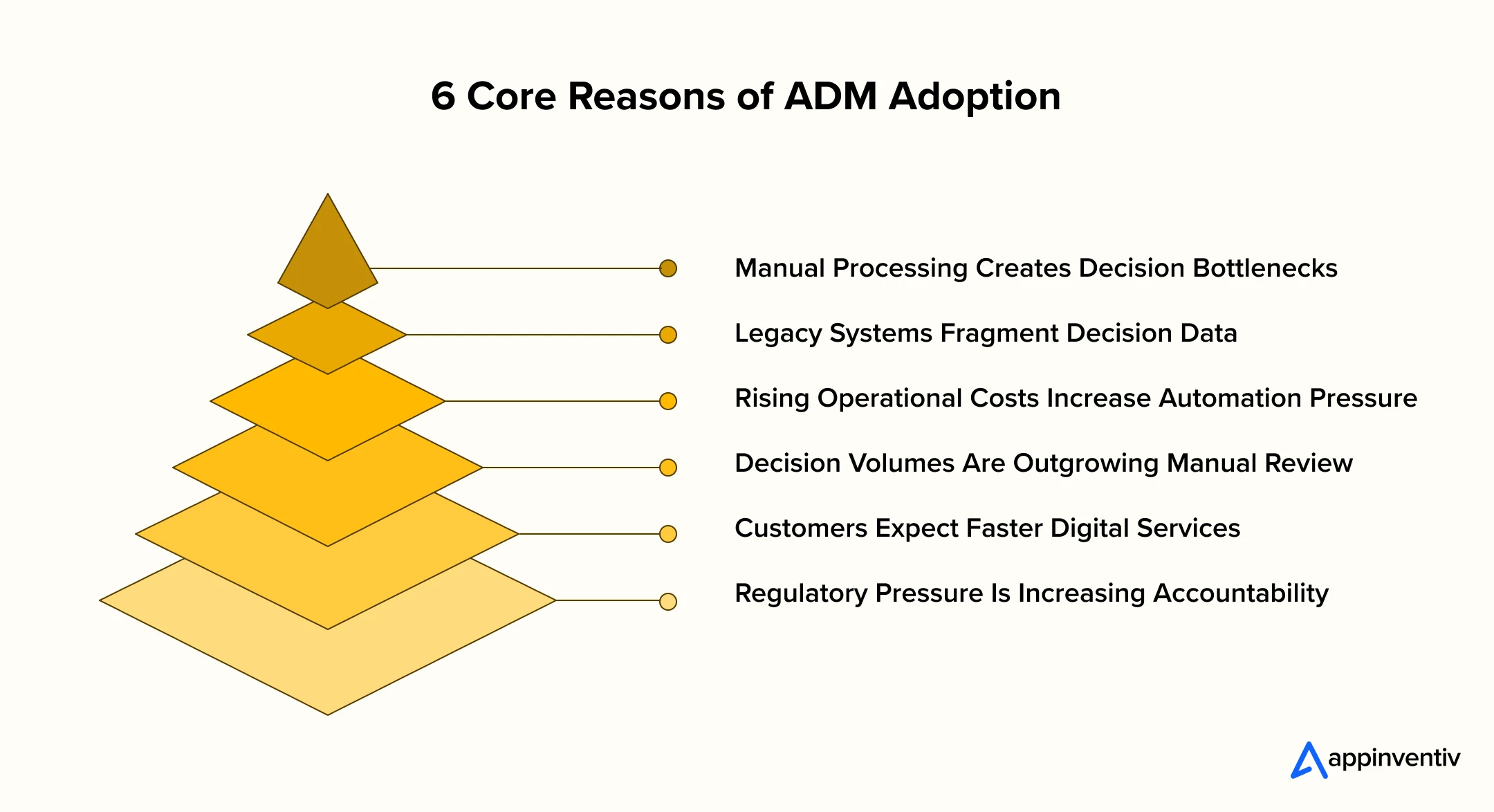
Manual Processing Creates Decision Bottlenecks
Teams reviewing cases one at a time can’t keep pace with rising volumes, and turnaround times stretch out as a result, frustrating customers waiting on a straightforward answer.
Legacy Systems Fragment Decision Data
Older disconnected databases force staff to manually compile information from disparate sources, drastically increasing the likelihood of critical human error during evaluations.
Rising Operational Costs Increase Automation Pressure
Maintaining large administrative teams for routine, repetitive tasks severely impacts profitability, forcing businesses to seek software-driven efficiency gains immediately.
Decision Volumes Are Outgrowing Manual Review
As digital services expand rapidly, the sheer quantity of daily customer interactions and micro-decisions completely overwhelms traditional human-centric processing capabilities.
Customers Expect Faster Digital Services
Modern consumers and citizens demand instantaneous responses for digital applications, rapid approvals and service requests, actively rejecting services requiring multi-day waiting periods.
Regulatory Pressure Is Increasing Accountability
Regulators demand precise, auditable records detailing exactly how organisations reach specific conclusions, which manual processes notoriously fail to provide consistently or accurately.
Use Cases of Automated Decision-Making in Different Sectors
ADM already sits behind everyday interactions across most sectors of the economy, usually without customers realising a system, not a person, made the call.
- Financial services and Insurance: credit scoring, loan pre-approval, claims triage, fraud flagging
- Healthcare and Aged care: appointment triage, eligibility for subsidised services, care-plan recommendations
- Retail and eCommerce: dynamic pricing, fraud detection, personalised offers
- Telecommunications: plan eligibility, churn risk scoring, network fault triage
- Utilities and Energy: billing anomaly detection, concession eligibility, outage prioritisation
- Employment and HR: resume screening, shortlisting, shift and roster allocation
- Compliance and Risk: transaction monitoring, sanctions screening, anomaly detection
- Customer Service and Operations: chat and call routing, case prioritisation, refund approvals
- Government and Public Services: benefits assessment, licensing, compliance checks
Automated Decision-Making in Government
Public sector agencies handle immense administrative volumes requiring absolute fairness, equity and transparency. Government departments deploy automated systems for processing social services benefits, managing routine grants and funding applications, and issuing standard licensing and permits. These software architectures also calculate tax and revenue obligations, assess standard migration visas and execute complex fraud detection operations at a national scale.
Key applications include:
| Government function | ADM application | Human role |
|---|---|---|
| Grants | Eligibility screening, application scoring and funding prioritisation | Review exceptions, assess complex applications and approve outcomes |
| Licensing | Eligibility checks, document validation and licence renewals | Review unusual cases and make discretionary decisions |
| Social services | Eligibility assessment, benefit calculations and service prioritisation | Review complex circumstances and handle appeals |
| Revenue | Tax assessment, risk scoring and anomaly detection | Investigate flagged cases and approve enforcement actions |
| Migration | Application triage, document checks and risk assessment | Review complex cases and make final decisions where required |
| Local government | Permit assessment, service requests and development application triage | Assess exceptions, apply discretion and approve outcomes |
| Compliance | Risk scoring, case prioritisation and breach detection | Investigate cases and determine appropriate action |
| Public health | Risk assessment, case prioritisation and resource allocation | Validate high-risk cases and make clinical or policy decisions |
| Procurement | Supplier screening, tender evaluation and compliance checks | Review shortlisted suppliers, exceptions and final approvals |
All these applications of government automated decision making typically stand on the 3 key aspects: custom workflow automation, human oversight and accountable implementation.
Custom workflow automation remains critical to managing the unprecedented scale of citizen interactions across multiple departments. However, strict human oversight must firmly complement this automation. Accountable implementation ensures that citizens retain the legal right to challenge machine-generated outcomes securely.
What Are the Benefits of Automated Decision-Making for Australia?
The automated decision making benefits organisations are most often speed and consistency, but the complete advantages run deeper once a system is actually in production.
Faster Decision Processing
Algorithmic engines execute complex evaluations in milliseconds. This enables instant customer approvals, rapid transaction clearing and real-time service delivery that physical teams simply cannot match.
More Consistent Application of Rules
ADM software completely eliminates human cognitive fatigue and subjective bias. Decision logic executes exactly as programmed every single time, ensuring absolute uniformity across all customer interactions.
Reduced Operational Workload
Automating routine assessments liberates expensive human talent permanently. Highly trained professionals can immediately redirect their focus toward complex problem solving, strategic planning and empathetic customer management.
Earlier Risk and Anomaly Detection
Systems ingest and analyse massive datasets continuously. This allows organisations to identify fraudulent patterns, network threats and compliance breaches long before human analysts could detect them.
Better Resource Allocation
Data-driven processing accurately predicts demand spikes and operational requirements. Enterprises can deploy capital, physical inventory and human resources with extreme precision and minimal financial waste.
Improved Customer and Community Experiences
Instantaneous processing removes frustrating wait times entirely. Customers receive immediate certainty regarding their applications, claims or service requests, driving substantially higher satisfaction and brand loyalty.
Stronger Decision Traceability
Every automated action generates an immutable digital signature. Organisations can instantly retrieve the exact data points and specific business rules that determined any historical operational outcome.
Greater Operational Scalability
Digital infrastructure handles sudden transactional surges effortlessly. Enterprises can process ten thousand applications exactly as easily as ten without hiring additional temporary administrative staff.
How to Implement Automated Decision-Making?
Transitioning from manual evaluation to software-driven processing requires a highly methodical, deeply governed engineering approach. Successful automated decision making implementation follows a structured, step by step process, which is as follows:
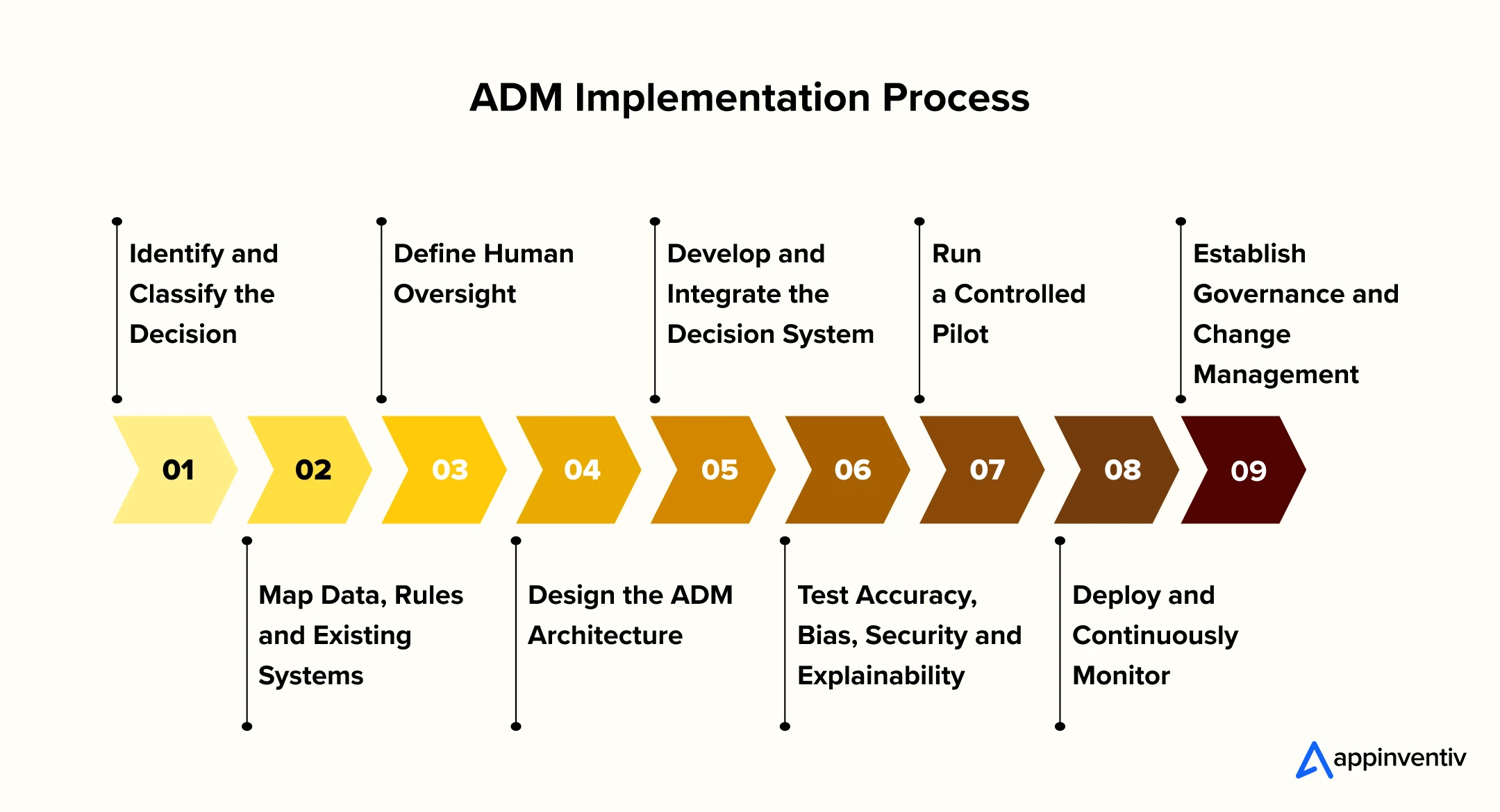
1. Identify and Classify the Decision
Analyse the exact business workflow to determine if the choice relies on objective criteria or requires nuanced human empathy. Classify the regulatory risk, potential community impact and the precise volume of daily transactions expected before committing to automation.
2. Map Data, Rules and Existing Systems
Audit all required input sources, structured databases and external API dependencies thoroughly. Document the exact business logic, legislative requirements and internal operational policies that dictate exactly how the final conclusion must be reached technically.
3. Define Human Oversight
Establish clear operational parameters dictating exactly when the software must pause and request physical intervention. Design strict escalation workflows for edge cases, ambiguous data inputs and scenarios where the algorithmic confidence score falls below acceptable risk thresholds.
4. Design the ADM Architecture
Construct a highly resilient technical blueprint ensuring continuous availability and secure data transit between microservices. A typical ADM architecture looks like:
Data Ingestion -> Rules/AI Processing -> Core Decision Engine -> Integration Layer -> Workflow/Case Management -> Human Review Interface -> Audit & Monitoring Logs
5. Develop and Integrate the Decision System
Write the foundational code for deterministic rules engines and train necessary machine learning models carefully. Build secure RESTful APIs, automate surrounding workflows, integrate tightly with legacy databases and develop highly intuitive user interfaces for operational staff.
6. Test Accuracy, Bias, Security and Explainability
Execute rigorous quality assurance protocols before any live launch. Perform deep functional testing, validate data integrity continuously, assess statistical models for demographic bias, run aggressive penetration tests and ensure the system clearly explains its outputs logically.
7. Run a Controlled Pilot
Deploy the algorithmic system in a highly restricted production environment parallel to existing manual workflows. Compare the software-generated outcomes against historical human decisions to verify accuracy, operational speed and system stability thoroughly.
8. Deploy and Continuously Monitor
Launch the system gradually across the broader enterprise architecture. Implement real-time monitoring dashboards to track algorithmic performance, identify data drift instantly and ensure the underlying cloud infrastructure scales smoothly during peak transaction periods.
9. Establish Governance and Change Management
Assign clear ongoing accountability across the organisation to maintain long-term system integrity.
Business Teams -> Legal Counsel -> Data Engineers -> Technology Operations -> Security Specialists -> Risk Managers -> Operational Staff
Validate the use case, architecture and integration requirements before committing to development.

What Are the Risks of Automated Decision-Making and How to Mitigate Them?
Delegating consequential choices to software introduces distinct operational and reputational hazards. Without rigorous architectural controls, flawed algorithms can amplify historical biases, expose sensitive data and trigger widespread compliance failures. Successful enterprise adoption requires anticipating these technical vulnerabilities and embedding robust risk mitigation strategies directly into the core system design phase.
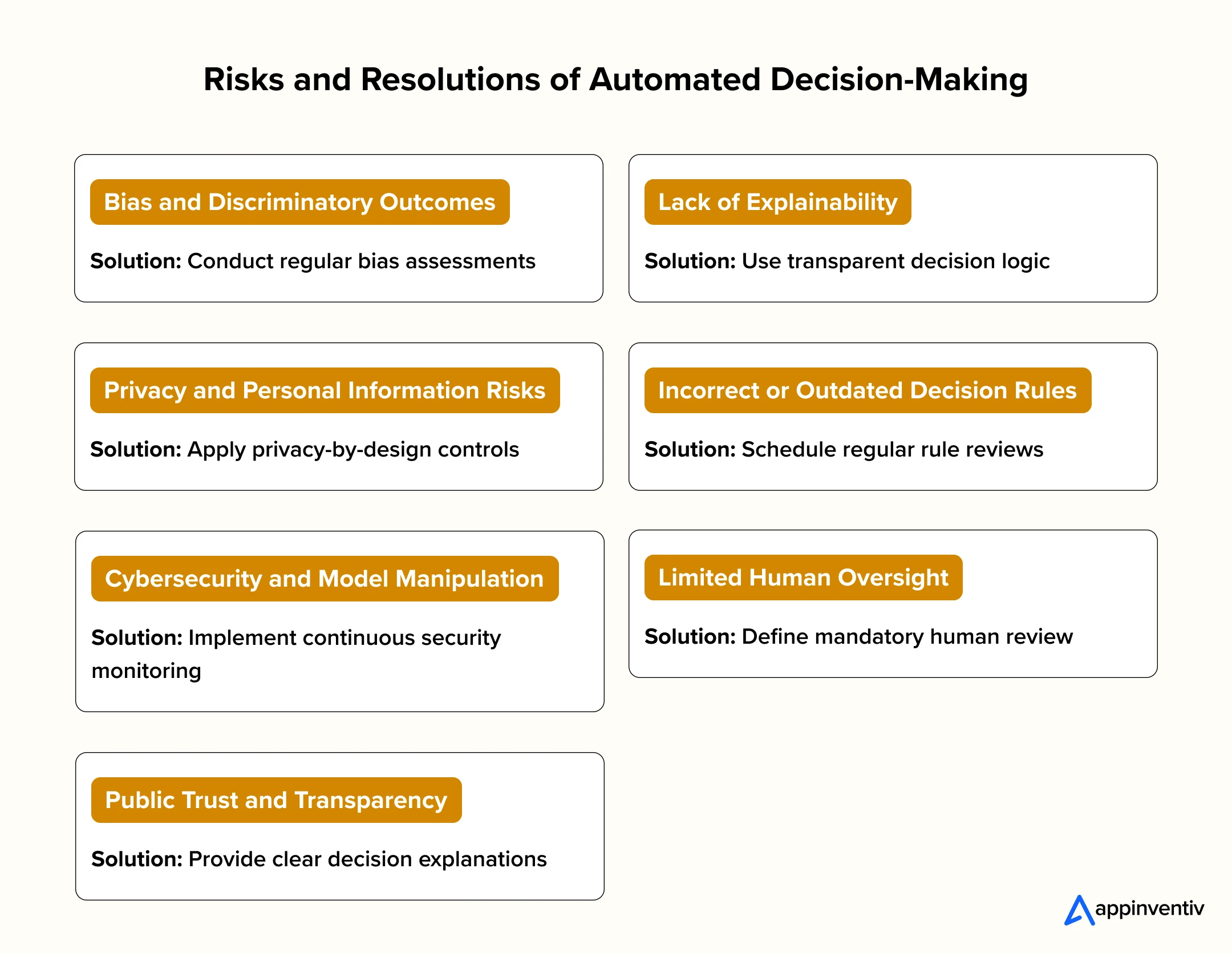
Bias and Discriminatory Outcomes
Historical data often contains hidden prejudices that algorithms inadvertently learn, blindly replicate and apply to new demographic cohorts unfairly.
Solution: Mandate diverse training datasets, enforce regular algorithmic bias testing and implement strict demographic parity checks before deploying any model.
Lack of Explainability
Complex neural networks often function as opaque black boxes, making it impossible to clearly explain exactly how they reached a specific conclusion.
Solution: Prioritise interpretable machine learning models and deterministic rules engines for high-stakes choices where regulatory explanations remain strictly mandatory.
Privacy and Personal Information Risks
Processing massive datasets increases the risk of unlawful personal data exposure, violating strict domestic privacy legislation and destroying customer trust permanently.
Solution: Deploy robust data anonymisation protocols, enforce strict role-based access controls and rigorously minimise personal data ingestion to necessary fields only.
Incorrect or Outdated Decision Rules
Static software logic becomes highly dangerous when market conditions, government policies or internal business strategies change rapidly without corresponding system updates.
Solution: Establish a centralised rule management interface, mandate scheduled logic reviews and maintain agile deployment pipelines for rapid policy updates.
Cybersecurity and Model Manipulation
Malicious actors routinely attempt to poison training data or actively exploit input parameters to force algorithmic systems into making incorrect, advantageous choices.
Solution: Execute continuous adversarial testing, deploy robust API security gateways and monitor incoming data streams for subtle injection anomalies constantly.
Limited Human Oversight
Removing people entirely from the loop prevents the early identification of edge cases, contextual nuances and catastrophic systemic failures.
Solution: Design mandatory human escalation triggers for any low-confidence outputs, ambiguous data inputs or automated decisions significantly impacting individual rights.
Public Trust and Transparency
Consumers feel alienated and highly suspicious when faceless systems reject their applications without providing clear reasoning or accessible avenues for appeal.
Solution: Publish plain-language explanations of algorithmic criteria and proactively build simple, accessible pathways for individuals to request human reviews seamlessly.
Automated Decision-Making Architecture
A robust technical architecture deliberately isolates the core decision logic from surrounding application interfaces, enabling rapid policy updates without compromising overall system stability. This highly modular design pattern ensures secure data ingestion, deterministic processing, seamless legacy integration and the creation of immutable audit trails necessary for strict regulatory compliance and subsequent dispute resolution.
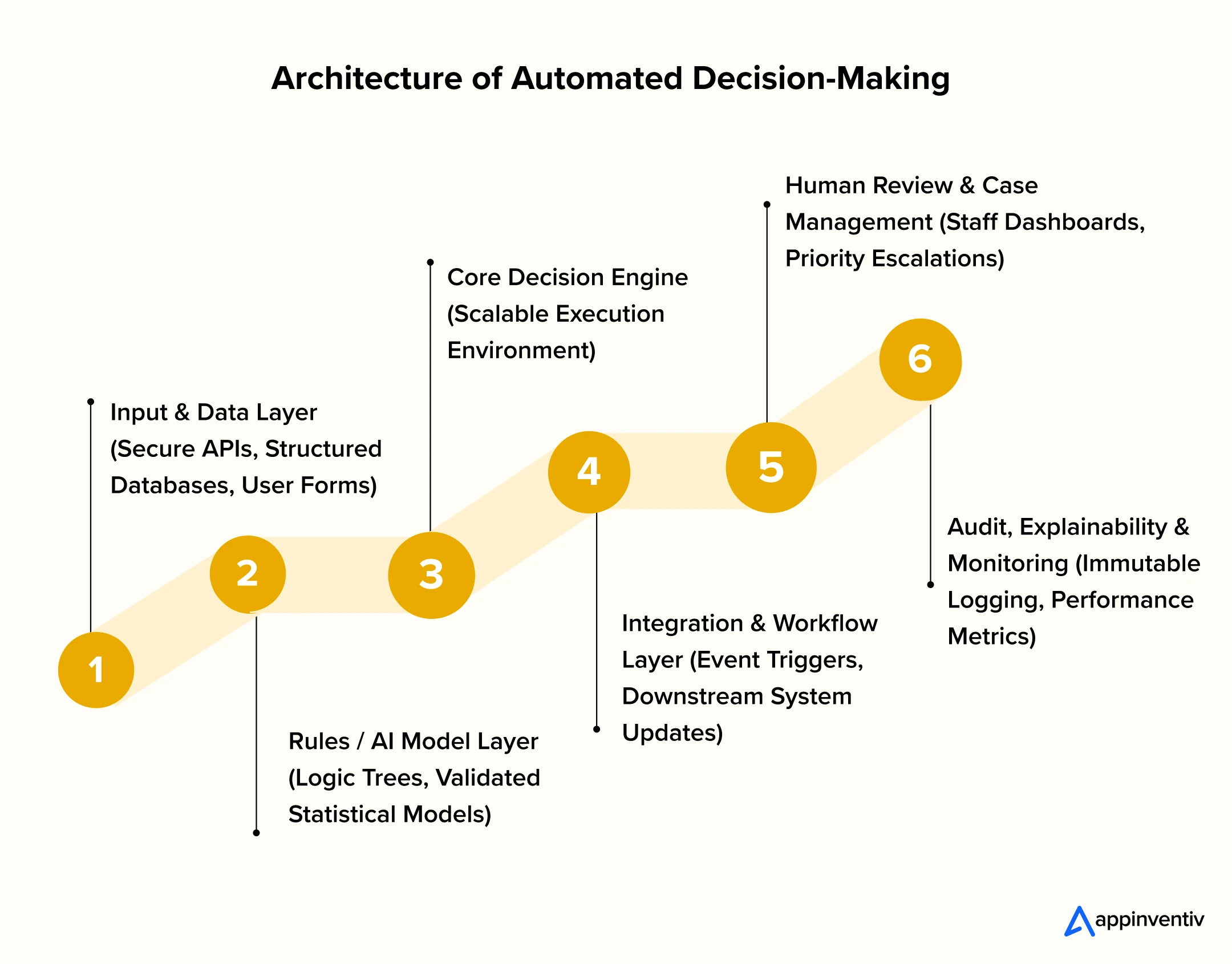
Crucially, robust Security, Identity Management and Data Governance frameworks must wrap entirely around this architectural stack continuously to prevent unauthorised interference.
Automated Decision-Making Regulations and Governance
The regulatory landscape demands strict algorithmic accountability across all industries. Enterprise boards face increasing pressure to prove software-driven outcomes remain fair, secure and legally defensible. Navigating this environment requires commercial leaders to embed privacy controls, data sovereignty and robust audit mechanisms directly into their core technology architecture from day one.
OAIC Transparency and Privacy Act Reforms
Taking effect on 10 December 2026, mandatory privacy updates require all commercial enterprises to explicitly disclose automated decision systems. When software substantially influences choices affecting individual rights, corporate entities must comprehensively detail the specific personal data utilised and the underlying algorithmic logic within their public privacy policies.
Financial and Corporate Sector Mandates
Regulated entities must align algorithmic deployments with stringent operational frameworks. Financial institutions deploying decision engines must comply with APRA’s CPS 230 and CPS 234. Simultaneously, ASIC expects corporate directors to actively govern AI models, ensuring commercial pricing algorithms and automated credit systems avoid breaching established consumer protection laws.
Government Frameworks as Commercial Benchmarks
While policies like the National AI Assurance Framework and the NSW AI Assessment Framework technically govern public agencies, they actively establish the expected baseline for enterprise vendor risk. Private organisations building software for government procurement must mirror these exact risk, safety and ethical evaluation methodologies to secure commercial contracts.
Cybersecurity and Critical Infrastructure (SOCI)
Enterprises managing vital supply chains or utility grids must align decision automation with the Security of Critical Infrastructure (SOCI) Act. Beyond specific algorithmic oversight, automated architectures require encrypted data flows, strict identity access management and domestic data residency protocols to satisfy broad legislative mandates and maintain extreme cyber resilience.
ADM Governance at a Glance
| Framework / Requirement | Relevance to ADM |
|---|---|
| OAIC Privacy Reforms (Dec 2026) | Mandatory transparency for commercial algorithms impacting individual rights |
| APRA CPS 230 / CPS 234 | Operational risk and security rules governing financial sector automation |
| SOCI Act | Cyber resilience mandates for critical infrastructure decision engines |
| National AI Assurance Framework | Risk assessment baseline for public agencies and their enterprise software vendors |
| Broad Data Protection Rules | Strict encryption, access control and immutable audit logging requirements across all sectors |
How Much Does Automated Decision-Making Cost?
ADM costs typically range from AUD 70,000 to AUD 700,000, depending on system complexity, integration scope, AI requirements and compliance obligations. These figures are indicative rather than fixed market prices. The table below breaks down what actually drives cost within that range.
Automated Decision-Making Cost by Complexity
| ADM solution | Estimated cost |
|---|---|
| Basic rules-based decision engine | AUD 70,000–150,000 |
| AI-assisted decision platform | AUD 150,000–300,000 |
| Enterprise ADM platform | AUD 300,000–500,000 |
| Complex/high-compliance ADM ecosystem | AUD 500,000–700,000+ |
The final estimate can move substantially depending on integrations, data preparation, security requirements, AI or ML complexity, legacy constraints, testing, assurance and ongoing monitoring.
ADM Implementation Cost Breakdown by Stages
| Cost component | What it covers | Estimated cost range |
|---|---|---|
| Discovery | Process mapping, rule definition and initial architecture design | AUD 15,000–40,000 |
| Data | Data cleansing, preparation, pipeline integration and governance | AUD 20,000–80,000 |
| Engineering | Core decision engine and custom application development | AUD 40,000–150,000+ |
| AI/ML | Statistical model development, training and validation | AUD 30,000–120,000 |
| Integration | Connecting APIs, enterprise resource planning and legacy systems | AUD 25,000–90,000 |
| Security | Identity and access management, encryption and threat monitoring | AUD 15,000–50,000 |
| Assurance | Functional testing, compliance auditing and algorithmic validation | AUD 20,000–60,000 |
| Deployment | Cloud infrastructure setup, automated release pipelines and launch | AUD 10,000–30,000 |
| Operations | Ongoing performance monitoring, maintenance and logic rule updates | AUD 5,000–15,000 / month |
Build vs Buy vs Customise an ADM Platform
Organisations must carefully weigh their architectural approaches.
| Approach | Best suited to |
|---|---|
| Off-the-shelf decision engine | Standardised, well-defined decision logic |
| Existing enterprise platform | Organisations already invested in compatible workflow or rules platforms |
| Custom ADM development | Complex decision logic, specialised workflows and deeper integration requirements |
| Hybrid architecture | Organisations combining commercial components with custom decision, data or workflow layers |
Custom development becomes more relevant when decision logic is closely tied to proprietary processes, legacy systems, sovereign requirements or advanced auditability. It also provides greater control over how human oversight and workflow automation are implemented.
Share your decision volume, complexity and integration landscape for an indicative cost range and delivery timeline.

How Agentic AI Could Change Automated Decision-Making?
Agentic AI could extend automated decision making applications by allowing software agents to gather information, coordinate multiple systems and prepare actions across a workflow. The opportunity is significant, but agent autonomy also increases the need for permission boundaries, approval gates and activity monitoring.
Potential applications include:
- Agent-assisted information gathering
- Multi-step workflow automation
- Decision preparation
- Cross-system orchestration
- Human approval gates
- Controlled agent permissions
The distinction matters: automating actions around a decision is different from delegating a consequential decision to an autonomous agent. The latter requires a substantially stronger control model.
The DTA’s 2026-27 corporate plan specifically identifies governance, privacy, cybersecurity, transparency and accountability as considerations for emerging generative and agentic AI, alongside its work on an agentic AI addendum to the technical standard.
Common Mistakes When Implementing Automated Decision-Making
Most ADM failures are not caused by the decision engine alone. They come from weak process design, poor data, unclear accountability or insufficient operational controls around the technology.
- Automating a Broken Process: Automating an inefficient workflow can make poor process design faster without addressing its underlying problems.
- Treating ADM as Only an AI Project: Effective ADM combines software engineering, data, workflow, integration, governance and human decision design.
- Ignoring Legacy-System Constraints: Existing applications can determine integration complexity, data availability and the practical limits of automation.
- Using Poor-Quality Data: Inaccurate, incomplete or inconsistent data can undermine automated outcomes regardless of model sophistication.
- Leaving Human Oversight Undefined: Without clear intervention rules, reviewers may not know when to challenge, override or escalate an automated outcome.
- Treating Compliance as a Final-Stage Activity: Privacy, security, assurance and audit requirements can affect architecture, so addressing them late often creates redesign.
- Launching Without Monitoring and Auditability: A decision system needs evidence of how it performs after deployment, not only during testing.
- Scaling Before Proving the Decision Model: A controlled pilot provides evidence about accuracy, exceptions, operational impact and governance before wider deployment.
Build and Integrate Automated Decision Systems with Appinventiv
Executing sophisticated algorithmic solutions demands a technology partner with deep engineering experience and incredibly rigorous delivery standards.
Appinventiv, an experienced AI development company in Australia, uniquely combines both to build highly secure, fully auditable systems. We partner directly with corporate and government leaders to reliably transform complex regulatory requirements into robust, high-performing digital realities. We are fully approved on the Queensland Government ICTSS and Local Buy LGA procurement panels.
With over 11 years of APAC delivery experience, a team of 1700+ tech architects and 5+ agile delivery centres across the nation, we consistently drive 35% efficiency gains for domestic enterprises.
Our operations maintain a flawless 99.50% security compliance SLA, fully certified under strict ISO 27001, ISO 9001 and SOC2 standards. Some of our key areas of expertise include:
Enterprise ADM Engineering
We build custom decision systems combining bespoke software engineering, sophisticated data architecture, targeted artificial intelligence and highly resilient workflow automation effortlessly.
Integration-Led Implementation
Our engineers seamlessly connect advanced algorithmic systems with your existing enterprise applications, complex external APIs, legacy mainframe platforms and highly secure data environments.
Governance-Ready Architecture
We embed comprehensive auditability, clear explainability, stringent cybersecurity protocols, mandatory human oversight and strict compliance frameworks into the foundational automated decision making systems development architecture.
From Strategy to Production
Our teams actively support your complete digital journey from initial decision assessment and precise architecture mapping through secure development, deployment and ongoing operational optimisation.
If you are looking to automate a high-volume decision process but not sure where to get started, we are your preferred partner. Design your ADM strategy today.
FAQs
Q. What is automated decision-making?
A. Automated decision-making uses software, predefined rules, algorithms or AI to produce or support decisions based on defined inputs. It can operate fully automatically or include human review.
Q. Is automated decision-making legal in Australia?
A. Automated decision-making is not subject to one single Australian law covering every use case. Legality depends on the decision, sector, data involved, applicable legislation and governance obligations.
Q. What regulations apply to ADM in Australia?
A. Relevant obligations can include the Privacy Act and Australian Privacy Principles, sector-specific requirements and government AI policies or assurance frameworks. From 10 December 2026, additional APP 1 transparency requirements will apply to certain automated decisions involving personal information.
Q. How long does it take to develop an ADM system?
A. A focused rules-based solution can take 4 to 6 months, while enterprise ADM platforms involving multiple integrations, AI, governance and testing can require considerably longer time that can stretch from nearly 6 to 12+ months,
Q. Can ADM integrate with legacy systems?
A. Yes. ADM can connect with legacy applications through APIs, integration layers, data pipelines, middleware or controlled migration. The integration strategy should be defined before selecting the decision architecture.
Q. When should a decision remain human-led?
A. Human decision-making should remain central where outcomes are highly consequential, difficult to explain, dependent on professional judgement or likely to require contextual information that automation cannot reliably assess.
Q. How can organisations make automated decisions explainable?
A. Use transparent rules where appropriate, document model inputs and outputs, retain audit logs, provide meaningful decision reasons and define processes for human review and challenge.


Fast 2-minute response, fully NDA-protected.
AI Red Teaming Attack Strategies: Jailbreak, Crescendo, Base64 & More Explained
Key takeaways: Jailbreak testing must follow the full execution path from prompt and context to retrieval, tools, and enterprise APIs. Crescendo and adaptive attacks expose failures that single-turn testing misses by exploiting conversation history and model feedback loops. Base64 and Unicode tests probe gaps in normalization, tokenization, filtering, and decoding before adversarial input reaches model…

AI Agent Protocols: MCP, A2A, ACP & More Explained
Key takeaways: MCP connects agents to enterprise tools, while A2A lets independent agents delegate tasks without exposing internal logic. The protocol stack now spans agent access, collaboration, UI interaction, open networking, commerce, and machine-to-machine payments. A2A had support from 150+ organizations by April 2026, with 22,000+ GitHub stars and five production-ready SDK languages. Enterprise agent…
Jev Explained: Enterprise Use Cases, Limitations and How to Adopt
Key takeaways: What it is: Jev is a System One model from TypeSafe AI. It returns typed choices, scores and true-or-false probabilities instead of text. Where it wins: The strongest Jev use cases are high-volume, narrow decisions such as triage, routing, scoring and guardrails. Where it stops: It cannot generate text. It struggles with math…