


































Mudra
AI Hallucinations in Enterprise Apps: Real Costs, Root Causes, and How to Fix Them

VP - Technology, AI & ML Expert
September 30, 2026
 Share -



- 01What are AI Hallucinations in Enterprise Applications?
- 02What do AI Hallucinations in Enterprise Apps Actually Look Like?
- 035 Real-World Hallucinations That Reshaped Enterprise AI Risk Thinking
- 04How do Large Language Models Hallucinate Inside Professional Tools?
- 05What Are the Real AI Hallucination Risks in Business Applications?
- 06What is The True Cost of AI Hallucinations in Enterprises?
- 07What are AI hallucination challenges specific to different industries?
- 08How Can Businesses Prevent AI Hallucinations in Enterprise Systems?
- 09What Architecture Helps Reduce Hallucinations in LLM Applications?
- 10How do top enterprise AI platforms handle hallucinations today?
- 11What should be on your AI hallucination mitigation checklist?
- 12How can Appinventiv help you out?
- 13FAQs

copied!
Key takeaways:
- AI hallucinations are no longer minor model flaws; they now create real financial, legal, and reputational exposure for enterprises.
- Most hallucination failures happen because AI systems are not grounded in current, verified, and access-controlled business data.
- RAG helps reduce hallucinations, but it only works well when paired with citation enforcement, clean retrieval, and post-output verification.
- High-stakes AI decisions need human review, confidence routing, and audit trails before they reach customers, regulators, or downstream systems.
- The strongest hallucination defense is not a better model alone, but a layered architecture built around data quality, verification, monitoring, and governance.
AI hallucinations in enterprises have stopped being an interesting research curiosity. They are now a P&L problem, a compliance exposure, and a board-level conversation, the moment a customer-service copilot quotes a refund policy that doesn’t exist, or a financial AI fabricates a regulatory citation in a board report.
The EY 2025 Responsible AI Pulse survey of 975 C-suite leaders found 99% of organizations reported AI-related financial losses, with 64% above $1 million and an average of $4.4 million per affected company. AllAboutAI’s 2026 dataset adds that 47% of enterprise AI users made at least one major business decision based on hallucinated content.
In the past 24 months, hallucinations have cost a Big Four firm a public refund to a national government, forced an airline to honor a policy its own bot invented, sanctioned attorneys at a New York firm, triggered viral cancellations at a $10B startup, and pushed a U.S. mayor’s flagship tech initiative toward shutdown.
This guide is the playbook we use with regulated clients to engineer hallucinations out of production AI.
Is Your AI Hallucinating Its Way Through Millions?
EY found 64% of enterprises lost over $1 million to AI hallucination errors last year.
What are AI Hallucinations in Enterprise Applications?
An AI hallucination is a confident, plausible output from a generative model that is factually wrong, fabricated, or unsupported by any source the model was given. In an enterprise context, the qualifier matters.
It is not the chatbot saying something quirky. It is your AI invoice agent inventing a PO number, your legal copilot citing a court case that never happened, or your sales AI fabricating a “champion confirmed” status that the rep never actually verified.
Three properties make hallucinations uniquely dangerous inside enterprise systems:
- They are statistically inevitable in current architectures. Large language models predict the most likely next token based on patterns in training data. They are prediction engines, not knowledge bases — multiple peer-reviewed papers, including the OpenAI/Georgia Tech “Why Language Models Hallucinate” study (Sep 2025), trace this to the statistical pressures of pretraining and the way evaluations reward guessing.
- They sound more confident when they are wrong. MIT CSAIL research published in 2026 traces this overconfidence to a specific flaw in reinforcement-learning training and proposes a fix called RLCR. Today’s reasoning models deliver every answer with the same conviction, whether they are right or just guessing.
- They propagate silently through workflows. Bad output looks identical to good output. Without an explicit validation layer, a hallucinated value in step one becomes “verified data” by step five.
The CFO question, then, is not “is our AI accurate?”
It is: what is the cost of every undetected hallucination that reaches a customer, a regulator, or a downstream system?
When teams approach this question seriously, enterprise AI consulting typically pays for itself in the first audit cycle.
What do AI Hallucinations in Enterprise Apps Actually Look Like?
The common framing — “the model made something up” — undersells the operational variety. In production environments, we see hallucinations cluster into 5 distinct failure modes, each of which demands a different mitigation.
| Failure mode | What it looks like in production | Typical business impact |
|---|---|---|
| Fabricated facts | AI cites a clinical study, statute, or product spec that does not exist | Regulatory liability, customer trust loss |
| Invented endpoints and fake APIs | Code-generation copilot imports a non-existent library or calls a fake API route | Security exposure, broken builds, supply-chain risk |
| Wrong-context grounding | Model retrieves a real document but applies its content to the wrong customer or case | Compliance breaches, mis-sold products |
| Confidence-without-evidence | Sales or qualification AI marks deal stages as “confirmed” without any underlying interaction | Forecast distortion, lost deals, missed coaching |
| Subtle data corruption | Extraction tool reads “$2,500/month” as “$2,500” — passes validation but is fundamentally wrong | Pricing errors, downstream analytics failure |
The last 2 are the most insidious. They survive automated tests, slip past human spot-checks, and only surface when a deal closes wrong, a price ships wrong, or a pipeline review is conducted on phantom data. This is the core that results in accuracy improvement of enterprise AI models as a discipline: aggregate accuracy numbers hide where the variance actually lives.
5 Real-World Hallucinations That Reshaped Enterprise AI Risk Thinking
Each incident below isolates a specific, preventable failure. Skim the bolded outcomes — those are the ones your board will pattern-match to.
- Deloitte Australia (2025) — partial refund on an AU$440K government contract. A 237-page welfare-compliance report built with Azure OpenAI GPT-4o contained ~20 fabricated academic citations and an invented quote from a Federal Court judge. It could have been avoided by using RAG against real legal/academic databases with post-generation citation validation.
- Air Canada (2024) — global precedent that companies are liable for AI agent outputs. Support chatbot invented a retroactive bereavement-fare policy; tribunal rejected the “chatbot is a separate legal entity” defense and ordered the airline to honor the made-up policy. RAG to the live policy page with citation enforcement could have avoided it, paired with human routing on refund queries.
- Mata v. Avianca (2023) — $5,000 sanction; the case every law firm now trains on. NY attorneys filed a brief with 6 ChatGPT-generated cases that didn’t exist. The pattern continues: Johnson v. Dunn (2025), a $31K California fine, the Utah Bednar sanction. The precaution was to use domain-grounded research tools with citation provenance enforced at output, plus mandatory human verification of every cited authority.
- NYC MyCity chatbot (2024) — flagship initiative now slated for shutdown. Azure AI bot told employers they could steal tips, landlords they could refuse Section 8, and restaurants they could go cashless illegally. The Mamdani administration has called it “functionally unusable.” It could have been fixed through a retrieval anchored to the NYC Admin Code with citation enforcement, plus hard escalation on tenant, labor, and wage queries.
- McDonald’s / IBM (2024) — 2-year partnership terminated, 100+ locations rolled back. AI drive-thru added 9 sweet teas instead of 1, put bacon on ice cream, and mixed orders across lanes. Internal accuracy ceiling: ~85%. The solution was to place confidence thresholds for human takeover, plus drift monitoring on order accuracy.
The pattern across all 5: No architecturally enforced source of truth, no verification between generation and the customer-facing action, no graceful path for low-confidence outputs. Each was preventable with the engineering discipline that already existed.
How do Large Language Models Hallucinate Inside Professional Tools?
Hallucinations in large language models are not a single phenomenon. Understanding the root mechanism is what separates a real fix from a Band-Aid. 5 causes account for the vast majority of enterprise incidents:
- Training data gaps. The model never saw your 2025 product catalog, your internal pricing matrix, or your most recent SOP. Asked about them, it generates the plausible answer, not the correct one. This is what put the wrong refund policy in Air Canada’s chatbot.
- Outdated information. Off-the-shelf foundation models have knowledge cutoffs. A model frozen in early 2024 will confidently describe a regulatory regime that has since been replaced. NYC’s MyCity bot ran on a corpus that did not stay synchronized with city rule changes.
- Lack of operational context. Enterprise AI often runs without access to real-time, proprietary data. With no source to ground in, the model defaults to its general training prior. This is precisely how Cursor’s “Sam” invented a policy that did not exist.
- Reasoning over-reach. Vectara’s Hallucination Leaderboard has shown that “thinking” models like GPT-5, Claude Sonnet 4.5, and Gemini 3 Pro can hallucinate more on grounded summarization, not less. When asked to summarize a source faithfully, “thinking harder” can pull the model away from the text in front of it. This is the Deloitte failure mode — the model elaborated, which should have been extracted.
- Generic models on specialized tasks. A general-purpose LLM applied to a domain-specific task — legal precedent, drug interactions, tax positions — inherits none of the validation rigor of a domain-trained system. Mata v. Avianca is the canonical example.
The pattern across these causes is consistent: hallucinations spike when the model is forced to guess because the system around it failed to give it what it needed. That gap is precisely the engineering problem generative AI development has to solve before a single feature ships to a real user.
Nearly Half Your AI-Led Decisions Could Be Wrong
47% of enterprise AI users made major business calls based on hallucinated content.
What Are the Real AI Hallucination Risks in Business Applications?
The generative AI risks in enterprise apps are not uniform across sectors. Here is how the risk profile breaks down across the industries we work in most heavily:
1. Operational and financial exposure.
This is the visible damage. Customer support agents quote wrong policies (Air Canada), supply chain tools fabricate ETAs, and finance copilots calculate against incorrect metrics. Spotlight.ai’s 2025 enterprise sales analysis found that 23% of late-stage enterprise sales deal losses traced to AI-generated qualification data that was hallucinated.
2. Regulatory and legal hazards.
This is where AI hallucination challenges get expensive fast. The Stanford RegLab and HAI 2024 study, “Hallucinating Law,” remains the benchmark on this topic — LLMs hallucinate between 69% and 88% on specific legal queries. Even purpose-built legal AI tools fail. A follow-up Stanford HAI study (May 2024) found Lexis+ AI produced incorrect information more than 17% of the time, and Westlaw AI-Assisted Research hallucinated more than 34%.
For European operations, the timeline tightens further. Per the European Commission’s AI Act framework, the bulk of obligations apply from August 2026, with non-compliance penalties reaching €35 million or 7% of global annual revenue. The compliance window for AI regulation in Europe is no longer notional; it is on the calendar.
3. Trust and adoption collapse.
This is the slow-burn cost. When users see an AI tool confidently produce a fabricated chart or a phantom customer record, they stop trusting any of its output. Cursor’s case shows how fast this cascades: a single hallucinated policy email triggered a viral wave of subscription cancellations within hours from highly technical users, exactly the demographic an AI coding tool cannot afford to lose.
The Deloitte refund to the Australian government followed the same arc at a slower speed: once a Big Four firm’s analytical rigor is publicly questioned, every prior deliverable becomes suspect.
4. Hidden costs of AI hallucinations.
These do not show up on a single line item. They show up everywhere.
- Verification overhead. Per the Suprmind 2026 compilation citing Forrester, enterprises spend an average of 4.3 hours per employee per week verifying AI output, at a cost of roughly $14,200 per employee per year.
- Rework and corrections. Communications teams across multiple industry surveys have issued public corrections after publishing AI-generated content with false claims.
- Delayed adoption in regulated sectors. Healthcare leaders consistently cite hallucination concerns as the top barrier to AI deployment, forfeiting the productivity gains they originally projected.
What is The True Cost of AI Hallucinations in Enterprises?
The actual cost of AI hallucinations in enterprises shows up in 5 buckets — and most CFOs are only tracking 1 or 2. Understanding the full risks of artificial intelligence in business means accounting for every category below, not just the ones that generate a support ticket.
| Cost category | Measurable today | Often missed | Typical annual range |
|---|---|---|---|
| Direct remediation | Refunds, manual corrections, support escalations | Engineering hours spent debugging “weird” outputs | $50K – $2M |
| Compliance and legal | Fines, sanctions, settlement costs | Insurance premium increases, audit hours | $10K – €35M (EU AI Act ceiling) |
| Trust and brand | Churn, NPS drops post-incident | Permanent loss of pricing power on AI-led products | $100K – $10M+ |
| Workforce verification | Documented QA reviewer time | “Shadow verification” by analysts who quietly redo AI work | ~$14K per AI user/yr (Forrester) |
| Opportunity cost | Delayed launches | A pipeline that never enters because internal trust is broken | 1–2 quarters of pipeline value |
When we run pre-engagement diagnostics with mid-market and enterprise clients, average annual exposure from AI-generated errors that propagate through workflows lands above $1 million, the bulk of which is invisible until you instrument for it.
Worth weighing against your projected AI development cost: every dollar that goes into retrieval hygiene and verification is a dollar pulled out of the verification-overhead and remediation buckets above.
What are AI hallucination challenges specific to different industries?
The risks of generative AI in enterprise apps are not uniform across sectors. Here is how the risk profile breaks down across the industries we work in most heavily:
| Industry | Hallucination rate (domain) | Primary risk vector | Compliance exposure |
|---|---|---|---|
| Healthcare | 50–82% on adversarial clinical vignettes | Misdiagnosis, fabricated dosages | HIPAA, FDA SaMD, EU AI Act high-risk |
| Legal | 69–88% on specific legal queries (Stanford RegLab, 2024) | Fabricated case citations, statute errors | Bar sanctions, malpractice |
| Financial services | 3–8% on regulatory queries (per industry benchmarks) | Wrong rates, fabricated regulations | SEC, FINRA, EU MiCA |
| Code generation | Up to 99% on fake-library prompts in adversarial tests; ~20% baseline package hallucination rate (USENIX Security 2025) | “Slopsquatting,” supply chain attacks | Security, IP exposure |
| Customer support | 39% of AI customer service bots required rework in 2024 (AllAboutAI, 2026) | Wrong policies quoted | Consumer protection |
| Sales and CRM | ~23% of late-stage deal losses tied to hallucinated qualification (Spotlight.ai, 2025) | Forecast distortion | Internal governance |
The asymmetry matters for prioritization. A 5% hallucination rate in a marketing copy generator is annoying. A 5% hallucination rate in a clinical decision support tool is a patient safety incident, which is why healthcare software development for AI features cannot be approached with the same risk model as a general SaaS rollout.
The same logic applies to AI in fintech, where a fabricated rate or invented regulation is not a UX issue — it is a SEC, FINRA, or MiCA exposure waiting to be discovered in an audit.
How Can Businesses Prevent AI Hallucinations in Enterprise Systems?
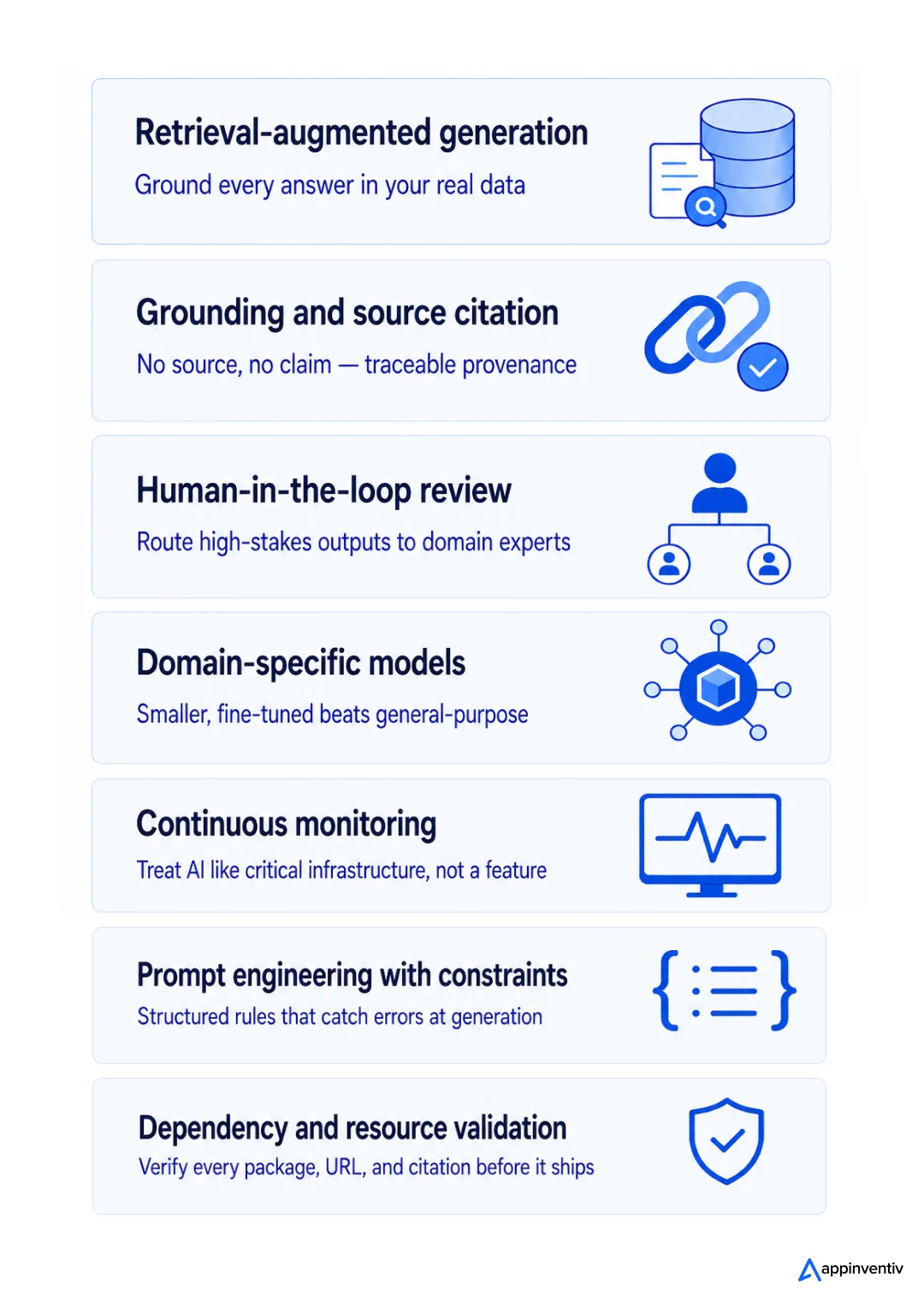
There is no silver bullet, but there is a stack. This layered approach matters even more in building AI browser agents and their reliability, where one hallucinated instruction can become a real browser action unless retrieval, verification, and human approval gates are built into the workflow.
Effective AI risk mitigation strategies for enterprises layer multiple defenses, because each catches a different class of error. Here is the architecture we deploy across regulated client engagements: annotated, where useful, with which incident above each layer would have caught.
Layer 1: Retrieval-augmented generation (RAG)
RAG is the standard of care for enterprise document Q&A and any application where the answer must come from your company’s data, not the model’s training prior. Instead of asking the model “what does our refund policy say?”, a RAG system retrieves the actual policy document at query time and instructs the model to answer only from that retrieved content.
What would have helped: Air Canada (live policy retrieval), Cursor (live policy retrieval), MyCity (anchored to current code/rules), Deloitte (grounded in real legal/academic databases).
Published industry benchmarks consistently show RAG cuts hallucinations by roughly 70% compared to vanilla LLM responses. RAG for reducing hallucinations is not a silver bullet.
The Stanford HAI work on legal AI tools showed RAG-powered systems still hallucinate in 17–34% of queries. RAG works best when paired with strong retrieval hygiene — clean source documents, good chunking, semantic embedding tuned to your domain, and citation enforcement. It is also why mature RAG development starts with a data audit, not a model selection.
Layer 2: Grounding and source citation
Force the model to cite. If it cannot show its source, it cannot make the claim. Every output should include traceable provenance — the exact document, the exact passage, the exact retrieval timestamp.
What would have helped: Deloitte (every fake citation would have failed validation against the source corpus), Mata v. Avianca (no real case-law record means no answer).
In high-stakes systems we build, we enforce a hard rule: no citation, no answer. This is implementable at the prompt layer, the orchestration layer, or with structured output schemas that fail the request if a source field is empty.
Layer 3: Human-in-the-loop for high-stakes decisions
Not every output needs human review. The trick is using confidence-based routing: high-confidence outputs flow automatically, low-confidence or high-impact outputs route to a domain expert.
What would have helped: Air Canada (refund queries to human review), MyCity (legal/labor queries to human review), Mata v. Avianca (mandatory verification of every cited authority).
Specifically, mandatory human review belongs on patient-facing clinical recommendations, final loan or claim decisions, customer-facing legal language, contract terms and pricing exceptions, and anything that becomes a permanent record (filings, disclosures).
Confidence-based routing is also the core idea behind a newer class of decision models. For teams asking “What is Jev?”, the short answer is a model that returns typed answers with a confidence score attached, which makes this split easier to automate once those scores are tested on your own data.
Layer 4: Domain-specific and smaller models
A general-purpose 70B-parameter model will often hallucinate more on a specialized task than a smaller model fine-tuned on your domain. Bloomberg’s BloombergGPT and similar vertical-specific models consistently outperform generic LLMs on their target domains.
What would have helped: MyCity (a NYC-law-trained model with refusal-on-out-of-scope), Mata v. Avianca (a real case-law-grounded research tool versus a general chatbot).
For most enterprise workloads, we now recommend a hybrid: a frontier model for general reasoning, a fine-tuned domain model for terminology accuracy, with the orchestration layer routing each query to the right model.
The same pattern holds whether the underlying build is AI agent development for an autonomous workflow or AI chatbot development for a customer-facing channel — the model is downstream of the routing decision.
Layer 5: Continuous monitoring and evaluation
Treat your AI like critical infrastructure, not a feature. That means automated regression testing on a labeled hallucination test set, real-time confidence scoring, anomaly detection on output distributions, a logged “golden set” of queries you re-run on every model or prompt change, and a formal incident response process for hallucination-driven errors.
This is where mature LLMOps for enterprise applications earn their keep: drift, retraining cadence, and inference observability are operational disciplines, not one-off project tasks.
What would have helped: Cursor (anomaly detection would have surfaced the spike in policy-related claims well before Reddit did), McDonald’s (drift in order accuracy was visible internally before the TikTok storm).
Layer 6: Prompt engineering with constraints
Structured prompt engineering with explicit constraints catches a meaningful share of hallucinations before they generate. Useful patterns:
- “If the answer is not in the provided context, respond with ‘INSUFFICIENT_CONTEXT’.”
- “Cite the exact source sentence after every claim.”
- “Do not generate any numerical value not present in the source.”
- Chain-of-Verification: ask the model to draft, then ask it to verify each claim independently.
Layer 7: Dependency and external-resource validation (for code-gen and agentic systems)
Anywhere an AI suggests an external resource, a package, a URL, an API endpoint, a vendor SKU, a regulatory citation, that resource needs verification before it enters a workflow.
What would have helped: Slopsquatting (package existence and reputation checks in CI), Deloitte (citation validation against academic and legal indexes).
For code-gen agents specifically: package allowlists, sandboxed install-and-test before merge, and SCA scanning on every dependency suggested by AI.
What Architecture Helps Reduce Hallucinations in LLM Applications?
The reference architecture we deploy for regulated clients combines 6 components:
- Source-of-truth data layer — vector database, knowledge graph, or both, with versioned ingestion from authoritative enterprise systems
- Retrieval orchestrator — handles hybrid search (semantic plus keyword), reranking, and access control per user and per document
- Grounded generation layer — LLM call with strict prompt scaffolding, citation enforcement, and structured output schema
- Verification layer — independent fact-checking pass (often a second model or rule engine) that compares output against retrieved sources
- Confidence-based router — high-confidence outputs flow directly to the user, low-confidence routes to a human-in-the-loop
- Observability and logging — every prompt, retrieval, output, and reviewer action logged for audit, drift detection, and EU AI Act readiness
This is the architecture behind systems we have built where hallucination rates dropped below 1% in production, not because the underlying LLM got better, but because the system around it refused to ship unverifiable output. The same pattern is a natural fit for settings involved in agentic RAG implementations in enterprise, where multiple agents reason over documents and need traceability at every step.
How do top enterprise AI platforms handle hallucinations today?
Cloud and platform vendors have converged on a similar pattern, though the implementation details vary:
| Provider approach | Mechanism | Best fit |
|---|---|---|
| Native RAG services | Managed vector stores plus grounded generation APIs | Teams without strong ML ops |
| Guardrails frameworks | Output filtering, PII redaction, topic constraints | Compliance-first deployments |
| Foundation model plus tooling | Customer brings a model, the platform provides observability | Enterprises with existing ML teams |
| Vertical AI products | Pre-tuned models for legal, medical, and financial domains | Fast time-to-value in regulated sectors |
| Hybrid orchestration | Multi-model routing with cost and accuracy weighting | High-volume, multi-use-case deployments |
What sets the best implementations apart is not which platform they chose. It is how rigorously they built the retrieval, verification, and monitoring layers on top of it. The platform is 30% of the answer.
Your engineering discipline is the other 70%. Note that Deloitte’s Azure OpenAI deployment, NYC’s Azure AI deployment, and Cursor’s frontier-model-based support agent all ran on best-in-class platforms — and all hallucinated their way into the news cycle.
What should be on your AI hallucination mitigation checklist?
A pragmatic checklist for your next AI deployment review:
- Data foundation. Is your AI grounded in authoritative, current, access-controlled enterprise data?
- Retrieval quality. Have you measured retrieval precision and recall on a labeled set, not just answer quality?
- Citation enforcement. Does every generated claim trace back to a specific source passage?
- Confidence scoring. Does the system know when it does not know — and route accordingly?
- Human-in-the-loop triggers. Are high-stakes outputs forced through domain expert review?
- Domain alignment. Are you using a general-purpose model where a specialized one would do better?
- Continuous evaluation. Do you re-test on a hallucination golden set every model or prompt update?
- Audit trail. Could you reconstruct exactly what the AI was told, retrieved, and produced for any given output 6 months from now?
- Incident response. Is there a formal process for hallucination-driven errors, including disclosure to affected users?
- External-resource validation. Are AI-suggested packages, URLs, citations, and identifiers verified before they enter a workflow?
- AI disclosure. When users interact with an AI agent, is it clearly labeled as one?
- Regulatory mapping. Have you mapped each AI system to applicable EU AI Act, HIPAA, FINRA, or sector-specific requirements?
If you cannot answer “yes” to at least 9 of these, your enterprise AI is carrying risk you have not priced. This is the gap AI governance consulting closes — surfacing exposure before a regulator or customer does.
$4.4 Million is the Average Hit. What Is Yours?
Most enterprises discover AI hallucination costs only after the damage compounds silently.
How can Appinventiv help you out?
Our Achievements & Case Studies

Vyrb

JobGet

Deloitte Tech Fast 50

Times Business Awards (Tech Company of the Year

Clutch Top 100 Powerhouse List

Gurushala


For more than 10 years, Appinventiv has operated as a full-service artificial intelligence development company building compliance-heavy software for healthcare networks, fintechs, large retailers, and global enterprises. And over the last 3 of those years, we have engineered hallucination resistance into AI systems where the cost of being wrong is measured in patient outcomes, regulatory fines, or 8-figure deal exposure.
Our approach is deliberately unflashy. We do not ship pilot demos that look impressive in a boardroom and break in production. We build systems where every layer — data ingestion, retrieval, generation, verification, monitoring — is designed to catch a specific class of failure that standalone LLMs cannot catch on their own.
Where our custom AI consulting services typically plug in:
- AI readiness audits. We assess your data maturity, governance, and architecture before you commit a development budget. Most hallucination problems are upstream of the model.
- RAG and agentic system development. We build multi-agent RAG architectures, including platforms like MyExec, where the system reviews business documents and surfaces traceable, sourced recommendations for SMB executives.
- Domain-specific model engineering. 50-plus bespoke LLMs fine-tuned for specific industries, including healthcare and financial services, where general models simply do not meet accuracy thresholds.
- AI governance and guardrails. Observability, drift detection, prompt-injection resistance, and compliance instrumentation for HIPAA, SOC 2, GDPR, and EU AI Act readiness.
- Production hardening of existing AI systems. We are often brought in after a pilot has shipped and started hallucinating. We have taken systems from double-digit hallucination rates to under 1% without changing the underlying model.
Our engineering bench includes 200-plus data scientists and AI engineers, 150-plus deployed custom AI models, and delivery experience across 35-plus industries. More importantly, we have built the guardrails the EU AI Act will demand of every high-risk system from August 2026 onward — before clients had a regulator forcing them to.
If you are scaling AI for enterprise workflows and the gap between your AI’s confidence and its accuracy is starting to create real exposure, talk to an engineering lead. The cheapest hallucination is the one you catch before it ships.
FAQs
Q. How do top enterprise AI platforms handle hallucinations in their applications?
A. Top platforms combine four mechanisms: retrieval-augmented generation, output guardrails, citation enforcement, and confidence-based routing. AWS Bedrock, Azure AI Foundry, Google Vertex AI, and OpenAI’s enterprise tier all offer managed grounding APIs to connect models to verified data. Platform features alone are insufficient; Deloitte, NYC MyCity, and Cursor all hallucinated on best-in-class platforms.
Q. What are AI hallucinations in business software?
A. AI hallucinations in business software are confidently stated outputs that are factually wrong, fabricated, or unsupported by source data. Examples include invented citations, fabricated customer records, false product specs, and made-up regulatory rules. They are dangerous because they look identical to correct outputs and propagate silently through downstream workflows.
Q. How do large language models hallucinate in professional tools?
A. LLMs hallucinate because they are statistical prediction engines, not knowledge bases. Asked about data they were not trained on or cannot access, they generate the most plausible answer rather than admit uncertainty. Common triggers: outdated training data, missing operational context, generic models on specialized tasks, and over-reasoning on grounded summarization.
Q. What are the best enterprise AI tools to reduce hallucinations in natural language processing?
A. The most effective stack combines RAG frameworks (LlamaIndex, LangChain), vector databases (Pinecone, Weaviate, Milvus), evaluation platforms (Vectara HHEM, Galileo, Arize AI), and verification APIs. No single tool solves hallucination — layered systems with custom orchestration tuned to your domain consistently outperform off-the-shelf solutions in regulated industries.
Q. Where can I find case studies on AI hallucination management in business software?
A. The most rigorous public sources are the AI Incident Database (incidentdatabase.ai) and the OECD AI Incidents Monitor — both maintain catalogued case files for Deloitte, Cursor, McDonald’s, IBM and other major incidents. Stanford HAI’s RegLab studies, the Vectara HHEM Leaderboard, and OpenAI’s HealthBench publish quantitative benchmarks. Forrester, Gartner, and EY publish enterprise cost analyses.
Q. How do major cloud providers address hallucinations in their AI services for businesses?
A. Major cloud providers offer managed grounding (Amazon Bedrock Knowledge Bases, Azure AI Search, Vertex AI Search), output guardrails, model evaluation suites, and observability tooling. Cloud-native tools alone are insufficient for high-stakes domains. Enterprises must layer custom verification, domain-specific fine-tuning, and human review on top.
Q. What is the real cost of AI hallucinations for businesses?
A. Global business losses from AI hallucinations reached an estimated $67.4 billion in 2024 (AllAboutAI 2026). EY’s 2025 survey of 975 C-suite leaders found 99% reported AI-related financial losses, 64% above $1 million, with an average of $4.4 million per affected company. Public examples: Deloitte’s AU$440K refund, Air Canada’s tribunal payment, Cursor’s subscription churn.
Q. How can enterprises prevent AI hallucinations?
A. Enterprises prevent AI hallucinations through layered defenses: RAG to ground models in real data, citation enforcement so claims trace to sources, human-in-the-loop on high-stakes outputs, domain-specific or fine-tuned models, structured prompt constraints, external-resource validation for code-gen, and continuous monitoring with hallucination test sets. No single technique is sufficient.
Q. Why are hallucinations more risky in enterprise AI systems?
A. Enterprise AI outputs feed automated workflows, regulated decisions, and customer-facing communications — so errors propagate silently and trigger compliance liability, financial loss, and reputational damage. Healthcare, legal, and finance face the steepest exposure under HIPAA, SEC, and the EU AI Act. The Air Canada ruling established that companies are legally liable for AI agent outputs.
Q. What architecture helps reduce hallucinations in AI systems?
A. A 6-layer architecture works best: (1) source-of-truth data layer with versioned ingestion, (2) retrieval orchestrator with hybrid search, (3) grounded generation with citation enforcement, (4) verification layer that fact-checks output against retrieved sources, (5) confidence-based router that escalates uncertain outputs, (6) observability for audit and drift detection. Applied rigorously, this takes most production AI below 1% hallucination rate.
VP - Technology, AI & ML Expert

Fix AI hallucinations before they cost
Captcha:
3 + 4 =

Fast 2-minute response, fully NDA-protected.
Read More Blogs

AI Data Integration: How to Connect, Clean and Prepare Data for AI
Key takeaways: AI initiatives fail when fragmented, poor-quality data reaches models without sufficient context, controls or ownership. AI-ready pipelines must connect, clean, enrich, govern and continuously monitor data across its lifecycle. Real-time processing matters when AI decisions depend on current transactions, events, inventory or operational conditions. Data architecture should follow the AI use case, balancing…
Chirag Bhardwaj
13 Oct 2026

AI-Native SDLC: Foundational 90-Day, 5R AI SDLC Adoption Playbook
Key takeaways: Why AI coding tools accelerate coding and software delivery How AI-native SDLC shifts engineering from code to intent, context, and outcomes The role of specifications, AI agents, and continuous verification in enterprise delivery How to redesign engineering teams for human–agent collaboration The platform, governance, and guardrails required to scale AI-native development A practical…
Chirag Bhardwaj
12 Oct 2026

AI Agent Governance: How to Govern Autonomous AI Across Business Systems
Key takeaways: AI agents require controls at the action, identity, data, tool, and workflow levels. Every enterprise agent should have a registered owner, an approved purpose, and a defined risk tier. Access must be based on the agent’s task rather than inherited from a human user or shared service account. High-impact actions need real-time policy…
Chirag Bhardwaj
12 Oct 2026














