




















How to Prevent Social Engineering Attacks in the Enterprise: Types, Examples, and Defense Strategies

 Share -



- 01Types of Social Engineering Attacks Targeting Enterprises
- 02Real-World Examples of Social Engineering Attacks
- 03The Rise of AI-Powered Social Engineering Attacks
- 04How to Prevent Social Engineering Attacks: Best Practices
- 05Why Enterprises Need a Structured, Expert-Led Defense Strategy
- 06How Appinventiv Helps Enterprises Prevent Social Engineering Attacks
- 07FAQs

Key takeaways:
- Social engineering attacks exploit human trust, making even well-secured enterprises vulnerable to a single convincing interaction.
- AI is making phishing, vishing, and impersonation attacks faster to launch, harder to detect, and easier to scale.
- Strong verification processes are essential, especially for credential resets, financial requests, and other high-risk actions.
- Phishing-resistant authentication, least-privilege access, and layered security controls can significantly limit attack impact.
- Realistic, role-specific training helps employees recognize modern threats, including AI-generated and deepfake scams.
- Effective defense requires people, processes, technology, and compliance to work together as one connected security strategy.
Security teams keep pouring budget into firewalls, endpoint tools, and network monitoring. Yet most breaches still trace back to something simpler: an employee who trusted the wrong email, call, or request.
That’s social engineering. No malware required, no exploit code. Just someone convincing enough to get a person to hand over access.
The tactics are also changing faster than most defenses can keep up. Mandiant’s M-Trends 2026 report, drawing on over 500,000 hours of incident response, found voice phishing has now overtaken email as attackers’ primary entry point. In cloud-related breaches specifically, voice phishing accounted for 23% of confirmed access methods. Attackers aren’t just sending emails anymore. They’re calling help desks and talking their way past verification checks in real time.
For enterprises, this isn’t just an IT problem anymore. A single successful attempt can trigger a data breach, a fraudulent wire transfer, or a ransomware infection, and the fallout often outlasts the incident itself.
AI is making things worse. AI social engineering attacks read more naturally now. Voices can be cloned convincingly enough to fool employees on a live call. And attackers can research and target individuals at a scale that simply wasn’t possible a few years ago.
So what actually works? This guide covers what social engineering looks like today, the tactics behind most attacks, real incidents worth learning from, and how to prevent social engineering attacks with defenses that actually hold up.
IBM’s 2026 report found AI-enabled breaches cost companies $6 million on average, about $1 million more than the global norm. Prevention costs a fraction of that.

Types of Social Engineering Attacks Targeting Enterprises
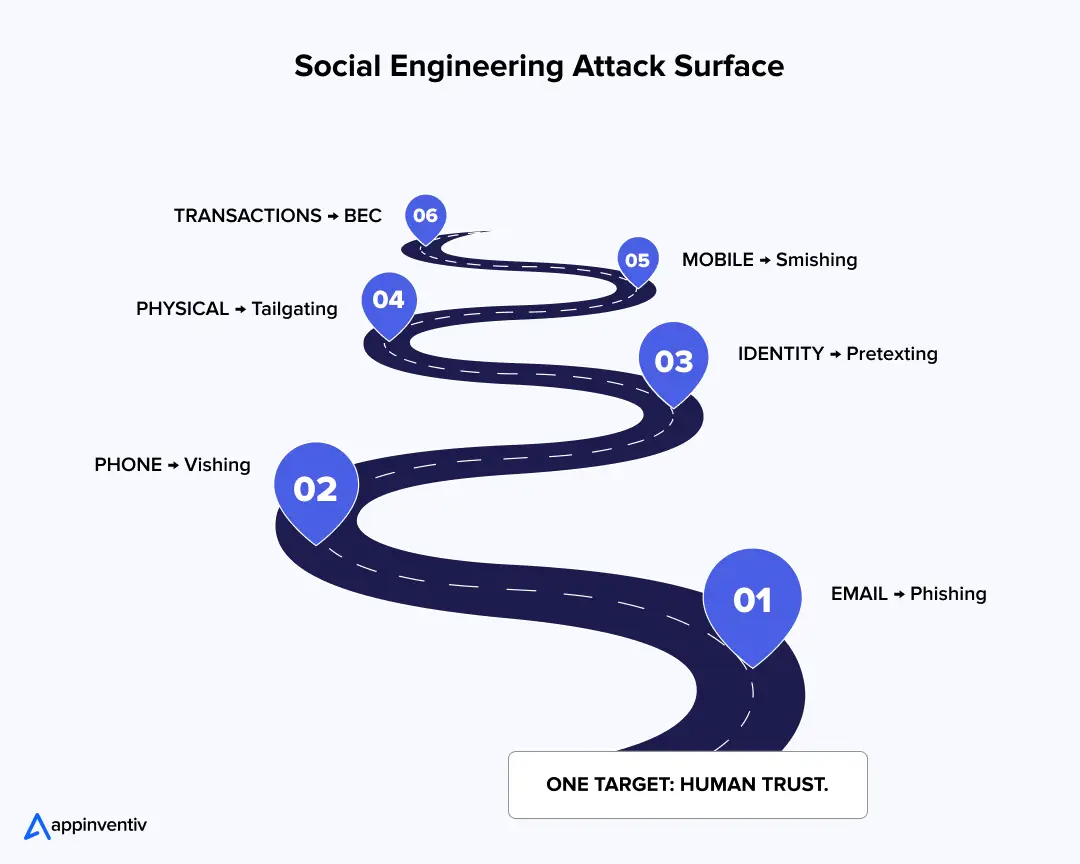
Most attackers stick to a handful of tried-and-tested tricks, and they’ll often stack two or three together in the same campaign. Below is a breakdown of the ones enterprise teams run into most, and where AI is changing the game.
Phishing: Mass and Spear-Phishing Email Attacks
Phishing is still the biggest volume driver for initial access, but it’s come a long way from the obvious scam emails of ten years ago.
- Sender domains get spoofed using lookalike characters, or attackers exploit gaps in SPF, DKIM, or DMARC setup
- A domain registered one letter off from a real brand is often all it takes
- Spear-phishing goes further, pulling details from LinkedIn, org charts, or leaked data to make the message personal
- LLMs now handle most of this legwork. A model can scrape someone’s public footprint and write a clean, well-worded email in seconds, no more broken English giving it away
How to spot it: Hover over links before clicking, check the actual sender address rather than the display name, and be wary of urgency (“act now,” “verify immediately”). When in doubt, contact the sender through a separate, known channel.
Vishing: Voice Phishing and AI Voice Cloning
Vishing usually means spoofed caller ID, someone posing as IT, a bank, or an internal extension. The bigger shift lately is voice cloning.
- A handful of seconds of audio, pulled off a YouTube video or an earnings call, is enough to build a synthetic voice
- Good enough to fool an employee on the phone, and in some cases, good enough to slip past voice-based password reset checks
- A few 2026 breach reports now put vishing ahead of email as attackers’ preferred way in
How to spot it: Never authorize transfers or share credentials based on a call alone. Use callback verification, hang up and dial the number on file, not one the caller provides. As voice-based systems get more common in enterprise workflows, voice agent security has become just as critical as email filtering
Pretexting: Fabricated Scenarios for Access
This one’s about the story. An attacker poses as an auditor, a new hire, someone from a vendor, and backs it up with fake paperwork or credentials that hold up under a quick glance.
- The better campaigns pull real names and reporting lines from breached HR records or a scraped company directory
- The more internal detail baked into the story, the less likely someone stops to question it
How to spot it: Verify identity and authorization independently, through a manager or a known internal directory, before granting access or sharing information, no matter how convincing the story sounds.
Baiting: Malware-Laced Lures
Baiting works by offering something the target wants, and the payload rides along with it.
- A free download, a USB stick labeled “Payroll 2026,” a fake software update
- Dropped USB drives still work surprisingly often, since autorun or driver exploits can fire the moment the drive goes in, even on endpoints that are supposedly locked down
How to spot it: Never plug in unknown USB devices or download software from outside approved sources. Route anything found or unsolicited through IT for inspection first.
Business Email Compromise (BEC): Executive Impersonation Fraud
Of everything on this list, BEC tends to cost the most. An attacker gets into or spoofs an executive’s inbox, usually after an earlier phishing attempt, then asks for a wire transfer or a change to payroll banking details.
- Deepfake video is starting to show up here too
- There have already been cases of attackers joining a live video call using a synthetic CFO or CEO to push through a fraudulent transfer on the spot
Some enterprises are countering this with facial recognition software development benefits built into identity checks for high-value approvals.
How to spot it: Treat any request for a wire transfer or banking change as high-risk by default. Require dual approval and a verbal confirmation through a separate, pre-established channel, regardless of how urgent the request seems.
Tailgating and Piggybacking: Physical Access Exploits
Not everything happens on a screen. Some of the simplest breaches start with someone just walking through a door they shouldn’t have access to, no phishing email or spoofed number involved at all.
- Tailgating is just following an employee through a badge-locked door, often while carrying something bulky so holding it open feels natural
- Piggybacking is close to the same thing, except the employee knows and lets it happen anyway
- Neither one touches the badge system at all, since no credential ever gets stolen
How to spot it: Don’t hold secure doors open for anyone without a visible badge, even if it feels awkward. Flag unfamiliar faces in restricted areas rather than assuming someone else already checked.
Quid Pro Quo: Fake Support Exploits
Here the attacker offers help, usually posing as IT, in exchange for a login or remote access. It works because most employees are conditioned to cooperate with anyone who sounds like they’re there to fix a problem.
- Help desk impersonation falls under this too, and it’s becoming more common
- A caller pretends to be locked out, and if the process isn’t tight, that alone can trigger a password reset without MFA ever coming into play
Enterprises that want to prevent app incidents like this usually start by tightening exactly this kind of verification gap.
How to spot it: IT should never ask for a password outright. Confirm any unsolicited “support” contact through the official help desk line before acting on it.
Smishing: SMS and Mobile-Based Phishing
Same idea as phishing, just over text or messaging apps, dressed up as a delivery update, an MFA prompt, or an IT notice. It tends to work better than email precisely because people treat their phones as more personal and trustworthy.
- Phones show less of the actual URL than a desktop browser does, so a spoofed link is harder to catch
- AI-built smishing kits mean an attacker can run these campaigns at scale without doing much manual work at all
How to spot it: Avoid tapping links in unexpected texts, even ones that look like MFA prompts. Open the app or site directly instead of following the link.
What ties all of these types of social engineering attacks together isn’t a technical flaw. It’s trust, and the gaps in how that trust gets verified. AI hasn’t really created new attack types here, it’s just made the old ones cheaper to run and harder to spot.
Real-World Examples of Social Engineering Attacks
The tactics from the last section aren’t hypothetical. They show up in breach reports every quarter, and the losses are getting harder to ignore.
The CarGurus Vishing Breach (2026)
A single phone call was enough to compromise 12.4 million customer records at CarGurus. The breach traced back to one vishing call, no malware, no exploited vulnerability, just a phone conversation that got an attacker past verification.
- Illustrates how a single successful call can expose data at a scale that would normally take weeks of technical exploitation
- A strong reminder that call-based verification processes are often the weakest link in an otherwise well-defended stack
The Mandiant-Tracked SaaS Vishing Campaign (2025)
This one is worth studying in detail because of how little “hacking” was actually involved. Throughout 2025, a threat cluster tracked by Mandiant used voice phishing to compromise credentials at third-party SaaS vendors, then harvested OAuth tokens, session cookies, and hard-coded access keys once inside. Those stolen secrets were then used to pivot into the environments of major downstream enterprise customers, with victims later receiving extortion notes branded under the ShinyHunters name.
- No malware deployed and no software vulnerability exploited at any stage
- The entire attack chain ran on phone calls and the persistent access that SaaS tokens quietly provide
- Shows why third-party and vendor risk assessments need to account for social engineering, not just technical audits
The HK$18.5M AI Voice Cloning Scam (2025)
Voice cloning moved from theoretical to costly fast. In Hong Kong, fraudsters used AI-generated voice cloning to impersonate a company’s finance manager, convincing staff to authorize a transfer worth HK$18.5 million.
- A small sample of real audio, often pulled from an earnings call or a public interview, was enough to build a convincing clone
- Cases like this are part of why several banks have had to rethink voice-based authentication for high-value transactions
Scattered Spider’s Retail Attack Wave
Not every incident needs deepfakes to succeed. Scattered Spider’s social engineering campaigns against retailers led to an estimated $300 million in losses, largely through help desk impersonation and convincing a support agent to reset credentials for an account they didn’t own.
- No AI involved at all, just a well-rehearsed phone script and a support process that trusted the caller too easily
- A useful counterpoint to the AI hype: plenty of damage still comes from old-fashioned pretexting
It’s a clear case for why basic cybersecurity measures for businesses still matter more than flashy AI defenses.
What these examples of social engineering attacks have in common isn’t sophistication. It’s that verification failed somewhere simple, a phone call, a help desk reset, a voice that sounded right. That pattern is exactly what the prevention strategies later in this guide are built to close.
The Rise of AI-Powered Social Engineering Attacks
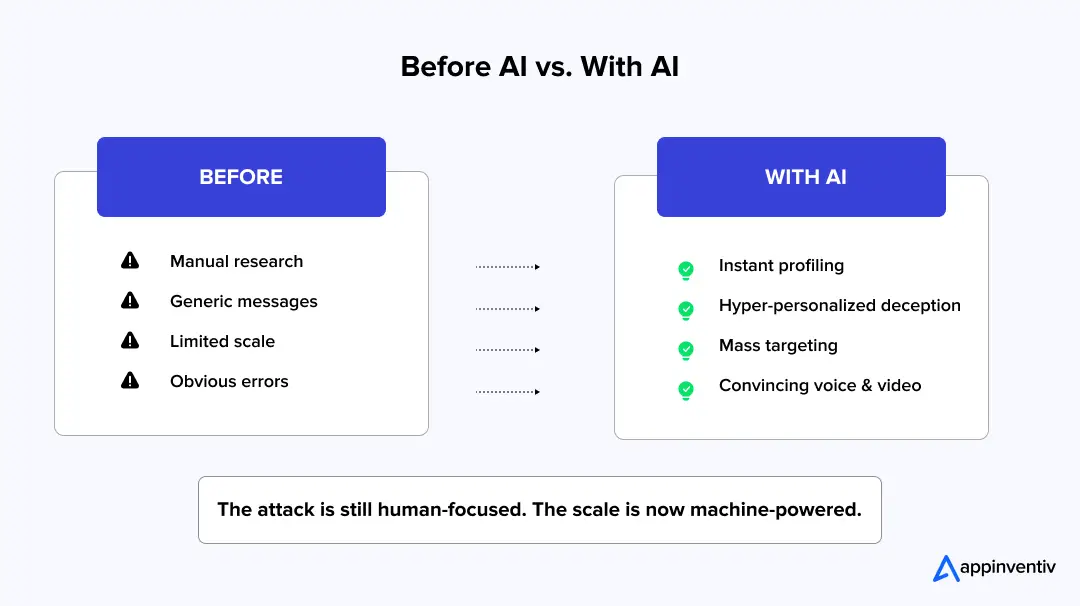
AI hasn’t replaced any of the tactics covered earlier. It’s made them faster, cheaper, and harder to catch. What used to take a skilled attacker hours of research and writing now takes minutes, and the output is often good enough to fool trained employees. That shift is what’s driving the rise of AI social engineering attacks across every channel covered above.
The Economics Have Shifted
A spear-phishing email that once took close to an hour to research and write can now be produced by an AI-assisted attacker in under five minutes. Voice cloning has seen a similar drop, with tools that once required a specialized production studio now costing a small amount in cloud compute and needing just a few seconds of sample audio.
Grammar and tone errors, once a reliable red flag in phishing emails, are largely gone too. The output reads clean enough that the usual awareness training cues no longer catch it.
Attack Tooling Has Turned Into a Commercial Product
Phishing-as-a-service kits handle almost the entire campaign now, site creation, messaging, even the templates, all generated by AI. Running a convincing operation barely takes any skill anymore.
Deepfake voice and video features are showing up in these kits as standard, not as some add-on extra. Attackers can churn out hundreds of personalized messages in the time it used to take to write a handful by hand.
Deepfakes Have Moved From Novelty to Routine
Live deepfake video is now being used inside video calls to impersonate executives in real time, not just in pre-recorded clips. A majority of organizations have already dealt with at least one deepfake-related social engineering incident in the past year, and the trend is climbing, not leveling off.
These attacks succeed on belief rather than malware. When employees see and hear someone they trust, scrutiny drops fast, which is exactly what makes this category so hard to defend against with technical controls alone.
AI Has Raised the Ceiling, Not Changed the Floor
It’s worth being precise about what AI has actually changed, since the hype tends to run ahead of reality. Recent frontline breach analysis shows AI is not yet the root cause of most incidents, most successful intrusions still trace back to basic process failures like weak identity verification, excessive permissions, and poor logging.
That’s useful news for defenders. The fixes that worked before AI still work now, they just need to be applied more consistently, with verification processes that hold up even when the voice, face, or writing on the other end looks completely legitimate.
This is also where AI agents for cybersecurity are starting to help, automating the consistency that manual processes struggle to maintain.
AI has made attacks faster and cheaper to launch. Your defenses need to move just as fast.

How to Prevent Social Engineering Attacks: Best Practices
Awareness training alone isn’t enough for real social engineering protection anymore, not with attacks moving this fast. Enterprises that actually reduce their exposure tend to combine layered technical controls with process discipline, and they apply both consistently rather than treating them as a one-time rollout.
Here’s what an effective approach to how to prevent social engineering attacks actually looks like at enterprise scale.
Build Verification Into Every High-Risk Process
Most social engineering attacks succeed because a request, a transfer, a credential reset, a data share, gets approved without real verification.
- Require callback verification for any financial request, using a number on file, not one provided by the caller
- Mandate dual approval for wire transfers and payroll changes above a set threshold
- Set up a known-channel rule: if a request feels urgent or unusual, confirm it through a separate, pre-established communication method
Deploy Phishing-Resistant Authentication
Passwords and even standard MFA are increasingly bypassed through prompt-bombing and help desk impersonation. Enterprises need something stronger sitting underneath identity and access management, not just a password and a one-time code.
- Move toward FIDO2 or passkey-based authentication wherever possible, since it can’t be phished the way a one-time code can
- Tighten help desk reset procedures so a phone call alone is never enough to trigger a credential reset
- Monitor for MFA fatigue attacks, repeated push notifications sent to wear an employee down into approving one
Run Realistic, Frequent Security Awareness Training
Generic annual training doesn’t hold up against attacks this convincing. Employees need to see what current tactics actually look like, not a slideshow from three years ago.
- Simulate phishing, vishing, and even deepfake scenarios regularly, not just once a year
- Train specific high-risk teams, finance, IT help desk, and executive assistants, on the exact tactics most likely to target their role
- Make reporting suspicious activity fast and blame-free, since employees who fear punishment tend to stay quiet instead of flagging something
Tighten Identity and Access Management
A lot of social engineering damage comes from over-permissioned accounts. Even a successful attack does far less harm if the compromised account can’t reach much.
- Apply least-privilege access so employees only have access to what their role actually requires
- Rotate credentials and audit permissions regularly, especially for accounts with financial or administrative access
- Segment networks so a single compromised account can’t move laterally into sensitive systems
- Run regular vulnerability assessment and penetration testing to catch over-permissioned accounts before an attacker finds them
Monitor for AI-Generated and Deepfake Threats
Traditional email filters weren’t built to catch AI social engineering attacks or synthetic voice and video. That gap needs a dedicated layer of defense. This is where AI in cybersecurity earns its keep, flagging patterns no manual review could catch at enterprise scale.
- Deploy AI-based detection tools that flag anomalies in writing style, sender behavior, or communication patterns
- Watch for deepfake indicators on video calls, unnatural blinking, lighting inconsistencies, or audio that doesn’t quite sync
- Keep logging and monitoring tight enough to catch post-compromise activity, since AI-assisted attacks increasingly leave no obvious initial trace
Secure Physical Access, Not Just Digital
It’s easy to focus entirely on email and phone-based attacks and forget that tailgating and piggybacking still work.
- Enforce a strict no-tailgating policy, even when it feels awkward to challenge someone
- Use visitor badges that are visually distinct and require escort for anyone without full access credentials
- Train front-desk and security staff to verify identity for anyone claiming vendor or contractor access
- Consider biometric software development for high-security zones where badge-only access isn’t enough
None of these controls work in isolation. A strong verification process doesn’t help much if help desk staff can still be talked into a reset over the phone, and phishing-resistant MFA doesn’t stop a fraudulent wire transfer approved without a callback. The strongest defenses come from layering all of this together, and building it as a program rather than a checklist.
Why Enterprises Need a Structured, Expert-Led Defense Strategy
Everything above, verification protocols, phishing-resistant MFA, deepfake monitoring, tighter access controls, reads fine on a slide. Actually building real social engineering protection across every business unit and every vendor relationship is a different job altogether.
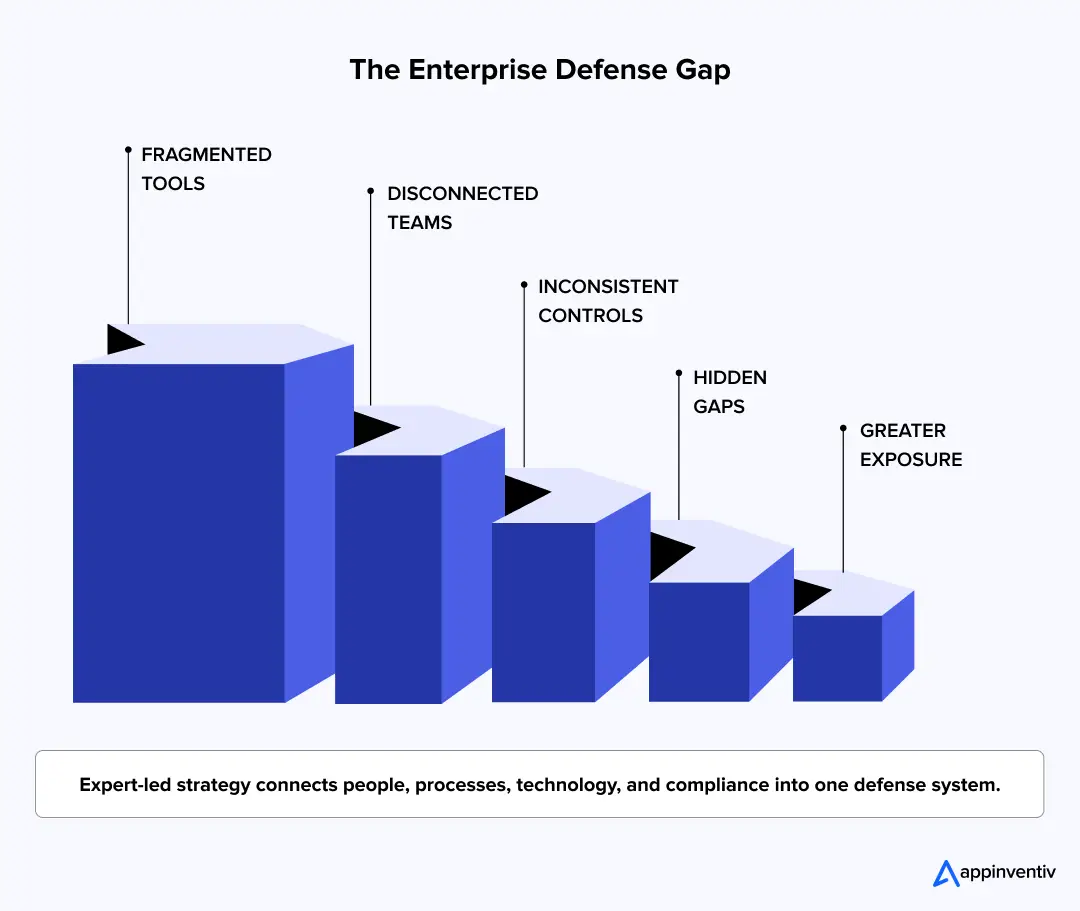
In-House Awareness Training Has a Ceiling
Most security teams already run some version of phishing simulations and yearly training. Effort isn’t the problem. Depth and scale are.
Keeping pace with AI-generated attacks means rewriting simulation content against whatever LLM-written phishing looks like this quarter, testing vishing scripts and synthetic voice scenarios, and tracking click-through and reporting rates across thousands of employees split by role and risk exposure. Most internal teams are already stretched thin running SIEM monitoring and patch cycles. Adding this on top, and keeping it current, is a lot to ask of a team that’s also fighting daily fires.
Technical Controls Need to Work Together, Not Just Exist
Rolling out phishing-resistant MFA, identity monitoring, and AI anomaly detection as separate point tools rarely adds up to the layered defense enterprises think they’re buying.
A FIDO2 rollout doesn’t do much if it isn’t wired into the identity provider’s conditional access policies. An anomaly detection tool flagging odd login behavior needs to cross-reference SSO logs, endpoint telemetry, and email gateway data, not sit off to the side generating alerts nobody has time to read.
Getting these tools to actually share signal, through a proper SIEM or SOAR integration, and trigger automated response instead of manual triage every time, takes architecture work most internal IT teams simply aren’t staffed for.
This is fundamentally an enterprise application security problem, not a shopping list of individual tools.
Compliance Adds Another Layer of Technical Complexity
Enterprises working across regions, especially in fintech and healthcare, run into compliance frameworks that overlap directly with social engineering defense. PCI DSS, HIPAA, GDPR, and SOC 2 and IT compliance regulations for industries in the US vary further by sector, adding another layer enterprises have to map correctly. Each spell out their own identity verification, access logging, and breach notification requirements, and the technical controls that satisfy one don’t automatically satisfy another.
A callback verification process good enough for one regulator’s identity assurance level might fall short of another’s audit trail requirements. Miss this and it’s not just a breach risk anymore, it’s a compliance failure sitting on top of one. A defense strategy that treats compliance as an afterthought instead of building it into the architecture tends to reveal its gaps during an audit, or worse, after an incident, when there’s no quiet way to fix it.
The Real Cost of Getting This Wrong
One successful attack, a wire transfer approved off a fake voice call, a help desk reset triggered by a convincing pretext, usually costs more than what it would’ve taken to prevent it in the first place. Beyond the direct loss, there’s regulatory penalties, forensic investigation, damaged customer trust, and the grind of rotating credentials and rebuilding systems across every environment the compromised account touched.
That’s the real reason more enterprises are stepping away from piecemeal, in-house-only social engineering attack prevention, folding it instead into a broader cybersecurity risk management strategy. They need a partner who can handle the technical architecture, map the compliance requirements, and run the training, as one connected program built around how the organization actually operates, not three separate initiatives that happen to share a budget line.
Piecemeal fixes won’t hold up against attacks like these. Let’s build a structured defense program around how your enterprise actually operates.

How Appinventiv Helps Enterprises Prevent Social Engineering Attacks
We start with an assessment, mapping where verification gaps actually exist across email, voice, physical access, and third-party vendor touchpoints, before recommending a single tool.
From there, we build phishing-resistant MFA and identity verification workflows directly into existing systems, rather than layering on point solutions that don’t talk to each other. Deepfake and anomaly detection get wired into this same architecture, so flags from one system trigger action across the rest, not a separate dashboard nobody checks.
For enterprises handling regulated data, our cybersecurity compliance consulting services map identity verification, access logging, and breach notification requirements against frameworks like PCI DSS, HIPAA, GDPR, and SOC 2, built into the architecture from day one, not retrofitted after an audit flags a gap.
We also run the training piece: realistic phishing, vishing, and deepfake simulations for high-risk teams, with reporting loops that feed back into the technical controls instead of sitting in a separate compliance folder.
As one of the cyber security solution providers that’s delivered 1000+ enterprise-grade solutions across fintech and healthcare, this is the same integrated approach we bring to every engagement, architecture, compliance, and training working as one system instead of three disconnected initiatives.
Not sure where your current defenses have gaps? Talk to our security team about what a structured social engineering defense strategy could look like for your organization.
FAQs
Q. What is social engineering in cybersecurity?
A. Social engineering in cybersecurity is the practice of manipulating people, rather than exploiting software or systems, to gain unauthorized access to information, accounts, or physical locations. It relies on psychological tactics like urgency, authority, and trust instead of technical exploits, which is why it bypasses even well-secured infrastructure. Common forms include phishing, vishing, pretexting, and baiting.
Q. Why do cyber attackers commonly use social engineering attacks?
A. Attackers favor social engineering because it’s often faster and cheaper than breaking through technical defenses. Firewalls and endpoint protection can take significant effort to bypass, but a convincing email or phone call can get an employee to hand over access voluntarily. AI has lowered the cost further, letting attackers generate convincing phishing emails and voice clones in minutes instead of hours.
Q. How to prevent social engineering attacks?
A. Preventing social engineering attacks takes a layered approach: callback verification for financial requests, phishing-resistant MFA like FIDO2 or passkeys, frequent and realistic awareness training, least-privilege access controls, and monitoring for deepfake or AI-generated threats. No single control is enough on its own. Enterprises that reduce their exposure combine technical safeguards with strict verification processes and apply both consistently.
Q. Which best practices can help defend against social engineering attacks?
A. The strongest defenses combine verified request protocols (dual approval, callback confirmation), phishing-resistant authentication, regular simulation-based training for high-risk teams like finance and IT help desks, tight identity and access management, and dedicated monitoring for AI-generated and deepfake threats. Physical access controls, like enforcing no-tailgating policies, matter just as much as digital ones.
Q. Why is it important to detect and prevent social engineering attacks?
A. Social engineering is now the leading cause of successful breaches for many enterprises, ahead of malware and unpatched vulnerabilities. A single successful attempt can lead to data breaches, fraudulent wire transfers, ransomware deployment, or regulatory penalties, and the costs of recovery often far exceed the investment needed to prevent it in the first place. Early detection also limits how far an attacker can move once inside, reducing the scale of the damage.


Fast 2-minute response, fully NDA-protected.
Ecommerce Security: A Guide to Protecting Your Commerce Stack From Modern Cyber Threats
Key takeaways: Modern commerce stacks expand attack surfaces across APIs, cloud systems, third parties, payments, and customer identities. PCI DSS 4.0.1 compliance mandates strict client-side monitoring to prevent modern web-skimming and Magecart attacks. Strong ecommerce cyber security requires layered controls across architecture, identity, data, transactions, infrastructure, and integrations. Continuous testing, threat monitoring, AI-aware controls, and…
How to Hire the Right Cybersecurity Expert for Your Business
Key Takeaways Define the business risk before choosing a security title or engagement model. Match the role to the environment, whether the priority is cloud, application, compliance, incident response, or network defense. Evaluate cybersecurity professionals through relevant scenarios, practical tasks, evidence, and references. Compare permanent, consulting, managed, and hybrid models against the coverage the business…
Cybersecurity Compliance Requirements Every Enterprise Needs in 2026
Key takeaways: Compliance is now a core business priority, influencing revenue, market access, and customer trust. Enterprises must navigate multiple overlapping regulations across industries and regions. Unified compliance controls help reduce duplicated work, complexity, and overall costs. Continuous monitoring and risk assessments help identify compliance gaps before they become costly issues. Automation streamlines evidence collection,…