




















AI Coding Agent Development Cost: Enterprise Pricing, Architecture & ROI Guide (2026)

 Share -


- 01How Can Enterprises Accurately Estimate AI Coding Agent Development Costs?
- 02AI Coding Agent Development Cost Breakdown by Project Scope
- 03The Anatomy of an Enterprise AI Coding Agent
- 04AI Coding Agent Development Cost Across Every Development Phase
- 05Common AI Coding Agent Development Challenges and How to Solve Them
- 06The Hidden Costs of Building and Operating an AI Coding Agent
- 07How Enterprise AI Coding Agent Architecture Impacts Development Cost
- 08Build vs Buy: Which AI Coding Agent Approach Delivers Better ROI?
- 09Strategies to Reduce AI Coding Agent Development Cost Without Sacrificing Performance
- 10How Does Development Time Affect AI Coding Agent Cost?
- 11How to Choose the Right AI Coding Agent Development Partner for Enterprise Success
- 12How Can Appinventiv Help You Build a Secure, Enterprise-Ready AI Coding Agent?
- 13Frequently Asked Questions

Key takeaways:
- Custom AI coding tools cost between $50K and $500K. Internal system design and software links drive the total price.
- Future running fees stem from token bills, server hardware, company rules, and tool tracking, not just initial construction.
- Multiple coordinated agents, data-search tools, and operational links deliver superior financial returns. These advanced features require higher initial engineering funds from your firm.
- Corporate choices must focus on data safety, code ownership, legal compliance, and three-year totals rather than monthly seat fees
- A stepped launch plan drops technical risks and boosts worker tool use. The method proves clear financial returns prior to firm-wide deployment.
Software teams now use artificial intelligence for more than simple code autocomplete. Large companies invest in autonomous coding agents, driving up the AI coding agent development cost, to handle complex engineering tasks.
These tools read entire code repositories, plan development steps, and write production code. They review pull requests, run tests, and interact directly with deployment pipelines.
Engineering leaders drive this change for specific reasons. They want faster shipping schedules, higher developer output, and lower maintenance costs.
Building an enterprise agent requires substantial custom engineering. The system combines language models, vector databases, and new data retrieval protocols. It integrates secure code environments, delivery pipelines, and company guardrails into a single platform.
Every technical choice changes your infrastructure bills, token usage, and long-term labor expenses. Gartner predicts AI coding costs will exceed developer salaries by 2028.
This guide analyzes the real cost to build an AI coding agent platform from a corporate standpoint. We examine primary spending drivers and highlight unexpected fees. We show how your deployment plans and feature choices shape the total cost of ownership.
This information helps technology leaders plan accurate budgets. You can build an agent that brings clear financial returns to the enterprise.
Deploy custom AI coding agents that automate software engineering workflows while maintaining enterprise security and governance.
How Can Enterprises Accurately Estimate AI Coding Agent Development Costs?
Your total cost changes based on what the software does. The AI model is only one part of the price. Engineering hours, server needs, and maintenance costs shift with every feature. Connecting the tool to your internal systems also changes the budget.
Use this formula to plan your budget:
| AI Coding Agent Development Cost | Core Features + Architecture+Enterprise Integrations+Infrastructure+Security & Compliance+ Deployment Scale + Ongoing Operations |
|---|
Calculate these numbers first. The details below show how costs change for small, medium, and large projects. The following breakdown shows how these factors influence pricing across different project sizes.
Also Read: How Much Does It Cost to Build an AI Agent?
AI Coding Agent Development Cost Breakdown by Project Scope
Tool-building costs rise with additional independent features, additional software connections, and stricter safety rules. Small test projects simply confirm that your core features work well enough.
Full corporate platforms support large engineering groups, integrate with your current developer tools, and comply with strict company security rules.
The table below lists standard corporate spending figures by size.
| Project Size | Estimated Build Price | Typical Timeline | Best For | Main Features |
|---|---|---|---|---|
| Small Test Project | $50,000 – $100,000 | 6-8 weeks | Testing basic ideas | Simple code writing, prompt setups, small code access and model links |
| First Working Tool | $100,000 – $180,000 | 2-4 months | Limited pilot tests | Codebase-reading skills, data search, editor links, automated tasks and engineer logins |
| Single-Department Tool | $180,000 – $275,000 | 4-6 months | Single software teams | Git platform connections, delivery pipeline links, automated code reviews, data memory, performance tracking |
| Company Production System | $275,000 – $400,000 | 6-9 months | Corporate-wide rollouts | Many-codebase support, company safety, roles, oversight, monitoring, growth setups |
| Advanced-Agent Corporate Software Development Setup | $400,000 – $500,000+ | 9-12+ months | Huge worldwide corporations | Multiple-agent coordination, independent task performance, protocol links, deep logic, local hosting, corporate data connections |
Note: These prices reflect custom AI coding agent development solutions built for corporate setups. Final spending changes based on factors like feature choices, hosting options, connectivity issues, legal requirements, and the level of independence you want from the software, similar to general AI development cost estimates.
The Anatomy of an Enterprise AI Coding Agent
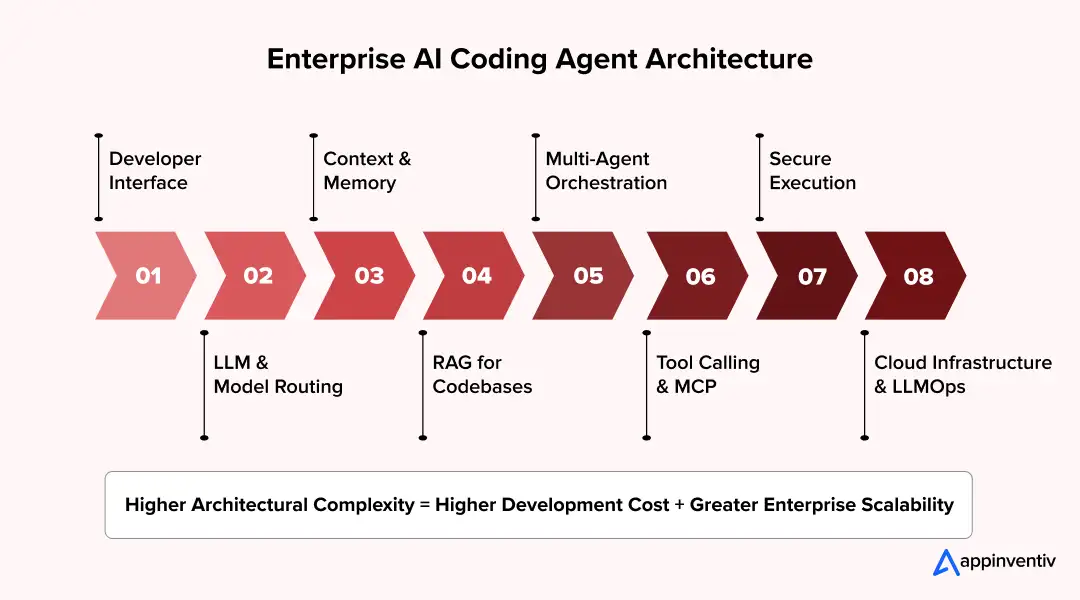
Enterprise AI coding agents are built as interconnected systems rather than standalone language models. Each architectural layer supports a specific part of the development lifecycle, from planning and reasoning to context retrieval, tool execution, governance, and infrastructure.
Together, these components determine how accurately the agent performs engineering tasks and how much the platform costs to build, deploy, and maintain.
| System Part | What It Does | Common Technologies |
|---|---|---|
| Developer Interface | Lets engineers interact through IDEs, web apps, or chat. | VS Code, JetBrains, React |
| Agent Runtime & Orchestration | Handles planning, reasoning, task execution, multi-agent workflows, and state management. | LangGraph, CrewAI, AutoGen, Semantic Kernel |
| LLM & Reasoning Layer | Processes engineering requests, generates code, and applies coding rules and policies. | GPT-4.1, Claude 4, Gemini 2.5, Llama 4 |
| Context & Memory Layer | Retrieves relevant code, documentation, APIs, and project history. | LangChain, LlamaIndex, Pinecone, Weaviate, pgvector |
| Tools & Integration Layer | Connects the agent with Git, CI/CD, IDEs, issue trackers, and enterprise APIs. | MCP, GitHub API, GitLab API, Jira, Jenkins |
| Secure Execution Layer | Runs AI-generated code in isolated environments for testing and validation. | Docker, Kubernetes, Sandboxes |
| Monitoring, Governance & Infrastructure | Tracks usage, model performance, security, compliance, and cloud resources. | Langfuse, OpenTelemetry, Grafana, AWS, Azure, GCP |
These architectural components work together during every engineering task. The agent interprets the request, retrieves repository context, plans the required actions, interacts with enterprise tools, validates the generated output, and submits it for review or deployment.
Every additional layer improves reliability, governance, and automation, but also increases engineering effort, infrastructure requirements, and the overall cost of building an enterprise AI coding agent.
Also Read: AI Video Agent Development: Architecture, Features, Use Cases, Tools & Cost Breakdown
AI Coding Agent Development Cost Across Every Development Phase
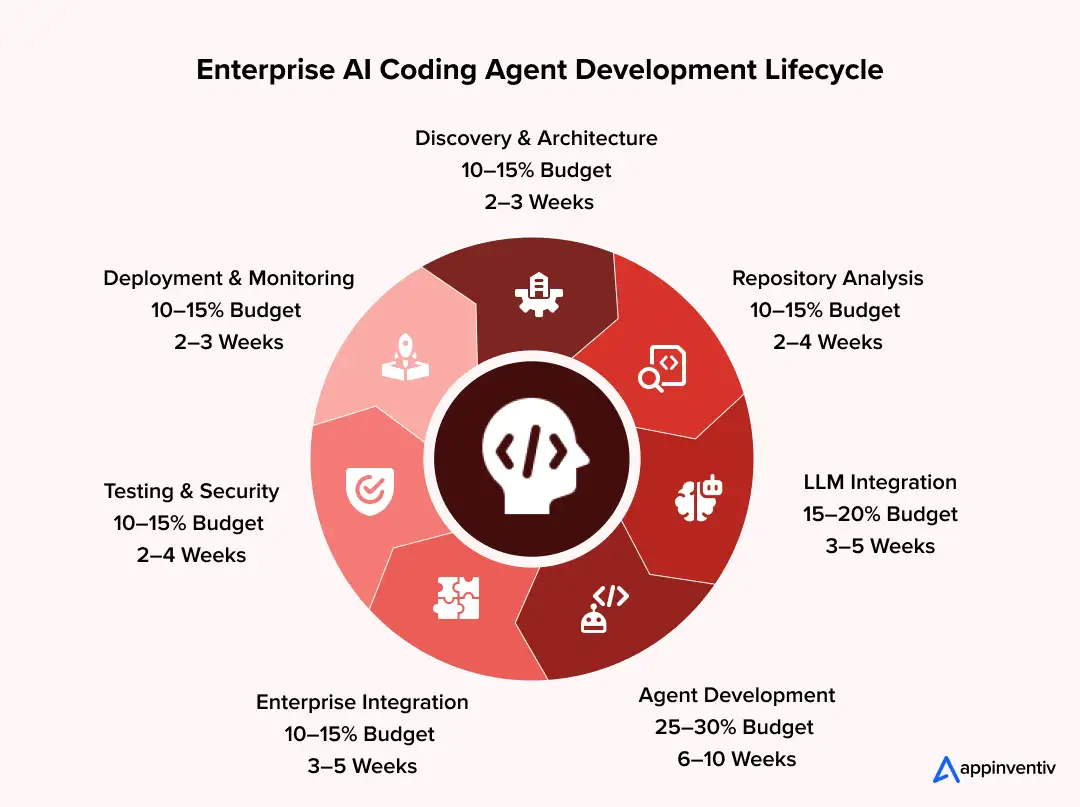
The AI coding agent development process is staged for corporate teams. Each step requires a different part of the budget. Initial stages focus on planning and design. Later steps cover code writing, system integration, testing, and launch setup. Tracking these steps helps your business predict costs and set clear timelines.
Discovery and System Design
Typical Cost: 10-15% | Estimated Timeline: 2-3 weeks
This step outlines your business goals, technical layout, and project path. Early choices guide the entire project and prevent expensive mistakes later.
Main Outputs
- Analysis of business and technical needs
- Clear descriptions of tool tasks
- High-level system design diagram
- Software and tool selection
- AI coding agent development roadmap and delivery timeline
Codebase Analysis and Data Setup
Typical Cost: 10-15% | Estimated Timeline: 2-4 weeks
Corporate codebases hold millions of lines of code across separate services. This step organizes source code, user guides, and technical files. The setup lets the agent locate files quickly and accurately.
Main Outputs
- Codebase reviews and platform analysis
- File sorting and code division plans
- Vector database installation
- Guidebooks and API data ingestion
- Data search pipeline construction
Model Selection and Connection
Typical Cost: 15-20% | Estimated Timeline: 3-5 weeks
Engineers pick the language models that fit your speed, security, and financial targets. Teams can now set up model choice rules, prompt styles, and data limits.
Main Outputs
- Language model testing and final choices
- Prompt creation and engineering
- Model connection code
- Data limit management plans
- AI speed benchmarking tests
Agent Building and Step Management
Typical Cost: 25-30% | Estimated Timeline: 6-10 weeks
This step takes the most time and effort. Engineers build the reasoning logic, company operations, and links. These parts enable the tool to complete coding tasks with minimal human intervention.
Main Outputs
- AI coding agent workflow creation
- Multi-agent coordination logic
- Tool connections and communication protocols
- Task planning and action systems
- Memory storage systems
Also Read: How to Build an AI Voice Agent? Process, Costs & Features
Corporate Platform Connections
Typical Cost: 10-15% | Estimated Timeline: 3-5 weeks
A successful AI coding agent implementation links the coding tool to your corporate software environment. The agent then runs inside current engineering systems without breaking developer workflows.
Main Outputs
- GitHub, GitLab, or Bitbucket connections
- Code editor links
- Delivery pipeline connections
- Jira and management platform links
- User identity and access setups
Testing and Security Checks
Typical Cost: 10-15% | Estimated Timeline: 2-4 weeks
The tool undergoes deep testing before launch. Engineers verify accuracy, reliability, security, and rule alignment across many different coding tasks.
Main Outputs
- Feature and connection tests
- AI answers reviews
- Security and weakness scans
- Speed benchmarking trials
- Compliance rule checks
Live Launch and Tracking
Typical Cost Share: 10-15% | Estimated Timeline: 2-3 weeks
AI coding agent deployment marks the final stage, preparing the platform for company-wide use. Teams set up constant monitoring to track reliability, speed, and system visibility.
Main Outputs
- Live corporate deployment
- Tracking dashboards
- Action logs and alert setups
- Speed adjustments
- User setup guides and technical papers
Common AI Coding Agent Development Challenges and How to Solve Them
Building an enterprise AI coding agent requires more than linking models to development tools. Teams must fix technical problems that hurt code quality, security, timelines, and upkeep. Fixing these issues early prevents project delays. It improves system stability and stops costly structural changes after launch.
Hallucinations and Code Reliability
Language models can write code that looks correct but fails during execution. This code introduces security flaws and breaks company coding standards.
Solution: Stop false results by combining retrieval-augmented generation (RAG) with repository indexing. Add automated testing and human approval steps. These checks test new code against your current files before launch.
Legacy Code and Missing Context
Large corporate code systems often contain undocumented logic and outdated software parts. The AI tool makes wrong suggestions when it lacks project facts.
Solution: Prepare your code files before launch. Index your repositories and upload all technical documents. Build a data retrieval layer to give the tool project history for every task.
Enterprise Integration Complexity
Connecting AI coding agents to code repositories and pipelines takes time. Linking them to security tools and internal software often delays the project.
Solution: Use standard APIs and modular links to simplify connections. This choice reduces future maintenance work when you add new corporate systems.
Monitoring and Failure Analysis
Multi-step AI tasks can fail during planning or data retrieval. Engineering teams cannot find the source of errors without clear visibility.
Solution: Set up central tracking, activity logs, and performance dashboards. Track every step the tool takes so your team can fix errors fast.
Project success depends on build quality rather than the specific AI model. Planning for these problems early helps companies control development costs. You will launch faster and build stable coding tools that scale across teams.
The Hidden Costs of Building and Operating an AI Coding Agent
Understanding AI coding agent hidden costs starts with recognizing that software development is only one part of your initial investment. Live software tools bring recurring operational costs. These monthly expenses matter just as much as the initial build price. Early planning protects your corporate budget from sudden overruns. It keeps your engineering systems running fast over time.
Token Usage and Processing Costs
Large codebases require millions of data tokens during code creation, bug fixes, and system analysis. Higher daily use directly raises your model bills. Some enterprises report AI coding costs reaching $20,000 per developer per month.
Hardware, Processor, and Cloud Hosting Fees
Coding agents need computing power for model replies, vector databases, file storage, and task execution. More user traffic raises these expenses.
Code Storage and Long-Term Memory Maintenance
The system must constantly track your source code, user guides, and data connections. This tracking lets the agent find the correct files. Keeping these data stores up to date requires ongoing server funding.
Security, Compliance, and System Control
Live corporate tools require robust AI cybersecurity agents to enforce access rules, audit logs, data encryption, and policy checks. Your system must comply with standards such as SOC 2, ISO 27001, and GDPR.
Model Checks, Testing, and System Updates
Language models need regular testing to maintain high code quality. Businesses spend money on automated checks, test data, prompt edits, and human reviews. These steps boost tool speed over time.
Tool Monitoring and Operational Tracking
System checks track token counts, answer delays, software errors, and model output. Special tracking software provides this visibility. These platforms add monthly subscription fees and labor needs.
Engineer Training and Company Use
Real success requires engineer training, usage rules, technical guides, and constant help. These actions increase developer output. They help your engineering groups get the most from the tool.
Missing these running costs makes your coding agent much more expensive than your original plan. A complete corporate budget must account for the initial build and the long-term price of ownership.
Connect repositories, DevOps, and enterprise systems through an architecture designed for long-term performance and lower ownership costs.
How Enterprise AI Coding Agent Architecture Impacts Development Cost
Corporate AI coding agents do more than connect models to code repositories. They blend separate software parts to find files, solve engineering tasks, use development tools, and run operations safely.
Every part requires distinct engineering hours, server hardware, and monthly funds. More advanced system designs raise your upfront price. Better setups bring stronger data protection and larger capacity over time.
Model Selection and Smart Routing
The language model serves as the central engine for your coding tool. Large companies rarely use just one model. Systems direct tasks to specific commercial or open-source models based on difficulty, response delays, safety rules, and message fees.
Small models can write technical guides. A large-reasoning Claude AI coding agent model handles complex code rewrites and system planning.
Common Technologies
- OpenAI GPT models
- Hugging Face models
- TensorFlow
- PyTorch
- Keras
Data Preparation and Memory Design
Language models cannot read an entire company codebase in one query. Skilled AI agent development services solve this issue by finding the most important files, guides, data connections, and past messages. This part changes your final answer quality and monthly token spending.
Common Technologies
- PostgreSQL
- MongoDB
- GraphQL
- Vector databases like Pinecone, Weaviate, Milvus, or pgvector
Multi-Agent Coordination Setup
A strong Multi-agent coding system architecture recognizes that corporate software creation involves many distinct steps. Modern AI platforms use separate, focused tools for planning, writing, testing, writing guides, and reviewing code.
A management layer guides these tools and directly affects your AI coding agent development cost. It tracks the steps of an order and passes information between them.
Enterprise teams avoid assigning every task to a single agent. Instead, they divide responsibilities across specialized agents for planning, coding, testing, documentation, and code reviews. This modular architecture improves response quality, simplifies maintenance, and reduces hallucinations in complex software engineering workflows.
Common Technologies
- LangGraph
- CrewAI
- AutoGen
- Apache Airflow
- Temporal
Data Retrieval Pipelines for Code
Data retrieval lets the tool check matching source code and technical guides before it answers. Engineers do not need to retrain models when code changes. The tool searches your index files in real time. This step increases precision and prevents false answers.
Common Technologies
- LlamaIndex
- LangChain
- OpenSearch
- Elasticsearch
- Pinecone
- PostgreSQL with pgvector
Tool Links and Editor Connections
A corporate coding tool brings real returns when it runs inside your regular development cycle. External links let the agent open pull requests, run tests, update tracking tickets, review edits, or launch applications within approved steps. Standard protocols enable agent interoperability across separate engineering applications.
Many organizations also adopt standardized orchestration frameworks instead of building custom integrations for every workflow. This approach simplifies tool communication, reduces engineering effort, and makes future integrations easier to maintain as enterprise environments grow.
Common Technologies
- GitHub
- Git
- Jenkins
- Kubernetes
- MCP Servers
- OpenAPI
- REST APIs
Locked Running Spaces and Protected Areas
New AI code must never run directly inside your live company servers. Corporate setups isolate code execution inside closed software containers or testing spaces. This arrangement lets your team verify software behavior before rollout. The step raises AI agent security and meets corporate legal standards.
Common Technologies
- Docker
- Kubernetes
- Istio
- Terraform
- Ansible
Hosting Layouts (Cloud, Hybrid, Private)
Choosing between AWS vs Azure, and other cloud providers changes your build prices and monthly operational costs. Shared cloud hosting reduces server management tasks. Split setups balance flexibility with company rules. Private servers provide full control over private source code and intellectual property assets.
Common Technologies
- AWS
- Microsoft Azure
- Google Cloud Platform (GCP)
- Kubernetes
- Terraform
Build vs Buy: Which AI Coding Agent Approach Delivers Better ROI?
Many companies buy standard AI coding tools to help engineers write code faster, part of a broader shift of AI transforming SaaS. Software engineering setups grow more complex over time. Bought platforms hit clear limits in customization, company oversight, and system connections.
Choosing to build AI coding agent solutions requires a higher initial price, but this choice gives your firm total control over system design, data safety, intellectual property, and future updates.
Many enterprises now spend $200–500 per developer each month on AI coding tools. Your final decision aligns with the company’s goals, the team’s skill levels, and financial returns over the coming years.
| Comparison Factors | Standard Paid Tools | Basic Building Software | Custom Corporate Agents |
|---|---|---|---|
| Real Examples | GitHub Copilot, Cursor, Windsurf, Claude Code | LangChain, Flowise, n8n, CrewAI | Bespoke corporate platform |
| Upfront Cost | Low | Medium | High |
| Standard Build Expense | Monthly user fees | USD 50K-150K | USD 150K-500K+ |
| Time to Deployment | Days | 1-3 months | 4-12 months |
| Three-Year Total Cost | High for large teams from monthly seat fees | Moderate | Moderate to high, based on servers and upkeep |
| Safety and Data Control | Low control over data use | Good | Full company control with private hosting choices |
| Property Ownership | The provider owns the software | Shared setup ownership | Complete ownership of system design, steps, and code ownership |
| Provider Lock-in | High | Moderate | Low |
| Customization | Limited | Moderate | Full changes to match company steps and engineering tracks |
| Corporate System Links | Basic standard connections only | Good | Custom links across code repositories, operations, systems, logins, and corporate tools |
| Legal Rule Support | Restricted by provider skills | Moderate | Built to follow SOC 2, ISO 27001, GDPR, HIPAA- compliant app, and company oversight policies |
| Growth Capacity | Works for single developers and small groups | Works for department rollouts | Built for company-wide engineering networks |
| Long-Term Returns | Best for fast output gains | Good for narrow automation projects | Highest for firms with big engineering groups, private codebases, and permanent AI goals |
Startups and small engineering teams get fast value from standard paid coding tools. Large firms have strict safety rules, tricky engineering tracks, and private code assets.
These corporations earn better long-term returns by building custom AI agents. The tailored system fits your current software tools and meets the company’s financial goals.
Strategies to Reduce AI Coding Agent Development Cost Without Sacrificing Performance
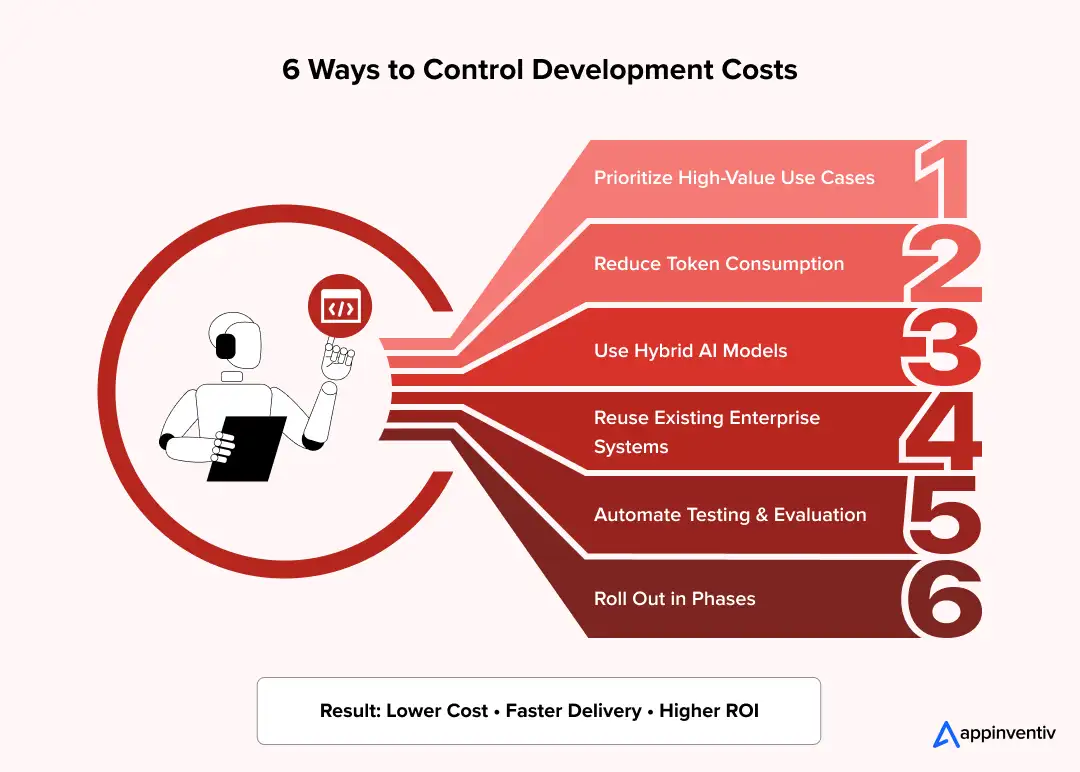
Saving money on development does not mean dropping key features. It requires smart structural choices from the start. These methods help companies manage spending. They let you build safe, expandable systems for live production engineering.
Focus on Top Corporate Needs
Start with tasks that bring clear financial returns. Focus on code generation, automated code reviews, or test creation. Adding extra skills later eliminates unnecessary engineering work.
Manage Data Limits and Token Counts
Pull only the matching code files and guides needed for the specific task. Do not scan whole repositories. Proper data filtering drops token counts. It builds clearer answers and lowers model fees. Gartner expects AI coding costs to surpass developer salaries by 2028 without stronger token governance.
Mix Large and Small Models
Direct everyday coding work to small models. Save expensive reasoning engines for complex project workflows. Smart routing lowers month-to-month bills and keeps tool speed high.
Use Your Current Software Parts
Connect to existing APIs, identity platforms, developer tools, and internal databases rather than building new components. This choice shortens construction timelines and minimizes integration bills.
Automate System Reviews and Quality Checks
Automated test setups, target datasets, and constant checks catch system errors early. Correcting tool flaws during development costs less than fixing software bugs after launch.
Roll Out the Tool in Stages
Deploy the agent to one engineering group first. Expand the software later. This strategy lets teams check system metrics and gather user notes. They perfect workflows, then launch them to the whole company.
Control development costs with phased implementation, intelligent architecture, and enterprise AI engineering built for long-term value.
How Does Development Time Affect AI Coding Agent Cost?
AI coding agent development timelines always change based on project size, system connection needs, and corporate goals. Teams deliver small test versions in a few weeks.
Full corporate platforms with independent agent workflows, deep software integrations, and system controls take several months to build. Speeding up these build schedules raises engineering costs.
You must pay for bigger teams, overlapping work tracks, and extra software testing loops.
| Project Step | Expected Timeline | Main Build Actions | Effect on Tool Costs |
|---|---|---|---|
| Planning and Design | 2-3 weeks | Corporate goal analysis, system design and picking software | Early mistakes cause expensive tool rewrites later. |
| Test Project | 6-8 weeks | Main model skills, codebase entry, technical proof | Checks feasibility before making larger investments. |
| Initial Working Tool | 2-4 months | Automated steps, data search, editor links | Balances speed with controlled corporate spending. |
| Full Corporate Build | 4-8 months | Multi-agent coordination, company connections, safety rules | Advanced systems require more engineering hours and links. |
| Live Launch | 1-2 months | Staff training, system tracking, speed edits, oversight | Drops running risks before firm-wide adoption. |
Many AI coding agent development challenges delay your launch dates. These specific elements include outdated software links, large code repositories, custom safety rules, legal checks, and extensive developer testing cycles.
Avoid rolling tools out to your whole engineering department at once. Smart companies lower upfront fees and mitigate risks. They start with one group, prove financial gains, then expand in steps.
How to Choose the Right AI Coding Agent Development Partner for Enterprise Success
Your choice of an AI coding agent development services partner shifts project bills, launch dates, and future returns. Use this checklist to find the best agent development company before you start building your corporate coding tool.
Corporate AI Vendor Checklist
- Past work completing corporate intelligence and software engineering setups
- Great technical skill with language models, data search pipelines, and multi-agent systems
- Clear success with safe software building, development security, and rules like SOC 2 or GDPR
- Past success linking coding tools to code editors, Git platforms, delivery pipelines, identity tools, and corporate programs
- Skill to guide the entire project from initial design to live tracking and system updates
- Clear pricing models with exact work boundaries, delivery dates, and total expense predictions
- Set help teams for post-launch upkeep, system fixes, and tool speed tunings
- A solid history of corporate clients with clear financial gains from their tools
How Can Appinventiv Help You Build a Secure, Enterprise-Ready AI Coding Agent?
Building a corporate AI coding tool requires more than picking a language model. It demands proper system design, secure software interfaces, clear oversight rules, and continuous performance monitoring. Appinventiv delivers AI integration services that help businesses build live coding agents that integrate with their existing software engineering tools.
We guide your project from initial planning and system design to custom agent building. Our teams construct smart platforms powered by multiple coordinated enterprise AI agents, data retrieval networks, and operations tracking.
Our engineers connect these platforms with company repositories, code editors, delivery pipelines, and cloud environments. We maintain strict data security, clear system tracking, and legal compliance rules.
Our company credentials include 100 autonomous AI agents launched and 150 custom models trained. A team of 200 data experts and software engineers serves clients across 35 separate industries.
Our systems helped large companies cut manual work by 50 percent. They hit 90 percent task accuracy and doubled system capacity. Deloitte and other industry groups rank us among the fastest-growing firms.
When you plan to build a safe corporate coding tool, our technicians help you choose the right system design, AI coding agent development cost, and rollout schedule.
Let’s connect & estimate the cost of developing your AI coding agent.
Frequently Asked Questions
Q. What is AI coding agent development?
A. Building a coding agent means designing, creating, and launching smart software to handle engineering tasks automatically. These systems do more than offer simple code autocomplete.
Corporate agents read entire code repositories, write software, and review edits. They run tests, connect with deployment pipelines, and execute work steps independently. They use data retrieval pipelines, communication protocols, and multi-agent coordination to complete complex work, all of which shape the final AI coding agent development cost.
Q. How to integrate an AI coding assistant into a development workflow
A. Successful rollouts start with selecting clear tasks, such as code writing, automated reviews, or test creation. Engineers connect the tool to code editors, Git repositories, delivery pipelines, and internal databases. For live company use, your team must set up user access rules, oversight policies, action logs, and constant tracking. These steps protect your private files and maintain high code quality.
Q. What is the cost of building a custom AI coding agent for enterprises?
A. Custom AI coding agent development usually costs between USD 50,000 and USD 500,000 or more. Final prices shift based on project size, tool features, system design, hosting choices, and software links. Full corporate platforms need a larger upfront spend than small test projects. These live systems include multi-agent logic, data search pipelines, pipeline links, safety rules, and private cloud hosting.
Q. How much does cloud infrastructure contribute to AI coding agent costs?
A. Cloud hardware stands as a primary monthly expense after your initial build. Bills cover processor power, model replies, vector databases, container setups, storage, and networking. These server costs rise as your code repositories grow and more engineers use the tool. Arranging your cloud layout and hardware needs early helps your business manage monthly running expenses and total ownership costs.


Fast 2-minute response, fully NDA-protected.

Retrieval Augmented Generation in Australia: Architecture, Implementation and Cost
Key takeaways: RAG grounds LLM answers in approved content, improving reliability without retraining a model. Data quality and access permissions decide production outcomes more than the model. Indicative build costs run from AUD 70,000 to 700,000, driven by data and integrations. Measure value against a pre-deployment baseline, separating realised benefits from projected savings. A general-purpose…
The Multiplier Effect of AI Agents: The Rise of AI Swarms
Key takeaways: AI agent swarms coordinate specialized agents to solve complex problems that may be difficult for a single agent to handle effectively. More agents do not automatically mean better outcomes. Swarms deliver value when work can be divided, executed in parallel, and coordinated toward a shared objective. Enterprise readiness depends on governance. Clear accountability,…
AI Data Integration: How to Connect, Clean and Prepare Data for AI
Key takeaways: AI initiatives fail when fragmented, poor-quality data reaches models without sufficient context, controls or ownership. AI-ready pipelines must connect, clean, enrich, govern and continuously monitor data across its lifecycle. Real-time processing matters when AI decisions depend on current transactions, events, inventory or operational conditions. Data architecture should follow the AI use case, balancing…