


























How Much Does It Cost to Build an AI Agent?

 Share -


- 01Development Costs Based on the Types of AI Agents
- 02Modern Business-Centric AI Agent Types
- 03AI Agent Pricing Tiers and Billing Models in 2026
- 04AI Agent Development Cost by Team Role and Location
- 05Key Factors That Influence AI Agent Development Cost for Custom Software
- 06Hidden Factors Affecting the Cost to Build an AI Agent that Often Go Unnoticed
- 07Understanding AI Agent Development Costs Through Real-World Examples
- 085. Claude
- 09How to Optimize the Costs to Develop an AI Agent?
- 10The Extensive Process to Create an AI Agent Software
- 11Build vs Buy: What’s the Better Option for Your AI Agent?
- 12How AI Agents Are Priced: Subscription vs. Usage-Based vs. Custom Build
- 13Why Choose Appinventiv for AI Agent Development?
- 14FAQs

Key Takeaways
- AI agent costs vary widely: from $25,000 for simple rule-based agents to $400,000+ for advanced multi-agent systems, depending on complexity and use case.
- Six core agent types drive pricing: Reactive, Model-Based, Goal-Based, Utility-Based, Learning, and Collaborative agents each carry distinct cost tiers based on capability.
- Hidden costs add up fast: Token usage, cloud infrastructure, monitoring, and model retraining can quietly add $2,000–$15,000+ in monthly operational expenses.
- Build vs. Buy is a critical decision: Custom agents offer full control and long-term ROI, while pre-built platforms offer faster deployment at lower upfront costs but with vendor limitations.
- Smart strategies can cut costs significantly: Using pre-trained models, phased development, edge AI, and transfer learning can reduce investment without sacrificing performance.
Building a custom AI agent costs between $10,000 and $500,000. Simple tools with fixed tasks sit at the low end. Complex enterprise systems require much larger budgets. These advanced systems process live data, connect to existing software, and follow strict security rules.
Understanding AI agent development costs requires looking past the initial build price. Your total budget includes cloud hosting, data pipelines, model fees, security audits, and continuous system maintenance.
Your chosen team structure changes the price tag. Building custom models from scratch demands millions in research and compute. Using existing foundation models with open frameworks reduces building time and infrastructure spend.
This guide breaks down AI agent development costs across six areas: feature complexity, developer rates, cloud resources, software integrations, running costs, and vendor pricing structures.
Development Costs Based on the Types of AI Agents
AI agents tend to vary in complexity, functionality, and purpose. Some operate on predefined rules, while others adapt and learn over time. Similarly, the cost of a custom AI agent for business depends on its capabilities, integrations, autonomy, and level of intelligence. The AI agent business ideas you choose also influence the technology, features, and architecture required for development.
Gartner predicts that at least 15% of day-to-day work decisions will be made autonomously by agentic AI by 2028, up from 0% in 2024. This shift toward greater autonomy can also increase the technical complexity and investment required for enterprise AI agents.
Here’s a breakdown of AI agent development costs based on different levels of complexity.
Reactive (Simple Reflex) Agents
These agents operate purely on predefined rules, responding to specific inputs without learning from past experiences. They’re best suited for tasks where the environment is fully observable. The costs to develop a reactive AI agent can range from a simple four-figure investment to over $40,000.
Model-Based Reflex Agents
Unlike reactive agents, these maintain an internal model of the environment, allowing them to make decisions based on historical data. Here’s how much model-based reflex custom AI agent software development costs.
| Development Level | Description | Estimated Cost | Example Use Case |
|---|---|---|---|
| Basic Development | Uses a limited internal model for decision-making | $25,000 – $35,000 | Chatbots that provide responses based on recent interactions |
| Mid-Level Development | Predictive capabilities and deeper contextual awareness | $35,000 – $50,000 | AI personal assistants managing calendar events |
| Advanced Development | Machine learning for real-time adaptability | $50,000 – $70,000 | AI-powered virtual doctors are diagnosing conditions from patient history |
Get a tailored estimate based on your agent type, integrations, complexity, and business requirements.
Goal-Based Agents
These agents evaluate different possible actions to determine the best course toward a specific goal. Here’s the approximate cost to build an AI agent software
| Development Level | Description | Estimated Cost | Example Use Case |
|---|---|---|---|
| Basic Development | Simple goal-setting and execution | $30,000 – $50,000 | AI-driven route optimization in logistics |
| Mid-Level Development | Adapts dynamically to real-time changes | $50,000 – $70,000 | AI-powered warehouse robots managing inventory |
| Advanced Development | Incorporates multi-layered goal planning | $70,000 – $100,000 | AI project managers allocate resources based on deadlines/workload |
Utility-Based Agents
These agents make decisions based on utility functions, optimizing for maximum efficiency, profitability, or user satisfaction. The cost of AI agent development here can vary from –
| Development Level | Description | Estimated Cost | Example Use Case |
|---|---|---|---|
| Basic Development | Simple utility functions for decision-making | $40,000 – $60,000 | Recommendation system engines |
| Mid-Level Development | Multi-variable utility assessments | $60,000 – $80,000 | AI-driven marketing automation tools |
| Advanced Development | Predictive analytics with complex real-time processing | $80,000 – $120,000 | AI financial advisors are adjusting strategies based on market trends |
Learning Agents
These AI systems evolve, using experience to improve their performance. The cost of an artificial intelligence agent here can range from –
| Development Level | Description | Estimated Cost | Example Use Case |
|---|---|---|---|
| Basic Development | Supervised learning for pattern recognition | $50,000 – $70,000 | AI email filters are improving spam detection over time |
| Mid-Level Development | Reinforcement learning for decision-making | $70,000 – $100,000 | AI stock trading bots learning from market trends |
| Advanced Development | Deep learning with autonomous adaptation | $100,000 – $150,000 | AI self-driving cars improving behavior continuously |
Collaborative Agents
These systems are designed to work alongside humans or other AI agents and facilitate collaborative problem-solving. Here’s how much it costs to develop an AI agent for the collaborative category.
| Development Level | Description | Estimated Cost | Example Use Case |
|---|---|---|---|
| Basic Development | Basic task-sharing for human-AI collaboration | $60,000 – $80,000 | AI document processing assistants |
| Mid-Level Development | Synchronizes with multiple systems for enhanced coordination | $80,000 – $120,000 | AI virtual team members assisting in business meetings |
| Advanced Development | Fully autonomous AI agents collaborating in real-time with humans | $120,000 – $200,000 | AI co-pilots supporting surgeons during live operations |
Modern Business-Centric AI Agent Types
These agent types reflect how AI is being applied in real-world business environments today. From simple chatbots to advanced LLM-powered systems and collaborative multi-agent networks, each type serves a specific function depending on the complexity of the task and business goal. Let’s explore what each of these modern AI agent types typically costs to build.
| Agent Type | Description | Estimated Cost Range | Example Use Case |
|---|---|---|---|
| Simple Chatbot | Basic rule-based or NLP-powered chatbot for answering fixed queries | $25,000- $50,000 | Customer support on websites, FAQs for apps |
| LLM-Powered Task Agent | Agents powered by models like GPT-4, designed to perform multi-turn interactions | $50,000- $100,000 | Virtual assistants, AI for internal workflows |
| Retrieval-Augmented Generation (RAG) Agent | Combines LLMs with custom knowledge bases for domain-specific answers | $100,000- $250,000 | Legal AI assistants, AI in healthcare and compliance |
| Multi-Agent System with Planning | Coordinated group of agents working across complex tasks with shared goals | $250,000 – $400,000+ | AI-powered supply chains, collaborative AI product design |
By understanding the different types and the cost to build AI agent software at various levels of complexity, businesses can make informed decisions about their AI investments. Whether looking for a simple automation tool or a highly advanced AI system, aligning costs with business objectives is key to maximizing ROI.
Related Article: How Agentic AI in Healthcare Is Bringing in Industry-level Transformation
AI Agent Pricing Tiers and Billing Models in 2026
Not all AI agents are created equal, and not all price points deliver the same capabilities. Before committing to a development budget, it’s crucial to align your expectations with what you actually get at each level. Here’s a breakdown of the key features typically offered across different pricing tiers in Agentic AI development.
McKinsey found that 62% of organizations are at least experimenting with AI agents, while only 39% report enterprise-level EBIT impact from AI. This makes it important to match agent capabilities with measurable business outcomes.
| Pricing Tier | Common Features | Ideal For |
|---|---|---|
| Basic ($25K – $50K) | – Rule-based logic – Fixed input/output responses – Basic UI – Single-language support | – Small-scale automation – Simple chatbots – Startups testing MVPs |
| Mid-Range ($50K – $150K) | – NLP integration – Basic machine learning – Multi-language support – API integrations – Basic analytics | – Internal tools – Customer support agents – Process automation |
| Advanced ($150K – $400K+) | – Real-time adaptability – Reinforcement/deep learning – Cross-platform integration – Voice, image, and text processing – Security & compliance layers – Scalable multi-agent architecture | – Enterprise-grade automation – AI copilots – Dynamic, context-aware assistants |
AI Agent Development Cost by Team Role and Location
Team structure directly drives the total project price. AI engineers, cloud architects, data specialists, and DevOps talent charge different rates. These rates depend on role, years of experience, and geographic region. The table below lists estimated 2026 hourly rates across major global markets.
| Development Role | USA ($/hr) | Australia ($/hr) | Europe ($/hr) | Middle East ($/hr) |
|---|---|---|---|---|
| AI/ML Engineer | 80–180 | 70–160 | 60–150 | 50–130 |
| AI Architect | 120–250 | 100–220 | 90–200 | 80–180 |
| Backend Developer | 60–150 | 55–130 | 50–120 | 40–100 |
| Data Engineer | 70–160 | 60–140 | 55–130 | 45–110 |
| DevOps / MLOps Engineer | 70–170 | 65–150 | 60–140 | 50–120 |
| UI/UX Designer | 50–120 | 45–110 | 45–100 | 35–90 |
| QA / AI Testing Engineer | 45–110 | 40–100 | 40–95 | 30–80 |
| Project Manager | 50–130 | 45–115 | 45–110 | 35–90 |
Key Factors That Influence AI Agent Development Cost for Custom Software
Developing an AI agent involves various factors that significantly influence the overall AI agent software development cost. Beyond complexity, customization, data requirements, integrations, and maintenance, the choice of AI agent development service can also affect the overall investment. The team’s expertise, development approach, and delivery model can influence both upfront costs and long-term maintenance. Here’s an expanded overview of all those factors:
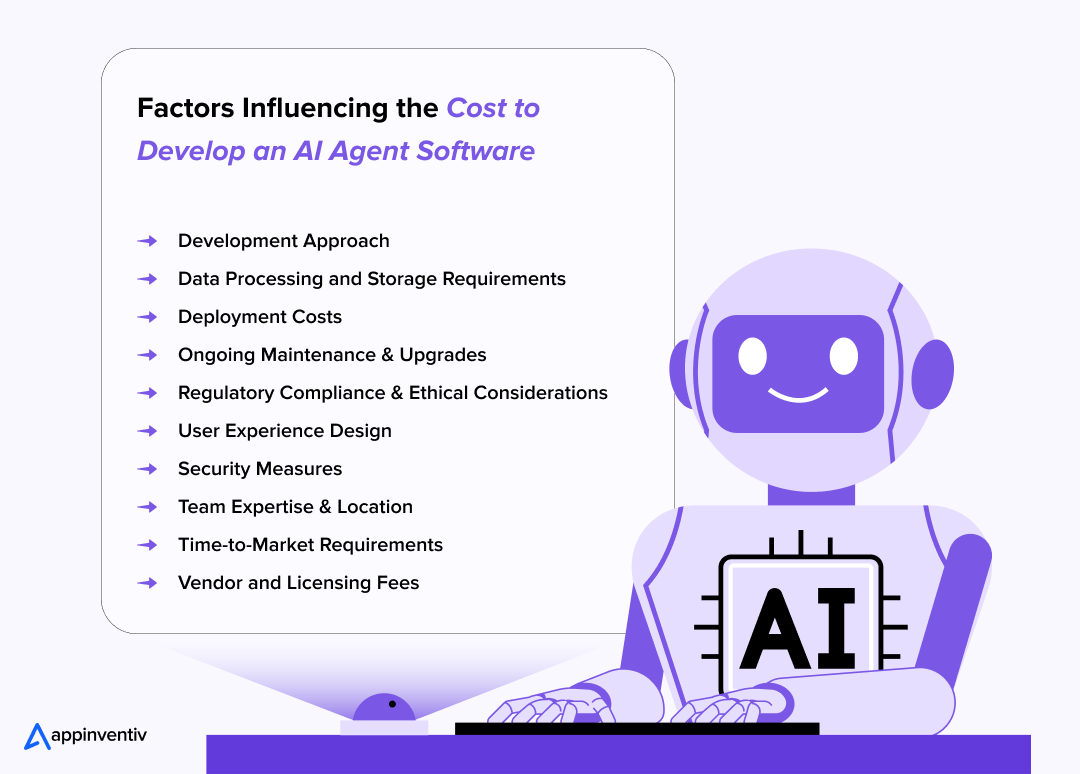
Development Approach
The strategy chosen to create an AI agent software can substantially affect costs:
- Building from Scratch: Crafting a custom AI model tailored to specific needs offers full control but demands extensive resources, leading to higher expenses.
- Utilizing Open-Source Models: Leveraging pre-trained models like GPT-4 or BERT can reduce development time and costs, though it may limit customization.
- AI-as-a-Service Platforms: Employing services from providers like AWS, Azure AI, or Google AI offers scalable solutions with subscription-based pricing, often resulting in cost savings.
Bottom Line: The choice between the custom process to make an AI agent software and leveraging existing platforms should align with the project’s specific requirements and budget constraints.
Data Processing and Storage Requirements
The volume and nature of data required for training and operating an AI agent influence storage and processing expenses:
- Small Datasets: Manageable data volumes may incur lower storage and processing costs.
- Large Datasets: Extensive data necessitates robust infrastructure, increasing expenses.
- Real-Time Data Processing: Systems requiring instantaneous data handling demand advanced computing capabilities, elevating costs.
- Storage Solutions: Choosing between on-premises storage and cloud-based options (e.g., AWS, Azure, Google Cloud) impacts cost and scalability.
Bottom Line: Aligning data strategies with business objectives is crucial for low artificial intelligence agent software development cost.
Deployment Costs
The environment in which the technology operates affects both the initial and ongoing cost to build artificial intelligence agent software:
- On-Premises Deployment: Requires significant investment in hardware and maintenance, offering greater control but at higher costs.
- Cloud Deployment: Provides scalability and flexibility with a pay-as-you-go model, often reducing upfront expenses.
- Hybrid Deployment: Combines both approaches, balancing control and scalability, but may introduce complexity and additional costs for developing an AI app.
Key Insight: Selecting the appropriate deployment strategy is vital for balancing control, performance, and cost to build AI agent software.
For cloud versus hybrid trade-offs tied to licensing, infra, and support, our AI Chatbot Development Cost Guide 2026 details how these choices affect long-term ROI.
Ongoing Maintenance and Upgrades
Continuous support is essential to ensure the AI agent’s effectiveness over time, along with balancing the cost to develop an AI agent:
- Bug Fixes and Patches: Regular updates are necessary to address issues and maintain security.
- AI Model Re-Training: Periodic updates to improve accuracy and adapt to new data trends are crucial.
- Scalability and Feature Enhancements: As user demand grows, expanding capabilities may require additional investment.
Key Insight: Planning for ongoing maintenance is crucial to sustaining the AI agent’s performance and relevance.
Regulatory Compliance and Ethical Considerations
Adhering to legal standards and ethical guidelines can influence custom AI agent development cost:
- Data Privacy Regulations: GDPR-compliant software development or adhering to laws like CCPA may require additional resources.
- Ethical AI Practices: Implementing measures to prevent biases and ensure fairness can add to development efforts.
Critical Consideration: Proactively addressing regulatory and ethical aspects can mitigate risks and avoid potential fines.
User Experience Design
Creating an intuitive and engaging interface enhances user satisfaction but may increase development complexity and, in turn, the cost of AI agent development:
- User-Centric Design: Investing in UX design ensures the AI agent is accessible and meets user needs.
- Accessibility Features: Incorporating features for users with disabilities can broaden the user base but may require additional resources.
Critical consideration: Prioritizing UX design can lead to higher adoption rates and better overall performance.
Security Measures
Protecting the AI agent from potential threats is essential:
- Data Encryption: Implementing robust encryption technology benefits businesses by safeguarding sensitive information.
- Threat Detection Systems: Deploying advanced security measures helps in early identification of potential vulnerabilities.
Key Insight: Investing in security measures protects the organization and its users, preventing costly breaches.
Team Expertise and Location
The skill level and geographical location of the development team can influence the cost of artificial intelligence agent:
- Experienced Developers: Hiring seasoned professionals may increase upfront costs but can lead to more efficient development and higher-quality outcomes.
- Geographical Location: Development costs vary by region due to differences in labor rates and operational expenses.
Key Insight: Balancing expertise and location can optimize the cost to develop an AI agent without compromising quality.
Time-to-Market Requirements
Accelerated development timelines can greatly impact the cost to develop an AI agent software:
- Expedited Development: Rushed timelines may require additional resources, increasing costs.
- Standard Timelines: Allowing adequate time for development can optimize resource allocation and cost.
Bottom Line: Aligning development timelines with business goals and resource availability is crucial for cost management.
Vendor and Licensing Fees
Utilizing third-party tools or platforms can introduce additional artificial intelligence agent software development cost:
- Licensing Fees: Costs associated with using proprietary software or tools.
- Vendor Contracts: Engaging external vendors for specialized services can add to expenses.
Key Insight: Carefully evaluating vendor offerings and licensing agreements can prevent unforeseen costs.
When you build artificial intelligence agent software, you should know that it isn’t just about coding a smart system – it’s about creating an intricate process influenced by data needs, integration challenges, deployment choices, and long-term upkeep.
Each decision, from choosing a development approach to ensuring security and compliance, carries financial implications. Implications that operate on the golden rule that the more advanced and tailored the product, the higher the investment required to create an AI agent software.

Hidden Factors Affecting the Cost to Build an AI Agent that Often Go Unnoticed
Even after your AI agent goes live, there are technical tasks that continue to add to the cost. These are not always visible at the start but become necessary as your system scales and users interact more with it. Let’s look at the hidden costs to develop an AI agent software:
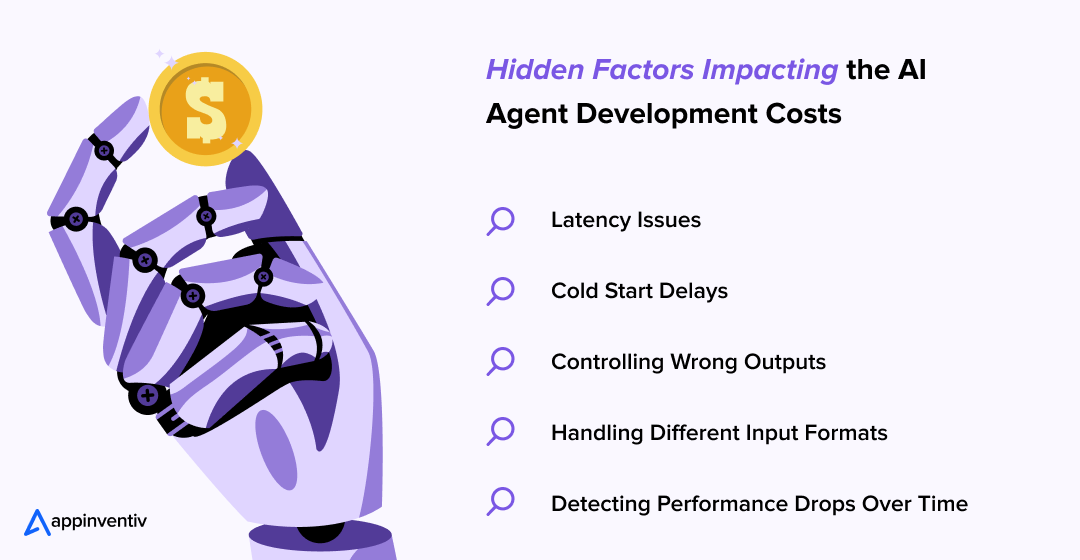
Latency Issues
If your AI agent takes too long to respond, you may need to optimize how quickly it loads and answers. This involves engineering techniques like response caching or keeping parts of the model running all the time, which can raise hosting and GPU costs.
Cold Start Delays
Some AI agents run into delays the first time a user sends a request. Fixing this often requires setting up warm start infrastructure or running low-latency containers in the background, which adds to monthly cloud expenses.
Controlling Wrong Outputs
AI agents sometimes give confident but incorrect answers. Preventing this means you need extra logic for checking outputs, adding fallback systems, or even retraining parts of the model to improve accuracy. This increases the workload after launch.
Handling Different Input Formats
If your agent needs to understand voice, images, or documents along with text, extra models must be added. Each type of input needs separate processing and increases integration and testing time.
Detecting Performance Drops Over Time
As your data changes, the AI model might get less accurate. To fix this, you need regular monitoring, custom tracking pipelines, and sometimes re-training the model. These updates take time, tools, and ongoing developer effort.
Apart from the ones mentioned above, here’s a breakdown of the most common operational expenses that can quietly accumulate into thousands of dollars per month:
| Operational Area | Typical Monthly Cost | Explanation |
|---|---|---|
| LLM/API Token Usage | $1,000 – $5,000+ | Each prompt or message processed through APIs like OpenAI, Cohere, or Anthropic incurs per-token fees. |
| Cloud Infrastructure | $500 – $3,000 | Hosting the AI agent with autoscaling, GPUs, and persistent storage drives up cloud bills. |
| Monitoring & Observability | $200 – $1,000 | Real-time tracking tools like Prometheus, Datadog, or custom dashboards are needed to maintain uptime and track drift. |
| Security & Access Control | $300 – $2,000 | Implementing role-based access, end-to-end encryption, and audit logging to meet compliance. |
| Data Storage | $50 – $500 per TB | Usage grows as more user interactions, training logs, and outputs get stored over time. |
| Technical Support | $200 – $2,000 | Whether in-house or vendor-backed, ongoing engineering time adds up. |
| Prompt Tuning/Model Updates | $500 – $3,000 (monthly/quarterly) | Regular tuning for better accuracy, new features, and adapting to new data trends. |
Understanding AI Agent Development Costs Through Real-World Examples
Understanding the cost of building an AI agent becomes much easier when you see how real businesses are using them. From customer service automation to decision-making systems, the cost often depends on how intelligent and integrated the agent needs to be. Below are a few examples of AI agents from actual industry scenarios to help you benchmark your investment.
1. ChatGPT by OpenAI
ChatGPT is a large-language-model assistant trained on huge data reserves and refined with reinforcement learning to answer open-ended questions, write code, and support customer service.
Estimated Cost – $500,000-millions of dollars
Note: The high cost to develop a chatbot like ChatGPT includes training large models, using powerful computers, and keeping it running safely for millions of users.
2. GitHub Copilot
Copilot is a smart coding assistant that helps developers by auto-completing code, suggesting functions, and explaining what the code does, all inside tools like VS Code.
Estimated Cost – $50,000 (MVP stage) to $500,000
Note: Cost depends on how much code it’s trained on, how many languages it supports, and how well it works with coding software.
For a deeper breakdown of enterprise pricing and architecture, see our guide to AI coding agent development costs.
3. Google Assistant
Google Assistant is a voice-first helper that answers queries, controls devices, and carries out tasks across Android phones, speakers, cars, and watches, relying on Google’s speech and knowledge-graph.
Estimated Cost – $100,000 to $500,000+
Note: The cost includes building voice recognition, natural language features, and connecting with many devices.
4. Character.ai
Character.ai lets anyone spin up AI personas, historical figures, fictional heroes, or entirely new characters that remember past chats and role-play in real time.
Estimated Cost – $40,000 to $300,000
5. Claude
Claude is a conversational AI built by Anthropic, designed to be helpful, honest, and harmless. It’s used for writing, coding, research, and safe general-purpose tasks.
Estimated Cost – $100,000 to $400,000+
Note: Costs include training large models, safety alignment, and managing cloud infrastructure to support wide-scale usage.
Also Read: Cost of Building an AI Agent Like Claude Coworker
6. Perplexity AI
Perplexity is an AI-powered search assistant that gives direct, summarized answers with sources, combining chatbot features with real-time web search. It’s used for fast, reliable, and conversational information lookup.
Estimated Cost – $150,000 to $250,000
Note: Cost of developing an app like Perplexity depends on combining search APIs, LLM integration, real-time web crawling, and keeping the responses accurate and up-to-date for users.
| AI Agent | What It Does | Estimated Development Cost |
|---|---|---|
| ChatGPT | Answers questions, writes code, holds conversations | $500,000 to millions |
| GitHub Copilot | Auto-completes code, suggests functions in real time | $50,000 to $500,000 |
| Google Assistant | Voice assistant for phones, homes, and smart devices | $100,000 to $500,000+ |
| Character.ai | Builds interactive AI personas with memory and role-play | $40,000 to $300,000 |
| Claude (Anthropic) | Safe and helpful chatbot for writing, coding, and research | $100,000 to $400,000+ |
| Perplexity AI | Chat and search AI that gives instant answers with sources | $150,000 to $250,000 |
How to Optimize the Costs to Develop an AI Agent?
Reducing the cost to develop an AI agent isn’t just about cutting expenses; it’s about making smart, strategic choices that balance performance and affordability. Businesses can minimize the AI agent development cost without compromising functionality by leveraging pre-trained models to optimize deployment and maintenance.
Below are key strategies tailored to implement during Agentic AI development that can ensure a cost-effective process as well as long-term sustainability.
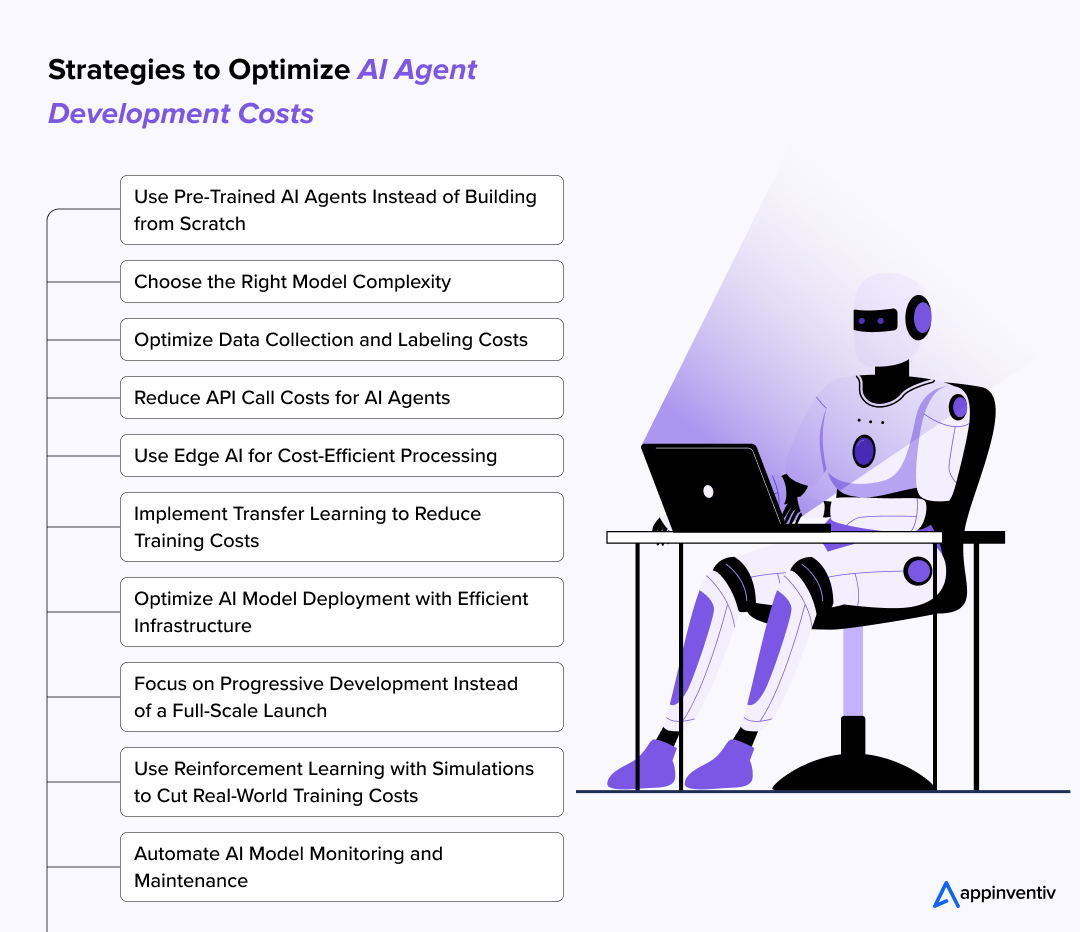
Use Pre-Trained AI Agents Instead of Building from Scratch
Instead of developing every AI capability from scratch, businesses can use pre-trained foundation models and existing platforms to reduce development time and cost. This approach is particularly useful for AI chatbot development, where existing models can handle much of the conversational intelligence, allowing development teams to focus on business logic, integrations, and customization. Using pre-trained foundation models can significantly reduce the cost of Generative AI development. Instead of building a model from scratch, teams can adapt an existing model through prompting, RAG, fine-tuning, or tool integration based on the agent’s requirements.
Choose the Right Model Complexity
Not every use case requires a complex AI agent with deep learning capabilities. Rule-based or retrieval-based agents can be sufficient for many applications and cost far less than generative AI models requiring extensive computational power.
Optimize Data Collection and Labeling Costs
Training an AI agent requires large volumes of labeled data, which can be expensive to source. Businesses can reduce costs by:
- Using synthetic data generation
- Leveraging existing datasets from open-source repositories
- Implementing semi-supervised or self-supervised learning techniques to mitigate manual labeling efforts
Reduce API Call Costs for AI Agents
AI models hosted on cloud platforms like OpenAI, Google Cloud AI, and Microsoft Azure charge per API call. Optimizing query structures, batching API calls, and using lower-tier models when possible can drastically reduce operational-level artificial intelligence agent development costs.
Use Edge AI for Cost-Efficient Processing
Cloud-based AI agents incur ongoing costs for every interaction. Deploying lightweight AI agents on edge devices (local servers, IoT devices, or on-premise solutions) can minimize cloud costs and improve response time.
Implement Transfer Learning to Reduce Training Costs
Instead of training an AI agent from scratch, transfer learning allows businesses to build on existing AI models. This reduces computational costs and the need for high-end GPUs, significantly lowering development expenses.
Optimize AI Model Deployment with Efficient Infrastructure
Hosting an AI agent on high-end GPUs 24/7 can be costly. Instead, businesses can:
- Use model quantization to reduce computational needs
- Deploy AI models on cheaper cloud instances during off-peak hours
- Implement auto-scaling to ensure resources are used efficiently
Focus on Progressive Development Instead of a Full-Scale Launch
Many AI projects fail due to over-investment in features that users may not need. A phased approach reduces unnecessary enterprise AI agent development costs, starting with a Minimum Viable AI Agent (MVAA) and gradually adding capabilities based on user feedback.
Use Reinforcement Learning with Simulations to Cut Real-World Training Costs
Training AI agents in real-world scenarios can be expensive, especially when the system needs to learn from repeated decisions and outcomes. For use cases that require this level of adaptation, machine learning development can support reinforcement learning pipelines and simulation environments before the agent is exposed to live production conditions. Instead, using simulated environments (such as OpenAI Gym or Unity ML-Agents) can significantly lower training costs while improving model accuracy.
Automate AI Model Monitoring and Maintenance
AI agents degrade over time due to data drift. Automating model retraining and performance monitoring using tools like MLflow, Weights & Biases, or Vertex AI reduces manual intervention costs while keeping the AI agent accurate.
Let’s create a roadmap that fits your budget

The efforts to build AI agent software don’t have to drain resources. Still, cost-efficiency requires strategic decisions at every stage, which we offer by suggesting businesses leverage pre-trained AI models instead of building from scratch, choose the right level of model complexity, and optimize data collection with synthetic data or self-supervised learning.
The Extensive Process to Create an AI Agent Software
AI agent development involves meticulously planned steps, each contributing to the project’s overall cost. Below is an overview of the process to develop an AI agent software, accompanied by estimated cost ranges:
Identify Use Cases and Define Objectives
This initial phase of Agentic AI development involves understanding the specific problems the AI agent will address and setting clear objectives. Collaboration between stakeholders is required to align the AI solution with business goals.
Estimated Cost: $1,000 – $5,000
Note: The cost of AI agent development varies based on the project’s complexity and the level of stakeholder engagement required.
Design and Prototype
At this stage, AI solution designers create wireframes and prototypes to visualize the AI agent’s functionality and user interface. This step helps refine ideas and gather early feedback.
Estimated Cost: $5,000 – $15,000
Note: Expenses depend on the design’s complexity and the tools used.
Data Collection and Preprocessing
Gathering relevant data and preparing it for training is crucial. This process includes data cleaning, normalization, and augmentation to ensure quality inputs for the AI model.
Estimated Cost: $10,000 – $50,000
Note: All the factors that affect custom AI agent development costs tend to escalate with the volume and complexity of data required.
AI Model Development and Training
Developers select appropriate algorithms and train the AI model using prepared data. This phase is resource-intensive, often requiring specialized hardware and expertise.
Estimated Cost: $10,000 – $100,000+
Note: Artificial intelligence agent development cost varies based on model complexity and computational resources needed.
Bonus Read: How to Build an Intelligent AI Model: An Enterprise Guide
Integration with Existing Systems
Automating the AI agent into current business systems ensures smooth operation and user acceptance. This step may involve API development and customization.
Estimated Cost: $10,000 – $30,000
Note: Costs depend on system compatibility and integration complexity.
Deployment
Launching the AI agent into the production environment involves setting up servers, configuring networks, and ensuring scalability.
Estimated Cost: $5,000 – $20,000
Note: The cost to make an AI agent software varies greatly based on deployment infrastructure and scale.
Maintenance
The last stage of developing an AI agent software – Ongoing support includes monitoring performance, updating models, and addressing issues to ensure the AI agent’s longevity and effectiveness.
Estimated Annual Cost: $10,000 – $50,000+
Note: Costs of developing an AI agent depend on the frequency of updates and the need for continuous improvement.
Understanding these AI agent development stages and associated costs helps budget and plan development, ensuring alignment with business objectives and resource availability.
Checkout major differences between Agenting engineering and vibe coding systems before you invest money in the wrong solutions.
Build vs Buy: What’s the Better Option for Your AI Agent?
PwC found that 79% of surveyed executives said their organizations were adopting AI agents, while 66% of adopters reported measurable productivity gains. This makes the build-versus-buy decision a question of cost, control, and scalability.
Should you build a custom AI agent from the ground up or buy a pre-built solution? The right choice depends on how complex your use case is, how much control you want, and your long-term business goals. Let us offer you a cost-focused comparison to help you decide:
| Criteria | Custom AI Agent | Pre-Built Tool or Platform |
|---|---|---|
| Use Case Fit | Best for complex or evolving workflows that need flexibility | Suited for basic to mid-level tasks and predefined flows |
| Time to Market | 3 to 6 months or more, based on requirements | 2 to 6 weeks depending on setup |
| Initial Investment | $40,000 to $400,000 depending on features, integrations, and complexity | $10,000 to $100,000 annually via licensing or subscription |
| Ongoing Costs | Maintenance, infra, model upgrades, token usage ($10,000–$50,000/year) | Subscription renewals, optional premium support |
| Customization | Fully tailored to your logic, workflows, and data sources | Limited to what the vendor offers |
| Integration Capability | Seamless integration with your CRM, ERP, HRMS, or proprietary tools | Mostly limited to standard APIs and connectors |
| Data Privacy | Complete control over how and where your data is processed | Data is often managed by the vendor |
| Scalability | Grows with your business and adapts to new use cases | Depends on vendor’s roadmap and infrastructure |
| Support and Maintenance | Managed in-house or with a trusted AI agent development partner like Appinventiv | Managed by the vendor as part of the license |
| IP Ownership | You own the full source code, data workflows, and logic | Vendor retains product ownership and core functionalities |
Why Custom Development Pays Off?
A custom AI agent may take more time and investment initially, but it gives you long-term control, scalability, and cost savings. You avoid subscription traps, vendor limitations, and gain a system that fits your business, not the other way around.
With a custom AI agent, you get full flexibility to design workflows that match how your team actually works. You control how the model is trained, how data flows, and what tools it connects to. This means no forced upgrades, no limits on features, and no dependency on a vendor’s roadmap or subscription terms.
Furthermore, you also gain full ownership of the code and architecture, so your system can scale as your needs grow. Whether it’s handling more users, supporting multiple languages, or adding new layers of logic, a well-built custom solution will evolve with your business and not hold it back.
And most importantly, a custom build gives you control over security and compliance, which is critical when dealing with sensitive data across finance, healthcare, or enterprise systems.
How AI Agents Are Priced: Subscription vs. Usage-Based vs. Custom Build
Deployment methods determine total platform pricing. Subscription plans charge recurring platform fees. Usage models charge per token or task. Custom builds require large upfront funding but offer maximum control. Leaders compare short-term expenses against long-term operational scale.
| Pricing Model | How It Works | Typical Cost | Best For | Main Consideration |
|---|---|---|---|---|
| Subscription | Pay fixed recurring fees for platform access | 20–1,000+ monthly | Small teams, standard tasks | Low upfront fee, vendor reliance |
| Usage-Based | Pay for individual tokens, tasks, or compute time | Variable pricing | Changing workload volumes | Expenses grow alongside volume |
| Custom Build | Design systems for specific operations | 10,000–500,000+ | Large enterprises, unique workflows | High upfront fees, ongoing upkeep |
Subscription plans match teams using standard off-the-shelf software. Usage pricing fits organizations with fluctuating monthly demand. Custom engineering serves enterprises needing full software ownership, proprietary integrations, and tight security controls.
Why Choose Appinventiv for AI Agent Development?
We hope this blog has helped you understand in detail the enterprise AI agent development costs and the multiple factors that impact it. Building AI agents that deliver tangible business value requires combining technical expertise, strategic cost management, and a forward-thinking approach.
At Appinventiv, we specialize in developing tailored custom AI development services to diverse business needs, whether virtual assistants, automation bots, or advanced decision-making systems. Our development process ensures that every AI solution aligns with industry-specific challenges while optimizing development and operational costs.
Cost efficiency is at the core of our approach. By leveraging pre-trained models, optimizing cloud infrastructure, and implementing efficient AI training methods, we help businesses minimize expenses without compromising performance.
But AI development isn’t just about cost – scalability is crucial in ensuring long-term value. Our bespoke AI solutions are designed to evolve with business needs, enabling seamless upgrades and integrations without requiring extensive redevelopment.
Data strategy and security are equally critical. We assist businesses in optimizing data collection, preprocessing, and compliance, ensuring AI agents operate with high-quality data while adhering to industry regulations in the healthcare, finance, and retail sectors.
As an AI Integration company, we follow a series of development strategies to maximize further ROI, including model quantization, efficient inference techniques, and edge AI deployment, reducing cloud costs while maintaining high-performance AI operations.
With a track record of successful AI implementations across industries, we empower startups and enterprises to harness AI without excessive financial risk. At Appinventiv, we develop AI agents and create intelligent, scalable, and cost-effective solutions that drive real business impact. Let’s build your AI-powered future – connect with our experts today.
FAQs
Q. How much do AI agents for customer service cost?
A. Building a customer service AI agent requires $25,000 to $100,000 depending on functional capabilities. Basic FAQ or support agents require $25,000 to $50,000. Complex agents with retrieval systems, database connections, multilingual support, voice options, and automated ticket handling demand $50,000 to $100,000+. Total budgets must account for model token charges, hosting infrastructure, system monitoring, and ongoing software maintenance.
Q. How much does enterprise AI agent development cost?
A. Enterprise AI agent builds cost between $100,000 and $500,000+ depending on architectural scope and deployment scale. Expenses increase with multi-system connections, private database access, complex retrieval systems, advanced orchestration, real-time decision loops, security controls, regulatory compliance, and multi-agent workflows. Large deployments mandate dedicated budgets for cloud resources, system observability, model execution, software maintenance, and performance tuning.
Q. What does it cost to provide an AI agent with real-time data at scale?
A. Connecting real-time data feeds adds $10,000 to $50,000+ to core development costs. Ongoing infrastructure expenses fluctuate with data throughput. Total spend includes external API fees, streaming pipelines, vector databases, retrieval systems, compute resources, caching layers, and monitoring tools. High-volume systems incur additional model execution costs during peak transaction spikes.


Fast 2-minute response, fully NDA-protected.
Jev Explained: Enterprise Use Cases, Limitations and How to Adopt
Key takeaways: What it is: Jev is a System One model from TypeSafe AI. It returns typed choices, scores and true-or-false probabilities instead of text. Where it wins: The strongest Jev use cases are high-volume, narrow decisions such as triage, routing, scoring and guardrails. Where it stops: It cannot generate text. It struggles with math…
How to Use AI Recruiting Agents to Streamline Sourcing, Screening and Candidate Engagement
Key takeaways: AI recruiting agents automate connected workflows across candidate sourcing, screening, engagement, scheduling, and recruitment reporting. Unlike traditional ATS platforms, recruiting agents can interpret hiring goals, choose permitted actions, and coordinate work across multiple systems. Enterprises can use AI agents to find relevant talent faster, maintain consistent screening, reduce candidate drop-off, and improve recruiter…
AI Governance in Healthcare: Framework, Development Process, Costs & ROI
Key takeaways: Only 29% of surveyed health systems enforce inventory tracking, data lineage, and sign-off policies, revealing a governance maturity gap. Regulatory registries recorded 1,430 artificial intelligence medical devices authorized through 2025, with 331 clearances granted during 2025 alone. Risk-tiered governance matches oversight directly to clinical impact, software autonomy, data sensitivity, model risks, and vendor…