






























AI Agent Governance: How to Govern Autonomous AI Across Business Systems

 Share -



- 01Why Traditional AI Governance Falls Short for Autonomous Agents
- 02What Are the Core Pillars of Agent Governance?
- 03How an AI Agent Governance Architecture Controls Every Action
- 04Major Risks Posed by Ungoverned AI Agents
- 05How to Build an Operating Model for AI Agent Governance
- 06How Enterprises Can Operationalize AI Agent Governance
- 07Emerging Trends Shaping Agent Governance
- 08How Much Does Agent Governance Cost?
- 09How Governance Improves the Return on Agent Investments
- 10How to Implement AI Agent Governance Across the Enterprise
- 11Enterprise Agent Governance Readiness Scorecard
- 12AI Agent Governance Mistakes That Leave Enterprises Exposed
- 13How Appinventiv Helps Enterprises Govern Autonomous Agents
- 14FAQs

Key takeaways:
- AI agents require controls at the action, identity, data, tool, and workflow levels.
- Every enterprise agent should have a registered owner, an approved purpose, and a defined risk tier.
- Access must be based on the agent’s task rather than inherited from a human user or shared service account.
- High-impact actions need real-time policy checks and human approval before execution.
- Agent activity should be logged from the initial instruction through every tool call and system change.
- Governance must continue after deployment because models, tools, data, and operating conditions change.
- Effective governance can reduce manual review, prevent uncontrolled consumption, and accelerate reliable deployments.
- A single governance platform cannot compensate for unclear ownership or poorly designed business processes.
Your enterprise AI generates the right answer. Now, can the same AI system be trusted to take the right action? With the right authority, the right data, the right systems, and a clear line of accountability?
This conversation matters as AI agents move from generating recommendations to executing work. IBM research found that 24% of executives already report AI agents taking independent action in their organizations, while 67% expect this by 2027.
The governance challenge, therefore, is not how to make agents autonomous. It is how to make autonomy bounded, observable, reversible, and accountable.
As agents begin approving requests, accessing sensitive data, and initiating transactions, enterprises must define the limits of that independence. Which decisions can an agent make? When does it need approval, and who remains accountable when it delegates work to another agent?
AI agent governance addresses these questions through defined ownership, access controls, technical guardrails, and continuous oversight. It helps businesses expand automation while maintaining control over security, compliance, costs, and operational risk.
The argument in brief
- Agents don’t fail like software. They act with delegated authority, so governance must answer who may do what, right now, not just how accurate is the model.
- Rules that live in policy documents or prompts won’t hold. They must execute at the moment of action.
- Platform controls help, but most enterprises will run agents across several platforms. The operating model has to sit above any one vendor.
Identify access gaps, set approval thresholds, and define the controls your agents need before expanding autonomy.

Why Traditional AI Governance Falls Short for Autonomous Agents
Consider a procurement agent allowed to prepare purchase recommendations. Months later, a finance agent built by another team begins approving the invoices those recommendations generate. Neither team broke a rule. But when the auditor asks who approved a $48,000 payment, the honest answer is “two agents, and nobody owns the combined workflow.”
Businesses have governed software, data, automation, and machine learning systems for years. Those controls remain useful, but agents introduce greater operational uncertainty.
A conventional workflow executes a fixed sequence. If an invoice exceeds a stated amount, the workflow sends it to an approver. The path and outcome are predictable.
An agent may interpret an invoice, check the contract, examine earlier transactions, contact another agent, and update the finance system. Its path depends on the context it discovers, making periodic model reviews and static policies insufficient.
Agents differ from conventional AI systems in five important ways:
- They make contextual decisions: Their next action depends on instructions, retrieved data, memory, and system feedback.
- They use tools: Agents can call APIs, execute code, search databases, send communications, or alter business records.
- They exercise delegated authority: Their actions rely on permissions granted by a person, administrator, or application.
- They retain or retrieve information: Memory and retrieval systems can influence decisions long after the original interaction.
- They collaborate: One agent may call another agent with different instructions, tools, data, and permissions.
A successful pilot can hide these risks. The problem grows when separate departmental agents influence the same transaction without a shared policy or audit trail. Persistent memory should also be treated as an attack surface. Enterprises need controls over what information can enter agent memory, which sources are trusted, how memories are validated and updated, and how poisoned or obsolete context can be identified and removed.
Governance defines permitted uses, restricted systems, owners, approvals, monitoring, incident procedures, and retirement conditions. It places autonomy inside boundaries the business can defend.
The regulatory case is also strengthening. The EU AI Act entered a major enforcement phase on August 2, 2026, but its obligations apply on different timelines depending on the type of AI system and the organization’s role. For enterprises deploying AI agents in or into the EU, governance therefore needs to connect use-case classification, documentation, transparency, human oversight, and risk controls to the specific obligations that apply.
What Are the Core Pillars of Agent Governance?
A dependable AI agent governance model combines organizational accountability with controls that operate during execution. A written rule will not stop an agent from calling the wrong API at 2 a.m. The rule must become a technical decision that can allow, restrict, escalate, or block an action. The multiple pillars that define agent governance for businesses:
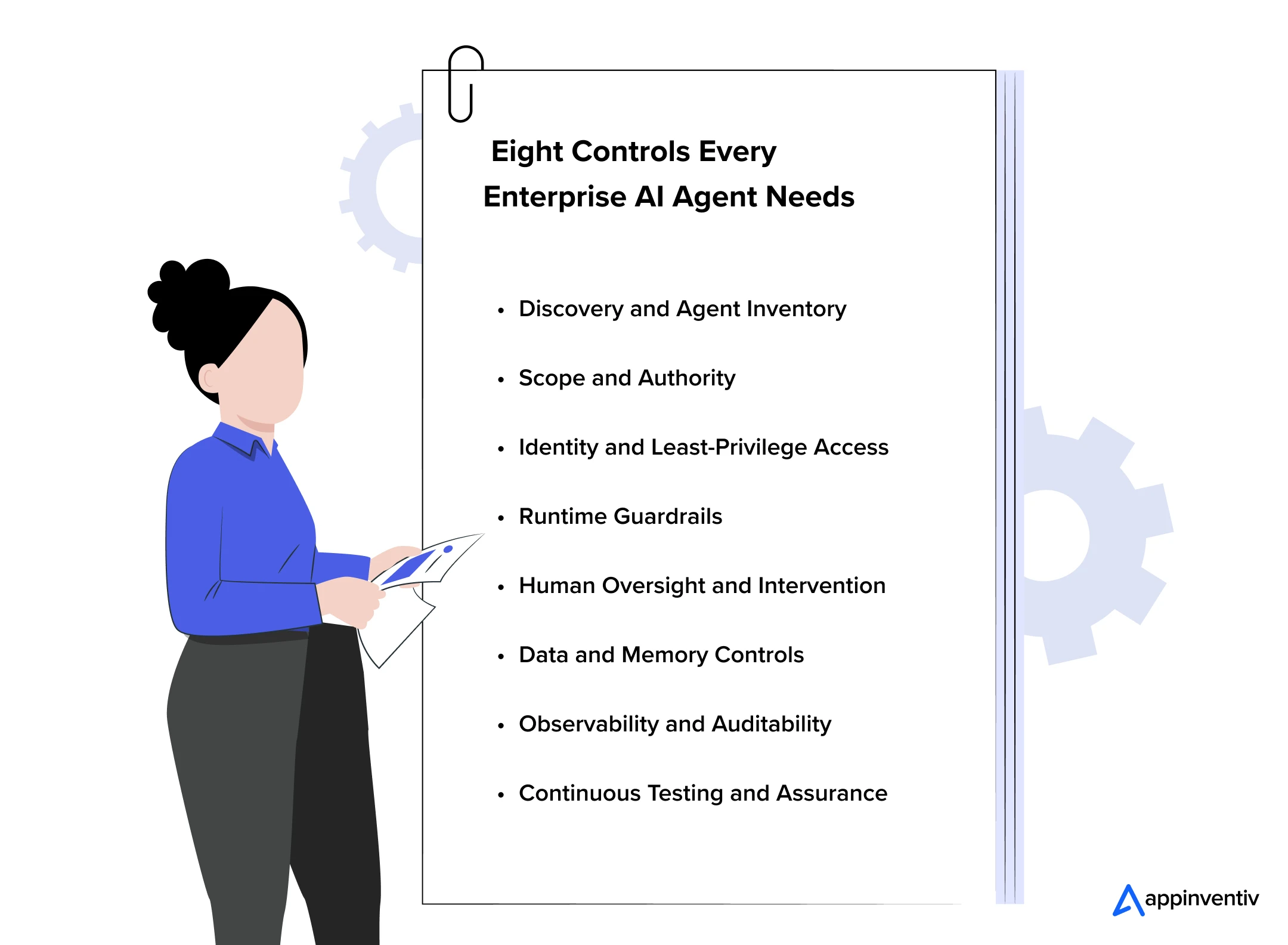
Discovery and Agent Inventory
A business cannot govern agents it cannot see. It needs a current inventory of internally developed agents, third-party agents, low-code deployments, browser-based tools, and unsanctioned experiments.
Each record should capture:
- Agent name, purpose, and version
- Business and technical owners
- Model and orchestration framework
- Connected data, tools, and APIs
- Permissions and machine identity
- Risk level and regulatory scope
- Deployment location and current status
- Last assessment date
Discovery must continue because SaaS features and employee-created tools can introduce shadow agents outside formal development programs.
Scope and Authority
Every agent requires a precise operating boundary. “Support procurement” is too vague. “Compare approved suppliers and prepare purchase recommendations below $50,000” is governable.
The boundary should define tasks, tools, data access, transaction limits, approvals, and escalation conditions. New responsibilities should pass through change control.
Identity and Least-Privilege Access
Agents should not use shared credentials or unrestricted employee accounts. Each agent needs a verifiable machine identity connected to its owner, purpose, permissions, and current version.
Access should be limited by system, record, function, and time. Short-lived credentials and just-in-time authorization reduce standing exposure.
A finance agent may read an invoice but should not change supplier banking details. A service agent may issue a small refund while escalating larger requests.
Runtime Guardrails
Testing cannot predict every situation an agent will encounter. Runtime controls must therefore inspect actions before they reach business systems.
The enforcement layer should determine:
- Who or what initiated the request
- Which agent is attempting the action
- Whether the action supports its approved purpose
- Whether the selected tool and data are permitted
- Whether financial or operational limits apply
- Whether approval is required
- Whether the action is reversible
- Whether behavior differs from its established baseline
This layer should remain independent from the agent’s reasoning. Asking a compromised agent whether its own action is safe does not provide meaningful protection.
Human Oversight and Intervention
Human involvement should reflect risk. Requiring approval for every routine action makes automation expensive. Allowing unrestricted execution exposes the business to unnecessary harm.
| Oversight Mode | How It Works | Suitable Use |
|---|---|---|
| Human in the loop | A person approves before execution | Payments, terminations, legal commitments |
| Human on the loop | The agent acts within limits while people monitor exceptions | Service operations, inventory updates |
| Human out of the loop | The agent independently handles bounded and reversible tasks | Classification, routing, internal summaries |
Every production deployment also needs an emergency stop. Authorized teams should be able to suspend the agent, disable selected tools, revoke credentials, and retain evidence for investigation.
Data and Memory Controls
Agents can expose information through prompts, responses, tool calls, logs, retrieval systems, and stored memory. Controls must follow data throughout the workflow.
Businesses should decide what data an agent may access, where it can be processed, how long it can be retained, and whether it can cross regions.
An AI agent for data governance can assist with classification, lineage, quality checks, and policy monitoring. However, the final authority should remain outside the agent. A system should not be the sole judge of whether its own access is legitimate.
Observability and Auditability
Traditional logs may confirm that an API was called without explaining why the agent selected it. A complete trace should connect the original instruction with retrieved sources, memory access, policy checks, tool calls, approvals, retries, system changes, costs, and the final outcome.
Sensitive information should be masked within traces, and access to audit records should remain restricted.
Continuous Testing and Assurance
Agents require ongoing evaluation against routine, ambiguous, hostile, and changing conditions. Testing should examine goal hijacking, prompt injection, unauthorized tool use, excessive permissions, data leakage, memory manipulation, unexpected code execution, third-party compromise, agent-to-agent deception, and cascading failures..
How an AI Agent Governance Architecture Controls Every Action
An effective AI agent governance architecture sits between agent reasoning and business execution. It enables agents to work across enterprise systems while preventing them from treating every available connection as unrestricted authority. Here are the various layers of the architecture:
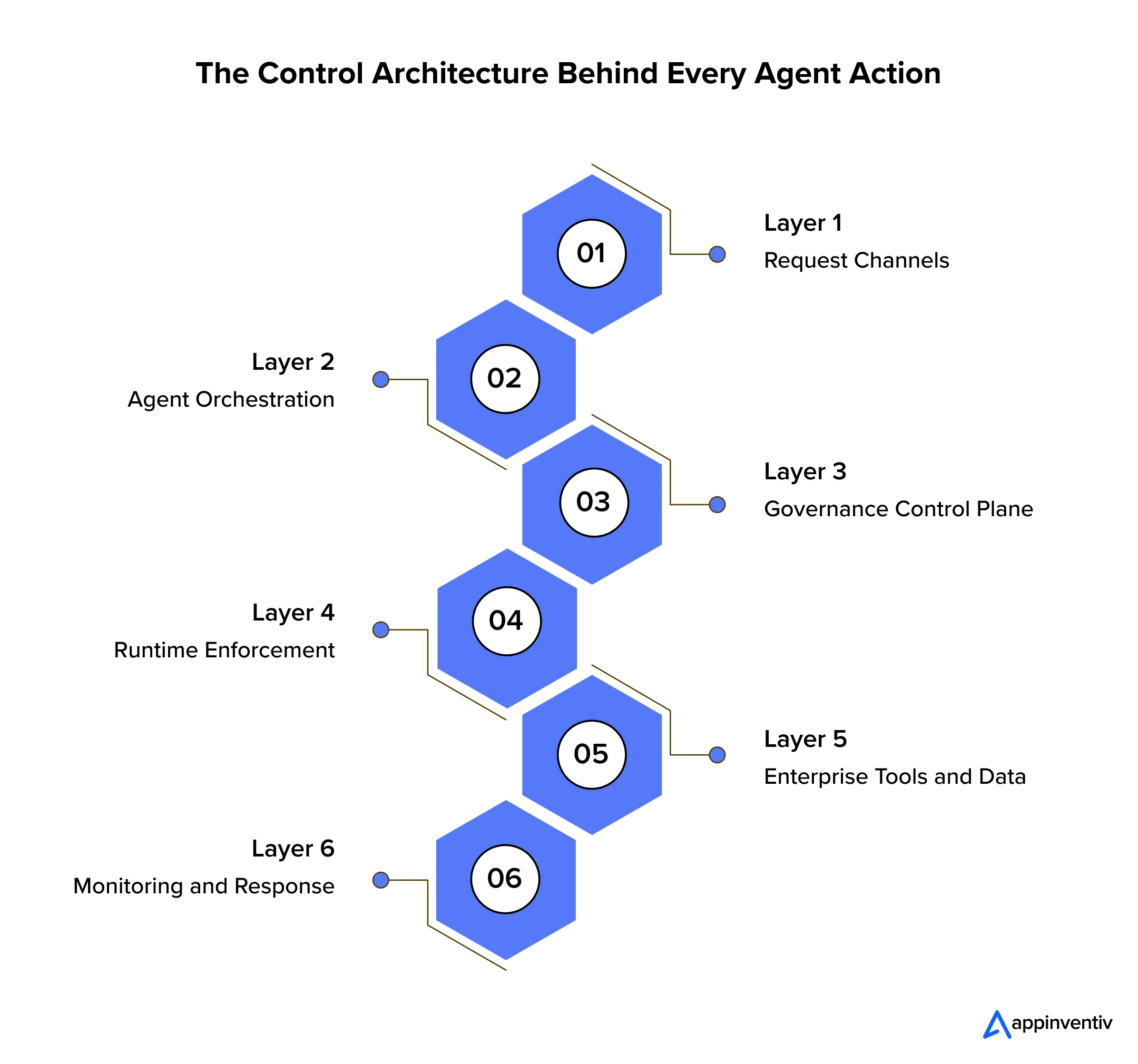
Layer 1: Request Channels
Requests may originate from employees, customers, applications, scheduled events, sensors, or other agents. The business must authenticate the requester and preserve the original intent before the agent begins planning.
Layer 2: Agent Orchestration
This layer manages reasoning, task decomposition, memory, model selection, and agent collaboration. It should carry the agent’s identity and approved purpose throughout the workflow.
Layer 3: Governance Control Plane
The control plane holds the agent registry, risk tier, policy library, approval rules, evaluation records, and ownership information. It helps the enterprise apply consistent controls across models, environments, and business functions.
Layer 4: Runtime Enforcement
A gateway checks prompts, retrieved content, agent messages, and tool calls. It validates identity, authority, data sensitivity, transaction limits, and behavioral signals before allowing execution.
Layer 5: Enterprise Tools and Data
Agents reach ERP, CRM, HR, finance, cloud, code, communication, and data platforms through controlled interfaces. Middleware and protected APIs are particularly important for legacy systems that were not built for autonomous access.
Layer 6: Monitoring and Response
Central monitoring brings together traces, policy violations, security alerts, consumption, and business outcomes. Response controls can isolate an agent, block a tool, revoke access, roll back a transaction, or notify the responsible owner.
The architecture must also create evidence. It should allow the enterprise to reconstruct an action without relying on the agent’s own summary of what happened.
Major Risks Posed by Ungoverned AI Agents
The cost of an ungoverned agent is not limited to a wrong answer. It can repeat an unsafe action at machine speed across several connected systems. The following table connects the primary risks with their business effects and practical controls.
| Risk | How It Affects the Business | Required Control |
|---|---|---|
| Excessive agency | The agent acts beyond its intended role or transaction limit | Scoped permissions and human approval thresholds |
| Goal hijacking | Malicious content redirects the agent from its original task | Input isolation and goal validation |
| Tool misuse | A legitimate tool is used in an unsafe context | Runtime tool-call inspection |
| Identity abuse | Stolen or shared credentials provide excessive access | Unique identities and short-lived credentials |
| Sensitive data exposure | Confidential data enters models, memory, logs, or external tools | Data classification, masking, and DLP controls |
| Memory poisoning | Manipulated memory changes future decisions | Memory validation, source controls, and versioning |
| Insecure agent communication | One agent accepts unauthorized instructions from another | Authenticated messages and delegation limits |
| Cascading failures | An error spreads through connected agents and workflows | Dependency mapping, circuit breakers, and isolation |
| Uncontrolled cost | Loops and repeated calls increase model and API consumption | Budgets, retry limits, and cost alerts |
| Weak accountability | Teams cannot establish who authorized an action | Named ownership and immutable audit trails |
| Human overreliance | Reviewers approve plausible recommendations without scrutiny | Risk-based review supported by complete evidence |
These risks become harder to contain when several agents share data or delegate work. Effective multi-agent governance must authenticate communication, limit delegated authority, prevent repeated loops, record cross-agent decisions, and assign ownership for the final outcome.
How to Build an Operating Model for AI Agent Governance
Technology controls cannot compensate for unclear ownership or fragmented decision-making. Enterprises need an operating model that establishes who owns each agent, who approves high-risk use cases, how risks are classified, and what information reaches business leaders.
The following elements explain how to structure ownership, classify agents by risk, convert governance policies into enforceable rules, and measure whether the program is working as intended.
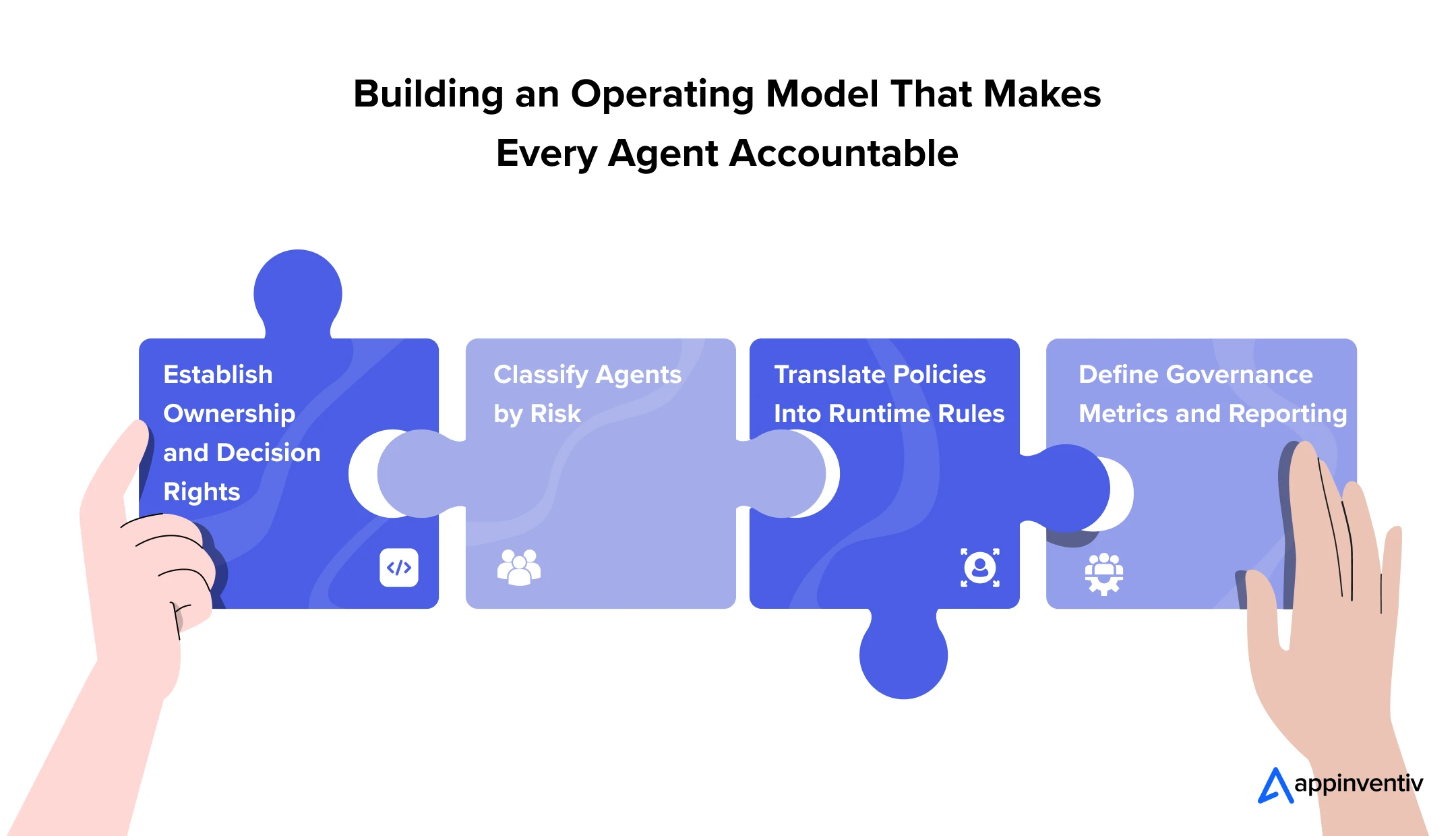
Establish Ownership and Decision Rights
A cross-functional governance group should include business operations, technology, security, data, legal, privacy, compliance, risk, and internal audit. The group defines enterprise standards, approves critical use cases, manages exceptions, and reviews portfolio-level risk.
Each agent still requires named accountability:
- A business owner responsible for the outcome
- A technical owner responsible for performance and reliability
- A data owner responsible for permitted information use
- A security or risk approver for higher-risk deployments
- An incident owner authorized to contain failures
Low-risk cases can follow a standard path, while high-risk agents receive deeper review.
Classify Agents by Risk
Classification should consider what the agent can affect rather than only which model it uses. Important factors include autonomy, data sensitivity, financial authority, customer exposure, reversibility, regulatory impact, transaction volume, system access, and reliance on other agents.
| Tier | Agent Profile | Governance Requirement |
|---|---|---|
| Low | Internal, advisory, and unable to change systems | Registration, basic testing, usage monitoring |
| Moderate | Uses internal data or prepares business actions | Access controls, evaluation, owner approval |
| High | Changes records, contacts customers, or supports material decisions | Runtime enforcement, human oversight, red teaming |
| Critical | Moves funds, alters infrastructure, or affects rights and safety | Executive approval, continuous monitoring, strict intervention |
Reversibility should carry significant weight. Drafting a message creates less exposure than sending it to 50,000 customers.
Translate Policies Into Runtime Rules
AI agent policy governance connects written expectations with controls that operate during execution. “Agents must not make large payments” is not enforceable until the organization defines amounts, exceptions, approvers, and prohibited conditions.
An executable policy might allow an invoice agent to prepare payments up to $10,000, require one approval up to $50,000, and require two approvers above that amount. Any change to beneficiary banking details should block autonomous payment, regardless of transaction value.The agent should never create and approve the same transaction. Policies should cover data, identity, tools, spending, retention, testing, incidents, and retirement. They should be versioned and tested alongside the agent’s code.
You should be able to answer these questions:
- How many agents are running today, and who owns each one?
- What is the most consequential action an agent can take without a human?
- Can we stop any agent within minutes, and prove what it did?
- Which agents come from vendors, and what do we know about them?
- What would we tell a regulator if one of them caused harm tomorrow?
Define Governance Metrics and Reporting
Executives need evidence that the agent portfolio remains controlled and valuable. Reporting should combine risk, performance, and financial measures rather than listing technical alerts alone.
Useful measures include:
- Task completion and exception rates
- Human override frequency
- Policy violations and blocked actions
- Unauthorized tool attempts
- Cost per completed task
- Incident detection and containment time
- Agents without current owners or assessments
- Value produced compared with operating cost
Critical incidents, unresolved exceptions, access expansion, and portfolio costs should reach executive governance forums.
We help you assign ownership, set risk-based approval rules, and give leaders visibility into agent performance, costs, and exceptions.
How Enterprises Can Operationalize AI Agent Governance
Written policies have limited value if they cannot influence how agents behave in live business environments. Enterprises must embed governance into every lifecycle stage, connect it with existing security and compliance controls, and use the right technology to enforce decisions during execution.
The following areas explain how businesses can maintain oversight throughout an agent’s lifecycle, align governance with enterprise security requirements, and select software that supports consistent control at scale.
Govern Agents Across the Business Lifecycle
An agent changes as its models, tools, permissions, data, and responsibilities evolve. AI agent lifecycle governance maintains control across those changes and throughout its working life.
| Lifecycle Stage | Required Governance Activities |
|---|---|
| Proposal | Business case, owner, intended use, initial risk classification |
| Design | Data mapping, authority limits, oversight plan, threat modeling |
| Build | Secure identity, approved components, policy integration, logging |
| Test | Functional evaluation, red teaming, access validation, recovery testing |
| Deploy | Version registration, staged release, approval evidence |
| Operate | Runtime monitoring, cost tracking, incident management |
| Change | Impact assessment, retesting, version control |
| Retire | Access revocation, memory handling, record retention |
Governance requirements should enter the backlog during AI agent governance development, not after the solution is ready for production. Model changes, new tools, expanded permissions, regional deployments, and higher autonomy should trigger reassessment.
Connect Governance With Security and Compliance
Governance defines acceptable use, authority, ownership, and accountability. Security protects agents and connected systems from unauthorized access, manipulation, and attack.
A mature AI agent security governance program should connect identity, API protection, data loss prevention, cloud security, monitoring, incident response, privacy, and vendor risk. This integration forms the foundation of enterprise AI agent governance security.
The NIST AI Risk Management Framework organizes risk activities around Govern, Map, Measure, and Manage. ISO/IEC 42001 establishes requirements for an AI management system, while ISO/IEC 42005 supports AI impact assessments.
These standards provide a base, but AI agent governance frameworks must extend their principles into runtime action. The enterprise must decide whether a specific agent may use a particular tool, access particular data, and perform the requested action at that moment.
Responding to an Agent Governance Incident
When an agent violates a policy or behaves unexpectedly, teams should follow four steps:
- Detect: Identify the issue through monitoring, an alert, or an employee report.
- Isolate: Suspend the agent, disable tools, or revoke credentials to prevent further impact.
- Assess: Trace affected systems, data, transactions, users, and downstream agents.
- Remediate: Reverse recoverable actions, correct the control failure, retest, and document the incident.
The agent should return to production only after the responsible owners confirm that remediation and testing are complete.
Select the Right Governance Software
As deployments expand, spreadsheets and manual approvals become difficult to maintain. For instance, an AI agent governance software gives enterprises a central way to discover agents, manage policies, monitor actions, and retain evidence.
The platform should support:
- Automated agent discovery and inventory
- Risk classification and ownership records
- Machine identity and access integration
- Runtime policy enforcement
- Tool and data-use monitoring
- Human approval workflows
- End-to-end activity tracing
- Evaluation and risk assessments
- Cost and consumption monitoring
- Incident investigation and agent shutdown
The selected AI agent governance software should work across models, clouds, frameworks, and enterprise applications while protecting sensitive traces.
No platform can decide who should own an agent or whether a process should be automated. The strongest governance technology operates inside a clear enterprise operating model.
Emerging Trends Shaping Agent Governance
As enterprises move from isolated pilots to connected autonomous systems, governance practices must evolve. The next phase will focus on verified identities, real-time enforcement, centralized control, continuous evaluation, and financial oversight.
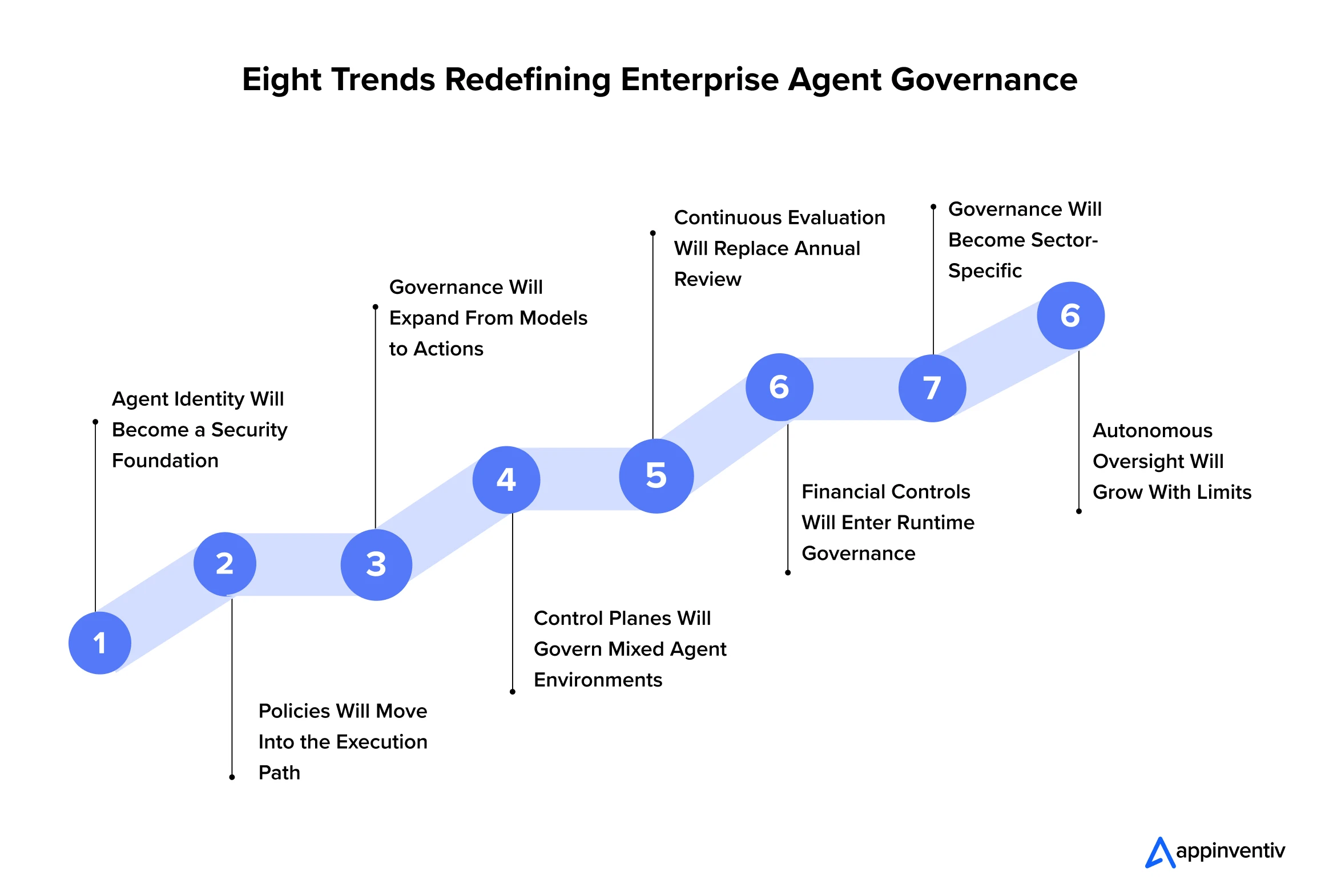
Agent Identity Will Become a Security Foundation
Enterprises are beginning to treat agents as non-human identities instead of software features. Each agent will need its own credentials, entitlements, owner, and activity history.
Identity teams will need to support short-lived agents, task-specific permissions, automated reviews, and immediate revocation.
Policies Will Move Into the Execution Path
Static documents are giving way to policy-as-code. Rules can assess actions against identity, data sensitivity, value, location, and business context before execution.
Governance Will Expand From Models to Actions
Early governance programs focused on model accuracy, bias, explainability, and training data. Agent oversight must also examine planning, memory, tools, transactions, and downstream consequences.
The primary governance question is shifting from “Which model did we use?” to “What action occurred, under whose authority, and with what result?”
Control Planes Will Govern Mixed Agent Environments
Central control planes will help businesses apply consistent policies across internal, cloud, SaaS, and specialist agents.
NIST’s 2026 standards initiative reflects this growing focus on secure agent operation and interoperability across the digital ecosystem.
Continuous Evaluation Will Replace Annual Review
Agent behavior can change after model updates, tool changes, or shifts in retrieved data. Enterprises will increasingly use production traces, simulated attacks, regression tests, and outcome data to evaluate agents continuously.
Financial Controls Will Enter Runtime Governance
Cost management will move beyond token dashboards. Policies will set budgets by agent, business unit, model, and task. Retry limits and loop detection will stop agents that consume resources without completing work.
Governance Will Become Sector-Specific
Banks, healthcare organizations, manufacturers, retailers, and government bodies face different risks. Shared controls will remain useful, but sector-specific rules will govern financial authority, clinical decisions, industrial safety, consumer rights, and public accountability.
Autonomous Oversight Will Grow With Limits
Monitoring agents will detect anomalies, review traces, identify policy conflicts, and recommend intervention. This can make autonomous AI governance more responsive at scale.
However, oversight agents should not receive unlimited authority over the systems they inspect. Independent controls, human escalation, and external evidence will remain necessary.
How Much Does Agent Governance Cost?
The cost depends on the number of agents, their autonomy, regulatory exposure, and the depth of integration with business systems. A limited implementation for a small set of internal agents may cost $40,000 to $100,000. A multi-department program may range from $100,000 to $300,000. A global platform covering critical workflows, custom integrations, continuous testing, and advanced controls may cost $300,000 to $500,000 or more.
These are planning estimates rather than fixed prices.
| Implementation Level | Typical Scope | Estimated Investment |
|---|---|---|
| Foundation | Inventory, policies, risk tiers, and pilot controls | USD $40,000-USD $100,000 |
| Multi-department | Central governance, integrations, and runtime policies | USD $100,000-USD $300,000 |
| Enterprise-scale | Global control plane, critical agents, and advanced monitoring | USD $300,000-USD $500,000+ |
Major cost components include strategy, discovery, risk assessment, architecture, identity, policy configuration, integrations, observability, testing, approvals, and training.
Recurring costs include licenses, cloud and model usage, log storage, testing, assessments, and governance personnel.
A dedicated AI governance consulting services provider can help enterprises define the right scope, select suitable controls, avoid unnecessary platform costs, and create an implementation roadmap aligned with their risk profile and business priorities.
How Governance Improves the Return on Agent Investments
Governance is often viewed as an added compliance cost. In practice, it can improve the economics of agent deployment. Clear limits, dependable data access, and automated checks reduce the effort spent reviewing routine actions or fixing avoidable mistakes.
It also allows enterprises to compare operating costs with business outcomes. Underperforming agents can be improved, restricted, or retired instead of consuming resources indefinitely.
How Stronger Governance Improves AI Agent ROI
Governance pays back in three places you can measure:
- Cost per completed task, including model, tool and human-review cost
- Review hours avoided, by auto-approving low-risk, reversible actions
- Incident cost avoided, using your own reversal and rework figures
Track these before and after. If an agent costs more than it saves, governance is what lets you see that and retire it.
How to Implement AI Agent Governance Across the Enterprise
Implementation does not require businesses to pause every initiative or build all controls at once. A phased approach allows teams to address the highest-risk deployments first and create reusable patterns for future agents.
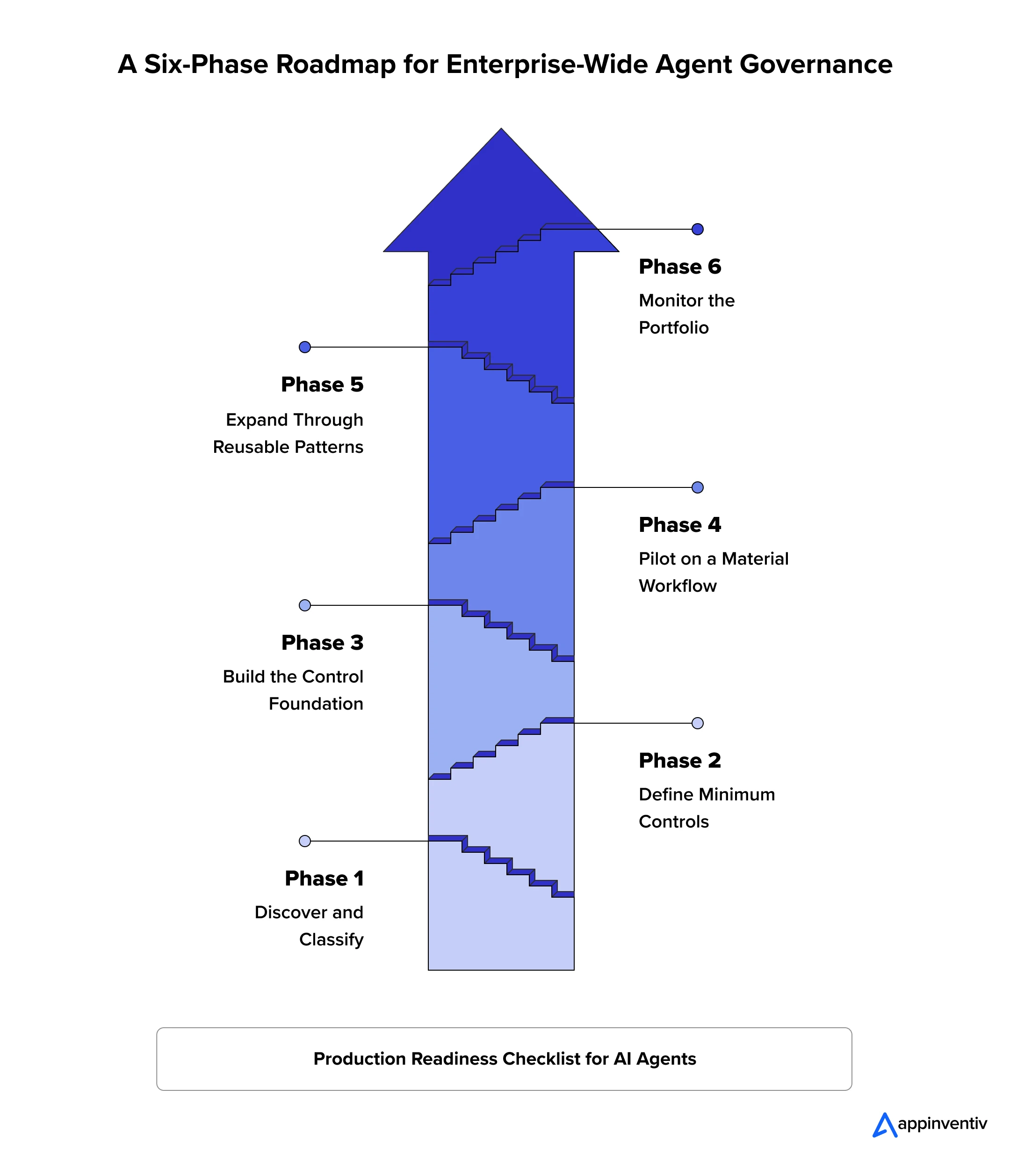
Phase 1: Discover and Classify
Build the inventory, identify owners, document connected systems, and assign provisional risk tiers. Start with agents that change records, communicate externally, move funds, or access sensitive information.
Phase 2: Define Minimum Controls
Set mandatory requirements for identity, access, logging, testing, human oversight, incident response, and retirement. Identify capabilities that remain prohibited until stronger controls exist.
Phase 3: Build the Control Foundation
Connect the agent registry with identity, policy enforcement, monitoring, approval, and security platforms. Standardize the protected interfaces through which agents reach enterprise tools.
Phase 4: Pilot on a Material Workflow
Choose one agent with measurable value and manageable risk. Run it through the complete process, including adversarial testing, limited production access, monitoring, and emergency shutdown.
Phase 5: Expand Through Reusable Patterns
Create approved designs for recurring use cases such as document processing, customer support, software delivery, analytics, and internal operations. Reuse controls while reassessing each agent’s specific risk.
Phase 6: Monitor the Portfolio
Track ownership, outcomes, costs, overrides, incidents, and policy violations across all agents. Review critical agents frequently and reassess them after material changes. This makes AI agent lifecycle governance measurable in daily operations.
This staged approach turns autonomous AI governance into a working business capability rather than a one-time documentation project.
Enterprise Agent Governance Readiness Scorecard
A proposed self-assessment for CIOs, CTOs, CISOs and AI program leaders.
- Agent visibility
Can we identify all deployed agents, including third-party and employee-created agents?
0 – Not in place
1 – Partially implemented
2 – Defined and operational
- Identity and authority
Does every production agent have a verifiable identity, named owner and defined permissions?
0 – Not in place
1 – Partially implemented
2 – Defined and operational
- Runtime enforcement
Are tool calls and material actions checked against enforceable policies before execution?
0 – Not in place
1 – Partially implemented
2 – Defined and operational
- Human accountability
Are approval thresholds, exception owners and emergency intervention rights explicit?
0 – Not in place
1 – Partially implemented
2 – Defined and operational
- Cross-agent governance
Can we trace delegation, data transfers and authority across agent-to-agent workflows?
0 – Not in place
1 – Partially implemented
2 – Defined and operational
- Monitoring and evidence
Can we reconstruct material actions and independently verify their outcomes?
0 – Not in place
1 – Partially implemented
2 – Defined and operational
- Economics and value
Do we measure cost per completed task, exception rates and realized business value?
0 – Not in place
1 – Partially implemented
2 – Defined and operational
- Lifecycle assurance
Do material changes trigger reassessment, testing and access reviews?
0 – Not in place
1 – Partially implemented
2 – Defined and operational
Answer all eight questions to generate your score and assess your Enterprise Agent Governance Readiness.
Production Readiness Checklist for AI Agents
Before granting production access, confirm that:
- The agent has an approved purpose and named owner.
- Its risk level and prohibited uses are documented.
- It uses a unique identity with limited permissions.
- Permitted tools, data sources, and actions are defined.
- Human approval thresholds are active.
- Adversarial and failure testing is complete.
- End-to-end logging is working.
- Cost limits and behavioral alerts are configured.
- Incident and shutdown owners are identified.
- Retirement and access-revocation procedures exist.
The checklist is a minimum release gate. Critical agents may require independent validation, sector-specific testing, and executive approval.
Explore how we design, secure, integrate, and govern autonomous systems for enterprise deployment.
AI Agent Governance Mistakes That Leave Enterprises Exposed
Governance can fail when businesses reuse processes designed for chatbots, conventional software, or employees. These gaps may remain hidden in a pilot but become serious after agents gain live data and transaction authority.
| Common Governance Mistake | Why It Creates Risk | Practical Way to Avoid It |
|---|---|---|
| Treating an agent like a chatbot | Agents can change records and trigger transactions, not just generate content | Classify systems according to their ability to act |
| Giving agents human-level access | Employee permissions usually exceed the agent’s task | Assign separate identities and task-specific access |
| Placing every control inside the prompt | Prompts cannot reliably enforce permissions or limits | Use an independent runtime enforcement layer |
| Logging only the final response | Final output hides retrieved data and attempted actions | Capture the complete request-to-action trace |
| Using one approval process for every agent | Low-risk work slows while critical actions remain under-controlled | Match approvals to autonomy, data, and impact |
| Ignoring third-party agents | SaaS agents may access sensitive data without adequate visibility | Include them in inventory, vendor review, and monitoring |
| Ending governance at deployment | Models, tools, permissions, and data continue to change | Maintain reassessment, testing, versioning, and retirement controls |
How Appinventiv Helps Enterprises Govern Autonomous Agents
Governing autonomous agents requires more than adding security checks after development. Businesses need a team that understands agent engineering, enterprise architecture, cybersecurity, data governance, compliance, and system integration. Appinventiv brings these capabilities together to help enterprises build agents that can operate safely across complex technology environments.
Our AI agent development services team begins by examining the business decisions and actions each agent will handle. We map its data access, connected tools, transaction authority, approval points, and potential failure scenarios. This groundwork helps establish an AI agent governance model aligned with the organization’s operations, risk appetite, and regulatory responsibilities.
We develop AI agent governance solutions that combine secure machine identities, least-privilege access, runtime policy enforcement, human approval workflows, end-to-end observability, and incident controls. These safeguards are integrated into the architecture rather than added after deployment.
Our approach to AI agent governance development also supports enterprises operating across multiple models, cloud environments, data platforms, and business applications. We design centralized control mechanisms that apply consistent policies while integrating with existing ERP, CRM, identity, security, and monitoring systems.
From initial risk assessment and governance architecture to testing, implementation, and continuous improvement, Appinventiv helps businesses establish accountability at every stage. This allows enterprises to scale autonomous agents with greater control, stronger security, and clear evidence of how every important action was authorized.\
For enterprises implementing agent governance, the work typically spans architecture, identity and access, security, data governance, runtime controls, enterprise integration, testing, and ongoing monitoring. Appinventiv specializes in AI agent development services and works across these layers to help organizations design and implement agentic systems with governance controls embedded into the architecture rather than added after deployment.
FAQs
Q. How Do You Implement AI Agent Governance in Enterprise Software?
A. Implementation begins by identifying what the agent can access, decide, and change within the software. Governance controls should then be embedded into the agent’s identity, data access, tool connections, approval workflows, and monitoring processes.
The implementation should include:
- Registering the agent with a named business and technical owner
- Defining permitted tasks, tools, data, and transaction limits
- Assigning a unique identity with least-privilege access
- Applying runtime rules before actions reach business systems
- Requiring human approval for high-impact decisions
- Recording prompts, tool calls, approvals, and completed actions
- Testing the agent before deployment and after material changes
- Establishing incident response and emergency shutdown procedures
Q. What Are the Best Practices for AI Agent Governance Frameworks?
A. Effective AI agent governance frameworks combine organizational accountability with technical controls that work during execution. They should govern the complete agent workflow rather than concentrating only on model accuracy or output quality.
Important practices include:
- Maintaining a continuously updated agent inventory
- Assigning clear ownership and decision rights
- Classifying agents according to autonomy and potential impact
- Enforcing unique identities and task-specific permissions
- Converting written policies into machine-enforceable rules
- Monitoring agent behavior, costs, and business outcomes
- Testing for prompt attacks, tool misuse, and data exposure
- Reassessing agents when models, tools, or permissions change
- Retiring unused agents and revoking their access
Q. How Do You Integrate AI Agent Governance Into Existing Business Systems?
A. Governance can be integrated with ERP, CRM, and internal tools through protected APIs, policy gateways, identity systems, and approval workflows. The governance layer should inspect an agent’s request before allowing it to read data or change a business record.
A practical integration approach involves:
- Mapping the agent’s data and system interactions
- Replacing direct connections with controlled APIs or middleware
- Connecting agent identities with enterprise access management
- Applying transaction and permission limits at runtime
- Routing sensitive actions through existing approval workflows
- Sending agent activity to security and monitoring platforms
- Preserving end-to-end traces for compliance and audit
- Using abstraction layers when legacy systems lack secure APIs
Q. How Do You Establish an AI Agent Governance Framework?
A. Start with one high-value use case rather than attempting to govern every possible agent at once. Use that implementation to define ownership, policies, risk tiers, technical controls, and deployment requirements that can later be reused across the enterprise.
The process should cover:
- Creating a cross-functional governance team
- Discovering existing and planned agents
- Assigning business and technical owners
- Establishing agent risk classification criteria
- Defining minimum security and oversight requirements
- Building standard testing and approval procedures
- Selecting governance and monitoring technology
- Piloting the framework on a controlled workflow
- Measuring results and improving controls before expansion
Q. How Can Appinventiv Help Businesses Govern Autonomous AI Agents?
A. Appinventiv helps enterprises design and implement governance as part of the agent architecture rather than adding it after deployment. Our teams combine AI engineering, cybersecurity, enterprise integration, data governance, and compliance expertise to establish dependable controls across connected business systems.
Our support includes:
- Assessing agent use cases, risks, and autonomy requirements
- Designing the governance operating model and architecture
- Establishing machine identities and access boundaries
- Integrating runtime policies and human approval workflows
- Connecting agents securely with ERP, CRM, cloud, and data systems
- Implementing observability, audit trails, and cost monitoring
- Testing agents against misuse, manipulation, and workflow failure
- Supporting controlled deployment and continuous improvement


Fast 2-minute response, fully NDA-protected.

'I.D.E.A.S.' - The Five Pillar Framework to Ace AI-Native Enterprise Apps in 2027
Key takeaways: AI-native enterprise apps are moving beyond AI agents toward intelligent, adaptive, autonomous and context-aware digital capabilities that can operate across mobile, web, voice, wearables and emerging interfaces. The I.D.E.A.S. framework for AI enterprise apps in 2027 - Interactive Intent, Decisioning Autonomously, Experiential System Design, Adaptive Execution, and Security Layered. Context intelligence and reusable…

Automated Decision-Making in Australia: Benefits, Cost and Implementation
Key takeaways: Automated decision-making combines rules, algorithms, AI and human oversight to improve high-volume decisions. ADM programmes require privacy, security, auditability and accountability to be designed into architecture. ADM implementation costs typically range from AUD 70,000 to AUD 700,000 or more. Implementation starts with decision mapping, then moves through development, testing, controlled pilots and monitoring.…
AI Red Teaming Attack Strategies: Jailbreak, Crescendo, Base64 & More Explained
Key takeaways: Jailbreak testing must follow the full execution path from prompt and context to retrieval, tools, and enterprise APIs. Crescendo and adaptive attacks expose failures that single-turn testing misses by exploiting conversation history and model feedback loops. Base64 and Unicode tests probe gaps in normalization, tokenization, filtering, and decoding before adversarial input reaches model…