
























Diet and Nutrition App Development: Process, Features, Cost, and Technology Stack

 Share -



- 01Main Types of Diet and Nutrition Platforms
- 02Diet and Nutrition App Development Process
- 03Key Features of Diet and Nutrition Platforms
- 04Technology Stack for Diet and Nutrition Platforms
- 05Use Cases for Diet and Nutrition Platforms
- 06Advanced AI Capabilities in Diet and Nutrition Platforms
- 07Business Benefits of Nutrition Platforms
- 08Challenges in Diet and Nutrition App Development
- 09Diet and Nutrition App Examples and Success Factors
- 10Diet and Nutrition App Development Costs
- 11Diet and Nutrition App Development Timelines
- 12Monetization Models for Diet and Nutrition Platforms
- 13How Appinventiv Can Help Develop a Diet and Nutrition Tracking App
- 14Frequently Asked Questions

Key Takeaways
- Diet and nutrition tracking app development goes past basic calorie counters with verified food databases, custom meal schedules, AI tools, wearable device links, and corporate manager tools.
- Structure database models around raw food items, serving portions, nutrient facts, recipes, software links, and regional diet rules.
- Pair computer vision models, recommendation algorithms, language engines, and strict rule layers to deliver safe user personalization.
- Test nutrition math, AI predictions, software connections, security settings, and external vendor files before live production releases.
- Enterprise platforms cost over $500K when projects include AI capabilities, external software connections, privacy compliance, and multi-tenant rules.
Diet and nutrition app development requires far more than basic meal logs and calorie counters. Enterprise products need verified nutrition databases, custom meal schedules, wearable data feeds, and server backends built for high user activity.
Development begins with product scoping, user research, data modeling, and system architecture. Engineering teams connect mobile client apps to food catalogs, health devices, payment gateways, and cloud servers. Artificial intelligence supports meal photo scanning, custom food recommendations, and automated diet coaching.
The market is projected to reach $4.6 billion by 2030. System security guards user identities, consent permissions, database encryption, access roles, and audit trails. Regional privacy laws dictate compliance rules based on your business model and target markets.
This guide shows you how to develop a diet and nutrition tracking app, covering product models, key features, AI tools, and practical use cases. It covers engineering lifecycles, technology stacks, technical challenges, costs, timelines, and revenue structures.
Build around AI, nutrition data, wearables, and enterprise workflows before competitors lock in market share.

Main Types of Diet and Nutrition Platforms
Your product model dictates required features, data structures, and diet and nutrition app development plans. Six product categories dominate current markets.
Calorie and Nutrition Trackers
These platforms log daily meal intake. Users record items with barcode scans, search, voice commands, or photos. The system calculates calories, proteins, fats, carbs, and daily targets from the entry.
Meal Planning and Recipe Apps
Diet and nutrition planning app development turns goals into daily meal plans. Algorithms rank recipes based on diet rules, allergies, targets, ingredients, and portion sizes. Auto-generated shopping lists link meal plans to retail purchasing systems.
Fitness and Nutrition Platforms
These platforms combine food logs with activity, sleep, and heart metrics, similar to how a fitness and nutrition app like MyFitnessPal operates. Mobile operating systems, wearable devices, and smart scales send activity logs to the central engine. The platform then compares energy intake against burned calories.
Condition-Specific Nutrition Apps
These tools address defined health needs like diabetes, high blood pressure, or severe allergies, often built alongside a dedicated diabetes management app. Data models require precise food rules, restricted lists, warnings, and verified recommendations. Medical cases need extra regulatory review.
Coaching and Dietitian Platforms
These systems connect patients with credentialed nutritionists using chat, video calls, care plans, and shared records. Database systems use role-based security. Patients and providers see relevant data for their exact needs.
Enterprise Wellness Platforms
These platforms serve employers, health providers, insurers, and wellness brands. They require multi-tenant architectures, organization management, single sign-on, consent tracking, and enterprise reporting. Multi-tenancy lets one software platform host separate client rules, user groups, data policies, and workflows without building individual applications.
Diet and Nutrition App Development Process
Production nutrition software demands more than user screens. Engineering teams build database models, connection channels, AI tools, security protocols, and operational workflows before launch. Standard development proceeds from product scope definition to long-term server management.
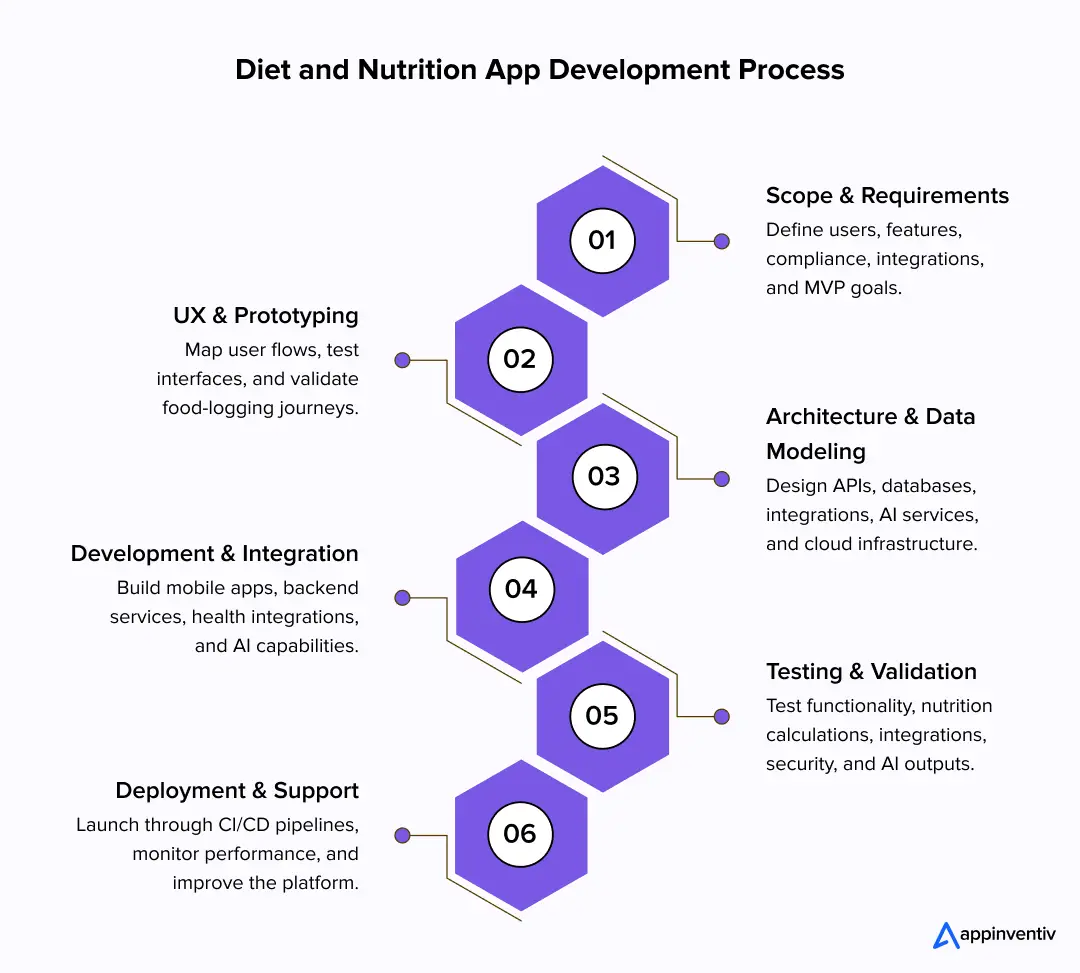
Step 1 – Scope Definition and Requirements
Teams define core user profiles, business monetization models, targets, and daily workflows. Product managers map custom diet and nutrition app development requirements directly to actions like recording meals, checking calorie totals, building dinner schedules, or booking consultation sessions.
Product leaders create priority charts and separate initial launches from future updates. Technical leads evaluate privacy laws during this phase. They assess data types, target regions, clinical partnerships, and planned software connections. The core specifications document defines target stories, acceptance rules, database needs, external software links, and clear release milestones.
Step 2 – User Experience Research and Testing
Food logging occurs multiple times per day. Extra clicks slow down user routines. User research identifies where people drop off, which logging methods work best, and how users read daily nutrient totals. Design teams test clickable wireframes before diet and nutrition tracking mobile app development begins.
Accessibility controls cover font sizing, color contrast, touch target sizes, screen readers, and app navigation. Regional settings account for language, weight units, currencies, local food names, and cultural meal patterns. Designers validate main user paths through usability testing before locking down visual assets.
Step 3 – System Architecture and Database Models
Diet and nutrition tracking app development relies on system architecture that handles transaction streams, health records, nutrition catalogs, analytics platforms, and external links without rigid interdependencies.
The backend relies on standalone modules for identity, user profiles, food records, target calculations, meal planning, paid accounts, alerts, and report generation. REST and GraphQL interfaces provide protected entry to these background services. The database structure maps links between food items, ingredients, portion sizes, nutrients, recipes, complete meals, and user accounts.
PostgreSQL databases handle main user transactions. Redis cache layers store popular food entries and active user sessions. Integration layers shield external APIs from internal logic. This setup prevents API changes, server drops, and partner format shifts from breaking central operations. AI processing runs on isolated servers. Model runs, dataset prep, prompt routing, and accuracy checks stay outside standard transaction paths.
Step 4 – User Interface Design
Approved wireframes expand into a structured design kit with standardized buttons, component states, fonts, screen paths, and accessibility standards. Interface layouts help users complete actions fast.
A person can log recurring meals, adjust portion weights, or view daily totals without clicking through multiple menus. Detailed metrics use layered views. Primary health numbers appear on main screens, and deep nutrient breakdowns rest in detailed submenus.
Step 5 – App and Server Engineering
Diet and nutrition tracking mobile app development teams code client applications using Swift, Kotlin, Flutter, or React Native. Backend teams build API endpoints, access systems, core rules, data processing paths, and admin features. OAuth 2.0 and OpenID Connect handle identity workflows.
Role-based permission systems restrict access to sensitive features and private user files. Server routines validate input data, check user permissions on every action, and write audit entries for sensitive account changes. Admin tools let staff manage app content, user accounts, paid subscriptions, food databases, provider profiles, and operational metrics.
Step 6 – System Connections and AI Tools
Engineers connect verified food databases, Apple HealthKit, Google Health Connect, fitness wearables, payment processors, and required third-party tools. Data pipelines clean and normalize input records. Third-party vendors use different units, item IDs, timestamps, and weight formats.
Standard internal schemas prevent format errors from spreading across system services. AI integration connects image vision tools, AI diet planner engines, and language models to standard product features. Rules engines review AI suggestions before displaying results to end users.
Step 7 – Software Testing and Data Validation
Quality checks cover more than code bugs. Testing teams verify nutrient math, unit conversions, ingredient totals, barcode lookups, and device data synchronization. Automated test scripts check API responses, core rules, math outputs, and legacy features. Connection tests check external vendor feeds and wearable sync paths.
Stress tests measure backend response times under heavy user traffic. Security reviews check login flows, permissions, API endpoints, session tokens, encryption layers, and code vulnerabilities. AI components use separate validation datasets. Quality teams track photo identification accuracy, portion sizing errors, suggestion relevance, response quality, and output safety.
Step 8 – Security, Compliance, and Launch Checks
Data teams link stored records to defined operational needs. Encryption guards user data during transmission and inside database storage. Security keys, secret tokens, access rules, log files, and storage timelines form the baseline production configuration. Compliance needs depend on business structures and geographical territories.
Legal checks review GDPR, UK GDPR standards, HIPAA privacy rules, CCPA policies, and state consumer laws. Launch readiness reviews verify privacy policies, user consent forms, account deletion paths, vendor contracts, security settings, and app store compliance rules.
Step 9 – Cloud Deployment and Production Support
Engineering teams ship updates using automated deployment scripts across development, staging, and live production environments. Cloud servers host containers on Amazon Web Services, Microsoft Azure, or Google Cloud. System monitoring combines server logs, system metrics, transaction traces, crash reports, and infrastructure alerts.
Tech teams track API errors, database queries, sync delays, and vendor uptime. AI deployments require continuous performance monitoring post-launch. Food catalog sources receive similar monitoring for missing items, record updates, and data errors. Teams that develop a diet and nutrition tracking app guide future feature updates using app telemetry, user tickets, error logs, and controlled feature tests.
Key Features of Diet and Nutrition Platforms
Strong features cut manual food logging, improve daily calculation accuracy, and give users clear metrics from eating logs. Enterprise platforms add controls for system management, clinical workflows, software links, and user permission rules.
User Profiles and Target Setting
Profiles store core user details. Systems save age, height, weight, activity levels, and food allergies. The application calculates target metrics using standard BMR formulas. Users update goals over time, and the system saves history. Data consent controls sit in separate settings menus.
Food Logging and Database Syncing
Logging options must remain fast. Users find items through search tools, recent lists, barcode scans, or manual weight entries. Every entry maps to structured nutrition facts. These facts record calories, protein, fats, carbs, fiber, and vitamins. Standard units keep measurements uniform across grams, ounces, and portions. Barcode scanners pull product data from external catalog databases. Users confirm details before adding items to daily records.
AI Features and Smart Planning
In AI-powered diet and nutrition apps, image vision models identify food items in photos. They estimate portion sizes and return confidence ratings. Rules engines block forbidden ingredients like allergens. Large language models process custom requests for recipe swaps. Retrieval systems feed vetted nutritional guides to the AI. What keeps these suggestions safe? Rules engines override AI output on high-risk items.
Recipe Engine and Schedules
Diet and nutrition planning app development includes a recipe system that saves ingredients, steps, portions, and dietary labels. The app updates total nutrition facts whenever users alter portion sizes. Meal planners connect recipes to weekly schedules. This data fills digital shopping lists and triggers cooking reminders.
Health Integrations and Progress Tracking
Dashboards display calorie intake, body weight, water consumption, and sleep metrics. Dedicated time-series databases store daily and monthly trends. Apple HealthKit and Google Health Connect feed wearable device data directly into the application. The system unifies unit types and timestamps before saving records.
Professional Coaching and Alerts
Dietitians review client logs, progress charts, and meal plans using manager roles. Built-in chat and video modules allow direct appointments. Automated alerts remind users to log meals and drink water. Account settings let users manage notification types and alert schedules.
Also Read: How Chatbots Are Shaping Healthcare Engagement
Billing Systems and Admin Controls
Payment tools manage subscriptions, family accounts, corporate plans, and invoices. Business administrators manage user bases, custom recipes, and content libraries from a central panel. Corporate platforms add audit logs, organization metrics, and safety checks for AI responses.
Technology Stack for Diet and Nutrition Platforms
Your custom diet and nutrition app technology stack choices must match projected data volumes, required integrations, AI workloads, and target platforms. A simple barcode tracker needs minimal server setup. Continuous device synchronization, real-time AI coaching, and dietitian workflows demand broader cloud infrastructure.
| Layer | Recommended Options |
|---|---|
| Mobile | Swift, Kotlin, Flutter, React Native |
| Backend | Node.js, Python, Go |
| APIs | REST, GraphQL |
| Database | PostgreSQL, MongoDB, Redis |
| AI Models | Python, PyTorch, TensorFlow |
| Language Models | OpenAI API, LangChain, LlamaIndex |
| Vector Storage | pgvector, vector databases |
| Cloud Infrastructure | AWS, Azure, Google Cloud |
| Health Integration | Apple HealthKit, Google Health Connect |
| Data Analytics | Data warehouses, BI tools |
| System Security | Identity management, encryption, key storage |
| Operations | CI/CD pipelines, containers, monitoring systems |
Use Cases for Diet and Nutrition Platforms
One underlying engine powers multiple diet and nutrition tracking app development business models. Target groups require distinct workflows, data sources, and user access permissions.
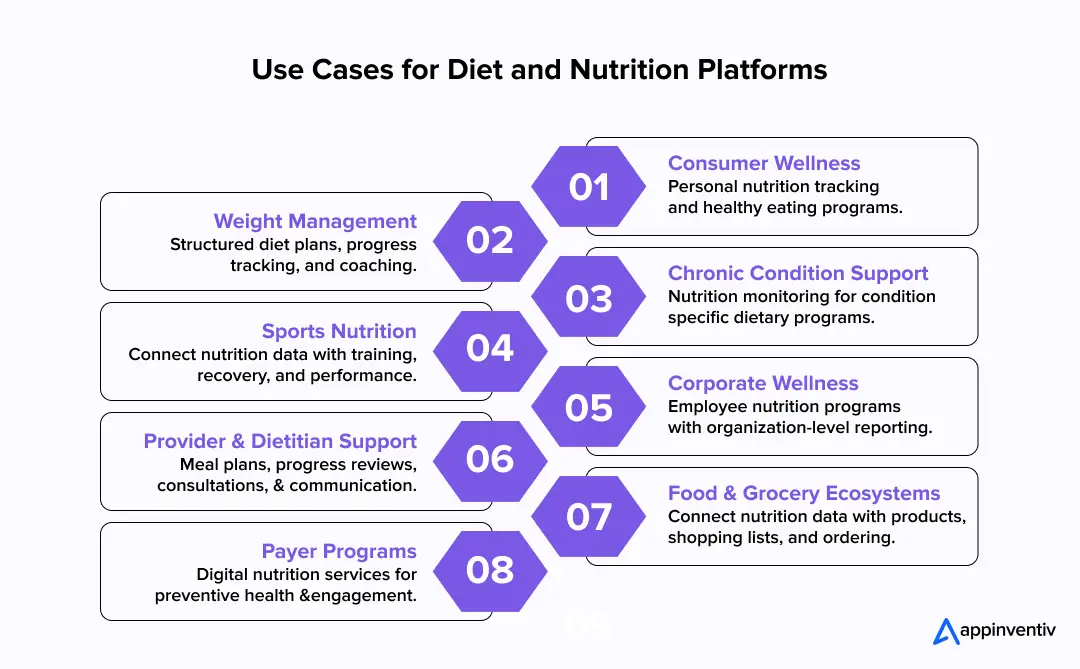
Consumer Health and Wellness
Consumer applications track daily food intake and personal health targets. Health and fitness apps reached 3.6B global downloads, up 6% year over year. Product teams study aggregate usage trends to improve meal suggestions, content, and engagement.
Weight Management
Weight management systems combine food intake, daily activity, body measurements, and target metrics. Businesses run structured wellness programs through these applications. Program managers track compliance and connect users directly with human coaches.
Chronic Condition Support
Health organizations manage targeted diet plans for conditions like diabetes and high blood pressure, an approach also seen in dedicated chronic disease management tools. Platforms log specific nutrient levels, flag risky trends, and share reports with approved doctors. Clinical deployments require medical board approvals and safety reviews.
Sports and Performance Nutrition
Athletic teams merge food logs with training metrics, daily activity, sleep quality, and recovery scores, the same data mix used in a fitness app like Strava. Trainers and athletes analyze total performance datasets to match nutrition targets with competition goals.
Corporate Wellness Programs
Companies offer nutrition software as an employee benefit. Enterprise platforms include company administration panels, team enrollment tools, and group reporting features. System managers track company-wide progress without seeing private individual records.
Provider and Dietitian Support
Dietitians and medical teams review client food logs, assign meal plans, check progress, and text patients through a connected patient engagement software layer. Role-based security permissions isolate clinical management screens from standard consumer views.
Food and Grocery Systems
Grocery stores and delivery services link nutritional data to product inventories, recipes, and digital carts. Users choose a weekly meal plan, pick ingredients, and purchase groceries in one continuous process.
Payer and Preventive Health Programs
Insurance companies run preventive wellness initiatives using digital diet tools, often as part of broader healthcare data security planning. What protects patient privacy in population reports? Security systems strip personal identifiers before sharing group health trends. Data feeds user coaching, risk scoring, and enterprise reporting.
Advanced AI Capabilities in Diet and Nutrition Platforms
AI-powered diet and nutrition apps cut manual data entry and improve custom user advice. Each model performs a clear, assigned job. Image vision models detect plate photos. Recommendation engines rank foods. Language models process text chat. Rules engines enforce fixed diet boundaries.
Photo Recognition and Portion Sizing
Image recognition models scan meal photos and estimate weights, a capability rooted in broader computer vision in healthcare applications. Systems assign confidence scores to predictions. A 2025 trial identified 86% of dishes correctly. What happens with unclear plate photos? The system asks users to confirm or edit food items and weight values. User edits create test data for future model updates.
Custom Recommendation Engines
Recommendation models order meals, single items, and recipes based on target metrics, taste choices, past logs, and daily workout activity. Hard-coding rules block forbidden items like known allergens or flagged ingredients. Machine learning algorithms rank safe choices using past user activity patterns.
Language Assistants and Guided Search
Language engines handle user questions about recipe swaps, missing ingredients, and approved food content. Retrieval systems connect models to verified nutrition files, recipe stores, and brand guidelines. High-risk medical questions move outside automated chat channels to trigger human dietitian referrals.
Habit Prediction and Retention
Machine learning algorithms track logging frequency, skipped meals, target metrics, and user activity. These signals guide alert timing, coaching actions, and app retention tools. Tech teams track model accuracy using standard metric targets.
System AI Pipeline Architecture
Data moves through a clear engineering path: User logs → data processing → strict rules → prediction model → output checks → user display → user edits.
Keep prediction execution separate from transactional core services. This separation lets teams update models without breaking user accounts, billing systems, or food logs. System logs track model builds, inputs, outputs, confidence numbers, and accuracy checks for ongoing support.
Build proprietary nutrition workflows around computer vision, personalized recommendations, RAG, and controlled model outputs.

Business Benefits of Nutrition Platforms
A diet and nutrition app development effort creates measurable value across user experiences, daily operations, and commercial growth. The largest business advantages come from linking structured eating records with personalized tools and connected software.
- Custom User Experiences: Saved profiles and eating logs allow platforms to deliver tailored meal plans, targeted suggestions, and timely alerts to individual users.
- Higher User Retention: Fast food logging loops and clear progress feedback remove friction for daily users. What drives long-term customer activity? Simple daily routines build strong user habits and reduce churn.
- Data Patterns: Structured eating records reveal clear behavioral trends, the kind of insight covered in our guide to predictive analytics in healthcare. Leadership teams use these trends to refine products and services.
- Multiple Revenue Streams: Digital platforms build income through paid subscriptions, human coaching packages, corporate software licensing, employee wellness contracts, and health provider partnerships.
- Connected Software Systems: Application programming interfaces link nutrition data with mobile health operating systems, fitness wearables, food retailers, and medical networks.
Challenges in Diet and Nutrition App Development
Custom diet and nutrition app development projects handle messy food logs, sensitive health profiles, vendor APIs, and custom meal plans. Each operational layer carries technical risks that affect data accuracy, user trust, and long-term retention. Engineering teams handle these risks during initial setup rather than applying post-launch fixes.
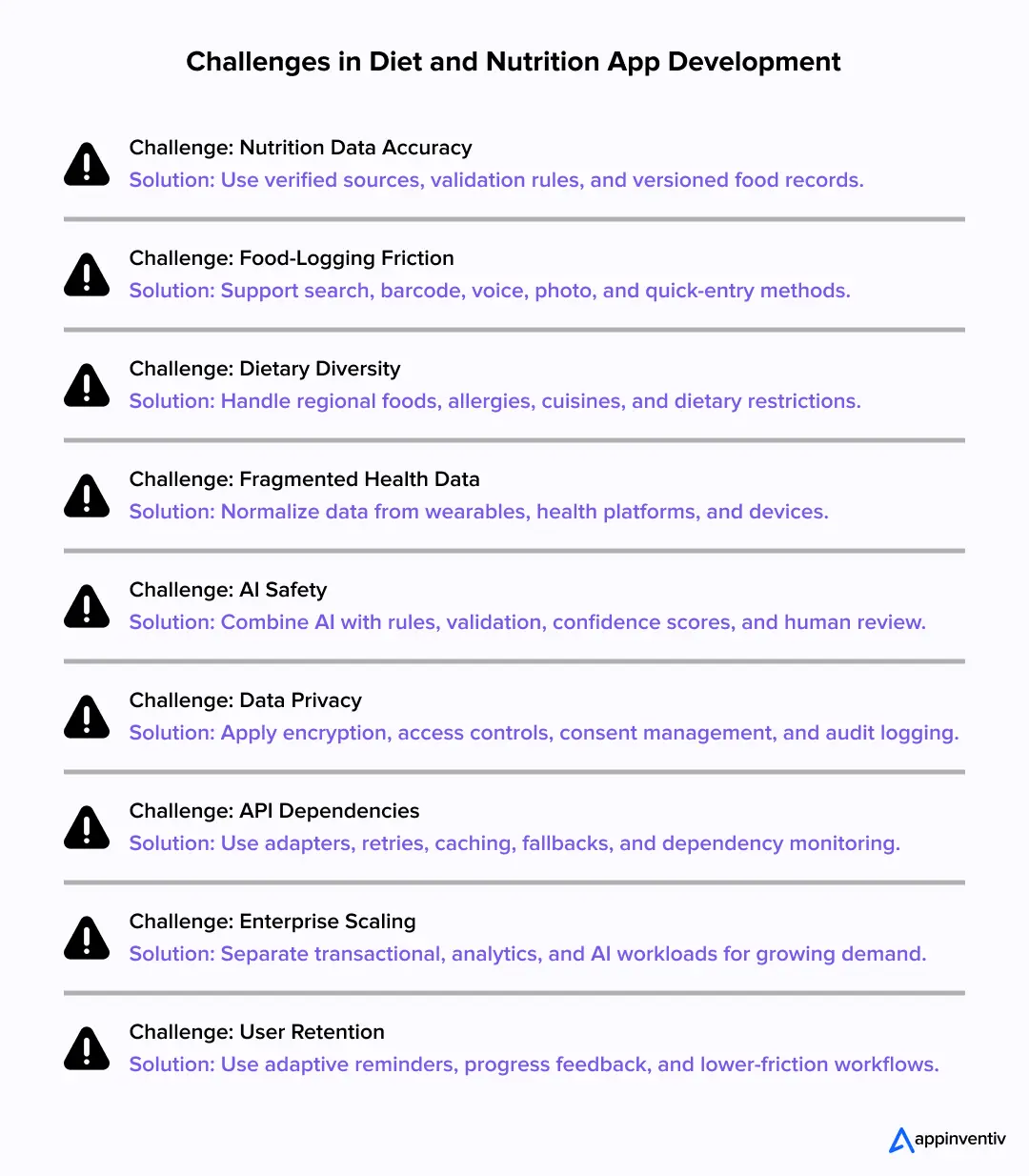
Maintaining Accurate Nutrition Data
Food databases often display duplicate, incomplete, or outdated records. Regional brands use different portion measurements for similar items.
Solution: Import verified databases like USDA FoodData Central. Apply strict verification rules and store versioned food files. Staff runs review queues for user edits and global food additions.
Reducing Food-Logging Friction
Manual entry creates tedious steps for daily users. Cluttered search lists discourage habit tracking.
Solution: Combine recent food lists, saved favorites, barcode tools, voice commands, photo scanners, and fast search screens. Pre-fill portion sizes and let users edit auto-detected numbers before saving entries.
Supporting Diverse Diet Preferences
Eating habits vary by geographic region, cultural cuisine, religious rules, allergies, and lifestyle choices.
Solution: Build flexible diet profile models using local food databases, strict allergen limits, cuisine tags, forbidden ingredient lists, and culturally relevant meal ideas.
Combining Fragmented Health Data
Health records arrive from mobile phones, wearables, smart scales, and medical tools in conflicting formats.
Solution: Build a central data normalization layer that translates third-party formats into uniform internal schemas. Connect Apple HealthKit and Google Health Connect adapters with strict timestamp validation rules.
Keeping AI Recommendations Safe
Generative AI tools can fabricate incorrect calorie values or suggest dangerous meals. How do engineering teams prevent bad AI output? Hard-coding rules block unsafe suggestions instantly.
Solution: Connect AI language models to verified nutrition databases through retrieval tools. Run fixed diet rules, medical review checks, confidence limits, output filters, and manual dietitian referrals for risky queries.
Protecting Private User Data
Nutrition profiles save sensitive details like medical conditions, food allergies, body weight, and daily routines, which is why healthcare data security is central to compliant builds. A study covered 237M app downloads.
Solution: Encrypt records in transit and in database storage. Set up role-based access rules, consent tracking tools, audit logs, token systems, and file deletion routines. Map all security controls to regional privacy regulations like GDPR and HIPAA.
Managing External Software Connections
Vendor catalogs, payment tools, health software, and AI APIs alter pricing, schema structures, rate limits, or uptime without warning.
Solution: Place third-party services behind modular integration adapters. Configure automated retries, circuit breaker tools, local caches, backup providers, API versions, and live service monitors.
Scaling System Performance
Customized meal plans build high workloads across user profiles, log entries, analytics engines, and AI models.
Solution: Isolate standard app traffic from heavy analytics and AI tasks. Use memory caching, background queues, automated server scaling, database partitioning, and event-driven data channels.
Maintaining Daily User Activity
Users stop logging meals when actions feel tedious, or notification prompts become annoying.
Solution: Build customizable alerts, adaptive reminder timing, progress dashboards, daily streaks, and targeted prompts. Track daily logging rates, drop-off points, feature usage, and alert click rates to tweak notification timing.
Diet and Nutrition App Examples and Success Factors
Top nutrition tools succeed by solving distinct user challenges. Their feature sets show how new platforms stand out in competitive markets.
MyFitnessPal
MyFitnessPal pairs a massive food database with barcode scanning, macro metrics, and wearable connections. The platform simplifies daily meal logging and provides users with complete nutritional records.
Noom
Noom builds its product around psychological behavior change. Personal coaching, daily lessons, goal tracking, and custom guidance drive user activity past basic calorie counting.
Lifesum
Lifesum shows strong diet planner app development by blending meal tracking with structured recipes, health targets, and custom suggestions. The app links routine food choices to long-term health metrics.
YAZIO
YAZIO combines calorie counters with fasting timers, recipe libraries, and target planning. Paid subscription tiers lock advanced planning tools and nutrient details.
Lose It!
Lose It! focuses on simple food logging and target tracking. Clear interface layouts lower the manual effort needed for daily meal entries.
What These Apps Reveal About Successful Product Development
Successful consumer products combine multiple high-value features. They cut food logging friction, align eating records with personal targets, and build daily user habits. Enterprise platforms add strict data governance, custom integrations, automated suggestions, and industry workflows.
Diet and Nutrition App Development Costs
Diet and nutrition app development cost reflects product scope, data connections, AI tools, and target platforms. When you build a diet and nutrition app, simple tracking tools require modest budgets. Enterprise systems connected to electronic health records, fitness wearables, commercial food databases, and AI servers need larger capital investments.
| Product Scope | Indicative Cost |
|---|---|
| Basic MVP | $50K to $100K |
| Mid-Level Production App | $100K to $200K |
| Advanced AI Platform | $200K to $500K+ |
| Enterprise Ecosystem | $500K+ |
Final estimates depend on feature complexity, system architecture, third-party vendor choices, and regulatory requirements.
Factors Impacting Development Budgets
- Feature Set: Advanced food logs, dietitian messaging, aggregate analytics, and custom recommendations raise engineering hours.
- Target Platforms: Coding separate native iOS and Android apps requires larger teams than sharing code across platforms.
- AI Tool Integration: Food recognition models, recommendation scripts, large language models, and testing routines increase initial costs.
- Food Database Licensing: Commercial nutrition catalogs charge recurring monthly fees for API access.
- Third-Party Connections: Syncing data from wearables, payment processors, and health platforms adds ongoing integration maintenance.
- System Architecture: Distributed cloud servers, event processors, and analytics channels demand expert server setup.
- Regulatory Compliance: Privacy audits, security tests, consent tracking, and regional health laws increase pre-launch workloads.
- UI and UX Design: Custom design kits, accessibility controls, regional translations, and health dashboards require specialized design work.
- Team Structure: Development team locations, domain experience, and contract terms affect overall hourly rates.
- Quality Assurance: Testing covers device models, API endpoints, nutrition calculations, and AI model predictions.
- Cloud Infrastructure: Cloud hosting, database storage, background processing, and AI execution create monthly operational expenses.
- Post-Launch Operations: Operating system updates, API revisions, security patches, and ongoing feature updates require steady support.
Build the right data model, integration layer, AI stack, and security controls before technical debt compounds.

Diet and Nutrition App Development Timelines
MVP diet and nutrition tracking mobile app development takes three to six months to build. Complete enterprise systems require six to twelve months of active engineering work. Complex AI features, health platform connections, regulatory reviews, and multi-tenant rules extend project schedules.
| Development Stage | Typical Timeline |
|---|---|
| Scope Definition And Requirements | 2 to 4 weeks |
| UX Research And Wireframes | 3 to 6 weeks |
| Core MVP Engineering | 8 to 16 weeks |
| Initial Market Launch | 4 to 8 weeks |
| Advanced AI and Software Links | 8 to 20+ weeks |
Key Timeline Drivers
Project schedules change based on target platforms, third-party connections, catalog size, AI features, and compliance testing. What slows down initial app delivery? Building separate native iOS and Android applications takes longer than building one cross-platform app. Enterprise projects require extra time for security audits, server configurations, data migration, and link testing.
Monetization Models for Diet and Nutrition Platforms
Revenue structures align with target audiences, core feature depth, and distribution channels. Health and fitness app IAP revenue reached $385M in January 2025, up 10% year over year. Enterprise platforms combine multiple payment models instead of relying on individual user subscriptions.
- Freemium Tiers: Apps offer basic food entry for free. Companies charge for detailed nutrient reports, custom meal schedules, AI tools, or exclusive guide content.
- Recurring Subscriptions: Platforms collect monthly or annual membership fees for expanded tools, custom settings, expert access, and advanced features.
- Paid Coaching Services: Businesses bundle dietitian appointments, custom meal plans, and direct specialist support into paid service packages.
- Corporate Licensing: Tech teams license underlying platform software to medical groups, insurance carriers, and corporate wellness brands.
- Employee Wellness Contracts: Sales teams sell wellness software packages directly to corporate employers through user seats or enterprise contracts.
- Medical Provider Partnerships: Platforms partner with healthcare networks to monitor patient diets, improve engagement, and support preventive care initiatives.
- Marketplace Commissions: Software platforms collect transaction cuts from dietitian sessions, meal box sales, and third-party grocery orders.
How Appinventiv Can Help Develop a Diet and Nutrition Tracking App
Enterprise nutrition software demands more than simple mobile screens. Large platforms require stable data pipelines, wearable connections, safe AI models, locked security controls, and high-volume background queues. Appinventiv guides products from initial planning and design through cloud setup, compliance audits, and post-launch support.
Product Capabilities
- Product Strategy: Define user paths, feature charts, MVP boundaries, and corporate operations.
- System Architecture: Construct modular cloud services, protected APIs, analytics queues, and scalable database models.
- AI Personalization: Add meal photo recognition, recommendation algorithms, chat assistants, and habit analysis with strict safeguards.
- Device Integrations: Our custom fitness app development services link Apple HealthKit, Google Health Connect, fitness wearables, smart scales, food catalogs, and hospital databases.
- Security Controls: Deploy data encryption, access policies, user consent panels, audit logs, and local privacy setups.
- Enterprise Operations: Build manager panels, provider portals, subscription management, analytics dashboards, and multi-tenant tools.
Appinventiv has delivered 500 digital health platforms. The company processes 10 million healthcare data points each year and powers 50,000 monthly virtual appointments. What makes specialized engineering important? Engineering teams cut care coordination delays by 45 percent and maintain continuous system uptime.
Create an AI-driven diet and nutrition platform configured for your exact target users, database feeds, system links, and business model. Contact our healthcare technology team to plan your diet and nutrition app development.
Frequently Asked Questions
Q. What are the top-rated apps for tracking daily calorie intake?
A. Popular calorie trackers include MyFitnessPal, Lose It!, Lifesum, YAZIO, and Cronometer. These applications differ in catalog depth, tracking detail, meal planning features, wearable device connections, and price points. MyFitnessPal emphasizes extensive food search options and device sync features. Cronometer delivers deep micronutrient breakdowns for detailed tracking. Lose It! prioritizes quick calorie logging and weight goals. Product teams choose benchmarks based on target user needs and required diet and nutrition app development workflows.
Q. How do users choose a diet and nutrition app for weight loss?
A. Buyers look for verified food database items, fast meal logging options, macro metrics, goal management screens, progress reports, and meal schedules. Wearable device connections supply active calorie burn metrics. Custom recommendations tailor daily prompts to food preferences and personal targets. Users evaluate data security policies to confirm privacy safeguards match personal standards.
Q. Which nutrition tracking applications connect with fitness wearables?
A. Top nutrition tools sync with Apple HealthKit, Google Health Connect, Fitbit, Garmin, and Samsung Health systems. These connections pull daily step counts, workouts, heart rates, sleep hours, and weight changes into central dashboards. Custom diet and nutrition tracking mobile app development requires API adapters, permission management tools, data normalization protocols, sync triggers, and conflict resolution systems for incoming metrics.
Q. Which diet and nutrition platforms offer personalized meal plans?
A. Lifesum, Noom, MyFitnessPal, YAZIO, and PlateJoy showcase strong diet planner app development with custom meal schedules. Algorithms customize suggestions using calorie targets, food preferences, allergies, fitness goals, preferred cuisines, and daily workout activity. Enterprise platforms expand planning by pairing nutrition databases with recommendation models, fixed health rules, user feedback loops, and AI models.
Q. How much does it cost to build a diet and nutrition app?
A. Simple MVP platforms cost $50,000 to $100,000. Mid-level software builds cost $100,000 to $200,000. Platforms with AI features, wearable sync, custom analytics, and compliance tools cost $200,000 to $500,000. Complex enterprise systems exceed $500,000. Diet and nutrition app development costs depend on feature scope, mobile frameworks, AI needs, catalog license fees, software links, system security, quality testing, and cloud server hosting.
Q. How long does custom nutrition app development take?
A. Engineering teams build basic MVP platforms in three to six months. Complete enterprise software requires six to twelve months of active engineering. Advanced AI modules, wearable device links, native mobile builds, privacy reviews, data migration, and testing cycles extend project schedules. Scope definition takes two to four weeks, prototype design takes three to six weeks, and core software engineering takes eight to sixteen weeks.
Q. What is driving growth in the diet and nutrition apps market?
A. The diet and nutrition apps market is expanding as users seek personalized nutrition advice, easier food tracking, and connected wellness services. Rising awareness of nutrition-related conditions, online fitness classes, social media influence, and changing user preferences are supporting market growth. Growing access to food databases also helps apps deliver more detailed nutrition information. These factors are contributing to rising nutrition app revenue, broader mHealth market adoption, and increased user penetration.


Fast 2-minute response, fully NDA-protected.
Wearable Data Integration: Connecting Multiple Devices to a Unified Health Platform
Key takeaways: Device support should reflect the measurements your service needs, the people using it, and the decisions those readings inform. A unified health data platform must preserve source, timing, and measurement context while resolving duplicate records. Phone health platforms, manufacturer APIs, and direct device connections serve different integration needs. Clinical workflows require agreed review…
Sleep Tracker App Development: Features, Wearable Integration, AI, and Compliance
Key takeaways: Sleep tracking presents opportunities across consumer wellness, fitness, healthcare, employee wellness, senior care, and infant-care markets. Successful products combine actionable insights, wearable connectivity, user-friendly reports, privacy controls, and clearly differentiated experiences. HealthKit, Health Connect, and direct device APIs provide different data depths, costs, limitations, and maintenance requirements. AI supports sleep-stage estimation and personalization,…
eCOA Software Development Guide: Enterprise Architecture, Tech Stack, Development Process, and Cost
Key takeaways: Build an enterprise eCOA platform using cloud servers, AI tools, and compliant system design. Map the full eCOA development process, from trial workflow analysis to live system maintenance. Connect your platform with EDC, CTMS, eConsent, HL7 FHIR, and wearables to simplify trial data sharing. Compare custom software against off-the-shelf platforms to make smart…