






























How to Use AI SDR Agents to Automate Outbound Prospecting and Generate Pipeline

 Share -


- 01Understanding the Role of An AI SDR Agent?
- 02AI SDR Agent vs. Traditional Sales Automation
- 03The AI SDR Agent Landscape: Where Does It Fit in the Modern Outbound Stack?
- 04How an AI SDR Agent Actually Runs an Outbound Prospecting Motion?
- 05How to Deploy an AI SDR Agent for Outbound Prospecting: A Step-by-Step Playbook
- 06How to Ensure That Your AI SDR is Working Well?
- 07Common Pitfalls in AI Outbound and Strategies to Avoid Them
- 08How Appinventiv Helps Businesses Build AI SDR Agents for Outbound Pipeline Growth?
- 09FAQs

Key takeaways:
- AI SDR agents replace repetitive manual research with autonomous, signal-driven prospecting and lead qualification workflows.
- Start with one defined prospecting workflow before expanding AI automation across the wider sales organization.
- Clear ICP rules, reliable data, and decision boundaries determine whether autonomous prospecting creates useful business value.
- Custom AI SDR workflows work best when integrated with existing CRM, sales processes, and human handoff requirements.
Outbound sales have always had a scaling problem. To create more pipeline, companies typically add more SDR capacity. More people can research more accounts, identify more contacts, send more messages, and manage more follow-ups. The model works, but it also raises acquisition costs and leaves skilled salespeople handling a large amount of repetitive work.
The problem is not simply that SDRs need to work faster. Modern B2B prospecting requires more information, better timing, and stronger relevance. A generic sequence can be sent to thousands of contacts. That does not mean it will create meaningful pipeline.
This is where AI SDR agents are changing the outbound model. Unlike basic sales automation, an agent can work through a sequence of tasks: review account information, assess signals, prioritize prospects, prepare outreach, interpret straightforward responses, and route qualified opportunities to the right person.
That shift is already moving beyond experimentation. McKinsey reported in 2025 that 19% of B2B decision-makers were already implementing generative AI use cases for buying and selling, while another 23% were in the process of doing so. The strongest use cases are increasingly connected to real sales workflows rather than isolated productivity experiments.
For sales leaders, however, the question is not whether an autonomous sales agent can send more emails. The real question is whether it can improve prospect selection, reduce manual effort, and help create qualified pipeline without making the outbound motion less controlled.
This blog will examine how an AI outbound sales agent fits into the sales process, which activities should remain human, how an outbound agent actually operates, and what it takes to deploy one against measurable pipeline outcomes.
Assess where an AI SDR agent can remove manual prospecting work and improve pipeline coverage.

Understanding the Role of An AI SDR Agent?
An AI SDR agent is an AI-powered sales system that can autonomously or semi-autonomously perform outbound prospecting tasks such as account research, lead qualification, contact prioritisation, personalised outreach preparation, follow-ups and pipeline handoffs based on predefined sales rules.
Unlike traditional sales automation which blindly executes static email sequences, an agentic AI for sales adapts to incoming data.
What to Automate with An AI SDR Agent?
The best starting point is work that is repetitive, data-intensive, and governed by reasonably clear rules. This can include:
- Top-of-funnel account and contact research
- List building based on defined ICP criteria
- Analysis of account and intent signals
- Contact prioritization
- Prospect brief creation
- Initial outreach preparation
- Multi-touch follow-up management
- Basic response categorization
- Meeting scheduling
- CRM updates and activity logging
For example, a rep targeting a new account may currently spend time moving between the CRM, company websites, news sources, sales intelligence tools, and previous engagement records. A custom AI agent for lead generation can consolidate much of that research before the rep decides whether to engage.
What Should Remain Human
Enterprise selling contains decisions that cannot be reduced to a fixed prospecting rule. Human sellers should continue to lead:
- High-stakes relationship development
- Complex discovery
- Strategic account planning
- Buying committee coordination
- Nuanced objection handling
- Enterprise negotiations
- Value-based conversations
- Final commercial decisions
The practical model is not AI SDR versus human SDR. It is a division of work. The agent handles defined prospecting operations. The sales team applies judgment where the commercial context becomes more complex.
AI SDR Agent vs. Traditional Sales Automation
The difference between an AI SDR agent and conventional sales automation is primarily about decision-making. Traditional tools automate known actions, such as sending a sequence after a trigger. An agent can assess available context, apply defined rules, and coordinate several steps before taking or recommending the next action. That makes workflow design more important than message volume.
| Traditional Sales Automation | AI SDR Agent |
|---|---|
| Executes predefined actions | Can evaluate context within defined boundaries |
| Often follows fixed sequences | Can support next-step decisions |
| Requires manual research inputs | Can gather and synthesize prospect context |
| Focuses on task automation | Coordinates multiple prospecting activities |
| Limited response interpretation | Can classify common responses and trigger workflows |
| Measures activity easily | Can be configured around pipeline outcomes |
Consider a standard sequence. A prospect enters the system, receives an email, and gets follow-ups after preset intervals. The workflow may work regardless of whether the account is highly relevant, whether a recent business event has changed the timing, or whether another stakeholder should be contacted.
An AI SDR agent can introduce a decision layer before those actions. It can assess whether the account fits the ICP, identify relevant signals, select an appropriate contact, generate a prospect brief, and determine whether the prospect should enter an approved outreach motion.
That does not mean every decision should be autonomous. Decision makers can define approval gates based on account value, strategic importance, confidence levels, or workflow risk.
The objective is not maximum autonomy. It is better automation of the right decisions.
The AI SDR Agent Landscape: Where Does It Fit in the Modern Outbound Stack?
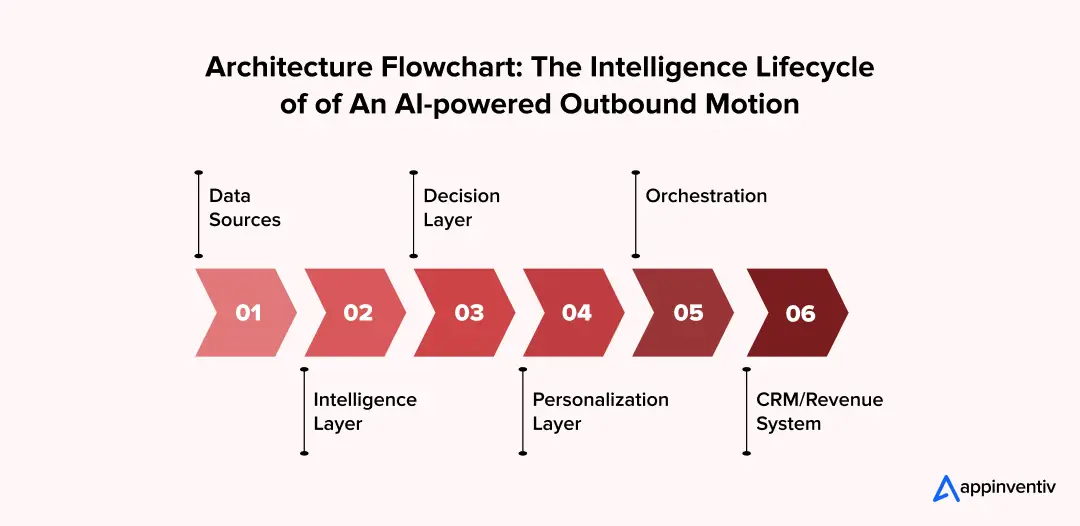
To build an effective AI outbound sales agent, you must understand the five layers of the modern outbound stack. The agent must fit seamlessly into your existing GTM workflow rather than act as a disconnected silo.
Architecture Flowchart: The Intelligence Lifecycle of of An AI-powered Outbound Motion
1. Prospect Intelligence Layer
This layer gives the agent the information needed to understand an account. Relevant inputs may include:
- CRM and customer history
- Firmographic information
- Company websites and public business information
- Hiring activity
- Product or market changes
- Technology signals
- First-party engagement data
- Other approved prospect intelligence sources
The agent does not need every possible data source. It needs reliable inputs that support the decisions it has been assigned to make.
2. Decision Layer
The decision layer determines how the system interprets prospect information. Typical questions include:
- Does this account fit the ICP?
- Is there a reason to engage now?
- Which contact should be prioritized?
- Is the signal strong enough to justify outreach?
- Which approved value proposition is most relevant?
- Should the prospect be handled automatically or reviewed by a person?
This is where an autonomous sales agent differs most from a basic sequencing tool.
3. Personalization layer
The purpose of this layer is not to insert more facts into an email. It is to establish relevance. There is a significant difference between mentioning that a company hired a new executive and understanding why that event might create a relevant business conversation.
A stronger workflow follows this logic:
| Business signal → potential implication → relevant problem or opportunity → approved value proposition → appropriate CTA |
|---|
Without that reasoning, AI-generated personalization can quickly become superficial.
4. Outreach Orchestration Layer
This layer manages approved actions across the outbound motion. It may coordinate:
- Outreach timing
- Channel selection
- Follow-up rules
- Response classification
- Sequence exit conditions
- Escalation to human sellers
5. Revenue Systems Layer
Finally, the agent needs to work with the systems already used by sales and revenue teams, particularly the CRM and sales engagement environment.
The agent should feed useful context back into those systems. If prospect decisions, conversations, and qualification outcomes remain outside the revenue record, the organization creates another information silo.
How an AI SDR Agent Actually Runs an Outbound Prospecting Motion?
Executing a successful outbound campaign demands rigorous process adherence and timing. Human teams struggle to maintain consistent research depth at scale. Autonomous sales agents solve this by executing a structured, programmatic workflow for every single prospect. This consistency ensures high-quality outreach regardless of volume.
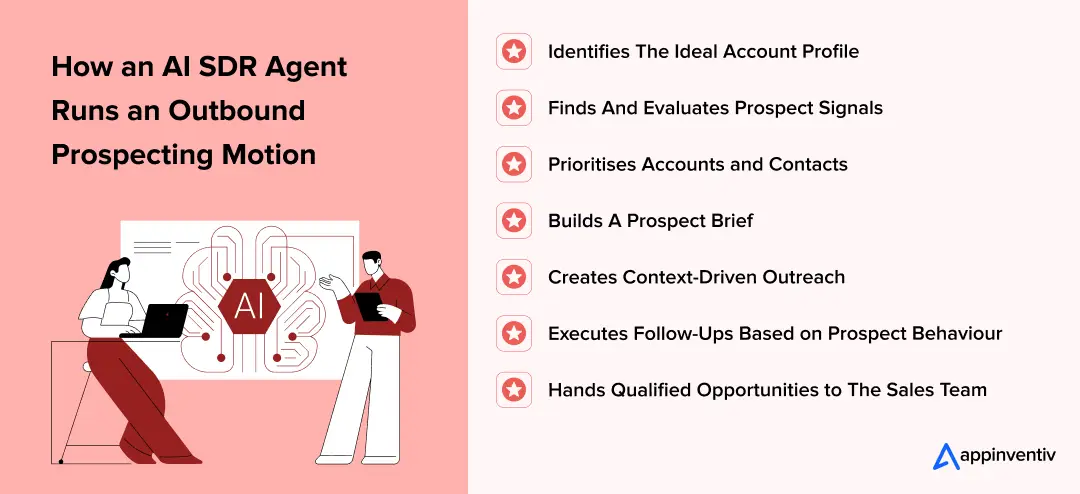
Step 1: Identifies the Ideal Account Profile
The agent scans global databases to locate companies matching strict firmographic and technographic criteria. It filters out irrelevant industries and targets organizations with specific revenue markers.
Step 2: Finds and Evaluates Prospect Signals
Instead of cold targeting, the system looks for active triggers. It identifies leadership changes, new technology deployments, or recent funding rounds that indicate an immediate business need.
Step 3: Prioritizes Accounts and Contacts
The AI scores the identified accounts based on signal strength. It then maps the buying committee to select the most relevant decision-makers within that specific organization.
Step 4: Builds a Prospect Brief
Before writing any message, the system compiles a structured summary of the individual. It reviews past interactions in the CRM and analyzes the prospect’s recent public statements or professional background.
Step 5: Creates Context-driven Outreach
Using the prospect brief, the agent drafts initial communications. The messaging references specific account signals and clearly aligns your product capabilities with the prospect’s immediate pain points.
Step 6: Executes Follow-ups Based on Prospect Behaviour
If the prospect opens the email but does not reply, the system adjusts the follow-up strategy. It handles common objections autonomously and can pivot the conversation based on the sentiment of any replies.
Step 7: Hands Qualified Opportunities to the Sales Team
Once the prospect agrees to a meeting, the agent coordinates calendar availability. It then generates an executive summary of the conversation history for the human sales representative.
How to Deploy an AI SDR Agent for Outbound Prospecting: A Step-by-Step Playbook
Successful AI development and deployment requires strict governance and phased rollouts. Launching an autonomous system without clearly defined operational boundaries introduces significant brand risk. By following a structured deployment playbook, enterprise leaders can test messaging efficacy in isolated environments before scaling operations across the entire revenue organization.
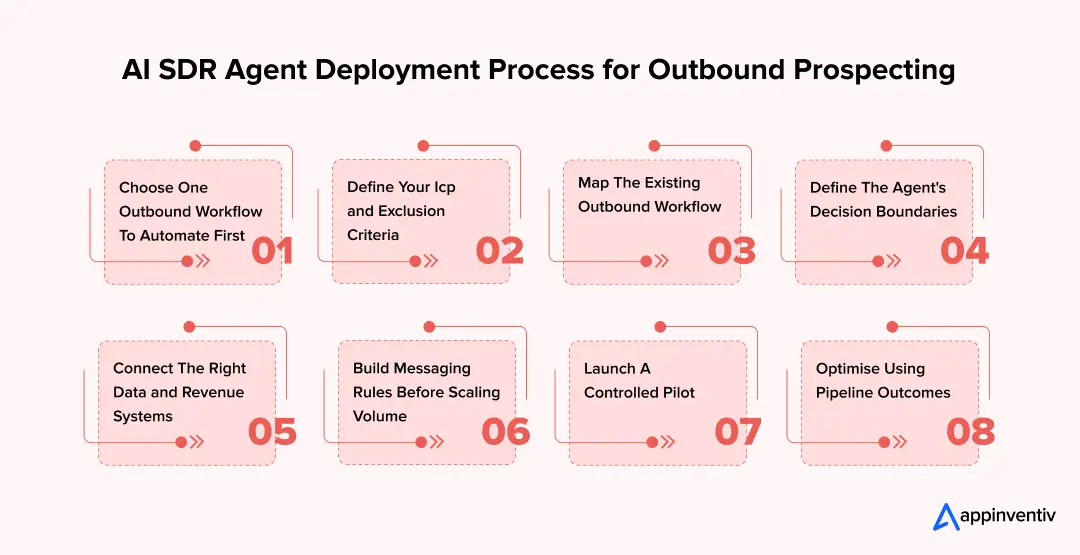
Step 1: Choose One Outbound Workflow to Automate First
Do not attempt to automate the entire SDR function immediately. Start narrow. Target highly specific use cases such as new-account prospecting, re-engaging dormant leads, or following up with event attendees.
Step 2: Define Your ICP and Exclusion Criteria
Your AI needs strict guardrails. Document exactly who constitutes a good prospect and who must be excluded. Define which accounts require human review and determine what specific signals indicate that automated outreach must stop immediately.
Step 3: Map the Existing Outbound Workflow
Document your current manual process to establish a baseline.
Account selected → Research → Qualification → Prioritisation → Personalisation → Outreach → Follow-up → Response → Qualification → Human handoff.
Step 4: Define the Agent’s Decision Boundaries
Establish clear authorization limits. Determine if the agent is allowed to negotiate meeting times autonomously or if it must always request human approval before sending custom pricing collateral.
Step 5: Connect the Right Data and Revenue Systems
Integrate the AI SDR agent development environment with your CRM. Clean your historical data to prevent the agent from making decisions based on outdated contact information or inaccurate account statuses.
Step 6: Build Messaging Rules Before Scaling Volume
Program strict tonal guidelines. Ensure the system understands your corporate brand voice and strictly forbids the use of overly aggressive sales language or unverified product claims.
Step 7: Launch a Controlled Pilot
Run the agent in a sandbox environment for three weeks. Require human representatives to manually approve every generated message before dispatch to catch hallucinations or contextual errors.
Step 8: Optimise Using Pipeline Outcomes
Review the pilot data. Adjust the prompt engineering and decision logic based on the quality of the meetings booked, rather than simply looking at email open rates.
Turn fragmented prospecting tasks into an intelligent, measurable outbound process.

How to Ensure That Your AI SDR is Working Well?
Evaluating autonomous systems requires looking past traditional top-of-funnel metrics. High email open rates mean nothing if they do not convert to commercial conversations. Decision makers must measure the economic efficiency of the AI agent for enterprises by tracking its direct contribution to qualified pipeline and its impact on lowering overall customer acquisition costs.
Positive Reply Rate
This indicates whether the targeting and message context are producing genuine engagement. It should not be viewed in isolation. A high reply rate from poorly qualified accounts may create more work without improving pipeline.
Meetings Booked and Accepted
Track both. A booked meeting that the sales team rejects is not the same as a qualified conversation that progresses through the pipeline.
Cost Per Meeting and Acquisition Efficiency
Compare the operational effort required to generate qualified meetings before and after deployment. The purpose is not to claim that AI makes human sellers unnecessary. It is to understand whether repetitive prospecting work can be handled more efficiently.
Pipeline Generated
This is one of the clearest commercial measures. Track the value of opportunities sourced or materially influenced through the defined outbound motion. Sales leaders should also review conversion from initial engagement to meeting, qualified opportunity, and later pipeline stages.
Also Read: How much does it cost to build an AI agent: A complete guide
Common Pitfalls in AI Outbound and Strategies to Avoid Them
Improperly configured AI agents can damage your brand reputation at scale. Without strict technical guardrails, automated systems will hallucinate context, annoy prospects, and destroy sender domain authority. Understanding these failure points allows technology leaders to architect robust fallback mechanisms and human-in-the-loop review processes.
| Common Pitfall | What Goes Wrong | How to Avoid It |
|---|---|---|
| Automating Bad Targeting at Greater Speed | If the ICP is vague, the agent can create a larger volume of irrelevant activity. | Define targeting and exclusion rules before deployment, then review the quality of prioritized accounts during the pilot. |
| “Frankenstein” Personalization | Messages can sound personalized while combining unrelated facts that have no real connection to the prospect’s priorities. | Require a clear link between the signal, the business implication, and the value proposition. |
| Giving the Agent Poor-Quality Data | Outdated contacts, incomplete accounts, and inconsistent CRM history can produce poor recommendations and awkward outreach. | Address critical data gaps before assigning the agent high-value prospecting decisions. |
| Optimizing for Activity Instead of Pipeline | More emails, more research, and more automated tasks can look impressive on a dashboard while sales results remain unchanged. | Tie reporting to qualified conversations, accepted meetings, opportunities, and pipeline. |
| No Clear Stop and Escalation Rules | A prospecting agent needs to know when not to continue. | Define stop conditions, escalation scenarios, and human review requirements as part of the workflow. |
| Treating the AI SDR as a Set-and-Forget System | Markets, ICPs, sales messaging, and account priorities change over time. | Review performance regularly and update targeting, decision rules, and messaging based on pipeline results. |
How Appinventiv Helps Businesses Build AI SDR Agents for Outbound Pipeline Growth?
Custom AI SDR agent development is most effective when it reflects the way a business actually sells. At Appinventiv, our team of 1700+ tech experts helps organizations design agent workflows around their ICP, account priorities, existing revenue systems, and sales handoff requirements rather than forcing a complex enterprise process into a generic automation product. The focus remains on execution, integration, and measurable pipeline outcomes.
Our AI agent development services support organizations across the delivery lifecycle, including:
- ICP and outbound workflow assessment
- Custom AI agent workflows for account research and prioritization
- CRM and revenue system integration
- Signal-based prospecting automation
- AI-assisted prospect research and personalization
- Human-in-the-loop approval workflows
- Lead qualification and routing
- Agent monitoring and workflow optimization
In our 11+ years of industry experience, we have successfully deployed 100+ Autonomous AI agents like MyExec and trained 150+ Custom AI models. For instance, we have built a signal-led AI SDR workflow for enterprise prospecting.
Case Study: Building a Signal-Led AI SDR Workflow for Enterprise Prospecting
Our AI engineers worked on an AI-led outbound prospecting workflow for a business targeting high-value enterprise accounts. The challenge was not a lack of prospect data. The sales team already had access to relevant account information, but SDRs were spending considerable time researching companies, assessing potential opportunities, and deciding which prospects should receive immediate attention.
We designed the workflow to bring these activities into a more structured prospecting process. The AI SDR agent was configured to monitor defined account signals, assess ICP fit, prioritize relevant prospects, and prepare the context needed for outreach.
The workflow followed a controlled sequence:
Monitor defined signals → Evaluate ICP fit → Prioritize accounts → Generate a prospect brief → Prepare relevant outreach → Route qualified engagement to the sales team
This approach helped reduce the operational effort involved in early-stage prospecting while keeping strategic conversations and commercial decisions with the human sales team.
For us, the objective of an AI SDR agent development initiative is not to remove salespeople from the process. It is to build a more consistent path from prospect intelligence to qualified sales conversations.
Let’s collaborate to build an AI SDR Agent together.
FAQs
Q. Is AI SDR Agent development actually worth it, or just automation hype?
A. The value of AI SDR Agents depends entirely on implementation. If you use AI simply to write generic emails faster, the ROI is minimal. However, when you utilize AI to process vast amounts of unstructured intent data and autonomously orchestrate highly relevant multi-channel workflows, the reduction in customer acquisition cost is substantial and highly verifiable.
Q. Can an AI SDR agent replace my SDR team?
A. No. Autonomous systems replace the repetitive data aggregation and initial contact phases of the sales cycle. This technology reallocates your human capital to higher-tier tasks, allowing junior team members to function effectively as Account Executives who focus entirely on negotiation, relationship management, and closing complex transactions.
Q. How much outbound volume can one agent handle?
A. There is no useful fixed number. Capacity depends on workflow complexity, data availability, channels, approval requirements, account research depth, and response handling rules. Enterprises should prioritize relevant and controlled activity rather than setting volume targets without considering pipeline quality.
Q. Does an AI SDR agent hurt email deliverability?
A. The agent itself does not inherently damage deliverability. It only harms deliverability if poorly configured. A professionally developed system utilizes advanced orchestration to rotate sending domains, implement Spintax to ensure message variability, and enforce gradual volume scaling. Proper system architecture inherently protects your infrastructure from automated spam filters and blacklist triggers.
Q. What data does an AI SDR agent need?
A. At a minimum, the workflow needs a defined ICP and reliable account and contact information. CRM history, engagement data, business signals, and other approved intelligence sources can improve prioritization and prospect context when they are relevant to the specific outbound use case.


Fast 2-minute response, fully NDA-protected.
The Multiplier Effect of AI Agents: The Rise of AI Swarms
Key takeaways: AI agent swarms coordinate specialized agents to solve complex problems that may be difficult for a single agent to handle effectively. More agents do not automatically mean better outcomes. Swarms deliver value when work can be divided, executed in parallel, and coordinated toward a shared objective. Enterprise readiness depends on governance. Clear accountability,…

AI Data Integration: How to Connect, Clean and Prepare Data for AI
Key takeaways: AI initiatives fail when fragmented, poor-quality data reaches models without sufficient context, controls or ownership. AI-ready pipelines must connect, clean, enrich, govern and continuously monitor data across its lifecycle. Real-time processing matters when AI decisions depend on current transactions, events, inventory or operational conditions. Data architecture should follow the AI use case, balancing…

AI-Native SDLC: Foundational 90-Day, 5R AI SDLC Adoption Playbook
Key takeaways: Why AI coding tools accelerate coding and software delivery How AI-native SDLC shifts engineering from code to intent, context, and outcomes The role of specifications, AI agents, and continuous verification in enterprise delivery How to redesign engineering teams for human–agent collaboration The platform, governance, and guardrails required to scale AI-native development A practical…