





























Measurable Glycemic Improvement
Peer-reviewed trials of CGM-supported self-management, including the DIAMOND study, link structured digital tracking with clinically meaningful A1c reductions and more time in the 70 to 180 mg/dL range.


 Leader in AI-First Product Engineering Read Full Article
 IT Managed & Outsourcing
 Contact Us

Appinventiv engineers HIPAA-compliant diabetes care apps with CGM integration, AI-powered glucose forecasting, bolus support, and clinician dashboards built for remote patient monitoring reimbursement. From discovery to FDA-grade documentation, one accountable team ships it all.







The IDF Diabetes Atlas counts 537 million adults living with diabetes worldwide, expected to reach 643 million by 2030. In the US alone, the NIH reports 38.4 million people with diabetes and 97.6 million adults with prediabetes. Each one makes daily decisions around glucose, meals, medication, and care, creating the kind of repeat engagement most health apps struggle to earn.
As a healthcare app development company, Appinventiv builds diabetes care platforms that connect CGMs, support insulin workflows, and turn patient data into clinician-ready RPM insights. The outcome is a product built for better glycemic control, stronger retention, and recurring reimbursement value.
The American Diabetes Association puts the total cost of diagnosed diabetes in the US at $412.9 billion a year. Payers and providers fund any product that demonstrably bends that curve.
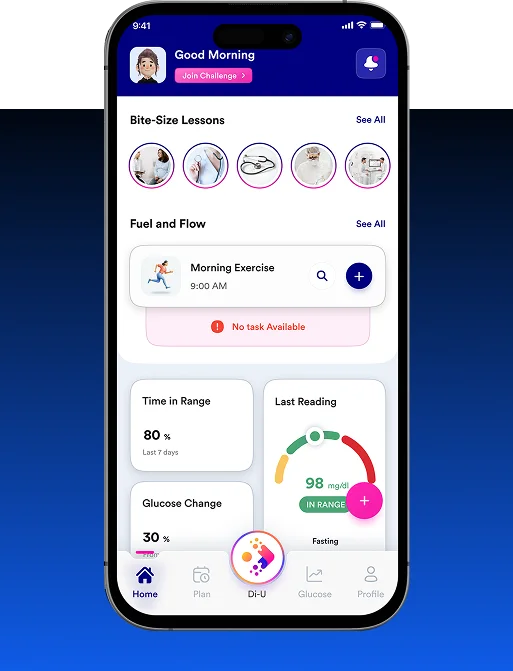
Live CGM stream with trend arrows, time-in-range scoring, and an estimated A1c that updates as readings arrive over Bluetooth Low Energy.
Carb counting with food chips, a bolus calculator driven by insulin-to-carb ratios, and a correction slider that patients actually understand.
Hypoglycemia predicted 30 to 60 minutes ahead, caregiver notifications, and one-tap ambulatory glucose profile reports for the clinic.

Supporting note: Every interaction shown here maps to a production module our teams have shipped: BLE device pairing, HL7 FHIR data normalization, safety-reviewed alert logic, and clinician-side RPM workflows.
Share your requirements under NDA and receive a clickable prototype plus a clinical workflow map within 5 business days.
Peer-reviewed trials of CGM-supported self-management, including the DIAMOND study, link structured digital tracking with clinically meaningful A1c reductions and more time in the 70 to 180 mg/dL range.
With US diabetes spending at $412.9 billion annually per the ADA, payers reward products that reduce avoidable ER visits, hypoglycemia admissions, and readmissions through earlier intervention.
Glucose checks, meals, and dosing create 8 to 12 natural app touchpoints per day. That cadence drives retention curves that most consumer health categories cannot reach, compounding lifetime value.
Remote physiologic monitoring under CPT codes 99453 to 99458 converts device data review into recurring, billable clinical activity for provider organizations in the US.
HIPAA-aligned architecture, IEC 62304 software lifecycle documentation, and ISO 13485 design controls position the product for enterprise procurement and, where needed, FDA SaMD pathways.
De-identified, aggregated glucose and adherence data powers payer reporting, value-based care contracts, and pharma real-world evidence programs that open additional revenue conversations.
Inside Appinventiv, dedicated healthcare engineering pods pair clinical advisors, compliance reviewers, and data scientists with product squads. Here is where that machinery gets pointed.
BLE pairing for devices like Dexcom, FreeStyle Libre, smart insulin pens, pumps, and glucose meters, with all readings converted into HL7 FHIR Observation format so every connected system can read and use the data easily.
Machine learning models trained on CGM time series predict hypoglycemia and hyperglycemia 30 to 60 minutes ahead, with explainable triggers, drift monitoring, and clinician-reviewed alert thresholds.
Clinician dashboards with triage queues, threshold-based workflows, time-tracking for CPT 99457 and 99458, and audit-ready documentation that makes the billing department as happy as the care team.
Condition-specific onboarding, insulin-to-carb ratio setup, regionalized food libraries, pregnancy-safe glycemic targets, and pediatric caregiver modes designed with endocrinology input.
White-label diabetes prevention program experiences with cohort coaching, gamified streaks, biometric milestones, and outcomes reporting mapped to CDC DPP recognition requirements.
Endocrinologist video consults, asynchronous messaging, e-prescription and pharmacy refill integrations, and EHR write-back so the visit note lands where clinicians already work.

Book a 30-minute discovery call with a healthcare delivery lead. NDA-first, zero obligation, and you keep the workshop notes either way.

For startups validating a care model
For digital health companies scaling engagement
For providers, payers, pharma, and medtech
| Work Package | What's Covered | Effort | Cost Range |
|---|
| Discovery and clinical workflow mapping | User journeys for patients, caregivers, and clinicians; SaMD classification screening; success metrics | 80 – 160 hrs | $4K – $8K |
| UX research and UI design | Accessibility-first flows (WCAG 2.2 AA), low-vision and senior-friendly patterns, motion specs | 200 – 400 hrs | $8K – $20K |
| Core tracking engine | Logging flows, trend analytics, time-in-range and estimated A1c calculations, offline-first sync | 300 – 500 hrs | $12K – $25K |
| CGM / BLE device integration (per device family) | BLE GATT pairing, background sync, SDK certification requirements, signal-loss handling | 120 – 250 hrs | $6K – $14K |
| Bolus calculator and alert engine | Insulin-to-carb ratios, correction factors, stacking prevention, hazard analysis per ISO 14971 | 200 – 350 hrs | $10K – $20K |
| AI / ML forecasting module | Time-series model training, MLOps pipeline, drift monitoring, explainability layer | 250 – 450 hrs | $15K – $30K |
| Clinician portal and RPM workflows | Triage queues, threshold worklists, CPT time-tracking, audit logs and role-based access control | 300 – 600 hrs | $15K – $35K |
| EHR integration (per health system) | SMART on FHIR auth, Observation and CarePlan resources, write-back, sandbox-to-production certification | 150 - 300 hrs | $8K - $18K |
| Backend, APIs, and cloud infrastructure | Microservices, PHI encryption at rest and in transit, key management, CI/CD, autoscaling | 250 - 450 hrs | $12K - $25K |
| QA, V&V, and penetration testing | Automated test suites for alert logic, traceability matrix, OWASP MASVS security testing | 200 - 400 hrs | $8K - $20K |
| Compliance documentation | Risk files, software safety classification, design history file inputs, privacy impact assessments | 120 - 280 hrs | $6K - $15K |
| Project management and DevOps | Sprint ceremonies, release management, environment governance, stakeholder reporting | % based | 10 - 15% |

15 to 20 percent of initial build cost per year: OS upgrades, device SDK updates, store policy changes, and bug-fix SLAs.
$10,000 to $30,000 per year covering penetration tests, OWASP MASVS re-verification, and HIPAA security risk assessments.
$500 to $5,000 per month on HIPAA-eligible infrastructure, scaling with monthly active users, data retention, and analytics workloads.
Quarterly drift review and retraining cycles as the user population and devices evolve.
CPT 99453: device setup and patient education
CPT 99454: device supply with daily readings, per 30 day
CPT 99457: first 20 minutes of monthly care management
CPT 99458: each additional 20 minutes
Software as a Medical Device: software intended for medical purposes without being part of a hardware device. Dosing calculators often qualify, which changes the regulatory pathway and budget.
Software safety classification under the medical device software lifecycle standard. Class C (injury or death possible) demands the deepest documentation and verification effort.
The modern interoperability standard for exchanging healthcare data. Glucose readings map to FHIR Observation resources so EHRs and analytics platforms can consume them.
An auth framework letting your app launch inside an EHR and access patient data with clinician consent. Required for most Epic and Oracle Health integrations.
Business Associate Agreement: the HIPAA contract your cloud vendor and development partner must sign before touching protected health information (PHI).
Protected Health Information and the process of stripping identifiers (HIPAA Safe Harbor or Expert Determination) so data can power analytics legally.
Verification and validation: documented proof that the software was built correctly and that the right product was built. Mandatory for SaMD, smart for everything else.
The FDA premarket submission demonstrates that a device is substantially equivalent to one already on the market. Relevant if your app crosses into Class II SaMD territory.

Send your feature list today and receive a work-package-level cost sheet, with timeline and team composition, within 48 hours.

Clinical workflow mapping, SaMD regulatory triage, competitor teardown, AI personalization strategy, and a build-vs-buy review of device SDKs. Deliverable: Product requirements document and compliance roadmap.
Glucose data architecture, FHIR resource modeling, BAA-covered environments, CI/CD setup, and data pipelines supporting personalization in healthcare. The compliance checklist locks before a single screen is built.
Design sprints with endocrinology advisors, UX researchers, and stakeholders to prioritize features, personalized care journeys, and reimbursement value.
Two-week sprints with clinical safety reviews, AI-driven personalization features, automated alert validation, and staged CGM integration sign-offs with full traceability.
App store submission, RPM billing enablement, clinician onboarding kits, AI model monitoring, and a 90-day hypercare window with accelerated SLAs and weekly health reports.
The India's Fastest-Growing Companies 2026 Recognised by TIME and Statista

Statista High Growth Companies APAC - 2026

Statista India's Growth Champions 2023

Bring us your security checklist, compliance questions, and product scope. Our healthcare delivery team will walk you through the proof points, controls, and delivery model before you commit.


HIPAA
Protects PHI across healthcare apps, EHR integrations, patient portals, telehealth platforms, analytics systems, and cloud environments.

HITECH
Strengthens HIPAA enforcement around electronic health information, breach notifications, and secure digital healthcare operations.

FDA 21 CFR Part 11
Governs electronic records, e-signatures, audit trails, access controls, and validation workflows in regulated healthcare software.

FDA SaMD Guidance
Guides risk-based engineering for software used in diagnosis, treatment, monitoring, clinical decisions, or medical device functionality.

ISO 14971:2019
Risk management for medical devices, governing hazard analysis, clinical safety risks, alert thresholds, and ML-driven predictions.

HL7 FHIR
Standardizes healthcare data exchange across EHRs, apps, APIs, devices, labs, payers, and care delivery systems.

ISO/IEC 27701:2019:
Privacy information management extending 27001 controls for healthcare data protection and privacy governance.

ISO 13485:2016
Quality management for medical devices, applying design controls wherever software informs clinical or patient-facing decisions.

SOC 2
Validates controls for security, availability, processing integrity, confidentiality, and privacy in healthcare technology environments.

HITRUST
Provides a healthcare-focused risk and compliance framework for managing security, privacy, and regulatory controls.

IEC 62304
Medical device software lifecycle processes, with safety classification driving documentation depth for SaMD and device-connected builds.

ONC Health IT Certification
Supports conformance for certified health IT, EHR-connected platforms, patient access, and clinical data exchange.

ISO/IEC 27001:2022
Information security management protecting PHI across cloud infrastructure, connected devices, APIs, and delivery workflows.

USCDI
Defines standardized health data classes and elements for interoperable healthcare information exchange in the US.
Explore healthcare products our teams have shipped across chronic care, connected records, in-hospital communication, and health intelligence.
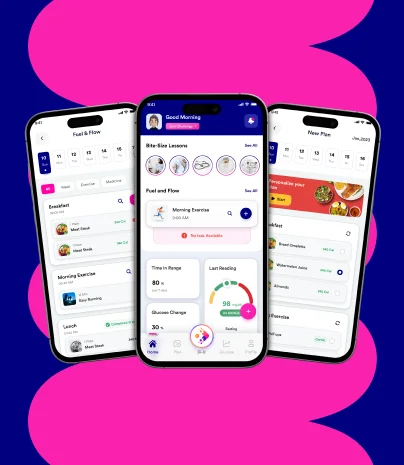
A US-based chronic care app for diabetes patients with AI wellness recommendations, prescription tracking, and remote consultations. Appinventiv migrated it to a cloud-native, HIPAA-compliant AWS setup built to scale.
A unified health record platform that consolidates data from a person's apps, wearables, and devices, links them with caregivers, and shares insights with researchers. Appinventiv built the aggregation layer and three connected experiences.

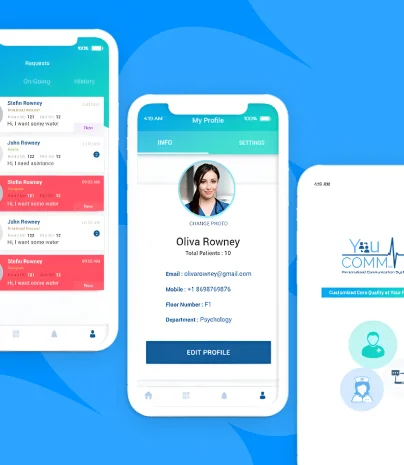
An in-hospital system that lets patients alert nurses through on-screen taps, voice, or head gestures, with automatic escalation when a request goes unanswered. Appinventiv built the nurse app, patient tablet interface, and admin panel.
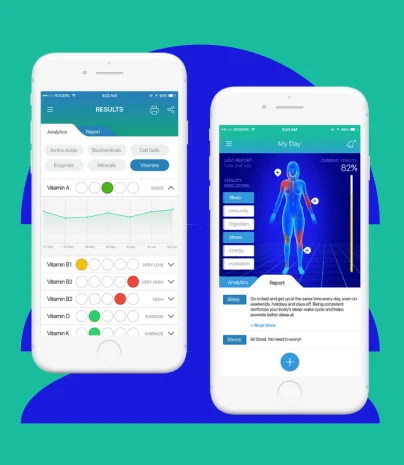
The first wellness system built on resonant-frequency analysis, turning a short voice sample into a full well-being report. Appinventiv built the voice-capture pipeline and the algorithm behind its 3D analysis.
An basic app with manual logging, reminders, and trend reports typically ships in 4 to 6 months. Builds with CGM integration, AI forecasting, and clinician dashboards run 6 to 9 months, while SaMD-classified enterprise platforms with EHR integration take 9 to 14 months including documentation cycles.
It depends on the function. Wellness-style trackers generally fall outside FDA oversight, while features that calculate insulin doses or drive treatment decisions can classify the product as Software as a Medical Device. Our consulting phase includes a regulatory triage so the classification and its budget impact are known before development starts.
Yes. Integrations are built through official device SDKs and partner APIs, with BLE data pipelines normalized to HL7 FHIR Observation resources so readings flow cleanly into clinician dashboards, EHRs, and analytics platforms.
PHI is encrypted in transit and at rest, access follows role-based controls with full audit logging, and infrastructure runs on HIPAA-eligible cloud services under signed BAAs. Engineering processes align with ISO/IEC 27001 controls, and mobile builds are tested against OWASP MASVS.
Use the interactive estimator on this page for a directional range, then request the line-item quote. As a benchmark, basic apps run $45K to $80K, growth builds with CGM and clinician dashboards run $90K to $180K, and SaMD-grade enterprise platforms start around $200K. Every quote is itemized by work package.
Yes. Builds for US provider organizations include workflows mapped to CPT codes 99453 through 99458, with time-tracking and documentation features that make monitoring activity billable and audit-ready from day one.
Completely. Source code, design assets, documentation, and trained model artifacts will be transferred to you under the master services agreement. Repositories live in your organization's accounts from the first sprint if preferred.
Every launch includes a 90-day hypercare window with accelerated SLAs. Beyond that, annual support packages covering maintenance, OS and SDK upgrades, security re-testing, and ML model retraining typically run 15 to 20 percent of the initial build cost per year.



 Manual glucose, meds, meal, and activity logging