





























What It Really Takes to Build a Social Media Platform in 2026: Technologies, Architecture, and Scalability Drivers

 Share -



- 01Core Development Technologies: The Foundation of Modern Social Media Systems
- 02Performance & Scalability Technologies: Engineering for Millions of Concurrent Users
- 03Real-Time Technologies: Powering Instant Interaction at Scale
- 04AI, ML & Data Technologies: The Intelligence Layer of Social Platforms
- 05Security Technologies: Protecting Users, Data, and Platform Integrity
- 06Emerging Technologies Driving the Future of Social Media
- 07The Hidden Technology Layer Most Blogs Miss: System Design Decisions That Make or Break Social Platforms
- 08How Appinventiv Solves Core Technology Challenges in Building Social Media Platforms
- 09FAQ's

Key takeaways:
- Social platforms now run like large systems, where backend decisions shape speed, stability, and user experience
- Real-time systems decide if messages, feeds, and updates feel instant or start to lag under load
- Personalization drives engagement, and weak content ranking often leads to early user drop-off
- Feed design and data flow issues usually surface only after real users start interacting at scale
- Early system choices often decide if the platform scales smoothly or needs expensive fixes later
Social media technology in 2026 runs as full-scale systems, not simple apps. With over 5.66 billion users worldwide, even small delays affect millions of people at once. Each tap or scroll triggers a chain of events across distributed services, data pipelines, and real-time networks. A single feed refresh can rank content, fetch media, and update user signals in a few milliseconds.
One of the clearest ways technology is transforming social media platforms is how quickly the old app stack model breaks under scale. It works for early builds, but it struggles once user numbers grow. Feeds slow down, data falls out of sync, and systems become harder to manage. The issue is not the interface. The issue sits deep in the technology that powers it.
Platforms such as Meta Platforms, TikTok, and X (formerly Twitter) run on distributed systems built for constant activity. They process billions of actions each day across regions and devices without breaking the user experience.
The shift is direct. The relationship between technology and social media decides how a platform scales, how users engage, and how value is created. This blog will break down the importance of technology in social media platform performance, speed, and reliability.
Most platforms fail at scale because early architecture decisions ignore real-world concurrency, global traffic patterns, and system pressure.
Core Development Technologies: The Foundation of Modern Social Media Systems
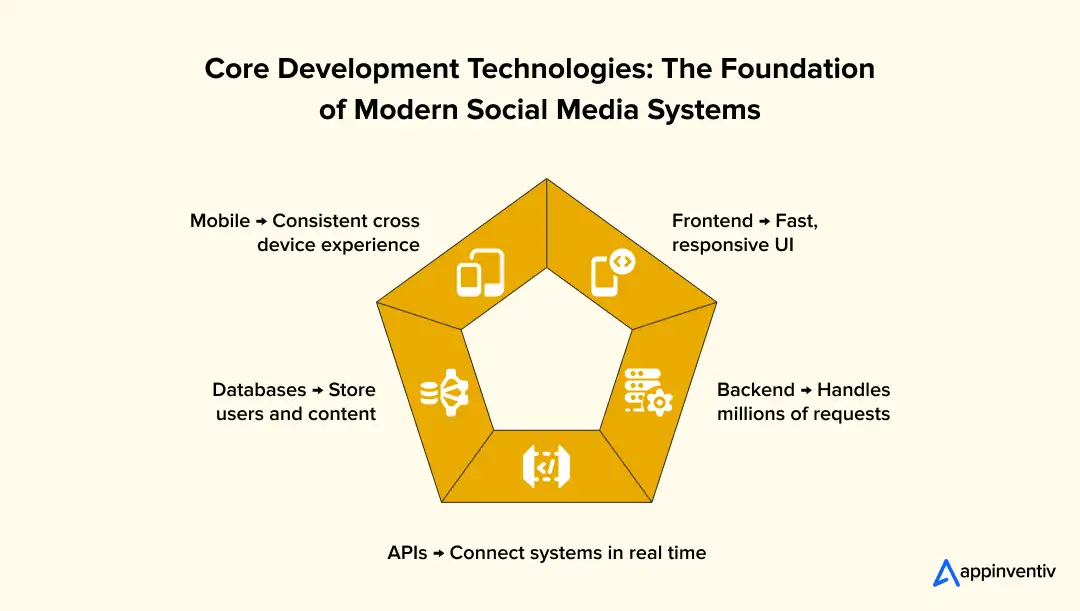
Every large social platform, regardless of platform type, rests on a small set of core technologies. These systems decide how fast the product feels, how it behaves under load, and how stable it remains during peak traffic. Each layer has a clear role, and small gaps in one layer are quickly visible to users.
Frontend Technologies Powering High-Performance Interfaces
This layer controls what users see and how quickly the interface responds.
- React, Angular, Vue.js
These frameworks split the interface into smaller parts, which directly shapes app UI design decisions at every stage. Only the part that changes gets updated. This keeps scrolling smoothly, even when new content loads every second. - Server-Side Rendering (SSR)
The server prepares the page before it reaches the user. The screen shows content almost instantly, which helps reduce early drop-offs. - Client-Side Rendering (CSR)
The browser builds the page after loading scripts. It works well for interactive features, but it can feel slow on the first load. - Edge Rendering
Content is processed closer to the user’s location. This reduces delay, especially for global audiences.
Also Read: Benefits of Angular for Business
Mobile Technologies for Scalable Cross-Platform Experiences
This layer keeps the app stable and consistent across different devices.
- Flutter
One codebase runs on both iOS and Android. It handles animations and complex layouts well, which is useful for content-heavy feeds. - React Native
Uses shared logic with native components. It allows faster updates without losing native behavior. - Runtime Optimization
Social apps load images, videos, and live updates together, which is where the react native vs native choice directly affects performance. Poor handling leads to stutter and crashes.
Backend Technologies Enabling High-Concurrency Systems
This layer handles requests, processes data, and keeps everything running during heavy usage.
- Node.js
Works with event-driven processing. It can manage many connections at once, which makes it well-suited to chat systems and live updates. - Python
Commonly used for data tasks and machine learning. It supports recommendation systems and content ranking. - Java
Known for stable performance under heavy load. Often used in services that cannot fail under pressure. - PHP
Teams often weigh PHP vs Python when choosing a backend for content-heavy publishing workflows. - Concurrency Models
Systems avoid waiting for one task to finish before starting another. This keeps response times low during peak traffic.
Also Read: Best PHP Frameworks for Web Development
API Technologies for Data Delivery at Scale
This layer connects the frontend, backend, and databases. Teams looking for a deeper breakdown can refer to a complete API guide before choosing between REST and GraphQL.
- REST APIs
Straightforward request and response model. Works well for predictable operations. - GraphQL
Sends only the data needed for a request. This reduces extra load and speeds up feeds. - API Gateways
Act as entry points for all requests. They route traffic and handle security checks. - Backend-for-Frontend (BFF)
Shapes responses based on the device. Mobile apps and web clients receive only what they need.
Database Technologies for Social Graph and Content Systems
This layer stores and retrieves user data, relationships, and content.
- MongoDB
Handles flexible data types such as posts and comments. It adapts well as content formats change. - PostgreSQL / MySQL
Manage structured data, such as user accounts and relationships. They keep records consistent. - Polyglot Persistence
Different databases handle different tasks. Each system is used where it performs best. - Sharding
Data is split across multiple servers. This allows systems to grow without slowing. - Indexing
Helps the system find data faster. Without it, feed loading and search become very slow.
Also Read: MongoDB vs MySQL: Which Database is Better For Your Business
Performance & Scalability Technologies: Engineering for Millions of Concurrent Users
Growth changes everything. A system that works well with 10,000 users starts to struggle when a million users show up at once. With 7.8 new users joining social platforms every second, that pressure builds faster than most systems can handle. Delays appear first. Then failures follow. This layer determines how long a platform can remain stable during traffic spikes.
Also Read: How to Create a Social Media App
Cloud Computing as the Backbone of Global Social Platforms
This layer gives the system room to grow without manual setup.
- Cloud Platforms (AWS, Azure, GCP)
Servers are available on demand. Capacity can increase during peak hours and drop later. This keeps the system responsive without long setup cycles. - Multi-Region Deployment
The same service runs in different parts of the world. Users connect to the nearest region, reducing latency. - Auto-Scaling Systems
The system adds more instances when traffic increases. It removes them when the load drops. This keeps performance stable.
Content Delivery Networks (CDNs) for Media Acceleration
This layer handles images, videos, and static files.
- Edge Caching
Content is stored close to users. Requests travel a shorter distance, so pages load faster. - Media Handling
Files are resized and compressed before delivery. This reduces load time on slower networks. - Distributed Delivery
Content is served from many locations instead of one central server. This avoids bottlenecks.
Microservices Architecture for Independent Scaling
This layer splits the system into smaller parts.
- Service Separation
Messaging, feeds, and login systems run on their own services. If one slows down, others keep working. - Targeted Scaling
High-traffic services scale on their own. This prevents unnecessary load on the entire system. - Faster Changes
Teams update one service at a time. This reduces risk during releases.
Containerization & Orchestration (Docker, Kubernetes)
This layer controls how services run across machines.
- Docker
Packages the application with all the dependencies it needs. The same setup runs in every environment. - Kubernetes
Starts, stops, and scales containers based on demand. It replaces failed instances automatically. - Service Coordination
Services find and talk to each other without manual configuration.
Also Read: Kubernetes Horizontal Pod Autoscaling – What is it and how does it work?
Serverless Architectures for Event-Driven Workloads
This layer runs code only when needed.
- Event-Based Execution
Tasks run when triggered by actions such as uploads or messages. - Automatic Scaling
Each function scales based on demand. No pre-allocation is required. - Reduced Idle Resources
Systems do not keep unused servers running, which keeps operations lean.
Caching Technologies (Redis, Memcached)
This layer reduces repeated work inside the system.
- Redis
Stores frequently use data in memory. Feeds and sessions load faster. - Memcached
Handles simple key-value caching. It reduces pressure on databases. - Cached Feeds
Popular content is stored temporarily. The system avoids rebuilding the same data for each request. - Lower Response Time
Cached data returns almost instantly, which keeps the platform responsive during peak traffic.
Real-Time Technologies: Powering Instant Interaction at Scale
Open any social app and send a message. It shows up right away. The average user now switches across 6.75 platforms every month, which is why popular app features often center on speed and real-time response. Start a live video, and people join without waiting.
That speed does not come from basic request-response systems. It comes from connections that stay open and systems that react the moment something changes.
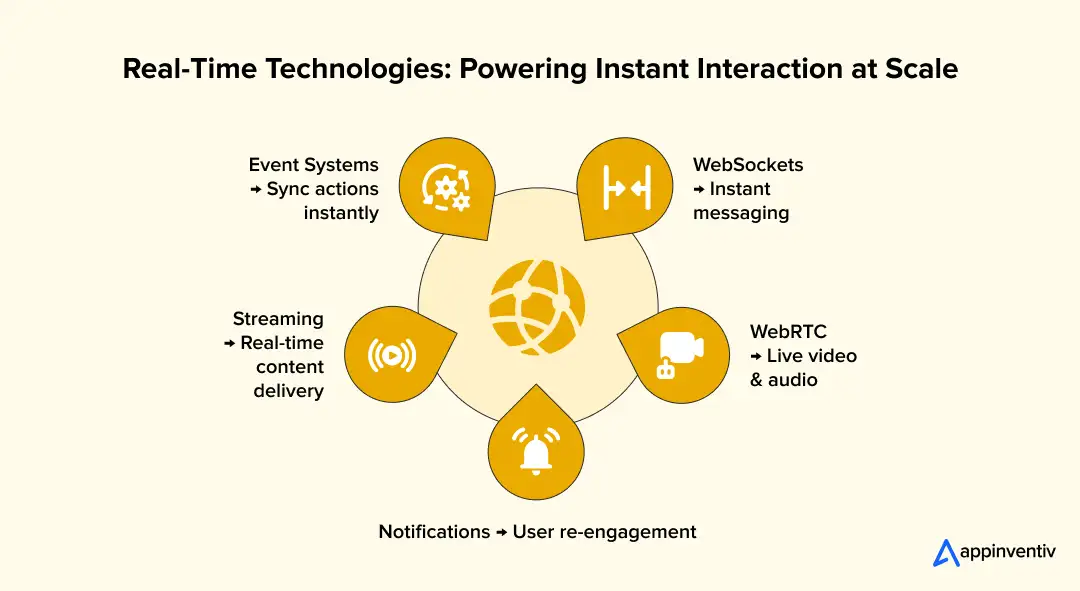
WebSockets for Persistent Communication
This layer keeps the connection alive rather than opening it repeatedly.
- Always-on Connection
The app and server stay connected after the first request. No need to reconnect for every update. - Instant Updates
Messages, reactions, and typing signals show up without delay. There is no refresh cycle. - Shared State
If something changes on one device, it reflects on others at the same time.
WebRTC for Live Video & Audio Systems
This layer handles direct audio and video between users.
- Direct Connection
Users connect instead of routing everything through a central server. - Fast Media Transfer
Video and audio move with very little delay, which keeps calls natural. - Quality Adjustment
The stream shifts based on network strength. This prevents sudden drops.
Push Notification Systems (Firebase, OneSignal)
This layer brings users back even when the app is not open.
- Trigger-Based Alerts
A new message or a similar trigger sends a notification right away. - Background Delivery
Notifications reach the device even if the app is closed. - Targeted Delivery
Messages can be sent to specific users based on activity or behavior.
Streaming Technologies & Pipelines
This layer moves live content from one user to many others.
- Input Flow
A video or audio stream is received by the system from the user’s device. - Processing Step
The system prepares the stream for different speeds and devices. - Delivery Flow
The stream reaches viewers with minimal delay. - Adaptive Playback
The player adjusts quality based on the connection, so playback continues without breaks.
AI, ML & Data Technologies: The Intelligence Layer of Social Platforms
Open a social app, and the feed already feels familiar. That is AI in social media working quietly in the background. For social media for business, that relevance is critical, users now spend 2 hours 40 minutes each day on these platforms, so content needs to stay visible for longer sessions.
You see posts that match your taste, even from accounts you do not follow. That behavior builds over time. The system watches what you click, how long you stay on a page, and what you ignore. It then reshapes the feed with each action.
Machine Learning for Feed Ranking & Recommendations
This layer decides what shows up first and what gets buried.
- Ranking Models
The ML algorithms behind this look at watch time, clicks, and past actions to assign each post a ranking score. - Recommendation Systems
New content appears based on patterns from similar users. This helps surface posts outside your network. - Ongoing Updates
The model shifts as behavior changes. A sudden interest in a topic is reflected in the next few scrolls.
Natural Language Processing (NLP)
This layer reads and interprets text across the platform.
- Content Checks
Comments and captions pass through filters that flag harmful or abusive language. - Tone Detection
Understanding NLP applications shows how intent detection goes beyond keyword matching in both moderation and content ranking. - Multi-language Support
Text from different languages is processed and understood in the same flow.
Big Data Technologies
This layer handles the constant stream of activity across the platform.
- Data Capture
Every action gets recorded, and big data analytics is what turns that raw stream of signals into feed intelligence. - Batch Jobs
Large chunks of data are processed later to spot trends and patterns. - Real-Time Flow
Some updates happen instantly, such as refreshing a feed after a new interaction.
Personalization Engines
This layer shapes what each user sees.
- Activity Tracking
The system tracks viewing habits, clicks, and skips. - User Patterns
Over time, a profile forms. The feed adjusts based on that pattern. - Context Signals
Time, device, and recent activity influence what appears next. - Continuous Change
The feed never stays fixed, and that continuous relevance is one of the key ways social apps monetize engagement.
Content ranking and behavior tracking need to evolve constantly or users stop interacting with the platform.

Security Technologies: Protecting Users, Data, and Platform Integrity
Security problems show up fast on social platforms, and for social media for business use, a single breach can erode user trust overnight. Fake accounts spread spam. Stolen credentials lead to account takeovers. A single breach can expose millions of users. The systems in this layer work quietly in the background, but they carry a heavy load every second.
Encryption Technologies
This layer protects data as it moves and as it sits in storage.
- Data in Transit
The advantages of encryption go beyond transit protection, covering stored data and message-level security across the platform. - Data at Rest
Stored data remains encrypted inside databases. Even internal access stays restricted. - End-to-End Encryption
Messages are locked on the sender’s device and unlocked only by the receiver. No middle system can read them.
Authentication & Authorization (OAuth, MFA)
This layer controls who can access the platform and what they can do.
- OAuth
Users log in through trusted services without sharing passwords directly. This reduces credential exposure. - Multi-Factor Authentication (MFA)
There are multiple MFA approaches worth evaluating, each adding a different layer of protection beyond the password. - Access Control
Permissions define what each user or service can access inside the system.
Fraud & Abuse Detection Systems
This layer tracks unusual behavior and blocks harmful activity.
- Behavior Monitoring
Systems watch for patterns such as rapid posting, repeated logins, or bot-like actions. - Anomaly Detection
Sudden changes in activity trigger alerts. Suspicious sessions can be limited or blocked. - Content Filtering
Harmful or spam content is flagged before it spreads widely.
Blockchain (Optional Advanced Layer)
This layer adds an extra level of trust, and enterprise blockchain use cases show where it has been deployed effectively beyond social platforms.
- Decentralized Identity
Users control their identity without relying on a single system. - Content Ownership
Records can verify who created content and when it was created. - Tamper Resistance
Stored records cannot be altered easily, which adds trust in certain workflows.
Emerging Technologies Driving the Future of Social Media
User expectations keep shifting, and the future of social media technology is being shaped by what people do beyond scrolling. They interact, create, and expect the platform to respond in real time. New technologies are pushing social apps toward more immersive and responsive experiences.
Augmented Reality (AR)
This AR for business layer adds digital elements to what the camera sees.
- Face Filters and Effects
Filters adjust in real time as users move. This is now common in short videos and stories. - Interactive Layers
Users can tap objects placed in the scene. This is often used for product previews and branded content. - Live Tracking
The system tracks face and motion instantly. If tracking lags, the experience breaks.
Virtual Reality (VR)
This layer places users inside a fully digital space.
- Shared Spaces
Users join the same virtual room for events or conversations. - Avatar Interaction
As AI transforms VR use cases, avatar interactions are becoming more responsive and contextually aware in real time. - Continuous Presence
The environment stays active as long as users are connected.
Spatial Computing & Metaverse Layers
This particular enterprise spatial computing and metaverse layer connects digital environments with user identity.
- Persistent Spaces
Changes remain even after users leave. The same space looks the same when they return. - Identity Carryover
The same profile works across different environments. - Connected Systems
Mobile, web, and immersive spaces share the same data and interactions.
Edge Computing
This layer shifts processing closer to the user.
- Nearby Processing
Requests are handled by servers closer to the user’s location. - Faster Interaction
Features like AR and live updates respond faster. - Load Distribution
Work is spread across multiple points rather than a single central system.
The Hidden Technology Layer Most Blogs Miss: System Design Decisions That Make or Break Social Platforms
Most discussions stop at tools and frameworks. The real pressure shows in system design. Small choices here affect feed speed, data accuracy, and uptime. These decisions sit under the surface, but users feel the impact right away.
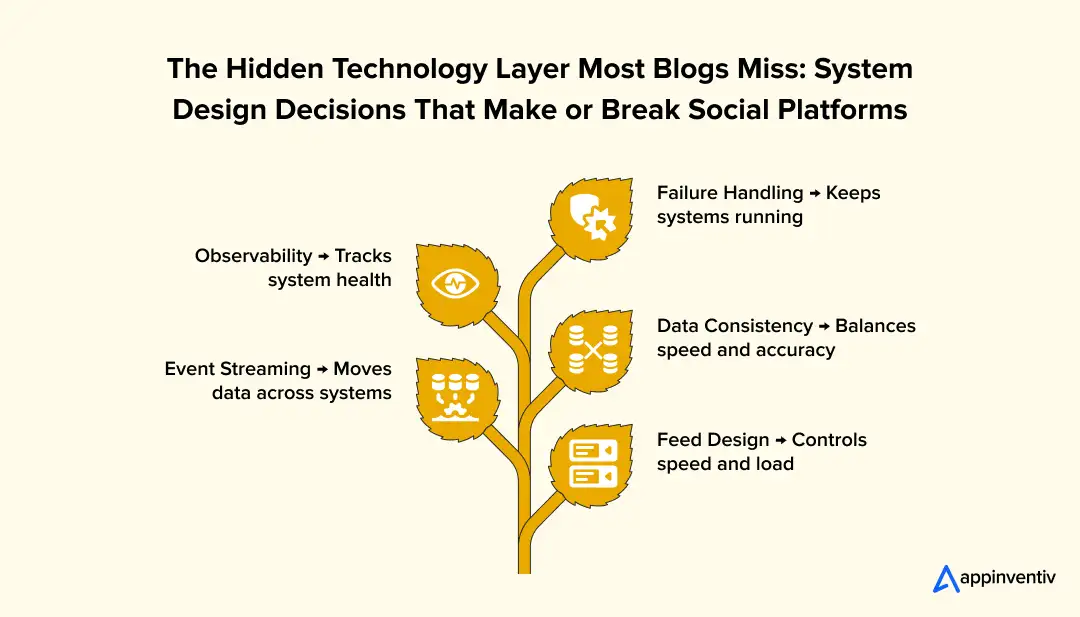
Feed Architecture Technologies (Fan-out vs Fan-in)
This layer decides how feeds are built and delivered.
- Fan-out
The system pushes content to followers when a post is created. Feeds load fast, but write operations increase. - Fan-in
The system pulls content when a user opens the app. This reduces write load but can slow feed generation. - Hybrid Models
Large platforms mix both methods. Active users get pre-built feeds, and less active users get on-demand content.
Event Streaming Systems (Kafka)
This layer moves data across services as events.
- Event Flow
Each action, like a like or comment, becomes an event. - Stream Processing
Services read these events and react in sequence. This keeps systems in sync. - Scalability
Event streams handle high volumes without blocking other processes.
Data Consistency Models
This layer controls how accurate and up-to-date data remains across systems.
- Strong Consistency
All users see the same data at the same time. This is used in critical operations. - Eventual Consistency
Data updates spread over time. A short delay may exist, but the system stays faster. - Trade-Off Balance
Systems choose speed and accuracy based on the feature.
Observability Stack
This layer tracks system behavior and detects issues early.
- Logging
Systems record events and errors for review. - Monitoring
Metrics track performance, such as response time and error rates. - Tracing
Requests are followed across services to find delays or failures.
Failure Handling Technologies
This layer keeps the system running during errors.
- Circuit Breakers
Requests stop hitting failing services to prevent wider issues. - Retry Mechanisms
Failed operations are attempted again after a short delay. - Graceful Degradation
Non-critical features turn off during failure, while core functions remain active.
Messaging, feeds, and updates collapse quickly when system design does not support high concurrency.
How Appinventiv Solves Core Technology Challenges in Building Social Media Platforms
Scaling social platforms exposes the same pressure points, and understanding social media app development cost factors helps teams plan for the right architecture from the start.
Today, 93.8% of internet users are active on social media each month, making social media for business an arena where performance and reliability are non-negotiable. Systems slow down, feed lag, and real-time features break.
Appinventiv, a top social media app development company, addresses these issues at the architecture level.
Track record:
- 150+ social media platforms launched
- 10+ years of experience
How Challenges Are Solved
- Real-time delays (WebSockets, WebRTC)
Distributed messaging and event pipelines keep updates stable during traffic spikes. - Slow feeds and database load
Hybrid feed models, Redis caching, and data sharding reduce response time - Global latency gaps
Multi-region cloud setups and edge processing keep performance consistent - Low engagement from poor feeds
ML-based ranking and real-time data pipelines improve relevance - Security risks and bot activity
Encryption, secure login systems, and behavior tracking block threats - Service failures in distributed systems
Container orchestration and monitoring isolate issues before they spread
Case Snapshots
- Real-time voice messaging system
- 50,000+ downloads
- $1M+ funding secured
Avatus (Avatar-based social platform)
- Digital identity with avatar interaction
- Cloud + blockchain-backed system
- Real-time interaction across environments
Building a social platform at scale requires systems that stay stable under pressure. If your platform needs to support real-time interaction, global users, and large-scale data flow, Appinventiv can help design and build the right social media technology foundation. Let’s connect!
FAQ’s
Q. What is the best social media technology stack for building a platform?
A. There is no fixed stack that works for every platform. Teams choose based on scale and feature needs. A common setup includes React for the interface, Node.js or Java for backend services, and a mix of MongoDB and PostgreSQL for data. What matters is how well these systems handle traffic, not just the tools themselves.
Q. How do developers ensure scalability in social media platforms?
A. The intersection of technology and social media design means the system must be built to grow from the start. Services are split so each can scale on its own. Data is distributed across multiple servers, and caching stores frequently accessed results. Traffic is spread across regions. This setup keeps response time stable even when user numbers rise quickly.
Q. How are real-time features like chat and live streaming implemented?
A. Chat systems use open connections that stay active, so messages move instantly. Live streaming sends video in small pieces as it is created. The system keeps pushing data instead of waiting for the full file. This allows users to interact without delay.
Q. What role does AI play in social media app development?
A. In social media for business contexts, AI decides what users see in their feed, directly affecting reach and engagement. It studies actions such as watch time, likes, and skips. Based on this, it ranks content and suggests new posts. It also helps detect harmful content and filter it before it spreads.
Q. What security technologies are required for social media apps?
A. Data is encrypted when it moves and when it is stored. Login systems often include a second step, like a one-time code. Platforms also track behavior patterns to spot unusual activity, such as bots or repeated login attempts, and block them early.
Q. What is the role of microservices architecture in social media apps?
A. The platform is divided into smaller services, each handling a specific task like feeds, messaging, or login. These services run independently. If one service slows down, others continue to work. This makes the system easier to scale and manage over time.
Q. How do recommendation algorithms work in social media platforms?
A. The system tracks how users interact with content. Watching a video longer, liking a post, or skipping it all sends signals. These signals help rank future content. The feed keeps updating as new actions come in, so no two users see the same feed.


Fast 2-minute response, fully NDA-protected.

UK Social Media Ban for Under-16s: How to Comply With the Online Safety Act as a Platform Owner
Key takeaways: The Online Safety Act is already enforced — platforms must comply now. Ofcom can investigate and fine platforms today. Children’s safety and age checks are already mandatory. The under-16 ban is not law yet (still under discussion). Platforms must prepare now for stricter upcoming rules. If you run a user-to-user service in the…

How Much Does It Cost to Build a Dating App Like Grindr?
Key takeaways: The cost to build a dating app like Grindr ranges between $40,000 and $200,000+, depending on features and scale. Privacy, security, and compliance with global data laws are major cost drivers in LGBTQ+ dating app development. Advanced features like AI matchmaking, video calls, and community tools increase overall development costs. The global dating…

Dating App Development in Australia: Features, Process and Costs
Key takeaways: In Australia, the adoption of dating apps shows no signs of slowing, and the market is expected to reach a value of $58.4 million by 2029. Features like geolocation, profile management, real-time messaging, video calls, and privacy settings are crucial to ensure a seamless user experience and user engagement. It's important to consider…














