


































How to Build Workforce Management Software in Australia: What Businesses Should Know in 2026

 Share -



- 01Why Workforce Management Software Is Now a Strategic Priority in Australia
- 02A Step-by-Step Process to Workforce Management Software Development in Australia
- 03What Are the Must Have Features of Workforce Management Software?
- 04Compliance and Regulatory Considerations in Australia
- 05How Much Does It Cost to Develop Workforce Management Software in Australia (2026)?
- 06ROI Framework: How Australian Enterprises Recover the Investment
- 07What Are the Key Use Cases of WMS in Different Industries Across Australia
- 08Emerging Trends in Workforce Management Software in 2026 and Beyond
- 09Common Challenges When Building WFM Software and How to Address Them
- 10How Appinventiv Supports WFM Software Development in Australia
- 11FAQs

Key takeaways:
- Custom workforce management software development in Australia is now a compliance and operational necessity for enterprises managing complex Modern Award structures.
- Award interpretation logic, integration architecture, and security posture aligned with the ASD Essential Eight are the three technical dimensions that distinguish audit-ready WFM platforms from basic scheduling tools.
- Total cost of ownership for custom WFM software in Australia ranges from AUD 70,000 to AUD 700,000 or more.
- Successful implementation follows an eight-step development lifecycle, moving from award logic mapping to sovereign cloud deployment.
- Compliance obligations including Superannuation Guarantee, Single Touch Payroll, and the Closing Loopholes Act 2024 must be treated as architectural constraints, not reporting add-ons.
Australia’s labour market has rarely been more operationally complex as it is in 2026. With the Fair Work Commission’s evolving mandates and the stringent “Closing Loopholes” legislation, the margin for error in human capital management has vanished.
Wage theft enforcement has sharpened, penalty rate obligations under Modern Awards remain a persistent compliance risk, and casualisation across healthcare, retail, and logistics means workforce composition shifts weekly rather than quarterly.
At the same time, labour shortages in aged care, mining, and infrastructure are pushing shift unpredictability to levels that expose businesses to both operational disruption and wage compliance gaps. Relying on legacy systems or rigid off-the-shelf platforms often results in technical stagnation and fragmented workflows that stifles growth.
According to the Fair Work Ombudsman Annual Report, the agency recovered over AUD 509 million for 251,475 underpaid/unpaid workers in 2022-23; a record that signals both the scale of non-compliance and the regulatory intent behind enforcement.
For enterprise leaders, that figure is not an abstraction. It is a liability exposure their current systems may not be equipped to manage.
This blog addresses one specific question: how to build workforce management software in Australia that passes through the rigorous Fair Work audits while providing a scalable, sovereign architecture for 2026 operations.
Most Australian enterprises overpay for WFM platforms that were never designed for Modern Award complexity. We can map the gap between what you have and what compliance requires.

Why Workforce Management Software Is Now a Strategic Priority in Australia
At its core, WFM software is a purpose-built enterprise platform that coordinates workforce scheduling, time and attendance, Modern Award interpretation, leave management, and labour compliance in a single integrated system.
Unlike generic HR tools, a custom WFM system is engineered around an organisation’s specific workforce structure, enterprise agreements, and regulatory obligations, replacing fragmented manual processes with automated, audit-ready workflows.
What has shifted is the strategic weight now attached to it across Australian enterprise. In 2026, these systems are no longer just “back-office utility”; they have become “board-level priority.”
Addressing the Australian “Compliance Debt”
Rising base wages and penalty rate complexity are not the only pressure. The proportion of casual and contingent workers in sectors like hospitality, retail, and healthcare has grown substantially, making headcount management harder to standardise across payroll systems that were never designed for multi-employment-type logic. Award interpretation errors, when compounded across thousands of employees over months, produce outcomes that satisfy no one: payroll teams, legal, or regulators.
Compliance exposure varies by industry.
- In mining, fatigue management regulations under state-based OHS frameworks require real-time visibility into shift hours.
- In healthcare, nurse-to-patient ratios tied to rostering are both a regulatory and patient safety obligation.
- Logistics operators managing transport workers face overlapping obligations under the Heavy Vehicle National Law and the Fair Work Act simultaneously.
The Limits of Off-the-Shelf Solutions
The more telling shift is in how organisations frame the question. The conversation has moved from whether a WFM platform is necessary to how deeply it should be tailored to the organisation’s specific workforce architecture.
Off-the-shelf tools handle generic scheduling adequately. They rarely handle complex award stacking, multi-site roster logic, or real-time compliance checks against bespoke enterprise agreements with the precision Australian enterprise now requires.
Also Read: White-Label HR Software Development Cost in Australia
A Step-by-Step Process to Workforce Management Software Development in Australia
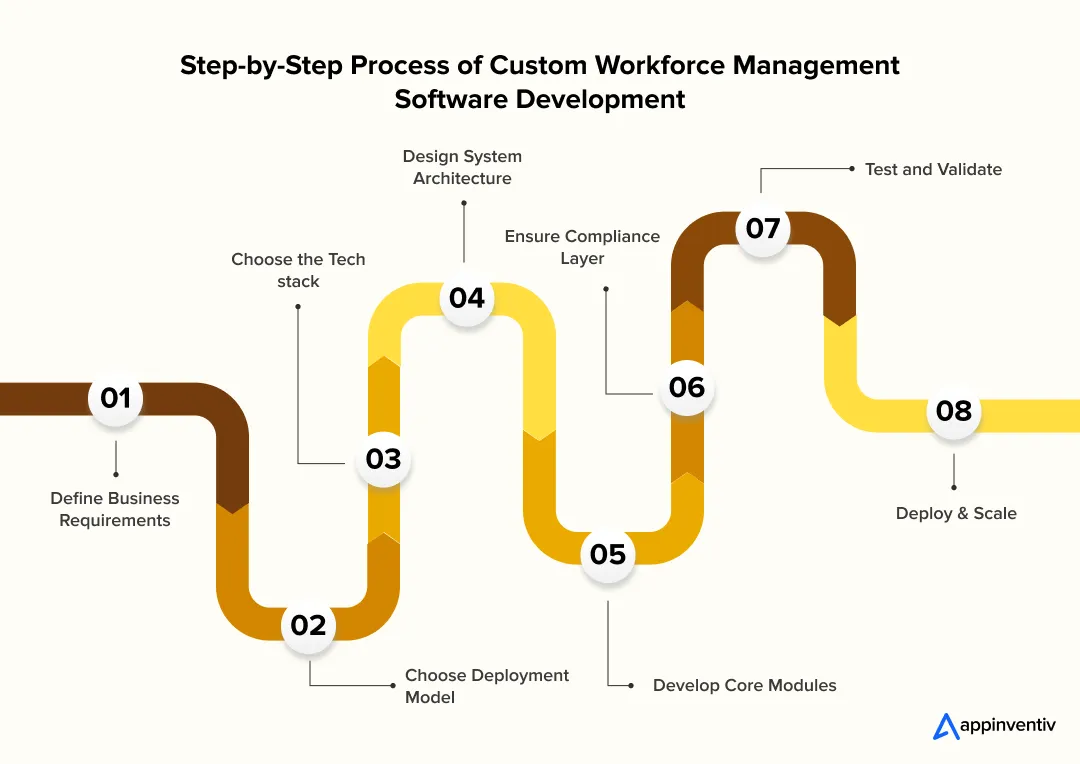
Workforce management software development in Australia involves far more than assembling a feature list. It requires aligning technical architecture with regulatory obligations, integrating into existing payroll and HR systems, and building for scale across diverse workforce types. The following steps reflect what you should consider when building a WFM system.
Step 1: Define Business Requirements
Start with operational specificity, not feature catalogues. Map your workforce types, award categories, shift structures, and integration dependencies. This involves documenting every Enterprise Agreement (EBA) that applies to the workforce. In Australia, this stage often reveals that a one-size-fits-all approach is the primary driver of existing payroll leakage and compliance risk.
Step 2: Choose a Deployment Model
Decision-makers must evaluate the benefits of a pure public cloud against hybrid or sovereign cloud models. Given the Australian Signals Directorate’s (ASD) focus on critical infrastructure, many Australian firms are opting for onshore hosting via AWS (Sydney/Melbourne regions) or Azure to ensure data residency and satisfy the Privacy Act 1988.
Step 3: Choose the Right Tech Stack
The selection of a WFM software tech stack involves a trade-off between speed to market and long-term maintainability. The stack must support high concurrency for peak login times during shift starts and ensure robust data integrity for audit readiness.
Below is the reference architecture we apply across enterprise WFM builds in the Australian market.
| Layer | Technology Options | Strategic Justification |
|---|---|---|
| Frontend | React, Angular | High performance for complex, interactive scheduling grids and real-time updates. |
| Backend | Node.js, Java, .NET | Scalable handling of asynchronous shift requests and heavy computational logic. |
| Cloud | Amazon Web Services, Microsoft Azure | Local data residency and alignment with ASD security frameworks. |
| Database | PostgreSQL, MongoDB | Relational integrity for payroll records; NoSQL flexibility for extensive audit logs. |
| APIs & Integrations | Payroll systems, HRMS platforms, ERP connectors | Essential for real-time synchronisation with Xero, MYOB, or SAP S/4HANA. |
Step 4: Design System Architecture
Architecture decisions made at this stage carry ten-year cost implications. For Australian enterprises, the priority is a decoupled, microservices-based design. This ensures the Award Interpretation Engine (the most volatile part of the code) can be updated independently of the User Interface. This is a critical safeguard for the annual July 1 wage increases or sudden legislative shifts like the “Right to Disconnect.
The following table guides how you should approach the WMS architecture choice
| Architectural Pillar | Enterprise Requirement | Strategic Value for AU Business |
|---|---|---|
| Cloud Model | Hybrid or Sovereign Cloud | Ensures PII remains onshore to satisfy the Privacy Act and ASD guidelines. |
| Microservices | Decoupled Award & Logic Engines | Allows for rapid updates to payroll rules without risking downtime for the entire roster. |
| API Gateway | RESTful/GraphQL Integration Layer | Facilitates real-time data flow between the WFM, SAP/Workday, and local IoT sensors. |
| Data Layer | Real-time Workforce Intelligence | Feeds live data into audit-ready logs for Fair Work compliance and executive dashboards. |
Step 5: Develop Core Modules
Development focuses on building the foundational features of workforce management system software. This includes the rostering engine, time-tracking modules, and the communication layer. An API-first approach ensures the system integrates with existing HRIS and payroll ecosystems rather than becoming a data silo.
Step 6: Ensure the Compliance Layer
This phase bakes Australian law directly into the system architecture. Award interpretation logic, Fair Work Act obligation checks, data residency controls, and audit logging need to be embedded at the data and service layers, not bolted on at the UI level. Systems that treat compliance as a reporting function rather than an operational constraint tend to fail during audits.
Step 7: Test and Validate
Testing must extend beyond basic functionality. In the Australian context, rigorous payroll parallel runs are performed to ensure the system’s calculations match the accuracy required for Fair Work compliance across hundreds of edge-case scenarios and historical pay cycles.
Step 8: Deploy and Scale
The final phase involves a phased rollout, typically starting with a single site or department. This allows for the refinement of the user experience (UX) based on real-world feedback from Australian employees, ensuring high adoption rates before the full enterprise-wide launch.
Appinventiv has delivered 250+ digital systems across Australia, with a 96% client retention rate and 99.5% security compliance SLA. We bring the same rigour to every WFM engagement.

What Are the Must Have Features of Workforce Management Software?
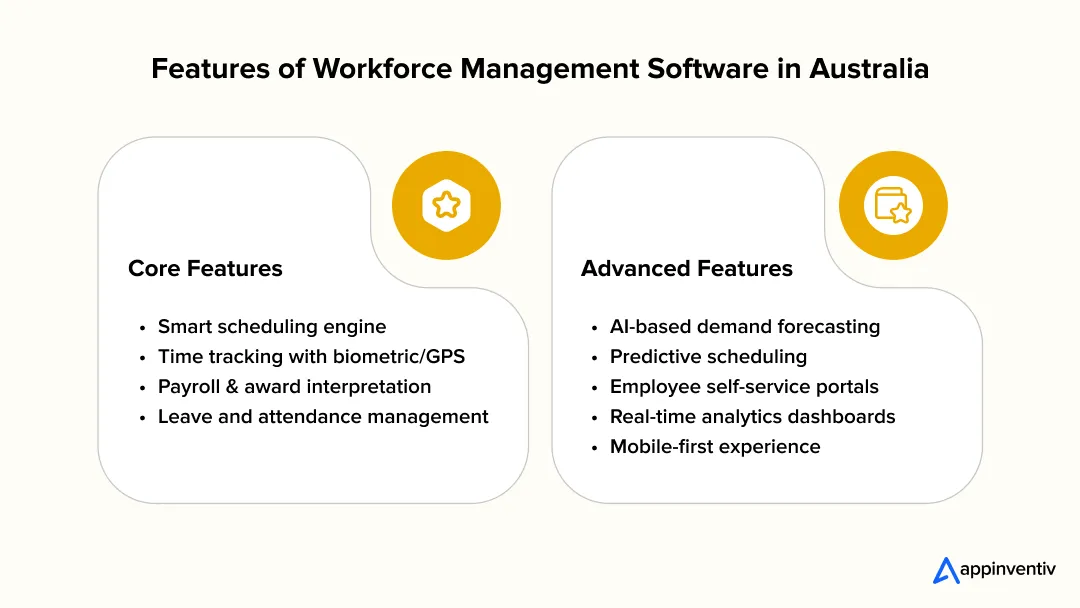
The features of workforce management system software have expanded considerably over the past three years, driven by AI availability in Australia, mobile workforce growth, and compliance enforcement intensity. What follows reflects both baseline requirements and the advanced capabilities Australian enterprise clients are now building into scope from day one.
Core Operational Features
These modules form the baseline for any functional custom workforce management system software in the Australian market:
- Smart Scheduling Engine: Automated rostering that balances availability, skills, and costs while preventing breaches of “Right to Disconnect” laws and fatigue limits.
- Time Tracking & Geo-Fencing: GPS-enabled mobile check-ins and biometric integration provide a tamper-proof audit trail for field-based workforces in mining and construction.
- Live Award Interpretation: A dedicated engine applying penalty rates, allowances, and overtime multipliers per Modern Awards or EBAs in real-time.
- Leave & Attendance Management: Centralised tracking of annual, sick, and long-service leave that automatically updates accruals and prevents scheduling conflicts.
- Fatigue & Safety Monitoring: Real-time tracking of work hours against OHS standards to prevent burnout and ensure compliance with industry-specific safety regulations.
Advanced 2026 Expectations
To remain competitive, enterprise leaders are now prioritising features that offer predictive rather than reactive capabilities:
- AI-Based Demand Forecasting: Analysing historical data and seasonal trends to predict headcount requirements, essential for hospitality and retail peak periods.
- Predictive Scheduling: Suggesting efficient shift patterns that minimise labour leakage and maximise coverage without exceeding pre-defined budget caps.
- Employee Self-Service (ESS): Mobile-first portals for shift swaps and availability updates, reducing HR administrative load and increasing staff autonomy.
- Real-Time Analytics Dashboards: Granting executives visibility into “labour spend vs budget” variances and high-risk compliance areas across multiple sites.
- Dynamic Labour Costing: Instant visibility into the true cost of a shift, including all on-costs, before a roster is published.
Compliance and Regulatory Considerations in Australia
Compliance in Australian workforce management is not a documentation exercise. It is a technical constraint that determines whether a platform can be relied upon in a regulatory investigation. These considerations should shape architecture, not just reporting outputs.
Fair Work Act and Modern Awards
With over 100 Modern Awards, each containing specific rules for overtime, shift breaks, and penalty rates, the risk of “accidental” non-compliance is high.
- Automated Award Interpretation: Systems must be capable of ingesting complex Enterprise Agreements (EBAs) and automatically applying the correct pay rules. This eliminates the “human factor” where managers might inadvertently miscalculate a tool allowance or a split-shift penalty.
- The “Right to Disconnect”: Since late 2024, the legal right for employees to refuse contact outside of work hours has fundamentally changed how WFM systems must handle notifications. Software must now include “blackout” periods for push notifications and automated shift offers to avoid breaching these protections.
Closing Loopholes Act 2024
The Closing Loopholes Act 2024 introduced two provisions with direct technical implications for WFM platforms:
- Same job, same pay: Labour hire workers must receive the same pay as directly employed equivalents. WFM systems managing mixed direct and labour hire workforces need contractor classification logic that flags rate discrepancies at the scheduling stage, not post-payroll.
- Casual conversion tracking: Expanded rights for casual employees to convert to permanent employment require WFM platforms to track hours patterns and trigger conversion eligibility alerts automatically. Systems that rely on manual HR review for this obligation carry material compliance risk.
Superannuation Guarantee and Single Touch Payroll
Two ATO obligations intersect directly with WFM platform architecture:
- Superannuation Guarantee (SG): Employers are required to contribute 11.5% of ordinary time earnings (rising to 12% in July 2025) to each eligible employee’s superannuation fund. Underpayment of SG attracts ATO penalties in addition to any Fair Work exposure. SG calculation logic should be embedded at the payroll engine layer and validated during parallel-run testing.
- Single Touch Payroll (STP): All employers must report payroll, tax, and super information to the ATO on or before each payday via STP. WFM platforms with integrated payroll output must produce STP-compatible data. This is a non-negotiable technical requirement that should be confirmed during vendor or architecture selection, not discovered during deployment.
Data Privacy and Sovereignty
The Privacy Act 1988 governs how employee personal information is collected, stored, and accessed. Proposed reforms to the Act, which include strengthened enforcement and expanded individual rights, increase the technical obligations on systems that process biometric data, location data, or health information as part of workforce management functions.
For organisations in sensitive sectors, data residency requirements mean that workforce data should not be processed or stored on infrastructure outside Australian jurisdiction without explicit governance approval. This directly affects cloud vendor selection and third-party integration architecture.
Industry-Specific Regulatory Considerations
Depending on the sector, your WFM platform may need to interface with secondary regulatory frameworks. For instance:
- Healthcare and aged care operators need to account for nurse-to-patient ratio obligations and, where relevant, interoperability considerations tied to My Health Record and related digital health frameworks.
- Banking and financial services organisations face APRA prudential standards that extend to operational resilience, which includes workforce management systems supporting critical functions.
- Mining and infrastructure operators have obligations under the Security of Critical Infrastructure Act 2018, which imposes risk management obligations relevant to systems managing personnel data for critical asset operations.
Security Frameworks
Alignment with the ASD Essential Eight remains the most widely recognised security baseline for Australian enterprise systems. WFM platforms handling biometric data, location tracking, and payroll inputs require particular attention to application control, multi-factor authentication, and privileged access management. Identity and access management architecture should reflect least-privilege principles with role-based access tied to operational function, not organisational hierarchy.
How Much Does It Cost to Develop Workforce Management Software in Australia (2026)?
The cost to build workforce management software in Australia is determined primarily by integration complexity, the depth of award interpretation logic required, compliance architecture, and the scale of the workforce being managed.
Most custom workforce management software development cost in Australia falls within a range of AUD 70,000 for constrained MVPs to AUD 700,000 or more for full-scale platforms with AI forecasting, multi-site logic, and deep payroll integration.
| Complexity Level | Estimated Cost (AUD) | Key Characteristics |
|---|---|---|
| Basic MVP | 70,000 – 150,000 | Core scheduling, time tracking, basic award support |
| Mid-Level Platform | 150,000 – 400,000 | Deep integrations, configurable compliance engine, multi-workforce-type support |
| Enterprise-Grade | 400,000 – 700,000+ | AI forecasting, multi-site architecture, advanced analytics, full audit capability |
These ranges assume Australian development standards, security testing aligned with ASD guidelines, and compliance validation across relevant Modern Awards. Offshore development reduces unit cost but increases integration risk, compliance validation complexity, and knowledge transfer overhead in ways that frequently extend delivery timelines.
ROI Framework: How Australian Enterprises Recover the Investment
Three categories of financial return are consistently measurable across Australian WFM implementations:
- Labour cost savings: Automated award interpretation at the roster-build stage eliminates post-payroll correction cycles. Organisations managing 500+ employees across multiple awards typically recover 1.5-3% of annual wage spend through error reduction alone.
- Compliance penalty avoidance: The FWO recovered AUD 509 million in 2022-23. Enterprises with auditable, system-generated pay records carry materially lower enforcement and remediation exposure than those relying on manual processes.
- Administrative overhead reduction: Self-service portals, automated leave calculations, and integrated STP output reduce payroll team workload by an average of 35% based on Appinventiv’s Australian delivery benchmarks.
Cost ranges are useful starting points. Your actual figure depends on integration depth, workforce complexity, and compliance requirements. We provide estimates tailored to your real architecture.

What Are the Key Use Cases of WMS in Different Industries Across Australia
Workforce dynamics in Australia vary significantly by sector, from the remote operations of Western Australian mines to the high-pressure environments of East Coast aged care facilities. Custom WFM software addresses these unique industry pressures by automating sector-specific compliance and operational workflows. Here are some prominent benefits of enterprise workforce management software development:
Retail and Hospitality
Multi-site operators managing casual and part-time workforces under the General Retail Industry Award or Hospitality Industry Award face scheduling complexity that off-the-shelf tools handle inconsistently. Custom WFM platforms allow penalty rate calculations to be applied at the roster-build stage, not post-payroll, reducing correction costs and compliance risk simultaneously.
Healthcare and Aged Care
Aged care providers operating under the Aged Care Act have workforce obligations tied to registered nurse hours and staffing ratios. Scheduling systems that cannot enforce these constraints at the roster level, and flag potential breaches before shifts are published, create both patient safety and regulatory risk. The sector’s high turnover rates also make workforce visibility and demand forecasting materially valuable.
Mining and Field Services
Fatigue management, site access controls, and FIFO rotation logistics make workforce management in resources and mining technically complex beyond standard scheduling requirements. Integration with site access systems, GPS tracking for remote worker safety, and shift compliance reporting for OHS purposes are standard requirements in the resource sector deployments.
Logistics and Supply Chain
Transport and logistics operators managing drivers under the Heavy Vehicle National Law alongside general warehouse staff face dual compliance obligations that few commercial WFM platforms handle natively. Custom systems built to manage these parallel requirements provide operational clarity that reduces both compliance exposure and dispute resolution overhead.
Emerging Trends in Workforce Management Software in 2026 and Beyond
The workforce management software development process in Australia is being shaped by several trends that are moving from pilot to production. Understanding these shifts helps frame investment decisions over a three-to-five-year horizon.
- Agentic AI tools in Australia autonomously cross-reference skills, cost, and Fair Work compliance to fill shift gaps. This reduces middle-management decision fatigue while ensuring every automated action remains legally defensible and audit-ready.
- Gig workforce integration is becoming a standard requirement as organisations blend permanent, casual, and contractor workforces on common scheduling and compliance platforms.
- Real-time compliance engines that flag award breaches at the scheduling stage, rather than during payroll processing, are reducing error correction cycles across retail and healthcare clients.
- Workforce digital twins, which model workforce behaviour and capacity against operational scenarios, are moving from research context to enterprise planning tools in logistics and mining.
- IoT and wearable integration for fatigue monitoring, lone worker safety, and biometric attendance verification is expanding the data inputs available to WFM systems in field-based industries.
Common Challenges When Building WFM Software and How to Address Them
Most WFM delivery failures follow predictable patterns. Awareness of these failure modes, and their architectural remedies, is operationally more valuable than feature planning at the outset of a build.
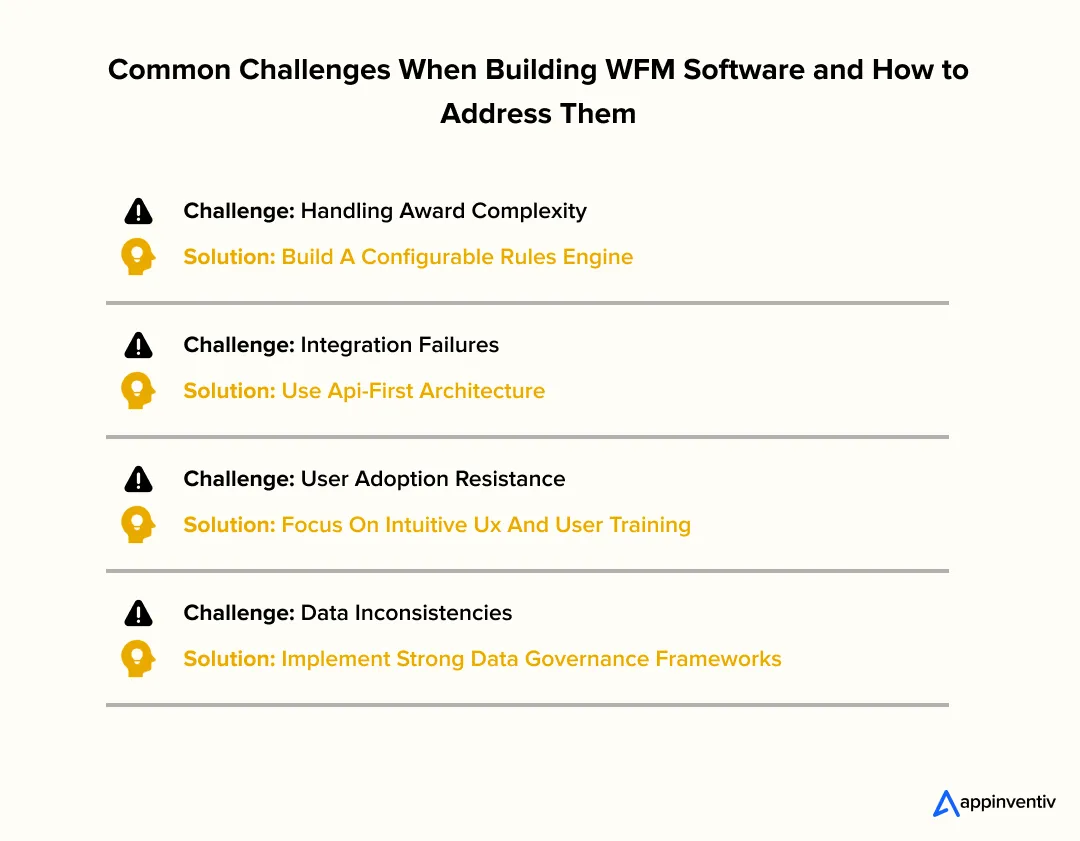
Handling Award and EBA Complexity
The sheer volume of pay rules in Australia frequently overwhelms standard logic engines. Projects often stall when attempting to hard-code these rules, resulting in a fragile system that breaks during the next enterprise bargaining round or Fair Work update.
- The Resolution: Engineering a configurable rules engine is essential. Moving away from static code to a metadata-driven approach allows HR or Legal teams to adjust pay conditions and allowances via a secure interface, bypassing the need for constant developer intervention.
Integration Failures with Legacy Systems
Workforce management software cannot operate in a vacuum. It must communicate with legacy payroll systems, ERPs such as SAP, and various HRIS platforms. Fragmented data flows lead to “source of truth” conflicts and manual reconciliation marathons that drain productivity.
- The Resolution: Adopting an API-first architecture ensures connectivity. By treating every internal module as a service, data flows seamlessly between the WFM platform and the broader tech stack, preserving data integrity across the entire organisation.
User Adoption and Cultural Resistance
Employees often view new workforce tools, particularly those involving GPS or biometrics, with skepticism. This is a sensitive area in Australia given the strong domestic privacy culture and union presence.
- The Resolution: Prioritising Employee-Centric UX shifts the narrative. Focusing on features that directly benefit the worker, such as simplified shift swapping and instant leave visibility, frames the technology as a tool for “wage transparency” rather than mere surveillance.
Data Governance and Consistency
A lack of clear data strategy leads to the accumulation of “dirty data,” which compromises reporting accuracy and heightens compliance risks during audits.
- The Resolution: Establishing a Rigorous Governance Framework from the project’s inception is vital. Defining clear data ownership and automating validation at the point of entry ensures the system architecture consistently mirrors internal audit requirements.
How Appinventiv Supports WFM Software Development in Australia
Answering how to build workforce management software in Australia is not just a product decision. It is a compliance-heavy, integration-intensive, and data-driven transformation initiative. Most projects fail not because of poor development, but because they underestimate the complexity of award interpretation, real-time scheduling, and system interoperability.
This is where Appinventiv’s software development services in Australia step in.
We approach workforce management platforms as enterprise systems, not standalone tools. That means every solution is designed around three pillars: compliance-first architecture, AI-driven decisioning, and seamless enterprise integration.
With 11+ years of APAC delivery experience and a team of 1600+ tech architects, we ensure that your digital assets (over 3000 of which are already deployed across Australia) are engineered for the local market. Our approach is grounded in commercial pragmatism and technical rigour, reflected in our 90% recurring client base.
As a partner ranked among APAC’s high-growth companies by Statista and the Financial Times for two consecutive years, we understand the pace of change in the Australian market. We operate through more than five agile delivery centres across the country, providing the local presence needed to navigate complex digital transformations across 35+ industries.
We don’t just build software; we build enterprise-grade governance engines. Our delivery is has resulted in average efficiency gains of 35% for our Aussie partners. This performance is backed by a 99.50% security compliance SLA, ensuring that every system we build adheres to the rigorous ISO and SOC2 standards necessary to satisfy Australian board-level risk assessments.
Real-World Impact: JobGet Case Snapshot
Our capability in handling high-concurrency labour markets is best demonstrated by our work with JobGet. The challenge was to reduce the friction in the hourly job market, an area where traditional, slow-moving HR platforms fail. We engineered a mobile-first ecosystem that prioritised speed, reducing the job-search-to-hire timeline from weeks to mere minutes.
By developing a real-time instant messaging layer and an AI-driven matching algorithm, we allowed employers to find and communicate with qualified candidates instantly.
The results?
- 150,000+ successful placements
- $52 million in funding raised
- 2 million+ app downloads
- 50,000 companies on the platform
- Won the MIT Inclusive Innovation and Gold award from Mass Challenge
For an Australian enterprise, this level of engineering expertise translates into a WFM system that doesn’t just record shifts, but actively optimises labour availability in high-pressure sectors like retail and hospitality.
We bring this same high-concurrency engineering to your internal WMS, ensuring your managers can fill an emergency shift in an Australian hospital or mine site as easily as a consumer app matches a user to a service.
Let’s identify the specific architectural requirements for your next-generation workforce platform. Book a Technical Roadmap Session Now
FAQs
Q. What is workforce management software (WFM software)?
A. WFM software is a purpose-built enterprise platform that manages workforce scheduling, time and attendance, award interpretation, leave management, and labour compliance in a coordinated system. It replaces manual rostering and fragmented payroll processes with integrated, automated workflows aligned to the organisation’s specific workforce structure and regulatory obligations.
Q. How long does it take to build WFM software in Australia?
A. A basic MVP typically requires 4 – 6 months from requirements finalisation to production deployment. Mid-level platforms with integrations and compliance engines generally take 8 – 12 months. Enterprise-grade workforce management software development in Australia with AI capabilities and multi-site architecture takes 12 to 18 months, depending on integration complexity and stakeholder availability during requirements and testing phases.
Q. How is AI transforming workforce management in Australia?
A. AI is shifting WFM from reactive rostering to predictive workforce planning. Demand forecasting models that draw on historical attendance, operational data, and external signals allow organisations to build rosters that balance cost, compliance, and service levels simultaneously. Predictive scheduling is also reducing fatigue-related incidents in mining and healthcare by modelling rest period compliance before shifts are published.
Q. What industries benefit most from workforce management software in Australia?
A. Retail, hospitality, healthcare, aged care, mining, logistics, and construction benefit most from workforce management software Australia-wide, given the combination of complex award structures, large casual workforces, shift-based operations, and direct compliance obligations. These industries carry the highest labour cost concentration and the greatest regulatory exposure from scheduling and payroll errors.
Q. What are the benefits of enterprise workforce management software development?
A. The benefits of enterprise workforce management software development include measurable reductions in payroll error rates, improved award compliance, real-time labour cost visibility, reduced administrative overhead in rostering and leave management, and improved workforce planning accuracy through data-driven forecasting. For Australian enterprises, the compliance risk reduction alone often justifies the investment.


Fast 2-minute response, fully NDA-protected.

Beyond Customer Portal Development: Building Connected Digital Services
Key takeaways: A portal without CRM, ERP and billing integration leaves your staff doing the connecting. Start with customer tasks, then integrate only the systems those tasks actually need. Name one system of record for each data type before choosing APIs or middleware. Plan integration, security and privacy obligations at the start, not after the…

CRM Software for Local Government: From Community Requests to Better Service Delivery
Key takeaways: A council CRM should sit around existing systems as a service layer, not replace them. Integration with ERP, rates, property and GIS systems prevents another data silo and duplicate entry. Start with one high-volume service, pilot it with residents, then scale on measured results. Track resolution time, SLA compliance, self-service rates and cost…

The Ultimate Guide to CRM for Insurance: Features, Cost, Top Platforms, Integration & More
Key takeaways: CRM for insurance connects sales, service, and claims into one governed system, distinct from the policy administration system. Core features span pipeline management, policy visibility, claims tracking, commission management, AI analytics, and compliance controls. Cost ranges from roughly USD 15,000 for configuration to USD 150,000 and beyond for custom development at enterprise scale.…