























Appinventiv Call Button
Case Study | Mining & Resources | Enterprise | Australia | Appinventiv

Modernising Legacy OT
and IT Across Australian
Mining

How Appinventiv unified disconnected operational and corporate technology across nine remote mining sites into governed, real-time operational intelligence, without disrupting live production.

Futuristic Sydney Opera House visual
9 sites unified on one platform
38% drop in unplanned downtime
99.4% OT network uptime
62% faster NGER reporting
Overview

Multi-site Australian Mining Operator

A large-scale mining operator running heavy industrial assets across remote regions in two states. The enterprise manages data across 280+ active SaaS systems, operational technology vendors, and third-party maintenance contractors inside critical production environments.

The Challenge

Years of Site-By-Site Decisions Had Made Scale Itself The
Problem

Nine sites had grown their own systems in isolation, leaving the enterprise with no shared view of equipment health, emissions data, or safety status across the operation.

The Solution

An Architecture Built for the Environment, Not Retrofitted
to It

Appinventiv connected OT and IT behind a secure boundary, processed data at the edge for remote resilience, and automated NGER reporting, all without disrupting live production.

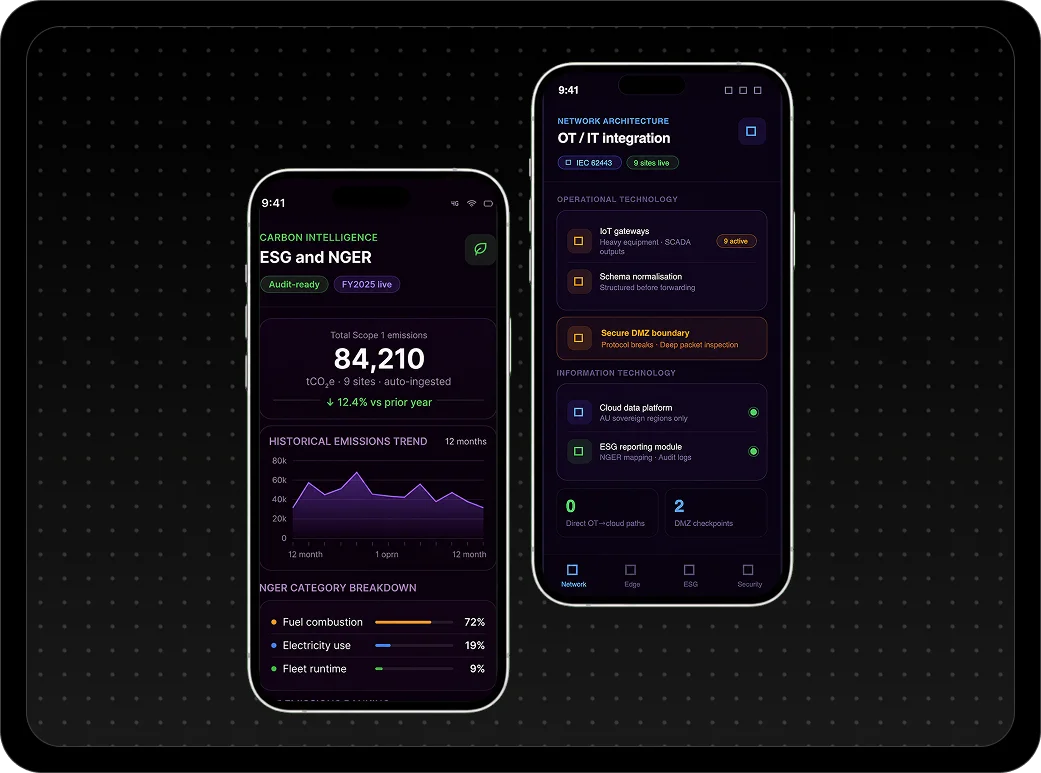
Industrial IoT gateways at each site capture telemetry from heavy equipment and SCADA outputs, normalising it into a structured schema before forwarding to the cloud. The OT and IT boundary follows IEC 62443 principles: no direct path from control systems to cloud, with all data transiting a secure DMZ that uses protocol breaks and deep packet inspection.

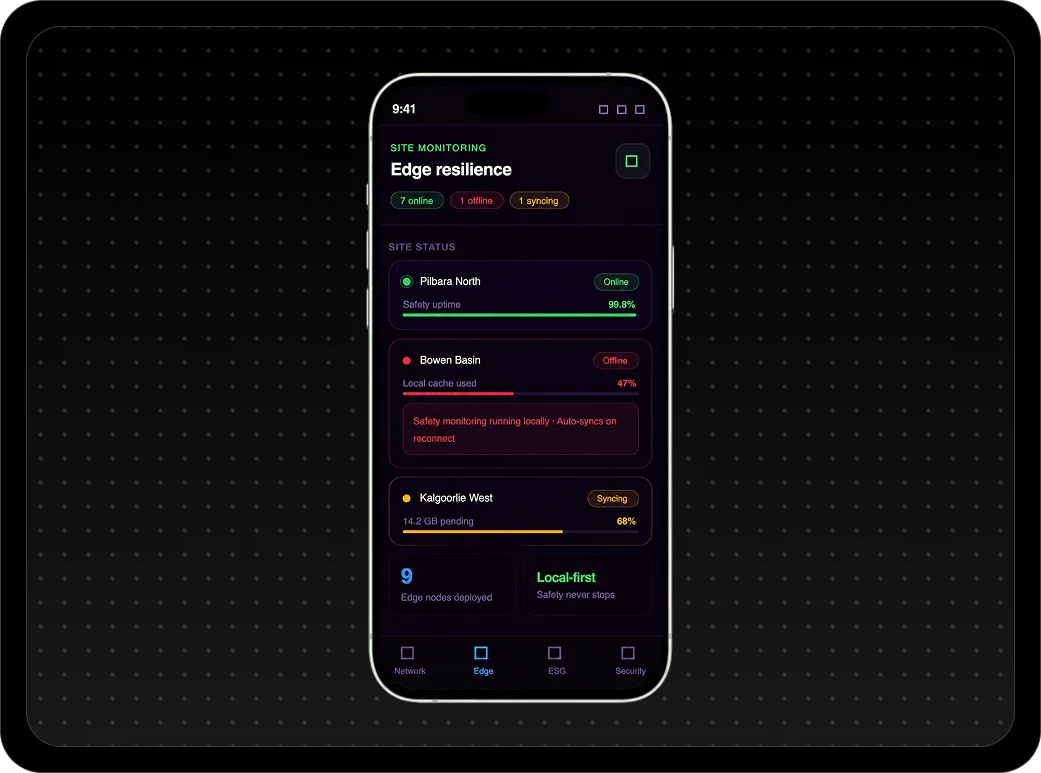
Edge computing nodes process safety monitoring and vital telemetry locally at each site. If a satellite link drops, the site keeps running, caching data and synchronising automatically the moment connectivity is restored.

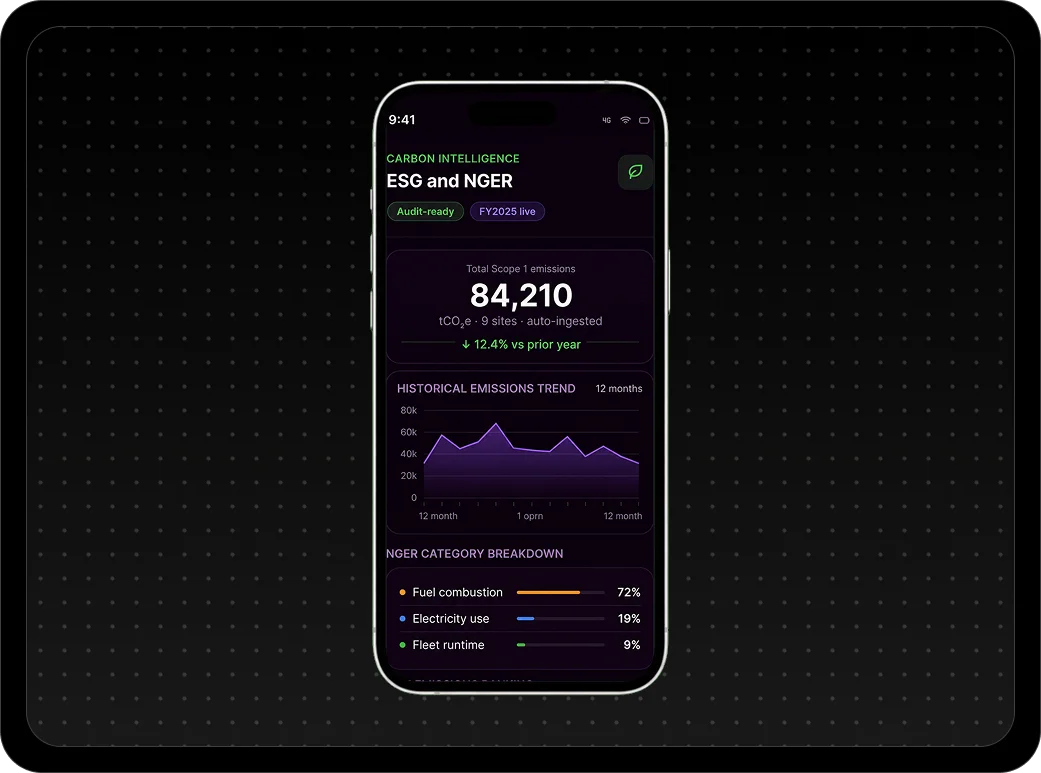
Fuel, electricity, and fleet runtime data ingest automatically from source assets across all nine sites. A custom module maps live data to NGER carbon accounting categories, generating audit-ready disclosures with full provenance and moving sustainability teams from lagging reports to proactive carbon management.

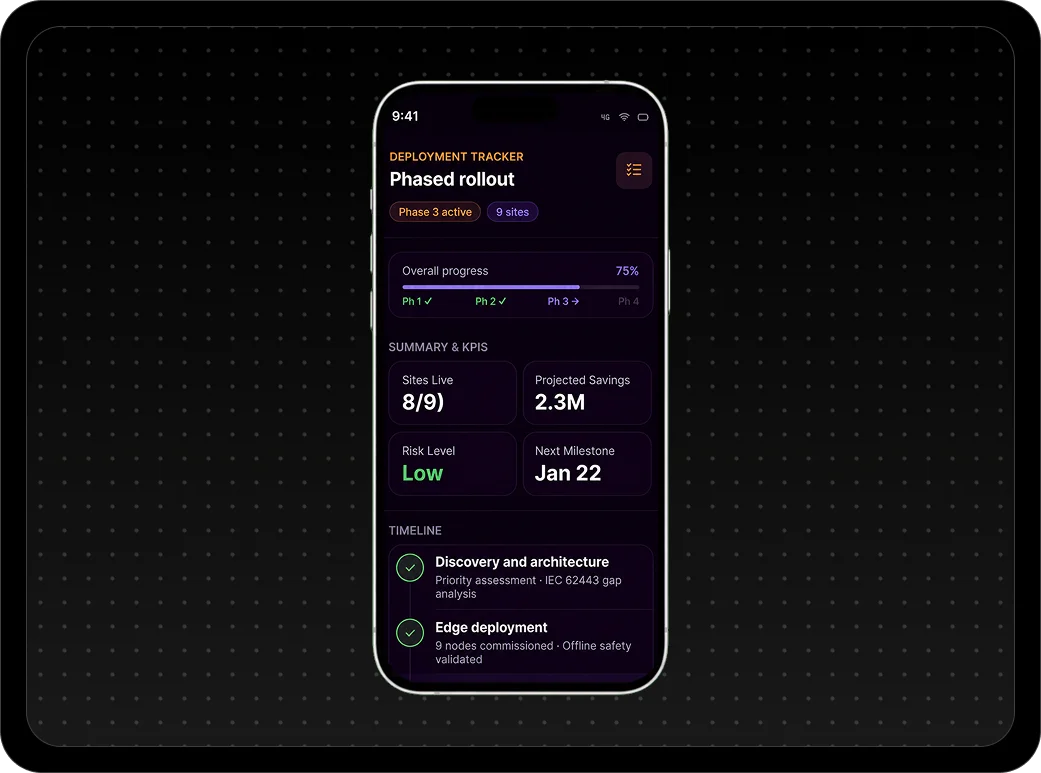
Discovery and architecture design at priority sites, edge deployment tested in isolation before going live, predictive and ESG intelligence activation, then enterprise-wide rollout with role-based access and an activated audit and data governance framework.

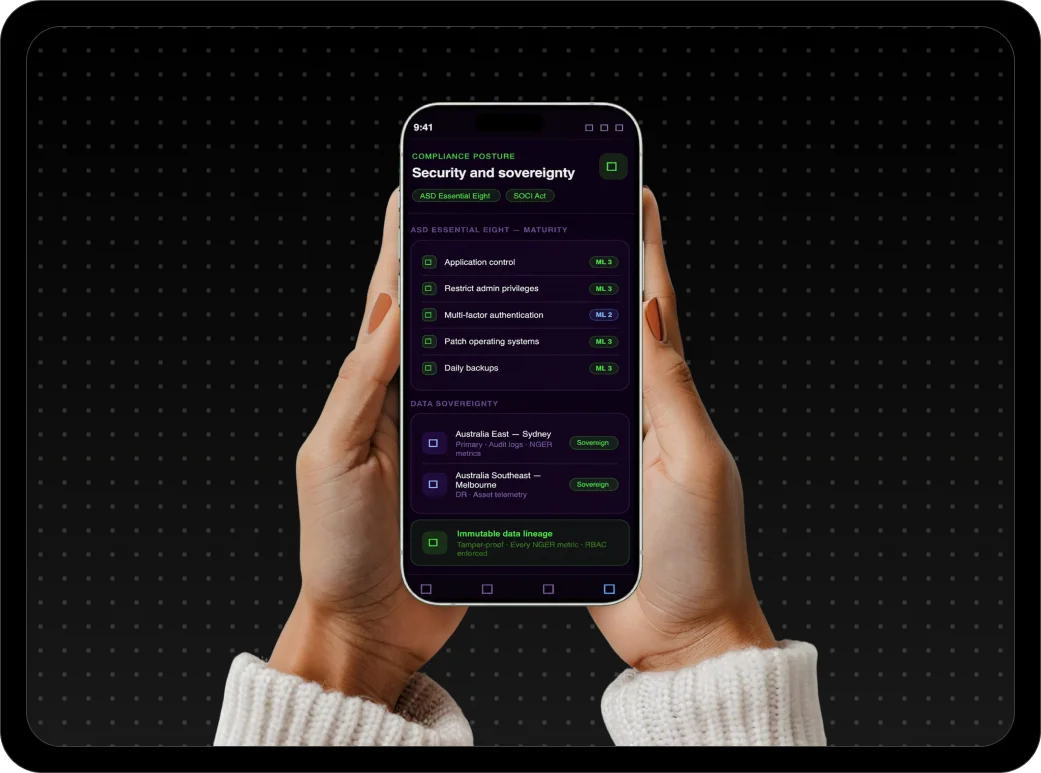
Aligned to the ASD Essential Eight and the SOCI Act. All audit logs, environmental data, and asset telemetry are stored exclusively in Australian cloud regions, with role-based controls and tamper-proof, immutable data lineage for every NGER metric.

Tech Stack

The Technology Stack Behind
Real-Time OT/IT Integration

AWS IoT Greengrass
AWS IoT Greengrass
OPC UA
OPC UA
Apache Kafka
Apache Kafka
AWS Sagemaker
AWS Sagemaker
Amazon Redshift
Amazon Redshift
AWS Sydney
AWS Sydney
IEC 62443
IEC 62443
Power BI
Power BI
React
React
Terraform
Terraform
The Result

Fragmented Legacy Systems Became Unified Operational Intelligence

Telemetry, asset health, emissions, and safety alerts now flow into one governed view, cutting downtime and reporting cycles while keeping every site running through satellite outages.

9 / 9
sites unified under a single operational dashboard for the first time
38%
drop in unplanned equipment downtime after predictive maintenance replaced reactive scheduling
99.4%
OT network uptime across remote sites, including during satellite outages
62%
faster NGER reporting, from six weeks of manual reconciliation to under two

From Fragmented to Connected: The Operational Shift

Nine sites running in isolation became one governed operation. Here is what changed across OT integration, maintenance, and ESG reporting once the platform went live.

BEFORE

  • OT/IT integration: Fully siloed; no data flow
    between equipment and enterprise systems.

  • Maintenance: Reactive; failures triggered
    costly remote mobilisations.

  • ESG reporting: Manual spreadsheets, six-
    week reconciliation, no lineage.

AFTER

  • OT/IT integration: Secure, real-time telemetry on a
    governed architecture, raw equipment to executive view.

  • Maintenance: Condition-based; predictive models auto-
    generate prioritised work orders.

  • ESG reporting: Automated pipeline; audit-
    ready NGER disclosures in under two weeks.

Predictive maintenance also cut technician mobilisation costs by 27%. Operational data now flows from raw equipment to the executive view in real time, and NGER disclosures are audit-ready by default across all nine sites.

Modernising legacy mining infrastructure?

Talk to us about OT and IT convergence, predictive asset management, and audit-ready ESG reporting for multi-site Australian operations, without disrupting live production.

Frequently Asked Questions

How long does a deployment of this kind take for a multi-site mining operation?

Most multi-site engagements run between 6 and 18 months from discovery through to enterprise-wide rollout. That accounts for OT network assessment, safety boundary validation, edge hardware deployment, data pipeline engineering, and phased site activation. A single-site pilot can typically be completed in four to six months.

How do you protect operational continuity when integrating with live OT systems?

Control systems are treated as integration sources throughout; never migration targets. The existing OT infrastructure stays in place and in operation. Integration works through read-only telemetry extraction at the edge, with zero direct write-back connectivity to safety-critical systems.

Can the architecture operate reliably at remote sites with poor connectivity?

Yes. Edge computing nodes at each site process and store data locally, keeping safety monitoring and equipment telemetry active regardless of satellite status. Data synchronises to the central platform automatically when connectivity is restored, ensuring zero data loss during WAN blackouts.