


























Cloud Server Security Assessment: How to Identify and Fix Infrastructure Vulnerabilities

 Share -



- 01Why Cloud Server Security Assessment Matters More in 2027?
- 02Why Cloud Infrastructure Vulnerabilities Keep Slipping Through
- 03The Infrastructure Vulnerabilities Every Cloud Server Assessment Must Uncover
- 04How to Conduct a Cloud Server Security Assessment in 7 Steps
- 05What to Fix First: The 4R Risk Lens
- 06How to Fix Cloud Infrastructure Vulnerabilities: A Remediation Playbook
- 07Emerging Cloud Security Risks You Should Prepare For
- 08How Appinventiv Shortens the Path From Findings to Fixes
- 09FAQs

Your cloud servers are probably not being breached by zero-days. They are being breached by a permission someone forgot to remove, a management port left open after a late-night fix, or an API key baked into a machine image two years ago.
Picture one service account with editor rights across several projects. An attacker finds its key in a build log, signs in like any other workload, and lists every secret the account can read. There is no exploit and no alarm. Wiz’s Cloud Threats Retrospective 2026 found that roughly 80% of documented cloud intrusions in 2025 began with vulnerabilities, exposed secrets or misconfigurations.
Most enterprises already run scanners, so visibility is rarely the real gap. The gap is deciding which findings matter, assigning responsibility, and making sure a corrected vulnerability does not return with the next pipeline deployment.
A well-run cloud server security assessment closes that gap. It scopes the estate, ranks findings by business risk, and makes sure fixes stay fixed.
Key takeaways:
- Most cloud breaches start with known weaknesses: cloud misconfigurations, exposed secrets and unpatched servers, not zero-days.
- Rank findings by reachability, privileges, data sensitivity and recurrence, not by CVSS score alone.
- AWS, Azure and Google Cloud fail in different places, so assessments need provider-specific checks.
- Fixing security gaps in infrastructure code ensures that vulnerabilities do not return tomorrow.
- Machine identities require the same rigorous access controls as your human administrative users.
Do you know which of your cloud servers faces the greatest security risk? Explore the common cloud security vulnerabilities, understand how they affect AWS, Azure, and Google Cloud environments, and learn how to assess infrastructure risks and prioritize remediation measures to strengthen your cloud security posture.
Why Cloud Server Security Assessment Matters More in 2027?
A cloud server security assessment is a structured review of compute, identity, network, data and logging controls that finds exploitable weaknesses and ranks them by business impact. It matters for modern enterprises because release cycles, machine identities and AI workloads are multiplying faster than manual reviews can keep up, and attackers are automating discovery.
The urgency for these assessments has reached a critical point. The Google Cloud Threat Horizons H1 2026 report notes that, during the second half of 2025, the window between public vulnerability disclosure and active exploitation shortened from weeks to just days. Attackers are actively probing environments almost immediately after a flaw becomes public knowledge.
When you evaluate server security in cloud computing, you must understand how different validation methods overlap and where they differ. They complement each other, but an assessment is the connective tissue that makes the others actionable.
Assessment, Audit, Penetration Test and CSPM: How They Fit Together
These activities address different parts of cloud security. Treating them as interchangeable often leaves gaps in coverage or creates duplicated effort.
| Activity | Primary purpose | Typical frequency | Output |
|---|---|---|---|
| Cloud security risk assessment | Find and rank real, exploitable risk across the estate | Periodically and after major changes | Prioritized findings with owners and fixes |
| Cloud security audit | Prove controls meet a standard such as SOC 2, HIPAA or PCI DSS | Per audit or compliance cycle | Attestation and control exceptions |
| Cloud penetration testing | Show what an attacker can actually achieve on selected targets | Usually annually and after major releases | Exploit narratives and evidence |
| CSPM | Flag configuration drift against policy | Continuous | Alerts and posture scores |
A clean audit does not mean a safe estate, and a CSPM dashboard does not tell you which alert could take down a customer-facing service. The assessment uses all three inputs to answer the question a CIO actually asks: what do we fix first?
Why Cloud Infrastructure Vulnerabilities Keep Slipping Through
Cloud infrastructure vulnerabilities slip through because modern deployment speed outpaces manual review cycles. Development teams release changes quickly, infrastructure teams manage multiple environments, and security teams work with findings from different tools. The result is a gap between detecting a weakness and correcting it. Understanding where that gap originates helps improve your assessment strategy.
Deployments Move in Minutes, Reviews Move in Months
Development teams deploy infrastructure using automated pipelines multiple times a day. If your security review process relies on a manual check at the end of the month, you are exposed for weeks. The speed of cloud native development means that a single misconfigured infrastructure template can be deployed across hundreds of servers before a security analyst even logs in to review the architecture.
One Checklist Does Not Fit Three Clouds
Enterprises operating across multiple clouds often try to apply a single cloud server security checklist across all environments. This approach fails because each provider handles resource architecture differently.
The Intruder 2026 Cloud Security Index highlights this fragmentation perfectly. On AWS, 87% of environments have S3 buckets lacking HTTPS enforcement. On Azure, 55% of environments have Entra ID accounts without multifactor authentication. On Google Cloud, the primary risks center on identity and access management. Applying generic rules to specific cloud ecosystems leaves massive gaps in your defense.
The following table groups common cloud security issues into six categories and compares how frequently they occur across the three major cloud providers.
| Category | AWS | Azure | Google Cloud |
|---|---|---|---|
| Weak IAM controls | 97% | 90% | 87% |
| Missing logging and alerting | 98% | 80% | 82% |
| Misconfigured services | 68% | 80% | 37% |
| Permissive firewalls | 83% | 45% | 34% |
| Exposed services | 76% | 64% | 8% |
| Weak encryption | 49% | 35% | 8% |
Machine Identities Are the New Perimeter
We used to protect networks by securing the perimeter. Now, the perimeter is identity. Specifically, non human identities like service accounts, API keys, and temporary tokens are the most targeted assets. These machine identities often hold broader permissions than human users and rarely undergo access reviews. When a threat actor compromises a service account, they bypass the network perimeter entirely.
Your Software Supply Chain Reaches Into Production
Third party dependencies are deeply integrated into enterprise workloads. A vulnerability in an open source logging library or a misconfigured third party integration directly compromises your server. Threat actors actively target these dependencies because a single successful exploit grants access to thousands of downstream enterprise environments.
Findings Without Context Create Alert Fatigue
Vulnerability scanning cloud environments usually results in thousands of critical alerts. When every alert is marked as critical, engineers stop trusting the queue, and the board sees a count instead of a risk. That is how a known, fixable issue stays open long enough to be exploited.
The Infrastructure Vulnerabilities Every Cloud Server Assessment Must Uncover
Every cloud server assessment should test nine recurring weakness classes, from over-privileged identities and open management ports to metadata service abuse and untested backups. The table below outlines the core components of cloud server security and how vulnerabilities present themselves in active production environments.
| Vulnerability | What It Looks Like on a Cloud Server | First Check to Run |
|---|---|---|
| Weak identity and access controls | Excessive IAM permissions, inactive accounts, or unrestricted service identities. | Review privileged roles, unused identities, and permission assignments. |
| Exposed services and permissive network rules | Unnecessary public access to administrative interfaces, databases, or application ports. | Review firewall rules, security groups, and public endpoints. |
| Unpatched OS and workload vulnerabilities | Outdated operating systems, server software, libraries, and runtime components. | Compare installed versions against current vulnerability information. |
| Exposed secrets | API keys, passwords, or access tokens stored in code, configuration files, or logs. | Review repositories, deployment variables, and secret storage practices. |
| Instance metadata service weaknesses | Workloads have insufficient restrictions around access to instance metadata. | Review metadata service configuration and workload access controls. |
| Weak encryption and key management | Sensitive information is unencrypted or encryption keys have excessive access permissions. | Review encryption policies, key permissions, and rotation practices. |
| Missing logging and alerting | Administrative activity, access changes, or security events are not adequately recorded. | Verify audit log coverage, retention, and alert configurations. |
| Insecure images, containers, and IaC templates | Vulnerable container images, excessive container privileges, or insecure deployment templates. | Review image scans, container configurations, and IaC security checks. |
| Backup and recovery gaps | Backups are incomplete, inaccessible, or insufficiently protected. | Review backup coverage, access restrictions, and recovery testing. |
Cloud Provider Spotlight: Top Misconfigurations in 2026
Based on the Intruder 2026 index, your assessment must prioritize different areas depending on your provider. For AWS, focus heavily on storage bucket encryption and permissive ingress rules. For Azure, prioritize enforcing MFA across all Entra ID users and securing storage key management. For Google Cloud, dedicate your attention to rigorous IAM policy validation.
How to Conduct a Cloud Server Security Assessment in 7 Steps
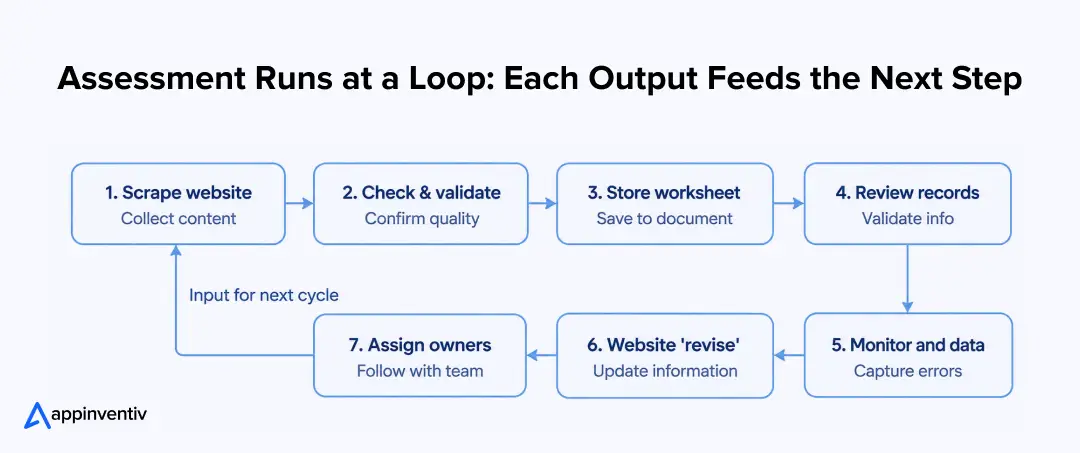
A reliable cloud security risk assessment follows seven steps: scope by business risk, benchmark configurations, scan workloads, review identities, check network and data protection, validate and prioritize, then assign ownership. Each step produces an output the next one depends on. Skip one, and the final report looks complete while hiding the gaps attackers actually use.
Define the Assessment Scope and Identify Cloud Assets
You cannot secure what you cannot see. Begin by mapping every compute instance, container registry, and serverless function across all accounts. The output of this stage is a comprehensive asset inventory that includes development, staging, and production environments.
Evaluate Cloud Configurations Against Security Baselines
Compare your current infrastructure settings against industry standards like the CIS Benchmarks. This step identifies deviations such as unencrypted storage volumes or missing logging configurations. The output is a gap analysis highlighting structural weaknesses.
Scan Servers and Workloads for Vulnerabilities
Deploy agentless or agent based tools to inspect the operating systems and software packages running on your instances. This identifies missing patches and outdated libraries. The output is a technical vulnerability report detailing specific CVEs present in the environment.
Review Identity, Access, and Privilege Management
Analyze every human and machine identity interacting with your servers. Look for over privileged service accounts and missing multifactor authentication. The output is a matrix of access permissions highlighting toxic combinations of rights.
Evaluate Network Security and Data Protection
Inspect virtual private clouds, subnets, and routing tables to ensure that backend servers cannot be accessed directly from the internet. Verify that data is encrypted both at rest and in transit. The output is a network topology map exposing potential data exfiltration routes.
Validate Findings and Prioritize Security Risks
Filter the raw technical findings by applying business context. A critical vulnerability on an isolated internal testing server is less urgent than a medium severity flaw on a public facing payment gateway. The output is a prioritized remediation list sorted by actual risk.
Document Findings and Assign Remediation Ownership
Security assessments fail when findings lack an owner. Assign every prioritized risk to a specific engineering squad with a defined service level agreement for resolution. The output is a tracked ticketing workflow integrated directly into your engineering tools.
Identify high-risk infrastructure gaps and build a remediation approach that fits your cloud architecture and release cycles.
What to Fix First: The 4R Risk Lens
Traditional scoring systems measure how severe a vulnerability is in theory. The 4R Risk Lens measures how critical that vulnerability is in your specific environment. By evaluating Reachability, Rights, Records, and Recurrence, technology leaders can direct engineering hours toward fixes that actually reduce business risk.
If you have a thousand vulnerabilities, you must use a contextual framework to filter the noise.
| Factor | Question to ask | Signals to use | Score it high when |
|---|---|---|---|
| Reachable | Can an attacker reach it from the internet or from an identity they could plausibly compromise? | Public IPs, open ports, exposed endpoints, EPSS score, CISA KEV listing | It is internet-facing or one hop from a weak identity |
| Rights | What can it do once compromised? | Attached roles, effective permissions, lateral movement paths | It holds admin, write or cross-account access |
| Records | Does it touch sensitive or regulated data? | Data classification, PII, PHI, cardholder data, intellectual property | A breach would trigger customer notification or regulatory reporting |
| Recurrence | Will this vulnerability reappear in the next deployment? | Root cause in IaC, a golden image or a shared pipeline template | The flaw lives in code that redeploys automatically |
By applying this lens, a high severity operating system flaw on a completely isolated backend server drops in priority, while a medium severity permission issue on an internet facing proxy jumps to the top of the queue.
How to Fix Cloud Infrastructure Vulnerabilities: A Remediation Playbook
Identifying a gap is only half the process. A successful remediation playbook fixes cloud server security concerns into precise engineering tasks. By addressing identity, network, secrets, and data layers systematically, you can harden your environments and integrate security guardrails directly into the continuous integration pipeline.
Securing the Identity Layer
Revoke all unused IAM permissions immediately. Implement least privilege access by ensuring that a service account only has the exact permissions required to execute its specific function. Enforce hardware backed multifactor authentication for all human users accessing the cloud console.
Intruder’s index found unrotated IAM access keys in 71% of AWS accounts and unused service accounts in 75% of Google Cloud accounts. Unused identities carry pure risk.
Hardening the Network
Close all management ports to the public internet. Access to SSH or RDP must require a secure bastion host, a virtual private network, or a modern zero trust network access solution. Segregate your workloads so that a compromised web server cannot freely communicate with your core database.
Patching Servers and Images
Do not patch running servers manually. Instead, update the base machine image and redeploy the server. Implement a golden image pipeline where every operating system image is pre hardened and scanned for vulnerabilities before it is approved for use by engineering teams.
Managing Secrets Safely
Remove all hardcoded passwords and API keys from your configuration files. Migrate these credentials to a dedicated secrets management service. Configure your applications to retrieve credentials dynamically at runtime, and implement automated rotation policies for all database passwords.
Enforcing Data Encryption
Ensure that all block storage volumes and object storage buckets are encrypted at rest using keys managed by your organization. Enforce TLS 1.2 or higher for all data in transit between your load balancers and your backend servers.
Improving Logging and Detection
Enable cloud audit logging across all accounts. Forward these logs to a centralized, tamper evident storage location. Configure automated alerting for highly suspicious activities, such as the sudden creation of new administrator roles or the modification of critical network routes.
Fix at the Source So It Stays Fixed
This is where most programs fall short. If you manually change a security group rule in the cloud console, the next automated pipeline run will revert your change. You must fix the vulnerability in the underlying Terraform or CloudFormation code. Integrating security checks into the development pipeline ensures that cloud server security benefits are permanent.
The 30/60/90 Day Remediation Timeline
Implementing these fixes requires a structured approach. Use this timeline to manage your remediation efforts logically.
| Days 0–30: Close Immediate Exposure Focus: Identity and infrastructure
Days 31–60: Strengthen Core Controls Focus: Access and workload security
Days 61–90: Establish Continuous Governance Focus: Automation and accountability
|
The timeline should be adjusted to the organization’s exposure and operational requirements. An actively exploited vulnerability in a critical production system should not wait for its scheduled remediation phase.
Identify critical exposure points and build a cloud security strategy around your enterprise architecture.

Emerging Cloud Security Risks You Should Prepare For
The next wave of cloud server security threats is less about new techniques and more about speed and scale. AI is shrinking the time between disclosure and exploitation, autonomous agents are adding identities nobody reviews, and short-lived workloads are slipping past periodic scans. Assessments built for 2027 need to cover all three, continuously.
AI-Driven Attacks and Faster Exploitation
Wiz reports that the new vulnerability disclosures it flagged in the first half of 2026 roughly doubled from the previous half, a trend it links to AI-assisted vulnerability research and weaponization. Activity aimed at AI infrastructure roughly doubled as well. For internet-facing servers, a patch SLA measured in weeks no longer matches the threat. Defenders need the same AI security help on their side, mainly for triage and correlation, so people spend their time on decisions rather than sorting alerts.
Cloud Identity and Machine Identity Security
The sheer volume of machine identities now far exceeds human users. Threat actors actively target compromised OAuth tokens and service accounts to execute bulk data exfiltration. Securing these identities requires rigorous monitoring of trusted integrations and aggressive enforcement of least privilege policies.
Containers, Kubernetes and Serverless
As workloads transition from traditional servers to containers and serverless functions, the attack surface shifts. Vulnerabilities in container base images or overly permissive Kubernetes role based access controls can compromise an entire cluster. Security assessments must now scrutinize container registries and orchestration configurations with the same rigor applied to virtual machines.
Infrastructure-as-Code Modules and Base Images
Public Terraform modules, Helm charts and base images now shape production as much as your own code does. Pin versions, verify signatures, and scan modules before merge, so a default from someone else’s template does not become your exposure.
From Periodic Assessment to Continuous Posture Management
Continuous discovery, drift detection and pipeline checks should run every day. A deep assessment with attack-path validation still belongs on the calendar at least yearly and after major changes. Track mean time to remediate by severity, the recurrence rate of fixed findings and asset coverage together. A low finding count means little if half the estate is not being scanned.
How Appinventiv Shortens the Path From Findings to Fixes
A cloud security assessment is most useful when its findings translate into engineering decisions. At Appinventiv, we approach cloud infrastructure security through architecture, DevSecOps, infrastructure automation, and ongoing operational monitoring.
When we conduct a security assessment, we do not just hand over a list of problems. We take ownership of the remediation process, integrating fixes directly into your infrastructure as code repositories. Once the work is done, our cloud security services continue through DevSecOps pipelines and round-the-clock monitoring, so new releases are checked before they reach production.
Our cloud engineering capabilities include more than 500 cloud migrations, 2,000+ cloud deployments, and 20+ hybrid-cloud environments. As a cybersecurity consulting services company, we also provide continuous infrastructure monitoring and integrate security checks into development and deployment workflows.
One example is our cloud optimization engagement for a challenger bank. The project addressed fragmented multi-cloud governance, inconsistent configurations, and deployment inefficiencies. The resulting framework achieved a 30% reduction in total cost of ownership, 40% faster deployments, and 99.98% uptime. The broader lesson is that infrastructure performance, security governance, and operational stability need to work together.
Cloud server security rarely fails because organizations have no security tools. More often, the problem is that vulnerabilities are not prioritized correctly, remediation lacks clear ownership, or fixes do not address the underlying cause.
Start this quarter by scoping your most critical services and running your top findings through the 4R lens. Schedule Your Cloud Security Assessment.
FAQs
Q. What is server security in cloud computing?
A. Server security in cloud computing is the protection of virtual servers and the workloads they run, covering the operating system, installed software, network access, identities, data and logs. Under the shared responsibility model, the provider secures the physical layer and hypervisor, while your team secures everything running above it.
Q. What is a cloud server security assessment?
A. A cloud server security assessment is a structured review that finds exploitable weaknesses across cloud compute, identity, network, data and logging controls. Unlike a basic scan, it validates which findings an attacker could actually use, ranks them by business impact and assigns each one an owner and a fix.
Q. What does a cloud server security assessment include?
A. It includes asset discovery and scoping, configuration checks against baselines such as CIS Benchmarks, vulnerability scanning of servers and images, identity and privilege review, network and data protection checks, and validation of the most critical attack paths. The output is a ranked risk register and an owned remediation plan.
Q. What are the key threats to managed server security?
A. The main threats are cloud misconfigurations, over-privileged or compromised identities, exposed secrets, unpatched internet-facing software and software supply chain compromises. AI infrastructure, such as model gateways and agent credentials, is a fast-growing target. Most attacks still begin with known weaknesses rather than new techniques.
Q. What are the benefits of cloud server security?
A. Strong cloud server security reduces the number of ways attackers can get in, shortens incident response and makes compliance audits faster because evidence is already in place. It also lets engineering teams release more often, since guardrails catch risky changes before production instead of after an incident.
Q. Why use cloud based server security?
A. Cloud-based security tools read configuration, identity and network data directly from provider APIs, so they see short-lived resources that traditional tools miss. They scale with your workloads, run continuously and plug into deployment pipelines, which lets teams catch problems while code is still being written rather than after release.
Q. How often should cloud infrastructure security be assessed?
A. You should conduct formal cloud security assessments at planned intervals and after significant infrastructure changes, migrations, or security incidents. Continuous monitoring should complement these reviews by identifying configuration drift, newly disclosed vulnerabilities, and changes in access permissions.
Q. Which tools are used for cloud security assessments?
A. You should typically combine native cloud security assessment tools such as AWS Security Hub, Amazon Inspector, Microsoft Defender for Cloud and Google Security Command Center with third-party CSPM or CNAPP platforms, vulnerability scanners and IaC scanners like Trivy. No single tool replaces the judgment needed to validate and prioritize findings.
Q. How long does a cloud security assessment take?
A. The duration depends on infrastructure size, cloud providers, workload complexity, and assessment scope. A focused assessment of a limited environment may take days, while a multi-cloud enterprise assessment involving numerous applications, identities, and dependencies may require several weeks. A short scoping exercise up front gives you a reliable timeline before work begins.


Fast 2-minute response, fully NDA-protected.

How to Build a DESC-Compliant Azure Architecture in the UAE Without Data Residency Risks
Key takeaways: Azure UAE data residency compliance is not just about choosing UAE North or Central; logs, backups, APIs, identity flows, and monitoring paths also need control. DESC-aligned Azure architecture should be planned before deployment or migration to avoid audit issues, delayed approvals, and expensive rework. Enterprises must map the full data journey across storage,…

How Cloud Services Accelerate Product Development for Businesses
Key takeaways: Cloud product development changes the speed, cost, and risk profile of modern software delivery. The cost of cloud product development ranges between $40,000 and $400,000 or more. Cloud platforms give you instant access to AI/ML, edge computing, and advanced analytics without dropping tons of money upfront. Appinventiv supports enterprise cloud product development through…

Green Cloud - How Cloud Adoption Helps Improve Sustainability/ESG Goals of Enterprises
Key takeaways: Adopting green cloud solutions lowers energy consumption, cuts emissions, and reduces operational costs. Companies like UEM Edgenta and Bharti Airtel have seen measurable improvements in sustainability and efficiency. AI Enhances Green Cloud Efficiency. AI optimizes energy use, predicts demand, and minimizes waste in cloud infrastructure. Your Green Cloud Roadmap. Start with an infrastructure…