


























Post-Merger Data Integration for Middle East Groups: Onboarding a New Brand in 90 Days

 Share -



- 01Why Post-Merger Data Integration Is Now a Repeat Job for GCC Groups
- 02Days 0 to 15: Map the Acquired Brand's Data and Its Legal Limits
- 03Days 15 to 30: Choose Consolidation, Federation or a Hybrid
- 04Days 30 to 50: Build the Golden Record With Master Data Management for M&A
- 05Days 50 to 70: Run Data Migration After Acquisition Without Breaking Brand Reports
- 06Days 70 to 90: Lock In Post-Merger Data Governance
- 07The Post-Merger Integration Checklist for Your First 90 Days
- 08What Most Integration Teams Get Wrong
- 09How Appinventiv Helps Middle East Groups Onboard Brands in 90 Days
- 10FAQs

Post-merger data integration for a Middle East group comes down to moving an acquired brand’s customer, product and finance data onto the group platform. The hard part is doing it without breaking the brand’s reporting or the region’s data protection laws. Ninety days is enough if the work runs in five gated phases and starts with a legal map of the data before anything moves. This playbook covers those phases, the consolidation decision and the checks a CIO should hold the team to on day 90.
Key takeaways:
- GCC groups closed 192 deals worth $65.1 billion in H1 2026, and most capital stayed in the region, so cross-border brand onboarding is now routine work
- Map every dataset against Saudi and UAE transfer rules in days 0 to 15, before a single record moves
- Decide by day 30 whether to consolidate, federate or run a hybrid, domain by domain
- Build golden records before migration, because migrating duplicates only spreads them across more systems
- Close day 90 with named data owners, a shared glossary and lineage behind every group KPI
Appinventiv maps residency rules, builds golden records and migrates brand data so group reports reconcile by day 90.

Why Post-Merger Data Integration Is Now a Repeat Job for GCC Groups
For most GCC groups, post-merger data integration has become a recurring capability they use whenever they make a purchase. Regional capital is buying regional brands, often across the UAE and Saudi border, and each brand arrives with its own CRM, ERP, POS and loyalty data that the group has to absorb without disrupting the business it just paid for.
The deal numbers explain the shift. According to Grant Thornton’s GCC and UAE M&A Market Review, GCC M&A reached $65.1 billion in the first half of 2026, up 12.1%, and the UAE accounted for 80.9% of that value and 131 of the 192 completed deals. PwC Middle East’s mid-year review found that intra-regional dealmaking rose 2%, while inbound cross-border activity fell by about 19%.
That pattern changes the brief for the data team. A group that acquires two or three brands a year cannot reinvent its integration method each time, any more than a franchise operator would redesign its store-opening checklist for every new outlet. It needs a repeatable data platform onboarding process to consistently onboard new brands.
Post-acquisition data integration done on the fly carries a measurable cost. For a board, ad hoc M&A data integration shows up as late reporting on deal targets and a compliance review that lands exactly when attention should be on growth.
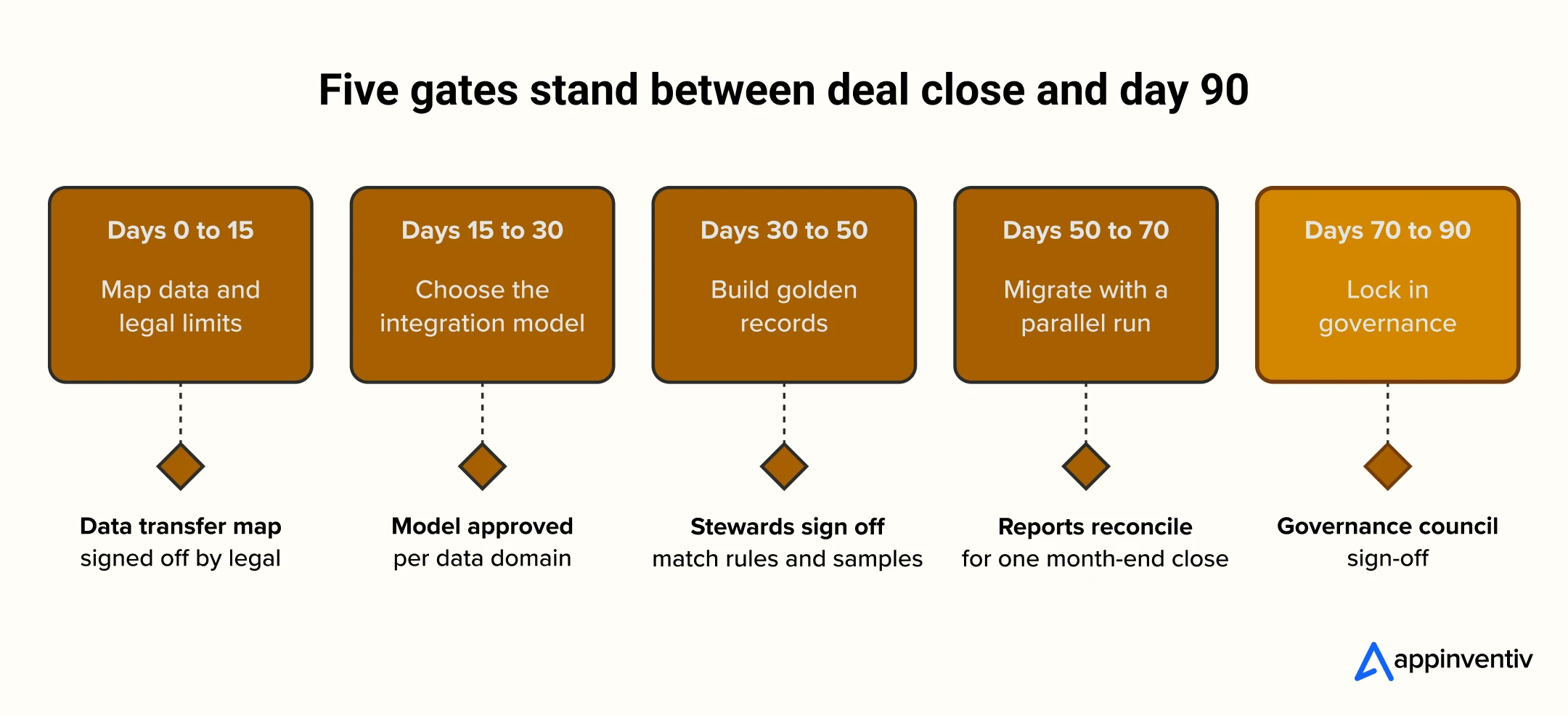
Read the roadmap left to right, and do not start a phase until the gate below the one before it is signed off.
Days 0 to 15: Map the Acquired Brand’s Data and Its Legal Limits
The first 15 days decide what can move at all. Before engineers build a single pipeline, the team needs an inventory of every system the acquired brand runs, the personal data each one holds, where it is hosted and which law governs it.
What the Data Inventory Must Capture
The inventory is a working register the integration team will use for the next 75 days, so it has to be specific enough to act on. For each system, the register should record the following:
- Systems of record: CRM, ERP, POS, loyalty, eCommerce, HR and finance tools, including any legacy systems due for modernization
- The business owner and the technical owner on the acquired side
- Personal data categories, including any sensitive data
- Hosting location and cloud region, plus every third-party processor contract
- Data volumes, refresh frequency and the reports that depend on each source
Data Residency Rules That Shape Post-Merger Data Integration in the GCC
Saudi Arabia’s Personal Data Protection Law (PDPL) has been fully in effect since 14 September 2024 and is enforced by the Saudi Data and AI Authority (SDAIA). A Saudi-based controller that relies on appropriate safeguards must complete a transfer risk assessment under Saudi data protection law before personal data leaves the Kingdom.
The UAE federal PDPL generally allows transfers to countries the UAE Data Office recognizes as adequate, while the DIFC and ADGM free zones run their own data protection regimes. Sector rules add another layer of UAE data residency: the UAE Central Bank requires licensed financial institutions to store customer and transaction data inside the UAE.
So what happens when the acquired brand has a Saudi loyalty base, and your group platform runs in a UAE region on managed cloud infrastructure? That flow needs its risk assessment on file before the first sync, or the group can keep that domain on a sovereign cloud region inside the Kingdom so data residency is never in question. Either way, legal sits in this phase from day one.
The exit gate for this phase is a data transfer map signed off by legal, showing which datasets can move, which must stay in-country and which need a transfer assessment first.
Also Read: Sovereign AI Infrastructure in the Middle East: Enterprise Guide
Days 15 to 30: Choose Consolidation, Federation or a Hybrid
By day 30, leadership must decide how far the acquired brand’s data will be integrated into the group platform. The three workable models are full consolidation onto group systems, a federated multi-brand data platform, similar to a customer data platform for retail groups, where the brand keeps its systems and publishes to a shared layer, and a hybrid that consolidates some domains and federates others.
| Model | What Moves | Best Fit | Trade-Off |
|---|---|---|---|
| Consolidation | All domains move onto group systems | Brands being fully absorbed, with heavy customer overlap | Fastest route to one view, highest disruption to brand teams |
| Federation | Brand keeps its systems and publishes approved data to a shared layer | Brands with in-country data or a separate customer proposition | Least disruption, slower to reach shared definitions |
| Hybrid | Finance and master data consolidate, operational systems stay | Brands with their own P&L that still report into group finance | Needs clear rules on which domain lives where |
The choice is made for each data domain using three questions. If regulated personal data has to stay in-country, federate that domain. If the brand will keep its own P&L and customer proposition, run a hybrid. If customers overlap heavily and the brand will be absorbed, consolidate. Federated domains also need federated data governance, in which each brand owns and publishes its data as a product, under group-wide standards. The same principle sits behind a data mesh.
Our view, from working with multi-brand groups such as Americana, is that most GCC groups land on the hybrid. Group finance needs one chart of accounts in the group’s ERP software within a quarter, while brand teams need their POS and loyalty tools to keep running through peak trading. Because this choice shapes subsequent phases, many groups use software consulting services in Dubai to pressure-test the model before the steering group signs off.
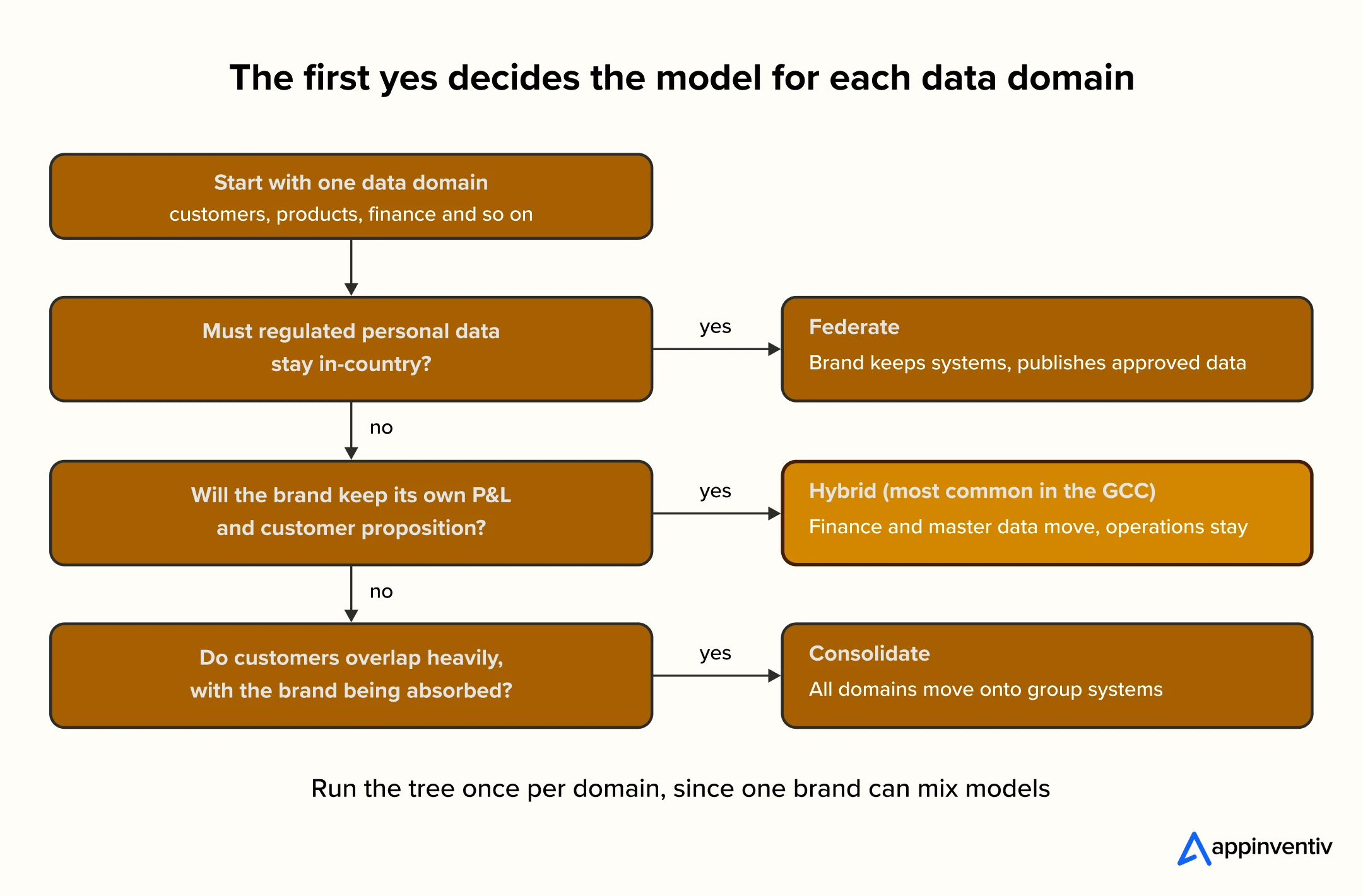
Start at the top for each data domain and follow the first “yes” across to its model.
The exit gate is an integration model approved by the integration steering group for each data domain.
Days 30 to 50: Build the Golden Record With Master Data Management for M&A
Master data management for M&A is the step teams most often rush through, and it determines whether merged reports can be trusted. A golden record is the single agreed version of a customer, product or supplier, built by matching records from both brands and keeping the most reliable attribute from each source.
Dun & Bradstreet makes a useful distinction here: data integration connects systems, while master data alignment agrees on what the records mean. Moving bad data faster between systems only spreads the confusion to more dashboards.
Think of it as merging two phone contact lists. The same person appears as “M. Al Mansoori” in one and “Mohammed Almansoori” in the other, with two different numbers. Entity resolution is the matching logic that decides these are one person and which number to keep, and it has to run before anything is migrated.
Which Domains to Master First
Start with the domains behind group-level decisions, because each one feeds a report the board is already waiting for:
- Customers, where the two brands share a base and loyalty programs overlap
- Products and SKUs, which drive shared procurement and pricing data analytics
- Suppliers, where duplicate vendor records block spend consolidation
- Chart of accounts and reference data such as currencies, country codes and store hierarchies
The exit gate consists of data stewards from both brands signing off on the match rules and a sample of golden records in each mastered domain.
Days 50 to 70: Run Data Migration After Acquisition Without Breaking Brand Reports
Data migration after an acquisition usually fails on the day a brand loses its own reports before the group’s are trusted. The fix is to run the old and new pipelines in parallel and reconcile them before the old one is switched off, which is what makes a zero-downtime cutover possible.
Two techniques do most of the work. Change data capture (CDC), a core part of any cloud data migration strategy, streams every insert and update from the brand’s source systems to the group platform in near real time, so the two sides stay in step during the parallel run. In most new builds, the platform is a lakehouse architecture that keeps raw brand data and modeled group data in a single store, so finance and brand teams query the same numbers. Data contracts are agreed schemas and definitions between the brand team and the platform team, so a field renamed in the brand’s ERP does not silently break a group dashboard.
The exit gate is parallel reports that reconcile within an agreed tolerance for a full month-end close.
How Americana Unified Data Across 12 Brands
Americana Restaurants shows what this looks like at scale. Americana runs 2,100+ restaurants and 12 brands across 12 countries, including KFC, Pizza Hut and Krispy Kreme. Appinventiv built automated Python and SQL ETL pipelines that cleaned, structured and normalized multi-source data, then rolled the platform out across all brands. The platform has processed more than 60.45 million orders with zero downtime, and report load times dropped by 90%.
Also Read: Data Integrity and Security During Cloud Migration
Days 70 to 90: Lock In Post-Merger Data Governance
Post-merger data governance keeps the integration from decaying after the project team moves on. By day 90, every mastered domain needs a named owner, a shared glossary of definitions and data lineage (a traceable record of where each figure in a group report comes from and how it was transformed) behind its business intelligence dashboards.
Brands rarely reach the same level of data maturity. A family-run retail brand may have no data owner at all, while the group already runs a governance council. The answer is a minimum standard every brand must meet on day 90: a named owner per domain, role-based access, a retention policy and lineage on every group KPI. More advanced practices can follow as part of the group’s enterprise data strategy.
The exit gate is a governance council sign-off on ownership and access, after which the brand moves to business as usual.
How Y.K. Almoayyed & Sons Centralized Data Governance
Y.K. Almoayyed & Sons, a Bahrain-based diversified group, faced a version of this problem. Its file systems and databases lacked centralized archival governance and retention and retention, encryption and traceability rules were hard to enforce. After Appinventiv implemented policy-driven archival with KMS encryption, audit trails and role-based access on AWS, in line with cloud security controls, storage costs fell by 32%, and IT intervention dropped by 40%.
The Post-Merger Integration Checklist for Your First 90 Days
The checklist below condenses each phase into what must be done and the gate that closes it. Integration leads can use it as the agenda for the weekly steering meeting.
Before day 0, it helps to know where the acquired brand and your own platform stand. The scorecard below gives integration leads a quick read on readiness across the eight areas this playbook depends on.
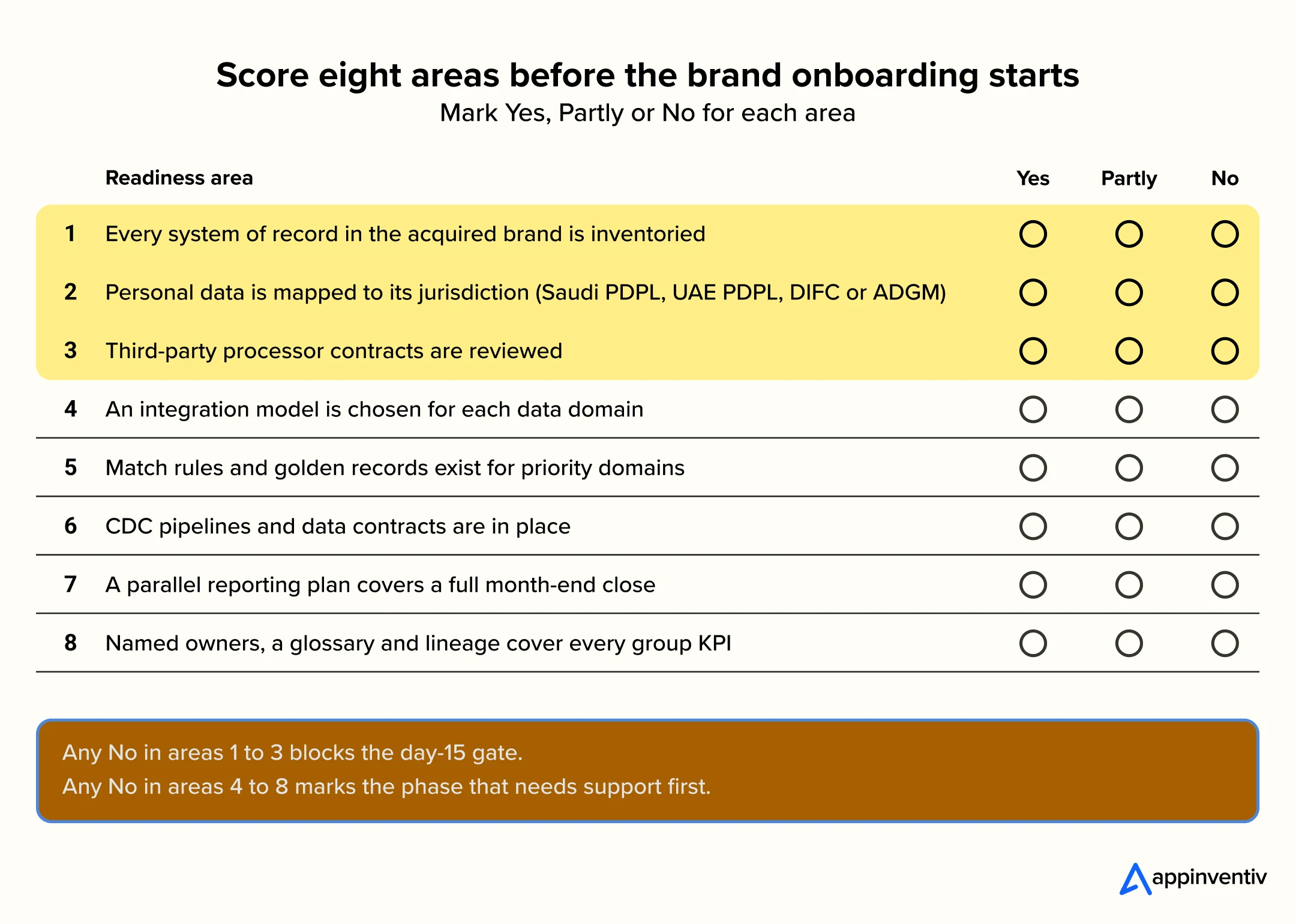
Mark each area honestly. The first “No” from the top shows where your 90 days are most at risk, and the shaded rows are the ones the day-15 gate depends on.
| Phase | Must Be Done | Exit Gate | Lead Owner |
|---|---|---|---|
| Days 0 to 15 | System inventory, personal data register, processor contracts reviewed | Data transfer map signed off by legal | Group CDO with legal counsel |
| Days 15 to 30 | Model chosen per data domain, target architecture drafted | Model approved by steering group | Integration steering group |
| Days 30 to 50 | Match rules written, golden records built for priority domains | Stewards sign off golden record samples | Data stewards from both brands |
| Days 50 to 70 | CDC and data contracts live, parallel run started | Reports reconcile for one month-end close | Platform engineering lead |
| Days 70 to 90 | Owners named, glossary published, lineage on group KPIs | Governance council sign-off | Group governance council |
See where your data platform stands, then let our data integration engineers close the gaps before the next acquisition closes.

What Most Integration Teams Get Wrong
Most failed brand onboardings fail on sequence, not effort. Teams move data before they have agreed on what it means, or they race a calendar target rather than the exit gates.
The first-100-days rule is a good example. Duncan Angwin’s study of integration speed found little overall support for first-100-day activity, on its own, predicting long-term success. Ninety days is a sensible container for this playbook, but the gates matter more than the date.
Migration order is the fix that gets skipped most. Rank each dataset by business criticality and regulatory sensitivity: critical but low-sensitivity data moves early with a parallel run; sensitive data with low criticality stays in-country and federates; low-stakes data migrates or retires early; and data that is both critical and sensitive moves last, after its transfer assessment.
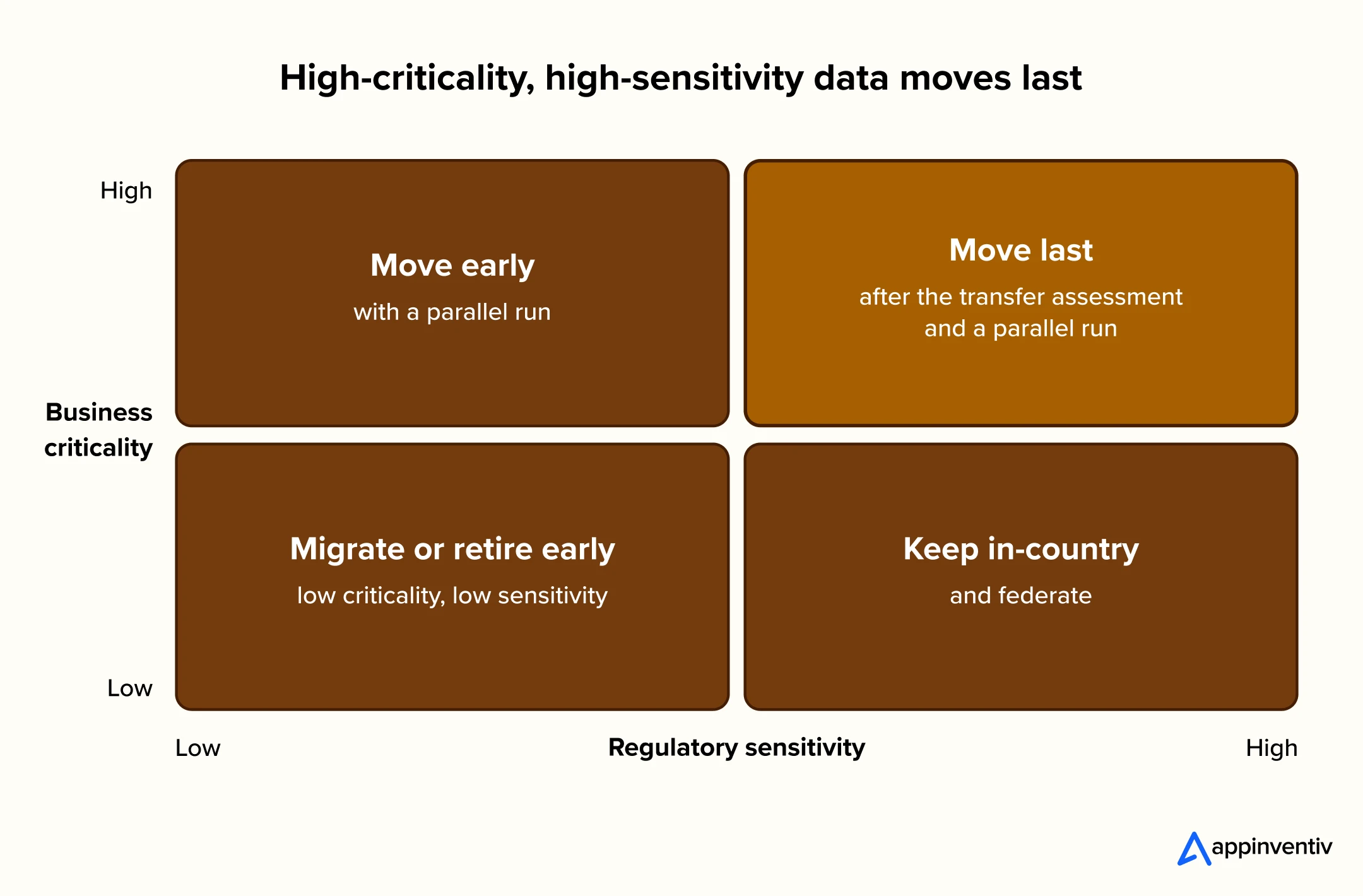
Plot each dataset in its quadrant, then migrate the top-left first and the shaded top-right last.
Four other mistakes come up repeatedly in GCC brand onboardings:
- Treating data residency and Saudi Arabia compliance as a legal afterthought, which forces a rebuild when a Saudi dataset turns out to need a transfer assessment
- Migrating before mastering, which copies duplicate customers into every group report
- Switching off brand reports on cutover day, before group reports have reconciled
- Leaving no owner after day 90, so definitions drift within two quarters
Every week without a model adds brand reports the group cannot trust. Get a domain-by-domain recommendation now.

How Appinventiv Helps Middle East Groups Onboard Brands in 90 Days
Appinventiv has led digital transformation across the GCC for more than 10 years, delivering 1,000+ digital projects in the region and executing 12+ government and compliance programs. Our data integration services in Dubai, across the UAE and in Saudi Arabia are built around the five gates in this playbook, so legal, finance and brand teams can see progress in their own terms.
The Americana platform is the clearest proof: one data layer across 12 brands, auto order assignment up from 42% to 82%, geofencing compliance up from 20% to 80%, and zero downtime across 60.45 million orders.
A governed layer like this is the AI-ready data foundation on which AI integration across brands depends. The same discipline (residency mapping, golden records, parallel runs and named owners) applies whether you are onboarding your first acquired brand or your fifth.
If a deal has just closed or is about to, book a data integration consulting session with our Dubai team and leave with a transfer map and a domain-by-domain model recommendation for your post-merger data integration.
Let’s connect and merge brand data without losing reports.
FAQs
Q. What does onboarding a new brand into a group data platform involve?
A. It involves four workstreams running together: legal mapping of where data can go, a model decision per data domain, master data work to build golden records, and a governed migration with parallel reporting. Each workstream needs an owner from both the group and the acquired brand, or decisions stall between the two teams.
Q. How long does it take to onboard an acquired brand onto a shared data platform?
A. Ninety days covers the core onboarding: residency mapping, golden records for priority domains, a reconciled parallel run and governance sign-off. Full ERP consolidation or a new custom data platform usually takes longer. Multi-brand platforms like the one Appinventiv built for Americana typically take six to ten months end-to-end.
Q. How do you keep data governance consistent across brands with different data maturity levels?
A. Set a minimum standard every brand must meet and measure each brand against it quarterly, then layer the group’s fuller governance model on as each brand matures. Pair each acquired brand with a group data steward for its first two quarters so definitions and access rules are enforced locally.
Q. What are the data residency and compliance risks for GCC brands?
A. The risk most groups miss sits with third-party processors. An acquired brand’s SaaS tools, analytics vendors and backups may already host personal data outside the country. Each contract needs to be reviewed against the Saudi PDPL and UAE transfer rules, and free zone entities in DIFC or ADGM need checks under their own regimes.
Q. When should a group bring in data integration consulting support?
A. Bring support in before the deal closes, while the target’s systems can still be assessed during due diligence. External support adds the most value when the group has no repeatable onboarding method yet or when brands operate in several jurisdictions. Early involvement keeps post-merger data integration on the deal’s critical path from the first week.


Fast 2-minute response, fully NDA-protected.

Data Analytics for Government: Use Cases, Benefits and Implementation Strategy
Key takeaways: Data analytics can help government move from reactive reporting to evidence-based, proactive decision-making. The highest-value use cases are those directly connected to public outcomes, resource efficiency and operational priorities. The next stage is AI-enabled and real-time government, where analytics, simulation and intelligent systems support faster and more anticipatory decisions. Australian government agencies generate…

How to Hire Data Engineers for Your Enterprise? All You Need to Know
Key takeaways: Hiring data engineers individually slows execution and increases delivery risk at enterprise scale. Partnerships give faster access to senior talent without long recruitment cycles or retention issues. Cost depends more on capability and responsibility than salary alone. The right hiring model directly affects business speed, stability, and ROI. Partnering with experienced teams converts…

How Data Analytics is Shaping the Future of UK Businesses Across Sectors
Key Takeaways Data has moved from support to strategy. UK companies no longer treat analytics as an add-on; it’s shaping how they forecast demand, design products, and compete for customers. Every sector is finding its own rhythm. From retail and healthcare to energy and education, organizations are using data differently, but the goal is the…