
























Mudra
AI Sales Agent Development: Here’s a Guide that Covers the Entire Workflow

VP - Technology, AI & ML Expert
July 31, 2026
 Share -


- 01Before you build, understand what a sales AI agent actually does inside a revenue team.
- 02What should your AI sales agent architecture look like?
- 03How do you build an AI sales agent step by step?
- 04Which tech stack should you pick for an AI agent for sales?
- 05How much does it cost to build a sales agent in-house?
- 06How long does it take to develop and deploy an AI agent for sales?
- 07What compliance requirements should enterprises consider before deployment?
- 08What are the biggest challenges in sales agent implementation?
- 09What are the best practices for integrating sales AI into existing CRM systems?
- 10Should you buy sales agent software or build a custom one?
- 11Where do AI-powered sales agents deliver the fastest ROI?
- 12How does sales agent development change across industries?
- 13How can Appinventiv help you out?
- 14FAQs

copied!
Key takeaways:
- Start narrow. Tie one workflow to one number before writing code; the teams that scale agentic AI almost always begin with a single use case, not a platform.
- Data sets the ceiling. Audit, dedupe, and enrich your CRM before the build, because an agent cannot reason about accounts it cannot see.
- Ground it and fence it. Anchor every response in your own approved content and grant least-privilege access, so the agent acts without inventing a price or overreaching.
- Budget the whole picture. Plan for $40K to $400K+ to build and $2K to $15K a month to run, with integration depth and data cleanup, not the model, driving most of the number.
- Governance is the moat. Roughly 40% of agentic projects get canceled over cost, fuzzy ROI, and weak controls; a day-one KPI and real guardrails separate shipped from shelved.
Building an agent that survives production costs $40,000 to $400,000 but can also go beyond $1M. As for the timeline, the process takes 8 to 24 weeks, and fails most often for reasons that have nothing to do with the model. Dirty CRM data, missing guardrails, and compliance blind spots kill more of these projects than any LLM shortcoming ever will.
The market has already voted. Salesforce’s 2026 State of Sales research found that 87% of sales organizations now use some form of AI, and 54% of sellers have worked with agents directly. Gartner projects that agents will put $234 billion of enterprise application spending at risk by 2030, roughly 20% of all SaaS spend, as work gets completed across systems instead of inside interfaces
So the question on your desk is not whether an AI agent for sales belongs in your revenue stack. It is how to build one that books a qualified pipeline instead of apologizing to prospects. We have spent the past decade building compliance-heavy AI systems for enterprises, and this guide walks through the architecture, the steps, the real costs in dollars and euros, and the regulatory landmines. No fluff, just the playbook.
Pressure-Test Your AI Idea
Budget approved, no clear path to pipeline: that is how six-figure builds stall. Send us your workflow and in 30 minutes you will know if it is worth building.
Before you build, understand what a sales AI agent actually does inside a revenue team.
A sales AI agent is software that perceives context, reasons over it, and then acts across your revenue systems without waiting for a human prompt. It researches accounts, drafts and sends outreach, qualifies inbound leads, books meetings, and writes everything back to the CRM. That last part matters. A chatbot talks. An agent does.
The distinction from earlier tools comes down to autonomy. A generative AI assistant drafts an email when asked. An agentic AI agent for sales decides which account needs the email, writes it, checks it against your messaging guardrails, sends it, logs the activity, and schedules the follow-up.
Deloitte called this shift early, predicting in its 2025 TMT Predictions report that 25% of companies using generative AI would launch agentic pilots in 2025, doubling to 50% by 2027.
In day-to-day revenue work, agents cluster around five jobs:
- Outbound prospecting: account research, list building, and personalized first-touch sequences
- Inbound qualification: instant engagement, discovery questions, and routing before a lead goes cold
- Meeting operations: scheduling, reminders, prep notes, and no-show recovery
- CRM hygiene: activity capture, field updates, and pipeline data that reps never type again
- Forecast support: deal-risk signals surfaced from calls, emails, and stage velocity
The payoff shows up in the performance data. Salesforce found top-performing sellers are 1.7 times more likely than underperformers to use prospecting agents for outreach. That gap compounds every quarter it goes unaddressed.
What should your AI sales agent architecture look like?
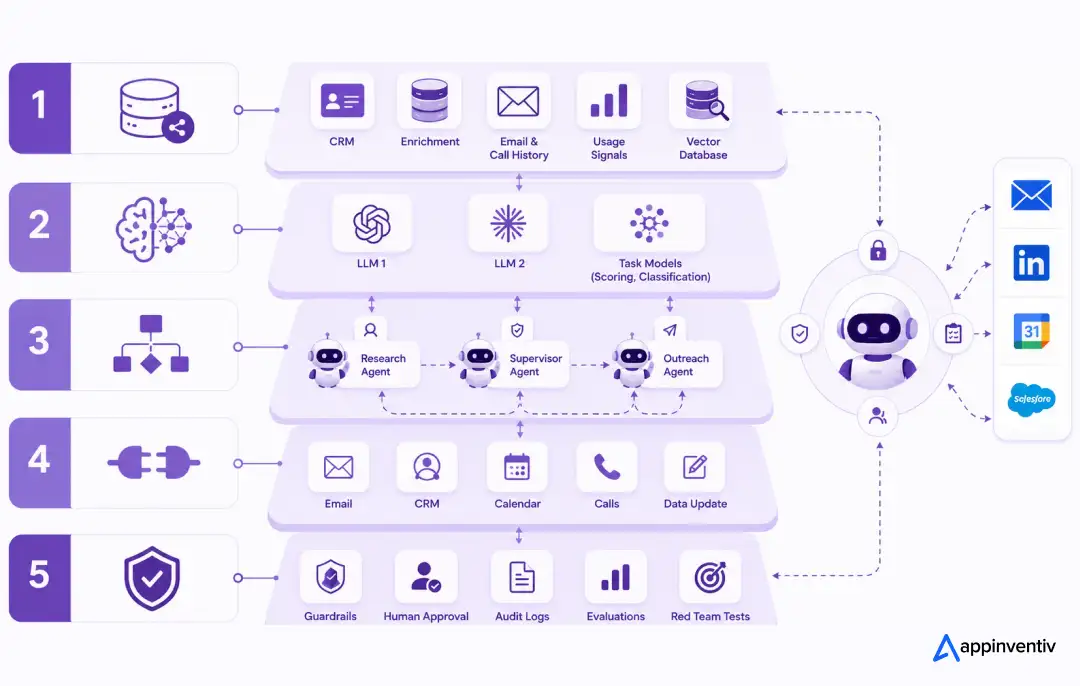
Every AI sales agent architecture that holds up in production has five layers. Miss one and you will meet it again during an incident review.
- Data layer. Your CRM, enrichment providers, email and call history, product usage signals, and a vector database that makes all of it retrievable. This layer decides whether your agent sounds informed or generic.
- Model layer. One or more LLMs for reasoning and generation, plus smaller task models for scoring and classification. Model choice is a swap, not a marriage, if you architect for it.
- Orchestration layer. The logic that breaks goals into steps, manages state, and coordinates a multi-agent sales system: a research agent feeding an outreach agent, with a supervisor agent enforcing rules. Standards like the Model Context Protocol (MCP) now make AI agent interoperability across tools far less painful than it was even two years ago.
- Action layer. Authenticated connectors that let the agent send email, update records, and book calendar slots under least-privilege permissions.
- Trust layer. Guardrails, human-approval checkpoints, audit logs, and evaluation harnesses. This is the layer regulators and your CISO will ask about first.
Get the five layers right and the org chart question answers itself: the agent handles the repetitive 60%, your reps keep the conversations that close.
How do you build an AI sales agent step by step?
The steps to build AI sales agent programs that actually reach production look less like a hackathon and more like a disciplined rollout. Here is the sequence we run.
Step 1: Pick one workflow and one number
Do not boil the ocean. Choose a single workflow- outbound prospecting, inbound qualification, or renewal outreach- and tie it to one KPI: meetings booked, speed to lead, or pipeline per rep. McKinsey’s 2025 State of AI survey found only 23% of organizations are scaling agentic AI anywhere, and most of those are in just one or two functions. Narrow scope is how the winners got there.
Step 2: Audit your data foundation
Your agent cannot reason about accounts it cannot see. Audit CRM coverage, dedupe records, fix ownership fields, and map where enrichment fills the gaps. Two weeks here saves two months later.
Step 3: Design the sales agent workflow on paper
Before any code, diagram the full sales agent workflow: triggers, decision points, tool calls, and every escalation path to a human. Define what the agent may never do, such as quoting custom pricing. Paper is cheap. Production rollbacks are not.
Step 4: Choose your build approach and stack
Decide between configuring an off-the-shelf platform, assembling frameworks, or full custom development. The next two sections give you the tech stack and the budget math to make that call with your eyes open.
Whichever approach you pick, you are assembling the same seven components. This is the architecture beneath the tool names, the reference we hand engineering before a single vendor gets chosen.
| Component | What it does | Why it matters for a sales agent |
|---|---|---|
| Reasoning core | The LLM that plans, decides, and writes the language | Route complex deal logic to a stronger model tier and cheap classification to a smaller one; this is your cost and quality dial |
| Orchestration and planner | Breaks a goal into steps, holds state, retries on failure | Where a multi-agent sales system lives: a research agent feeding an outreach agent under a supervisor that enforces the rules |
| Memory store | Short-term context plus long-term account and deal memory | Long-term memory is what lets a follow-up three weeks later reference the last call instead of starting cold |
| Knowledge and retrieval | Grounds every answer in your approved content | The anti-hallucination layer: pricing, product, and playbooks the agent quotes from instead of inventing |
| Tool and action layer | Executes work: sends email, books meetings, writes to the CRM | Scoped, least-privilege connectors; write access to activity fields, never to opportunity amounts |
| Guardrail and policy engine | Enforces what the agent may say and do | Blocks unapproved discounts, off-brand claims, and outreach that skips consent before it reaches a prospect |
| Observability and evaluation | Traces each step, logs actions, scores quality | Sampled daily, this is how you catch model drift before your customers do |
Step 5: Build retrieval and grounding
Wire the vector database, embed your product docs, pricing rules, and messaging frameworks, and ground every generation in retrieved fact. Retrieval-augmented generation (RAG) is what keeps your agent from inventing a discount. Thoughtful generative AI development services at this stage set the ceiling on answer quality.
Step 6: Wire the action layer with least privilege
Connect email, calendar, and CRM APIs with scoped tokens. The agent gets write access to activity fields, not to opportunity amounts. Log every action with a reason code so audits take minutes, not weeks.
Step 7: Evaluate, red-team, and pilot
Build an evaluation set from real scenarios before launch: 200 to 500 test cases covering tone, accuracy, and refusal behavior. Red-team it with prompt injection and off-policy requests. Then pilot with 5 to 10 reps or one segment, and measure against the step 1 KPI.
Step 8: Ship, monitor, iterate
Launch behind human approval, then relax checkpoints as override rates fall. Review evals weekly, watch for drift, and expand to the next workflow only after the first one pays for itself.
Knowing the steps isn't enough.
Ship it as an operations build, not a model demo. See how we turn these steps into a working, audited agent.
Which tech stack should you pick for an AI agent for sales?
The right tech stack depends on your team’s skills and how much control you need. The table below reflects what we see working in enterprise deployments.
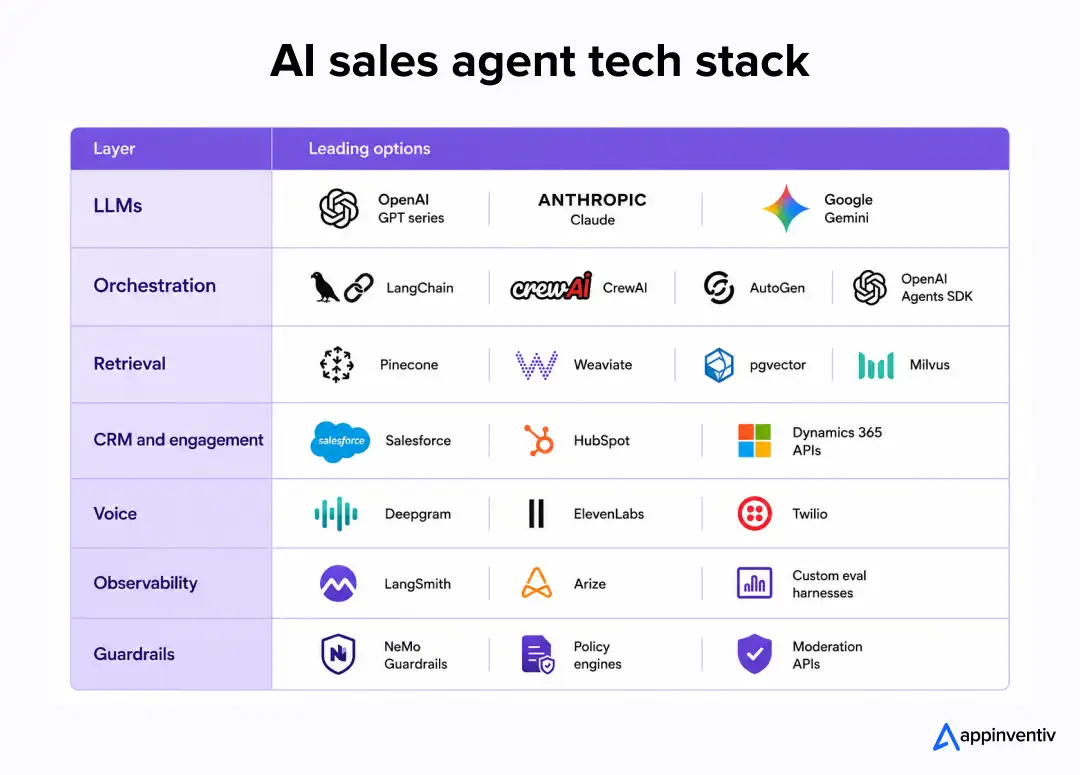
Two cost notes on models. Published list prices for flagship LLM APIs currently run in the range of $2 to $5 per million input tokens and $12 to $25 per million output tokens, with smaller models an order of magnitude cheaper, and providers reprice quarterly. Budget for routing, not for a single model.
A caution on buying instead: the sales agent tools market is crowded with what Gartner calls “agent washing,” rebranded chatbots and RPA sold as agents. Gartner estimates only about 130 of the thousands of vendors claiming agentic capabilities are the real deal. Kick the tires hard.
How much does it cost to build a sales agent in-house?
The honest AI sales agent development cost answer is a range, because scope drives everything. Engineering benchmarks on AI agent development cost put RAG-based agents at $100,000 to $250,000 and multi-agent systems with planning at $250,000 to $400,000 and above. Mapped to sales use cases, budgets land like this:
| Build tier | What you get | US budget | EU budget |
|---|---|---|---|
| Scoped pilot | One workflow, one channel, human approval on every send | $40,000 to $90,000 | €37,000 to €83,000 |
| Production agent | RAG grounding, CRM integration, guardrails, dashboards | $90,000 to $250,000 | €83,000 to €230,000 |
| Enterprise multi-agent platform | Multiple coordinated agents, voice, SSO, audit, compliance tooling | $250,000 to $400,000+ | €230,000 to €370,000+ |
What moves the cost to build these systems up or down:
- Integration depth: two clean APIs versus nine legacy systems is often the whole budget story
- Data readiness: messy CRM data adds 15% to 25% in cleanup effort before real build starts
- Compliance burden: regulated industries add audit trails, consent logic, and legal review cycles
- Voice: a calling agent adds telephony, latency engineering, and TCPA consent workflows
- Evaluation rigor: eval suites and red-teaming are 10% of budget and the best money you will spend
Then there is run cost, the line item everyone forgets at the budgeting table. Expect $2,000 to $15,000 per month across LLM APIs, enrichment data, hosting, and monitoring for a production deployment. Back-of-the-napkin ROI stays simple: if the agent frees 6 hours per rep per week across a 20-rep team, it pays for itself well inside a year.
How long does it take to develop and deploy an AI agent for sales?
A scoped pilot ships in 8 to 12 weeks. An enterprise-grade build with voice, multiple integrations, and compliance review runs 16 to 24 weeks and up. Phases overlap, so totals run shorter than the sum.
| Phase | Duration | What happens |
|---|---|---|
| Discovery and design | 2 to 3 weeks | Workflow selection, KPI definition, architecture blueprint |
| Data preparation | 2 to 4 weeks | CRM audit, cleanup, enrichment, vector store setup |
| Core build | 4 to 8 weeks | Agent logic, RAG, prompts, orchestration |
| Integration | 2 to 4 weeks | CRM, email, calendar, telephony connections |
| Evaluation and pilot | 3 to 6 weeks | Eval suite, red-teaming, limited rollout |
| Hardening and scale | 2 to 4 weeks | Performance tuning, monitoring, phased expansion |
Development timelines slip for predictable reasons: security reviews that start late, CRM admins looped in at week 10, and legal seeing the outbound scripts for the first time at launch. Invite all three to the kickoff, and you will hold the schedule.
What compliance requirements should enterprises consider before deployment?
Compliance is where sales AI projects get killed late, and late is expensive. IBM’s 2025 Cost of a Data Breach Report put the average US breach at $10.22 million, and found that breaches involving shadow AI cost $670,000 more than average, while 97% of organizations that suffered AI-related breaches lacked proper AI access controls. Bake the requirements in from day one.
| Rule | When it applies | What your agent must do |
|---|---|---|
| TCPA (US) | AI-voice or prerecorded sales calls and texts | Prior express written consent, caller ID, instant opt-out |
| CAN-SPAM (US) | Commercial email at any volume | Accurate headers, physical address, opt-outs honored within 10 business days |
| State AI laws (US) | Varies by state | Disclosure duties; Colorado’s amended ADMT law takes effect January 1, 2027 |
| EU AI Act | Selling into the EU | Transparency obligations from August 2, 2026: users must know they are talking to AI; fines reach €35 million or 7% of global turnover |
| GDPR (EU) | Any EU prospect data | Lawful basis for outreach, data minimization, deletion rights |
The FCC settled the biggest US question in February 2024: its declaratory ruling confirmed that TCPA restrictions on artificial voices cover AI-generated and cloned voices, so AI sales calls without prior express consent are unlawful. If your roadmap includes calling, consent capture is not a phase-two feature.
For governance structure, the NIST AI Risk Management Framework and its 2024 Generative AI Profile give you a defensible baseline US enterprises and auditors both recognize. Pair it with SOC 2 controls and, for multinationals, ISO/IEC 42001. None of this is optional at the enterprise agent tier; procurement teams now ask for it by name.
What are the biggest challenges in sales agent implementation?
Gartner predicts over 40% of agentic AI projects will be canceled by the end of 2027, citing escalating costs, unclear business value, and inadequate risk controls. Every one of those causes is avoidable. Here is what actually goes wrong in sales agent implementation, and the fix for each.
| Challenge | Why it happens | The fix |
|---|---|---|
| Hallucinated claims | Ungrounded generation quotes wrong prices or promises features | RAG against approved content; block numeric claims without a source |
| Dirty CRM data | Years of inconsistent entry starve the agent of context | Data audit in week one; enrichment; ongoing hygiene automation |
| Integration debt | Legacy APIs, rate limits, and brittle middleware | Event-driven architecture; queue writes; sandbox testing |
| Rep distrust | Agents imposed on teams get quietly ignored | Co-design with reps; show override stats; celebrate saved hours |
| Unclear ROI | No baseline metric was set before launch | One KPI from day one; weekly reporting against it |
| Security gaps | Shadow AI and missing access controls | Least-privilege tokens, AI usage policy, access reviews [7] |
| Model drift | Quality decays as models, prompts, and markets shift | Weekly evals; version pinning; regression tests before upgrades |
The pattern behind the failures is consistent: teams treat the agent as a model problem when it is an operations problem. The organizations scaling successfully redesigned workflows around the agent instead of bolting it onto old processes.
What are the best practices for integrating sales AI into existing CRM systems?
CRM integration makes or breaks the daily usefulness of an AI agent for sales, because the CRM is where sales operations actually live. The practices below come from deployments where AI in CRM moved from pilot to company-wide default.
- Read broadly, write narrowly. Give the agent wide read access for context but scoped write access to activity and note fields. Stage changes and amounts stay human-approved until override rates prove otherwise.
- Make writes idempotent. Duplicate tasks and double-logged calls destroy rep trust faster than any hallucination. Dedupe on external IDs.
- Respect API budgets. Salesforce and HubSpot rate limits are real; queue and batch writes rather than hammering endpoints on every event.
- Sync bidirectionally with low latency. An agent working from yesterday’s pipeline emails a prospect who already signed. Event-driven sync beats nightly batches.
- Log every action with a why. Reason codes on each write turn compliance reviews from archaeology into a filter query.
- Start in sandbox, promote with evidence. Prove accuracy against a copy of production data before touching live records.
Voice adds its own wrinkle: real-time transcript-to-record flows need the patterns in AI voice assistant CRM integration, where latency and field mapping decide whether calls become clean pipeline data.
Should you buy sales agent software or build a custom one?
Both paths are legitimate. The math depends on scale, differentiation, and data sensitivity.
| Factor | Off-the-shelf sales agent software | Custom AI sales agent development |
|---|---|---|
| Time to value | 2 to 6 weeks | 8 to 24 weeks |
| Year-one cost | $30 to $150+ per user per month | $40,000 to $400,000+ project |
| Cost at 100+ seats | Compounds every year | Amortizes; run cost only |
| Differentiation | Same playbook as your competitors | Your data, your rules, your moat |
| Compliance control | Vendor’s roadmap and audit posture | Your controls, your audit trail |
| Lock-in | High; data and workflows live in their cloud | Low; you own the stack |
Our rule of thumb after a decade of these decisions: buy to learn, build to compound. A SaaS tool is a fine way to validate that agents move your KPI. But once the workflow proves out, teams that build these capabilities on their own data and systems stop renting a commodity and start compounding an asset. Most sales AI agent solutions we replace were purchased fast and outgrown faster.
The hybrid path works too. Plenty of our clients keep a vendor tool for generic sequencing while a custom agent handles the workflows where their proprietary data creates an edge.
Where do AI-powered sales agents deliver the fastest ROI?
Four workflows consistently return their build cost first.
- Outbound research and email. An AI sales email agent that researches an account, finds the trigger event, and drafts a grounded first touch collapses the 20 minutes reps spend per prospect into seconds. This is where Salesforce’s data shows top performers separating from the pack.
- Inbound speed to lead. When a demo request lands at 11 pm on a Friday, the agent qualifies, answers product questions from retrieved docs, and books Monday’s meeting before a competitor’s rep has seen the notification.
- Automotive retail. The automotive sales AI agent has become a standout vertical use case: dealerships run agents that answer after-hours inventory questions, handle trade-in inquiries, and book test drives, then hand the showroom a briefed buyer. The broader shift we track in AI in the automotive industry shows why dealer groups are moving budget here.
- Renewals and expansion. Agents that watch usage signals and open renewal conversations 90 days out quietly protect more revenue than most net-new programs generate.
Voice-led qualification deserves a mention as a fifth: pairing these workflows with a calling agent built along the lines of our guide on how to build an AI voice agent extends the same engine to the phone channel, consent rules included. Market momentum backs the investment case across all five: MarketsandMarkets values the AI agents market at $7.84 billion in 2025, headed to $52.62 billion by 2030 at a 46.3% CAGR.
How does sales agent development change across industries?
The eight steps do not change from one vertical to the next. What changes is the data the agent reasons over, the systems it has to touch, the signals that mean a prospect is ready to buy, and the rules that govern the conversation. Here is what actually shifts when you build for five common industries.
| Industry | What the agent keys on | Systems to integrate | The build wrinkle |
|---|---|---|---|
| Ecommerce and retail | Cart and browse behavior, catalog and inventory, order status | Commerce platform, CDP, PIM, support desk | High volume, low ticket: tune for instant response and never let it promise an out-of-stock SKU |
| Real estate | Listing interest, budget, location, financing readiness | MLS and IDX feeds, CRM, calendaring | Long, emotional cycle: nurture for months, route hot leads in seconds, and respect licensing limits on advice |
| Automotive | Model interest, trade-in value, financing, test-drive intent | DMS, live inventory feed, F&I tools | After-hours inventory and trade-in answers drive the ROI; TCPA consent is non-negotiable before a callback |
| SaaS and B2B tech | Product usage, ICP fit, intent data, champion mapping | CRM, product analytics, enrichment, sequencer | Multi-threaded deals: the agent arms the rep and works PQL follow-up, it does not close on its own |
| Financial services and insurance | Eligibility, risk profile, life events | Core policy or admin systems, CRM | Heaviest compliance: suitability, disclosures, and audit trails, with a human approving anything that resembles advice |
Notice the pattern. The more regulated and higher the ticket, the more the agent shifts from acting on its own toward preparing a human to act. An ecommerce agent can close the loop end to end; a financial-services agent should tee up a licensed rep with a clean brief. Set the autonomy dial to the vertical, not to the demo.
Who Owns the Risk?
Nearly 40% of agentic projects get canceled. The survivors planned for data, consent, and drift on day one. Send us the workflow and the metric it must move.
How can Appinventiv help you out?
This is the one section where we will talk about ourselves, because you should know who is behind the advice. Appinventiv has spent 10+ years building AI systems for enterprises where compliance is not a checkbox but a design constraint, with 100+ autonomous agents deployed and a bench of 200+ data scientists and engineers.
Our Achievements & Case Studies

JOBGET

Clutch

Deloitte

Times Business Award

Gurushala AI

Vyrb Social Media App


Our AI agent development services cover the full arc this guide describes: workflow selection, architecture, RAG and orchestration engineering, guardrails, and the evaluation harnesses that keep quality from drifting after launch. Where an existing revenue stack is the starting point, our AI integration services connect agents to Salesforce, HubSpot, and the legacy systems nobody wants to touch, with the least-privilege patterns your security team will sign off on.
We scope in weeks, not quarters, and we put the cost and timeline ranges from this guide into a fixed proposal before you commit. If the business case does not clear, we will tell you that too. A pilot that should not be built is cheaper to kill on a whiteboard.
FAQs
Q. What team do you need to keep an AI agent for sales running after launch?
A. AI-powered sales agents do not run themselves after launch. Plan for a fractional core: a RevOps owner who manages workflows and KPIs, an engineer (roughly half-time) for prompts, evals, and integrations, and a named escalation contact in sales. Enterprises add quarterly reviews with security and legal. If you build with a partner, a managed-services retainer typically replaces the engineering seat.
Q. Which KPIs prove your sales agent is actually paying off?
A. Track five: reply rate on agent-drafted outreach, meeting acceptance rate, speed to lead, cost per qualified opportunity, and the human override rate. Override rate is the sleeper metric. When it falls below about 10% and stays there, you have earned the right to remove approval checkpoints and scale volume.
Q. How much CRM history does a sales agent need before it adds real value?
A. Twelve months of closed-won and closed-lost records across roughly 1,000 accounts is a comfortable floor for scoring and personalization. Thinner data is workable: enrichment providers fill firmographic gaps, and the agent can run rules-based logic while it accumulates interaction history. What it cannot survive is wrong data, so accuracy beats volume every time.
Q. Can one AI agent for sales support multiple languages and regions?
A. Yes. Modern LLMs handle major business languages well, and one agent can route by region. The hard part is not translation but localization: consent rules, send-time norms, formality levels, and disclosure requirements differ by market. Treat each new region as a compliance review plus a tone pass on templates, not a toggle.
Q. Should a sales agent be allowed to negotiate pricing or discounts?
A. No, not autonomously. The pattern that works in production: the agent presents list pricing from approved sources, flags discount requests, and routes them to a human with full context, or operates within hard floor prices set in the guardrail layer with every exception logged. Pricing authority is the last thing you delegate, if you ever do.
Q. What happens if your LLM provider deprecates the model behind your agent?
A. This is an architecture question, and the time to answer it is before you build. An abstraction layer over model calls, a regression eval suite you can run against any candidate model, and contract terms covering deprecation notice periods turn a forced migration into a two-week swap instead of a rebuild. Multi-model routing from day one makes it a non-event.
VP - Technology, AI & ML Expert

Build Your AI Sales Agent With Experts (Talk to Us)
Captcha:
3 + 4 =

Fast 2-minute response, fully NDA-protected.
Read More Blogs

Retrieval Augmented Generation in Australia: Architecture, Implementation and Cost
Key takeaways: RAG grounds LLM answers in approved content, improving reliability without retraining a model. Data quality and access permissions decide production outcomes more than the model. Indicative build costs run from AUD 70,000 to 700,000, driven by data and integrations. Measure value against a pre-deployment baseline, separating realised benefits from projected savings. A general-purpose…
Peter Wilson
22 Oct 2026
The Multiplier Effect of AI Agents: The Rise of AI Swarms
Key takeaways: AI agent swarms coordinate specialized agents to solve complex problems that may be difficult for a single agent to handle effectively. More agents do not automatically mean better outcomes. Swarms deliver value when work can be divided, executed in parallel, and coordinated toward a shared objective. Enterprise readiness depends on governance. Clear accountability,…
Chirag Bhardwaj
19 Oct 2026
AI Data Integration: How to Connect, Clean and Prepare Data for AI
Key takeaways: AI initiatives fail when fragmented, poor-quality data reaches models without sufficient context, controls or ownership. AI-ready pipelines must connect, clean, enrich, govern and continuously monitor data across its lifecycle. Real-time processing matters when AI decisions depend on current transactions, events, inventory or operational conditions. Data architecture should follow the AI use case, balancing…
Chirag Bhardwaj
13 Oct 2026