


































Auto Spare Parts Management System Development: Complete Enterprise Guide

 Share -



- 01Step-by-Step Auto Spare Parts Management System Development Process
- 02Enterprise Architecture and Technology Stack for an Auto Spare Parts Management System
- 03AI Capabilities That Differentiate Modern Spare Parts Management Systems
- 04Enterprise Use Cases of Auto Spare Parts Management Systems
- 05Custom vs. Off-the-Shelf Spare Parts Management Software
- 06Business Benefits Beyond Inventory Management
- 07Common Challenges in Auto Spare Parts Management System Development and How to Overcome Them
- 08Cost to Develop an Auto Spare Parts Management System and Expected ROI
- 09The Future of Auto Spare Parts Management Systems
- 10Build an Enterprise-Ready Auto Spare Parts Management System with Appinventiv
- 11FAQs

Key takeaways:
- Build an AI parts platform that links inventory, purchasing, warehouses, dealers, and ERP systems into one network.
- Examine system architecture, tech stacks, and software connections built for multi-site parts operations.
- See how AI sharpens order forecasts, stock planning, purchasing, and part lookups to cut daily delays.
- Compare custom code and ready-made apps to pick the best software investment for business growth.
- Review development budgets, rollout risks, return on investment, and upcoming tech trends across the parts industry.
Automotive aftermarket companies depend on a steady supply of spare parts. Many enterprises still rely on separate ERP tools, spreadsheets, and manual tracking. Inventory records drop out of sync. Warehouses hold slow-moving stock, and critical parts run out. Procurement teams spend hours calling suppliers for inventory updates. Dealers receive incomplete data, and repair delays cause lost sales.
Market pressure grows each year across the industry. The urgency is only increasing. The global automotive aftermarket is projected to grow from $457.08 billion in 2026 to $604.57 billion by 2034, putting even greater pressure on manufacturers, dealerships, and parts distributors to modernize their spare parts operations.
Customers demand fast service, and vehicle product lines expand every month. Legacy systems cannot sync warehouse inventory in real time. They cannot match VIN numbers, connect APIs, or forecast stock needs across regions.
Why do executives invest in a custom auto spare parts management system (ASPMS) software? Connected platforms combine inventory, purchasing, warehouse operations, and analytics into one system. This guide covers auto spare parts management system development from start to finish. It details system design choices, technology stacks, AI tools, project costs, and expected financial returns.
Build an intelligent spare parts platform that improves warehouse accuracy, fulfillment speed, and inventory visibility across every location.
Step-by-Step Auto Spare Parts Management System Development Process
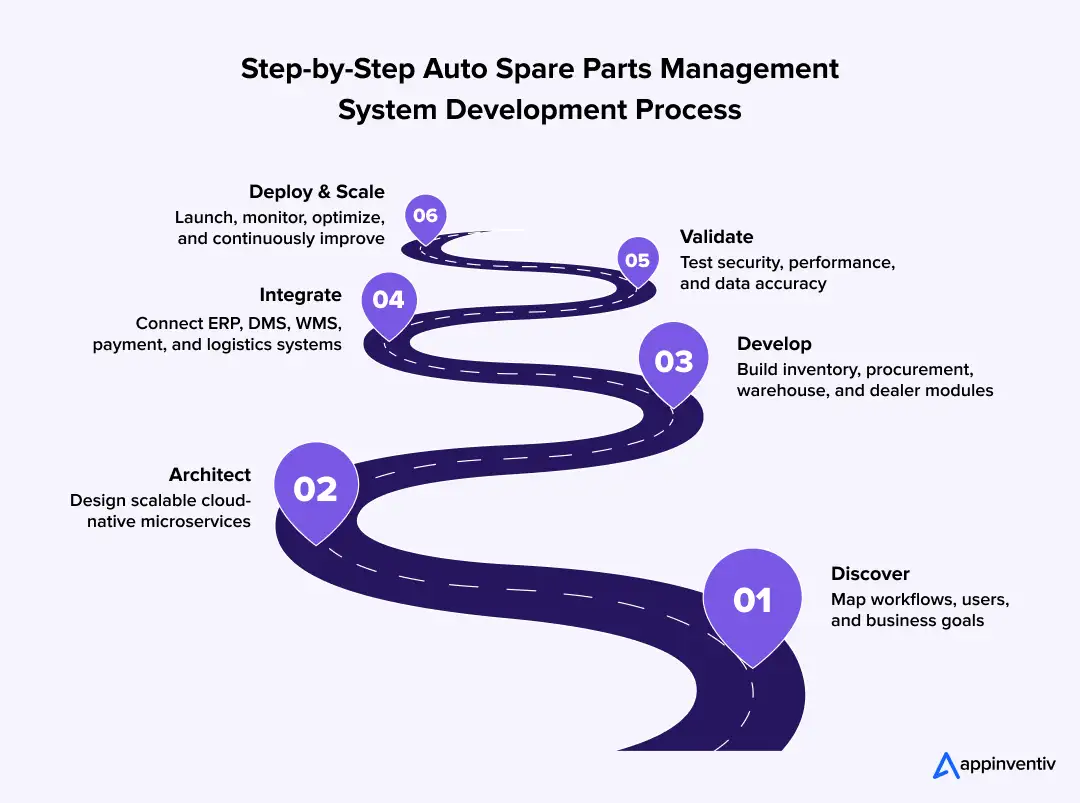
Building a parts platform takes more than writing software. Engineers design a system that links warehouses, suppliers, dealers, procurement teams, ERPs, and analytics into one environment. Each phase shapes how the platform runs as inventory grows and new users join.
Discovery and Requirement Analysis
Learning how to build a spare parts inventory system starts by tracking how spare parts move through your business. Teams map daily workflows, spot delays, and write clear requirements before writing code.
Developers meet with warehouse managers, buyers, finance teams, dealers, and IT staff. They answer key questions:
- How many warehouses will the system serve?
- Which ERP, CRM, or dealer tools need connection?
- How do managers approve purchase orders?
- What rules trigger automatic reorders?
- How do teams process returns and warranty claims?
- Which reports do executives read each week?
Engineers evaluate your tech stack, database models, security rules, and data quality. This early review stops scope creep and produces a clear roadmap.
Planning the System Architecture
System architecture determines if the platform handles millions of records and thousands of active users across multiple sites.
Many companies choose microservices. Instead of placing all features into one large program, developers break functions into separate tools. Inventory, purchasing, warehouse tasks, order tracking, and analytics run independently. They talk through secure APIs. Teams update single services without stopping the entire platform.
Standard spare parts management system features include:
- API Gateway for request routing
- User authentication and authorization services
- Inventory service
- Purchasing service
- Warehouse management service
- Parts catalog service
- Order management service
- Reporting and analytics service
- Notification service
- AI and machine learning service
Messaging tools like Apache Kafka or RabbitMQ sync inventory changes across warehouses instantly. Search engines like Elasticsearch speed up lookups across OEM numbers, cross-references, and vehicle fitment data.
UI/UX Design
Employees use the platform daily, so a strong UI/UX design approach increases output. Software teams build custom dashboards for specific job roles instead of one general layout.
Role examples include:
- Warehouse staff scanning items on handheld scanners
- Buyers reviewing vendor quotes and purchase orders
- Sales staff checking real-time stock across locations
- Executives reviewing turnover rates and purchasing costs
- Dealers searching parts using VIN lookups
React, Angular, or Vue.js power the web screens for desktop users. Flutter or React Native run mobile apps for field staff. Developers connect barcode scanners, RFID readers, and camera tools to mobile apps to speed up item processing.
Backend and Core Module Development
One of the key steps to building spare parts inventory software is a backend that powers every transaction in your parts operation. Engineers build core modules first, then add advanced features.
Standard modules include:
- Inventory control
- Warehouse operations
- Purchasing
- Vendor management
- Parts catalog
- Vehicle fitment engine
- Order tracking
- Price management
- Warranty and returns
- Customer accounts
- Reporting and analytics
Relational databases like PostgreSQL or Microsoft SQL Server store core data. Redis caches frequent searches to speed up screen loads. Object storage holds invoices, part images, repair manuals, and warranty files.
REST or GraphQL API development links services to web portals, mobile apps, dealer systems, and external software. Access controls, encryption, audit logs, and multi-factor logins protect financial records.
ERP and Third-Party Integrations
Most automotive companies run legacy software. A new parts platform must connect with these current tools through automotive ERP software rather than replace them.
Common connections include:
- SAP S/4HANA
- Oracle ERP
- Microsoft Dynamics 365
- Dealer Management Systems
- Warehouse Management Systems
- CRM tools
- Accounting applications
- Payment gateways
- Logistics and shipping platforms
- OEM parts catalogs
- VIN lookup services
Integration teams use REST APIs, SOAP services, webhooks, message queues, or service buses. Strict data sync rules keep stock levels, purchase orders, and prices matched across all systems.
Testing and Quality Assurance
Testing confirms that every module works before launch. Quality assurance goes beyond basic feature checks. Engineers test:
- Inventory accuracy
- API response speeds
- System load capacity
- Data security
- User acceptance
- Data migration accuracy
- Failover recovery
- Mobile and browser support
High-volume platforms need deep performance testing. Simulated traffic reveals database slowdowns, API bottlenecks, and sync delays before users log in.
Deployment and Continuous Support
Launch day starts long-term management. Development does not end at release.
Engineers deploy systems to AWS, Microsoft Azure, or Google Cloud using Docker containers and Kubernetes. CI/CD pipelines bring intelligent automation to builds, testing, and updates. This process reduces launch risks and speeds up software releases.
After launch, engineers track system health, server loads, API speeds, database growth, and security logs with monitoring software. Regular updates add features, patch security gaps, and adapt the code to business growth as part of the ongoing spare parts management system development process.
Enterprise Architecture and Technology Stack for an Auto Spare Parts Management System
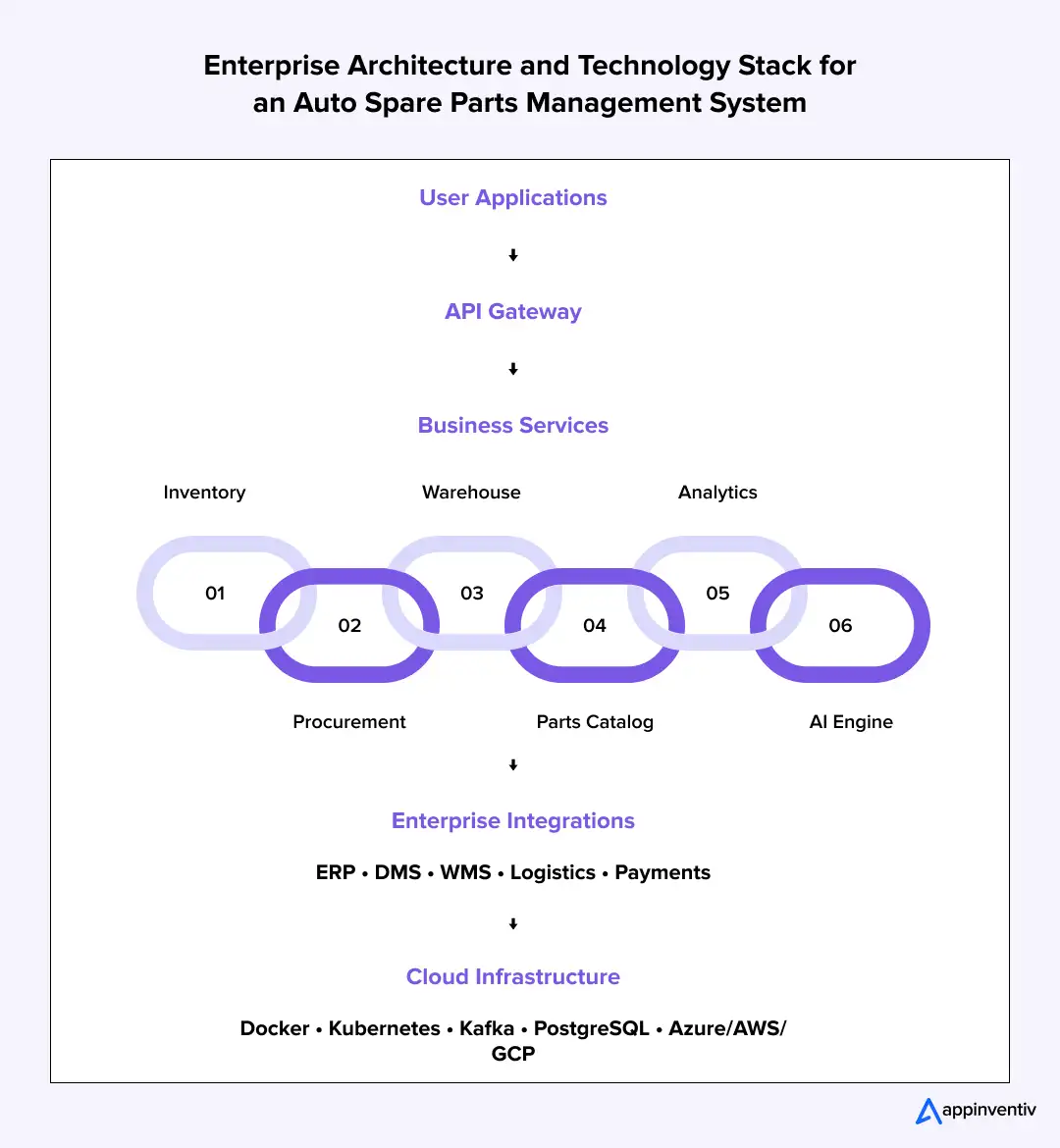
An enterprise auto spare parts management system development effort processes inventory updates, purchase orders, warehouse tasks, and dealer requests in real time. Systems require an architecture built for speed and integration.
Most companies build cloud-native microservices. Each business function runs as a separate service. Services grow without affecting the rest of the software.
Presentation Layer
The presentation layer provides access for teams through specific interfaces.
- Web Portal: Inventory managers, buyers, finance staff, and admins use web applications for daily operations.
- Mobile Applications: Warehouse workers, field technicians, and dealership teams run mobile apps on handheld devices. They scan barcodes, track stock transfers, receive items, and confirm deliveries.
API Gateway
The API Gateway acts as the single entry point for the platform. It logs users in, checks incoming requests, enforces security rules, and routes traffic to specific services. This setup links web portals, mobile apps, dealer screens, and external software.
Core Business Services
Developers divide application logic into separate services for specific operational duties.
- Inventory Service: Tracks stock across warehouses, records item movements, holds stock reservations, and updates counts instantly.
- Warehouse Service: Manages item receiving, bin storage, stock transfers, picking, packing, and shipping tasks.
- Purchasing Service: Automates buying requests, vendor quotes, purchase orders, approval chains, and delivery receipts.
- Parts Catalog Engine: Stores OEM part numbers, cross-references, replacement histories, vehicle fitment data, prices, and warranties. Teams combine Elasticsearch with VIN decoding tools for fast search results.
- Analytics Service: Gathers operational data into live dashboards. These screens display stock turnover, part aging, vendor performance, fulfillment speeds, and warehouse metrics.
- AI Layer: Machine learning models study past transactions, seasonal patterns, vendor lead times, and stock shifts. They predict future orders, recommend buy quantities, flag slow stock, and spot buying errors.
Also Read: Predictive Analytics Software Development
Integration Layer
Parts platforms connect directly with existing enterprise software. Integration services share data using REST APIs, GraphQL, message queues, or webhooks.
Standard integrations include:
- SAP S/4HANA
- Oracle ERP
- Microsoft Dynamics 365
- Dealer Management Systems
- Warehouse Management Systems
- CRM tools
- Logistics providers
- Payment gateways
- OEM parts catalogs
- VIN decoding tools
This integration layer matches stock levels, purchase orders, pricing, and client records across all business units.
Data Layer
Different storage engines support distinct data tasks. PostgreSQL stores transactional records like inventory movements and purchase orders. Redis speeds up common stock searches using in-memory caches. Object storage holds invoices, part images, manuals, and warranty files.
Infrastructure Layer
Companies run enterprise platforms on AWS, Microsoft Azure, or Google Cloud Platform. Docker packages each service into containers. Kubernetes manages container deployment, server scaling, and auto-recovery. Apache Kafka or RabbitMQ sends messages between backend services without delays. Monitoring platforms track system health, server speeds, and security events.
Recommended Technology Stack
The table below shows a standard software stack for enterprise spare parts systems. Final tech choices match your existing IT setup and business needs.
| Layer | Common Technologies |
|---|---|
| Frontend | React, Angular, Vue.js |
| Mobile | Flutter, React Native |
| Backend | Java Spring Boot, .NET, Node.js |
| API Layer | REST APIs, GraphQL, API Gateway |
| Databases | PostgreSQL, Microsoft SQL Server |
| Caching | Redis |
| Search Engine | Elasticsearch |
| Event Streaming | Apache Kafka, RabbitMQ |
| AI & Machine Learning | TensorFlow, PyTorch, Azure AI, Amazon SageMaker |
| Cloud Infrastructure | Microsoft Azure, AWS, Google Cloud Platform |
| Containerization | Docker |
| Orchestration | Kubernetes |
| DevOps | GitHub Actions, Azure DevOps, Jenkins |
| Monitoring | Prometheus, Grafana, ELK Stack |
| ERP Integration | SAP S/4HANA, Oracle ERP, Microsoft Dynamics 365 |
This structure lets companies open new warehouses, add dealerships, connect new business tools, and add AI features without rebuilding the platform. Every service scales on its own, and data stays clean across all business units.
AI Capabilities That Differentiate Modern Spare Parts Management Systems
Modern auto parts inventory management systems use AI in automotive operations to forecast sales, track warehouse actions, and guide buying choices. Companies spot stock risks early. They act on clear data rather than reacting to empty shelves.
AI-Based Demand Forecasting
AI-based demand forecasting relies on machine learning models that study past sales, repair trends, vendor delivery speeds, seasonal shifts, warranty records, and stock movements. They predict future parts needs. Buying teams order stock earlier, cut inventory shortages, and limit excess supply in each warehouse.
The business impact is measurable. Organizations can reduce inventory levels by 20% to 30% by combining machine learning with dynamic demand forecasting and inventory optimization.
Predictive Inventory Planning and Replenishment
Predictive analytics turns sales forecasts into concrete inventory actions. The software calculates reorder amounts and flags slow-moving stock. It shifts items between warehouses and sends parts to dealers based on local needs. The engine factors in vendor delivery times and buying habits to cut delays and maximize stock use.
Computer Vision and OCR
Computer vision identifies spare parts, checks barcode labels, counts items, and spots damaged goods using warehouse cameras or mobile devices. OCR reads text from paper invoices, packing slips, and vendor receipts. It sends this data directly into purchasing and ERP workflows. These tools remove manual typing tasks and boost record accuracy.
AI-Powered Parts Search
Parts catalogs often contain hundreds of thousands of SKUs. Search engines combine natural language processing, VIN decoding, semantic search, and Elasticsearch. Workers find matching parts by typing vehicle details, part numbers, descriptions, or uploading part photos.
Generative AI Assistants and Intelligent Procurement
Generative AI tools let employees request stock counts, vendor stats, and operational reports using spoken or written questions. AI guides purchasing teams by scoring vendor reliability and suggesting backup suppliers. It spots buying risks and creates purchase orders based on stock forecasts and company rules.
Enterprise Use Cases of Auto Spare Parts Management Systems
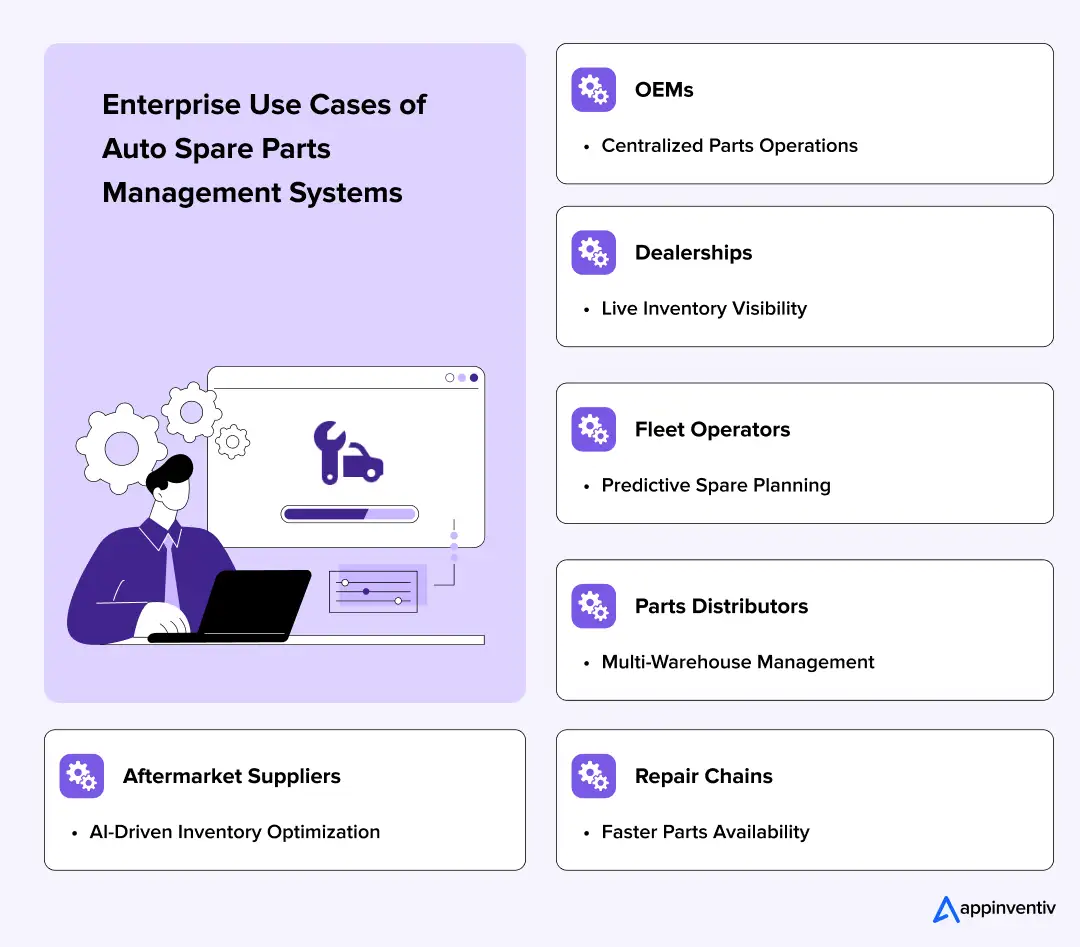
Automotive companies manage spare parts in different ways. Operational problems overlap across business types. Inventory counts must stay accurate across locations. Purchasing teams need clean vendor data.
Service teams need parts on time. Custom software connects inventory, warehouses, purchasing, and dealer networks inside one auto spare parts management system.
Automotive OEMs
OEMs manage vast parts catalogs across plants, distribution hubs, and dealer sites. Central software syncs stock levels in real time. It matches parts by VIN number. It connects directly to ERP tools like SAP S/4HANA. Global makers like Toyota and Volkswagen run connected parts platforms to support after-sales services.
Auto Dealership Networks
Dealerships require exact inventory counts to speed up vehicle repairs. Central software displays live stock levels across all locations. The system automates stock reorders. It manages part transfers between dealer sites. AI search helps service advisors find matching parts quickly.
Fleet Management Companies
Fleet operators use IoT in automotive operations to keep commercial vehicles running and control maintenance spending. The platform predicts order volumes for common replacement parts. It monitors stock levels across repair shops. The system automates purchase orders. This process cuts vehicle downtime and sharpens service scheduling.
Parts Distributors
Distributors handle high order volumes across multiple warehouses and vendors. The system automates stock tracking and warehouse tasks. It runs barcode scanners and RFID readers for fast fulfillment. Inventory records stay accurate across every distribution center.
Auto Repair Chains
Repair chains need fast access to matching parts across service garages. AI search, VIN decoders, and real-time stock sync help mechanics. Technicians verify the correct part and check local inventory. They confirm stock availability prior to starting repair work. This step eliminates service delays and raises workshop productivity.
Automotive Aftermarket Suppliers
Aftermarket suppliers manage changing sales across wholesalers, retailers, dealerships, and websites. AI forecasts demand trends and automates stock replenishment. Purchasing analytics balance inventory levels across channels. Suppliers reduce surplus stock and improve supply chain schedules.
Bring inventory, procurement, warehouses, dealers, and ERP systems together before disconnected operations begin limiting business growth.

Custom vs. Off-the-Shelf Spare Parts Management Software
Pre-packaged software fits smaller businesses with standard inventory workflows and basic integrations. Custom platforms give growing companies the control needed to manage multiple warehouses, dealer networks, vendors, and complex operations.
| Factor | Custom Software | Off-the-Shelf Software |
|---|---|---|
| Scalability | Expands as order volumes and warehouse networks grow. | Constrained by vendor subscription plans and system limits. |
| ERP Integration | Connects directly to SAP S/4HANA, Oracle ERP, and Microsoft Dynamics. | Offers standard connections, but custom links require extra work. |
| AI Readiness | Integrates custom machine learning models and generative AI tools. | Relies on features set by the software vendor’s schedule. |
| Security | Matches exact internal compliance rules and security standards. | Restricts teams to built-in vendor security controls. |
| Workflows | Adapts code to fit existing business operations. | Forces companies to adjust daily operations to match the app. |
| Long-Term TCO | Requires higher initial investment but cuts ongoing per-user fees. | Starts with lower fees but costs accumulate through licensing. |
| Vendor Lock-in | Gives complete ownership of source code and future updates. | Creates continuous reliance on third-party developers. |
When Custom Development Makes Sense
Custom spare parts management software development suits companies with specific operational demands. It works best for leaders who need deep ERP links, automated AI forecasting, tailored workflows, and multi-site scaling without vendor restrictions.
Also Read: Build vs Buy Software: Which Is Right for You
Business Benefits Beyond Inventory Management
Modern spare parts inventory management software delivers value beyond tracking stock. They connect purchasing, warehouses, suppliers, and analytics into one network. Companies improve operational speed, cut spending, and make clear decisions.
Operational Benefits
Companies gain live stock visibility across every site. Modern barcode and RFID-enabled warehouse operations can achieve more than 99.5% inventory location accuracy and 99.8% order accuracy, reducing picking errors and improving fulfillment performance. Automated reorders and warehouse workflows speed up order processing, prevent stockouts, and accelerate deliveries.
Financial Benefits
Stronger demand forecasts and purchasing plans reduce surplus stock and holding fees. This has a direct financial impact, considering inventory carrying costs typically account for 20% to 30% of total inventory value and continue to rise the longer parts remain in storage. Faster inventory turnover, fewer rush orders, and reliable vendor performance lower operating costs. These changes protect working capital.
Strategic Benefits
Connected platforms powered by automotive analytics give executives a unified view of inventory, purchasing, and warehouse activity. Leaders plan faster and build stronger supply chains. Better part availability improves customer service. Live operational metrics guide strategic choices.
Common Challenges in Auto Spare Parts Management System Development and How to Overcome Them
Spare parts management challenges in the automotive industry go beyond writing code. The software connects with existing databases, processes high transaction volumes, and supports daily tasks without causing downtime. Addressing core risks early protects system stability and speeds up rollout schedules.
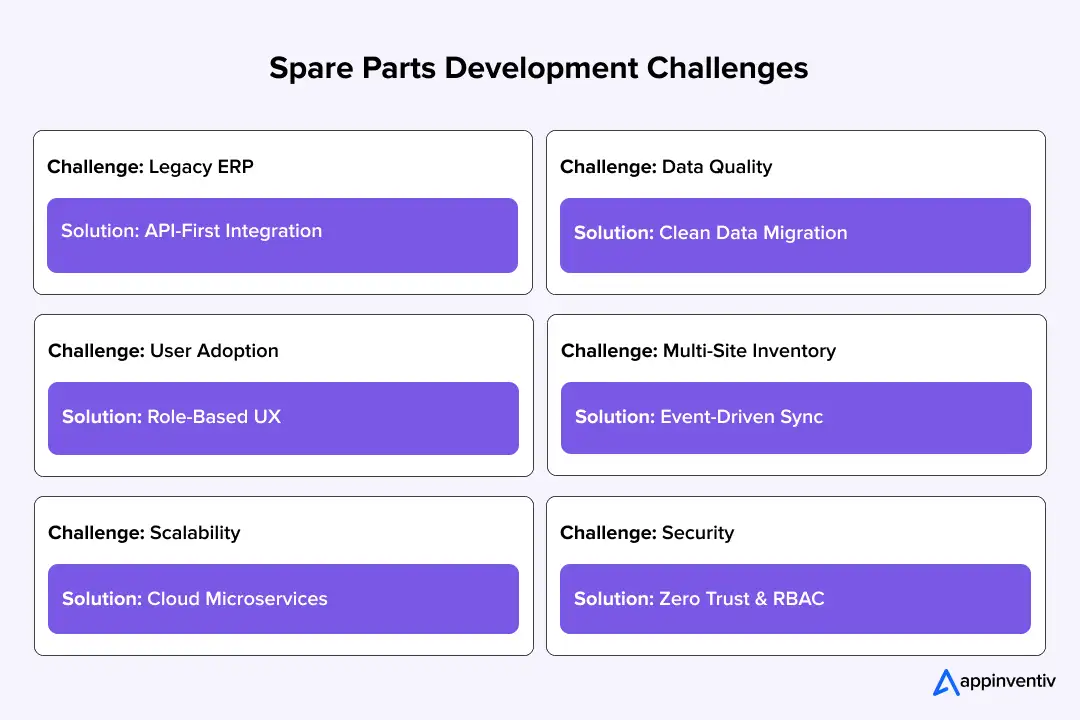
Legacy ERP Integration
Connecting new software to legacy systems without a clear legacy application modernization plan creates data errors and sync delays.
Recommended Solution: Use API-first connections and enterprise service buses to link SAP S/4HANA, Oracle ERP, and Microsoft Dynamics. Data moves freely without replacing core business software.
Data Migration and Inventory Accuracy
Inventory databases hold duplicate part numbers, old vendor records, and conflicting descriptions. Transferring bad data creates operational headaches later.
Recommended Solution: A clear data migration strategy cleans and standardizes stock records before migration. Automated data checks, master data rules, and trial runs spot errors prior to launch.
User Adoption
Warehouse teams, buyers, and dealer staff resist software that complicates daily tasks.
Recommended Solution: Build role-specific screens, run interactive training, and release features in stages. Gathering early feedback improves system adoption before full deployment.
Multi-Location Synchronization
Keeping stock records matched across sites gets difficult as inventory moves quickly.
Recommended Solution: Build an event-driven system with Apache Kafka or RabbitMQ. Real-time updates match inventory counts instantly and eliminate stock conflicts across sites.
Scalability
Order volumes surge as enterprises add warehouses, vendors, and dealer networks. Platforms built for current demand fail under future traffic.
Recommended Solution: Build microservices with Docker and Kubernetes. Individual services scale up during busy periods without slowing down the rest of the software.
Cybersecurity
Parts systems store purchase orders, vendor contracts, pricing lists, and client records. Cybercriminals target these central databases.
Recommended Solution: Strong cybersecurity measures like multi-factor logins, role-based permissions, API security, and data encryption protect these systems. Continuous monitoring and security audits align platform safety with ISO 27001 and SOC 2 standards.
Cost to Develop an Auto Spare Parts Management System and Expected ROI
The cost to develop spare parts management software varies with system scope, integrations, AI features, and deployment choices. Enterprise software requires a larger budget than basic inventory apps. Complex operational rules and high traffic drive up development effort.
| Project Scope | Estimated Cost (USD) |
|---|---|
| Basic inventory management system | $50K to $100K |
| Mid-sized business platform | $100K to $200K |
| Enterprise spare parts management system | $200K to $350K |
| AI-powered enterprise platform with advanced integrations | $350K to $500K+ |
Factors That Influence Development Cost
Spare parts management system development cost changes based on technical and operational demands:
- Number of software modules and business workflows
- Connections to ERP, CRM, DMS, and external tools
- AI features like demand forecasting and automated purchasing
- Total count of warehouses, active users, and inventory sites
- Cloud hosting setup and deployment models
- System security, compliance rules, and permission settings
- Custom reports, live dashboards, and analytics tools
- Mobile applications and offline scanning capabilities
Expected ROI
A custom platform returns value long after launch. Companies cut carrying costs with clear order planning. Automated reorders reduce stockouts. Live stock counts speed up order processing. Mechanics locate parts faster to boost shop output. Higher stock turnover and AI-guided buying reduce operational expenses and prevent wasted budget.
Also Read: Automotive Software Development Cost
Every delay increases inventory expenses and technical debt. Build a platform that delivers measurable operational and financial returns.

The Future of Auto Spare Parts Management Systems
Spare parts management moves from basic tracking toward automated daily operations as part of broader digital transformation in the automotive industry. Progress in artificial intelligence, connected devices, and warehouse automation helps automotive brands maintain part stock, cut operational spending, and match shifting market demand in real time.
Agentic AI
Agentic AI executes daily tasks beyond basic recommendations. System software creates purchase requests, transfers stock between warehouse locations, and flags supply risks using clear business rules.
Digital Twins
Digital twins technology mirror real warehouses and supply networks. Companies run virtual tests on stock levels, floor layouts, and buying choices prior to making live site updates.
Autonomous Procurement
Purchasing platforms review vendor performance, compare part prices, track supplier shipment lead times, and generate purchase orders with minimal manual intervention from internal staff.
Also Read: Software-Defined Vehicle Strategy: What It Means for the Auto Industry
IoT and Predictive Maintenance
IoT in enterprise settings connects vehicles, factory machines, and warehouse tools to send real-time operational data. Platform systems project spare part needs long before components break down.
Warehouse Robotics and Hyperautomation
Mobile robots, automated storage tools, and software workflows speed up item picking, packing, stock counts, and order dispatching while cutting manual physical tasks.
Sustainability
AI in sustainability initiatives drives smart demand forecasts and clean inventory planning that cut surplus stock. Software limits scrap waste, reduces emergency rush freight trips, and improves resource use across supply networks.
Build an Enterprise-Ready Auto Spare Parts Management System with Appinventiv
As an automotive software development company, Appinventiv knows that building an enterprise parts platform takes more than writing code. Engineering teams need deep experience with software architecture, AI models, cloud environments, ERP links, and legacy system updates. Appinventiv combines these technical skills to help automotive brands build platforms that support long-term growth.
Our engineering teams design software around your specific operational workflows. We build tools for inventory control, purchasing, warehouse tasks, dealer portals, and AI demand forecasts. We connect new platforms with existing systems like SAP, Oracle ERP, and Microsoft Dynamics. Our developers update legacy software and build cloud applications that handle expanding order volumes.
We manage your platform across every phase of software development. Our services cover product planning, interface design, backend engineering, testing, deployment, and ongoing maintenance. You partner with one engineering team for auto spare parts management system development from project kickoff through long-term operations.
Placeholder for automotive proof points:
- 800+ OTA Updates Delivered
- 150+ Vehicle Platforms Modernized
- 80+ CAN Bus & AUTOSAR Integrations
- 65+ Battery Management Systems Developed
- 80+ Connected Fleet Deployments
- 40+ Automotive AI Models in Production
Let’s connect and build a custom spare parts management system that scales with your business.
FAQs
Q. What is an auto spare parts management system?
A. An auto spare parts management system development project connects stock tracking, purchasing, warehouse tasks, vendor management, and part sales inside one application. The software displays live stock counts, automates orders, links to ERP tools, and forecasts stock needs to raise accuracy and speed up operations.
Q. How much does it cost to develop a spare parts management system?
A. Development costs range from $50,000 to over $500,000. Final prices depend on software scope, AI features, ERP connections, user counts, warehouse sites, security needs, and hosting options. Enterprise systems with tailored workflows and deep analytics require larger budgets than basic inventory apps.
Q. How long does it take to build a spare parts management software?
A. Development timelines for spare parts inventory management software range from 4 to 12 months. Engineering teams complete basic inventory apps in a few months. Enterprise platforms with AI tools, ERP links, mobile apps, and multi-site support require extra time for planning, testing, and rollout.
Q. Should I build a custom spare parts management system or use off-the-shelf software?
A. Off-the-shelf apps fit companies with standard stock workflows and basic technical requirements. Custom spare parts management software development fits companies with complex operational demands. It supports ERP connections, AI inventory forecasting, tailored workflows, strict security, and multi-site scaling.
Q. How does a spare parts management system integrate with existing ERP software?
A. Systems link to current ERP software using REST APIs, middleware, webhooks, or service buses. These connections match stock counts, purchase orders, vendor details, prices, and financial data across platforms like SAP S/4HANA, Oracle ERP, and Microsoft Dynamics 365.
Q. Can a spare parts management system predict demand and prevent stockouts?
A. Yes. A spare parts inventory management system powered by AI studies past sales, stock movements, vendor delivery speeds, seasonal patterns, and repair records to predict order trends. The software recommends order amounts, flags shortages early, and creates purchase requests before warehouses run out of stock.
Q. Who needs a spare parts management system—dealerships, repair shops, or manufacturers?
A. Any company that handles automotive stock benefits from custom parts software. Core users include vehicle OEMs, dealer groups, fleet managers, parts distributors, repair chains, and aftermarket vendors. The software displays live stock counts, simplifies purchasing, and gets parts to technicians faster.


Fast 2-minute response, fully NDA-protected.

ERP Solutions for Local Government: Features, Integrations, and Costs
Key takeaways: ERP for local councils unify isolated municipal workflows, reducing manual overhead and cross-departmental friction. It ensures regulatory alignment with state Local Government Acts and AASB standards. Modular, API-first architectures enable seamless bi-directional integration with GIS, EDRMS, and state planning portals. Phased implementation reduces operational downtime, ensuring financial transparency and sustained community trust. ERP…

Aerospace ERP Software Development: Cost, Features, Timeline & Tech Stack
Key Takeaways Aerospace ERP platforms help production, procurement, maintenance, and finance teams work from the same operational records. Aircraft manufacturers use ERP systems to track serialized parts, supplier activity, maintenance history, and production schedules more accurately. Modern aerospace ERP environments now include AI forecasting, IoT telemetry, digital twins, and predictive maintenance monitoring. ERP modernization projects…

ERP Implementation Costs: Pricing, TCO, and the Hidden Cost Drivers of Large-Scale Deployments
Key Takeaways ERP implementation costs typically range from $50,000 to $1,000,000+, varying by business size, customization, and deployment model. Major cost drivers include software licensing, infrastructure, customization, data migration, integration, training, and change management. Hidden costs often arise from data preparation, process reengineering, scope changes, and ongoing post-launch support. Advanced technologies like AI, IoT, and…