






























How to Use AI Recruiting Agents to Streamline Sourcing, Screening and Candidate Engagement

 Share -



- 01What Is an AI Recruiting Agent and How Is It Different From AI-Assisted Recruiting?
- 02Business Benefits of AI Agents for Recruiting
- 03AI Recruiting Agent vs Traditional ATS and AI Recruiting Software
- 04Where AI Agents Fit Across the Recruiting Lifecycle
- 05How an AI Recruiting Agent Actually Runs Sourcing and Screening
- 06How AI Agents Improve Candidate Engagement
- 07Where AI Recruiting Agents Fit by Hiring Volume and Type
- 08A Reference Architecture for AI Recruiting Agents
- 09How to Implement AI Recruiting Agents Step by Step
- 10Metrics That Show Whether Recruiting Agents Are Working
- 11Common Failure Points in Agent-Led Recruiting and How to Prevent Them
- 12How to Govern AI Recruiting Agents Without Losing Human Control
- 13Why Enterprises Need Custom-Built AI Recruiting Agents
- 14How Much Do AI Recruiting Agents Cost and What ROI Can Enterprises Expect?
- 15How AI Recruiting Agents Will Reshape Enterprise Talent Acquisition
- 16How Appinventiv Can Help Build AI Recruiting Agents
- 17FAQs

Key takeaways:
- AI recruiting agents automate connected workflows across candidate sourcing, screening, engagement, scheduling, and recruitment reporting.
- Unlike traditional ATS platforms, recruiting agents can interpret hiring goals, choose permitted actions, and coordinate work across multiple systems.
- Enterprises can use AI agents to find relevant talent faster, maintain consistent screening, reduce candidate drop-off, and improve recruiter productivity.
- Successful implementation requires clean recruitment data, secure system integrations, defined autonomy limits, human approvals, and continuous performance monitoring.
- Custom-built recruiting agents offer greater control over hiring workflows, screening logic, candidate data, compliance requirements, and enterprise scalability.
- AI recruiting agent development can cost between $40,000 and $500,000, depending on workflow complexity, integrations, candidate volume, and governance needs.
Recruiting teams rarely struggle because they lack applicants. They struggle because useful candidate information is scattered across job boards, professional networks, spreadsheets, inboxes, talent communities, and applicant tracking systems. Recruiters spend hours moving between these systems, repeating searches, reviewing unsuitable profiles, and following up with candidates who may have already lost interest.
AI recruiting agents can change that operating model. Instead of automating one isolated task, they can pursue a defined hiring objective across several steps. An agent can search approved talent sources, compare profiles against job-related criteria, update candidate records, draft personalized outreach, schedule follow-ups, and alert a recruiter when human judgment is needed.
The opportunity is already visible. Talent acquisition professionals using generative AI report an average 20% reduction in workload, according to LinkedIn’s 2025 Future of Recruiting report. At the same time, the World Economic Forum reports that nearly 40% of skills required on the job are expected to change by 2030. For employers, this creates a difficult combination: roles are changing faster, yet recruiters still lose time to administrative work.
Using AI agents for recruiting can close this execution gap. However, value does not come from giving an agent unrestricted control. It comes from designing focused workflows, reliable data connections, clear approval points, and measurable outcomes.
This blog explains how enterprises can use recruiting agents across sourcing, screening, and candidate engagement without losing fairness, compliance, or the human element of hiring.
Build a recruitment agent that responds faster, follows up consistently, and brings qualified candidates closer to conversion.
What Is an AI Recruiting Agent and How Is It Different From AI-Assisted Recruiting?
AI recruiting agents are goal-oriented software systems that can understand a recruiting task, plan the required actions, use connected tools, and complete part of the workflow within defined limits. They combine language models with recruiting data, business rules, integrations, memory, and orchestration logic.
A conventional recruiting tool waits for a user to apply a filter or click the next button. An agent can determine the next permitted action based on the outcome of the previous one. For example, it may search an approved database, identify profiles with mandatory certifications, remove duplicates already present in the ATS, prepare an evidence-based shortlist, and ask a recruiter to approve outreach.
This does not make the agent the hiring manager. The enterprise still decides which criteria matter, what data can be used, when consent is required, and which decisions need human approval.
The difference is agency. An AI-assisted recruiting tool helps a person complete one task. It may rewrite a job description, summarize a resume, suggest search terms, or draft an email after receiving a prompt. The recruiter still initiates every action and carries the workflow forward.
An AI recruiting agent receives a defined goal and can coordinate several permitted actions toward it. It remembers workflow state, chooses the next step, uses connected systems, checks the result, and escalates exceptions. For example, it can refresh a talent pool, remove ATS duplicates, prepare a shortlist, request approval, send outreach, and schedule interested candidates without restarting the process after every task.
This distinction places agents within the wider evolution of AI in recruitment. AI-assisted features improve individual activities. Agentic systems connect those activities into an outcome-driven workflow.
How an AI Recruitment Agent Works
A typical agentic workflow includes the following layers:
- Goal and instructions: The recruiter provides a requisition, mandatory qualifications, preferred skills, location limits, compensation range, and exclusion rules.
- Context retrieval: The agent retrieves the job description, competency framework, approved candidate data, hiring history, and communication templates.
- Planning: It divides the goal into actions, such as searching, deduplicating, matching, contacting, and scheduling.
- Tool use: It connects with the ATS, CRM, career site, job boards, email, calendar, assessment platform, or HRIS through controlled APIs.
- Reasoning and validation: It compares evidence with job-related criteria, checks confidence thresholds, and identifies missing information.
- Action or escalation: The agent completes low-risk actions and routes sensitive or uncertain cases to a recruiter.
- Audit and learning: It records the action, data source, output, approval, and result so the workflow can be evaluated and improved.
The difference between a useful agent and an uncontrolled automation lies in these boundaries. Every action should have an owner, permission level, confidence threshold, and fallback path.
Business Benefits of AI Agents for Recruiting
Recruiting involves constant coordination across requisitions, candidate profiles, interviews, feedback, and communication channels. AI agents reduce this operational burden by completing repeatable activities while recruiters retain control over important hiring decisions. Let’s look into the major benefits of developing an AI recruitment agent for easy talent acquisition.
Faster Candidate Sourcing
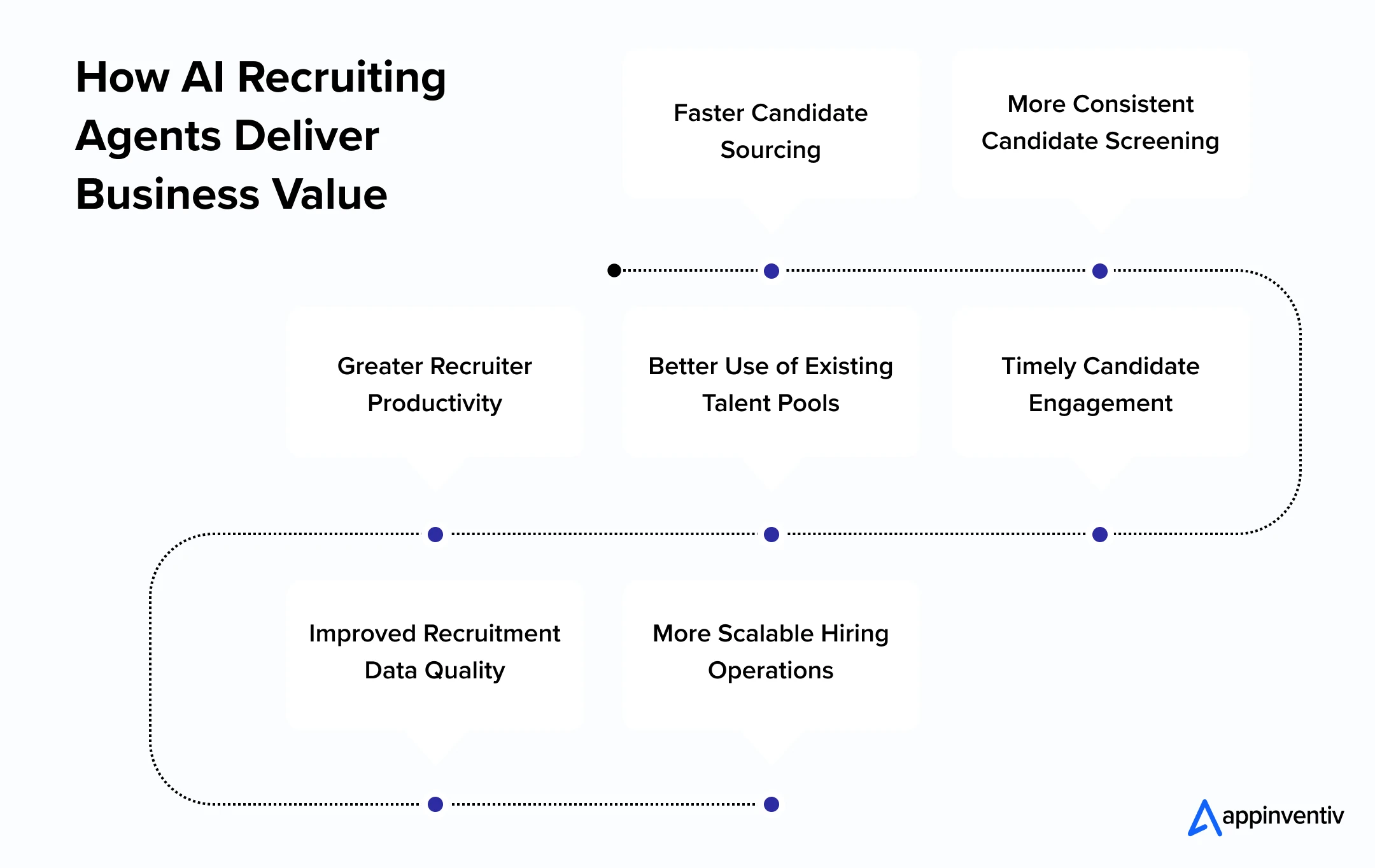
Recruiters often repeat similar searches across job boards, professional networks, and internal databases. AI agents can continuously search approved sources, remove duplicate profiles, and identify suitable candidates based on predefined requirements.
This helps recruiters build relevant talent pools without restarting the sourcing process for every position.
More Consistent Candidate Screening
Manual screening can vary based on workload, interpretation, and recruiter experience. An AI candidate screening agent can evaluate profiles against an approved rubric and organize the supporting evidence.
Recruiters can then review the candidate’s qualifications, missing information, and potential fit without reading every profile from scratch.
Timely Candidate Engagement
Delayed communication frequently causes qualified candidates to lose interest or accept another offer. AI agents can send application updates, manage follow-ups, answer routine questions, and coordinate interview schedules.
This consistent communication reduces candidate drop-off while creating a more responsive hiring experience.
Better Use of Existing Talent Pools
Many enterprises already have thousands of previous applicants and passive candidates stored in their ATS or CRM. However, recruiters rarely have enough time to search these records whenever a new position opens.
AI agents can revisit approved candidate databases, match existing profiles with new openings, and confirm whether candidates remain interested.
Greater Recruiter Productivity
Talent acquisition automation reduces time spent on repetitive searches, record updates, scheduling, and follow-ups. Recruiters can use the recovered time for interviews, hiring-manager discussions, candidate assessment, and offer closure.
The benefit is not limited to saving hours. It allows the same recruiting team to support more requisitions without proportionally increasing headcount.
Improved Recruitment Data Quality
Incomplete profiles, duplicate records, inconsistent skill labels, and outdated candidate stages weaken recruitment reporting. AI agents can identify these issues and update permitted fields using validated information.
Cleaner ATS and CRM data helps enterprises measure sourcing performance, candidate movement, recruiter capacity, and hiring outcomes more accurately.
More Scalable Hiring Operations
Recruitment volumes can rise quickly during business expansion, seasonal hiring, or entry into new markets. Adding recruiters for every temporary increase is rarely practical.
AI agents help enterprises manage higher volumes by running repeatable workflows continuously. Human involvement can then remain focused on exceptions, sensitive conversations, and final hiring decisions.
The purpose of using AI agents is not simply to accelerate recruitment. It is to build a scalable hiring function that combines automation with meaningful human judgment.
AI Recruiting Agent vs Traditional ATS and AI Recruiting Software
The AI recruiting agent vs ATS comparison is not a choice between two substitutes. An ATS remains the system of record. It stores applications, candidate stages, interview feedback, compliance data, and requisition history. Traditional AI recruiting software may add matching, resume parsing, chat, or predictive scoring to a specific part of that system. An agent works across these tools to advance an approved goal and decide which permitted action comes next.
| Area | Applicant Tracking System | AI Recruiting Agent |
|---|---|---|
| Primary role | Records and manages the hiring process | Pursues a defined recruiting goal |
| Interaction | Depends mainly on user actions and fixed workflows | Selects the next permitted action from context |
| Data coverage | Mostly application and requisition records | Can use approved ATS, CRM, job-board, assessment, and communication data |
| Search | Uses filters, Boolean queries, and stored criteria | Can translate role requirements into contextual and iterative searches |
| Screening | Applies configured rules or ranking features | Collects evidence, explains matches, identifies gaps, and escalates uncertainty |
| Engagement | Sends templates and scheduled messages | Can personalize, respond from approved knowledge, and adapt follow-up timing |
| Decision authority | Stores decisions made in the process | Should operate within thresholds and preserve human approval for material decisions |
| Best use | Governance and process administration | Cross-system workflow execution and coordination |
An enterprise therefore does not usually replace its ATS with an AI recruitment agent. It adds an agentic layer that reads from and writes to the ATS under role-based permissions. This protects the system of record while making the surrounding workflow more responsive.
Where AI Agents Fit Across the Recruiting Lifecycle
An agent can support almost every recruiting stage, but not every stage should receive the same autonomy. Administrative work can often be automated. Decisions with legal, ethical, or material consequences require closer review.
| Recruiting Stage | Agent Action | Recommended Human Control |
|---|---|---|
| Workforce demand | Summarize recurring skill and capacity gaps | Business leader approves the hiring need |
| Job design | Draft role descriptions from approved competency data | Recruiter and hiring manager validate criteria |
| Sourcing | Search permitted channels and refresh talent pools | Recruiter approves strategy and outreach pool |
| Screening | Compare evidence with stated requirements | Recruiter reviews shortlist and adverse outcomes |
| Engagement | Send approved messages and answer routine questions | Recruiter handles negotiation and sensitive topics |
| Scheduling | Find availability and coordinate calendars | Participants manage exceptions |
| Interview support | Create structured guides and summarize feedback | Interviewers score and decide independently |
| Offer coordination | Collect approvals and generate approved documents | HR and hiring manager approve the offer |
| Reporting | Track funnel health, delay, and conversion | TA leader interprets business implications |
This tiered model prevents a common mistake: treating all recruiting actions as equally low risk.
How an AI Recruiting Agent Actually Runs Sourcing and Screening
Traditional sourcing starts with a requisition and a manual search. Recruiters translate requirements into keywords, open profiles one by one, maintain lists, check the ATS for duplicates, and send outreach. The process works, but it does not scale well across many specialist roles.
AI agents for recruiting can automate candidate sourcing by maintaining the search as a continuous workflow rather than a one-time query. It then carries the approved sourcing output into structured, evidence-led screening.
How the Agent Runs Candidate Sourcing
1. Convert the Requisition Into a Search Brief
The agent first separates mandatory requirements from preferences. It can structure skills, proficiency, experience, certification, location, work authorization, compensation, availability, and industry exposure. It should also identify ambiguous criteria and ask the recruiter to clarify them.
This step matters because weak job descriptions create weak searches. Terms such as “rock star,” “culture fit,” or “top-tier background” offer little job-related evidence and may introduce unnecessary bias. The sourcing brief should use observable and defensible requirements.
2. Search Across Approved Talent Sources
The sourcing agent can query internal talent communities, previous applicants, employee referrals, recruiting databases, and licensed external platforms. Semantic matching helps it identify profiles that express the same capability in different languages.
For example, a candidate may not use the exact phrase “cloud cost optimization.” Their profile may still show FinOps, cloud resource governance, reserved-instance planning, and unit-cost reporting. A contextual search can connect that evidence without relaxing a mandatory requirement.
3. Enrich and Deduplicate Candidate Records
Candidate data is often incomplete or repeated across systems. The agent can merge permitted records, flag conflicts, standardize skills, and identify stale details. It should retain source attribution and avoid filling gaps with assumptions.
Data enrichment must respect platform terms, privacy notices, retention policies, and regional law. Public availability does not automatically make every data point appropriate for a hiring decision.
4. Build Explainable Talent Pools
Rather than producing an unexplained match score, the agent should show why each profile entered the pool. Evidence may include a certification, relevant project, years of role-specific work, language ability, or location match. Missing and uncertain details should remain visible.
Explainability helps recruiters challenge the output. It also makes it easier to audit whether the search favored proxies that were unrelated to job performance.
5. Refresh the Search as Conditions Change
Recruiting conditions rarely remain static. The hiring manager may change the location, accept an adjacent skill, revise compensation, or fill part of the headcount. The agent can rerun the search, update the pool, and show what changed.
This persistent activity is where AI agents for recruiting provide more value than isolated search assistance. They can keep working toward the hiring goal without forcing the recruiter to rebuild the process each time.
How the Agent Runs Candidate Screening
Screening is one of the most sensitive stages of recruiting. It affects who gets access to an opportunity. It is also vulnerable to poor data, weak criteria, historical bias, and false precision.
An AI candidate screening agent should therefore organize job-related evidence, not make an unreviewable final decision.
Structure Candidate Information
Resumes differ widely in format and language. The agent can extract skills, roles, project outcomes, qualifications, and employment dates into a consistent schema. It can also distinguish explicit evidence from inferred information.
If a certification is mandatory and the resume does not show it, the correct result may be “not confirmed,” not “unqualified.” The agent can request the missing detail or route the profile for review.
Apply an Approved Evaluation Rubric
Before screening starts, recruiters and hiring managers should agree on the rubric. Each criterion needs a definition, evidence source, weight, exclusion rule, and review process. Protected characteristics and unjustified proxies must not enter the assessment.
The agent can then compare candidates against the same published requirements. Consistency can reduce arbitrary variation, but only if the underlying rubric is fair and job-related.
Produce Evidence-Based Summaries
A useful screening summary answers four questions:
- Which mandatory requirements are supported by evidence?
- Which preferred capabilities are present?
- What information is missing or contradictory?
- Why does the agent recommend review, progression, or clarification?
Recruiters should be able to open the source record behind every material claim. A polished summary without traceable evidence can make an error appear more credible.
Handle Exceptions and Low-Confidence Cases
Nonlinear careers, transferable skills, accessibility needs, career breaks, international qualifications, and unusual job titles can confuse automated systems. Confidence thresholds should send these cases to people rather than pushing the agent toward a forced classification.
The U.S. Equal Employment Opportunity Commission warns that algorithmic tools can unlawfully screen out people with disabilities when safeguards or reasonable accommodations are missing. Its guidance on AI and the Americans with Disabilities Act makes human review and accommodation paths essential parts of the design.
Monitor Selection Outcomes
Teams should test results before deployment and continue monitoring them after launch. Useful checks include selection-rate differences, false negatives, overrides, error patterns, source quality, and outcomes across relevant groups where legally permitted.
An agent that performs well during a pilot may drift as job requirements, labor markets, data sources, or model behavior change. Screening governance is an ongoing operating process, not a launch checklist.
How AI Agents Improve Candidate Engagement
Candidates judge an employer throughout the process. A delayed update, repetitive request, or generic message can undo the value of a strong employer brand. Yet recruiters cannot personally respond to every routine question at every hour.
AI candidate engagement agents can keep communication active while reserving human attention for moments that need judgment or empathy.
Personalize Outreach With Real Context
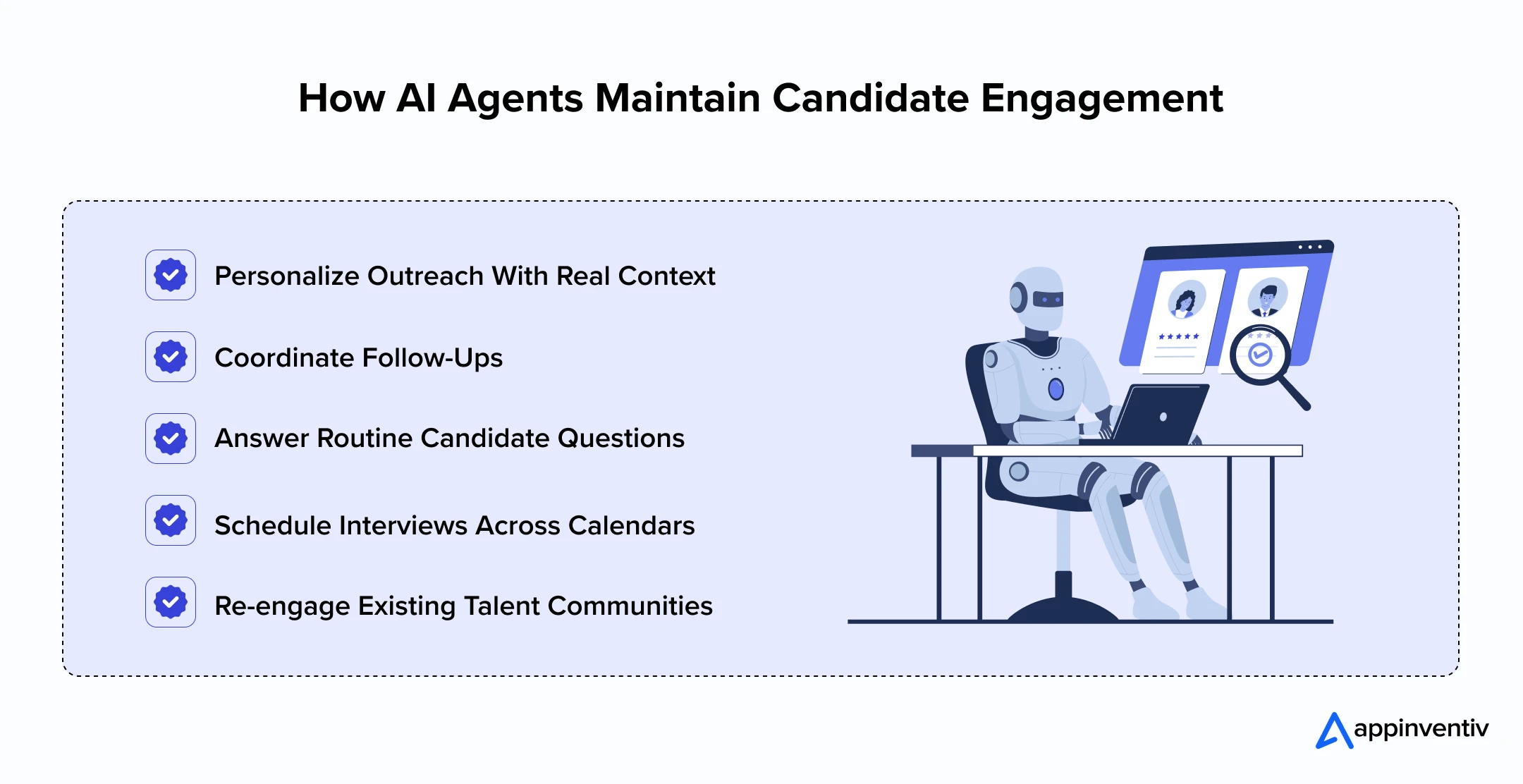
The agent can draft outreach based on a candidate’s relevant experience, the role, location, and stated preferences. It should reference only permitted facts and avoid pretending that a recruiter personally reviewed details they did not see.
The objective is relevance, not artificial intimacy. Two specific sentences tied to the role usually work better than a long message filled with generic praise.
Coordinate Follow-Ups
Agents can monitor responses and send follow-ups at approved intervals. They can stop outreach after an opt-out, detect when a candidate has already replied through another channel, and alert a recruiter when interest or concern requires attention.
This prevents duplicate messages and the awkward experience of receiving an automated reminder after completing the requested action.
Answer Routine Candidate Questions
Connected to an approved knowledge base, an agent can answer questions about the process, interview format, workplace location, benefits, documentation, accessibility, or application status. High-impact subjects such as compensation exceptions, immigration advice, complaints, and offer negotiation should move to an employee.
Answers should disclose that the candidate is interacting with an automated assistant when required or appropriate. The conversation should also include a clear route to a person.
Schedule Interviews Across Calendars
Scheduling agents can find interviewer availability, apply time-zone and panel rules, send invitations, manage rescheduling, and update the ATS. They can also remind interviewers to submit feedback without exposing one interviewer’s assessment to another before completion.
Re-engage Existing Talent Communities
Many organizations repeatedly buy access to external candidate databases while strong previous applicants sit unused in the CRM. An AI agent for hiring can revisit consented talent pools when a relevant role opens, confirm interest, and update preferences.
Re-engagement must respect retention periods and candidate consent. Records should not remain actionable indefinitely simply because storage is inexpensive.
Where AI Recruiting Agents Fit by Hiring Volume and Type
The right role for an agent depends on hiring volume, process stability, talent scarcity, and decision complexity. High-volume recruitment benefits from coordination at scale. Specialist hiring benefits more from deeper search and evidence mapping. The following use cases show where AI agents for recruiting are most practical.
| Hiring Environment | Best Agent Role | Suitable Autonomy | Main Outcome |
|---|---|---|---|
| High-volume, repeatable hiring | Eligibility checks, updates, scheduling, and reminders | High for administrative actions; reviewed screening | Faster movement with fewer candidate drop-offs |
| Moderate-volume professional hiring | Sourcing, profile summaries, outreach, and coordination | Moderate with shortlist approval | More recruiter capacity and consistent follow-up |
| Low-volume specialist hiring | Talent mapping, adjacent-skill discovery, and research | Low to moderate with close recruiter review | Broader access to scarce talent |
| Executive or highly sensitive hiring | Market intelligence and confidential coordination | Low; human-led decisions and engagement | Better research without weakening discretion |
| Campus or seasonal campaigns | FAQs, application checks, assessments, and scheduling | High for routine workflows; controlled progression | Consistent candidate handling at peak volume |
| Internal mobility | Skills matching, opportunity alerts, and profile refresh | Moderate with employee control and manager review | Greater visibility of existing workforce skills |
High-Volume Frontline Hiring
For retail, logistics, hospitality, and customer operations, agents can check basic eligibility, location, shift preference, and availability. They can answer role questions and coordinate interview slots at scale. Recruiters handle accommodations, exceptions, and final selection.
Specialist Technology Recruitment
Agents can map adjacent technical skills, search internal and external talent pools, and summarize project evidence. This is valuable when job titles vary widely and keyword matching misses capable candidates.
Internal Mobility
An agent can match employees with openings, projects, mentors, or development paths using permitted skills data. Employees should be able to correct their profiles and understand why an opportunity was recommended.
Campus and Graduate Recruitment
Recruiting teams can use agents to answer recurring questions, manage event leads, verify application completion, schedule assessments, and maintain timely updates. Screening should avoid criteria that unfairly disadvantage candidates with limited access to conventional experience.
Healthcare Recruitment
Agents can check whether required licenses or certifications are documented, identify regional eligibility, and coordinate multi-stage credentialing. Verification should rely on authoritative systems, and a professional should review conflicts.
Recruitment Process Outsourcing
RPO providers can configure agents for different clients, role families, service-level agreements, and communication rules. Strong tenant separation is essential so one client’s candidate information, prompts, or hiring logic never enters another client’s workflow.
A Reference Architecture for AI Recruiting Agents
An enterprise deployment generally needs more than a model connected to the ATS. It requires a controlled architecture in which data, tools, policies, and human approvals work together.
| Architecture Layer | Purpose |
|---|---|
| Experience layer | Recruiter workspace, candidate chatbot, email, SMS, and career-site interfaces |
| Agent orchestration | Breaks goals into tasks, selects tools, tracks state, and manages handoffs |
| Knowledge layer | Stores job frameworks, policies, FAQs, templates, and approved recruitment guidance |
| Integration layer | Connects ATS, CRM, HRIS, job boards, calendars, assessments, and identity services |
| Intelligence layer | Supports language understanding, semantic search, matching, summarization, and classification |
| Governance layer | Enforces access, consent, approvals, audit logs, testing, retention, and monitoring |
| Analytics layer | Measures funnel outcomes, quality, time, cost, exceptions, and agent performance |
The agent should access only the tools and records needed for its role. A scheduling agent does not need authority to change a candidate’s screening result. A sourcing agent does not need access to employee medical or payroll data.
How to Implement AI Recruiting Agents Step by Step
Implementing AI recruiting agents requires a controlled approach that connects technology with existing hiring processes. Enterprises should begin with a focused use case, define human approval points, prepare recruitment data, and test the agent before wider deployment. The following steps can help move the solution from initial planning to production without compromising hiring quality, security, or compliance.
Step 1: Select a Narrow, Measurable Workflow
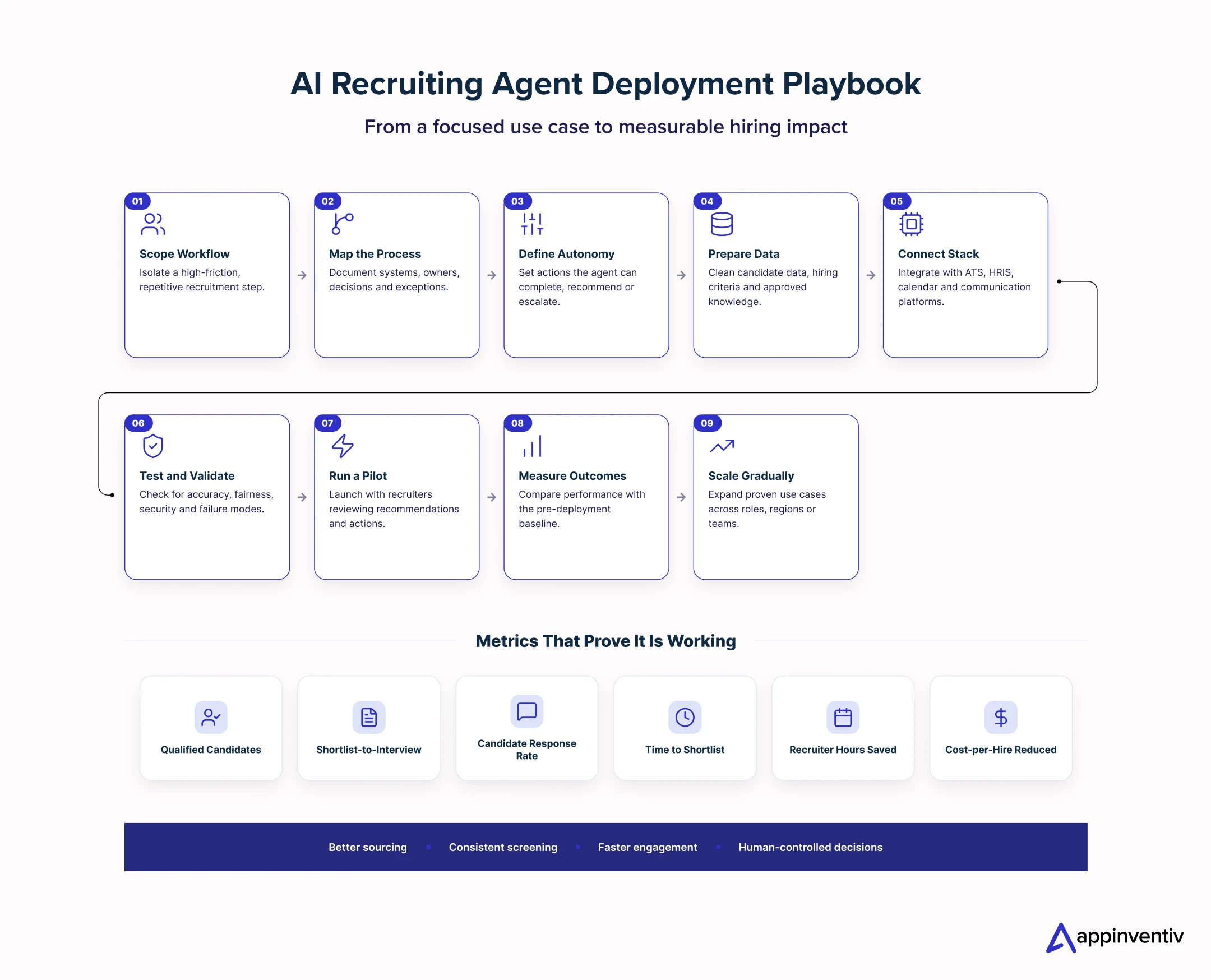
Start with a role family that has sufficient volume, stable criteria, and visible operational friction. Interview scheduling, talent-pool rediscovery, application completion, or recruiter-assisted screening can make useful pilots.
Avoid beginning with fully automated rejection. It combines high consequence with difficult governance and can damage candidate trust before the organization has learned how the system behaves.
Step 2: Map the Current Process
Document each task, system, owner, wait state, exception, decision, and handoff. Baseline time to shortlist, recruiter hours, response time, conversion, candidate drop-off, and quality indicators.
Without a baseline, the team may celebrate activity rather than improvement.
Step 3: Define Autonomy Boundaries
Classify actions into three groups:
- Autonomous: Low-risk, reversible actions such as deduplication or interview reminders
- Approval required: Outreach lists, screening recommendations, or sensitive responses
- Human only: Final hiring decisions, accommodation judgments, negotiations, and complex complaints
Set confidence thresholds, escalation reasons, retry limits, and stop conditions. An autonomous hiring agent still requires boundaries; autonomy should describe its workflow capacity, not unlimited authority.
Step 4: Prepare Data and Knowledge
Review job descriptions, competency models, disposition codes, candidate records, templates, and FAQs. Remove obsolete fields, duplicate rules, and criteria without a clear relationship to the work.
Give the agent approved knowledge through retrieval rather than relying on a general model to invent an answer. Every policy response should trace back to a current source.
Step 5: Integrate the Recruiting Stack
Use APIs and event-driven connections where possible. Define which system owns each field and how conflicts are resolved. Protect ATS integrity with validation, scoped service identities, rate limits, and rollback mechanisms.
The AI recruitment automation agent should not create a second, disconnected candidate record. It should advance the governed process already used by recruiters.
Step 6: Test Quality, Safety, and Fairness
Test normal cases, rare profiles, incomplete data, conflicting records, multilingual resumes, accessibility scenarios, malicious instructions, and integration failures. Compare agent output with structured human review.
Red-team the workflow for prompt injection. A resume or external webpage may contain text designed to manipulate a model. Untrusted candidate content must be treated as data, not as instructions to the agent.
Step 7: Run a Recruiter-in-the-Loop Pilot
During the pilot, show recruiters the agent’s evidence, confidence, and proposed action. Capture approvals, edits, rejections, and reasons. This produces better evaluation data than asking whether users “liked” the tool.
Tell candidates how automation is used where required, and provide an accessible path to human assistance.
Step 8: Measure Business and Candidate Outcomes
Compare the pilot with the baseline. Look beyond time saved. A faster shortlist has little value if hiring managers reject most profiles or qualified applicants abandon the process.
Step 9: Expand by Capability
Once one workflow is reliable, reuse governed components such as identity, audit logging, integration connectors, knowledge retrieval, and approval services. Expand to another role family or adjacent recruiting task without copying every local exception into the core platform.
Explore our AI agent development services to build secure, integrated, and enterprise-ready recruitment solutions.
Metrics That Show Whether Recruiting Agents Are Working
The performance of recruiting agents should be measured across the entire hiring funnel. Enterprises must assess whether the agents improve sourcing quality, screening consistency, candidate responsiveness, recruiter productivity, and hiring outcomes. Comparing these metrics with pre-deployment benchmarks helps determine whether the investment is delivering measurable business value.
| Outcome Area | Metrics to Track |
|---|---|
| Sourcing | Qualified profiles per search, source yield, rediscovered candidates, outreach acceptance |
| Screening | Recruiter agreement, false-negative review, shortlist-to-interview rate, override rate |
| Engagement | Response time, response rate, opt-out rate, application completion, candidate drop-off |
| Speed | Time to source, time to shortlist, time to schedule, time to fill |
| Quality | Hiring-manager acceptance, interview-to-offer rate, quality of hire, early retention |
| Efficiency | Recruiter hours saved, cost per screened candidate, cost per hire, requisitions handled |
| Governance | Escalations, unsupported claims, access violations, bias indicators, audit completeness |
Quality of hire should not be reduced to one number. Combine job performance, retention, hiring-manager feedback, and role-specific outcomes over a defined period. Compare like-for-like roles and account for labor-market changes.
Common Failure Points in Agent-Led Recruiting and How to Prevent Them
Agent-led recruiting can fail even when the underlying model appears capable. The most common breakdowns occur when the agent follows unclear hiring criteria, acts on unreliable data, receives excessive system permissions, or optimizes speed without checking candidate outcomes. These failures are workflow problems as much as model problems.
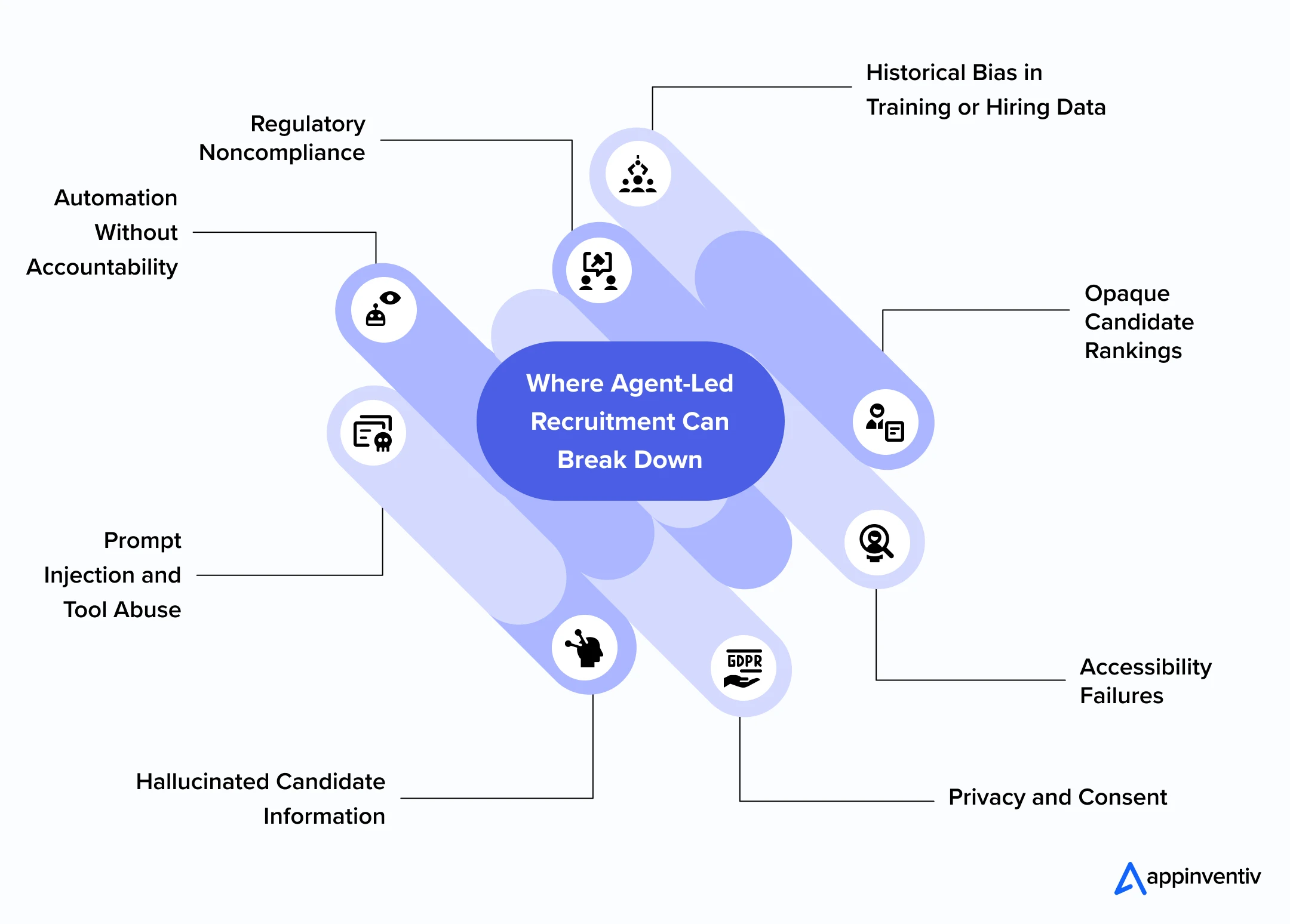
Historical Bias in Training or Hiring Data
Past hiring decisions can reflect unequal access or subjective preferences. Training an agent to imitate them may scale the same pattern. Use job-related criteria, representative testing, outcome monitoring, and independent review.
Also Read: AI Bias in Business: How Enterprises Detect and Reduce Bias in AI Models
Opaque Candidate Rankings
A single score can hide uncertain data and weak assumptions. Require evidence by criterion, show missing information, and let recruiters challenge the output.
Accessibility Failures
Timed assessments, speech analysis, video tools, and chatbot-only processes can disadvantage candidates with disabilities. Offer reasonable accommodations and an alternative channel. The EEOC specifically advises employers to maintain accommodation processes when algorithmic tools are used.
Privacy and Consent
Agents can combine data more easily than traditional tools, increasing privacy risk. Limit collection, define the lawful purpose, enforce retention, record consent where needed, and give candidates appropriate access or correction routes.
Hallucinated Candidate Information
A model may turn an inference into a fact. Require citations to source records, prohibit unsupported enrichment, and label unverified details. Never allow generated content to silently overwrite authoritative data.
Prompt Injection and Tool Abuse
Candidate documents and external profiles are untrusted inputs. Separate instructions from content, restrict tool permissions, sanitize retrieved text, validate outputs, and require approval for consequential actions.
Automation Without Accountability
Vendor responsibility does not remove employer responsibility. Name business, HR, legal, privacy, security, and technical owners. Keep logs showing what the agent did, why it acted, and who approved the outcome.
Regulatory Noncompliance
Requirements differ by location and use case. New York City’s Automated Employment Decision Tools rules, for example, require specified tools to undergo a recent bias audit, make audit information public, and provide notices before use. Enterprises should map every deployment to the jurisdictions of the employer, job, and candidate instead of adopting one global assumption.
How to Govern AI Recruiting Agents Without Losing Human Control
AI recruiting agents handle personal data and influence employment opportunities. This makes governance a core part of implementation rather than a final compliance exercise. Enterprises must define what the agent can access, which actions it can perform, and when a recruiter must intervene.
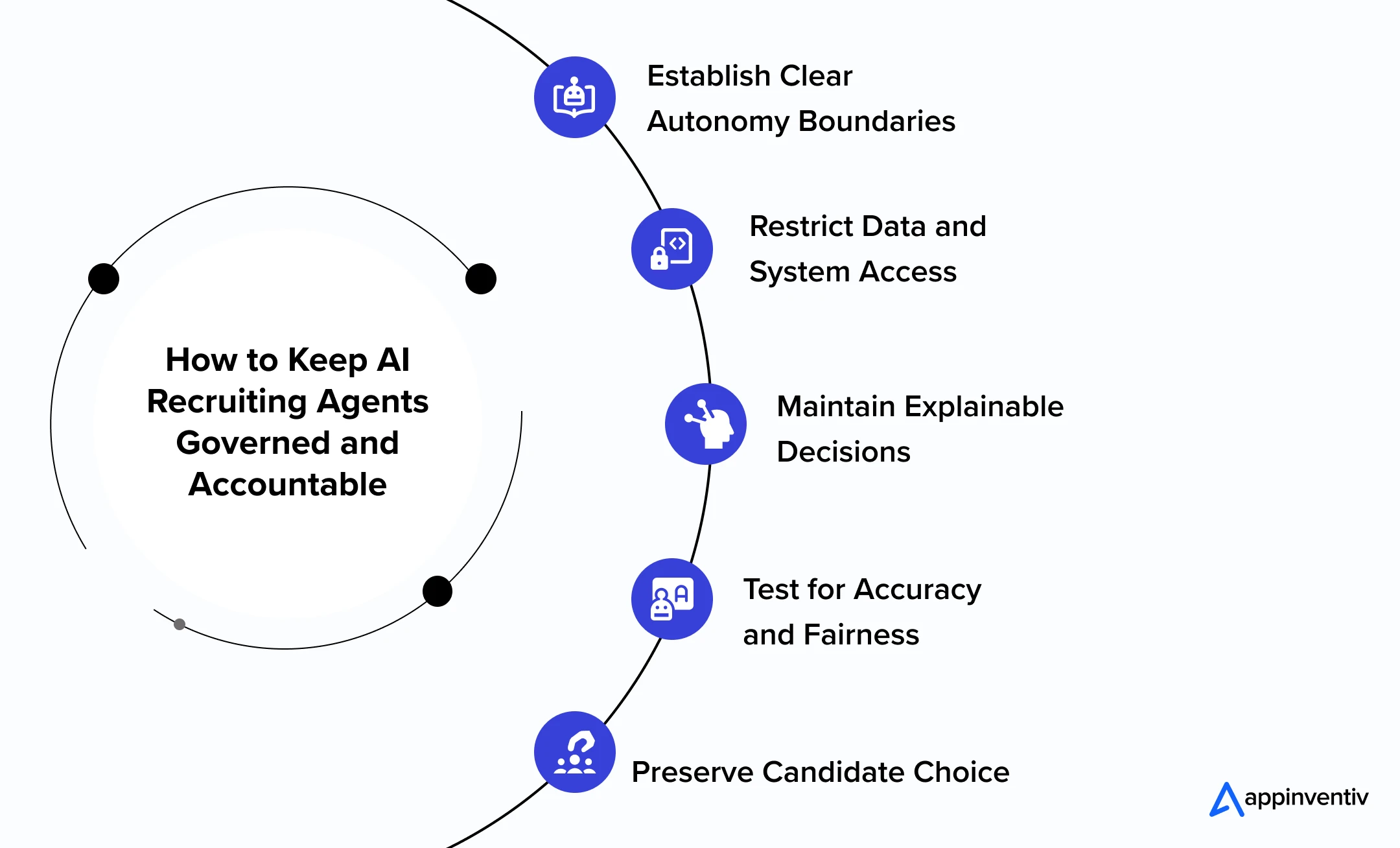
Establish Clear Autonomy Boundaries
Not every recruitment task should receive the same level of automation. Low-risk administrative activities can run independently, while screening recommendations and candidate decisions require closer supervision.
| Level | Suitable Activities | Required Control |
|---|---|---|
| Autonomous | Record deduplication, reminders, status updates, and scheduling | Workflow monitoring and audit logs |
| Approval-based | Candidate outreach, shortlist creation, and screening recommendations | Recruiter approval before execution |
| Human-led | Rejections, accommodations, negotiations, and final hiring decisions | Direct ownership by authorized employees |
Restrict Data and System Access
Each agent should access only the information required for its assigned task. A scheduling agent may need candidate availability and interviewer calendars, but it does not need compensation history or assessment scores.
Role-based permissions, service identities, encryption, and retention rules help prevent unnecessary exposure of candidate information.
Maintain Explainable Decisions
Recruiters should understand why the agent recommended, flagged, or escalated a candidate. Every material output must link back to job-related evidence rather than an unexplained score.
Missing details should remain marked as unverified. The agent must not convert assumptions into candidate facts.
Test for Accuracy and Fairness
Enterprises should test agent outcomes across different candidate groups, career paths, resume formats, languages, and accessibility scenarios. Monitoring should continue after deployment because candidate data, hiring requirements, and models can change.
Recruiter overrides, false negatives, selection-rate differences, and recurring errors can reveal where the workflow needs correction.
Preserve Candidate Choice
Candidates should know when automation materially influences the hiring process where disclosure is required. They must also have a clear way to request human assistance, correct their information, withdraw consent, or seek reasonable accommodation.
Before production deployment, enterprises should confirm:
- The agent has a defined hiring objective
- All screening criteria are job-related
- Data access follows least-privilege principles
- High-impact actions require human approval
- Recommendations include supporting evidence
- Candidates can request human review
- Bias and accuracy testing occurs regularly
- Every agent action is recorded
- Incident owners and shutdown procedures are defined
- Candidate data follows approved retention periods
Governance must exist inside the workflow. A written policy cannot control an agent with excessive permissions, unreliable data, or no meaningful human oversight.
Why Enterprises Need Custom-Built AI Recruiting Agents
Off-the-shelf agents work for standardized activities such as scheduling, FAQs, and basic outreach. Enterprise recruitment, however, involves unique workflows, approval structures, integrations, hiring criteria, and regional regulations. Custom-built AI agents for recruiting can accommodate these requirements without forcing teams to change established processes.
| Area | Off-the-Shelf Agent | Custom-Built Agent |
|---|---|---|
| Workflows | Standardized | Aligned with enterprise processes |
| Integrations | Limited connectors | Connects existing ATS, CRM, HRIS, and job platforms |
| Screening | Vendor-defined logic | Uses approved hiring criteria |
| Governance | Standard controls | Custom permissions, approvals, and audit rules |
| Scalability | Product-dependent | Expands across roles, regions, and hiring volumes |
| Ownership | Vendor-dependent | Greater control over data and future development |
Why Custom Development Works Better
A custom AI recruitment automation agent can:
- Follow business-specific hiring workflows
- Apply approved competency frameworks
- Connect fragmented recruitment systems
- Maintain role-based access controls
- Escalate sensitive decisions to recruiters
- Adapt to changing regulations and hiring needs
Enterprises can also retain their existing ATS and recruitment platforms. The custom agent acts as an orchestration layer that coordinates sourcing, screening, engagement, and scheduling across them.
For complex, high-volume, or regulated hiring, custom development provides the control and flexibility required to scale recruitment automation safely.
Build an AI recruitment agent that sources relevant talent, supports consistent screening, and keeps recruiters in control.
How Much Do AI Recruiting Agents Cost and What ROI Can Enterprises Expect?
The cost of implementing AI recruiting agents typically ranges from $40,000 to $500,000. A focused agent for scheduling, candidate FAQs, or outreach falls toward the lower end. An enterprise-grade system supporting sourcing, screening, engagement, multiple integrations, and regional compliance requires a higher investment.
Major Cost Components
| Cost Area | What It Covers |
|---|---|
| Discovery and planning | Process assessment, use-case selection, requirements, and implementation roadmap |
| Data preparation | Candidate-data cleanup, job taxonomy, competency frameworks, and knowledge-base development |
| Agent development | Workflow orchestration, reasoning logic, prompts, memory, and approval controls |
| System integration | ATS, CRM, HRIS, job boards, assessments, communication tools, and calendars |
| Security and compliance | Access controls, encryption, bias testing, privacy reviews, and audit mechanisms |
| Infrastructure | Model usage, cloud services, databases, messaging, and monitoring tools |
| Maintenance | Performance evaluation, model updates, workflow changes, and production support |
Usage-based expenses continue after deployment. These may include model calls, candidate messages, sourcing-platform access, cloud resources, and observability services.
Where the Financial Returns Come From
The ROI of an AI agent for hiring comes from measurable improvements across recruiter productivity, hiring speed, sourcing costs, and candidate conversion.
Enterprises can quantify:
- Recruiter hours redirected toward higher-value activities
- Lower agency and external sourcing expenditure
- Reduced time to source, shortlist, schedule, and hire
- Higher candidate response and completion rates
- Increased reuse of existing talent pools
- Lower interview coordination costs
- More requisitions managed without proportional team growth
- Lower costs associated with long-standing vacancies
A simple starting formula is:
Annual ROI = (Annual quantified benefits − Annual agent costs) ÷ Annual agent costs × 100
Enterprises should not treat every automated action as a financial saving. Recovered time creates value only when it increases recruiting capacity, avoids expenditure, shortens vacancies, or improves hiring outcomes.
How AI Recruiting Agents Will Reshape Enterprise Talent Acquisition
The next phase of talent acquisition automation will move beyond individual recruiting tools. Enterprises will use connected agents that coordinate workforce planning, sourcing, screening, engagement, scheduling, and recruitment analytics.
Specialized Agents Will Work Together
Instead of assigning the entire hiring process to one large system, enterprises may use agents with narrow responsibilities. A sourcing agent can discover candidates, a screening agent can organize evidence, and an engagement agent can manage communication.
A governing orchestration layer will control data access, approvals, handoffs, and audit records across the agent network.
Skills Will Matter More Than Job Titles
Job titles vary across industries, countries, and organizations. Future recruiting agents will increasingly evaluate verified capabilities, project experience, and adjacent skills rather than relying only on exact keywords.
This can help employers find candidates whose experience matches the work even when their previous title does not match the vacancy.
Internal and External Talent Data Will Converge
Recruiting agents will connect external candidate discovery with internal mobility, workforce planning, and employee development. When a role opens, the system may identify an existing employee, previous applicant, contractor, or external candidate using one governed skills framework.
This will position recruitment as part of a wider talent intelligence ecosystem.
Candidate Journeys Will Become More Responsive
Agents will maintain communication across time zones, answer approved questions, arrange interviews, and prevent candidates from remaining in inactive stages. Recruiters will take over when the conversation requires judgment, persuasion, negotiation, or empathy.
Human Oversight Will Become More Important
More capable agents will not remove the need for people. They will make clearly defined human control more important.
The strongest recruiting systems will know when to act autonomously, when to request approval, and when to stop. Enterprises that establish these boundaries early will be better positioned to scale AI recruiting without weakening fairness, compliance, or candidate trust.
How Appinventiv Can Help Build AI Recruiting Agents
Deploying agents in recruitment requires more than adding a conversational interface to an ATS. The solution must work across fragmented systems, protect sensitive candidate data, explain its outputs, and remain controllable when requirements change.
Appinventiv helps enterprises identify high-value recruiting workflows, define the right autonomy boundaries, and build an implementation roadmap. Our teams can map existing sourcing, screening, scheduling, and engagement processes before converting them into measurable agent workflows.
As an AI agent development services provider, we design and develop agentic systems that connect with ATS, CRM, HRIS, calendars, job platforms, knowledge bases, and communication channels through secure integration layers. The architecture can include retrieval-grounded answers, role-based access, human approvals, audit logs, confidence thresholds, and continuous evaluation.
Our AI, product, cloud, data, and security specialists also help enterprises test accuracy, resilience, privacy, and operational performance before scaling. This gives talent teams an AI agent for hiring that fits their actual process rather than forcing them into a generic automation model.
Our expertise is also demonstrated through JobGet, an AI-powered recruitment platform we developed to connect blue-collar job seekers with employers. We integrated resume-like profiles, location-based matching, real-time messaging, meeting scheduling, and in-app video interviews, helping reduce the conventional hiring journey from months to weeks. The platform went on to secure $52 million in Series B funding, achieve 2 million+ downloads, and support 150,000+ successful job placements.
Whether the priority is to automate candidate sourcing, introduce recruiter-assisted screening, improve AI candidate engagement, or create an end-to-end agent ecosystem, we can help move the idea from pilot to production.
FAQs
Q. How can enterprises use AI recruiting agents across the hiring process?
A. Enterprises can use AI recruiting agents to coordinate repetitive activities across sourcing, screening, engagement, and interview scheduling. The agents can work across approved recruitment systems while escalating sensitive decisions and exceptions to hiring teams.
Common applications include:
- Searching internal and external talent pools
- Matching candidate skills with job requirements
- Preparing evidence-based candidate summaries
- Identifying missing application information
- Personalizing candidate outreach
- Answering routine candidate questions
- Coordinating interviews across calendars
- Updating candidate records and recruitment stages
Q. How is an AI recruitment agent different from an ATS?
A. An ATS primarily stores candidate information and manages movement through predefined recruitment stages. An AI recruitment agent can interpret a hiring objective, determine the next permitted action, and coordinate activities across the ATS, CRM, job boards, calendars, and communication systems.
The main differences include:
- An ATS serves as the recruitment system of record
- An agent executes approved cross-system workflows
- An ATS depends mainly on predefined rules and user actions
- An agent responds to context and changing workflow conditions
- An ATS stores candidate and requisition data
- An agent uses that data to recommend or complete the next step
- Material hiring decisions should still remain under human control
Q. What should enterprises consider before implementing an AI agent for hiring?
A. Enterprises should begin with a clearly defined recruitment problem rather than introducing automation across the complete hiring lifecycle. The selected workflow should have stable rules, sufficient volume, measurable delays, and clear human ownership.
Before deployment, the business should assess:
- Recruitment workflow and candidate-data quality
- ATS, CRM, HRIS, calendar, and job-board integrations
- Agent access permissions and autonomy limits
- Job-related screening criteria
- Human approval and escalation requirements
- Privacy, consent, and data-retention obligations
- Bias, accuracy, accessibility, and security testing
- Performance metrics and monitoring responsibilities
- Model updates and incident-management processes
Q. How can enterprises measure the ROI of AI recruiting agents?
A. Enterprises should compare agent performance with a documented pre-deployment baseline. The evaluation of AI agents for recruiting should measure whether automation increases recruiter capacity, improves candidate movement, reduces operating costs, and supports better hiring outcomes.
Businesses can track:
- Time to source, shortlist, schedule, and fill
- Recruiter hours saved per requisition
- Qualified candidates identified per search
- Outreach response and application completion rates
- Shortlist-to-interview and interview-to-offer conversion
- Candidate drop-off and opt-out rates
- Cost per screened candidate and cost per hire
- Hiring-manager acceptance and early retention
- Agent error, escalation, and recruiter override rates


Fast 2-minute response, fully NDA-protected.

AI Data Integration: How to Connect, Clean and Prepare Data for AI
Key takeaways: AI initiatives fail when fragmented, poor-quality data reaches models without sufficient context, controls or ownership. AI-ready pipelines must connect, clean, enrich, govern and continuously monitor data across its lifecycle. Real-time processing matters when AI decisions depend on current transactions, events, inventory or operational conditions. Data architecture should follow the AI use case, balancing…

AI Agent Governance: How to Govern Autonomous AI Across Business Systems
Key takeaways: AI agents require controls at the action, identity, data, tool, and workflow levels. Every enterprise agent should have a registered owner, an approved purpose, and a defined risk tier. Access must be based on the agent’s task rather than inherited from a human user or shared service account. High-impact actions need real-time policy…

'I.D.E.A.S.' - The Five Pillar Framework to Ace AI-Native Enterprise Apps in 2027
Key takeaways: AI-native enterprise apps are moving beyond AI agents toward intelligent, adaptive, autonomous and context-aware digital capabilities that can operate across mobile, web, voice, wearables and emerging interfaces. The I.D.E.A.S. framework for AI enterprise apps in 2027 - Interactive Intent, Decisioning Autonomously, Experiential System Design, Adaptive Execution, and Security Layered. Context intelligence and reusable…