































How to Build AI Infrastructure: Cost, Challenges, Compliance, and Everything Enterprises Get Wrong

 Share -


- 01What AI Infrastructure Actually Means at the Architecture Level
- 02Core Components of an Enterprise AI Infrastructure Stack
- 03The AI Infrastructure Development Process
- 04The Real Cost of Building AI Infrastructure
- 05Choosing a Deployment Model: Cloud, On-Prem, Hybrid, or Sovereign
- 06AI Infrastructure Challenges Enterprises Consistently Underestimate
- 07Compliance and Governance: The Layer Enterprises Build Last and Regret Building Last
- 08Why Enterprises Overspend, and Why Governance Maturity Doesn't Fully Protect Against It
- 09Choosing the Right AI Infrastructure for Your Business Size
- 10FAQs

Key takeaways:
- AI infrastructure success depends more on architecture, data, and governance than on the AI model itself.
- Production-ready AI requires compute, data pipelines, MLOps, networking, monitoring, and governance to work as one integrated stack.
- Choosing the right deployment model (cloud, on-prem, hybrid, or sovereign) directly impacts scalability, compliance, and long-term costs.
- Most enterprise AI cost overruns stem from infrastructure bottlenecks, integration complexity, and poor capacity planning, not GPU pricing alone.
- Embedding security, compliance, and observability from day one reduces deployment risks and eliminates costly rework later.
Worldwide AI spending is on track to hit $2.59 trillion in 2026, a 47% jump year over year, with AI infrastructure alone accounting for more than 45% of that total, according to Gartner. Most of that money is going into infrastructure decisions that will be hard to reverse for the next three to five years, and the failure pattern hasn’t really changed since 2024: the model performs beautifully in a controlled pilot, then stalls, slows down, or blows through budget the moment it hits real production traffic.
The model usually isn’t the problem. What’s underneath it is. Compute topology that wasn’t sized correctly. A data pipeline that can’t actually feed the GPUs at the rate they need. An orchestration layer nobody stress-tested. A compliance posture that exists on paper but wouldn’t survive a real audit.
Building AI infrastructure is a systems engineering problem long before it’s a data science one, and it deserves the rigor a bank would apply to a core platform migration. Capacity planning against real workload curves. An architecture that accounts for interconnect bandwidth, not just raw FLOPS on a spec sheet. Governance built into the stack from day one instead of bolted on after a regulator comes asking.
This guide is for enterprise technology leaders, AI teams, and budget owners who have already worked through an AI readiness guide and are now focused on building production-ready systems. It covers the architecture, cost mechanics, and compliance requirements that determine whether an AI system can scale successfully in real-world environments.
Appinventiv has delivered 300+ AI-powered solutions with prediction models built to 98% accuracy, helping enterprises reach production up to 10x faster than building alone.
What AI Infrastructure Actually Means at the Architecture Level
Artificial intelligence infrastructure is the full technical substrate that lets an organization train, fine-tune, serve, and govern AI systems reliably at scale. That’s compute and its interconnect fabric. Storage tiered for throughput and IOPS both. Networking built for collective communication patterns, not just point-to-point traffic. An orchestration and MLOps layer managing the model lifecycle end to end. Observability and governance wired in, not stapled on afterward because compliance asked for it in Q3.
In practice the architecture tends to settle into four layers, and most teams only really understand this after their first painful production incident. Together, these four layers make up the essential AI infrastructure components enterprises need in place before any model reaches production.
- At the bottom sits the infrastructure layer itself: GPU or accelerator clusters (NVIDIA H100/H200/GB200, AMD MI300X, or cloud-native TPUs), high-bandwidth interconnect (NVLink and NVSwitch inside a node, InfiniBand or RDMA over Converged Ethernet across nodes), and storage split between a hot tier for active training data, usually a parallel file system like Lustre or WekaFS, and a cold tier for archival datasets and checkpoints.
- Above that, the orchestration layer: Kubernetes with GPU-aware scheduling through the NVIDIA GPU Operator, or Slurm if you’re running HPC-style batch training. This handles resource allocation, job queuing, fault tolerance for training runs that go on for days, and the pipeline that promotes a model out of experimentation and into staging, then production.
- Then the MLOps layer: Experiment tracking through MLflow or Weights & Biases, model registries, feature stores that keep training and serving features consistent (a mismatch here is a surprisingly common source of production bugs), and CI/CD built for model artifacts rather than application code. For inference, this is also where serving frameworks like Triton or vLLM live, handling batching, quantization, multi-model serving.
- At the top, governance and observability: Drift detection. Latency and token-cost monitoring. Audit logging that records model version, input, output, and access identity for every single inference call. Policy enforcement that actually gates a deployment based on compliance status, rather than trusting a checklist someone filled out three months ago.
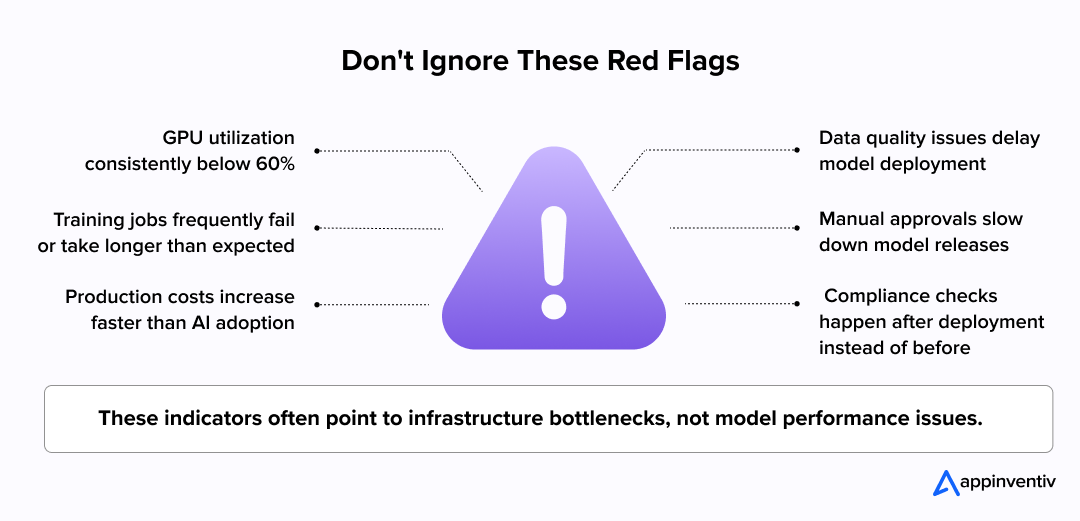
Here’s the thing most infrastructure failures come from: a mismatch between these layers, not a defect within any one of them. A team sizes a GPU cluster for training throughput and then finds the storage tier can’t sustain the read bandwidth needed to keep those GPUs fed, so six-figure accelerators sit half-idle waiting on I/O.
Or the orchestration layer handles containerized inference just fine but has no defined path to move a fine-tuned model out of a notebook and into that serving layer without someone doing it by hand at 11pm. That second one, more than anything, is where “pilot to production” timelines quietly die.
Core Components of an Enterprise AI Infrastructure Stack
Understanding the core AI infrastructure components is where most teams start, and where most of the hidden dependencies get missed. Getting AI ML infrastructure right starts with these six pieces working together, not sitting in isolation.
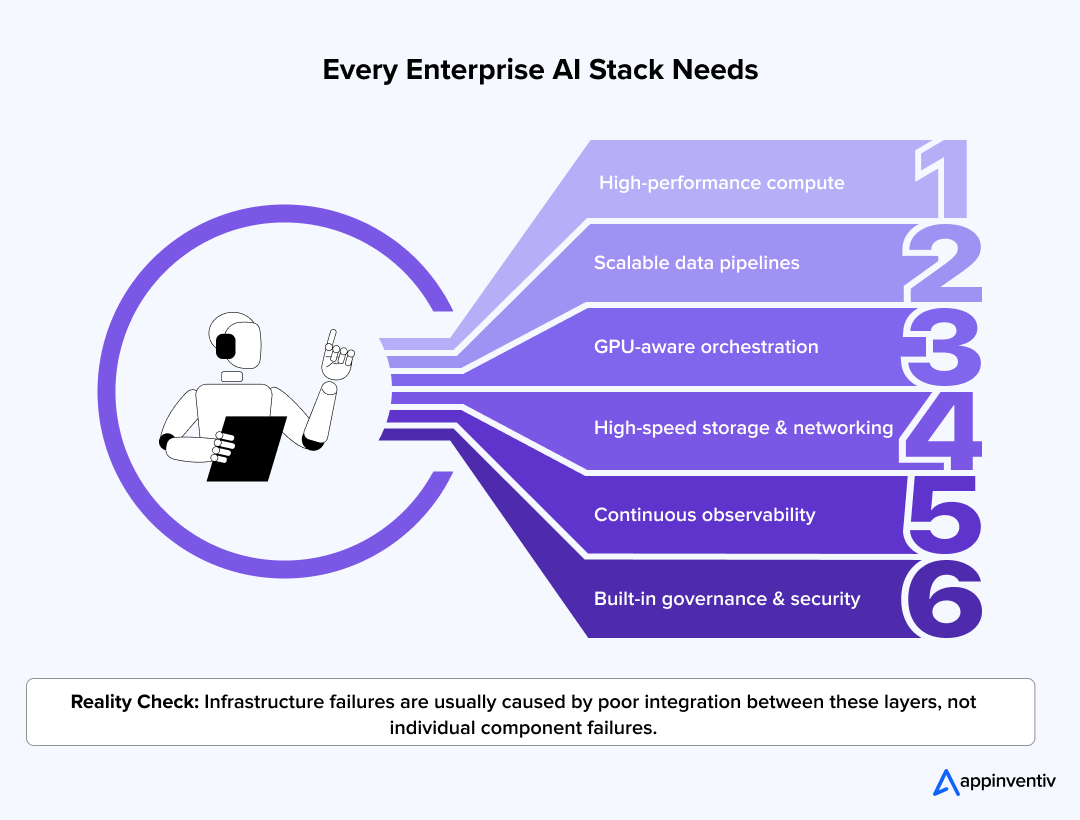
Compute
The GPU-versus-accelerator call depends entirely on the workload, which is really a question of choosing the right AI tech stack for what you’re actually running.
Training large models favors high-memory-bandwidth GPUs with strong NVLink interconnect for tensor and pipeline parallelism. Inference-heavy workloads, RAG accelerators especially, often get better economics from smaller instances with aggressive batching and INT8/FP8 quantization instead of reserving frontier-class GPUs for every request.
Data Pipelines
This is where most budgets get it wrong. Beyond basic ETL, the layer needs data versioning (DVC, or lakehouse-native versioning through Delta Lake or Iceberg), lineage tracking, and validation gates that catch schema drift before it wrecks a training job.
If there’s one place the AI infrastructure development process quietly falls behind, it’s here. Not the modeling.
Orchestration And MLOps Infrastructure
GPU-aware Kubernetes scheduling, autoscaling tied to queue depth instead of plain CPU or memory metrics, and a model registry that actually enforces approval gates before any version reaches a production endpoint.
This layer is also where AI infrastructure automation, autoscaling, automated retraining triggers, self-healing jobs, cuts down the manual overhead of running models at scale.
Storage And Networking
Parallel file systems for training throughput, object storage for checkpoints and datasets at rest, and network fabric sized for the all-reduce and all-gather operations distributed training leans on.
Undersized east-west bandwidth between nodes is one of the most common causes of poor GPU utilization, and one of the least visible too, since the dashboard just shows GPUs as “busy” without saying they’re waiting on I/O.
Monitoring And Observability
Needs to go beyond standard infrastructure metrics: embedding drift detection, output quality scoring, token-level cost tracking for LLM workloads, and latency percentiles tracked per model version rather than averaged across the fleet, because averages hide the version that’s quietly degrading.
Governance And Access Control
Role-based access scoped to model, dataset, and environment. Encryption at rest and in transit as a baseline, not a differentiator anyone should brag about. And audit logs that are actually queryable, since regulators and internal auditors need to reconstruct a decision after the fact, not just confirm a log file exists somewhere.
None of these sit in isolation. A generative AI infrastructure stack behind a customer-facing RAG application has different latency and throughput needs than one running batch fraud scoring overnight, and that should shape the architecture from the design phase, not just the model choice.
The AI Infrastructure Development Process
Here’s how to build AI infrastructure step by step, without skipping the parts that quietly cause budget overruns. Building AI infrastructure isn’t one procurement decision. It’s a sequence, closer to knowing how to build AI software end to end than to buying a rack of GPUs, and skipping steps in that sequence is where most budget overruns and slipped timelines actually come from.
- Readiness audit: Map current data maturity against what the workload actually needs, volume, update frequency, schema stability, existing pipeline throughput. Most teams discover this phase is 60 to 70% data engineering work. Not infrastructure shopping, whatever the original plan said.
- Architecture design: Size compute against workload type. Training-heavy needs high-bandwidth interconnect, inference-heavy needs horizontal scaling and aggressive caching. Storage tiering and orchestration get decided here too, and compliance requirements, data residency especially, need to shape network topology and region selection at this stage. Not after.
- Pilot deployment: Built against production-representative data volume and latency targets, not a curated demo dataset that makes everyone feel good in the steering committee meeting. Undersized storage throughput and network bottlenecks show up here, and they’re far cheaper to fix now than after a full rollout.
- Scaled production rollout: Autoscaling, monitoring, access control, and audit logging need to already be live before traffic ramps. Retrofitting governance onto a system already handling production requests is expensive and usually needs a service window nobody wants to schedule. This is the AI infrastructure deployment stage where governance and monitoring need to already be live, not added after traffic ramps.
- Continuous optimization: GPU utilization, cost per inference, model performance, all of it drifts as usage patterns shift. The organizations that stay ahead of this run a standing cost and architecture review, often quarterly, instead of treating the initial build as finished.
For most enterprises the whole sequence runs six to twelve months, start to stable production. Data pipeline maturity is usually what decides where in that range a given project actually lands.
Appinventiv’s team maps your readiness, architecture, and pilot phases upfront, so your AI infrastructure moves from assessment to production without costly rework along the way.
The Real Cost of Building AI Infrastructure
AI development cost is the number every finance leader wants first. Most organizations spend $40,000 to $400,000 on their first AI project, with ongoing monthly costs running $3,000 to $80,000 depending on scale. Lightweight API integrations can come in under $5,000. Complex builds involving custom model training, dedicated GPU clusters, and full MLOps tooling regularly cross $500,000, sometimes by a lot.
For enterprises running AI in production at real scale, the average infrastructure cost at roughly $2.4 million a year across compute, storage, networking, and platform licensing combined. That sits inside a much bigger figure: Gartner expects worldwide AI spending to hit $2.59 trillion in 2026, a 47% jump over 2025, with more than 45% of that going straight into infrastructure. Servers, chips, compute capacity.
The number that’s harder to plan around is the overrun. Mavvrik and BenchmarkIT found 80 to 85% of enterprises miss their AI infrastructure cost forecasts by more than 25%. A 2026 DoiT and Sapio Research survey found 79% of enterprises had AI cost overruns in the past year, and that includes organizations with mature FinOps practices already running. Squared Tech’s analysis puts total cost of ownership at two to three times the initial budget as the routine outcome. Not the exception.
Once you look closely, the drivers are pretty specific. Integration engineering, wiring AI systems into existing ERP, CRM, and data warehouse environments through custom authentication and API middleware, often eats 40 to 60% of total build cost on its own. GPU idle time from undersized storage or network throughput is a quieter one: an enterprise can be paying for peak GPU capacity while actually getting 40 to 50% utilization, because the pipeline simply can’t keep the accelerators fed fast enough. And token-based inference pricing adds a third variable that’s structurally harder to forecast than fixed compute, since usage tracks unpredictable user behavior rather than a provisioned baseline you can plan against.
AI Infrastructure Costs at a Glance
| Cost Category | Range / Figure | Notes |
|---|---|---|
| First AI project (typical) | $40,000 – $400,000 | Initial build cost |
| Ongoing monthly cost | $3,000 – $80,000 | Depending on scale |
| Lightweight API integration | Under $5,000 | Minimal build |
| Complex build (custom models, GPU clusters, MLOps) | $500,000+ | Often exceeds this |
| Enterprise production AI (annual) | ~$2.4 million | Compute, storage, networking, licensing combined |
| Global AI spending (2026 projection) | $2.59 trillion | 47% jump over 2025 (Gartner) |
| Share of spending going to infrastructure | 45%+ | Servers, chips, compute capacity |
| Enterprises missing cost forecasts by 25%+ | 80–85% | Mavvrik / BenchmarkIT |
| Enterprises with cost overruns (past year) | 79% | DoiT & Sapio Research, 2026 |
| Total cost of ownership vs. initial budget | 2–3x | Squared Tech, described as routine, not exceptional |
| Integration engineering share of build cost | 40–60% | ERP/CRM/data warehouse integration, auth, API middleware |
| GPU utilization despite peak-capacity pricing | 40–50% | Due to storage/network bottlenecks feeding accelerators |
Choosing a Deployment Model: Cloud, On-Prem, Hybrid, or Sovereign
The deployment decision shapes everything downstream of it, cost curve, latency profile, and how much compliance work the network topology has to carry on its own. Four models cover most enterprise scenarios in 2026. Getting AI infrastructure deployment right at this stage is what prevents a costly re-architecture two years in.
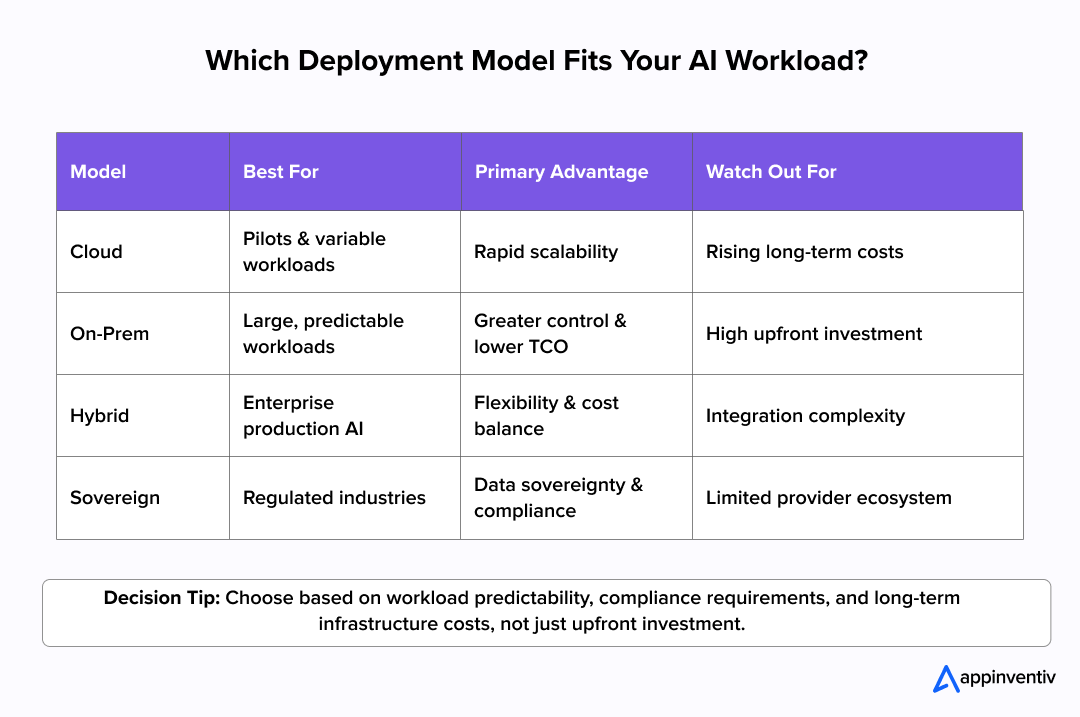
Public Cloud
Public cloud suits variable, bursty workloads, and organizations still validating a use case. AI cloud infrastructure is the fastest path to a working pilot, with elastic capacity for training spikes when you need it. But at sustained high-volume inference the math flips: running continuous, large-scale workloads on AWS, Azure, or Google Cloud can cost millions more a year than equivalent on-prem capacity, modeled over three to five years, mostly because reserved and on-demand GPU pricing just doesn’t amortize the way owned hardware does.
On-Premises
On-premises infrastructure earns its keep once workloads are predictable and large enough to justify the capital spend. It also puts direct control over data location and network topology back in-house, which matters for latency-sensitive inference and for compliance postures that need provable data residency, not just a claim of it.
Hybrid
Hybrid setups keep sensitive or steady high-volume workloads on-prem while bursting to cloud for peak demand, experimentation, or overflow training. This is genuinely where most mature enterprise AI infrastructure ends up. Cloud as elastic capacity, not the default runtime for everything.
Sovereign AI Infrastructure
Sovereign AI infrastructure went from a niche consideration to a mainstream one fast in 2026, largely because of the EU AI Act. US cloud providers remain subject to the extraterritorial reach of the US CLOUD Act, so organizations operating in the EU are increasingly shifting workloads to sovereign or EU-headquartered infrastructure specifically to cut that legal exposure. Not for cost. Not for latency. For the law itself.
Which One Actually Fits? There’s no universal right answer. It comes down to workload volume, interconnect needs, data sensitivity, and which regulatory frameworks actually apply to the data and geography in question.
AI Infrastructure Challenges Enterprises Consistently Underestimate
Some of these show up on a risk register early. Most don’t, until they’re already costing money. Each one below has a practical fix from the build side, not just a warning.
GPU Scarcity and Power Constraints
GPU scarcity is still real in 2026, demand for AI-optimized compute keeps outpacing supply. But beyond raw availability, the constraint increasingly shows up as power and physical space instead.
Some organizations report using their entire facility power budget while occupying only a fraction of available floor space, which says a lot about how much AI racks demand compared to what most data centers were originally built for.
Energy demand follows directly from that: AI racks need far more power than legacy electrical infrastructure was designed to deliver, and lead times for high-density power and liquid cooling retrofits have stretched out as a result.
From a build perspective, the fix is workload-side, not just procurement-side. Right-sizing through quantization (INT8/FP8) and dynamic batching cuts GPU-hour demand meaningfully before adding a single rack. Where power is genuinely constrained, a hybrid split, reserved cloud capacity for burst training paired with owned hardware for steady inference, avoids a multi-quarter wait on facility upgrades.
Data Pipeline Readiness
Data pipeline readiness gets underestimated almost every single time. Feature stores, schema validation, and lineage tracking all need to be production-grade before a model sees meaningful traffic. That’s what actually makes a pipeline AI ready infrastructure, not just a working ETL job. Treating it as something to patch later during the pilot phase is exactly how timelines slip by months.
From a build perspective, this needs to be scoped as its own workstream from day one, with schema validation and lineage tracking built during the assessment phase, not bolted onto the pilot once data quality issues surface in testing. Teams that treat the feature store as core infrastructure, not a later add-on, consistently hit production timelines closer to the six-month end of the range.
Legacy System Integration
Legacy system integration is its own headache. Connecting AI infrastructure to existing ERP, CRM, and data warehouse systems means custom authentication, often OAuth2/OIDC token brokering across systems that predate modern identity standards entirely, plus data mapping and middleware work that gets underscoped at the estimating stage more often than not.
From a build perspective, an API gateway or middleware abstraction layer between the AI stack and legacy systems keeps authentication and data mapping logic in one maintainable place, rather than scattered across point-to-point integrations that break every time a legacy system gets patched. Budgeting integration engineering as a distinct line item, not folded into “infrastructure setup”, is what keeps this from blowing the estimate.
The Talent Gap
The talent gap is one nobody seems to plan for properly. Deloitte’s State of AI in the Enterprise 2026 survey, covering over 3,200 senior leaders, named the AI skills gap as the single biggest barrier to enterprise AI integration. Organizations without in-house MLOps and platform engineering expertise typically pay $150 to $300 an hour for outside specialists, and across a six-to-twelve-month build, that adds up fast.
From a build perspective, a hybrid staffing model works best: hire machine learning engineers as specialists for the architecture and pilot phases, while training internal platform teams to own operations once the system reaches production. That handoff plan needs to exist before the build starts, not get improvised once the specialists roll off.
Governance Failures at Scale
Governance failures show up at scale too. Weak governance, unclear ROI, runaway cost, not model failure, is the actual leading cause.
From a build perspective, this is where AI governance consulting guardrails observability work needs to happen early: RBAC, audit logging, approval gates in the model registry, all of it needs to ship with the pilot, not get added once the system is already in production. Retrofitting governance after scale is reached is one of the more expensive and disruptive changes an infrastructure team can be asked to make.
Compliance and Governance: The Layer Enterprises Build Last and Regret Building Last
The EU AI Act hit full high-risk enforcement on August 2, 2026, covering hiring algorithms, credit scoring, biometric systems, and emergency services AI, with penalties up to €35 million or 7% of global revenue. High-risk systems now need documented conformity assessments and human oversight built into the deployment pipeline before go-live, the core of what legally compliant AI development actually looks like. Not added afterward as a patch.
GDPR adds its own layer, and the distinction enterprises keep getting wrong is between data residency, where data physically sits, and data sovereignty, which jurisdiction’s laws actually govern access to it. A dataset stored in the EU but accessible by a US-headquartered vendor under US legal process can satisfy residency while still failing a sovereignty review.
One of the more overlooked failures in 2026 is residency drift: a new vendor or integration gets wired into a live system without a residency review, quietly creating a cross-border data flow that breaks the original compliance posture.
Nobody makes one bad decision. A dozen small ones add up instead. The organizations that handle this well build compliance into the infrastructure itself, change-control gates that trigger a review before any integration goes live, not a periodic audit that catches problems months later.
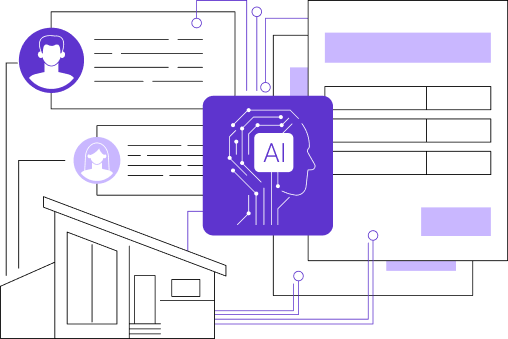
Get expert guidance on building governance, audit logging, and residency controls into your AI infrastructure from day one, not after an audit forces the issue.
Why Enterprises Overspend, and Why Governance Maturity Doesn’t Fully Protect Against It
FinOps maturity alone doesn’t fully fix the overrun problem, which is a little counterintuitive if you think about it. The pattern shows up repeatedly: projects run over budget because of architectural choices made early, not because finance teams failed to track spend after the fact. A well-run cost dashboard can’t undo a network topology or storage tier that was sized wrong from the start.
That points to something structural, not a discipline gap you can fix with more training. Usage-based token pricing. Agent workloads that chain multiple model calls per user action. Platform costs buried inside vendor bundling. All of it makes AI infrastructure genuinely harder to forecast than seat-based software spend, even for teams doing everything else right. The fix is architectural, not procedural. Cost attribution tagging at the request level, by model, team, use case. Real-time budget alerts tied to actual token or GPU-hour consumption instead of a monthly invoice review that arrives three weeks too late. The same change-control discipline applied to cost that gets applied to compliance, so forecasting runs off live usage data instead of assumptions somebody made months ago at the planning stage.
Choosing the Right AI Infrastructure for Your Business Size
A handful of questions tend to separate the builds that scale cleanly from the ones needing a costly rebuild within two years:
- What’s the actual workload profile, bursty and experimental or steady-state high-volume, and does the interconnect and storage architecture actually match it, or just look like it does on paper?
- Which regulatory frameworks apply to the data being processed, and does the network topology enforce residency and sovereignty by design, rather than by a policy document sitting in a shared drive?
- Does the organization have real in-house MLOps and platform engineering skill, or does the plan need to account for outside specialist cost from day one?
- What does a realistic three-to-five-year total cost of ownership actually look like across cloud, on-prem, and hybrid, including GPU utilization assumptions, not just the year-one number that made it into the business case?
- Is the governance, audit logging, and cost attribution layer designed into the architecture from the start, or pushed to phase two like it always seems to be?
Getting these right before committing to an architecture is usually the difference between infrastructure that scales with the business and infrastructure that becomes the reason the next initiative stalls.
It’s also where an experienced build partner tends to matter more than the tooling itself. Since the same GPU cluster and the same cloud account can produce very different outcomes depending on how the assessment, architecture, and governance work gets sequenced, which is exactly what a solid enterprise AI development partner checklist is meant to surface before a contract gets signed.
Appinventiv builds enterprise AI infrastructure solutions that combine workload profiling, compliance mapping, and cost modeling before any vendor commitment gets made. That groundwork shows up in the delivery numbers: 300+ AI-powered solutions delivered across industries, prediction models built to 98% accuracy, and infrastructure and delivery pipelines engineered to get enterprise AI systems to market up to 10x faster than teams building this from scratch on their own.
Whether you’re still scoping the build or already mid-rollout, our team can show you how to build AI infrastructure that won’t need a rebuild in two years. Ready to get your AI infrastructure right the first time? Talk to our AI Development team.
FAQs
Q. How much does it cost to build AI infrastructure?
A. Most enterprises spend $40,000 to $400,000 on a first AI project, with ongoing monthly costs between $3,000 and $80,000 depending on scale. Organizations running AI at full production scale average closer to $2.4 million a year across compute, storage, networking, and platform licensing.
Q. How long does it take to build AI-powered infrastructure?
A. Six to twelve months for most enterprises, from readiness assessment to stable production. Data pipeline and feature-store maturity is usually the deciding factor here, not model selection or GPU procurement.
Q. What compliance requirements apply to AI infrastructure?
A. The EU AI Act, GDPR, NIST AI RMF, and ISO/IEC 42001 form the core baseline, with sector overlays like DORA and NIS2 depending on industry. The EU AI Act hit full high-risk enforcement on August 2, 2026, with penalties up to €35 million or 7% of global revenue.The EU AI Act, GDPR, NIST AI RMF, and ISO/IEC 42001 form the core compliance baseline, with sector-specific regulations such as DORA for financial services and NIS2 for critical infrastructure applying where relevant. The EU AI Act entered full enforcement for high-risk AI systems on August 2, 2026, with penalties of up to €35 million ($39 million) or 7% of global annual turnover for the most serious violations.
GDPR violations can result in fines of up to €20 million ($22 million) or 4% of global annual turnover, along with corrective measures such as processing restrictions.
While NIST AI RMF and ISO/IEC 42001 are voluntary frameworks and do not impose direct financial penalties, failing to follow them can make it significantly harder to demonstrate due diligence, satisfy regulatory audits, achieve certification, or meet customer and procurement requirements. Organizations subject to DORA or NIS2 may also face regulatory enforcement, administrative fines, remediation orders, and increased supervisory scrutiny for non-compliance.
Q. What is the ROI of investing in AI infrastructure?
A. It varies a lot by use case, and most finance teams genuinely struggle to calculate it cleanly. Only 15% say they can without significant friction. Strong returns on agentic AI specifically are currently concentrated among a small group of high performers, not spread evenly across everyone who’s adopted it.
Q. How do you choose the right AI infrastructure for your business size?
A. Start with workload profile and interconnect needs, not budget. Bursty or experimental workloads lean cloud. Steady, high-volume workloads lean on-prem or hybrid with owned interconnect. Figure out which compliance frameworks apply to your data and geography before locking in network topology and region.


Fast 2-minute response, fully NDA-protected.

AI Data Integration: How to Connect, Clean and Prepare Data for AI
Key takeaways: AI initiatives fail when fragmented, poor-quality data reaches models without sufficient context, controls or ownership. AI-ready pipelines must connect, clean, enrich, govern and continuously monitor data across its lifecycle. Real-time processing matters when AI decisions depend on current transactions, events, inventory or operational conditions. Data architecture should follow the AI use case, balancing…

AI-Native SDLC: Foundational 90-Day, 5R AI SDLC Adoption Playbook
Key takeaways: Why AI coding tools accelerate coding and software delivery How AI-native SDLC shifts engineering from code to intent, context, and outcomes The role of specifications, AI agents, and continuous verification in enterprise delivery How to redesign engineering teams for human–agent collaboration The platform, governance, and guardrails required to scale AI-native development A practical…

AI Agent Governance: How to Govern Autonomous AI Across Business Systems
Key takeaways: AI agents require controls at the action, identity, data, tool, and workflow levels. Every enterprise agent should have a registered owner, an approved purpose, and a defined risk tier. Access must be based on the agent’s task rather than inherited from a human user or shared service account. High-impact actions need real-time policy…