































Digital Transformation in the Australian Healthcare Industry: Costs, Challenges, and Implementation Strategy

 Share -



- 01Why Digital Transformation in the Australian Healthcare Industry Has Become Urgent
- 02What Does Digital Transformation Mean in Healthcare?
- 03What Are Key Technologies Powering Healthcare Digital Transformation in Australia
- 04Digital Transformation Use Cases Across the Australian Healthcare Ecosystem
- 05What Are the Benefits of Digital Transformation in Healthcare?
- 06How to Build a Digital Transformation Strategy for Australian Healthcare Organisations
- 07How Much Does It Cost to Implement Digital Transformation in the Healthcare Industry in Australia?
- 08Biggest Barriers to Digital Transformation in Healthcare and How to Overcome Them
- 09Australian Compliance Requirements Healthcare Leaders Must Address
- 10Build vs Buy vs Modernise: Which Digital Transformation Approach Works Best?
- 11Real-World Examples of Digital Transformation in Australian Healthcare
- 12Why Choose Appinventiv for Healthcare Digital Transformation in Australia?
- 13FAQs

Key takeaways:
- Digital transformation has become a business necessity for Australian healthcare providers as they navigate workforce shortages, rising operational costs and growing patient demand
- Core technologies such as AI, cloud, EMRs, telehealth, IoMT, and data analytics are enabling more connected, efficient, and patient-centric healthcare systems.
- A phased implementation strategy, starting with digital maturity assessment, interoperability planning, and pilot deployments, helps reduce risks and improve adoption.
- Transformation costs in Australia typically range from AUD 70,000 to AUD 700,000+, depending on organisation size, legacy infrastructure, and integration complexity.
Australia’s healthcare system is evolving under mounting pressure. An ageing population, increasing rates of chronic disease, persistent workforce shortages, and rising operating costs are forcing healthcare organisations to rethink how they deliver care. At the same time, patients expect the same level of digital convenience from healthcare that they receive from banking, retail, and other everyday services. Meeting these expectations with fragmented systems and manual processes is becoming increasingly difficult.
This shift is making Digital Transformation in the healthcare industry in Australia a strategic priority rather than a technology upgrade. Hospitals, private healthcare providers, aged care organisations, and diagnostic centres are investing in electronic medical records, AI-powered clinical tools, cloud infrastructure, telehealth, and data-driven decision-making to improve patient outcomes while reducing operational inefficiencies. Across Australia, national initiatives such as My Health Record and expanding interoperability standards are further accelerating this transition.
However, successful transformation requires more than adopting new technologies. Healthcare leaders must balance regulatory compliance, cybersecurity, integration with legacy systems, budget constraints, and organisational change, all while ensuring uninterrupted patient care.
This blog explores what digital transformation means for the Australian healthcare industry, the technologies driving change, typical implementation costs, common challenges, and a practical roadmap for building a future-ready healthcare ecosystem that delivers measurable clinical and business value.
Modernise your healthcare ecosystem with a roadmap that aligns technology investments with clinical outcomes, compliance, and long-term operational goals.
Why Digital Transformation in the Australian Healthcare Industry Has Become Urgent
Australia’s healthcare system is facing a convergence of operational, financial, and demographic challenges that traditional models of care can no longer absorb. Rising patient volumes, workforce shortages, and fragmented clinical systems, all making it harder for providers to deliver high-quality care efficiently.
Growing healthcare demand: Australians aged 65 and over are projected to reach 22% of the population by 2050, up from 17% in 2022, driving sustained growth in chronic disease presentations and hospital admissions.
Workforce shortages: As of 2023, around 82% of health occupations were experiencing shortages, with fill rates for clinical vacancies falling to 44%, leaving fewer clinicians to absorb rising caseloads.
Rising administrative costs: Manual scheduling, paper referrals, and duplicate data entry continue to consume clinical hours that could otherwise go toward direct patient care, inflating the cost of every episode.
Fragmented patient data: Crucial medical histories remain trapped across isolated EMR databases, local pathology software, and loose referral letters. This lack of integration forces doctors to reconstruct a patient’s medical background on the fly during handovers.
Long patient wait times: Emergency department and elective surgery waitlists remain a persistent operational and reputational pressure point that digital triage and capacity forecasting can materially shorten.
Increasing cyberattacks: Medical networks are now prime targets for ransomware and data theft. The health sector led the nation in notifiable data breaches during early 2025, accounting for 18% of all reported incidents, with criminal groups driving 59% of those breaches.
Shift toward value-based care: Private insurers and government funders are actively moving funding models away from simple fee-for-service volumes toward concrete health outcomes. Tracking and proving these outcomes requires structured, auditable data flows.
Implementing an aggressive, system-wide digital transformation strategy for Australian healthcare industry frameworks offers the only practical way forward. Moving to connected, automated architectures allows providers to relieve frontline pressure, eliminate redundant paperwork, and base operational decisions on real-time clinical reality.
What Does Digital Transformation Mean in Healthcare?
Unlocking the true benefits of digital transformation in healthcare in australia requires a clear, unsentimental understanding of what this technical process actually entails. Enterprise modernization follows a distinct three-tier progression, and confusing the early steps with the final goal often leads to failed investments:
- Digitisation: Converting physical, analogue information into digital formats without altering the workflow, such as scanning paper clinical notes into unindexed PDF files.
- Digitalisation: Using digital data to improve and simplify existing processes, like implementing electronic prescribing to replace paper-based scripts without changing the underlying care model.
- Digital Transformation: Interconnecting clinical, operational, and data workflows to create entirely new care delivery models, such as deploying predictive remote patient monitoring systems that actively prevent hospital readmissions.
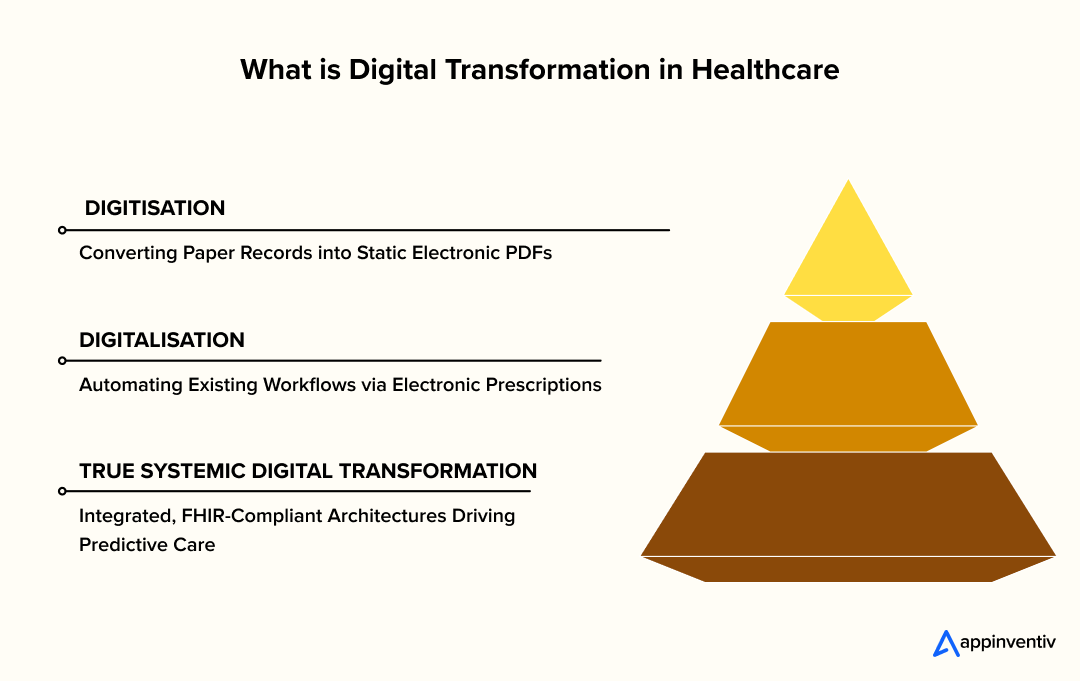
Enterprise healthcare leaders must avoid the trap of investing in digitalisation while expecting the strategic yields of a complete transformation. True modernisation replaces fragmented systems with unified platforms, ensuring that data flows securely across departments to inform clinical decision-making in real time
What Are Key Technologies Powering Healthcare Digital Transformation in Australia
Deploying standalone software often leads to isolated data pools. Executing a sustainable digital health transformation Australia-wide relies on building a cohesive technology ecosystem where data moves securely between clinical, operational, and patient-facing systems.
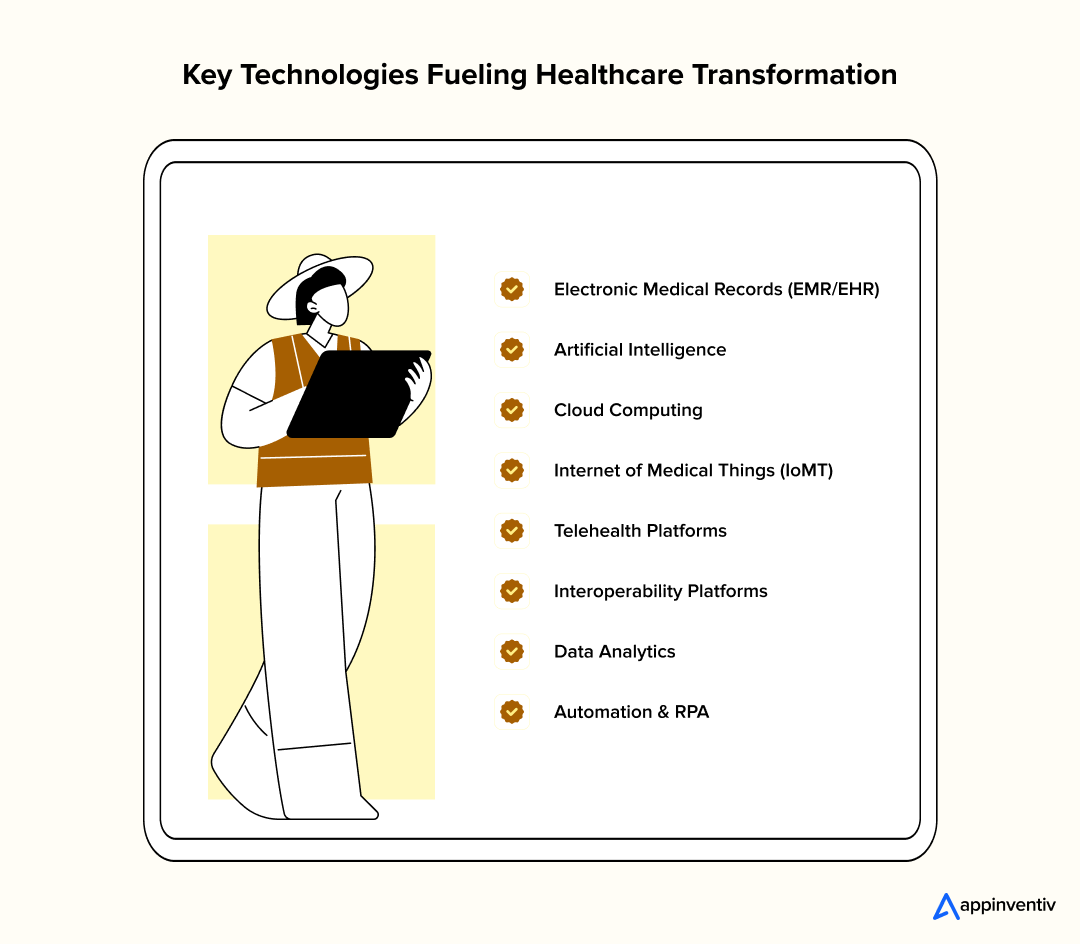
Electronic Medical Records (EMR/EHR)
- Operational Benefits: Pulls scattered patient histories into one central file. This cuts out dangerous transcription mistakes and gives doctors a single, reliable source of truth right at the bedside.
- Integration Challenges: Connecting legacy EMR installations with external specialist software requires extensive custom API development and data transformation.
Artificial Intelligence and Machine Learning
- Operational Benefits: AI in Australian healthcare accelerates diagnostic workflows, automates clinical transcription, and flags high-risk patient deteriorations early.
- Integration Challenges: Dropping AI models into a live clinical environment requires incredibly fast, low-latency data pipelines. It also calls for strict data governance to ensure the algorithms do not learn and repeat human clinical bias.
Cloud Computing Infrastructure
- Operational Benefits: Delivers flexible computing power, simplifies cross-site data access, and provides cost-effective, redundant data storage options.
- Integration Challenges: Keeping data compliant with local laws means you cannot just use any public cloud. You have to host everything within local, IRAP-assessed cloud data centres and logically partition your databases to ensure no data leaves the country.
Internet of Medical Things (IoMT)
- Operational Benefits: Allows teams to safely monitor chronic patients while they rest at home, which frees up physical hospital beds and lets facilities track expensive mobile medical gear in real time.
- Integration Challenges: Handling a continuous stream of data from thousands of wearable devices requires incredibly secure intake points. You also need smart data filters to stop minor device alerts from overwhelming and fatiguing your on-duty nursing staff.
Telehealth Platforms
- Operational Benefits: Telehealth platforms in Australia opens up immediate specialist medical access for regional and remote communities while saving city clinics from dealing with overcrowded physical waiting rooms.
- Integration Challenges: Getting a live video consultation to sync perfectly with a patient’s core clinical file requires complex WebRTC configurations and highly secure session keys to prevent any eavesdropping.
Interoperability Platforms
- Operational Benefits: Breaks down data silos by using HL7 and FHIR standards, allowing secure data exchange across different software vendors.
- Integration Challenges: Reconciling conflicting data formats between older legacy databases and modern FHIR profiles requires detailed semantic mapping.
Advanced Data Analytics
Operational Benefits: Converts raw operational and clinical data into actionable insights for hospital capacity planning and resource allocation.
Integration Challenges: Building reliable data pipelines requires consolidating un-structured data from multiple detached operational systems.
Automation and Robotic Process Automation (RPA)
- Operational Benefits: Quietly handles boring, repetitive back-office chores like cross-checking Medicare billing codes, sending out batch appointment reminders, and running standard data entry.
- Integration Challenges: Simple RPA software bots break easily the moment an underlying software provider changes a user interface layout, which requires constant developer monitoring and quick exception fixes.
Digital Transformation Use Cases Across the Australian Healthcare Ecosystem
The technology stack is only as valuable as its fit to sector-specific operating pressures. A model that works for a metropolitan hospital network rarely transfers cleanly to aged care or diagnostics without material redesign.
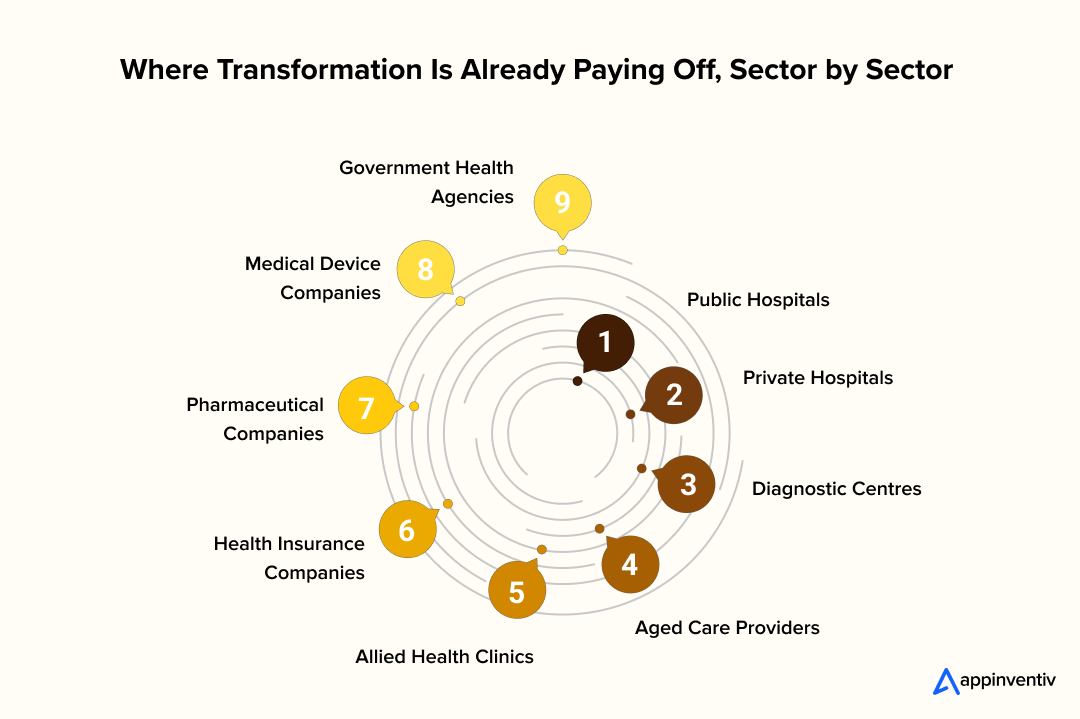
Public Hospitals
- Problem: Overcrowded wards, long emergency waiting lists, and patient notes that get trapped inside individual department databases.
- Technology: Rolling out fully interoperable EMR systems, smart bed-tracking dashboards, and AI tools to assist with emergency triage.
- Outcome: Shorter hospital stays, smoother patient movement between wards, and accurate, automated reporting to state health departments.
Private Hospitals
- Problem: Patients expecting smooth, modern digital experiences and intense competition to retain top medical specialists.
- Technology: Deploying self-service patient portals, online admission forms, and fully integrated billing systems.
- Outcome: Eliminating paperwork delays at the front desk, boosting patient satisfaction metrics, and gathering clean data to secure better value-based contracts with private insurers.
Diagnostic Centres
- Problem: Delays in getting scan results back to doctors and communication gaps with referring general practitioners.
- Technology: Shifting to cloud-native PACS image hosting, using AI to flag urgent scans in the queue, and setting up automated result delivery.
- Outcome: Cutting down the time it takes to issue reports, reducing the cost of running duplicate scans, and keeping referring clinics happy.
Aged Care Providers
- Problem: Chronic staff shortages combined with the pressure of meeting strict new government quality standards.
- Technology: Using wearable IoMT health trackers, central remote monitoring dashboards, and mobile care planning software.
- Outcome: Spotting health downturns before they become emergencies, staying fully compliant with aged care audits, and avoiding unnecessary, stressful ambulance transfers.
Allied Health Clinics
- Problem: Disjointed appointment calendars and an inability to easily share progress notes with a patient’s primary GP.
- Technology: Moving to cloud-based practice management software, integrated telehealth apps, and secure local messaging systems.
- Outcome: Keeping clinic schedules full, cutting out manual front-desk admin work, and ensuring true continuity of care for patients.
Health Insurance Companies
- Problem: Rising payouts, slow manual claims processing, and the constant threat of billing fraud.
- Technology: Using AI models to flag suspicious claims patterns, automating basic underwriting, and updating member portals.
- Outcome: Reimbursing valid claims within minutes, stopping financial leakage from fraudulent billing, and retaining members through a smoother service experience.
Pharmaceutical Companies
- Problem: Scattered, messy clinical trial data that stretches out drug development timelines and slows down regulatory sign-offs.
- Technology: Building central cloud data repositories, running AI-driven trial analytics, and using digital submission software.
- Outcome: Filling trial cohorts much faster and ensuring clean, uncompromised data pipelines for TGA evaluations.
Medical Device Companies
- Problem: Meeting strict post-market safety tracking rules while managing the maintenance needs of connected hospital hardware.
- Technology: Embedding native IoMT connectivity, setting up cloud device monitoring, and using predictive maintenance software.
- Outcome: Staying ahead of safety reporting mandates and fixing hardware bugs remotely before they cause equipment downtime.
Government Health Agencies
- Problem: Trying to hit national connected care targets while battling fragmented state-by-state data laws.
- Technology: Developing nationwide FHIR data exchange gateways, updating core digital health networks, and running central cyber threat monitoring.
- Outcome: Making real headway toward a fully connected national health network and gathering accurate population data to guide public health decisions.
What Are the Benefits of Digital Transformation in Healthcare?
When organizations successfully unlock the benefits of digital transformation in healthcare in Australia, the returns manifest across several measurable categories:
- Clinical Benefits: Shared health histories lower adverse drug event rates by reducing medication discrepancies at transitions of care.
- Operational Benefits: Digital workflows cut patient check-in times and reduce administrative scheduling workloads, giving staff more time for patient care.
- Financial Benefits: Transitioning to cloud-native models reduces capital expenditure on local server maintenance and lowers billing error rates.
- Patient Experience Benefits: Digital portals let patients view test results, manage appointments, and access virtual care options, reducing inbound call volumes.
- Compliance Benefits: Automated audit trails ensure access logs for sensitive patient records are immutable and readily available for regulatory reviews.
How to Build a Digital Transformation Strategy for Australian Healthcare Organisations
Digital transformation delivers the best outcomes when approached as a phased business initiative. These ten steps outline a practical, risk-managed rollout strategy for Australian healthcare networks:
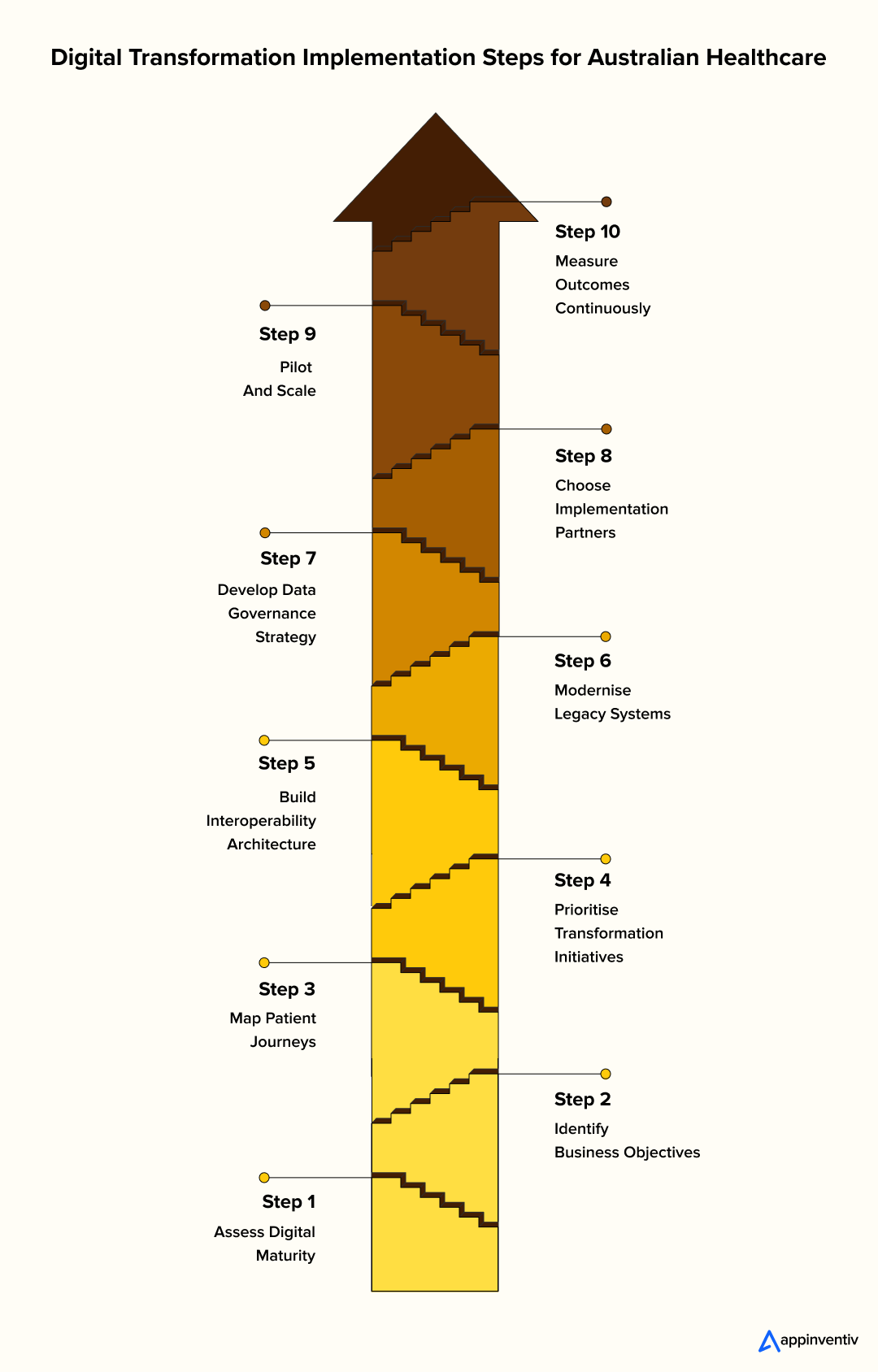
Step 1: Assess Your Digital Maturity
Before spending a cent, audit what is actually running on your floor. Look at database lag, network dropouts, and how your staff actually work. It is common to find clinicians using personal messaging apps or “shadow IT” workarounds just to get through a shift because the official systems are too slow. That is your true starting baseline.
Step 2: Define Clear Business and Clinical Objectives
Avoid building new healthcare software just because a competitor did. Tie every investment directly to a concrete operational bottleneck. For instance, aim to cut patient discharge times by twenty minutes or stop staff from having to enter the same Medicare data three separate times.
Step 3: Map Patient and Care Delivery Journeys
Follow a patient’s path from their very first online booking click to their final discharge summary. Pay attention to where files get stuck, where patients wait in hallways, and where clinicians have to re-key data. This journey map shows you exactly where new tools will actually help rather than disrupt.
Step 4: Prioritise High-Impact Use Cases
Do not try to overhaul every ward at once; that is a fast track to operational gridlock. Pick one or two high-value, manageable changes first like digital referrals or automated SMS appointment reminders to prove the concept works and build some internal trust.
Step 5: Design an Interoperable Technology Architecture
Your new system cannot afford to be another isolated island. Ensure your developers build around modern, open standards like FHIR and HL7 from day one. This keeps patient records moving securely across different clinics and diagnostic systems.
Step 6: Modernise Legacy Systems Gradually
Tearing out your core patient administration database overnight is incredibly risky. Instead, wrap your existing, stable databases in modern API layers. This lets you modernise individual front-end interfaces piece by piece while keeping clinical operations running smoothly.
Step 7: Strengthen Data Governance and Security
Patient data demands absolute security. Set up strict, role-based access so staff only see what they need for their immediate shift. Keep clean, immutable audit trails of who opened which record, and verify your cloud hosting meets local Australian data sovereignty rules.
Step 8: Choose the Right Technology and Implementation Partner
You need a development team that has prior experience in building healthcare systems. Code quality matters, but understanding how clinical shifts run and knowing the local compliance landscape matter more when things get busy. Select tech partners who can point to active, stable integrations in high-pressure Australian clinical settings.
Step 9: Launch a Pilot Before Scaling
Run your new software in a single ward or small clinic first. This live trial is where you will find the practical bugs like screen glare or lag on mobile network before they can disrupt your entire operation. Test the system with a receptive, tech-capable clinical team to gather honest feedback and build local champions.
Step 10: Measure Outcomes and Continuously Improve
Deploying software is just the beginning, not the finish line. Keep tracking system response times, how often staff bypass the new tools, and what patients say. Use these real-world metrics to tweak the system and plan your next updates. Set up a monthly catch-up between senior clinical leads and your IT team to fix user frustrations.
Address cybersecurity, interoperability, and compliance from day one with the right implementation approach.

How Much Does It Cost to Implement Digital Transformation in the Healthcare Industry in Australia?
Typically, most Australian healthcare digital transformation initiatives fall between AUD 70,000 and AUD 700,000 range, depending on scope. The healthcare digital transformation cost is majorly impacted by data migration complexity, the number of legacy systems requiring integration, compliance overhead for FHIR and TGA alignment, and so on.
For example, a modest single-site rollout sits at the lower end of the range, while a multi-facility network integrating AI, interoperability, and cybersecurity uplift across several systems moves toward the upper end.
Here is a table outlining an estimated cost breakdown of the digital transformation initiatives based on healthcare operation size:
| Organisation | Estimated Cost (AUD) | Estimated Timeline |
|---|---|---|
| Small Clinics | 70,000 – 150,000 | 3-6 months |
| Multi-location Providers | 150,000 – 400,000 | 6-14 months |
| Large Hospital Networks | 400,000 – 700,000+ | 14-24 months |
Biggest Barriers to Digital Transformation in Healthcare and How to Overcome Them
Most transformation delays trace back to a small set of recurring failure points. Naming them early, and resourcing against them deliberately, is what separates programs that stay on schedule from those that stall mid-delivery.
1. Legacy Systems & Siloed Architectures
Challenge: Decades-old core systems were not built to expose APIs, blocking data exchange across departments and partners.
Solution: Introduce integration middleware and FHIR-based gateways to modernise legacy systems rather than forcing an immediate full core replacement.
2. Regulatory and Compliance Maze
Challenge: Overlapping Privacy Act, My Health Records Act, and TGA obligations create ambiguity about which rules apply to new tools.
Solution: Build compliance mapping into architecture design from day one, not as a post-deployment audit exercise.
3. Workforce Resistance & The Digital Literacy Gap
Challenge: Clinicians under time pressure resist using digital tools that add steps without a visible benefit to patient care.
Solution: Involve clinical staff in design and prioritise workflows that measurably reduce documentation time.
4. The Telehealth Reimbursement Lag
Challenge: Funding models have not kept pace with virtual care delivery, creating uncertainty around long-term telehealth viability.
Solution: Design platforms flexibly enough to adapt to Medicare item number changes without full re-architecture.
Australian Compliance Requirements Healthcare Leaders Must Address
Compliance in Australian healthcare is not a checklist appended at the end of a project. It is an architectural constraint that shapes vendor selection, data flows, and system design from the outset.
| Requirement | Relevance to Digital Transformation |
|---|---|
| Privacy Act 1988 | Governs collection, use, and disclosure of personal information across all health technology systems |
| Australian Privacy Principles (APPs) | Sets baseline obligations for data handling, consent, and breach response |
| My Health Records Act 2012 | Establishes specific notification and access rules for the national My Health Record system |
| Therapeutic Goods Administration (TGA) | Classifies certain AI and software tools as medical devices requiring regulatory approval |
| Australian Digital Health Agency standards | Defines national conformance requirements for digital health products and services |
| Secure messaging | Requires encrypted, authenticated clinical communication between providers |
| FHIR | National standard for structured, interoperable health data exchange |
| HL7 | Legacy and current messaging standard underpinning much clinical system integration |
| ISO 27001 | International benchmark for information security management systems |
| SOC 2 | Assurance standard for vendors handling sensitive patient data in cloud environments |
| Cyber Security Act updates | Introduces evolving obligations for critical infrastructure and incident reporting |
| State-specific health information requirements | Adds jurisdictional variations in consent and data handling on top of federal law |
To ensure these regulatory boundaries do not halt operational speed, Appinventiv builds every platform using a pre-configured, compliance-first infrastructure blueprint.being ISO 27001 and SOC 2 certified, our development process naturally integrates role-based data masking, end-to-end field-level encryption, and automated audit logging directly into the core code.
This structural approach ensures your systems pass strict local assessments while maintaining the 99.50% security compliance SLA required by state and federal procurement frameworks.
Build vs Buy vs Modernise: Which Digital Transformation Approach Works Best?
The build, buy, or modernise decision is rarely binary in healthcare. Most organisations land on a hybrid model, and getting the balance wrong locks in cost and compliance exposure for years.
Off-the-shelf platforms deploy fastest but rarely fit clinical workflows without heavy customisation, while custom builds offer long-term flexibility at a higher upfront cost and delivery time. Modernising existing systems often delivers the strongest near-term return where core clinical platforms remain fit for purpose.
| Factor | Build | Buy | Modernise |
|---|---|---|---|
| Cost | High upfront | Lower upfront | Moderate |
| Scalability | High | Limited by vendor roadmap | Moderate to high |
| Time to deploy | Longest | Fastest | Moderate |
| Customisation | Full | Minimal | High |
| Compliance | Fully controllable | Vendor-dependent | Controllable within legacy constraints |
| Long-term TCO | Lower over time | Can rise with licensing | Moderate |
| Integration flexibility | High | Limited | Moderate to high |
| Innovation potential | High | Constrained by vendor | Moderate |
When to Apply Each Approach
- Bespoke Development: Best for large hospital networks or unique health services where tailored clinical workflows provide a distinct operational advantage.
- Off-the-Shelf Software: Ideal for standard administrative operations or smaller clinics with common, non-specialized operational workflows.
- Legacy Modernisation: Most appropriate when core legacy databases are reliable and stable, but require modern integration layers to connect with newer platforms.
Real-World Examples of Digital Transformation in Australian Healthcare
Analyzing recent projects of Digital Transformation in the Healthcare industry in Australia demonstrates how structured execution addresses core operational inefficiencies across different care scenarios:
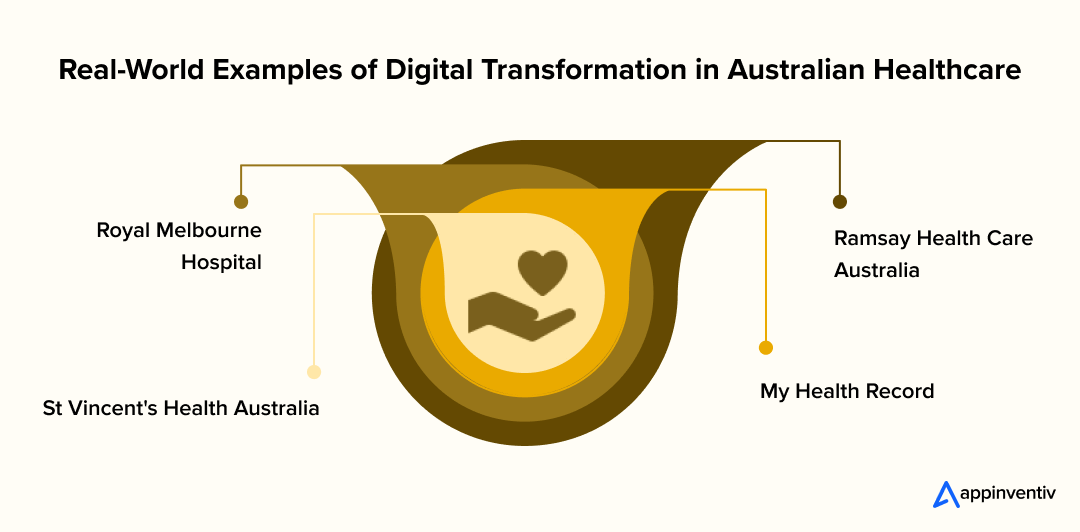
Royal Melbourne Hospital – Virtual Care Initiatives
The hospital deployed centralized virtual care pathways integrated with existing hospital record systems, improving outpatient monitoring capability and reducing emergency department re-admission rates for chronic disease cohorts.
St Vincent’s Health Australia – Clinical Workflow Integration
The medical platform upgraded core EMR modules with unified data capture tools at the point of care, reducing time spent on manual nursing documentation and increasing direct patient contact time across acute wards.
Ramsay Health Care – Private Hospital Platform Upgrades
Ramsay Health Care Rolled out integrated patient portals across multiple private clinical facilities, simplifying patient intake procedures and lowering administrative data-entry workloads for reception teams.
My Health Record – National System Integration
Connected state-based hospital networks with the national digital health record system, improving clinical visibility and allowing healthcare teams to access key patient information during cross-border transfers.
Why Choose Appinventiv for Healthcare Digital Transformation in Australia?
True digital transformation is not about buying off-the-shelf software and forcing clinical staff to adapt to it. It is about building custom, FHIR-compliant and TGA-aligned architectures that work alongside existing EMRs, so healthcare leaders stay focused on patient-centred care rather than technical complexity.
That is the same problem behind our healthcare software development services in Australia. Rather than fitting your workflows into rigid, off-the-shelf software packages, we build custom, interoperable environments tailored to your specific clinical needs.
Our healthcare technology services bridge the gap between complex legacy setups and modern, compliant technology. Whether you need to connect legacy EMRs, build AI-assisted diagnostic tools, or launch secure, consumer-facing mobile portals, our team of 1600+ tech experts help your organization modernize without disrupting active patient care.
Our experience delivering high-performance, compliant systems is proven by our work with leading global and regional healthtech brands like DiabeticU, Soniphi, YouComm and Health-e-People:
Here is What Sets Us Apart from Other Healthcare Transformation Service Provider
- More than 10 Years of Experience in APAC Delivery: A history of successful digital transformations across highly regulated public and private markets.
- A Team of Over 1,600 Tech Specialists: Deep expertise spanning custom mobile platforms, cloud systems, advanced data engineering, and machine learning.
- End-to-End Capabilities: Supporting your project from initial maturity audits and clinical workflow mapping through to secure custom coding, cloud migration, and ongoing maintenance.
- Built for Real Interoperability: Custom database integrations utilizing HL7 and FHIR standards, designed to easily share data with existing hospital networks and national databases.
- Security-by-Design Compliance: Frameworks built to meet strict ISO 27001, SOC 2, and local Australian Privacy Principles (APPs). All systems are developed to be audit-ready and compliant with national health data storage requirements.
- Approved Government Procurement Status: Appinventiv is a pre-approved digital transformation supplier, officially registered on both the Queensland Government ICTSS panel and the Local Buy LGA arrangement.
Ready to Build a Future-Ready Healthcare Ecosystem? Talk to our health tech experts today and elevate your digital transformation journey.
FAQs
Q. How do healthcare providers implement digital transformation in the Australian healthcare industry?
A. Most providers begin with a digital maturity assessment, followed by interoperability architecture and a phased rollout starting with a single department or facility before scaling organisation-wide, supported by continuous KPI tracking.
Q. How is AI transforming the Australian healthcare industry?
A. AI in healthcare is being applied to diagnostic imaging triage, clinical documentation, and administrative automation, with the Therapeutic Goods Administration treating certain clinical AI tools as regulated medical devices requiring formal approval.
Q. What is the ROI of digital transformation in the healthcare industry in Australia?
A. Returns are typically measured through reduced length of patient stay, lower administrative cost per episode, improved claims accuracy, and fewer compliance breaches, rather than a single blended percentage figure.


Fast 2-minute response, fully NDA-protected.

Wearable Data Integration: Connecting Multiple Devices to a Unified Health Platform
Key takeaways: Device support should reflect the measurements your service needs, the people using it, and the decisions those readings inform. A unified health data platform must preserve source, timing, and measurement context while resolving duplicate records. Phone health platforms, manufacturer APIs, and direct device connections serve different integration needs. Clinical workflows require agreed review…

Sleep Tracker App Development: Features, Wearable Integration, AI, and Compliance
Key takeaways: Sleep tracking presents opportunities across consumer wellness, fitness, healthcare, employee wellness, senior care, and infant-care markets. Successful products combine actionable insights, wearable connectivity, user-friendly reports, privacy controls, and clearly differentiated experiences. HealthKit, Health Connect, and direct device APIs provide different data depths, costs, limitations, and maintenance requirements. AI supports sleep-stage estimation and personalization,…

Diet and Nutrition App Development: Process, Features, Cost, and Technology Stack
Key Takeaways Diet and nutrition tracking app development goes past basic calorie counters with verified food databases, custom meal schedules, AI tools, wearable device links, and corporate manager tools. Structure database models around raw food items, serving portions, nutrient facts, recipes, software links, and regional diet rules. Pair computer vision models, recommendation algorithms, language engines,…