






























AI in Fuel Distribution: Costs, Compliance, Rollout

 Share -



- 01How are Trends in Fuel Distribution Looking Right Now?
- 02What Does the Role of AI in Fuel Distribution Look Like Across the Value Chain?
- 03Which AI Use Cases in Fuel Distribution Deliver Returns First?
- 04Which AI Technologies in Fuel Distribution Actually Run in Production?
- 05How Do You Build a Fuel Distribution Management System That Survives an Audit?
- 06How Much Does AI Integration in Fuel Distribution Cost?
- 07Should You Build, Buy, or Blend Your Fuel Management Software?
- 08How Do You Roll Out AI in Fuel Management Without Stalling Operations?
- 09Where Do AI in Fuel Distribution Programs Usually Fail?
- 10What is Next for AI in Fuel and Logistics Distribution?
- 11How Can Appinventiv Help You Out?
- 12FAQs

Key takeaways:
- Fuel accounted for $0.482 of the $2.336 it cost to run a Class 8 truck a mile in 2025, which makes every distribution decision a margin decision.
- Sequence by payback, not ambition. Tank-level runout prediction and wet stock anomaly detection return in 3 to 8 months. Predictive maintenance takes 8 to 14.
- Budget $180,000 to $650,000 for a production-first release, plus 18% to 25% of that annually. Legacy integration quietly consumes about 30% of it.
- Compliance is architecture, not paperwork. EPA 40 CFR 280, PHMSA 49 CFR, FMCSA, NIST Handbook 44, and IFTA all pull evidence from the same automated decision.
- AI advises on measurement and never becomes measurement. Your legal-for-trade meter stays the system of record.
- Nothing gets automated before week 30. Data truth, shadow forecasting, assisted dispatch, then bounded automation.
A half-cent per gallon decides whether your terminal-to-retail operation clears its number this quarter. That is the margin reality US jobbers, carriers, and downstream marketers work inside, and it is why AI in fuel distribution has stopped being a science project. Fuel ran $0.482 per mile for the average Class 8 operation in 2025, against a total operating cost of $2.336 per mile, according to the American Transportation Research Institute’s 2025 operational costs data. Every dispatch decision you make is a bet against that number.
We have spent the last decade building forecasting, routing, and compliance systems for operators who move physical products under federal scrutiny. What follows is the version we give clients when they ask what AI in fuel distribution actually requires: what to build, what it costs, what the regulators will ask for, and where these programs quietly fall apart.
Assess your ATG, telematics, and reconciliation data before committing your build budget.

How are Trends in Fuel Distribution Looking Right Now?
Three things, and none of them are new. What is new is that the tolerances have tightened to the point where manual judgment cannot hold them.
Demand signal decay. Retail pull swings on weather, local events, price spread against the rack, and competitor posting. A dispatcher working off last week’s draw will overfill half the sites and run the other half dry. The US Energy Information Administration reported distillate demand at 3.8 million barrels per day in May 2025, roughly 10% above the same month in 2020, with growth driven by manufacturing and freight activity that varies sharply by region. National averages tell you nothing about a specific site on a specific Tuesday.
Asset drag. Bobtails and transports sit. Drivers hit hours-of-service walls mid-route. A milk run built at 5 a.m. is stale by 9 a.m. because a construction detour added 22 minutes to leg three.
Invisible shrink. Wet stock variance hides inside meter drift, temperature compensation, delivery discrepancies, and outright theft. Most operators find it in the monthly reconciliation, which is 30 days too late to act on.
These are the core challenges in fuel distribution that every downstream operator recognizes, and they compound. A missed forecast creates an emergency run, the run burns overtime, and the reconciliation surfaces a variance nobody can trace.
What Does the Role of AI in Fuel Distribution Look Like Across the Value Chain?
Narrower than the vendor pitch decks suggest, and more valuable than the skeptics assume. The job is to convert high-frequency operational data into decisions made hours or days earlier than a human could make them, with a documented rationale attached. Everything else marketed as AI in the fuel distribution control stack is either a dashboard or a rules engine wearing a new label.
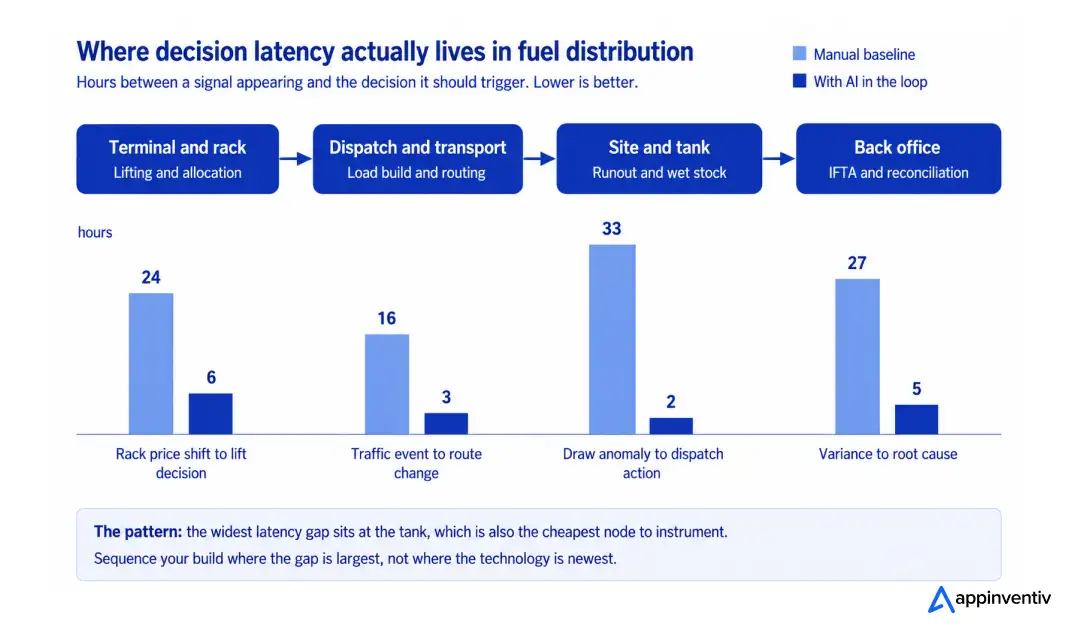
Practically, an AI-powered fuel distribution system sits in four places:
- Terminal and rack. Lifting optimization against posted rack prices, allocation constraints, and inbound scheduling.
- Dispatch and transport. Multicompartment load building, dynamic routing, and driver-hours feasibility checks before the load is assigned.
- Site and tank. Tank-level prediction, runout and retain avoidance, and anomaly detection on wet stock.
- Back office. Automated IFTA mileage allocation, exception-based invoice matching, and audit trail generation.
Research published in Energies in 2025 on hybrid human and AI collaboration in fuel delivery management makes a point we see borne out in every deployment: the returns come from matching AI to existing enterprise resource planning and dispatch processes, not from replacing the humans who run them. In plain terms, your dispatcher has to be able to override the system and have that override captured as a training signal.
That framing matters commercially, because it defines the role of AI in fuel distribution as augmentation with an audit trail rather than headcount replacement. It is also why generic AI in logistics playbooks underperform in downstream fuel. Parcel and LTL optimization assume fungible units. You are moving a regulated, temperature-sensitive, tax-encumbered commodity in compartmented vessels, which is why AI solutions for fuel distribution have to be built against your constraints rather than ported from a general logistics template.
Which AI Use Cases in Fuel Distribution Deliver Returns First?
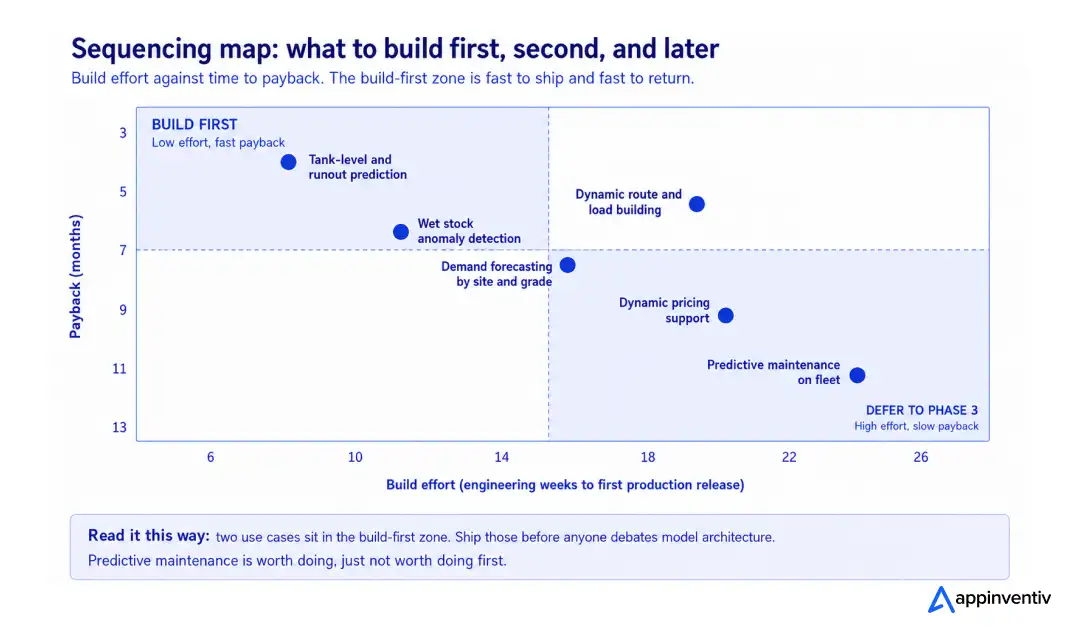
We sequence by payback period, not by sophistication. The ones that pay back inside two quarters share a trait: they attach to a decision that already happens on a fixed cadence and simply make it better.
| Use case | What the model does | Data you need on day one | Typical payback |
|---|---|---|---|
| Tank-level and Runout Prediction | Forecasts hourly draw per tank, flags runout and retain risk 48 to 72 hours out | ATG polls, delivery history, POS volume, local weather | 3 to 5 months |
| Dynamic Route and Load Building | Builds compartment-aware routes against live traffic, HOS, and site windows | Telematics, order book, site constraints, driver logs | 4 to 7 months |
| Wet Stock Anomaly Detection | Separates meter drift, temperature effect, and theft in the variance signal | ATG reconciliation, dispenser meters, delivery BOLs | 5 to 8 months |
| Demand Forecasting by Site and Grade | Predicts weekly volume per grade to drive procurement and allocation | 24+ months of volume, price spread, calendar features | 6 to 9 months |
| Predictive Maintenance on Fleet and Dispensers | Flags component failure before it strands a load | Engine fault codes, service history, dispenser telemetry | 8 to 14 months |
| Dynamic Pricing Support | Recommends street price against cost, elasticity, and competitor moves | Rack cost, volume, competitor pricing feed | 6 to 12 months |
Start at the top of that table. Ranking AI use cases in fuel distribution by payback rather than by ambition is the single discipline that keeps a program funded past year one. A US study on AI for sustainable logistics optimization tested Linear Regression, XGBoost, Support Vector Machines, and Neural Networks against real logistics datasets and found meaningful gains in route efficiency and delivery prediction using ordinary supervised methods. You do not need a frontier model to fix a runout problem. AI fuel demand forecasting works on clean tank data and a gradient boosting model that runs every hour.
The benefits of AI in fuel distribution show up as fewer emergency runs, higher drop sizes, and a reconciliation that closes without a mystery line item. Those are numbers your CFO already tracks, which is why the strongest AI applications in fuel distribution are the ones that improve a metric already on the Monday report.
Which AI Technologies in Fuel Distribution Actually Run in Production?
Here is the honest stack. We have shipped every layer below into regulated environments, and we have also watched teams overbuild the top of it while the bottom leaks.
| Layer | What runs in production | Where teams get it wrong |
|---|---|---|
| Ingestion | Kafka or Kinesis streams from ATG, telematics, POS, and ERP | Polling ATGs on a 4-hour cycle, which destroys the forecast horizon |
| Feature store | Versioned features for site, grade, driver, and vehicle | Rebuilding features in each notebook, so training and serving diverge |
| Forecasting | Gradient boosting for tabular demand, temporal fusion or LSTM for multihorizon site draw | Reaching for deep learning before exhausting XGBoost |
| Optimization | Mixed-integer programming with compartment and HOS constraints, reinforcement learning for rolling replanning | Treating this as a routing problem instead of a constrained assignment problem |
| Vision | Camera-based hose and grounding verification, placard and BOL extraction | Deploying without a human confirmation step on safety-critical checks |
| Agentic layer | Dispatcher copilots that draft plans and explain tradeoffs | Giving agents write access to dispatch before the guardrails exist |
| MLOps | Drift monitors, shadow deployments, retraining triggers, full decision logs | Shipping the model and skipping the monitoring, which is how you find drift in Q3 |
A 2025 study in Systems on machine learning-driven dynamic fleet rerouting shows the upside of getting the optimization layer right. Feeding real-time vehicle weight and local traffic into the routing model, rather than optimizing on static assumptions, cut both fuel consumption and emissions against conventional capacitated routing. Weight matters here more than almost anywhere else, because your vehicle sheds thousands of pounds at every stop.
If you are assembling this stack, the discipline you want in machine learning development services is boring: versioned data, reproducible training, and a rollback path. The AI technologies in fuel distribution that survive year two are the ones with monitoring attached. The interesting part is the domain constraints, not the algorithms.
Build explainable, auditable AI with decision logging designed for regulated environments.
How Do You Build a Fuel Distribution Management System That Survives an Audit?
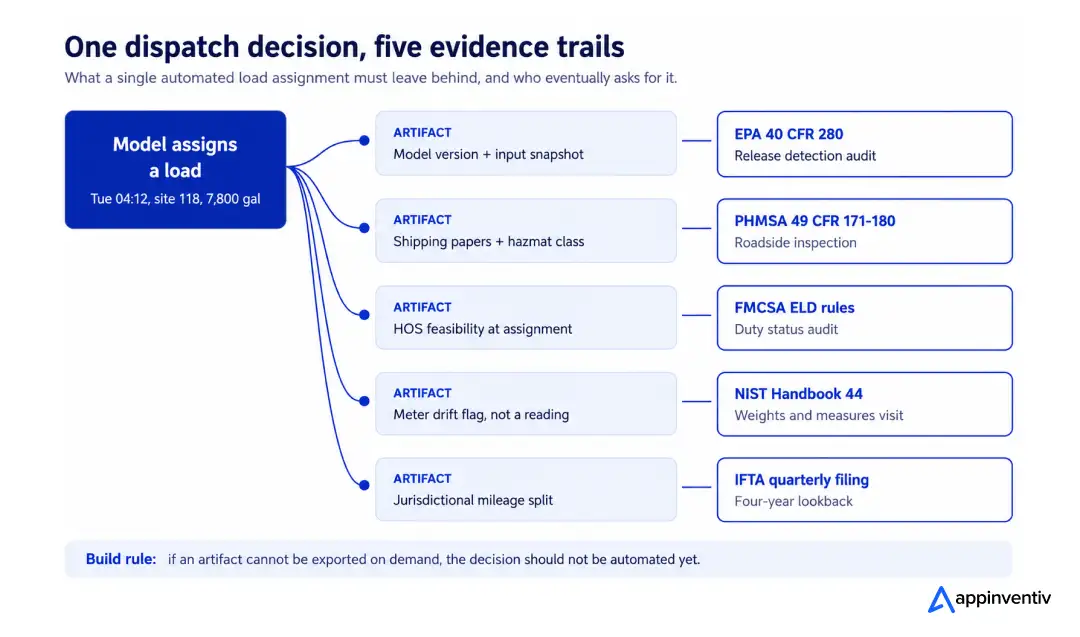
This is where most AI programs in this sector meet reality. You are not building a recommendation engine. You are building software whose outputs touch environmental compliance, hazmat transport, tax filing, and legal-for-trade measurement, all of which carry federal penalty exposure and none of which forgive a black box.
Every automated decision has to answer three questions on demand: what data produced it, which model version made it, and who could have overridden it. Design a fuel distribution management system around those three answers, and the audit becomes an export, not a fire drill.
| Regulatory surface | What it governs | What your system must produce |
|---|---|---|
| EPA 40 CFR Part 280, Subpart D | UST release detection, annual operability testing of leak detection components | Immutable ATG logs, alarm history, test records, and a clear line between model inference and the statutory detection method |
| PHMSA hazardous materials regulations, 49 CFR 171-180 | Classification, packaging, placarding, and carrier requirements for fuel transport | Shipping papers, driver qualification linkage, and emergency response info tied to each load |
| FMCSA hours of service and ELD rules | Driver duty status and logging for commercial motor vehicles | Route plans that are feasible against remaining HOS at the time of assignment, not at midnight |
| NIST Handbook 44, Section 3.30 | Legal-for-trade tolerance on retail motor fuel dispensers, maintenance tolerance of 1 cubic inch plus 1 cubic inch per indicated gallon | Meter drift analytics that flag calibration need without ever becoming the system of record |
| IFTA quarterly reporting | Jurisdictional mileage and fuel purchase reconciliation | Automated mileage allocation with four years of retained supporting records |
| NIST AI Risk Management Framework | Voluntary trustworthiness practices for AI systems | Documented risk mapping, measurement, and management for each deployed model |
That last row is moving fast. NIST issued a concept note in 2026 for an AI RMF profile covering trustworthy AI in critical infrastructure, aimed squarely at settings where AI decisions carry physical-world safety consequences. Energy is named in scope. Operators who build explainability and decision logging now will not be retrofitting it under deadline later.
One design rule we hold to without exception: AI advises on measurement; it never becomes measurement. Your legal-for-trade meter stays in the system of record. The model tells you when that meter is probably drifting.
Cybersecurity belongs in the same conversation. IBM’s 2025 Cost of a Data Breach Report put the average energy sector breach at $4.83 million, among the highest of any industry tracked. Connecting tanks, trucks, and terminals to a central inference layer widens the attack surface, and the big data analytics in oil and gas architecture you choose determines how much of that surface you expose.
How Much Does AI Integration in Fuel Distribution Cost?
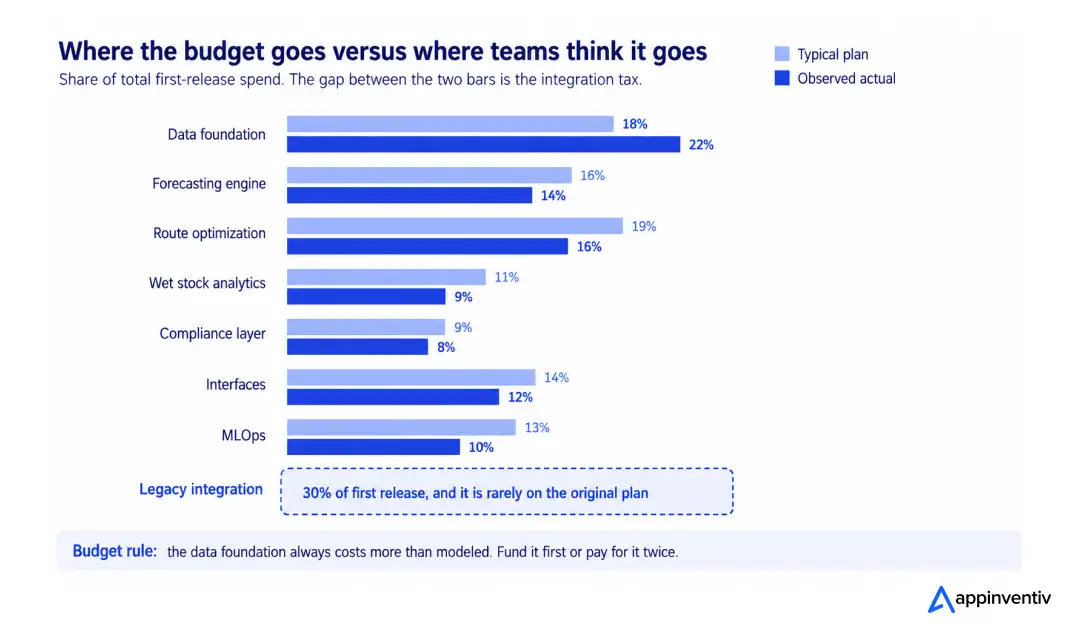
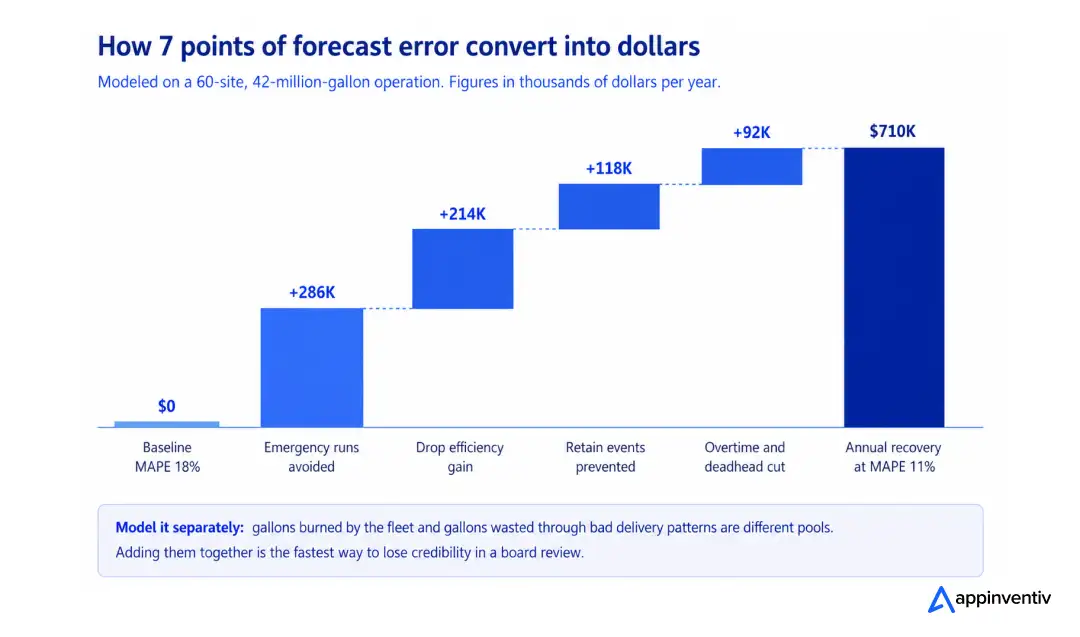
Straight answer, then the breakdown. A production-grade deployment of AI in fuel distribution for a midsize US distributor lands between $180,000 and $650,000 for the first release, with annual run cost at 18% to 25% of build.
Generally, we have identified that the AI development cost in 2026 typically ranges from $40,000 to $400,000+, depending on complexity, data readiness, and system scale. Additional requirements like predictive analytics and forecasting systems specifically sit in the $70,000 to $200,000 range. Fuel distribution sits at the upper end of that spread because of the integration and compliance load, not because the models are exotic.
Build Cost by Module
| Module | Scope | Cost range |
|---|---|---|
| Data Foundation | ATG, telematics, POS, and ERP ingestion, feature store, historical backfill | $45,000 to $110,000 |
| Demand Forecasting Engine | Site and grade level multihorizon models, backtesting harness | $60,000 to $140,000 |
| Route and Load Optimization | Compartment-aware MIP solver, HOS constraints, replanning loop | $70,000 to $180,000 |
| Wet Stock and Anomaly Detection | Variance decomposition, alerting, investigation workflow | $40,000 to $95,000 |
| Compliance and Audit Layer | Decision logging, model registry, evidence export for EPA, PHMSA, and IFTA | $35,000 to $85,000 |
| Dispatcher and Driver Interfaces | Web console, mobile app, override capture | $50,000 to $120,000 |
| MLOps and Monitoring | Drift detection, shadow deploys, retraining automation | $30,000 to $70,000 |
Annual Run Cost
| Line item | Typical annual range |
|---|---|
| Cloud Compute and Storage | $24,000 to $90,000 |
| Model Retraining and Data Engineering | $40,000 to $110,000 |
| Third-Party Data (Weather, Traffic, Competitor Pricing) | $12,000 to $45,000 |
| Support, Monitoring, and Compliance Upkeep | $30,000 to $80,000 |
The line item that blows budgets is never the model. It is integration into a 15-year-old dispatch system nobody has documented. Budget 30% of your first release for that work and you will be close. Teams running a legacy modernization track in parallel ship faster than teams bolting AI onto an untouched core.
Should You Build, Buy, or Blend Your Fuel Management Software?
Most operators land on blend, and they land there for the right reasons. Off-the-shelf platforms handle card control, tax reporting, and basic telemetry well. What packaged fuel distribution management software does not handle is your allocation logic, your customer-specific delivery contracts, or your rack strategy.
| Path | Fits when | Real cost | The catch |
|---|---|---|---|
| Buy | Under 25 sites, standard delivery patterns, no custom allocation | $30,000 to $120,000 per year subscription | Your data lives in someone else’s schema, and your forecasting is whatever they ship |
| Build | Complex allocation, proprietary pricing logic, multistate compliance load | $180,000 to $650,000 build, 18% to 25% annually | You own the roadmap and the maintenance |
| Blend | Most midsize and large US distributors | Platform subscription plus $120,000 to $400,000 custom layer | Integration discipline becomes the critical skill |
The blend pattern we deploy most often keeps commercial fleet fuel management software for cards, tax, and compliance reporting, then builds the forecasting and optimization layer on top of a unified data platform. Your fuel inventory management software captures what happened. The custom layer decides what happens next. That split keeps you off a vendor’s roadmap for the decisions that actually differentiate you.
Two things to check before you sign anything. Ask any fuel delivery management software vendor for their model’s backtested MAPE on sites like yours, then ask what happens to that number during a hurricane week. Ask second whether their fuel inventory management software exports raw event data or only reports, because a platform that will not give you your own tank history at the record level cannot support a custom forecasting layer later.
Fuel logistics management is ultimately a data ownership question dressed up as a software question. Own the events, rent the workflow.
Site count, complexity, and data readiness determine your investment. Get a tailored cost and payback model based on your operation.

How Do You Roll Out AI in Fuel Management Without Stalling Operations?
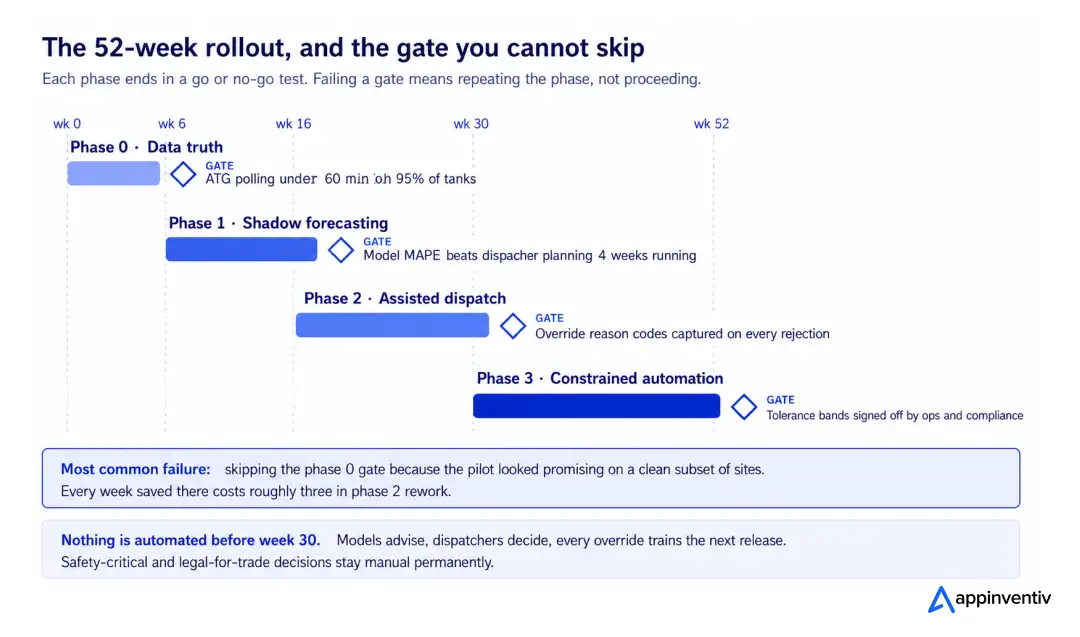
You do not big-bang this. We run a four-phase sequence, and phase zero always runs longer than clients expect.
Phase 0, weeks 1 to 6. Data truth. Audit ATG polling frequency, telematics coverage gaps, and the reconciliation process. Fix the polling cadence before anything else. If your tanks report every four hours, no model on earth will predict a runout 48 hours out.
Phase 1, weeks 6 to 16. Shadow forecasting. Run AI-powered demand forecasting models in parallel with your dispatchers, and let nobody act on model output yet. You are measuring MAPE against human planning and building dispatcher trust at the same time. This phase is where AI integration in fuel distribution either earns credibility or loses it permanently.
Phase 2, weeks 16 to 30. Assisted dispatch. Models propose, humans dispose. Every override gets captured with a reason code. Those reason codes become your most valuable training data and your best documentation for the auditor asking about human oversight.
Phase 3, weeks 30 to 52. Constrained automation. Auto-approve routine plans inside defined tolerance bands, escalate everything else. AI automation in fuel distribution should be bounded by explicit thresholds you can point to in a policy document, not by model confidence alone.
Two rules we enforce throughout. Never automate a safety-critical or legal-for-trade decision, and keep the IoT and telematics layer instrumented well enough to reconstruct any decision six months later.
Deloitte’s 2026 oil and gas outlook notes that advanced analytics and agentic capabilities are moving from pilot into enterprise-wide deployment, with US operators showing more coordinated adoption than most regions. The operators pulling ahead are not the ones with the biggest models. They are the ones who got phase 0 right.
Where Do AI in Fuel Distribution Programs Usually Fail?
Five failure modes account for nearly everything we have been called in to fix.
- Sensor Debt. Half the tanks report reliably, the other half drift, and nobody knows which is which. The model learns the noise. Fix instrumentation before modeling, always.
- Holiday and Event Blindness. A model trained on 24 months of data will misprice Memorial Day weekend at a site near a lake. Calendar and event features are not optional here.
- Override Starvation. Teams build the assisted dispatch layer without capturing why dispatchers reject recommendations, then wonder two quarters later why adoption stalled.
- Compliance Retrofit. Decision logging gets added after the fact, at three times the cost, under audit pressure. Build it in week one.
- Orphaned Ownership. The data science team ships and moves on. Nobody owns drift. By the following summer, the forecast was worse than the spreadsheet it replaced.
Every one of these is organizational, not technical. That matches what we see across AI in supply chain analytics deployments generally, and it is why we insist on a named internal owner before the first sprint. Governance is the part of AI in the fuel distribution control layer that nobody budgets for, and everybody needs.
What is Next for AI in Fuel and Logistics Distribution?
Four shifts are already visible in the work we are doing now.
- Agentic Dispatch. Copilots that draft a full day’s plan, explain the tradeoffs in plain language, and hand the dispatcher a defensible starting point. The value is not autonomy. Here is the explanation.
- Regulatory Codification of AI Oversight. The NIST critical infrastructure profile signals where this goes. Documented risk management for AI touching physical operations will become table stakes for anyone bidding on municipal or federal fuel contracts.
- Automated Transport Corridors. PHMSA opened rulemaking in December 2025 on modernizing hazardous materials regulations to accommodate highly automated transportation systems. Long horizon, but the telematics groundwork you lay now is the same groundwork those systems will need.
- Fuel Mix Complexity. Renewable diesel, ethanol blend variation, DEF, and EV charging at the same sites turn a single-product forecasting problem into a portfolio problem.
AI in fuel and logistics distribution is converging on a single operating picture across terminal, transport, and site. Operators building that picture on clean, governed data will absorb each new fuel type as a feature, not a project.
We check whether your vendor gives you raw event data or just reports and identify your best path forward.
How Can Appinventiv Help You Out?
We build the systems described above end-to-end for operators who cannot afford a rollout that disrupts deliveries.
Our teams have delivered more than 3,000 digital products across regulated, asset-heavy industries, and our AI development services follow the exact sequence this blog lays out: data truth first, shadow deployment second, constrained automation last. We bring certified AI engineers, data scientists, and MLOps specialists who have shipped explainable models into environments where an auditor eventually reads the logs.
What that looks like for a fuel operation:
- Discovery and data audit. We map your ATG, telematics, POS, and ERP landscape and tell you what is model-ready and what is not.
- Forecasting and optimization build. Site-level demand models, compartment-aware routing, and wet stock analytics on your data, not a template.
- Compliance architecture. Decision logging, model registry, and evidence export designed against EPA, PHMSA, FMCSA, and NIST expectations from day one.
- Integration into what you already run. Our logistics software development practice connects TMS, WMS, ERP, GPS, and telematics into one operational environment rather than another silo.
- Operate and improve. Drift monitoring, retraining, and a named team that stays after launch.
AI in the oil and gas AI industry earns its place by “continuously monitoring operations against established standards” and detecting compliance issues in real time. That is a materially different design goal than chasing efficiency alone, and it is the standard we build to.
Want a grounded read on your own operation? Our team runs a two-week data readiness assessment and hands you a cost build plan with a payback model you can take to your board. Talk to our engineering team, and we will start with your tank data.
FAQs
Q. How is AI transforming fuel distribution logistics?
A. It moves decisions earlier. Instead of reacting to a runout, dispatchers see a 48- to 72-hour forecast per tank and build loads against it. Instead of reconciling wet stock variance monthly, anomaly models separate meter drift from temperature effect from theft within hours.
Routing shifts from static milk runs to compartment-aware plans that account for live traffic, weight loss at each stop, and remaining driver hours. The measurable outcomes are fewer emergency deliveries, larger drop sizes, and a reconciliation that closes cleanly.
Q. What are the best software solutions for AI-driven fuel demand forecasting?
A. The right answer depends on your scale and how custom your allocation logic is. Under roughly 25 sites with standard delivery patterns, a commercial platform with built-in forecasting is usually sufficient. Above that, or with proprietary pricing and multistate compliance exposure, a custom forecasting layer on top of a unified data platform performs materially better because it can use your specific price spread, contract, and site features.
Whichever path you take, insist on seeing backtested mean absolute percentage error on sites comparable to yours, including performance during weather disruptions.
Q. What are the benefits of machine learning in fuel inventory management?
A. Four benefits show up consistently. Runout and retain events drop because tank-level prediction replaces threshold alerts. Working capital improves because inventory is positioned against forecast demand rather than safety stock rules of thumb. Shrink becomes explainable, since variance decomposition attributes losses to a cause instead of leaving a mystery line item. And audit posture improves, because every reorder carries a logged rationale. Operators typically see the first two within two quarters.
Q. How much does it cost to develop a fuel management system?
A. For a midsize US distributor, expect $180,000 to $650,000 for a production-grade first release, with annual run cost at 18% to 25% of build. Data foundation work runs $45,000 to $110,000, forecasting $60,000 to $140,000, and route optimization $70,000 to $180,000. The single largest budget risk is integration with legacy dispatch and ERP systems, which routinely consumes 30% of first-release effort. A narrower pilot scoped to forecasting alone can start closer to $90,000.
Q. Why work with Appinventiv on a fuel distribution AI build?
A. Because we have shipped compliance-heavy AI into production, not just prototypes. Our teams bring certified AI engineers, data scientists, and MLOps specialists who design decision logging, model registries, and evidence exports against EPA, PHMSA, FMCSA, and NIST expectations from the first sprint rather than retrofitting them under audit pressure. We have delivered more than 3,000 digital products across regulated industries, and we start every fuel engagement with a two-week data readiness assessment so you know what is buildable before you commit budget.


Fast 2-minute response, fully NDA-protected.

AI Data Integration: How to Connect, Clean and Prepare Data for AI
Key takeaways: AI initiatives fail when fragmented, poor-quality data reaches models without sufficient context, controls or ownership. AI-ready pipelines must connect, clean, enrich, govern and continuously monitor data across its lifecycle. Real-time processing matters when AI decisions depend on current transactions, events, inventory or operational conditions. Data architecture should follow the AI use case, balancing…

AI Agent Governance: How to Govern Autonomous AI Across Business Systems
Key takeaways: AI agents require controls at the action, identity, data, tool, and workflow levels. Every enterprise agent should have a registered owner, an approved purpose, and a defined risk tier. Access must be based on the agent’s task rather than inherited from a human user or shared service account. High-impact actions need real-time policy…

'I.D.E.A.S.' - The Five Pillar Framework to Ace AI-Native Enterprise Apps in 2027
Key takeaways: AI-native enterprise apps are moving beyond AI agents toward intelligent, adaptive, autonomous and context-aware digital capabilities that can operate across mobile, web, voice, wearables and emerging interfaces. The I.D.E.A.S. framework for AI enterprise apps in 2027 - Interactive Intent, Decisioning Autonomously, Experiential System Design, Adaptive Execution, and Security Layered. Context intelligence and reusable…