


































Cybersecurity for Banking: Solutions, Strategies, Risks & Best Practices

 Share -


- 01Cybersecurity for Banking: A Strategic Business Priority
- 02Benefits of Cybersecurity for Banking Industry That Show Up on the Balance Sheet
- 03Major Cybersecurity Threats Banks Face Today
- 04Global Banking Cybersecurity Regulations and Compliance
- 05Core Cybersecurity Solutions Across Banking Systems
- 06Banking Cybersecurity Architecture and How the Layers Fit Together
- 07Cybersecurity Best Practices for Banking That Keep Defenses Working
- 08AI and Agentic AI Security in Banking: Where It Helps and Where It Creates Risk
- 09Cyber Resilience for Banking When Prevention Fails
- 10Third-Party and Supply Chain Cybersecurity Banks Can't Fully Control
- 11Challenges in Implementing Cybersecurity for Banking
- 12How to Build a Modern Cybersecurity Strategy for Banking
- 13Future of Cybersecurity for Banking
- 14How Appinventiv Can Help Strengthen Banking Cybersecurity
- 15FAQs

Key takeaways:
- Banking cyber risk spans identity systems, software APIs, cloud platforms, payment networks, mobile apps, employees, and external suppliers.
- Ransomware, account theft, API abuse, vendor compromises, and payment fraud directly halt core banking services.
- Phishing-resistant authentication, Zero Trust rules, network segmentation, continuous logging, encryption, and secure coding form strong defenses.
- Agentic AI creates new threats through excessive rights, prompt injection, tool abuse, unmonitored actions, and network failures.
- Penetration testing reveals security vulnerabilities across web portals, mobile apps, APIs, cloud environments, and payment channels.
The importance of cybersecurity in banking is now a board-level financial question, not just a technical one. A stolen credential, an exposed API, or an unmonitored AI agent can lock payment systems and trigger regulatory action within hours.
Cybersecurity for banking now covers mobile apps, APIs, cloud workloads, payment platforms, customer identities, employee accounts, and third-party connections. Each connection gives attackers another way in. Basel’s 2026 operational resilience guidance tells banks to protect critical information assets and build tested capabilities for protection, detection, response, and recovery.
Regulators are raising the bar on identity, access, third-party oversight, incident response, and critical ICT systems. Banks that fall short face direct financial and reputational costs.
This guide covers cybersecurity for banking through what matters most to leadership: business impact, major threats, security architecture, AI and agentic AI risks, regulatory obligations, resilience, and the steps needed to build stronger enterprise security.
Find security gaps across identities, applications, APIs, cloud systems, and critical banking infrastructure before attackers exploit them.

Cybersecurity for Banking: A Strategic Business Priority
The importance of cybersecurity in banking is now measurable in financial terms, with cyber risk carrying a direct impact on banking operations. The European Banking Authority reported about €730 million in materialized losses from newly reported ICT events across EU banks in 2025, up from about €650 million in 2024. The number of reported events fell, yet the average loss per event increased.
The same assessment found that 74% of banks still ranked cyber risk and data security among their main operational risk drivers in spring 2026. 52% identified fraud as another leading driver.
Financial exposure goes beyond direct losses. A prolonged outage can affect payment processing, customer access, trading activity, and internal operations. A compromised privileged account can expose high-value systems before detection teams react.
For the C-suite, cybersecurity spending should track business exposure. Board reporting should connect security controls with fraud losses, critical service uptime, incident response times, and unresolved high-risk vulnerabilities.
Benefits of Cybersecurity for Banking Industry That Show Up on the Balance Sheet
Strong cybersecurity does more than block attacks. It protects revenue, customer trust, and the bank’s ability to operate without interruption.
- Fewer service disruptions: A bank with tested detection and containment stops an incident before it reaches core systems. Payments continue to process, and customers retain access to their accounts during an active threat.
- Lower fraud losses: Real-time transaction scoring and behavioral analytics detect account takeover and payment fraud before funds are moved. Every prevented transfer is money that never has to be recovered or written off.
- Stronger customer trust: Customers stay with a bank that protects their data and their money. A single public breach pushes account holders toward competitors, and rebuilding that trust takes years, not quarters.
- Faster regulatory compliance: Banks that build controls around identity, access, and incident response meet Basel, DORA, FFIEC, and PCI DSS requirements with less last-minute work. Clean audit evidence also speeds up regulatory reviews and reduces fines.
- Lower cost of incident response: A bank that detects and contains threats early spends less on forensic investigations, legal responses, and customer notifications. Mean time to detect and mean time to contain both drop the cost of every incident that does occur.
- Better third-party and partner confidence: Fintech partners, payment networks, and vendors prefer working with banks that can prove strong security posture. This opens up more opportunities for partnerships and integration without additional risk review delays.
These benefits of cybersecurity for banking industry stakeholders show up directly on the balance sheet, not just in the security team’s dashboard.
Major Cybersecurity Threats Banks Face Today
Cybersecurity risks across banking identity platforms, payment networks, software systems, and external suppliers remain closely connected. Cybersecurity breaches in banking often start with a single compromised credential that grants deep network access, or with a weak vendor exposing confidential records. Banking leadership must address seven major operational threats directly.
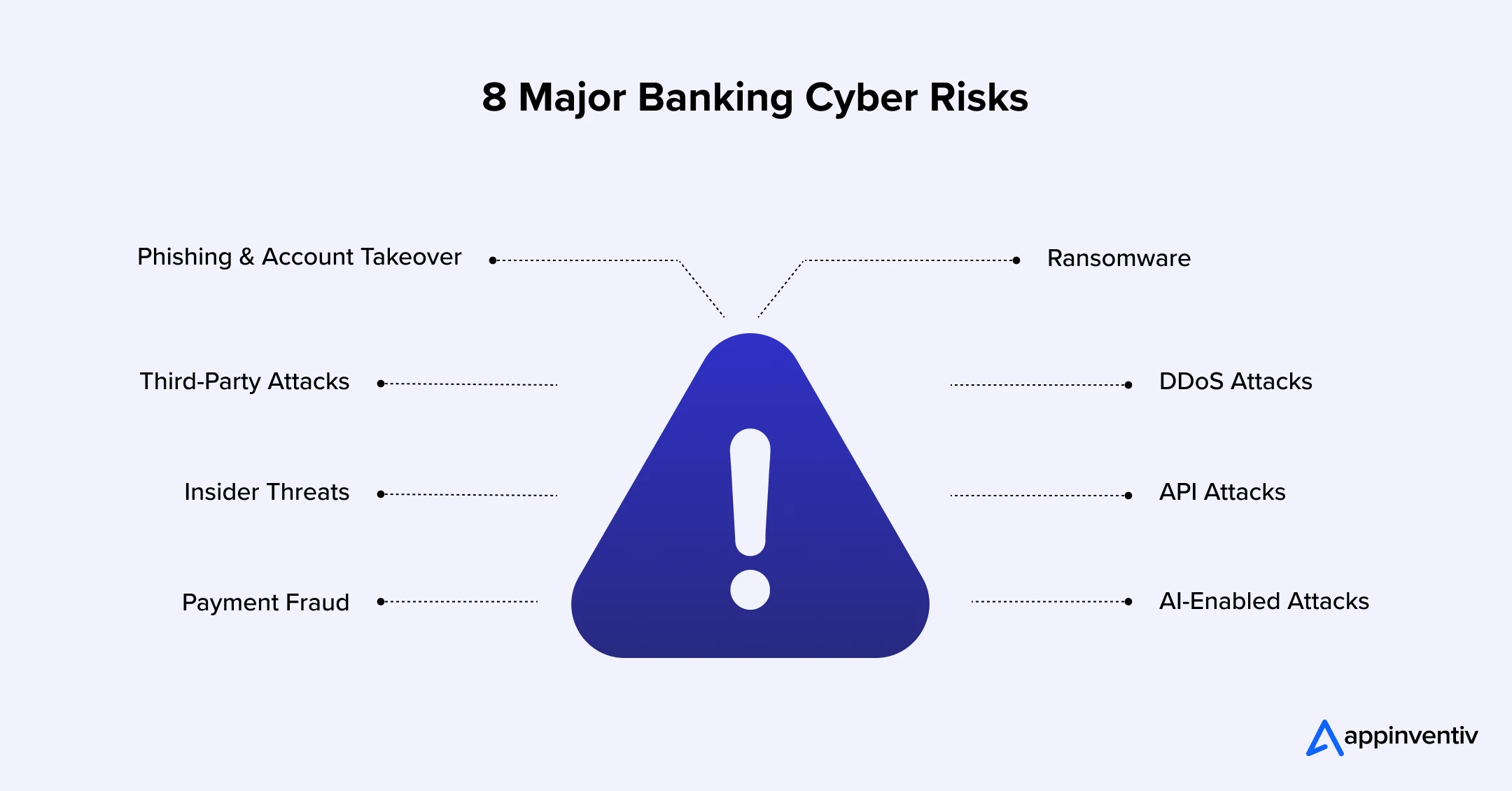
Phishing, Social Engineering, and Account Takeover
Criminals target humans directly to bypass technical perimeter defenses. Fraudulent support calls, fake login portals, and stolen security codes hand valid user credentials straight to intruders. Prompt fatigue forces approval through repeated login requests, and interception setups capture active session tokens during legitimate access attempts.
The FBI documented over 5,100 account takeover complaints, resulting in $262 million in losses, between January and November 2025. Impostors routinely posed as bank staff using text messages, calls, and emails to steal verification details.
Defenses require unified device intelligence, transaction oversight, and phishing-resistant hardware keys. Multi-factor authentication alone leaves several exposure paths open.
Also Read: How to Prevent Social Engineering Attacks in the Enterprise: Types, Examples, and Defense Strategies
Ransomware
Malware encryption turns off core operational assets beyond simple storage folders. Network lockouts halt equity trading, ledger updates, clearing settlement channels, and client services.
One of the most cited cybersecurity breaches in banking occurred when ICBC Financial Services detected ransomware on November 8, 2023. System lockouts stopped ledger maintenance and forced detachment from settlement agents, halting normal trading. The SEC cited poor emergency preparation as a primary failure factor.
Executive teams must verify operational continuity for critical services rather than relying on standard data backups. True resilience demands tested system restores, isolated network segments, strict admin controls, and explicit management authorization protocols.
Supply Chain and Third-Party Attacks
Financial institutions depend heavily on external cloud hosts, software developers, payment clearinghouses, and technical partners. Compromised vendor software grants direct access to institutional records.
Umpqua Bank reported a 2023 MOVEit vendor breach that exposed personal data for 429,252 customers. Leaked records contained full names, tax identifiers, and Social Security numbers. A 2024 event at the Federal Home Loan Bank of New York highlighted hidden downstream exposure.
Security teams stopped an attempted wire transfer linked to a compromised fourth-party contractor serving an active supplier. External audits must evaluate fourth-party links, system rights, data paths, breach reporting rules, and offboarding routines. Basic compliance surveys fail to reveal live vendor behavior inside private networks.
DDoS Attacks
Volumetric traffic floods knock web portals, mobile platforms, payment gateways, and core interfaces offline. Malicious bot networks generate massive bandwidth bursts to overwhelm network infrastructure limits.
An FBI investigation documented a campaign that began in 2012 and targeted nearly 50 financial organizations, with attempts at heavy disruption. Federal agencies coordinated threat intelligence updates to assist banking teams with containment efforts.
Operational resilience requires live stress testing against client application flows and supply partners. Automated rate caps, deep packet filtering, redundant server arrays, and backup routing paths must perform under actual crisis conditions.
Insider Threats and Privileged Access Abuse
Internal risks originate from current staff, external contractors, systems managers, and hijacked administrative accounts possessing excessive access rights. Unrevoked user tokens from departed workers create persistent vulnerability points.
Security operations must link administrative identities directly to core software and conduct continuous credential audits. Tactical risk containment relies on temporary access grants, strict administrative controls, divided operational duties, and instant account termination protocols.
API and Application Attacks
Connected digital banking relies on application programming interfaces linking mobile tools, settlement systems, fintech vendors, and core databases. Flawed access rules leak private customer balances. Flawed input validation opens backdoors for code injection. Broad administrative rights allow compromised scripts to manipulate sensitive internal functions.
Security assessments must inspect login verification, user permission levels, session state data, business rules, and outward data transfers. Skilled ethical hackers spot complex logical errors across interconnected financial tools that automated software fails to catch.
Payment Fraud and Transaction Manipulation
Network security breaches directly trigger illegal monetary transfers. Fraudsters use stolen login data, intercepted corporate email accounts, deceptive messaging, and altered routing numbers to launch illegal transfers. The OCC explicitly flags credential theft, email compromises, and account takeovers as primary catalysts for financial crime.
Modern protection requires adaptive transaction scoring rather than rigid conditional filters. Real-time evaluation models process device fingerprints, user habits, recipient history, transfer amounts, and anomalous actions before funds are cleared. Suspicious wire attempts demand secondary authentication checks or manual staff approval.
AI-Enabled Cyberattacks
Artificial intelligence helps threat actors generate persuasive scam communications, clone human voices, craft synthetic identities, and execute automated attacks. These automated capabilities expand the volume and precision of social engineering attempts.
The FBI recorded 22,364 complaints related to AI exploitation in 2025, resulting in total losses exceeding $893 million. The report highlighted deepfake audio, manipulated video, fake social profiles, and tailored chat interactions as core drivers of corporate fraud.
The Federal Reserve issued distinct warnings regarding deepfake threats targeting identity systems. Institutions must reframe automated threats as broader vulnerabilities in identity management. A resilient defense strategy unites strict authentication, transaction limits, voice identity checks, and continuous behavioral telemetry.
Also Read: Digital Immune System – How it Shields Your Business Against Cyberattacks
Global Banking Cybersecurity Regulations and Compliance
Cybersecurity for banking compliance regimes differs across geographies, banking models, payment activities and even banking services. Cybersecurity regulations & compliance for banks require security operations to directly correlate applicable legal requirements with a person, a control, an audit trail, and a testing schedule.
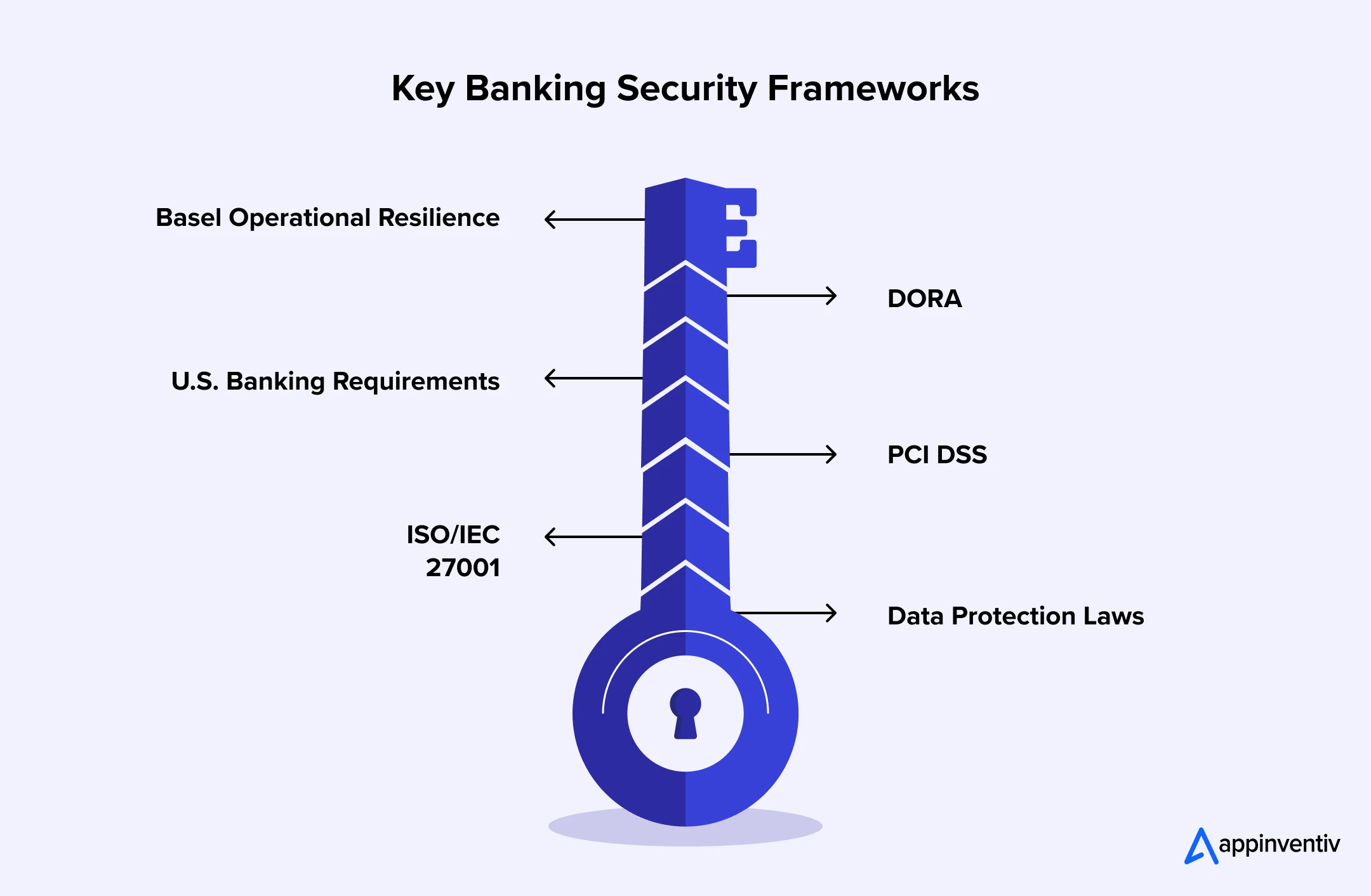
Basel Operational Resilience Principles
The Basel Committee sets resilience principles for corporate governance, business continuity, third-party risk, incident management, and information technology systems. These global standards keep critical banking functions running during a crisis. Banks document their core services, dependencies, backups, and control gaps. The board reviews operational risk by tracking how security incidents affect core banking operations.
DORA
The EU Digital Operational Resilience Act sets technical requirements for risk management, incident reporting, resilience testing, and third-party vendor oversight. Covered institutions must show proof through documented risk assessments, active incident protocols, and ongoing provider monitoring.
U.S. Banking Cybersecurity Expectations
Financial institutions in the U.S. answer to federal regulators, state authorities, and specific agency oversight. The FFIEC and banking agencies set rules for data protection, authentication, incident response, and vendor risk management. Regional rules like NYDFS 23 NYCRR Part 500 add stricter requirements for governance, risk assessment, access control, and breach notification. Security teams build their own jurisdiction-specific control ledgers rather than relying on generic compliance checklists.
PCI DSS for Payment Environments
PCI DSS v4.0.1 applies to any organization that processes, stores, or transmits credit card data. Security teams track cardholder data movement, access rights, encryption levels, vulnerability handling, and audit logging against fixed technical standards. Ethical hacking tests check the security of payment applications and related software.
ISO/IEC 27001
ISO/IEC 27001:2022 sets specifications for building an information security management system. The framework structures security across people, processes, and technology. Banks use this standard to assign control ownership, gather audit evidence, and run remediation plans that meet regulatory requirements.
Data Protection and Privacy Requirements
Information security strategies must align with global privacy laws. The GDPR sets data-handling rules for processing personal information of European Economic Area residents. Security teams enforce data lifecycle controls through classification rules, encryption, access limits, loss prevention policies, and secure record destruction. Leadership tracks compliance through mapped controls, clear ownership, active testing, and verified audit evidence.
Core Cybersecurity Solutions Across Banking Systems
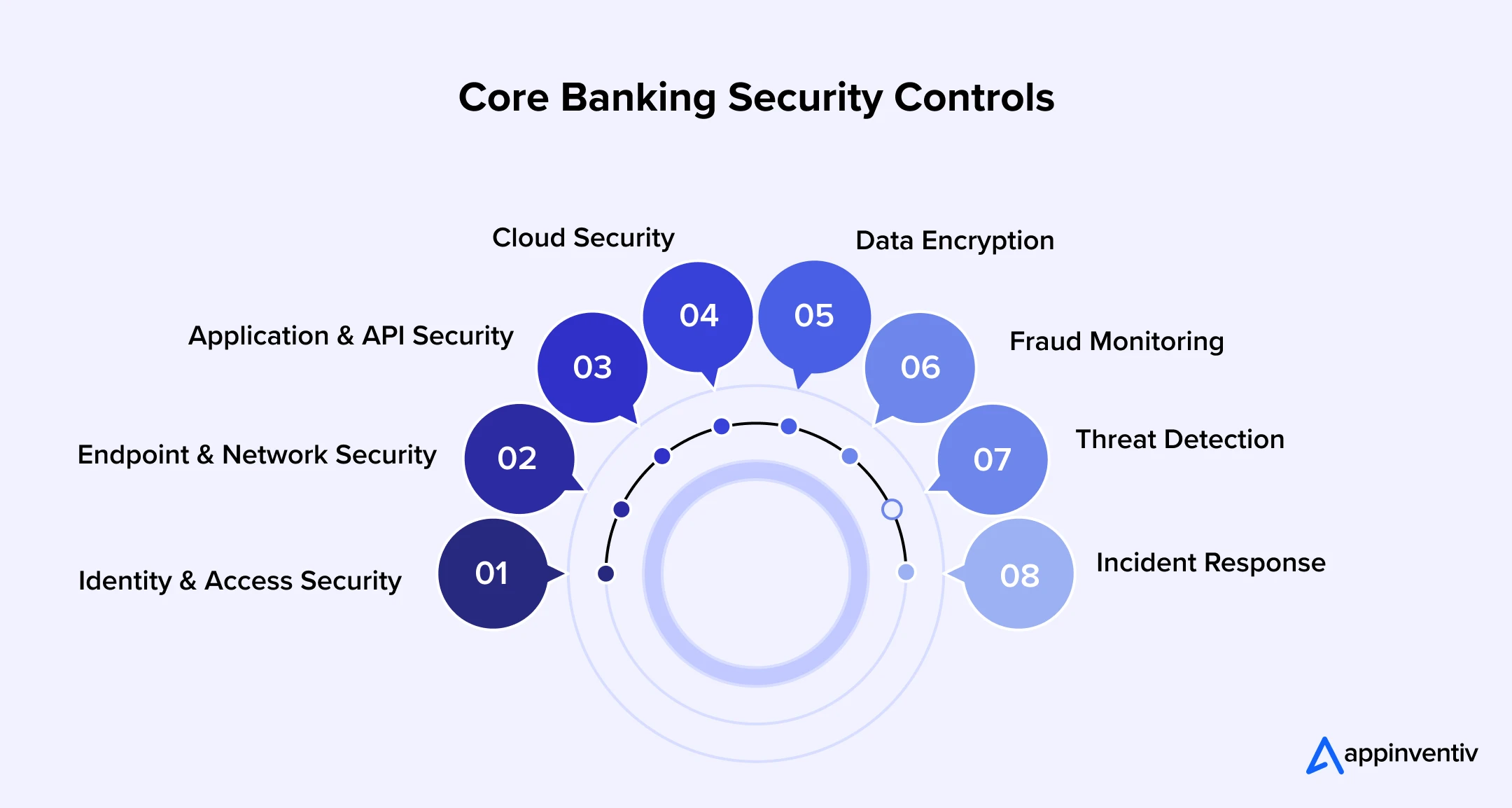
Modern cybersecurity solutions for banks need to protect specific attack surfaces rather than operate as disconnected security products. A banking security stack typically combines identity controls, application protection, network defense, data security, fraud detection, and security operations.
Identity Protection With IAM, PAM, FIDO2, and IGA
IAM, PAM, IGA, FIDO2, WebAuthn, and passkeys control access for customers, employees, administrators, and service accounts. PAM limits privileged access to approved users and tasks, while IGA manages access changes across directories and enterprise applications.
The key objective is to prevent stolen or excessive credentials from reaching high-value banking systems. Banks should pay close attention to standing administrative access, inactive accounts, service identities, and privileged connections to core systems.
Application and API Security With DevSecOps Controls
Banking applications need protection across web interfaces, mobile backends, microservices, and APIs. WAFs, API gateways, OAuth 2.0, mTLS, SAST, DAST, SCA, secret scanning, and SBOMs form the main technical layer.
These controls help identify vulnerable code, insecure dependencies, exposed secrets, weak authentication, and unauthorized API access. Manual security testing adds another layer by examining business logic and attack paths that automated scanners may not detect.
This is where cloud application security also becomes relevant for banks running customer-facing workloads on cloud infrastructure.
Mobile Application Security With RASP and Device Intelligence
Banking application security depends on defending the app itself, not just the servers behind it. Cybersecurity in digital banking now requires Runtime Application Self-Protection (RASP), which flags suspicious code changes while the app runs, alongside device binding and emulator detection that catch sessions running on compromised hardware.
Authentication on mobile pairs phishing-resistant methods with short-lived tokens and session timeouts, closing the gap that a stolen password alone used to open.
Endpoint and Network Defense With EDR, XDR, and Micro-Segmentation
Banks need visibility across employee devices, servers, virtual machines, ATMs, and connected IoT in banking environments. EDR, XDR, NDR, next-generation firewalls, NAC, segmentation, and micro-segmentation help detect malicious activity and restrict unauthorized movement.
Network policies should separate high-value environments such as core banking, payment processing, administrative systems, and customer-facing applications. This limits unnecessary communication between workloads during a compromise.
Cloud Workload Security With CSPM, CIEM, and CWPP
Cloud computing platforms introduce security requirements across identities, storage, containers, workloads, and configurations. Banks can use CSPM, CIEM, CWPP, secrets management, cloud-native logging, and workload isolation to control these environments.
CSPM identifies configuration problems. CIEM helps detect excessive cloud permissions. CWPP monitors workloads for malicious activity. Together, these controls give security teams better visibility across hybrid banking infrastructure.
Financial Data Protection With Encryption, Tokenization, and HSMs
Banks need separate controls for customer records, payment information, credentials, and other sensitive financial data. Encryption, tokenization, HSMs, DLP, database activity monitoring, and cryptographic key management protect data across storage, transmission, and processing.
Payment environments need stronger transaction controls than ordinary data systems. Device intelligence, beneficiary analysis, transaction velocity, and behavioral signals can feed machine learning analytics that identify suspicious activity before settlement.
Fraud Detection With Behavioral and Transaction Analytics
A banking SOC needs telemetry from identity systems, endpoints, networks, applications, cloud infrastructure, and payment systems. SIEM, UEBA, XDR, SOAR, threat intelligence, and automated orchestration bring these signals together.
A SIEM can correlate events into an investigation timeline. UEBA can flag unusual user or service-account behavior. A sudden device change, paired with a new beneficiary and a high-value transfer, is exactly the kind of pattern UEBA is built to catch before a transaction clears. SOAR can automate predefined actions such as isolating an endpoint or disabling a compromised identity. Automated orchestration tools can reduce the manual work required during active incidents.
Also Read: Cybersecurity Measures for Businesses
Banking Cybersecurity Architecture and How the Layers Fit Together
Modern cybersecurity in banking guards every technical layer and governs system interactions. Operations span user identities, digital channels, APIs, banking software, core ledgers, data storage, and security platforms.
- Identity Layer: Security teams deploy FIDO2 keys, adaptive verification, and identity platforms to manage access for customers, employees, administrators, and system services.
- Channel Layer: Web and mobile portals rely on web firewalls, bot filters, device signals, session controls, and runtime protection.
- API Layer: Gateways enforce user permissions, rate caps, schema validation, mutual TLS, and token policies across internal and external connections.
- Application Layer: Microservices and banking software deploy secure coding standards, vault credential management, service-to-service verification, and live runtime defenses.
- Core and Payment Layer: Core ledgers and payment switches require network segmentation, strict admin rights, continuous transaction monitoring, and strong authorization.
- Data Layer: Databases, data lakes, backups, and payment records use encryption, tokenization, hardware key management, and activity monitoring.
What a Modern Banking Security Stack Looks Like Across Banking Cybersecurity Solutions
| Security Objective | Technologies Used |
|---|---|
| Identity Protection | IAM, PAM, IGA, FIDO2, WebAuthn, passkeys |
| Application Protection | WAF, SAST, DAST, SCA, RASP |
| API Protection | API gateways, OAuth 2.0, mTLS, rate limiting |
| Infrastructure Defense | EDR, XDR, NDR, NGFW, NAC, micro-segmentation |
| Cloud Protection | CSPM, CIEM, CWPP, secrets management |
| Data Protection | Encryption, tokenization, HSM, DLP |
| Fraud Prevention | Behavioral analytics, device intelligence, transaction scoring |
| Threat Detection | SIEM, UEBA, SOAR, threat intelligence |
The strongest cybersecurity in banking programs connect these layers through shared identity policies, centralized telemetry, risk-based access, and continuous testing. That gives security teams a common view of threats instead of separate alerts from isolated tools.
Zero Trust protocols, threat intelligence, centralized logging, and behavioral analytics maintain continuous visibility across all environments. Effective architectures limit internal system trust, restrict lateral traffic, and retain detailed audit trails for high-risk operations.
Cybersecurity Best Practices for Banking That Keep Defenses Working
Strong cybersecurity in the banking sector runs on habits, not just tools. The same controls fail without regular testing, clear ownership, and metrics that show whether defenses work under pressure.
Patch On A Fixed Schedule
Banks set a deadline for every critical vulnerability and track how long each remains open. A patch that sits unapplied for weeks gives attackers a wider window to act.
Run Tabletop Exercises Every Quarter
IT, legal, executive leadership, and communications teams walk through ransomware, business email compromise, and vendor-breach scenarios together. These sessions test decisions under pressure, not just technical response.
Review Access Rights On A Set Cadence
Security teams remove standing admin access, inactive accounts, and unused service identities before an audit finds them. Departed employees lose access to Active Directory, VPN certificates, and cloud sessions on their last day, not weeks later.
Test Recovery, Not Just Backups
A backup that exists but has never been restored is not a recovery plan. Banks that test failover environments and restoration tools on a schedule recover faster during an actual outage.
Track Metrics That Show Real Resilience
Vanity metrics, like the number of firewall blocks, say little about how a bank would perform during an attack. The metrics below are directly tied to operational risk management in banking and provide the board with a clear view of security performance.
| Metric | What it shows |
|---|---|
| MTTD (Mean Time to Detect) | Speed of threat detection |
| MTTC (Mean Time to Contain) | Speed of threat containment |
| Recovery time | Ability to restore critical services |
| Critical vulnerability exposure | Unresolved exploitable risk |
| Privileged account exposure | High-risk administrative access |
| Fraud losses prevented | Financial impact of security controls |
| Critical service uptime | Effect of security on availability |
| Regulatory findings | Open compliance and control gaps |
Banks that review these numbers every quarter catch drift in their security posture before it turns into an incident.
AI and Agentic AI Security in Banking: Where It Helps and Where It Creates Risk
AI in banking now supports fraud detection, customer risk analysis, threat detection, and security operations. Financial institutions process large volumes of behavioral and transactional data with machine learning models. This cuts the workload for manual review teams.
AI-Enabled Attacks and Defensive Analytics
Attackers use artificial intelligence to write convincing phishing messages, clone voices, generate fake videos, and automate target reconnaissance. These methods raise the speed and volume of social engineering campaigns.
AI cybersecurity for banking institutions uses anomaly detection, behavioral analytics, UEBA, and machine learning to spot activity that breaks from normal patterns. Fraud engines combine device, account, location, and transaction signals to build real-time risk scores. Security teams then rank alerts, link related events, and use AI agents for cybersecurity for fixed containment tasks.
Cybersecurity Risks of Agentic AI in Banking
Agentic AI in banking creates a wider security problem than standard AI models. Agents read context, pull data, call tools, and take action without a person having to run every step.
The main cybersecurity risks of agentic AI in banking include:
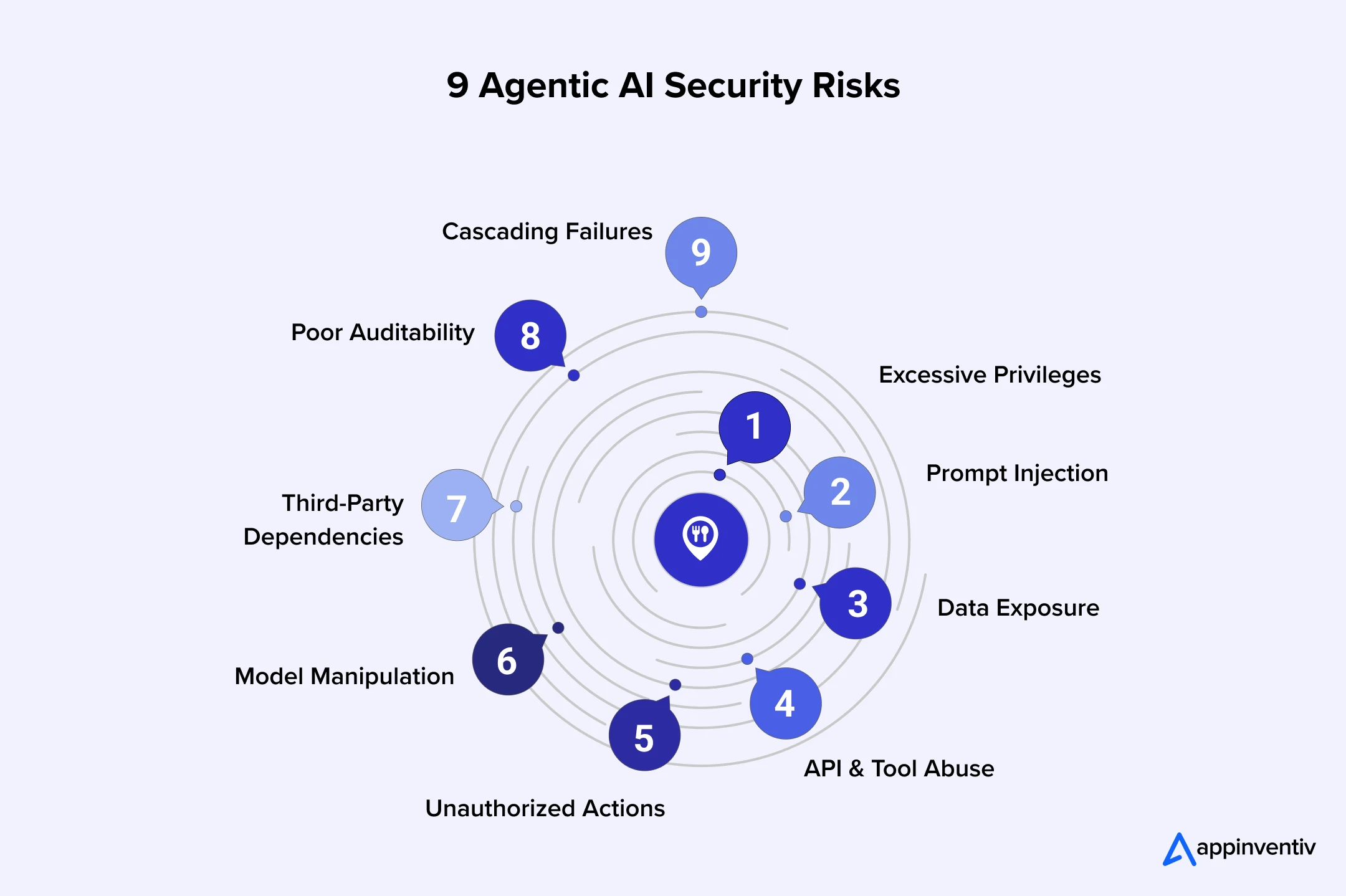
Excessive permissions can give a compromised agent access to customer records, payment systems, or administrative functions.
Prompt injection can manipulate an agent by embedding harmful content in emails, documents, websites, or retrieved data. NIST has named indirect prompt injection a security risk for tool-using agents.
Agent connections to payment APIs, databases, CRM systems, and internal services build another attack surface. A compromised agent can misuse legitimate tools when authorization rules are weak. High-risk actions, such as payment execution, account changes, and permission updates, need stricter controls.
Data exposure raises separate concerns. Agents process customer information, transaction records, internal documents, and compliance data. Weak retrieval permissions or output controls can expose data beyond the intended user or workflow.
Third-party AI platforms add further exposure through foundation models, cloud infrastructure, vector databases, and external AI services. Banks should check data handling, access policies, service dependencies, and incident procedures for every external provider. This is where working with a qualified cybersecurity solutions provider supports a wider security assessment and control design.
Controls for Securing Banking AI and Agents
Fixing these risks takes the same discipline banks apply to human access, built for systems that act on their own.
- Give each agent its own identity: A shared or generic login makes it impossible to trace which agent took which action. A dedicated identity per agent ties every request back to a single, auditable source.
- Apply least-privilege and tool-level authorization: An agent gets access only to the specific tools and data required by its task, nothing more. This limits what a compromised agent can reach, even if an attacker gains control of it.
- Sandbox agents and set data-access boundaries: Agents run in isolated environments separate from core banking systems. Weak retrieval permissions cannot then expose data outside the agent’s assigned scope.
- Set transaction limits and human approval thresholds: High-risk actions, such as payment execution or permission changes, undergo a human review before completion. This stops a manipulated agent from executing damage at machine speed.
- Test for prompt injection before deployment: Security teams run adversarial tests using the same malicious content types attackers use, hidden instructions in emails, documents, and retrieved data. This catches manipulation paths before an agent goes live.
- Monitor agents at runtime and log every action: Logs capture which agent acted, what data it accessed, which tools it called, and what followed. Red teaming and model validation, run on a set schedule, catch drift between how an agent was designed to behave and how it actually behaves.
- Build in an emergency kill switch: Security teams need a way to shut down a specific agent instantly, without disrupting the wider system, the moment monitoring flags abnormal behavior.
These controls give artificial intelligence in cybersecurity for banking and finance clear boundaries. Banks can run autonomous systems without losing control over what those systems touch.
Cyber Resilience for Banking When Prevention Fails
Cyber resilience keeps core banking operations running through an active incident, not just after one. The Basel Committee ties operational resilience directly to a bank’s ability to protect, detect, respond to, and recover from major disruptions. The Best Practices section above covers the testing habits that make this work. This section covers the framework those habits support.
- Prevent: Patch routines, identity controls, and network segmentation reduce the likelihood that a disruption will reach critical assets in the first place.
- Detect: Real-time visibility across identities, endpoints, and payment channels catches intrusions before they spread. Detection speed decides how far an attacker gets.
- Contain: Isolating an affected endpoint, revoking credentials, or pausing high-risk payments helps prevent damage from spreading once a compromise is confirmed.
- Respond: Response plans name who decides what, and tabletop exercises, already part of your quarterly cadence, test those decisions before a real crisis forces them.
- Recover: Recovery teams restore operations against set recovery-time and point objectives, using failover environments that are tested well before an actual outage.
- Learn and Improve: Every incident and every exercise feeds back into the program, with control failures and detection gaps assigned to a named owner and a completion date.
Also Read: How Sustainable Banking is Redefining the FinTech Landscape
Third-Party and Supply Chain Cybersecurity Banks Can’t Fully Control
Banks depend on cloud platforms, fintech partners, payment networks, and managed service providers, and each dependency extends security exposure past the bank’s own perimeter.
The Umpqua Bank MOVEit breach and the Federal Home Loan Bank of New York incident, both covered above, show what happens when that exposure goes unchecked. Effective vendor management governs the relationship from onboarding through exit, not just at signing.
Vendor Vetting and Ongoing Monitoring
Before onboarding, risk teams review a vendor’s SOC 2 audits, penetration test results, encryption protocols, and incident history, matching the depth of review to the data and access the vendor will hold. That review cannot stop at onboarding. Annual audits capture a single point in time and go stale fast, so security teams track exposed assets, vulnerabilities, and security scores on an ongoing basis instead. This matters most for fourth-party risk: primary vendors depend on their own sub-tier contractors, and a subcontractor breach reaches the bank’s network just as a direct vendor breach would. Mapping those sub-tier dependencies for high-impact vendors is the only way to see the exposure before it becomes an incident.
Contracts and Incident Coordination
Vendor contracts need explicit security terms: breach-notification windows, audit rights, data-residency rules, and patching deadlines, not general compliance language. Those same contracts should set clear incident protocols in advance, contact points, reporting timelines, and joint containment steps, so a breach does not start with banks and vendors figuring out who calls whom.
Business Continuity and Exit Planning
Every critical vendor needs a tested business continuity plan with defined recovery time and point objectives. Banks also need their own tested exit strategy for every critical vendor: how data gets extracted, credentials get revoked, and service continues if that vendor relationship ends.
Assess live attack paths across vendors, APIs, cloud workloads, privileged accounts, and connected banking infrastructure before attackers find them.

Challenges in Implementing Cybersecurity for Banking
Implementing cybersecurity within a bank’s broader digital transformation rarely fails from a lack of software products. The real challenge in cybersecurity in the banking sector involves deploying strict controls across legacy systems, cloud platforms, complex dependencies, and regulated operations without disrupting live services.
Legacy Banking Infrastructure
Core banking operations still run on legacy banking infrastructure: mainframes, older databases, proprietary protocols, and outdated authentication tools. These legacy environments lack native support for modern security controls. Integrating API gateways, multi-factor authentication, network segmentation, or unified logging requires complex custom software layers.
Hybrid IT Environments
Financial institutions manage infrastructure across local data centers, cloud hosts, web tools, and branch locations. Each environment generates unique telemetry and follows distinct security rules. Security teams must enforce uniform identity standards, system configurations, event logging, and access rules across all systems.
Technology and Tool Fragmentation
Disconnected applications for endpoint defense, central logging, identity governance, vulnerability scanning, and fraud tracking create isolated data silos. Security analysts waste hours manually connecting separate threat alerts. Unifying systems through shared telemetry, shared identity rules, and direct application interfaces closes operational gaps.
Cybersecurity Skills Shortages
Cybersecurity in the banking sector demands expert engineers across cloud defense, software testing, threat hunting, identity architecture, incident containment, and artificial intelligence safety. Hiring cybersecurity experts remains difficult worldwide. Most institutions pair internal staff with external cybersecurity services and specialist testing providers.
Cloud Migration
Migrating financial software to public cloud hosts completely alters operational risk profiles. Misconfigured identity roles, public storage buckets, excessive user permissions, unpatched containers, and exposed cryptographic keys create fresh attack vectors. Defense teams must engineer cloud-native security controls rather than apply traditional data center policies.
Third-Party Dependency
Core banking functions rely heavily on external software vendors, cloud hosts, and technology partners. Security teams maintain limited visibility into vendor hardware, code dependencies, or sub-tier contractors. This separation complicates ongoing vendor audits, access controls, legal contract enforcement, and contingency recovery plans.
AI Adoption
Artificial intelligence models introduce operational risks regarding account permissions, training data integrity, prompt manipulation, data privacy, model explainability, and vendor dependencies. Autonomous agentic platforms expand these vulnerabilities by connecting directly to operational tools and executing independent system actions.
False Positives and Alert Overload
Enterprise banking networks generate thousands of security alerts daily. Endless false alarms hide real attack signals and consume analyst capacity. Detection teams deploy risk-based prioritization, refined alert rules, user behavioral analytics, threat intelligence, and automated data enrichment to focus investigation efforts.
Compliance Complexity
International banks navigate overlapping regulatory standards across multiple global jurisdictions. Distinct rules apply to information security, data privacy, payment processing, operational resilience, and vendor management. Security leadership must run one unified security architecture that generates audit evidence for every regulatory agency.
Modernization Without Service Disruption
Financial institutions cannot implement security upgrades as easily as standard IT software replacements. Core ledgers and payment switches operate continuously, making unplanned downtime disastrous for institutional operations. Risk teams deploy phased migrations, parallel testing environments, controlled cutovers, detailed rollback procedures, and stress testing to protect live services.
Implementation success requires total operational coordination. Banks must deploy security controls that protect legacy architecture while supporting modern cloud platforms, evolving global regulations, and continuous business operations.
How to Build a Modern Cybersecurity Strategy for Banking
Cybersecurity solutions for banks follow a strategy implementation plan built as a repeatable operational cycle. Every phase produces explicit actions, accountable owners, and verifiable evidence for subsequent steps.
Step 1 – Assess
Catalog all assets, user identities, APIs, applications, databases, cloud hosts, suppliers, and core financial services. Map operational trust links and administrative access across these systems. This inventory exposes vulnerable assets and active attack routes to security staff.
Step 2 – Prioritize
Cybersecurity risk management in banking begins by ranking risks according to their financial impact on payment channels, client access, records, regulatory obligations, and core operations. A vulnerability inside a public banking API requires faster remediation than the same flaw on an isolated internal network.
Step 3 – Protect
Deploy technical defenses aligned with specific risk profiles. Apply IAM, PAM, network segmentation, web firewalls, EDR, CSPM, encryption, DLP, fraud analytics, and API controls across operational environments.
Step 4 – Detect
Aggregate system logs across identity tools, workstations, cloud hosts, networks, applications, APIs, and payment channels. Feed these signals into SIEM and UEBA tools to spot unusual activity and high-risk attack paths.
Step 5 – Respond
Draft clear playbooks covering ransomware, account takeovers, data leaks, insider abuse, API breaches, and vendor incidents. Specify escalation chains, network isolation steps, evidence preservation rules, and regulatory reporting procedures.
Step 6 – Test
Validate technical controls through penetration testing, red-team exercises, attack simulations, disaster-recovery runs, and agentic AI evaluations. Test end-to-end banking workflows rather than isolated software systems.
Step 7 – Measure
Executives track a focused set of operational and business metrics, covered in detail under Cybersecurity Best Practices for Banking.
Step 8 – Improve
Update security programs based on incident reviews, penetration test results, threat intelligence, control audits, and regulatory updates. Re-test patched vulnerabilities to eliminate repeating security gaps.
A strong strategy moves beyond static documentation. It operates as a repeatable routine that keeps security controls, banking operations, and business goals aligned.
Validate whether your controls withstand real attack techniques across applications, APIs, infrastructure, identities, and payment workflows.

Future of Cybersecurity for Banking
Today, the banking security architecture is shifting toward automated systems, identity verification and continuous risk assessment. This is an operational change facilitated by key technology changes.
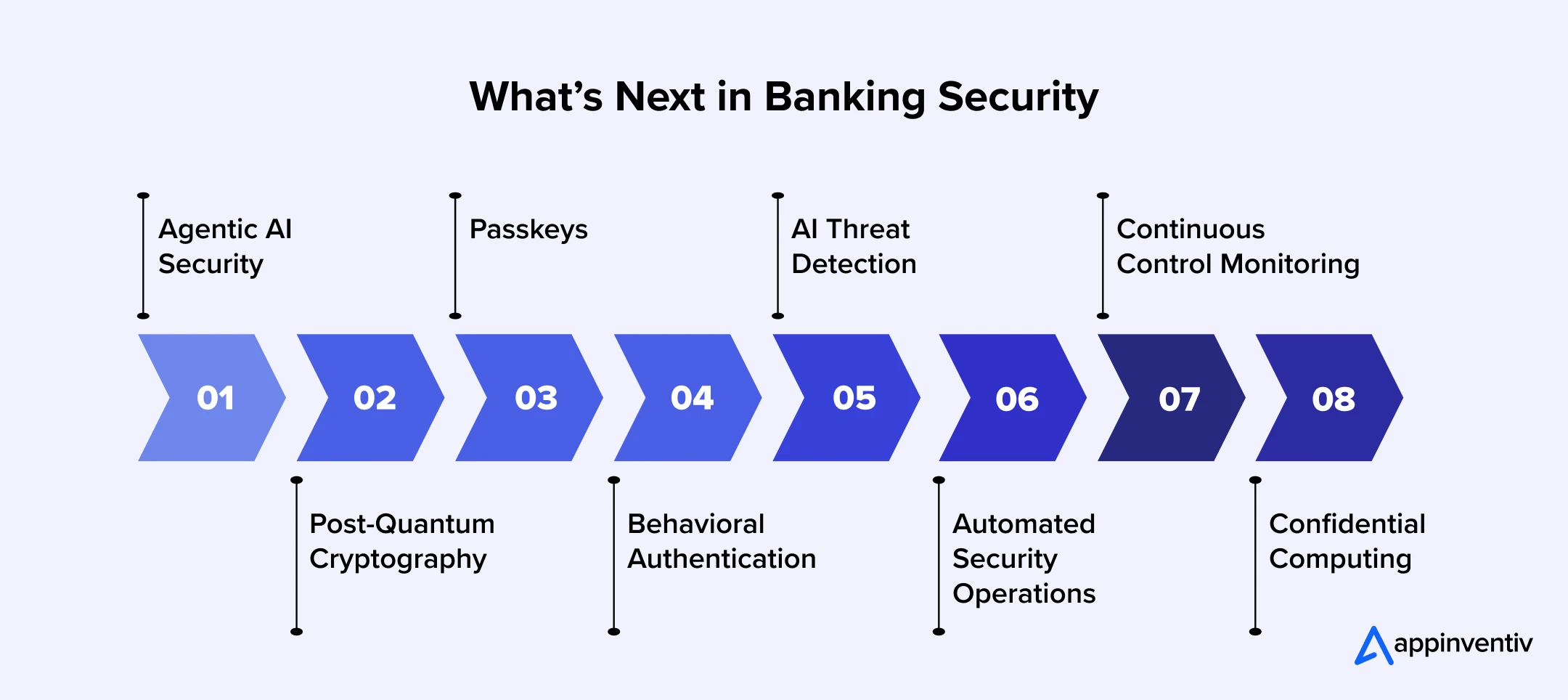
Agentic AI Security
Banks develop tailored controls to allow autonomous AI agents to access systems and perform administrative tasks. Dedicated agent identities, least-privilege permissions, isolated sandboxing, runtime monitoring, and human authorization checkpoints protect high-risk actions.
Post-Quantum Cryptography
Financial institutions need to make it quantum-safe by building infrastructure for quantum-resistant encryption. NIST published three new standards in the post-quantum arena: key establishment and digital signatures. Before moving to the cloud, security teams need to know what cryptographic resources exist in every application, API, certificate and hardware security module.
Also Read: Blockchain in Banking
Passkeys and Behavioral Authentication
Passkeys and biometric authentication are reshaping cybersecurity in digital banking by reducing reliance on conventional passwords. Continuous identity verification with behavioral signals such as device usage, login types and transaction context.
AI-Assisted Security and Real-Time Fraud Detection
Artificial intelligence in cybersecurity for banking and finance ingests large volumes of telemetry data into machine learning algorithms that prioritize alerts, detect abnormal activity, and automatically trigger response procedures. Fraud prevention engines analyze real-time transactions based on a device fingerprint, account history and user context.
Continuous Control Monitoring and Confidential Computing
Security operations in cloud environments are moving beyond periodic audits to address privileged access, system weaknesses, APIs and access policies. Sensitive workloads are protected while using shared computing infrastructure with confidential computing hardware.
Third-Party Risk and Regulatory Oversight
Cloud providers, AI solutions, software vendors, and technical vendors are subject to rigorous government oversight. Financial institutions must have detailed dependency maps, enforceable contract terms, and regular resilience testing with all partners.
Security Architecture shifts from periodic compliance auditing to real-time checks of User Identities, operational controls and critical technology dependencies.
How Appinventiv Can Help Strengthen Banking Cybersecurity
Appinventiv helps banking enterprises strengthen cybersecurity in banking by securing the applications, APIs, cloud systems, digital channels, and technology environments that support critical financial services. Its banking work spans 300+ transformation projects across 30+ countries, backed by 10+ years of banking domain expertise and a reported 97% client satisfaction rate.
Its cybersecurity services for banking address risks across the entire banking environment. Appinventiv can support security-focused architecture, secure application development, API protection, cloud security, identity controls, fraud-focused workflows, and security monitoring. This gives banking teams a security partner across both new digital platforms and modernization programs.
Appinventiv’s penetration testing services help banks validate those controls through web, mobile, API, network, and cloud penetration testing. Testing can examine authentication, authorization, privilege escalation, payment workflows, business logic, and exposed attack paths. Red-team exercises can test detection and response under realistic attack conditions. Remediation testing then verifies that identified weaknesses have been addressed.
For banking leaders, the value is practical: identify exploitable weaknesses, strengthen critical systems, and reduce exposure before attackers conduct testing.
Let’s connect and test your cloud banking infrastructure before attackers find weaknesses.
FAQs
Q. How does cybersecurity impact customers and their trust in banks?
A. Cybersecurity in banking directly affects customer confidence in their personal finances, identities, and personal data. Damaged accounts, data breaches, or prolonged service interruptions undermine client confidence and spur more fraud claims and account closures. Multi-factor authentication, real-time transaction surveillance, mobile application security and speedy containment measures highlight the benefits of cybersecurity for banking industry stakeholders, ensuring customer confidence and asset protection.
Q. What are the main cybersecurity regulations that banks need to comply with?
A. Operating jurisdictions, financial activities and processed records determine regulatory expectations. The Basel Committee’s operational resilience principles, the EU Digital Operational Resilience Act, and FFIEC supervisory standards are key frameworks. PCI DSS requirements cover payment environments, while GDPR and local privacy laws govern the processing of personal data. Security teams align each legal requirement to technical controls, ownership, validation processes and current audit evidence.
Q. What are the penalties for non-compliance with cybersecurity standards?
A. Regulatory penalties are penalties associated with certain provisions of statute or commercial contract that have been breached in an incident. Violation severity is subject to GDPR enforcement, which can impose statutory fines of up to €20 million or 4% of worldwide annual turnover. DORA enables national regulators to implement administrative penalties, operational restrictions and required corrective orders. PCI DSS compliance is enforced by individual payment card networks, which impose contractual fines and suspend transaction processing capabilities.
Q. How can banks test whether their cybersecurity controls actually work?
A. Security teams validate control performance by combining vulnerability scans, penetration testing, red-team simulations, configuration audits, attack-path mapping, and stress testing. Evaluation routines inspect public applications, software interfaces, mobile channels, identity systems, cloud hosts, admin rights, and payment workflows. Effective testing proves whether active threat actors can pivot from an initial entry point into core database records or wire transfer systems.
Q. What cybersecurity controls should banks prioritize first?
A. Cybersecurity solutions for banks should prioritize systems protecting core operational services and sensitive financial records. Core baselines demand phishing-resistant authentication, privileged account controls, network segmentation, patch management, endpoint detection, API protections, central logging, fraud analytics, and tested backup restoration. Risk evaluation models and operational service links dictate the implementation order rather than the total volume of software tools deployed. Basel Committee guidelines explicitly direct institutions to identify core data assets and align defensive investments directly with critical banking operations.
Q. How can Appinventiv help with banking cybersecurity?
A. Appinventiv provides specialized security services across banking applications, software APIs, cloud deployments, digital channels, and core technology systems. Penetration testing engineers inspect web portals, mobile software, connected APIs, network assets, cloud hosts, user permissions, and payment workflows. These technical audits verify whether established defenses withstand active attacks before technical vulnerabilities lead to operational breaches.


Fast 2-minute response, fully NDA-protected.

Ecommerce Security: A Guide to Protecting Your Commerce Stack From Modern Cyber Threats
Key takeaways: Modern commerce stacks expand attack surfaces across APIs, cloud systems, third parties, payments, and customer identities. PCI DSS 4.0.1 compliance mandates strict client-side monitoring to prevent modern web-skimming and Magecart attacks. Strong ecommerce cyber security requires layered controls across architecture, identity, data, transactions, infrastructure, and integrations. Continuous testing, threat monitoring, AI-aware controls, and…
How to Hire the Right Cybersecurity Expert for Your Business
Key Takeaways Define the business risk before choosing a security title or engagement model. Match the role to the environment, whether the priority is cloud, application, compliance, incident response, or network defense. Evaluate cybersecurity professionals through relevant scenarios, practical tasks, evidence, and references. Compare permanent, consulting, managed, and hybrid models against the coverage the business…

How to Prevent Social Engineering Attacks in the Enterprise: Types, Examples, and Defense Strategies
Key takeaways: Social engineering attacks exploit human trust, making even well-secured enterprises vulnerable to a single convincing interaction. AI is making phishing, vishing, and impersonation attacks faster to launch, harder to detect, and easier to scale. Strong verification processes are essential, especially for credential resets, financial requests, and other high-risk actions. Phishing-resistant authentication, least-privilege access,…