






























How Sustainable Banking is Redefining the FinTech Landscape

 Share -


- 01The New Operating Model for Sustainability in Banking
- 02Sustainable Banking vs. Traditional Banking
- 03How Sustainable Banking is Reshaping the FinTech Landscape
- 04Technologies Powering Sustainable Banking Transformation
- 05Enterprise Use Cases of Sustainability in Banking Across Financial Services
- 06Sustainable Banking Products Driving the Next Generation of Financial Services
- 07Business Benefits of Sustainable Banking for Financial Institutions
- 08The Hidden Cost of Delaying Sustainable Banking
- 09Common Challenges of Sustainability in Banking
- 10Enterprise Roadmap to Implement Sustainable Banking Successfully
- 11Sustainable Banking Examples in Action
- 12Future Trends Shaping Sustainable Banking
- 13How Appinventiv Helps Financial Institutions Build Sustainable Banking Solutions
- 14Frequently Asked Questions

Key takeaways:
- Banks are adding artificial intelligence, climate data, and cloud servers to their core software. These tools speed up lending, compliance, and risk management.
- Cloud-native platforms, ESG data systems, AI risk models, and Open Banking APIs power sustainable banking transformation across financial institutions.
- Green loans and tokenized assets build new income streams. These financial products protect long-term market stability.
- Step-by-step plans update mainframes safely. Upgraded systems meet strict carbon reporting laws and financial regulations.
- Major groups like HSBC, DBS, and NatWest lead this shift. They turn climate goals into measurable balance sheet results.
Sustainable banking priorities have changed fast over the past three years. Climate risk affects lending decisions today. Investors want clear environmental reports, and regulators demand exact compliance data. Meanwhile, customers also want financial products that match their personal values.
These demands change core banking technology, not just policy. Software platforms, artificial intelligence, and open data tools drive this market change. Banks use these tools to automate reports and evaluate credit. They launch green loans and specialized financing programs.
Modern sustainability in financial services relies on fast data and direct automation. The momentum behind this shift is evident, with global sustainable debt issuance surpassing $7 trillion cumulatively, highlighting how rapidly sustainable finance and banking markets have expanded. This article outlines the key software tools and enterprise capabilities driving this transformation.
Sustainable finance is scaling rapidly. Build AI-powered banking platforms before faster competitors redefine customer and regulatory expectations.
The New Operating Model for Sustainability in Banking
Sustainability in banking changes daily operations. The shift is already reflected at the leadership level. According to Deloitte, 100% of surveyed financial services organizations have board-level responsibility for ESG oversight, while 99% have adopted or selected an ESG reporting framework, making sustainability a core business function rather than a standalone compliance initiative.
Changes hit five areas: lending, risk management, customer service, compliance, and product design. Sustainability metrics become operational tools instead of static reports.
From Manual Compliance to Continuous Data
Banks no longer rely on yearly reports. Artificial intelligence and data platforms provide live risk monitoring, and teams make faster credit decisions and simplify regulatory audits.
From Simple Audits to Risk-Adjusted Credit
Standard lending reviews checked basic financials. Digital lending technology adds flood risk maps, emission targets, and supply chain data to credit files. Underwriters evaluate total loan risk prior to approval.
Real-Time Metrics Replacing Manual Spreadsheets
Staff spent months compiling manual spreadsheets in past years. New software dashboards connect core accounting systems directly to carbon tracking databases. Executives monitor carbon metrics daily. Market conditions shift fast, so leaders adjust business targets immediately.
Connected Software Systems
Application programming interfaces link core bank databases with external software vendors. Retail customers track carbon emissions inside their mobile banking app. Commercial clients access green trade credit at point of sale.
Replacing Legacy Banking Software
Old mainframes isolate customer records and slow down product releases. Cloud infrastructure replaces these disconnected databases. IT teams build and release green and sustainable banking products in weeks instead of quarters. Banks adapt to new carbon laws without rebuilding core systems.
Core Principles of Sustainable Banking
The new operating model of sustainable banking is built on five foundational principles: responsible lending, ESG-integrated decision-making, transparent reporting, financial inclusion, and long-term value creation. Together, these principles reshape how banks assess risk, design products, manage operations, and deliver lasting value for customers, investors, regulators, and communities.
Sustainable Banking vs. Traditional Banking
Traditional banks focus on balance sheets alone. Sustainable banks add climate data, automated risk tools, and long-term value tracking. Both models process money safely, but modern systems evaluate real-world impact alongside profit.
| Operating Area | Traditional Banking | Sustainable Banking |
|---|---|---|
| Lending Decisions | Evaluates financial history and credit scores alone. | Combines financial metrics with climate risk and supply chain data. |
| Regulatory Compliance | Relies on periodic audits and manual reports. | Runs continuous checks through automated data feeds and live tracking. |
| Risk Management | Tracks credit, market, and operational hazards. | Evaluates climate events, regulatory shifts, and long-term exposure. |
| Product Focus | Focuses on direct profit margins. | Balances financial returns with carbon reduction and social impact. |
| Data Architecture | Stores records in disconnected legacy software. | Centralizes files inside unified cloud data platforms. |
| Software Innovation | Depends on slow monolithic systems. | Uses cloud-native, API-first architectures to launch products fast. |
How Sustainable Banking is Reshaping the FinTech Landscape
Sustainable banking alters software design. This transformation is driven by growing executive accountability. A Deloitte study found that 53% of financial services executives identify boards as the primary source of pressure for ESG transparency, followed by ESG rating agencies (49%) and customers (38%).
As a result, banks are redesigning technology stacks to deliver continuous sustainability insights instead of periodic reporting. It changes how systems pull data, evaluate risk, and move funds.
Modern engines replace annual reports and manual audits, while algorithms and cloud servers process climate data instantly, and banks issue green products and track compliance automatically.
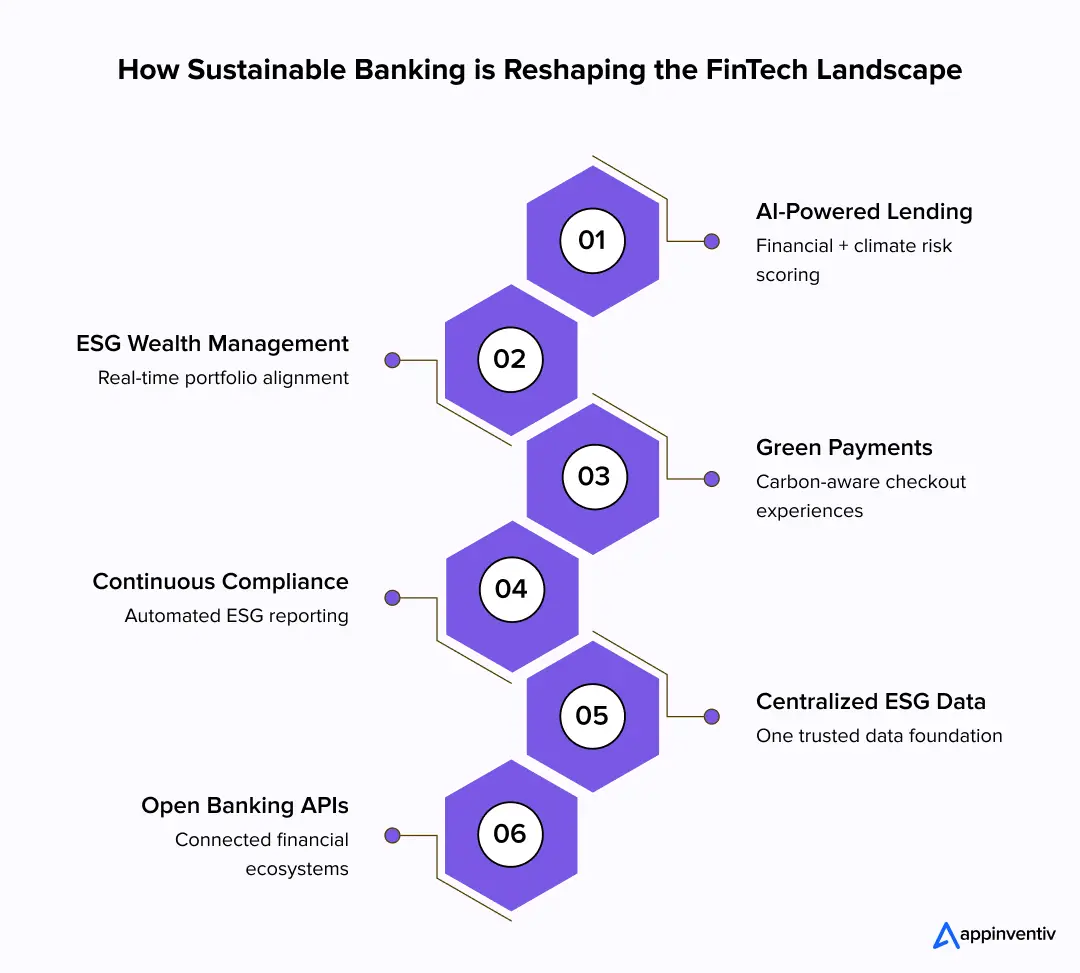
ESG Data in Digital Lending
Modern loan tools look beyond bank balances and credit scores. Underwriting software connects payment logs, climate risk scores, and supply chain records. Centralized repositories clean these metrics for machine learning models.
Banks evaluate applicants using software that checks financial strength and climate risk together. Underwriters approve loans quickly using lending analytics and build resilient portfolios.
Wealth Management and ESG Intelligence
Investment software combines financial metrics with sustainability tools. Ingestion tools pull data from rating agencies, public filings, and market feeds. Automated tools track portfolio alignment with climate goals every day. The software alerts managers to broad risks and suggests portfolio changes. Wealth management technology platforms match investment choices with client goals and compliance rules.
Payments, Embedded Finance, and Green Commerce
Payment platforms process more than money transfers. Checkout software connects carbon tracking apps and seller ratings directly into purchase flows. Payment links connect retail stores, ride apps, and online shops through secure API connections. Real-time event trackers analyze purchase records instantly. Customers check carbon output, purchase verified offsets, and earn green rewards during checkout.
Continuous Risk Management and Compliance
Risk teams track exposure in real time instead of checking quarterly reports. Automated systems combine climate metrics with credit, cyber, and liquidity risks. This process forms one single risk score for the company. Graph databases reveal hidden links between borrowers, suppliers, and business partners. Specialized regulatory technology tools build audit records and write official reports. These outputs meet EU Taxonomy rules, IFRS standards, and CSRD mandates.
Centralized Sustainability Data
Accurate reporting depends on reliable data. Financial firms build central databases for sustainability metrics. These databases gather structured and unstructured records from banking software, enterprise tools, payment networks, and regulatory feeds. Automated rules clean the incoming files to protect data quality. Executive dashboards show total emissions, loan volumes, and compliance metrics clearly.
Open Banking and Ecosystem Integration
Open Banking links institutions into shared software networks. Secure API connections and token authorization protocols move data between banks and technology partners. Banks connect directly with rating services, carbon tracking tools, and identity networks. Pre-built software components reduce technical complexity. Product teams launch green and sustainable banking tools fast without rewriting mainframe code.
Also Read: The Ultimate Guide to Banking App Development
Technologies Powering Sustainable Banking Transformation
Modern sustainable banking runs on new software systems. This growing technology investment reflects organizational change as well. Nearly 81% of financial services organizations have established or are building cross-functional ESG working groups to improve sustainability reporting, governance, and enterprise-wide collaboration.
These tools process large volumes of financial and climate data. Artificial intelligence, cloud infrastructure, and open APIs power daily tasks. Banks build green products and track compliance rules directly.
Artificial Intelligence and Machine Learning
Artificial Intelligence is the mainstay of banking software. Supervised and Unsupervised learning models are executed by teams to assess risk, detect fraud and validate credit scores. Model deployment, monitoring and retraining are part of the MLOps pipelines. Explainable AI (XAI) systems reveal to regulators and risk teams specific reasons behind decisions.
Cloud-Native Banking Infrastructure
Cloud-native systems process heavy climate data loads without slowing down. Microservices, Kubernetes orchestration, containers, and serverless computing let engineers update code independently. Core databases stay online during updates. Multi-cloud and hybrid cloud setups prevent system outages and satisfy local data laws.
ESG Data Platforms
ESG platforms gather information from ERP software, regulatory databases, rating agencies, satellite imagery, and IoT devices. Data lakes, lakehouse architectures, and data fabrics store these inputs in central networks. Metadata catalogs and master data management (MDM) tools clean information across all enterprise applications.
Open Banking APIs
Open Banking tools share account records across business partners securely. RESTful APIs, OAuth 2.0 protocols, OpenID Connect, and consent management frameworks protect user privacy. API gateways, service meshes, and Banking-as-a-Service (BaaS) platforms speed up integrations. Banks add green loans and payment tools to existing platforms.
Compliance and Security Foundations
Compliance and security are intrinsic features of the design of sustainable banking systems. The platforms now include sustainability frameworks such as the CSRD, EU Taxonomy, IFRS Sustainability Disclosure Standards (IFRS S1 & S2) and ISSB Standards. Systems are also compliant with banking security standards such as PSD2, Open Banking, GDPR, PCI DSS, SOC 2, and ISO 27001.
Financial and ESG files are protected by enterprise security features. AES-256 encryption, TLS 1.3 protocols, Role-Based Access Control (RBAC), immutable audit logs, and Security Information and Event Management (SIEM) platforms are used by engineers. The tools provide protection for company info, ease compliance reporting and improve customer confidence.
Blockchain and Distributed Ledger Technology
Blockchain networks record transactions in permanent logs. Financial groups use blockchain in banking to issue green bonds, trade carbon credits, and verify seller statements. Smart contracts execute payment terms automatically after users hit target metrics. Distributed ledgers make supply chain activity visible across business networks. Asset tokenization divides green assets into smaller digital shares.
Generative AI and Intelligent Automation
Generative AI handles complex operational work beyond customer chats. Banks deploy large language models (LLMs), Retrieval-Augmented Generation (RAG), vector databases, and AI agents to review climate disclosures. These algorithms draft compliance answers and assist account managers. Intelligent Document Processing (IDP) extracts facts from raw paperwork to replace manual entry.
IoT and Alternative Data Intelligence
Operating information is missing in standard account ledgers. Real-world performance is measured using banking IoT sensors, smart meters, satellite imagery, weather feeds, geospatial analytics and supply chain telemetry. Incoming data is processed by a streaming tool, such as Apache Kafka, or an event-driven architecture. Risk officers monitor live asset conditions, not the old reports.
Enterprise Use Cases of Sustainability in Banking Across Financial Services
Sustainable banking works differently across financial institutions. Retail banks focus on customer service and responsible lending. Commercial banks check climate risks, regulatory rules, and sustainable loans.
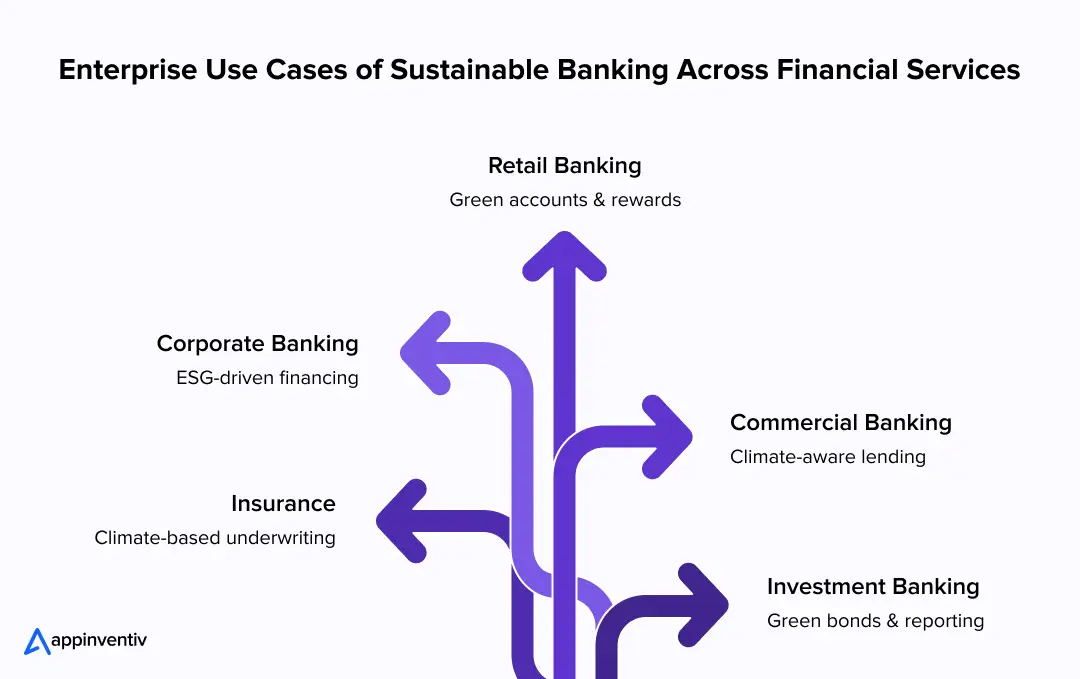
Retail Banking
Sustainability in retail banking is built directly into daily account tools. Software engines suggest green financial accounts based on spending activity. Mobile applications calculate transaction emissions scores. Banking systems reward responsible choices through cash credit and points programs.
Commercial and SME Banking
Commercial banks evaluate business borrowers beyond standard accounting logs. Artificial intelligence checks supply networks, factory emissions, energy bills, and operating risks. Loan officers view customer climate metrics on live dashboards. Teams offer green credit terms and financial advice to qualifying firms.
Corporate Banking
Large companies require funding matching long-term carbon targets and legal rules. Corporate platforms link climate risk tools and portfolio analytics to review funding applications. Automated software tracks loan terms and legal reporting for global subsidiaries.
Investment Banking and Sustainable Finance
Sustainable finance investment banking teams build complex products like green bonds and sustainability debt. Sustainable investment banking algorithms monitor corporate ESG metrics throughout the investment period. Digital portfolio management software runs due diligence, portfolio checks, and periodic reporting. Clear records give institutional investors direct oversight.
Insurance and Embedded Finance
Insurers merge climate metrics with connected financial networks to price policies. Field data from IoT sensors, telematics insurance, satellite photos, and weather stations updates underwriting risks. Embedded payment systems add climate insurance directly into real estate, shipping, and online checkout systems.
Transform enterprise use cases into scalable banking platforms powered by AI, cloud-native architecture, and modern compliance frameworks.
Sustainable Banking Products Driving the Next Generation of Financial Services
Banks build new financial products for responsible borrowers. These systems help clients make practical decisions and meet carbon targets.
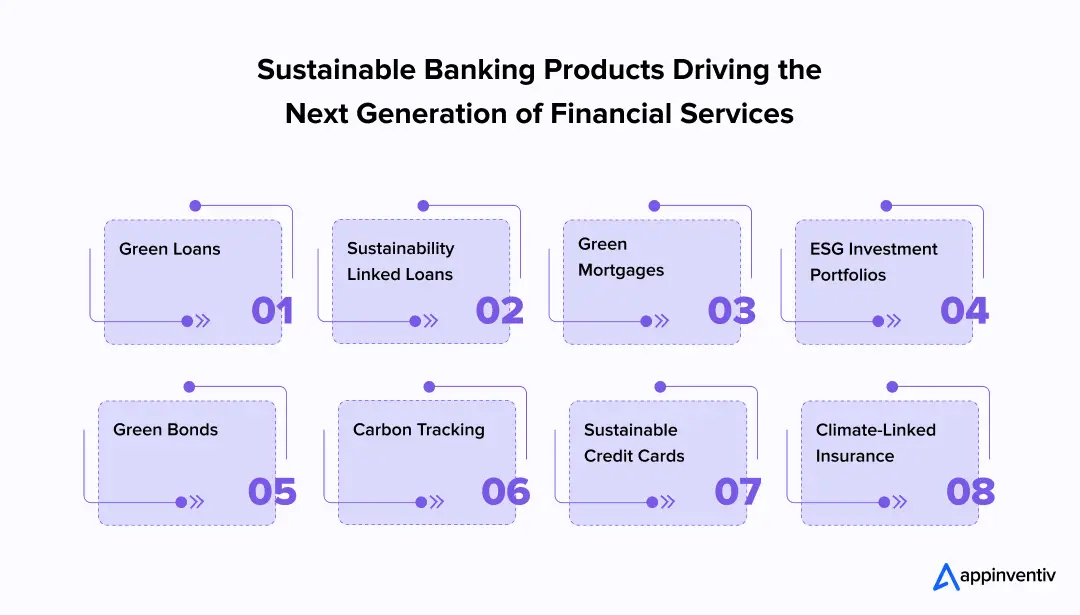
Green Loans
Green loans fund solar energy projects, energy-efficient buildings, and electric buses. Underwriting software checks project risks alongside financial records. Data platforms track actual carbon savings throughout the loan term.
Also Read: Green FinTech: Driving Sustainable Finance Through Innovative Applications
Sustainability-Linked Loans
Sustainability-linked loans tie interest rates to specific performance targets. Software tools track operational metrics using verified data feeds. Automated systems adjust borrowing costs after clients hit designated targets.
Green Mortgages
Green mortgages offer lower interest rates for energy-efficient property upgrades. Underwriters use property analytics, energy scores, geospatial maps, and climate models to set property values. This setup yields accurate loan terms for sustainable housing.
ESG Investment Portfolios
Wealth management tools create investment options focused on corporate governance and climate standards. Algorithms review risk ratings and market returns together. Automated monitors update asset allocations after market conditions shift.
Green Bonds
Green bonds raise money for clean energy and municipal water projects. Institutions use blockchain records, automated compliance checks, and digital reporting platforms to track spent funds. Investors verify fund deployment directly through immutable transaction logs.
Also Read: The Role of Blockchain in Solving the Challenges of Cross-Border Payments
Carbon Footprint Tracking
Banking applications show account holders the carbon footprint of daily transactions. Payment tools and carbon accounting APIs calculate emissions from merchant receipts. Applications combine these scores with eco-friendly rewards or offset choices.
Sustainable Credit Cards
Sustainable credit cards link payment cards to environmental incentives. Cardholders earn points for taking public transit or buying certified goods. Real-time analytics tools customize rewards based on active spending habits.
Climate-Linked Insurance
Climate-linked insurance uses field data to set policy terms and pricing. Algorithms analyze weather patterns, satellite images, IoT sensor data, and past claims records. Parametric insurance tools use smart contracts in insurance to issue payout transfers automatically.
Business Benefits of Sustainable Banking for Financial Institutions
Sustainable banking builds measurable financial value. Banks lower operational risk, cut administrative costs, and create new income streams to satisfy investor demands.
Stronger Risk Management
Algorithms review financial ledgers, operational logs, and climate data together. Early risk warnings give teams clear data before approving major loans or capital investments. Portfolios stay resilient against market drops.
Improved Regulatory Readiness
Automated compliance management software replaces manual tracking. Systems file compliance documentation for CSRD, IFRS standards, and EU Taxonomy mandates. Real-time data streams keep audit files ready for regulators year-round.
Lower Operating Costs
Cloud platforms and automated workflows complete routine administrative tasks. Software handles loan approvals, reporting, and customer inquiries faster. Operations teams shift time to strategic growth projects.
New Revenue Streams
Market demand expands for green and sustainable banking loans, sustainability-linked debt, carbon tracking apps, and ESG funds. Embedded payment tools let institutions earn fee income across new digital sales channels.
Customer Trust and Retention
Corporate clients and retail borrowers choose banks with verified sustainability goals. Clear ESG metrics and responsible financial products protect brand reputation. Long-term customer relationships improve.
Long-Term Business Growth
Modern software platforms let product teams launch new offerings quickly and adjust to legal changes without rewriting core systems.
The Hidden Cost of Delaying Sustainable Banking
Sustainable banking cost concerns often start with software upgrades, but delaying system updates costs far more. Old databases, manual reports, and scattered files raise operating expenses. Banks updating early cut credit risks and capture green market share fast.
- Rising Compliance Costs: Manual reporting and repeated audit checks raise expenses. Missing report deadlines trigger regulatory fines.
- Higher Risk Exposure: Poor visibility into climate hazards harms credit decisions. Weak data increases overall portfolio risk during extreme weather events.
- Slower Product Releases: Old databases delay green loans and ESG investment products. Competitors capture market demand first.
- Lost Market Position: Banks delaying system upgrades lose investor confidence and customer loyalty. They miss funding deals in growing green markets.
Common Challenges of Sustainability in Banking
Updating sustainability in banking operations brings technical challenges. Sustainability in the banking sector requires institutions to update legacy databases, unify fragmented files, follow evolving laws, and create clear compliance reports.
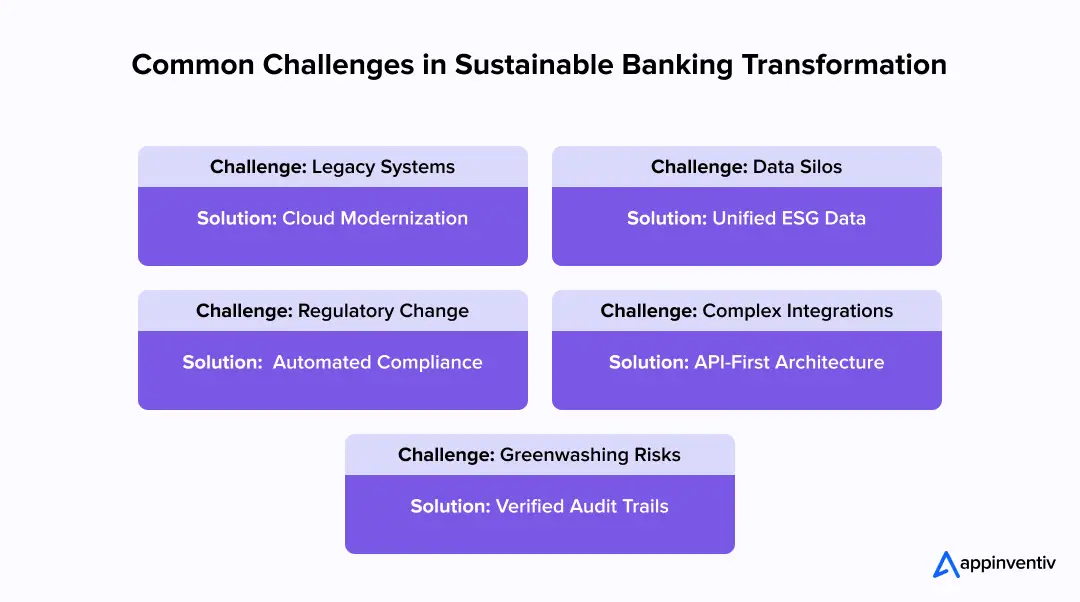
Legacy Core Banking Platforms
Challenge: Mainframe core systems block real-time environmental analytics, machine learning engines, and instant compliance updates.
Solution: Complete legacy banking modernization step by step using microservices, API layers, and cloud infrastructure. Software engineers build modern features without taking mainframes offline.
Disconnected Data Sources
Challenge: Environmental data lives across separate enterprise tools, credit databases, and vendor feeds. Disconnected databases lead to metric errors and inaccurate reports.
Solution: Store metrics inside central data lakes or lakehouse systems. Master Data Management rules and metadata catalogs clean incoming files to maintain clear data baselines.
Changing Global Regulations
Challenge: Banks with international operations must meet varied compliance rules across multiple countries. Rules change rapidly.
Solution: Deploy regulatory software to handle policy tracking, audit records, and report creation. Automated systems monitor international regulatory updates around the clock.
Software Network Integration
Challenge: Sustainable banking requires rapid data exchanges between banks, rating vendors, payment networks, and cloud platforms. Multi-vendor connections increase system complexity.
Solution: Build API-first architectures using API management tools, event-driven pipelines, and Banking-as-a-Service platforms. Standard software protocols link external vendors directly into internal applications.
Tracking Sustainability Performance
Challenge: Banking leaders struggle to define standard performance metrics and calculate environmental impacts accurately.
Solution: Build unified company scorecards linked to real-time analytics screens. Centralized tools track emissions, loan volumes, portfolio risks, and compliance milestones directly.
Stopping Greenwashing
Challenge: Unverified climate claims trigger financial penalties and ruin corporate reputations.
Solution: Control data using verified metrics, automated validation pipelines, and permanent audit logs. Standardized reporting builds trust with bank regulators and institutional investors.
Also Read: AI Governance, Guardrails and Observability
Enterprise Roadmap to Implement Sustainable Banking Successfully
Sustainable banking needs a direct implementation plan. Systems require clear execution phases to link business goals, regulatory rules, and software updates.
Step 1: Define Sustainability Objectives
Identify exact corporate targets at the start. Teams focus on expanding green credit lines, updating compliance software, or cutting operational emissions. Clear goals guide every technology purchase.
Step 2: Assess Existing Systems and Data
Review core databases, code pipelines, and data sources. This review reveals technical gaps and fixes bad data first.
Step 3: Build Core Digital Infrastructure
Update mainframes using cloud servers, microservices, API connections, and central data platforms. Flexible software systems help engineers add analytics and compliance features later.
Step 4: Add AI and ESG Intelligence
Deploy machine learning models and automated reporting tools across departments. Risk teams evaluate climate data fast during credit approvals.
Step 5: Strengthen Compliance and Control
Set clear rules for data safety, AI models, and regulatory updates. Continuous tracking software generates audit trails and lowers legal exposure.
Step 6: Measure Performance and Expand Operations
Track loan volumes, carbon metrics, and system speeds on real-time dashboards. Executive reviews help teams expand successful programs to other departments.
Also Read: Green App Development – The Ultimate Entrepreneur Guide to Building Eco-Friendly Mobile Apps
Sustainable Banking Examples in Action
Major banks put climate goals directly into daily lending and risk management. These real-world cases show how financial groups update core software.
HSBC Global Financing
HSBC makes sustainable finance a central part of its global strategy. The bank assists clients during their shift to low-carbon operations. It expanded green loan programs and updated risk management workflows. HSBC provided or facilitated $496 billion in sustainable finance between 2020 and 2025.
DBS Bank Corporate Loans
DBS Bank treats climate targets like a core growth driver instead of a compliance burden. The bank includes climate risk metrics in corporate loan reviews and wealth management services. It assists commercial clients in cutting factory emissions. DBS expanded its sustainable financing portfolio to 70 billion Singapore dollars by late 2023.
NatWest Climate Reporting
NatWest Group builds detailed climate reports across its banking network. The group publishes clean transition plans, impact reports, and audited environmental disclosures. External auditors verify these disclosures independently.
HSBC Green Financing Rules
HSBC established a formal Green Financing Framework matching rules set by the International Capital Market Association. This framework defines approved green investments, internal governance steps, and reporting standards. External parties audit the framework to provide an independent second-party opinion.
While leading banks continue to expand sustainable finance initiatives, the broader industry is also adapting to changing market dynamics. Recent changes to the Net-Zero Banking Alliance reduced the alliance’s combined assets by approximately 22%, illustrating how regulatory expectations, geopolitical priorities, and institutional strategies continue to reshape sustainable banking worldwide.
Partner with experts who build AI-powered sustainable banking platforms designed for compliance, resilience, and long-term competitive growth.
Future Trends Shaping Sustainable Banking
Sustainable banking will move beyond basic software updates. Regulatory momentum will continue to accelerate this shift. More than 30 jurisdictions are progressing toward mandatory sustainability disclosures aligned with ISSB standards, despite regional differences in implementation.
Financial institutions that modernize early will be better prepared for evolving global reporting requirements. Systems will score climate impact before executives approve financial deals.
Embedded Sustainability Systems
Banks currently run sustainability through isolated compliance departments. Over the next decade, developers will build climate tracking directly into lending, treasury, payments, and risk management tools. Software will evaluate climate risks prior to loan approvals.
Tokenized Green Assets
Financial groups will tokenize green bonds, carbon credits, and renewable energy assets on digital networks. Digital tokens allow instant settlement, automated rules, and fractional asset ownership. The Bank for International Settlements calls asset tokenization a foundational architecture for future financial markets.
Autonomous Banking Workflows
Algorithms currently assist underwriters, compliance officers, and support staff. Next, agentic AI in banking will coordinate complex tasks across departments. Agents will run risk models, write regulatory reports, and track investment portfolios with little human help. Institutions will add strict audit controls to oversee automated operations.
Unified Risk Analysis
Risk officers will measure climate risk alongside credit, liquidity, and market exposure. Banking platforms will simulate storm damage and market shifts using satellite imagery and weather data. These live models will set loan terms, shape asset allocations, and power stress tests across all departments.
Programmable Cross-Border Networks
Conflicting regulations and slow settlement networks delay international green loans. Programmable networks built on tokenized deposits and smart contracts will speed up international fund transfers. Central banks test these digital payment networks to lower transaction costs and improve audit transparency.
Data as a Competitive Advantage
Future market leadership will depend on automated data tools. Institutions with strong software models and clean datasets will use AI credit scoring to price risk accurately, launch custom products quickly, and satisfy new reporting laws.
How Appinventiv Helps Financial Institutions Build Sustainable Banking Solutions
Building sustainable banking systems requires technical banking knowledge and regulatory experience. Appinventiv provides banking software development services to banks, FinTech firms, and financial institutions to create modern software infrastructure. Engineering teams build AI-powered, cloud-native banking platforms with ESG intelligence and Open Banking capabilities.
Appinventiv modernizes legacy core databases and builds central ESG data platforms. Development teams deploy automated workflows and compliance software. This work lowers operational costs and meets legal rules without disrupting active banking channels.
Delivery Metrics
- 300 completed banking software projects
- 97 percent client satisfaction rating
- Software deployed across 30 countries
- 10 years of banking software experience
- 100 million secure transactions processed
- 99.90 percent platform uptime
- 40 percent speed improvements through automated workflows
Appinventiv helps leadership teams build green financial products and connected software networks. Let’s connect and start building your sustainable banking ecosystem today.
Frequently Asked Questions
Q. What is sustainable finance in banking?
A. Sustainable banking and finance channel investment towards environmentally responsible initiatives without compromising banks’ profits. It involves items such as green loans, sustainability-linked credit lines, green bonds and governance-based investments.
Q. What is sustainability in banking?
A. Bank sustainability is the integration of ESG into the bank’s routine. It alters the options banks can provide for loans, risk management, investments, and customers. It reshapes lending, investments, risk management, and customer services while reducing long-term risk.
Q. How can custom software support sustainable banking initiatives?
A. Custom banking software combines climate records, automates regulatory filings, and updates loan evaluation tools. Tailored code connects directly to internal core systems. It adapts quickly to new government laws and changing customer demands. Off-the-shelf software lacks this flexibility.
Q. Can sustainable banking software integrate with existing core banking systems?
A. Yes. Modern platforms connect to old core banking software using APIs, middleware, and microservices. Software teams add climate analytics, automated compliance tools, and reporting features without replacing central mainframe databases.
Q. What is the cost of sustainable banking solution development?
A. Development costs range from $40,000 to over $500,000. Total expenses depend on features, software connections, and system size. Basic platforms with carbon dashboards, green loan tools, and reporting modules cost less. Enterprise platforms with artificial intelligence risk engines, live analytics feeds, Open Banking APIs, and core database connections require higher investments.
Q. Why is sustainable banking important for financial institutions?
A. Sustainable banking helps financial institutions control and manage climate exposure and meet new disclosure requirements. It reduces admin costs and creates new income streams via green loans and specific debt. Good reporting establishes trust and interest among institutional investors.
Q. How can AI improve sustainable banking operations?
A. Artificial intelligence automates climate risk scoring, flags fraudulent transactions, and streamlines credit checks. Algorithms read large volumes of structured and unstructured files to generate audit reports. Risk officers make faster decisions backed by clean data.
Q. Can machine learning detect sustainability-related financial risks?
A. Yes. Machine learning models use ESG scores, transaction data, weather feeds, and other supply-chain data as inputs to identify climate hazards. These algorithms can assist with forecasting market movements, assessing credit risk, and creating robust loan portfolios for risk teams.


Fast 2-minute response, fully NDA-protected.
Cost of Developing a Payment Gateway: A Complete Breakdown
Key takeaways: Custom gateway development requires $50,000 to $500,000 in upfront capital, and enterprise platforms cost more at scale. Core infrastructure, security compliance, and settlement logic consume far more budget than basic checkout screens. High transaction volumes require concurrency controls, failover systems, monitoring tools, and automated reconciliation engines. Platform ownership creates recurring costs for security…

How Much Does RegTech Software Development Cost in the UK in 2026?
Key takeaways: RegTech software development cost in the UK spans £40,000 to £400,000+, with regulatory scope and legacy integration depth driving the cost. High-performance systems deliver a 30% to 50% reduction in manual workloads, protecting enterprises from severe FCA penalties. Advanced AI features generally represent around 25–40% of the total project investment due to the…

Building Next-Generation Digital Payment Systems for Australia's NPP Economy
Key takeaways: Australia's NPP is approaching 1.82 billion real-time transactions annually; BECS decommissioning by 2030 creates a hard migration deadline that cannot be managed through incremental patches. The July 2026 Payday Super mandate makes real-time payment infrastructure a legal compliance requirement. Enterprises without NPP-capable payroll systems are already operating against a regulatory clock. NPP platform…