





























How to Build Generative AI Systems for Sales: Architecture, Data Pipelines, and CRM Integration

 Share -



- 01Why Generative AI Matters in Modern Sales
- 02Steps to Build a Generative AI System for Sales
- 03Structural Components of Generative AI in Sales Workflows
- 04Benefits of Generative AI for Sales
- 05Generative AI in Sales: Practical Use Cases with Real Enterprise Examples
- 06How Generative AI is Used Across the Sales Process
- 07Future of Generative AI in Sales
- 08Cost to Build a Gen AI Solution for Sales: Detailed Breakdown
- 09Generative AI in Sales: Key Implementation Challenges and Mitigation Approaches
- 10Implement Generative AI in Your Sales Systems with Appinventiv
- 11FAQs

Key takeaways:
- Generative AI streamlines sales workflows, reducing manual tasks and boosting productivity.
- Integrated AI systems enhance lead scoring, forecasting, and personalized outreach for higher conversion rates.
- Real-time data pipelines and CRM integration are crucial for effective AI-driven sales strategies.
- Proper governance and continuous model improvement are essential to ensure compliance and maintain trust.
- Investing in generative AI enables scalable growth without increasing operational costs.
If you’re leading a B2B sales team today, the pressure is constant and often fragmented. You are expected to hit aggressive revenue targets, onboard and coach new representatives, manage pipeline health, and adapt to evolving go-to-market strategies. Somewhere in the middle of all this, generative AI in sales is emerging as a critical lever to handle growing complexity without increasing operational load.
Meanwhile, leadership is looking for better forecasting, quicker decisions and more strategic thinking in every aspect of the sales process. Yet, most sales teams are still burdened by manual processes, unrepresentative data and ad-hoc decision making.
Some 21% of commercial leaders claim they have fully deployed generative AI across the enterprise in B2B sales, while a further 22% are in pilot mode (Source: McKinsey). But the momentum is strong, with 66% of sales reps anticipating that AI will transform the way they work.
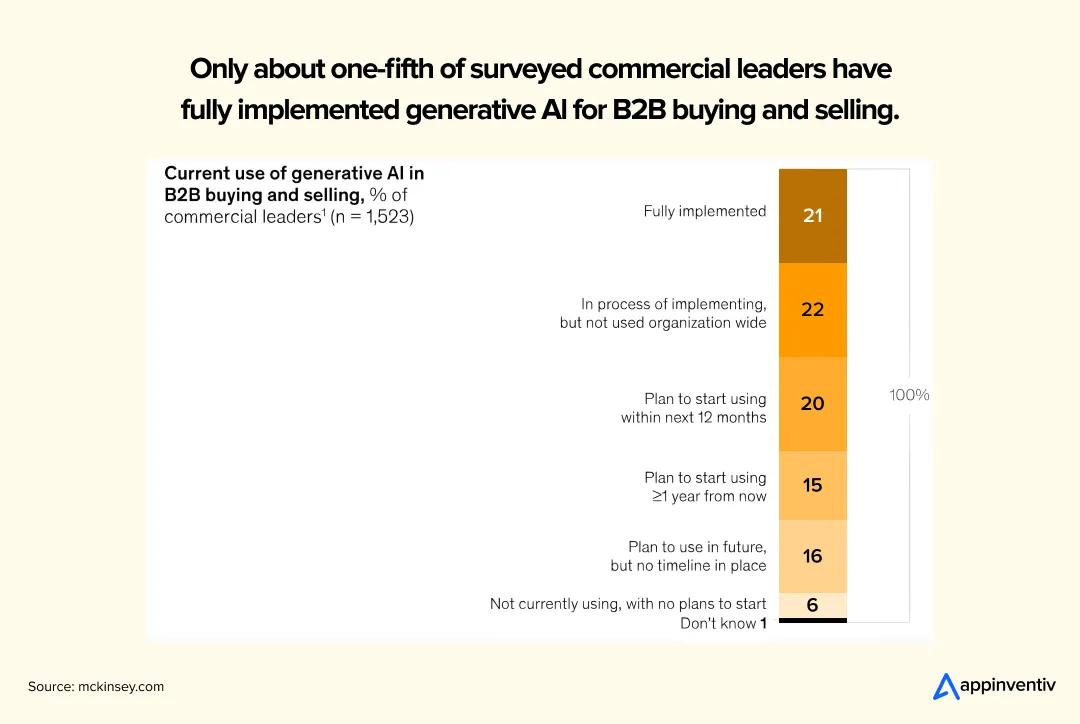
There is a clear disconnect between expectations and reality. For those that move beyond pilot projects, generative AI presents a clear opportunity to scale sales, increase efficiency and drive revenue growth.
In this blog, we will analyze the steps to build generative AI solution for sales, its structural components, benefits, use cases, challenges, and future prospects. However, let’s first begin with understanding why generative AI matters in modern sales.
Get in touch to develop systems tailored to your sales processes and scale.

Why Generative AI Matters in Modern Sales
Forget the broad noise around the use of AI in business for a moment. Strip it back to what actually changes inside a sales organization.
At its core, generative AI architecture for sales is about connecting data, context, and communication into one working system. It is not meant to replace sales teams, but to reduce friction in how they prepare, respond, and follow through on opportunities. The outcome is simple: less time spent searching for information and more time spent in actual selling conversations.
In practical terms, this shows up in a few clear shifts:
- Sales content no longer starts from scratch; it is shaped using prior deals and customer signals.
- Managers get structured visibility instead of scattered updates and manual reporting.
- Reps enter calls with contextual guidance instead of static playbooks.
- Routine work, like notes and follow-ups, is reduced through AI system development for sales automation.
This is where organizations that build gen AI system for sales teams begin to see real operational change, not just incremental efficiency.
Steps to Build a Generative AI System for Sales
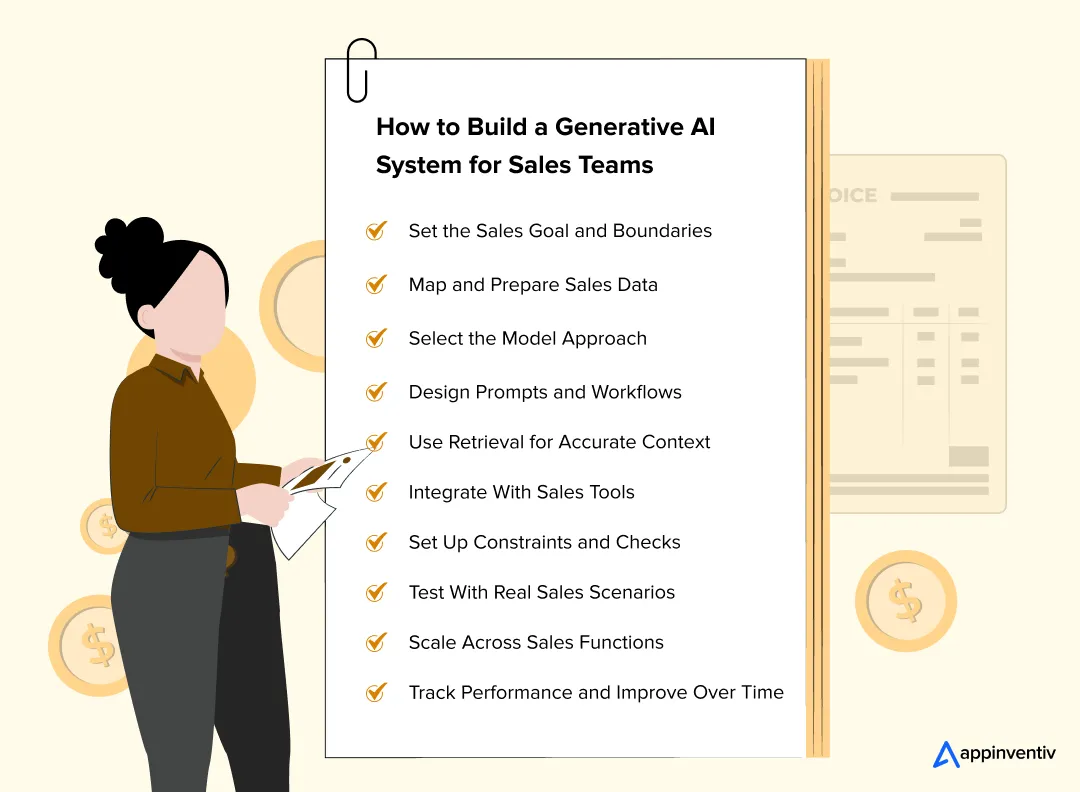
Building a generative AI system for sales requires a structured approach that aligns data, models, and workflows with real sales use cases. Here’s a clear roadmap:
Set the Sales Goal and Boundaries
Start with a well-defined use case that impacts a business process. For example, this could be lead qualification, faster response for outbound reaching, or proposal processing. When considering generative AI in sales, link each use case to a specific KPI, such as conversion rate, deal velocity, or pipeline coverage. This prevents aimless experimentation and helps align the system to revenue.
Map and Prepare Sales Data
Combine data from CRM, call/chat logs, product sheets and past deals. Clean and normalize formats, de-duplicate and reconcile data sources. Enrich the data (for example, label customer intent or industry). Having a robust data layer is imperative if you want to build generative AI solution for sales that makes relevant and correct responses.
Select the Model Approach
Decide whether a general large language model will work or if the model needs adaptation. The best practice is to begin with an API (such as OpenAI or Google Cloud) and then add fine-tuning or prompt engineering to the mix. Weigh up speed, price and control, particularly if the solution will be used for high volume sales support.
Design Prompts and Workflows
Create prompts to simulate real sales. Consider features like customer type, sales stage, product and tone. Create flowcharts for automating mundane tasks, like follow-up emails and call summaries. AI prompt engineering is important when you build a generative AI system for sales; the quality of the response is highly dependent on the quality of the prompt.
Use Retrieval for Accurate Context
Retrieval-augmented generation helps link to real-time business sources. This could be pricing sheets, knowledge bases, competitor analysis and regulatory information. This ensures that the chatbot does not hallucinate and provides reliable information to customers.
Integrate With Sales Tools
Add the system to existing systems used by salespeople, such as Salesforce or HubSpot. This means that the solution shows up in the sales team’s existing workflows (such as a dashboard of leads or in an email inbox). The more the tool is integrated, the greater the adoption rates.
Set Up Constraints and Checks
Set limits on content, price accuracy and privacy. Set up checks that alert to dangerous content, like unsubstantiated claims or leaking of customer data. This is particularly crucial when implementing a generative AI solution for sales teams, where mistakes can impact customer trust and sales.
Test With Real Sales Scenarios
Conduct test programs with a sample of salespeople. Gather qualitative insights into usability and relevance, and quantitative data on response quality and engagement. Evaluate workflows with AI to assess improvement or deterioration.
Track Performance and Improve Over Time
Monitor system performance via metrics like acceptance rate, lead conversion rate, and handling time. Analyse logs for frequent mistakes or missing information. Regular LLM fine-tuning, new data, or model changes ensure smooth performance.
Scale Across Sales Functions
Once tested, scale across other applications, including account management, upsell and cross-sell opportunities, after-sales support, and so on. Keep the system modular to easily integrate new features without disturbing workflows. This enables incremental growth without undue operational risk.
Also Read: Generative AI for Business: Use Cases, Benefits & Strategy
Structural Components of Generative AI in Sales Workflows
There are several architectural components of Gen AI in sales that define how data, models, and workflows interact to support AI-driven sales execution. Let’s have a deeper look at it:
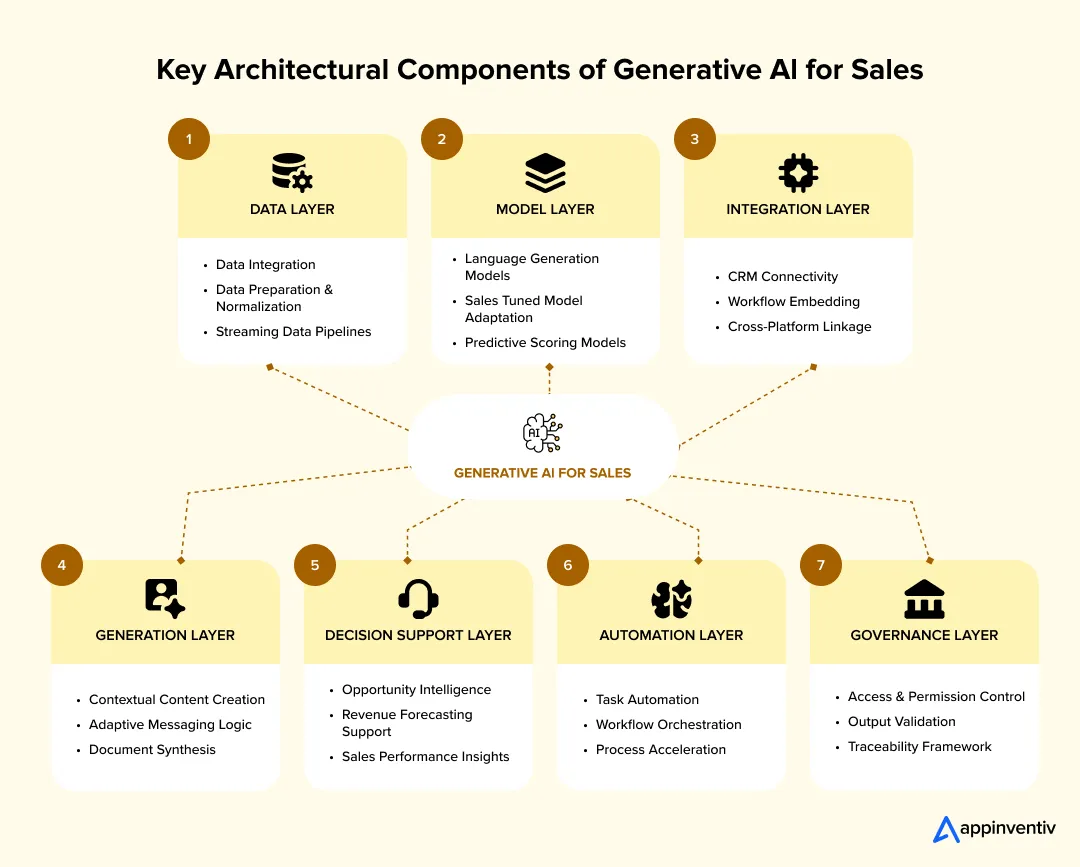
Data Layer
- Data integration of sales and customers: Aggregates account, opportunity, email, call, product usage, and external data into a structured format for AI to consume.
- Data preparation and normalization: Normalizes conflicting enterprise data so that models understand accounts, opportunities and interactions consistently.
- Streaming data pipelines: Feeds sales intelligence with real-time data from a variety of sources. This is where gen AI data pipeline development comes in for accuracy and timelines.
Model Layer
- Language generation models: Enable the generation of emails, summaries, proposals and responses in sales conversations.
- Sales-tuned model adaptation: Adapts generic models to grasp stages of deals, objections, pricing strategies and clues of buyer intentions.
- Predictive scoring models: Predict events like deal likelihood, attrition and upsell potential.
Integration Layer
- CRM connectivity: Integrates AI into an existing CRM system (Salesforce, SAP, Dynamics) for easy access by sellers.
- Workflow embedding: Links AI insights to sales tasks like follow-up, task assignment, and opportunity management.
- Cross-platform linkage: Integrates and coordinates marketing, sales, and support for seamless information flow in the customer journey.
Generation Layer
- Contextual content creation: Generates emails, sales decks, and responses, leveraging real-time deal details and historic interactions.
- Adaptive messaging logic: Tail tone, content, and format to the buyer and funnel stage.
- Document synthesis: Transforms unstructured customer feedback into proposals, summaries and account briefs.
Decision Support Layer
- Opportunity intelligence: Identifies risks, impediments and next steps in deals.
- Revenue forecasting support: Enhances AI sales forecast accuracy, behavioral indicators and pipeline progress.
- Sales performance insights: Uncovers sales gap and best practices for teams and regions. This can be the main driver of the return on investment for enterprises in generative AI for sales.
Automation Layer
- Task automation: Automates routine sales activities like CRM data entry, note-taking and creating follow-ups.
- Workflow orchestration: Connects activities across tools to make sales processes run seamlessly.
- Process acceleration: Shortens time to close by removing admin blocks.
Governance Layer
- Access and permission control: Controls access to sensitive customer and deal information per user roles and levels.
- Output validation: Validates content against compliance, legal and brand considerations.
- Traceability framework: Tracks the actions and outputs generated by the AI for audit trails and accountability. This is essential when companies build a Gen AI sales automation system for compliance.
Benefits of Generative AI for Sales
Generative AI improves how sales teams operate by reducing manual effort and enabling faster, more informed decisions across the pipeline. Here are some of the more advanced benefits of generative AI for sales workflows:
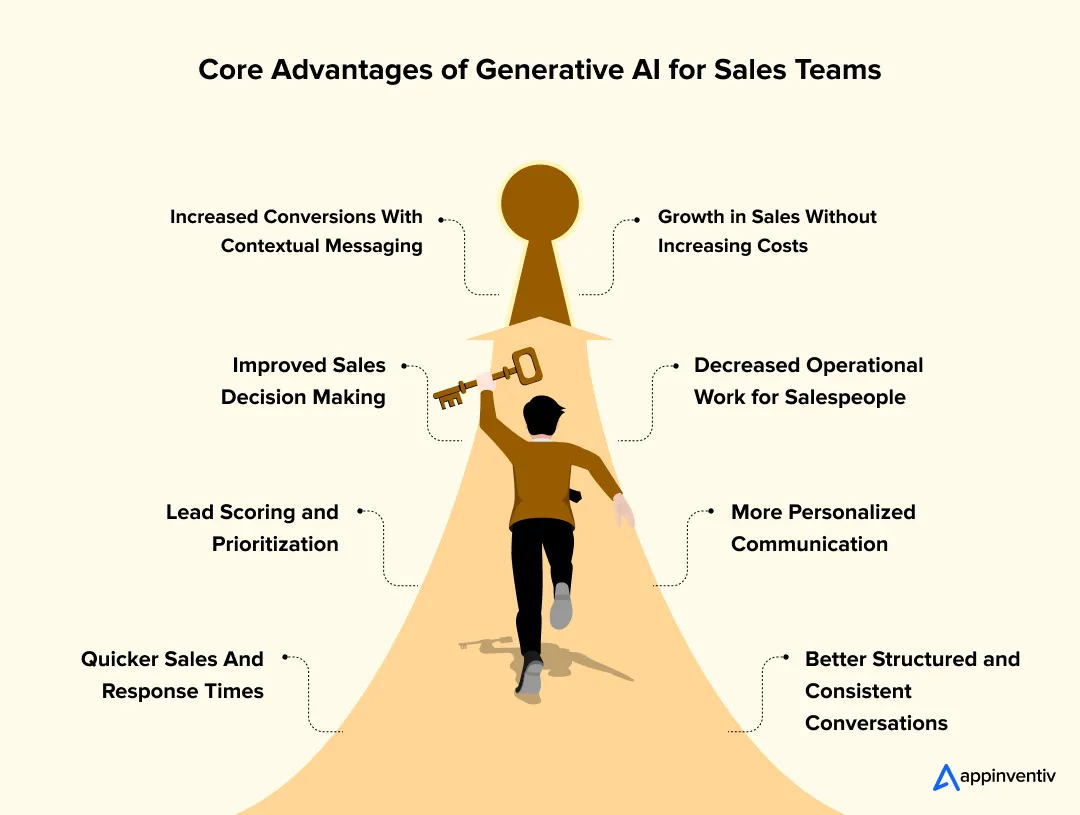
Quicker Sales And Response Times
AI-powered tools streamline common sales tasks like writing emails, call summaries and proposals. This enhances the response time through the funnel. An effective generative AI architecture for sales allows these processes to be automated to ensure smooth workflows without hiccups from manual intervention, increasing the speed of deal closure.
Lead Scoring and Prioritization
Machine learning algorithms can process behavioural cues, CRM data and interaction patterns to pinpoint qualified leads. This enables sales reps to focus on leads more likely to convert. In more sophisticated scenarios where you build a gen AI system for sales teams, lead scoring is more dynamic and evolving.
More Personalized Communication
Gen AI systems provide personalized messages based on customer demographics, industry sector and past interactions without additional effort. This enhances contact centre interactions. Gen AI CRM integration development brings personalization into the CRM process.
Improved Sales Decision Making
Generative AI provides salespeople with more information about deal progression, risks and next steps. This helps salespeople make faster and better decisions while deals are in progress. It is a core outcome of generative AI for sales teams, where intelligence is embedded directly into day-to-day operations.
Increased Conversions With Contextual Messaging
AI responses are relevant to the customer’s needs, enhancing engagement. This promotes more valuable conversations further down the funnel. Organizations that build generative AI solutions for sales often see improved conversion rates due to better-aligned messaging.
If you are still lagging behind, then it’s time to move beyond manual workflows and implement Gen AI-driven sales systems.

Generative AI in Sales: Practical Use Cases with Real Enterprise Examples
Large organizations are now using generative AI as part of their sales process. It’s now used for more than just generating content. It also aids in data management, customer interaction, business process automation, sales strategy and planning.
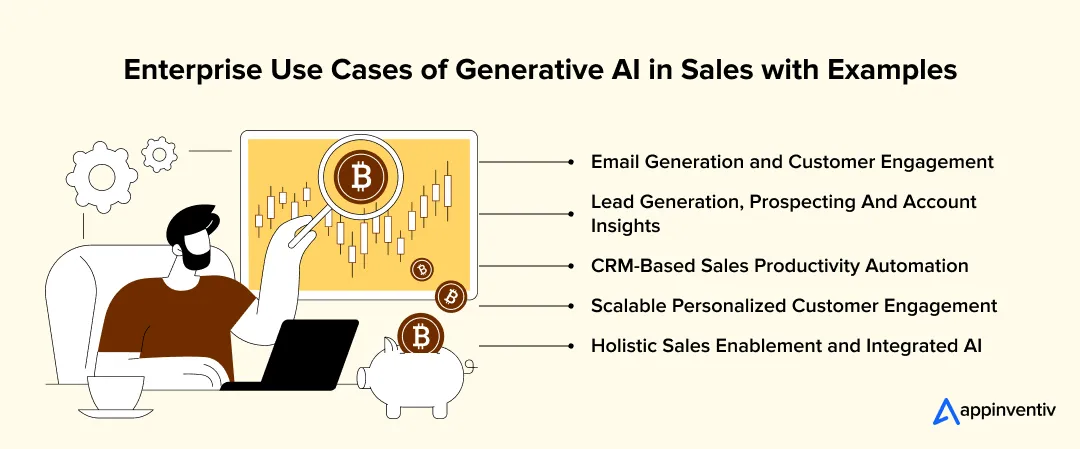
Email Generation and Customer Engagement
Generative AI is used by sales teams to create emails, follow-ups and responses to customers using CRM data like past emails, deal status, meeting notes, and account history. To do this at scale, companies usually develop a generative AI system for sales that is integrated with their CRM and messaging platforms.
Real-Life Example:
Microsoft has developed Dynamics 365 Copilot to assist its sellers with email and meeting summaries for customers. It can access structured CRM data and historical interactions to generate contextual communication within the sales process.
Lead Generation, Prospecting And Account Insights
Generative AI assists sales teams to accelerate account research turnaround by providing summaries of customer histories, engagement patterns and buying signals from structured and unstructured data.
Real-Life Example:
Amazon Web Services leverages generative AI to summarize account interactions and identify important activities from historical data. Salespeople use these insights to better prioritize leads and improve sales strategies.
CRM-Based Sales Productivity Automation
Salespeople spend a lot of their time performing routine tasks like entering information into the CRM system, documenting phone calls, creating summaries and tracking deal status. Generative AI automates these tasks by turning conversations and interactions into CRM records and summaries. It also helps in proposing the next steps in a deal.
Real-Life Example:
Salesforce’s Einstein Copilot produces call summaries, updates opportunities in the CRM, and answers questions. The conversation-based approach helps sellers reduce tedious work in cleaning up their CRM.
Also Read: How Copilot AI Sales Enablement Software Boosts ROI
Scalable Personalized Customer Engagement
Generative AI is used by sales and marketing teams to generate personalised content for outreach based on customer segments, vertical industries and behavioural cues. This might include variations of emails, product messaging, and campaign content targeted at different segments across different geographical regions.
Real-Life Example:
Coca-Cola leverages generative AI to generate personalized versions of marketing and sales content for various locations and segments. This allows for consistent yet personalized marketing at scale.
Holistic Sales Enablement and Integrated AI
Companies are transitioning from stand-alone AI applications to AI ecosystems that integrate CRM, data automation and analytics systems. These can assist throughout the entire sales process from lead to close. Companies invest in activities to build Gen AI platform for sales that seamlessly integrates communication, forecasting and workflows across the entire sales process.
Real-Life Example:
Oracle uses Fusion Cloud Sales AI to unify CRM, forecasting, and customer insights into a single system. It uses live pipeline data and historical customer signals to generate AI-driven recommendations, improving forecasting accuracy and supporting decision-making across the sales process.
How Generative AI is Used Across the Sales Process
Generative AI is applied across each stage of the sales lifecycle to improve speed, consistency, and decision quality. Here’s a detailed look at how it is applied:
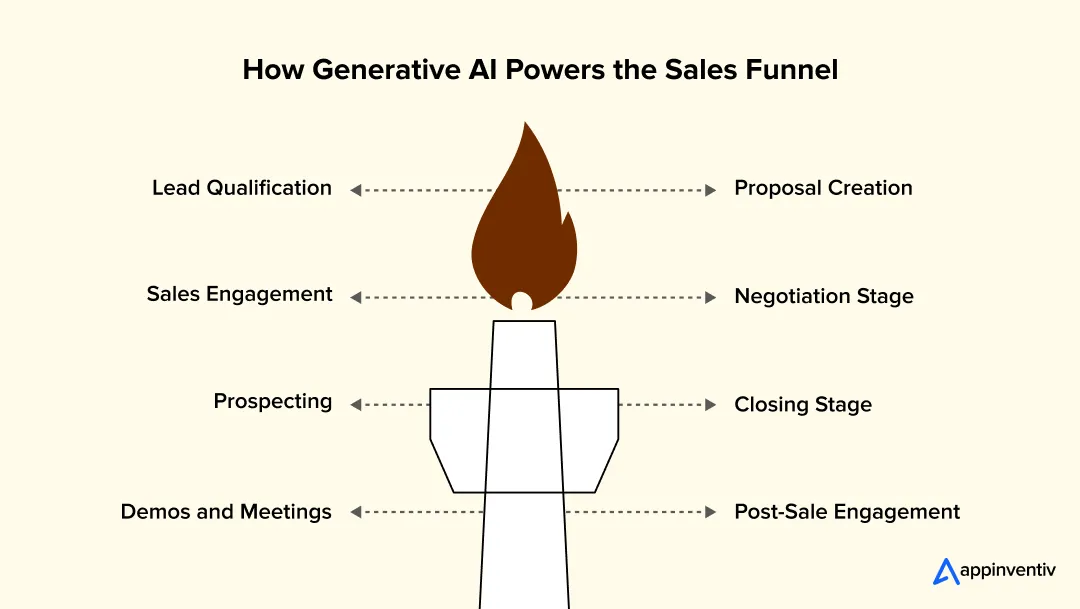
Lead Qualification
- Intent detection: Generative AI uses online engagement patterns to assess readiness to buy.
- Lead prioritization: It prioritizes leads by fit, urgency and historical conversation rates.
- Profile enrichment: AI enriches leads with CRM and other data into standardised summaries for quick assessment.
- Standardized scoring: It provides uniform lead qualification rules across departments and geographical areas.
Sales Engagement
- Context-aware messaging: Generative AI generates email and call responses based on CRM data and past conversations.
- Conversation support: It offers call support based on account history.
- Follow-up generation: AI generates follow-up messages based on the sales process stage.
- Response consistency: It ensures consistent messaging across sales reps and regions. To manage these interactions, many organizations want to develop Gen AI sales automation solutions.
Prospecting
- Account discovery: Generative AI examines structured and unstructured market intelligence to find companies that fit ideal customer profiles (ICP) and buying signals.
- Outbound personalization: It generates personalised outreach emails based on buyer industry, job title and company events.
- Trigger-based targeting: AI identifies indicators like job growth or funding rounds for better timing of outreach.
- Competitive visibility: It provides an overview of competitor activity in target accounts to optimize positioning. This is emblematic of generative AI in sales becoming a part of the early pipeline process.
Demos and Meetings
- Personalized demo content: Generative AI generates demo content tailored to customers’ industry and business needs.
- Meeting structuring: It creates agendas according to deals and stakeholders.
- Stakeholder mapping: It recognizes decision-makers and their priorities to set the conversation agenda.
- Interaction summaries: It summarizes meetings for discussion and action.
Proposal Creation
- Automated drafting: Generative AI creates proposals from templates, product information and customer needs.
- Requirement alignment: It aligns customer requirements with product features.
- Pricing scenarios: AI proposes pricing options based on the size of the deal.
- Validation checks: It warns about inconsistencies and incompleteness prior to submission.
Negotiation Stage
- Deal strategy support: Generative AI proposes strategies based on historical deal success.
- Concession planning: It spots areas for price or terms negotiation.
- Objection handling: It offers preemptive answers to common customer concerns.
- Internal alignment notes: It creates summaries for the sales, finance and legal departments during negotiations.
Closing Stage
- Risk identification: Generative AI flags approvals or risks that need to be resolved.
- Contract simplification: It translates lengthy deals into internal summaries.
- Approval workflow guidance: AI recommends a workflow for internal approvals.
- Closure readiness checks: It checks if all criteria are met. This is where companies often assess the RoI of generative AI in sales in terms of shorter sales cycles and leakages.
Post-Sale Engagement
- Upsell detection: Generative AI detects upsell opportunities from usage.
- Renewal intelligence: It predicts churn based on engagement and support data.
- Customer support assistance: AI provides relevant responses to resolve problems more quickly.
- Account growth planning: It develops long-term growth strategies from behavioural insights.
Future of Generative AI in Sales
Enterprise companies often develop Gen AI platforms for sales to go beyond sales to retention and growth. The future of generative AI in sales lies in building connected, intelligent systems that operate across the entire revenue lifecycle rather than isolated use cases.
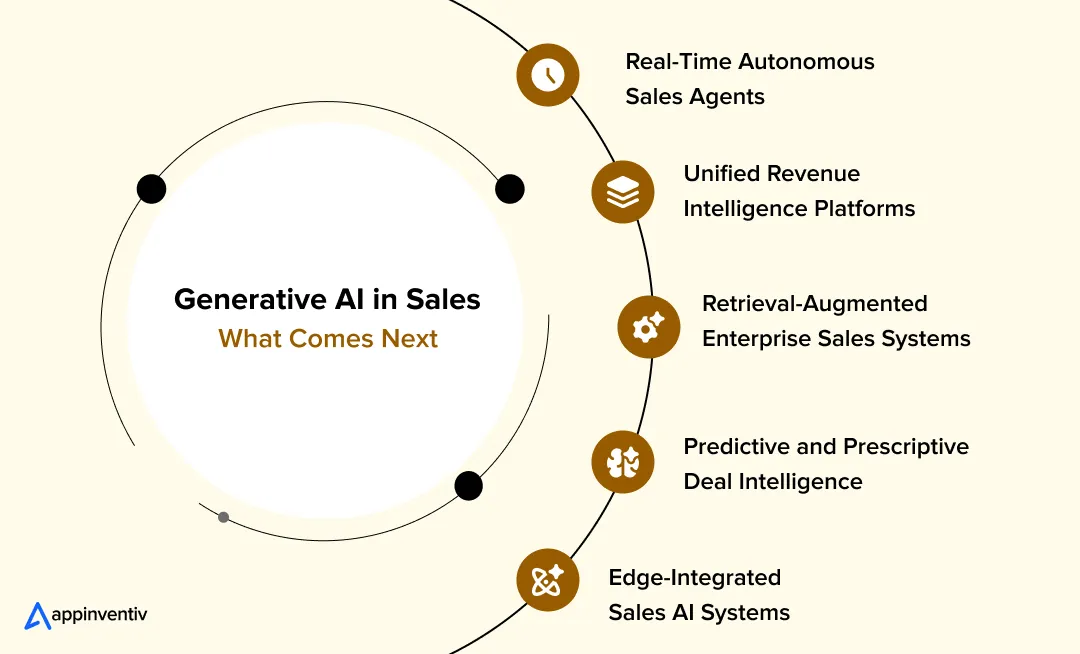
Real-Time Autonomous Sales Agents
Generative AI tools are shifting towards agent-based models that can perform multi-step sales processes without human intervention. AI agents can handle lead scoring, follow-up, CRM data entry and sales pipeline management through interactions with corporate systems. The emphasis is on event-based orchestration, enabling agents to react to CRM, email and customer events.
Unified Revenue Intelligence Platforms
Sales technologies are converging into unified intelligence layers that merge data from CRM, marketing and customer success. Generative AI provides the reasoning layer to these data sets, generating integrated insights into pipeline quality, deal risk and revenue projections. This overcomes silos between sales and revenue operations platforms.
Retrieval-Augmented Enterprise Sales Systems
Enterprise sales systems using generative AI are based on RAG methods connected to enterprise knowledge bases. These frameworks retrieve information from structured data sources such as CRM data, product catalogues, and past deals to ensure that the outputs are relevant and based on the client’s data rather than general training data.
Predictive and Prescriptive Deal Intelligence
Prescriptive AI is moving from descriptive to prescriptive analytics. Rather than simply describing the stage of the pipeline, generative systems now advise on actions such as price, timing to engage, and stakeholder engagement strategies. Such recommendations are dynamically updated with real-time indicators of deal progression.
Edge-Integrated Sales AI Systems
Edge AI in sales enables real-time intelligence directly within CRM and communication tools, improving response speed and decision support during live customer interactions and negotiations.
Cost to Build a Gen AI Solution for Sales: Detailed Breakdown
The cost of a generative AI solution for sales is not a one-time investment. It varies based on architecture, data readiness, integration complexity and scale. Enterprise AI solutions tend to fit in multiple cost categories.
Breakdown of Key Costs (Enterprise Level)
These cost components represent the primary investment areas required to design, deploy, and scale a generative AI solution within enterprise sales environments.
| Cost Component | Description | Estimated Costs (USD) |
|---|---|---|
| Data engineering & pipelines | CRM integration, data cleaning, ETL/ELT pipelines, real-time data sync | $50,000 – $250,000 |
| Model fine-tuning & prompt engineering | LLM adaptation, sales-specific fine-tuning, prompt engineering | $75,000 – $300,000 |
| AI infrastructure | Compute, GPUs, vector databases, inference as a service | $30,000 – $200,000 per year |
| CRM integration & integration | Salesforce, SAP, Dynamics, API creation, middleware | $40,000-$180,000 |
| UI/UX layer (application) | Sales copilots, dashboards, workflow, embedded assistants | $25,000 – $150,000 |
| Security & compliance | Data access control, encryption, audit trails, governance policy | $20,000 – $120,000 |
| Maintenance & optimization | Model refreshing, monitoring, retraining, tuning | $50,000 – $250,000 per year |
Total Estimated Build Cost
Mid-size deployments can run in the low six-figures, while enterprise-wide deployments can reach the mid-million dollar range for more complex and globally integrated systems. These costs vary based on data maturity, integration complexity, and the overall scope of the initiative to build a Gen AI system for sales teams.
| Scale of Deployment | Approx Total Build Cost |
|---|---|
| Mid-scale sales AI system | $150,000 – $500,000 |
| Large enterprise deployment | $500,000 – $1.5M+ |
| Multi-system rollout (worldwide) | $1M – $3M+ |
Factors That Can Affect Investment
Data maturity: Bad CRM hygiene means more data engineering or cleaning
Integration breadth: CRM and ERP integration increases implementation costs
Model selection: Fine-tuning is more expensive than using LLM via APIs
Latency requirements: Low-latency sales assistants require greater infrastructure costs
Security requirements: Compliance and AI data governance costs for regulated industries
From infrastructure to deployment, get clarity on where your investment will go.

Generative AI in Sales: Key Implementation Challenges and Mitigation Approaches
There are several practical complexities of deploying generative AI within real-world sales environments. However, with the right solution or mitigation strategies, this can be overcome.
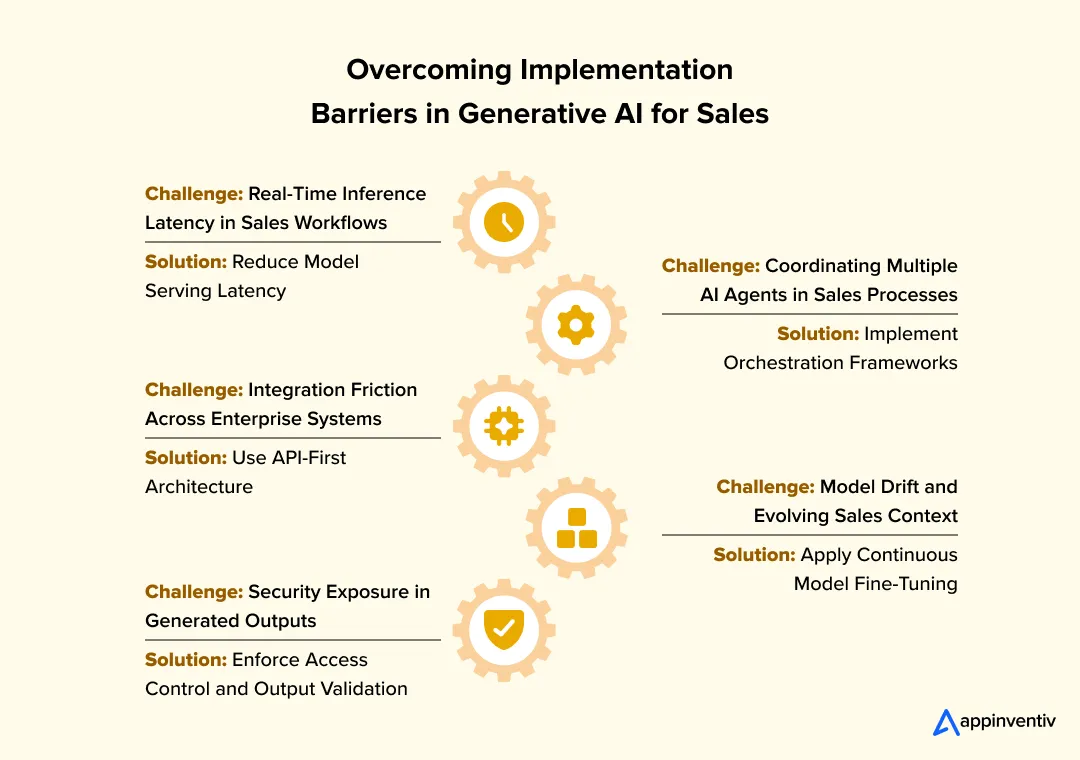
Real-Time Inference Latency in Sales Workflows
Real-time feedback is important for sales during calls, demos and negotiations. Delays in AI responses decrease interaction efficiency and trust in decision support.
Mitigation strategy:
Reduce model serving latency via edge computing, caching common requests, and thin inference layers. A robust generative AI architecture for sales guarantees fast response times for CRM and communication platforms.
Coordinating With Multiple Agents
Several AI agents involved in prospecting, qualifying and engaging a client can result in conflicting actions without coordination.
Mitigation strategy:
While building AI agents for sales, establishing orchestration mechanisms with role separation, memory and delegation. This improves reliability in AI system development for sales automation environments.
Integration Friction Across Enterprise Systems
Sales teams work across multiple systems, including customer relationship management (CRM), enterprise resource planning (ERP), marketing automation and support systems, leading to a patchy integration of AI.
Mitigation strategy:
Employ API-first design, microservices and data contracts. This enables a scalable build Gen AI system for sales teams’ applications across cloud enterprise stacks.
Model Drift and Evolving Sales Context
Shifts in prices, products and consumer preferences can render generative results irrelevant or inappropriate for the current sales context.
Mitigation strategy:
Establish ongoing fine-tuning processes, feedback from sales results, and periodic model updates. This aids in maintaining performance for generative AI for sales teams in dynamic environments.
Security Exposure in Generated Outputs
Unfiltered generative AI can reveal sensitive pricing, customer or contract information when generating outputs in an enterprise setting.
Mitigation strategy:
Apply and maintain rigorous role-based access controls, prompt filtering, encryption technology and output validation. These are critical for enterprise generative AI architecture for sales.
Implement Generative AI in Your Sales Systems with Appinventiv
Generative AI is increasingly a central component of sales systems. It enhances prospecting, lead management and deal closure by automating manual tasks and improving accuracy in sales decisions. It improves response speed, lead prioritization, and more, translating directly into increased sales, conversion rates and productivity.
Enterprises are increasingly seeking generative AI consulting services to establish the proper architecture, applications, and roll-out strategy prior to scaling these systems. Over time, generative AI will increasingly support real-time decision-making and action, so it’s a long-term strategic play for sales-driven businesses.
Appinventiv is helping enterprises design and implement such systems at scale, integrating data engineering, AI models, and system integration to build production systems that can be used for sales.
Here’s a detailed look at the AI projects we worked on:

Gurushala

- 10x accelerated question development
- Taxonomy-aligned questions

TOOTLE
- 35% increase in user activity
- 10x quicker travel insights
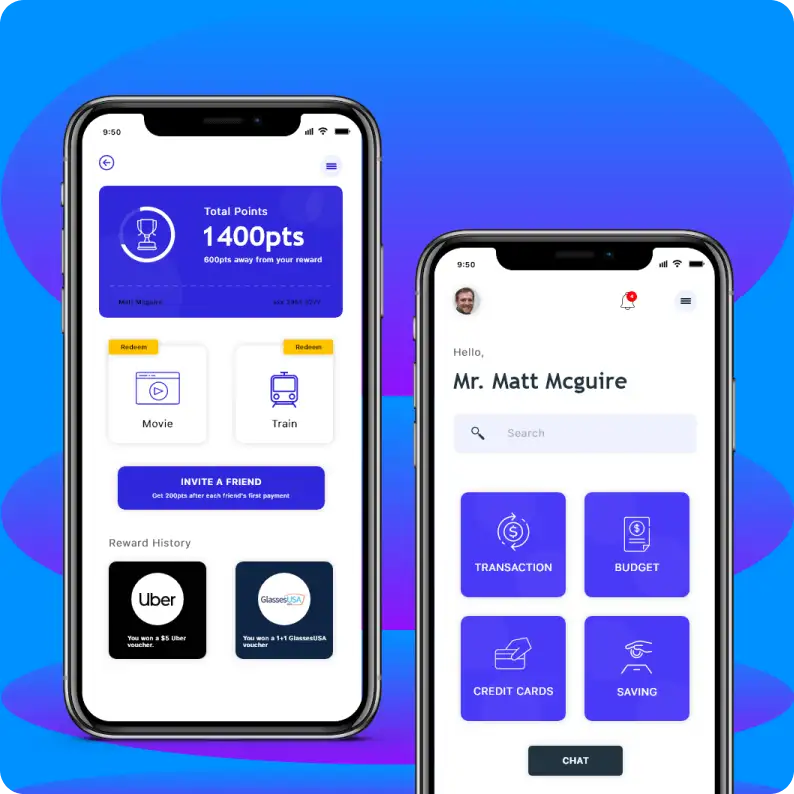
Mudra
- 12+ countries adopted the solution
- #1 engagement driver for users
If your organization is considering using generative AI in your sales systems, it’s beneficial to partner with experts who understand both the technical and business implications.
Appinventiv’s generative AI development services enable companies to go from proof of concept to production-ready sales applications. Talk to the experts today to see how they can help your business.
FAQs
Q. How to build Gen AI system for sales teams?
A. Here’s how you can build Gen AI system for your sales team:
- Define sales objectives and KPIs
- Prepare and structure data
- Select model and approach
- Design prompts and workflows
- Implement retrieval layer (RAG)
- Integrate with crm and tools
- Test, monitor, and scale
Q. What challenges might companies face when implementing generative AI in sales?
A. Here are some of the challenges that enterprises might encounter when implementing generative AI in sales:
- Data integrity and siloed CRM systems impact on accuracy
- Complexity in integrating with CRM, ERP and other channels
- Model hallucinations and insufficient contextual understanding
- Latency problems in real-time sales conversations
- Cybersecurity and privacy concerns with customer data
- Challenges in directly linked business impact and return on investment
- Reluctance from the sales team to use it due to a process change
Q. How does Appinventiv help enterprises implement generative AI solutions for sales automation?
A. Appinventiv, as a dedicated Gen AI development partner, helps enterprises implement robust Gen AI solutions for automating sales processes:
- Generative AI sales strategy: Identifies priority use cases based on revenue and sales pipeline.
- Custom Model Development: Helps enterprises build Gen AI model for sales tailored to deal stages, customer behaviour, and product context.
- Data Engineering and Pipeline Setup: Creates data pipelines for CRM, communication and external data.
- CRM and Workflow Integration: Integrates AI into sales platforms for easy integration and use.
- Scalable Architecture Design: Creates systems that can scale for use across different sales departments and geographies.
- Governance and Compliance: Provides user access controls, data validations and audit logs for secure implementation.
Q. How generative AI is used in sales?
A. Generative AI is used in sales to automate writing emails, summarise phone conversations, and update customer data in the CRM system, as well as draft personalised messages for customers. Generative AI uses past interaction and data to offer insights, next steps and enhance engagement. By integrating intelligence into workflows, it boosts efficiency, consistency and decision-making throughout the sales process.
Q. How does generative AI increase sales revenue?
A. Generative AI boosts sales revenue by enhancing lead scoring, personalising interactions and accelerating response times in the sales process. This allows sales teams to prioritise leads, close deals more quickly and maximise revenue. The RoI of generative AI in sales is reflected in improved conversion rates, reduced sales cycles, increased forecast accuracy and the capacity to grow sales without additional resources.


Fast 2-minute response, fully NDA-protected.

Retrieval Augmented Generation in Australia: Architecture, Implementation and Cost
Key takeaways: RAG grounds LLM answers in approved content, improving reliability without retraining a model. Data quality and access permissions decide production outcomes more than the model. Indicative build costs run from AUD 70,000 to 700,000, driven by data and integrations. Measure value against a pre-deployment baseline, separating realised benefits from projected savings. A general-purpose…

The Multiplier Effect of AI Agents: The Rise of AI Swarms
Key takeaways: AI agent swarms coordinate specialized agents to solve complex problems that may be difficult for a single agent to handle effectively. More agents do not automatically mean better outcomes. Swarms deliver value when work can be divided, executed in parallel, and coordinated toward a shared objective. Enterprise readiness depends on governance. Clear accountability,…

AI Data Integration: How to Connect, Clean and Prepare Data for AI
Key takeaways: AI initiatives fail when fragmented, poor-quality data reaches models without sufficient context, controls or ownership. AI-ready pipelines must connect, clean, enrich, govern and continuously monitor data across its lifecycle. Real-time processing matters when AI decisions depend on current transactions, events, inventory or operational conditions. Data architecture should follow the AI use case, balancing…