




































Understanding Precision Farming in Australia: Business Case, Benefits, Cost and ROI

 Share -



- 01Understanding Precision Farming in Australia: How It Differs from Traditional Farming, Smart Farming and Digital Agriculture
- 02The State of Australian Agriculture: Key Challenges Driving Precision Farming Adoption
- 03How Does Precision Agriculture Work: The Technology Ecosystem
- 04The Real Business Case for Precision Farming in Australia
- 05Core Benefits of Precision Farming for Australian Enterprises
- 06The Precision Farming Maturity Model: Where Does Your Operation Stand?
- 07How Much Does Precision Farming Technology Cost in the Australian Region?
- 08ROI Framework: How to Measure Returns from Precision Farming Investment
- 09The Barriers That Stall Precision Farming Projects and How to Navigate Them
- 10Precision Farming Use Cases for Australian Farmers Across the Agri Sectors
- 11How to Implement Precision Farming Platform: A Practical Roadmap
- 12Emerging Trends Shaping the Future of Precision Farming in Australia
- 13How Appinventiv Can Help Build Precision Farming Solutions
- 14FAQs

Key takeaways:
- Precision farming Australia is now a cost-control and compliance discipline, not an experiment. The returns sit in input savings and water efficiency before yield uplift.
- Total cost of ownership is driven by integration, connectivity and change management, not hardware alone. Budget for the full chain.
- Measure ROI across five dimensions over three to five seasons. A single-year payback test undervalues the investment.
- Data sovereignty and interoperability are board-level risks. Insist on ownership and portability before signing.
- Sector and connectivity reality should shape the architecture. A grain belt model does not transfer to rangeland or vineyards.
Back in 2018, the National Farmers’ Federation set an ambitious benchmark for the industry: increase Australian farm gate output to $100 billion by 2030. It seemed like a long shot at the time. The sector was navigating drought cycles, global trade disruptions, and persistent labour shortages across regional Australia.
Fast forward to 2025–26. ABARES now forecasts agricultural production value at a record $101.4 billion, four years ahead of schedule. NFF President Hamish McIntyre put it plainly: “This milestone wasn’t handed to us, but earned through droughts, fires and floods, through a pandemic and global trade disruption.”
That result did not arrive through conventional farming alone.
Across the grain belts of Western Australia, the cotton systems of the Murray-Darling, and the pastoral stations of Queensland’s channel country, something has shifted. Enterprise operators who invested in data infrastructure, precision agronomy, and connected machinery are the ones posting the most consistent margins. The gap between those operations and the ones still managing by gut feel and historical averages is widening, not narrowing.
Precision farming in Australia is now past the proof-of-concept phase. Australia precision agriculture market crossed $284 million in 2025 and is projected to grow at a 9.00% CAGR through to 2034, according to IMARC Group.
For the CIOs, CFOs, and operations executives reading this: the question is not whether precision farming technology delivers value. The field evidence answers that. The real questions are about implementation sequencing, architecture ownership, data sovereignty, and how to build a credible internal ROI case that finance and the board will actually sign off on. That is what this blog addresses.
Precision farming technologies are rapidly becoming a key part of that equation.

Understanding Precision Farming in Australia: How It Differs from Traditional Farming, Smart Farming and Digital Agriculture
Precision farming in Australia means moving away from broad, property-wide guesswork and shifting toward highly targeted, asset-specific management. In practical terms, it means you stop treating a massive 500-hectare paddock as a single, uniform block of land.
Instead, managers use spatial data, real-time tracking, and historical yield maps to break that land down into distinct, manageable zones based on actual soil profiles and water capacity.
From Per-Paddock to Per-Zone Decision Intelligence
Traditional farm management applies a uniform treatment across an entire field – the same fertiliser rate, the same irrigation volume, the same spray pass.
Precision farming disaggregates that approach. Variable-rate technology (VRT), guided by yield maps, soil electromagnetic surveys, and satellite-derived normalised difference vegetation index (NDVI) data, allows operators to treat a 500-hectare paddock as dozens of distinct management zones, each receiving inputs calibrated to its actual condition.
The commercial implication is direct: input waste is reduced, yield consistency improves, and per-tonne cost of production falls. At enterprise scale, where fertiliser spend alone can reach seven figures annually, zone-level management generates material savings.
The Four Operational Layers
Precision agriculture technology works through four interconnected layers, each answering a specific operational question rather than simply generating data:
- Sensing layer — “What is actually happening in this zone, right now?” Answered through soil moisture and nutrient probes, multi-spectral satellite imagery, drone-mounted sensors, and livestock biometric devices.
- Connectivity layer — “How does that data reach the platform reliably?” Answered through LoRaWAN sensor networks, Starlink broadband backhaul, and 4G/5G where available. Edge computing nodes handle latency-sensitive processing when upstream connectivity is intermittent.
- Intelligence layer — “What should we do differently because of this data?” Answered through AI and ML models generating prescription maps, anomaly flags, yield forecasts, and disease risk alerts.
- Execution layer — “How do we act on that precisely?” Answered through GPS-guided machinery, autonomous equipment, variable-rate applicators, and automated irrigation controllers.
Precision Farming vs. Smart Farming vs. Digital Agriculture
These terms appear interchangeably in vendor marketing. They represent meaningfully different scopes.
| Term | Scope | Primary Output | AU Context |
|---|---|---|---|
| Precision farming | Field and crop level | Variable-rate input prescriptions | Grain, cotton, horticulture |
| Smart farming | Whole-of-farm systems | Operational automation and monitoring | Mixed enterprise, livestock |
| Digital agriculture | Value chain and policy level | Data-driven traceability and compliance | Export markets, NGER reporting |
| Precision livestock farming | Animal-level monitoring | Individual health and productivity data | Pastoral, dairy, feedlot |
Knowing which scope a particular platform addresses avoids significant misalignment between what gets procured and what gets solved.
The State of Australian Agriculture: Key Challenges Driving Precision Farming Adoption
Australian agribusinesses operate under some of the toughest macroeconomic and environmental conditions in the world. High climate volatility, a permanent shortage of skilled regional labor, and massive transport distances to global export markets mean corporate margins are constantly under pressure. Some key drivers pushing precision farming adoption are:
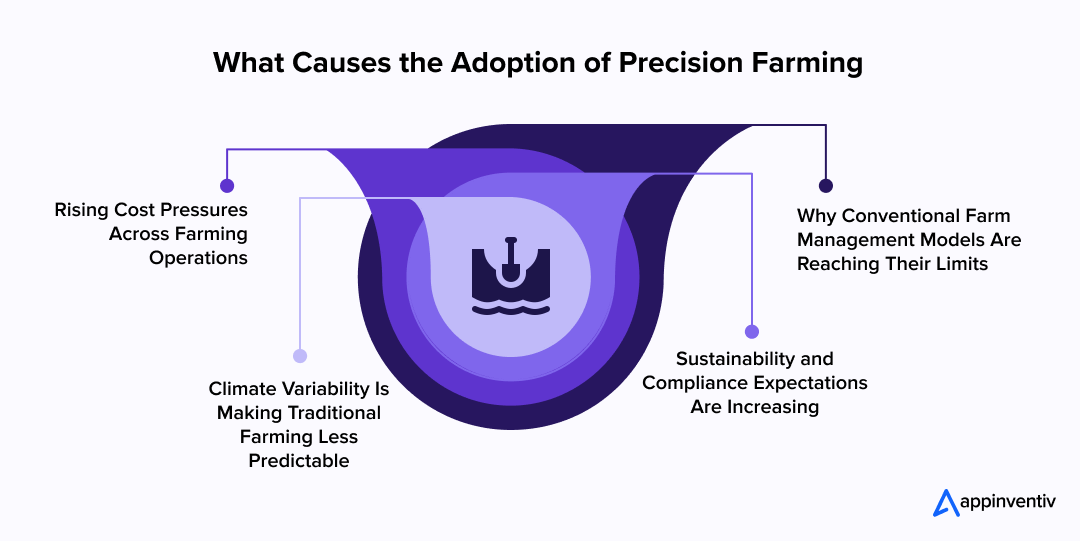
Rising Input Costs and Shrinking Margin Room
Fertiliser, diesel, water, and chemical costs have moved sharply upward across Australian broadacre and irrigated operations. For large grain enterprises, inputs typically represent 40–60% of gross revenue; a ratio that leaves little buffer when commodity prices soften or seasonal conditions disappoint.
Precision farming for Australian farmers addresses the input waste component directly. Not by reducing the total input budget arbitrarily, but by directing spend to the zones where the yield response justifies it.
Climate Variability Making Traditional Farming Less Predictable
Water scarcity is a persistent issue across Australian agriculture, compounded by climate variability that makes seasonal planning harder. Agriculture accounts for approximately three-quarters of Australia’s total water use, and the southern Murray–Darling Basin faces ongoing allocation pressure, according to ABARES.
Operations that cannot manage water precisely, allocating it to the zones and crops with the highest yield response, face both productivity and compliance exposure as water market prices remain elevated. Precision agriculture technology that reads soil moisture and localised weather lets operators commit inputs later, and with more confidence.
Labour and Skills Shortages Changing the Equation
Despite modest improvement, approximately 34% of Australian horticulture farms still reported difficulty recruiting workers in 2022–23, according to ABARES executive director Dr Jared Greenville. In broadacre, the structural problem is different: qualified machinery operators, agronomists with digital tools literacy, and data analysts with farming context are all undersupplied.
Precision and autonomous farming systems reduce the labour intensity of monitoring, spraying, and harvesting while improving the productivity of the skilled roles that remain.
Sustainability, Traceability and Compliance Becoming Commercial Requirements
Australia’s farm sector faces growing export market pressure to demonstrate environmental credentials. Scope 3 emissions reporting requirements, requirements under the National Greenhouse and Energy Reporting (NGER) framework, and the increasing commercial relevance of carbon credit generation are all pushing enterprise operators toward data infrastructure that can support audit-ready reporting.
Precision farming platforms that capture application records, soil carbon baselines, and water usage at zone level also generate the compliance data that regulators and trading partners are beginning to require.
How Does Precision Agriculture Work: The Technology Ecosystem
The key technologies used in precision farming in Australia fall into four working layers, plus a presentation layer that operators actually touch.
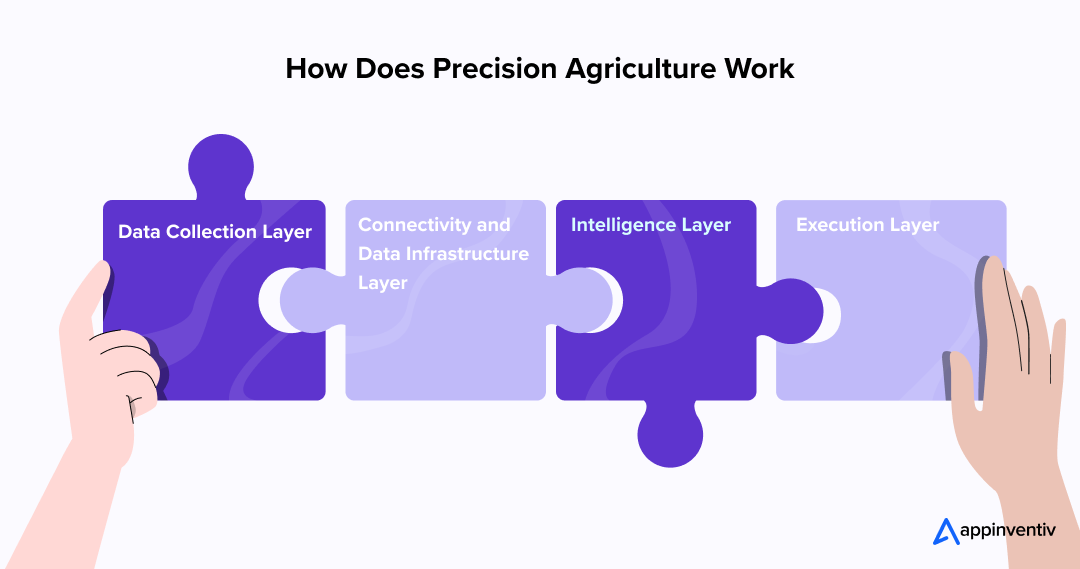
Data Collection Layer
Soil sensors, weather stations, satellite imagery, drone monitoring and livestock tracking systems gather field conditions continuously. Precision livestock farming relies heavily on this layer, using wearables and water-point sensors to flag animal health and movement across rangeland that is impossible to walk daily.
Connectivity and Data Infrastructure Layer
IoT networks, edge computing and cloud platforms move and stage the data. In remote Australia, connectivity is the constraint that decides what is feasible, so hybrid backhaul is common.
Intelligence Layer
Machine learning and AI powered farming models, predictive analytics and decision-support systems convert readings into prescriptions: how much water here, how much nitrogen there, which mob to move. This is where precision agriculture technology earns its return.
Execution Layer
GPS-guided machinery, autonomous equipment, Variable Rate Technology and smart irrigation apply the prescription with minimal manual input.
Technology Comparison: Key Precision Farming Tools
| Technology | Primary Use Case | Data Output | Connectivity Dependency | Typical AU Deployment |
|---|---|---|---|---|
| Soil sensors | Zone-level moisture and nutrient monitoring | Continuous time-series | Low (LoRaWAN) | Grain, irrigated horticulture |
| Satellite imagery (NDVI) | Canopy health, crop stress mapping | Weekly/biweekly rasters | None (pull-based) | Broadacre grain, cotton |
| UAV/drones | High-resolution scouting, spray application | On-demand point cloud | None (offline capable) | Viticulture, horticulture |
| GNSS auto-steer | Pass-to-pass accuracy, machinery guidance | Positional telemetry | Moderate (RTK correction) | All broadacre |
| Variable Rate Technology | Input prescription delivery | Application logs | Moderate | Grain, cotton, horticulture |
| Livestock wearables | Individual animal health and location | Real-time biometrics | High (cellular/LPWAN) | Pastoral, feedlot, dairy |
The Real Business Case for Precision Farming in Australia
The application of precision farming in agriculture solves problems with direct financial consequences. Inputs wasted on land that does not respond. Water applied to zones already at field capacity. Labour hours spent on observation tasks that sensors do better and cheaper. And compliance data reconstructed at year-end rather than captured automatically. Each of these has a cost. Precision farming removes or reduces it. Let’s see how:
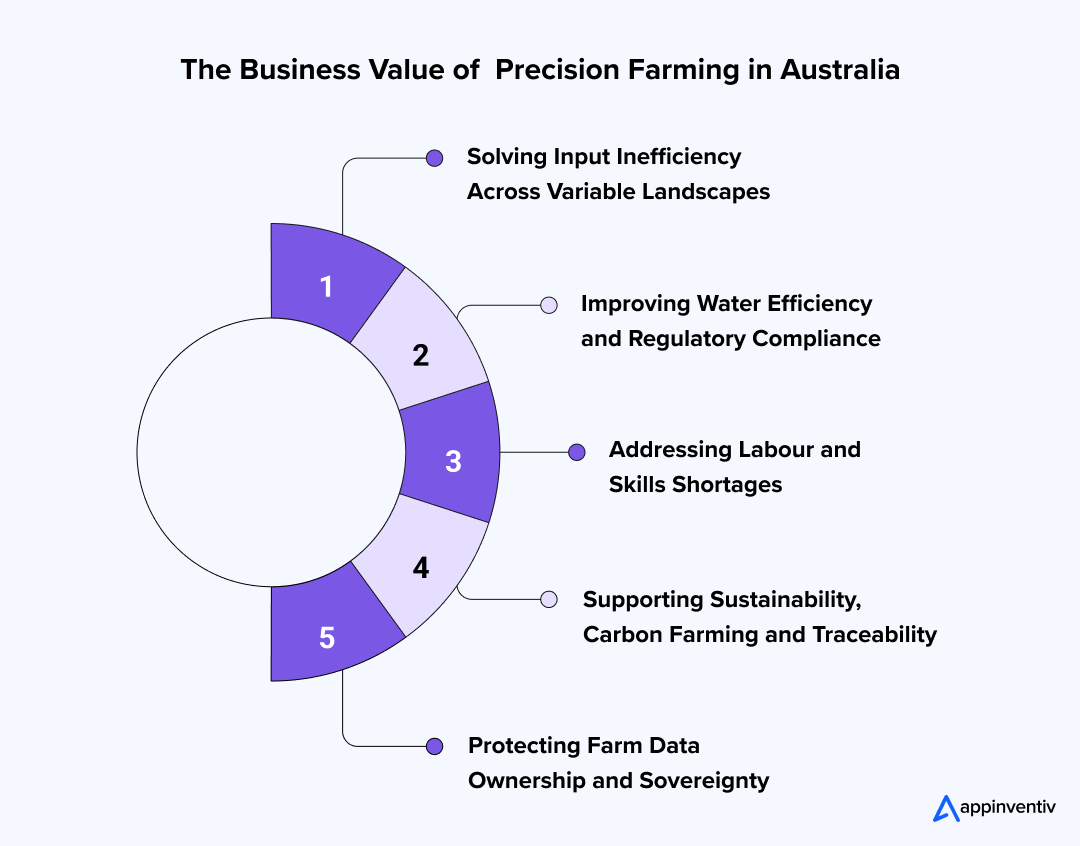
Solving Input Inefficiency Across Variable Landscapes
On uneven country, flat-rate application overspends on poor zones and underfeeds productive ones. Variable rate application corrects both, which is the clearest line item where the application of precision farming in agriculture pays for itself. In practice, precision farming agriculture lives or dies on this one calculation.
Improving Water Efficiency And Regulatory Compliance
Water is the binding constraint in much of irrigated Australia. Sensor-led scheduling cuts waste and, just as importantly, produces the usage records that water authorities and licence conditions increasingly require.
Addressing Labour And Skills Shortages
Skilled labour is scarce in regional areas. Autonomy and remote monitoring let smaller teams manage larger areas, and they reduce the cost of a missed window when staff are stretched.
Supporting Sustainability, Carbon Farming And Traceability
Carbon programs and premium buyers reward measurable practice. Precision data underpins carbon accounting and chain-of-custody claims without separate manual effort.
Protecting Farm Data Ownership And Sovereignty
Farm data has commercial value. Contracts that quietly transfer ownership to a vendor create long-term risk. Data sovereignty belongs in the procurement conversation, not the legal appendix.
Core Benefits of Precision Farming for Australian Enterprises
The benefits of precision farming span operations, finance, sustainability and strategy. Mapping them to your own scorecard, rather than a generic vendor list, is what separates a funded business case from a rejected one.
For precision farming for Australian farmers, the gains group into four categories that map cleanly onto enterprise reporting.
| Benefit Category | Key Outcomes |
|---|---|
| Operational | Faster decisions, reduced input waste, better risk management, granular asset utilisation data |
| Financial | Lower input costs per tonne, higher yield consistency, improved profitability per hectare |
| Sustainability | Reduced water consumption, lower fertiliser runoff, emissions reduction, improved soil health metrics |
| Strategic | Export market traceability, NGER compliance readiness, supply chain visibility, competitive differentiation |
Now that you know the benefits of precision farming, you must know where does your organisation currently sit, and what the journey looks like?”
The Precision Farming Maturity Model: Where Does Your Operation Stand?
Not every agricultural business is pursuing the same precision farming outcomes. Some organisations are still collecting data from disconnected systems, while others are already using AI to automate operational decisions.
Understanding where your operation sits on the maturity curve helps prioritise investments, set realistic ROI expectations, and avoid implementing technologies that the business is not yet ready to support.
Precision Farming Maturity Model
| Stage | What It Looks Like | Primary Outcome |
|---|---|---|
| Reactive Farm | Manual monitoring, historical records, experience-led decisions | Basic operational visibility |
| Connected Farm | Sensors, GPS-enabled machinery, and connected field assets | Real-time monitoring |
| Data-Driven Farm | Integrated farm data, dashboards, and variable-rate applications | Improved efficiency and lower input waste |
| Predictive Farm | AI-powered forecasting, risk alerts, and prescription recommendations | Proactive decision-making |
| Autonomous Farm | Automated equipment, robotics, and AI-driven operations | Enterprise-scale optimisation |
For most agribusinesses, the goal is not to jump directly to autonomy. The highest returns often come from progressing methodically through the maturity stages.
How Much Does Precision Farming Technology Cost in the Australian Region?
On average, the cost to implement precision farming in Australia ranges between AUD 70,000 and AUD 700,000 or more.
The cost of software development in Australia scales with ambition, not just hectares. Hardware is the visible spend, but integration, connectivity and change management often cost more. Setting realistic total cost of ownership early prevents the budget surprises that stall rollouts at year two. Costing precision agriculture in Australia starts with indicative ranges, though every operation differs.
The figures below reflect broadacre-weighted deployments.
| Scale | Profile | Indicative CapEx range | Primary cost driver |
|---|---|---|---|
| Mid-scale (2,000-5,000 ha) | Grain or mixed | AUD 70,000-AUD 150,000 | Hardware and connectivity |
| Large enterprise (5,000-20,000 ha) | Broadacre grain or cotton | AUD 150,000-AUD 350,000 | Platform integration and autonomy |
| Corporate agribusiness (>20,000 ha) | Multi-property | AUD 350,000-AUD 700,000 | Full-stack digital transformation |
A growing share of this spend is moving from capital to operating expense. Data-as-a-service and SaaS licensing spread cost across seasons, which improves cash flow alignment and lowers the upfront barrier. That shift is one reason the Australia precision agriculture market keeps widening with each passing year.
ROI Framework: How to Measure Returns from Precision Farming Investment
Enterprise finance teams need a structured ROI model they can interrogate, not a vendor-supplied percentage claim. The framework below gives procurement and operations a starting point for building their own numbers against their specific cost structure.
Five Dimensions of ROI
Input cost reduction: Quantified against current fertiliser, chemical, seed, and water spend. Calibrated by the reduction achievable through variable-rate application and precision irrigation across the operation’s actual soil variability profile.
Yield uplift: Modelled against a multi-season yield baseline. Accounts for the within-paddock variability currently leaving yield potential unrealised in high-response zones.
Labour productivity: Measured as the reduction in hours required for field scouting, manual record-keeping, and repetitive machinery operation. Valued at market rates for the relevant labour categories in the relevant region.
Risk mitigation: Probability-weighted reduction in yield loss events attributable to late detection of disease, pest pressure, or soil stress. Also captures the value of improved water allocation compliance and reduced regulatory exposure.
Sustainability revenue: Estimated ACCU generation potential and any export market premium attributable to verified sustainability credentials and provenance data.
Typical ROI Timelines
| Phase | Year Range | Primary Returns |
|---|---|---|
| Foundation | Year 1–2 | Input waste reduction, labour efficiency, connectivity infrastructure payback |
| Optimisation | Year 2–3 | Yield consistency improvement, autonomous system productivity, water efficiency gains |
| Enterprise-wide returns | Year 3–5 | Full AI-prescriptive benefit, carbon revenue, supply chain premium, compliance cost avoidance |
Typical Capital Allocation and ROI Model
The following table shows a standard financial framework used to evaluate a technology upgrade across a typical 10,000-hectare broadacre grain operation.
| Evaluation Metric | Conventional Baseline | Precision Target (Year 3) | Projected Annual Value |
|---|---|---|---|
| Urea Application | 120 kg/ha uniform blanket rate | Variable rate (60–150 kg/ha based on moisture maps) | AUD 110,000 direct cost reduction |
| Chemical Overlap | Average 6% overlap on headlands | Section control and automated guidance (<1% overlap) | AUD 45,000 reduction in input waste |
| Average Wheat Yield | 2.4 tonnes per hectare | 2.55 tonnes per hectare via optimized seeding | AUD 315,000 gross revenue increase |
| Data Collection Costs | Manual records across properties | Automated, machine-generated compliance data | AUD 25,000 administrative savings |
These figures are illustrative and require calibration against the operation’s actual input cost structure, yield baseline, and water entitlement position. The point of the model is to give finance a structure to pressure-test, not a number to use without adjustment.
The Barriers That Stall Precision Farming Projects and How to Navigate Them
Most failures are organisational, not technical. Connectivity gaps, fragmented data, lock-in risk and weak change management quietly drain value. Naming these challenges with precision farming implementation early, and budgeting for them, is the difference between a pilot and an operating capability.
Experienced operators have seen projects fail. The honest challenges with precision farming implementation are these.
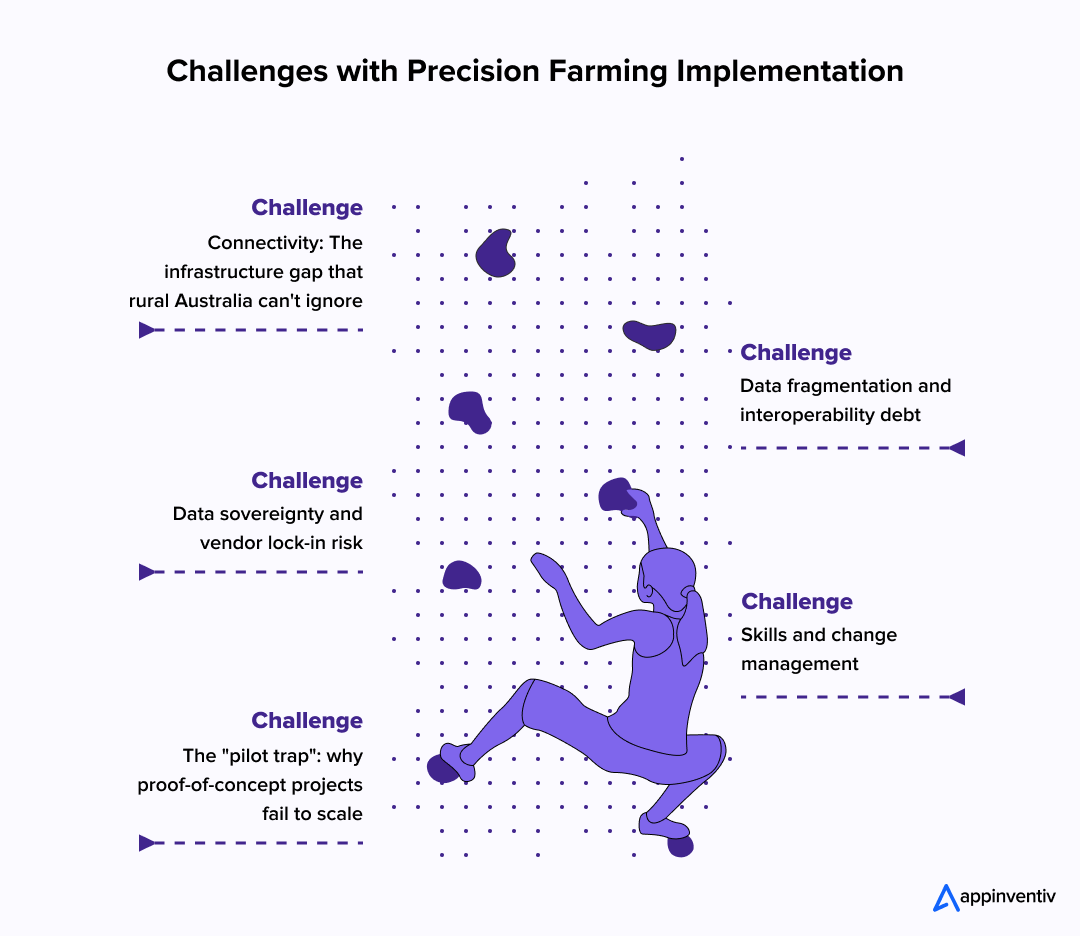
Connectivity Limitations Across Regional Australia
Many advanced precision tools require stable, low-latency data connections to stream high-resolution field data back to corporate systems. However, reliable mobile network coverage remains inconsistent across large areas of the Australian grain and pastoral belts.
To protect operations from connectivity dropouts, enterprises must avoid designs that rely entirely on continuous cloud connections. Building a resilient network means deploying edge computing units on field machinery to process data locally, using local LoRaWAN networks for sensor data, and installing Starlink satellite systems to handle primary data backup.
Data Compatibility and System Integration Issues
Enterprise operations often run mixed machinery fleets from different manufacturers, alongside a collection of legacy farm management software programs. These systems frequently save data in proprietary file formats that do not easily share information with each other or with corporate ERP systems. This lack of compatibility can trap valuable data in isolated silos, requiring manual data entry and slowing down operational planning.
Managing this requires strict adherence to open standards like ISOBUS (ISO 11783) and investing in dedicated API layers to clean and format field data before it enters corporate data lakes.
Technical Skill Gaps and Strategic Change Management
Moving to data-driven operations requires field staff, managers, and agronomists to adopt entirely new daily workflows. When field teams find new software platforms too complicated or feel they undermine their traditional expertise, technology adoption drops quickly. This can lead to expensive monitoring hardware being bypassed or ignored in the field.
Overcoming this cultural barrier requires involving field staff early in the design phase, simplifying user interfaces, and framing the technology as a supportive tool that reduces tedious manual work rather than an automated replacement for their practical farming experience.
The Pilot Trap and Scalability Constraints
Many agribusinesses struggle to expand small, successful technology pilots into full, enterprise-wide deployments across multiple regions. A pilot program that works well on a single property with an enthusiastic manager often runs into difficulties when rolled out across diverse geographies with different soil types, network conditions, and management styles.
To avoid getting stuck in a continuous pilot phase, teams must design their data systems, security protocols, and operational workflows with full corporate scaling in mind from day one.
Plan connectivity, data ownership and adoption before they erode the value of the investment with Appinventiv

Precision Farming Use Cases for Australian Farmers Across the Agri Sectors
Precision farming vs conventional farming plays out differently across Australia’s major agricultural sectors. The ROI profiles, regulatory contexts, and technology readiness levels vary enough that a sector-agnostic approach to deployment planning creates misalignment between investment and return.
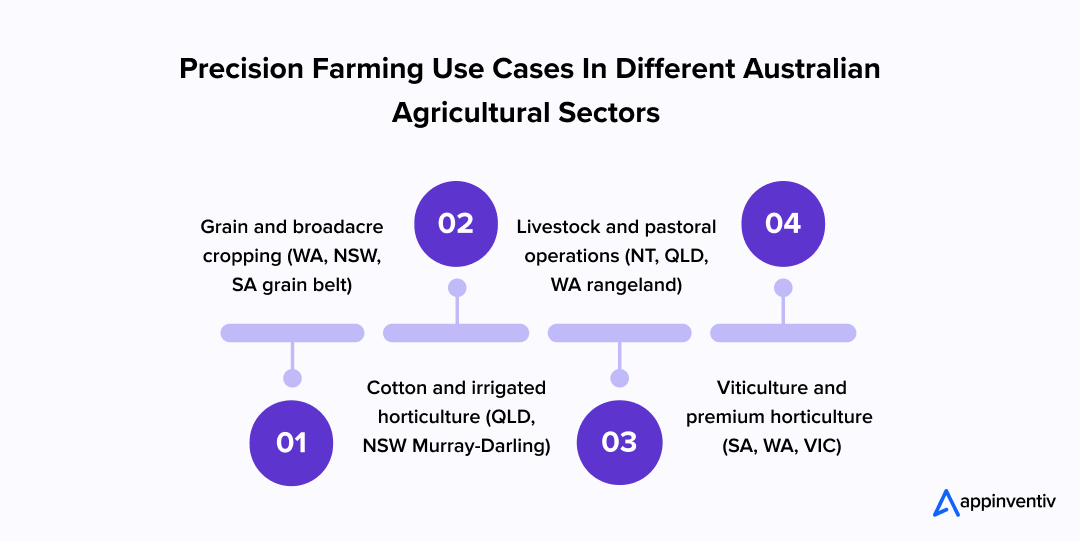
Grain and Broadacre Cropping
Variable rate fertiliser, GNSS auto-steer, and yield mapping are the most mature precision farming technologies in this sector. The next frontier for large grain enterprises is multi-season AI models that adjust prescriptions dynamically, accounting for soil carbon dynamics, rotation history, and climate-adjusted yield potential. Integration with commodity trading platforms and NGER reporting is becoming a standard requirement for grain corporates with institutional investors or listed parent companies.
Cotton and Irrigated Horticulture
Water is the defining input in irrigated systems, and water management is the highest-return precision farming use case for these operators. Soil moisture monitoring, automated irrigation scheduling, and regulated deficit irrigation protocols, supported by zone-level sensor data, directly reduce spend on the operation’s most constrained and expensive input. Cotton enterprises also face Basin Plan compliance monitoring obligations that precision irrigation data supports with minimal incremental effort.
Precision Livestock Farming
Pastoral operations across northern and western Australia face the most challenging connectivity environment in the sector, and the highest operational cost of imperfect animal visibility. GPS collar tracking, ear-tag biometrics, and automated water point monitoring provide the situational awareness that remote mustering and manual inspection cannot match across properties that span hundreds of thousands of hectares. The ROI case centres on mortality reduction, mustering efficiency, and labour cost relative to the alternative.
Viticulture and Premium Horticulture
Premium price points and export dependency make precision farming investment economics particularly favourable in these sectors. Canopy temperature mapping, targeted vine-row irrigation scheduling, and disease risk modelling reduce input costs while protecting the quality premiums that separate Australian wine and premium produce in export markets. EU and UK provenance and sustainability requirements are creating additional data infrastructure demand, operators who have that infrastructure already are in a materially stronger position than those building it under deadline pressure.
How to Implement Precision Farming Platform: A Practical Roadmap
Deployment sequencing matters as much as technology selection. A phased roadmap aligned to operational value delivery allows enterprise operators to demonstrate returns at each stage and maintain institutional confidence in the programme rather than asking for a large capital commitment before any returns are visible.
The key steps to build software for farm management and precision farming are as follows:
| Phase | Key Actions | Key Deliverable |
|---|---|---|
| 1 — Establish the Baseline | Audit operational inefficiencies, assess connectivity coverage, evaluate existing machinery and technology assets, and map available farm data sources | Implementation readiness assessment |
| 2 — Identify High-Value Opportunities | Prioritise use cases with the strongest business impact, evaluate property-specific requirements, and align investments with operational goals | Ranked technology investment plan |
| 3 — Build the Data Foundation | Consolidate historical farm data, deploy sensor infrastructure, establish data governance, and implement farm management platforms | Operational data platform |
| 4 — Validate Through Pilot Deployment | Test precision farming solutions on representative properties, measure performance under real operating conditions, and establish ROI benchmarks | Validated ROI baseline |
| 5 — Scale Across the Enterprise | Standardise deployment frameworks, integrate with ERP and compliance systems, train operational teams, and expand adoption across properties | Enterprise-wide deployment |
| 6 — Advance with AI and Automation | Introduce predictive analytics, automate operational workflows, deploy autonomous equipment, and enable carbon and sustainability reporting | Full-stack precision enterprise |
Emerging Trends Shaping the Future of Precision Farming in Australia
The next wave moves from monitoring to autonomous action. Operators who build clean data foundations now will adopt these capabilities cheaply, while those who delay will face costly retrofits to participate. Precision agriculture technology is maturing quickly along these critical fronts.
AI-powered predictive agriculture: Models that forecast yield, disease and weather impact before they hit the paddock.
Autonomous farming systems: Driverless tractors and robotic platforms moving toward true autonomous precision farming for australia, easing the labour constraint in remote regions.
Digital twins for agriculture: Virtual models of a farm that let managers test decisions before committing inputs.
Edge AI for real-time decisions: Processing on-device where connectivity is poor, so action does not wait for the cloud.
Carbon farming and regenerative agriculture: Precision data turning soil carbon and regenerative practice into verifiable, tradeable outcomes.
Robotics and autonomous harvesting: Selective robotic harvesting protecting quality in high-value horticulture.
How Appinventiv Can Help Build Precision Farming Solutions
Most precision farming programs do not fail on the technology. They fail when foundational issues are overlooked: connectivity treated as an afterthought, data trapped in a vendor’s format, a pilot that never had a path to scale. That is the work we do.
As an experienced AI development company in Australia, we help businesses turn a precision farming intent into a governed system that holds up across remote country, audit cycles and the next budget review.
Our agriculture software development services run from the business case through to live operation. Before anything gets built, we size the numbers procurement and finance actually need: where inputs are leaking, which use cases pay back first, and what total cost of ownership looks like once integration and connectivity are counted in. From there the architecture is designed to stay vendor-agnostic, so data ownership and residency remain with you, and the connectivity, data engineering, AI models and cybersecurity are built as one stack rather than a set of disconnected tools.
Low-connectivity agriculture is ground we have worked before. For IFOAM, an NGO backed by the United Nations and the Swiss Government, our team built MAAN, an agriculture and nutrition platform serving mountain communities across nine countries where networks were patchy or absent.
The core constraint there is the same one that breaks precision projects on remote Australian holdings: the software had to stay useful offline and reconcile cleanly once a connection returned. Designing for that from the outset, instead of patching it later, is what kept it working where it was actually used.
That experience sits on a wider delivery base. In our 11+ years of APAC delivery experience, we have deployed 3000+ digital assets across 35+ industries, and held a 96% client retention rate. Statista and the Financial Times have ranked us among APAC’s High-Growth Companies for two consecutive years.
For boards weighing vendor risk, governance counts as much as delivery, so we work to a 99.5% security compliance SLA across ISO and SOC2 certified delivery, and our work has driven efficiency gains of around 35% for Australian enterprises.
If precision farming is on your roadmap, it is time to make the move. Talk to our APAC team about sizing the business case, costs and ROI before you commit capital.
Book a Precision Farming Consultation
FAQs
Q. What is precision farming?
A. Precision farming is the practice of measuring variation across a paddock and matching inputs such as water, seed and fertiliser to what each zone needs, rather than applying flat rates. In Australia, it is used to cut input costs, manage water and meet compliance requirements.
Q. What are the benefits of precision farming?
A. The main benefits of precision farming are lower input costs, more consistent yield, better water and labour efficiency, reduced environmental impact, and compliance and traceability records that support lending, insurance and export access.
Q. What is the future of precision farming?
A. The future of precision farming in Australia points toward autonomous action and prediction: driverless machinery, AI yield forecasting, digital twins, edge processing and verifiable carbon outcomes. Operators with clean data foundations will adopt these fastest.


Fast 2-minute response, fully NDA-protected.
How To Build a Farm Management Software in Australia?
Key takeaways: Strategic roadmap on how to build a farm management software in Australia that aligns with multi-site, multi-entity farm operations. Explains core modules like farm mapping, livestock, inventory, workforce, finance, and ESG to create one unified operational source of truth. Breaks down the complete development journey from vision, domain modelling, and architecture to MVP,…
How AI-Powered Agriculture Apps in Australia Are Boosting Farm Gate Returns
Key takeaways: AI-powered agriculture apps in Australia are no longer productivity tools alone. When built around farm gate economics, they become decision infrastructure that directly influences cost control, quality consistency, and pricing outcomes. Traditional yield growth is insufficient under rising input costs and market volatility. AI-led agriculture platforms create value by improving timing, quality thresholds,…

Drones in Agriculture in Australia: Use Cases, Benefits & ROI Insights
Key takeaways: Drones are becoming a labour-offset tool for Australian growers, helping large farms operate efficiently with fewer onsite workers. The biggest impact comes when drone data is paired with software, AI, and automated workflows, not when drones are used only for visual monitoring. Precision spraying, livestock monitoring, vineyard heat-stress mapping, and broadacre yield forecasting…