































Aerospace ERP Software Development: Cost, Features, Timeline & Tech Stack

 Share -


- 01The Role of ERP in Transforming Core Aerospace Operations
- 02Key Components of Aerospace ERP Systems
- 03Must-Have Features in Aerospace ERP Software
- 04Core Integrations Required in Aerospace ERP Architecture
- 05Enterprise Architecture Considerations for Aerospace ERP Software Development
- 06Aerospace ERP Software Development Process
- 07Enterprise ERP Deployment & Modernization Strategy
- 08Key Benefits of Custom Aerospace ERP Software Development
- 09Major Challenges in Aerospace ERP Development and How Enterprises Overcome Them
- 10Key ERP Trends Shaping the Future of the Aerospace Industry
- 11How Much Does Aerospace ERP Software Development Cost?
- 12How Appinventiv Helps Enterprises Build and Modernize Aerospace ERP Systems
- 13Frequently Asked Questions

Key Takeaways
- Aerospace ERP platforms help production, procurement, maintenance, and finance teams work from the same operational records.
- Aircraft manufacturers use ERP systems to track serialized parts, supplier activity, maintenance history, and production schedules more accurately.
- Modern aerospace ERP environments now include AI forecasting, IoT telemetry, digital twins, and predictive maintenance monitoring.
- ERP modernization projects often involve phased rollout planning, legacy system migration, and plant-level operational coordination.
- Aerospace firms rely on ERP platforms for compliance reporting, inventory tracking, production visibility, and supplier management across global operations.
Aerospace ERP software development starts with understanding heavy operational pressures. Aircraft programs run across international supplier networks spread over multiple countries.
Engineering teams push daily design revisions. Production units track serialized components down to individual part numbers. MRO divisions manage maintenance records. These records stay active for decades.
Many systems still run on fragmented workflows built years ago. Engineering data sits in one place. Procurement works from another station. Quality teams keep separate compliance files. This division slows reporting and creates tracking gaps. Problems grow fast in facilities handling FAA documentation and AS9100 audits.
They struggle with ITAR controls and defense contracts tied to DFARS requirements. ERP for Aerospace and Aviation brings these separate steps into one connected environment. The market for this software will reach $12.5 billion dollars by 2033.
Factories continue to update older systems. Planning, inventory control, supplier coordination, and financial reporting share the same operational data layer. Teams get live visibility across BOM structures and manufacturing execution workflows.
This guide explains how firms build these platforms for large enterprises. It covers system architecture, modules, integrations, deployment plans, and new technology choices.
Aerospace firms upgrading ERP infrastructure gain faster reporting, stronger coordination, and fewer operational bottlenecks across plants.
The Role of ERP in Transforming Core Aerospace Operations
Aerospace programs depend on constant coordination between engineering, manufacturing, procurement, maintenance, compliance, and finance teams. ERP for aerospace connects these operations through a shared data environment.
Production & Manufacturing Control
Aerospace manufacturers manage complex shop floor steps. The software tracks engineer-to-order production workflows and multi-level BOM structures. It handles route sheet tracking, tooling scheduling, and machine scheduling.
Teams use it for avionics and composite manufacturing operations. Live shop-floor reporting connects through MES integrations. This tool gives production teams clear visibility across work orders, material availability, and assembly status.
Supply Chain & Supplier Coordination
Modern aerospace supply chains include hundreds of vendors. ERP for aviation tracks supplier activity across multiple regions. The system monitors tier-1 and tier-2 supplier activity, procurement workflows, and inventory synchronization.
It runs demand forecasting and stores supplier qualification records. Teams see material shortages and delays immediately. Supplier portals and procurement analytics improve coordination across sourcing operations.
MRO, Compliance & Lifecycle Tracking
ERP software for the aviation industry centralizes maintenance and compliance workflows. These workflows tie directly to long aircraft service cycles. The software runs maintenance scheduling, spare parts tracking, and predictive maintenance support.
It holds airworthiness documentation and AS9100 quality workflows. It manages ITAR and DFARS reporting, non-conformance tracking, and first article inspection records.
Enterprise Visibility & Cost Control
The platform combines operational and financial reporting into one environment. Teams use dashboard views for project accounting, milestone billing, and resource allocation. These dashboards show production KPIs and supplier performance tracking.
The system generates enterprise-wide reporting for faster access to operational and financial data across distributed facilities, and broader adoption of AI in aviation is further accelerating how that data is interpreted and acted upon
Key Components of Aerospace ERP Systems
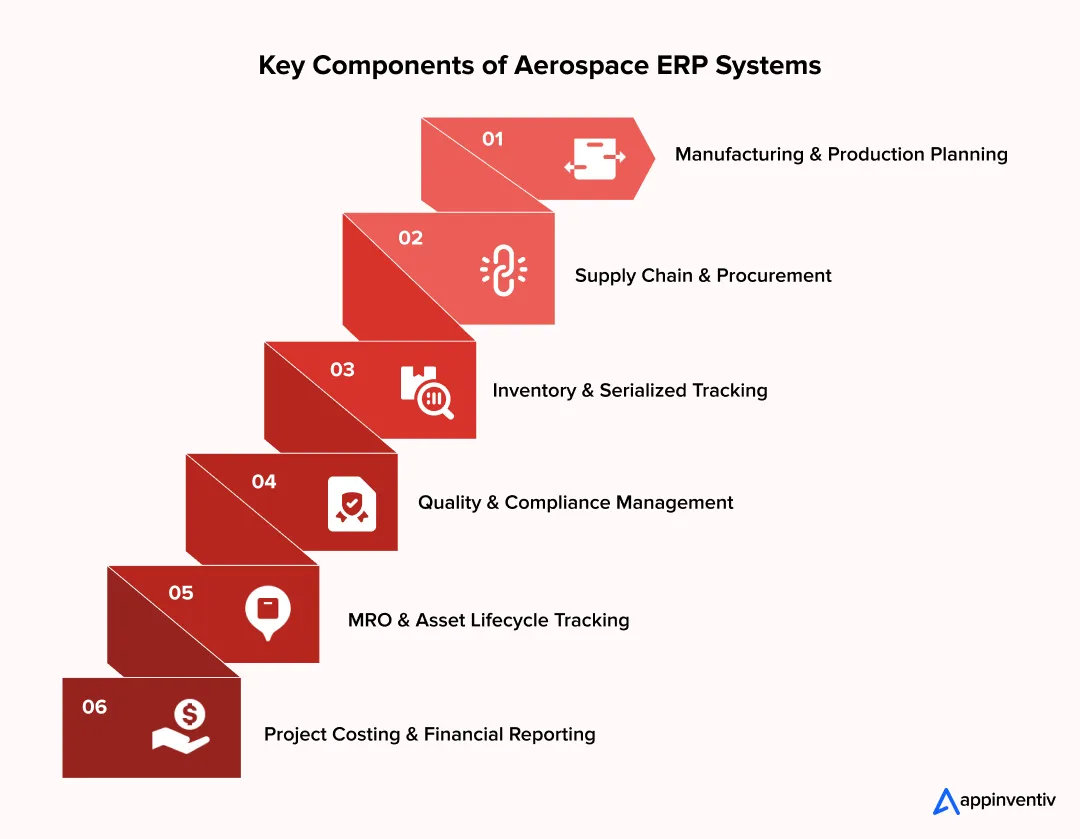
ERP for aerospace combines manufacturing, compliance, maintenance, procurement, and financial operations inside one connected system. Each module supports a different part of the aircraft production and service lifecycle.
Manufacturing & Production Planning
Aerospace production needs strict coordination between engineering and shop-floor operations. The core module tracks production scheduling and multi-level BOM management. It controls route sheet tracking, capacity planning, machine allocation, and tooling allocation.
The system manages work orders through direct MES connectivity. These modules help teams track aerospace assemblies, production delays, and material dependencies in real time.
Supply Chain & Procurement Management
Procurement teams manage supplier activity across global networks. The software centralizes sourcing and purchasing workflows. It runs procurement automation and opens supplier collaboration portals. The platform builds sourcing visibility and handles material requirement planning.
It manages vendor qualification tracking, purchase order management, and inventory replenishment workflows. Teams gain fast access to supplier data, procurement history, and inventory availability.
Inventory, Warehouse & Serialized Tracking
Aerospace manufacturers track thousands of serialized parts across production and maintenance spaces. Inventory modules support serialized inventory tracking, barcode integration, and RFID integration.
The system provides lot traceability, warehouse bin management, and visibility into spare parts. It records inventory movement tracking to support compliance audits and airworthiness documentation.
Quality Assurance & Compliance Management
Quality management remains a critical part of aerospace operations. The software centralizes inspection and compliance workflows. It runs AS9100 compliance workflows, inspection management, and CAPA tracking.
The system handles non-conformance reporting, audit-readiness reporting, document control, and revision-history management.
Quality teams keep centralized records across engineering, procurement, and manufacturing units. Firms study new methods like blockchain in aviation to strengthen audit trail integrity and parts verification.
MRO & Asset Lifecycle Management
Aircraft maintenance operations generate large volumes of operational data over time. The platform helps maintenance teams manage service workflows and asset performance. It handles fleet maintenance planning, service scheduling, and predictive maintenance tracking.
The software runs condition-based monitoring, spare parts coordination, and asset lifecycle analytics. Maintenance teams gain clear visibility into downtime, service history, and replacement cycles.
Project Costing & Contract Management
Defense and aerospace programs run across long production cycles with strict financial controls. The software supports project accounting, government contract tracking, and milestone billing.
It manages labor cost allocation, budget forecasting, and resource utilization reporting. Finance teams monitor program profitability and contract-level spending accurately.
Financial Management & Enterprise Reporting
Financial modules combine operational and accounting data within one reporting structure. The system runs multi-entity accounting, financial consolidation, budgeting, and forecasting. It handles procurement cost tracking, operational analytics, and KPI dashboards.
This tool builds enterprise reporting. Executives gain fast access to production, procurement, maintenance, and financial performance data across business units.
Must-Have Features in Aerospace ERP Software
Aerospace companies rely on ERP for aerospace to handle large production programs with thousands of moving parts. Engineering teams release design revisions daily. Procurement departments track suppliers across multiple countries.
Maintenance crews log service records that stay active for decades. The Aerospace ERP system’s features below help connect these operations through a shared system.
Real-Time Operational Visibility
Production teams need fast access to current operational data. ERP dashboards collect information from manufacturing lines, warehouses, procurement systems, and maintenance units.
Most platforms include live production tracking, plant-level reporting, and inventory movement visibility. They also offer work-order monitoring, operational KPI dashboards, and executive reporting tools. This helps teams react faster to material shortages and production delays.
End-to-End Part Traceability
Aircraft manufacturers must maintain detailed records for every serialized component. The system tracks parts from procurement through production and long-term maintenance cycles.
Core tracking functions include serialized inventory records, lot tracking, and supplier traceability. The software handles inspection history, maintenance-linked component records, and audit logs. These records support FAA and EASA reporting requirements.
Role-Based Security & Audit Trails
Systems store engineering data, supplier records, and defense contract documentation. Security controls limit access across departments and facilities. Common security tools include role-based access control, privileged account monitoring, and encrypted document storage.
The system tracks user activity and holds compliance audit logs. These controls support ITAR, DFARS, and CMMC programs.
AI Forecasting, Cloud Access & Workflow Automation
Modern ERP platforms support the following capabilities powered by AI in ERP systems. The tools handle inventory forecasting, supplier risk analysis, and anomaly detection. Firms use hybrid cloud deployment and remote operational access.
The software manages engineering change workflows, automated procurement approvals, and compliance document routing. These functions reduce manual coordination across manufacturing, procurement, quality, and maintenance operations.
Core Integrations Required in Aerospace ERP Architecture
Aerospace ERP systems rarely operate alone. Most enterprises already use PLM platforms, MES environments, supplier portals, maintenance systems, and analytics tools across different business units. A well-planned ERP software integration connects these systems through APIs, middleware layers, and shared operational data models.
| Integration Area | ERP Function | Operational Impact |
|---|---|---|
| PLM Integration | Connects engineering and production data | Keeps BOM revisions and design records aligned |
| MES Integration | Shares live manufacturing data | Improves shop-floor coordination |
| SCM Integration | Tracks suppliers and procurement activity | Improves sourcing visibility |
| IoT Integration | Collects equipment and aircraft telemetry | Supports predictive maintenance |
| CRM Integration | Connects customer and service records | Improves aftermarket support |
| BI Integration | Combines operational and financial reporting | Supports enterprise reporting |
PLM Integration
PLM systems manage engineering and product lifecycle records. ERP platforms exchange data with PLM environments to maintain production accuracy.
Common integration points include:
- CAD synchronization
- Engineering change management
- Revision control
- Product lifecycle governance
- BOM synchronization
This reduces manual data transfer between engineering and manufacturing teams.
MES Integration
MES platforms track shop-floor execution and machine activity in real time. ERP systems use this data for production planning and operational reporting.
MES integrations support:
- Machine telemetry
- Production scheduling
- Work-order execution
- Manufacturing synchronization
- Production analytics
Production managers gain better visibility into line performance and downtime events.
SCM, IoT, CRM & Analytics Integration
Aerospace ERP systems often connect with supplier networks, IoT in aviation environments, customer service platforms, and analytics tools.
These integrations support:
- Supplier communication
- Logistics coordination
- Vendor analytics
- Aircraft health monitoring
- Condition-based maintenance
- Field service coordination
- Enterprise KPI dashboards
- Predictive analytics reporting
This creates a connected operational environment across manufacturing, maintenance, procurement, and customer support teams.
Enterprise Architecture Considerations for Aerospace ERP Software Development
ERP for Aerospace and Aviation architecture affects how companies handle production, engineering, procurement, maintenance, and compliance activities every day. A weak architecture creates slow reporting, unstable integrations, duplicate records, and traceability gaps across manufacturing programs.
Older aerospace ERP environments often struggle under growing operational loads. Many still depend on tightly connected application stacks built years ago. Production planning, inventory, finance, and procurement modules all run inside the same environment. A small system update can affect unrelated workflows across the platform.
Microservices vs Monolithic ERP Architecture
Monolithic ERP platforms still exist across many aerospace plants. These systems centralize all business functions inside one codebase and database structure.
Modern ERP environments increasingly shift toward microservices and composable architecture models.
| Architecture Type | Operational Impact |
|---|---|
| Monolithic ERP | Slower release cycles and tighter system dependencies |
| Microservices ERP | Independent services with isolated deployment pipelines |
| Composable ERP | Selective module expansion across operational environments |
Microservices architecture helps aerospace firms separate manufacturing, MRO, procurement, analytics, and compliance services into smaller operational units. Teams can update one workflow without affecting the full ERP environment.
Many deployments now use Kubernetes clusters and containerized workloads across hybrid infrastructure.
Cloud, Hybrid & On-Premise Infrastructure
Commercial aerospace firms often place procurement systems, analytics environments, and supplier portals inside cloud infrastructure. Defense programs still keep controlled engineering workloads inside restricted environments.
Most large firms using ERP for aviation now operate a hybrid infrastructure.
Typical deployment patterns include:
- Cloud-based reporting systems
- On-prem engineering environments
- Hybrid manufacturing infrastructure
- Distributed failover systems
- Multi-cloud backup environments
This structure separates export-controlled workloads from broader operational systems.
Digital Thread & Operational Data Architecture
ERP platforms exchange data continuously with PLM, MES, SCM, QMS, CRM, and MRO systems. Engineering revisions, inspection reports, maintenance logs, supplier transactions, and BOM structures move across these systems every day.
Digital thread architecture connects this information through a shared operational model.
Core architecture layers often include:
- Master data management (MDM)
- Revision-controlled BOM synchronization
- Event-stream processing
- Operational data normalization
- Interoperability services
- Distributed integration pipelines
This helps teams maintain production consistency across engineering, manufacturing, procurement, and maintenance operations.
Security, APIs & High Availability
Aerospace ERP systems store ITAR-controlled drawings, DFARS records, supplier certifications, and defense contract documentation. Security controls must protect these environments across suppliers, contractors, and manufacturing facilities.
Common controls include:
- RBAC and identity federation
- Zero-trust access policies
- Encryption at rest and in transit
- Centralized audit logging
- SIEM-based threat monitoring
- CMMC and NIST 800-171 alignment
Most modern ERP platforms now use API-first architecture with middleware orchestration, asynchronous message queues, REST APIs, and event-driven communication layers.
High-availability infrastructure remains critical across aerospace operations. ERP environments often support distributed workloads, regional failover clusters, disaster recovery systems, and low-latency transaction processing across multiple production facilities.
Recommended Tech Stack for Aerospace ERP Software Development
Aerospace ERP environments connect manufacturing systems, procurement workflows, engineering platforms, supplier portals, warehouse operations, and maintenance records. Most enterprises use a mix of cloud infrastructure, on-prem production systems, and industrial communication layers across different facilities.
| Stack Layer | Technologies Commonly Used | Main Purpose |
|---|---|---|
| Backend Development | Java Spring Boot, .NET Core, Node.js | ERP logic, workflow processing, transaction management |
| Frontend Applications | React, Angular, Vue.js | Production dashboards and reporting interfaces |
| Mobile Applications | Flutter, React Native | Maintenance activity and warehouse operations |
| Database Systems | PostgreSQL, Oracle Database, Microsoft SQL Server | BOM records, supplier data and inventory tracking |
| Streaming Platforms | Apache Kafka, Apache Spark | Production telemetry and event processing |
| APIs & Middleware | REST APIs, GraphQL, MuleSoft, Apache Camel | ERP integration across PLM, MES, and SCM systems |
| Cloud Infrastructure | AWS, Microsoft Azure, Google Cloud | ERP hosting and distributed infrastructure |
| Container Management | Docker, Kubernetes | Application deployment and workload distribution |
| Industrial Protocols | MQTT, OPC UA | Machine communication and IoT connectivity |
| Reporting Platforms | Power BI, Grafana, Kibana | KPI tracking and operational analytics |
| Identity Management | Okta, Azure Active Directory | Authentication and access management |
| Security Monitoring | Splunk, IBM QRadar | Threat monitoring and audit visibility |
Most aerospace manufacturers still combine older production systems with newer cloud infrastructure. Engineering environments tied to ITAR and DFARS controls often remain inside restricted networks. Supplier systems, reporting tools, and analytics workloads usually operate through cloud-based infrastructure.
Modern aerospace operations demand API-first architecture, secure integrations, and scalable ERP infrastructure across global facilities.

Aerospace ERP Software Development Process
Building aerospace ERP software requires more than module configuration and database setup. Aerospace manufacturers operate across tightly regulated production environments with long supply chains, serialized inventory, engineering revisions, and strict compliance controls. ERP development must account for these operational realities from the beginning.
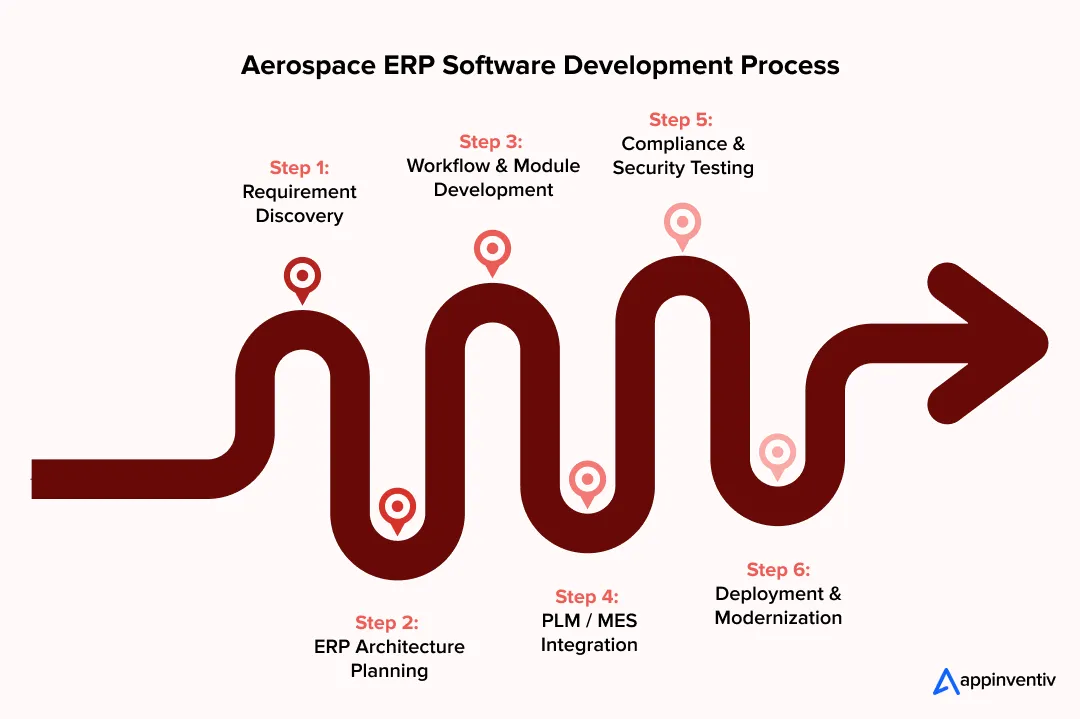
Phase 1 – Business Process Discovery & ERP Requirement Analysis
Most aerospace ERP software solutions begin with operational assessment workshops across manufacturing, procurement, engineering, quality, maintenance, and finance teams.
The discovery phase usually includes:
- Workflow mapping
- Stakeholder analysis
- Production dependency tracking
- Operational bottleneck discovery
- Supplier process review
- Compliance requirement gathering
- Audit workflow analysis
This stage helps teams identify disconnected systems, manual reporting gaps, and legacy workflow limitations across the organization.
Phase 2 – ERP Platform Selection vs Custom ERP Engineering
Some aerospace firms customize existing ERP platforms such as SAP or Oracle. Others focus on developing aviation ERP software from scratch around production and compliance requirements.
| ERP Model | Typical Use Case |
|---|---|
| SAP or Oracle Customization | Large enterprises with existing ERP infrastructure |
| Custom ERP Development | Highly specialized aerospace workflows |
| Composable ERP Architecture | Modular expansion across procurement, MRO, analytics, and manufacturing systems |
Composable ERP models allow companies to extend selected business functions without rebuilding the full operational stack.
Phase 3 – System Architecture & Data Model Design
Architecture planning defines how ERP modules exchange data across production, procurement, engineering, and maintenance systems.
Core design activities include:
- Operational data modeling
- BOM hierarchy design
- Supplier data architecture
- Serialized inventory structures
- Revision-controlled engineering records
- Manufacturing data flow mapping
ERP data models must support traceability across the full aircraft lifecycle.
Phase 4 – Module Development & Workflow Engineering
An experienced aviation software development company builds operational modules around business workflows and approval structures.
This stage often includes:
- Workflow automation
- Role-based workflows
- Procurement approval routing
- Engineering change workflows
- Custom business logic
- Compliance-driven validation rules
Most aerospace ERP environments also support configurable workflows across manufacturing and maintenance operations.
Phase 5 – Integration Layer Development & API Orchestration
Modern aerospace ERP systems exchange data continuously with external platforms.
Common integration layers include:
- ERP-MES integration
- ERP-PLM interoperability
- Middleware engineering
- REST API development
- Asynchronous message queues
- Real-time operational APIs
These integrations connect production systems, supplier portals, IoT environments, and analytics platforms.
Phase 6 – Compliance Validation & Security Engineering
Security and compliance testing remain critical across aerospace ERP environments.
Validation activities often include:
- Audit-readiness checks
- Penetration testing
- Access-control validation
- Secure architecture testing
- Compliance verification for ITAR, DFARS, and CMMC requirements
Security teams also review encryption controls, audit logging, and privileged access policies.
Phase 7 – Testing, Deployment & Continuous Modernization
ERP deployment usually happens in phases across manufacturing plants, procurement teams, and maintenance facilities.
Testing and rollout activities include:
- Load testing
- Scalability testing
- Integration testing
- Deployment automation
- Failover validation
- Operational monitoring
Post-deployment work continues long after the initial launch. Aerospace firms regularly expand ERP capabilities through analytics modules, AI forecasting tools, workflow updates, and operational reporting improvements.
Enterprise ERP Deployment & Modernization Strategy
ERP rollout across aerospace environments rarely happens in a single phase. Most manufacturers still operate older production systems, custom reporting tools, and isolated databases across engineering, procurement, maintenance, and finance teams.
Modernization projects must replace these systems without affecting production schedules or compliance reporting.
Legacy System Migration Strategy
Older ERP spaces often carry years of custom scripts, duplicate records, and unsupported integrations. When Implementing ERP solutions in aerospace, migration teams usually replace legacy systems in stages instead of attempting a full cutover.
Common modernization tasks include phased migration planning and technical debt reduction. Teams also handle legacy infrastructure retirement, module-by-module replacement, and operational risk assessment. This step reduces disruption across active manufacturing programs.
Multi-Plant Deployment Planning
Large aerospace firms run operations across multiple production plants, warehouses, and supplier networks. Rollout plans must account for different operational processes at each location.
Deployment planning includes distributed rollout scheduling, localization support, and regional compliance mapping. Teams also incorporate production continuity planning and supplier coordination. Most companies deploy the new software modules gradually across facilities.
Data Migration & Governance
Migration projects involve supplier records, BOM structures, and maintenance history. Teams compile inventory data and production logs collected over many years. Migration teams focus on master data governance, data cleansing, and duplicate record removal.
They run migration validation and traceability verification. Poor migration quality creates inventory and reporting problems later.
Change Management & Workforce Enablement
Software deployment affects production teams, procurement staff, maintenance crews, and finance departments. Many operational delays happen after deployment rather than during development.
Most rollout programs include workforce readiness planning and operational alignment reviews. They use department-level onboarding, process transition support, and user adoption tracking. These steps help teams adjust to new workflows faster.
ERP Adoption, Training & Operational Alignment
Training programs for ERP for aviation vary between engineering, manufacturing, quality, procurement, and maintenance teams. Each department interacts with software workflows differently.
Organizations provide role-specific training, workflow onboarding, and operational simulations. They supply reporting guidance and track adoption metrics. Training quality directly affects long-term software usage.
Also Read: On-Demand Aircraft: Revolutionizing the Future of Aviation
Continuous Monitoring & ERP Optimization
Modernization continues long after the initial deployment. Manufacturing environments change constantly across production, procurement, supplier management, and maintenance operations.
Post-deployment work includes KPI tracking, workflow refinement, and process optimization. Teams run operational reporting reviews and formal governance programs. Staff use this data to improve reporting accuracy and operational performance over time.
Key Benefits of Custom Aerospace ERP Software Development
ERP for aerospace manages the constant flow of information among engineering, procurement, production, maintenance, quality control, and finance teams. ERP software connects these departments through one operational system and reduces delays caused by disconnected workflows.
ERP software for the aviation industry improves operational productivity by 30% to 38% across discrete manufacturing environments through better coordination and real-time operational visibility.
| Benefit Function | Benefit Result |
|---|---|
| Compliance Management | Audit records, inspection logs, and traceability data are easier to manage |
| Supplier Coordination | Procurement teams track vendors, inventory, and material flow with better visibility |
| Production Operations | Manufacturing teams receive faster access to scheduling and work-order data |
| Maintenance Planning | MRO teams monitor spare parts, service records, and maintenance activity from one system |
| Financial Reporting | Finance departments track project costs and operational spending more accurately |
| Executive Oversight | Leadership teams access production, procurement, and operational KPIs faster |
ERP platforms also reduce manual reporting between PLM, MES, warehouse, procurement, and maintenance systems. This improves coordination across production facilities, supplier ecosystems, and long-term aircraft service operations.
Major Challenges in Aerospace ERP Development and How Enterprises Overcome Them
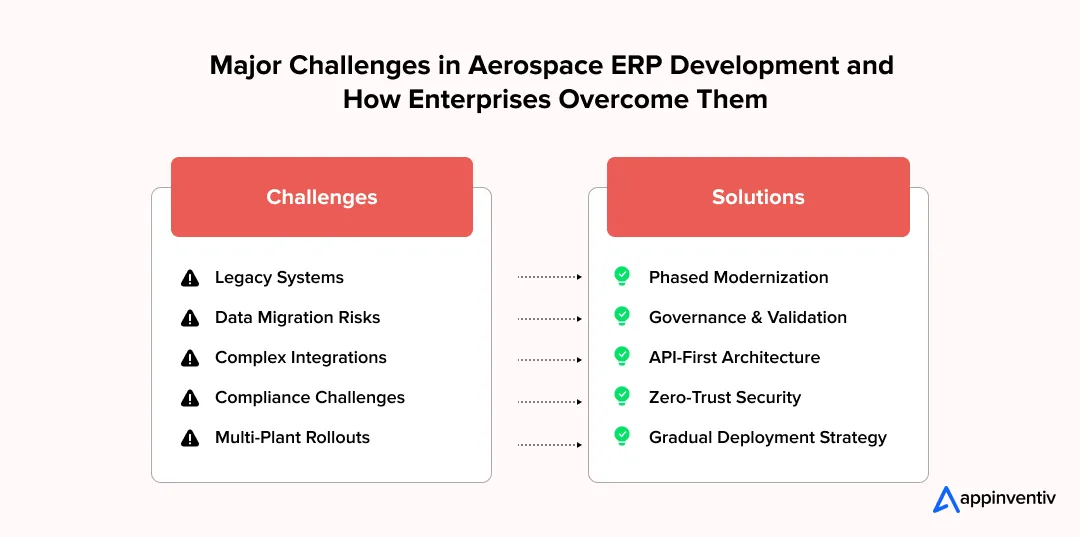
Aerospace ERP projects often involve older infrastructure, fragmented operational data, strict compliance controls, and distributed manufacturing environments. Most deployment risks appear during integration, migration, and operational rollout phases.
Legacy Infrastructure Dependencies
Many aerospace firms operate outdated ERP modules and unsupported databases. They run custom production systems built years ago. Enterprises address this trouble through phased ERP modernization and gradual module replacement. They select hybrid infrastructure deployment and legacy workload isolation.
Complex Data Migration Requirements
ERP migration projects involve large volumes of data collected over decades. This data includes BOM records, supplier databases, and maintenance logs. It contains inspection history and serialized inventory data. Teams manage this process through master data governance and migration validation cycles. They run duplicate record cleanup and traceability verification.
Cross-System Integration Complexity
ERP systems exchange data with PLM, MES, and QMS tools. They connect with SCM, MRO, and analytics environments. Poor synchronization creates reporting faults and traceability issues. Firms solve this through API-first architecture and middleware orchestration. They build event-driven integrations and centralized interoperability layers.
Compliance Validation & Security Risks
Aerospace ERP systems must support strict rules. They handle ITAR, DFARS, and AS9100 reporting requirements. They meet CMMC and FAA rules. Enterprises manage security through role-based access control and audit logging. They apply penetration testing and zero-trust security models.
Enterprise User Adoption Resistance
An ERP rollout changes workflows across multiple departments. It alters production, procurement, maintenance, and reporting steps. Management overcomes user resistance through role-specific onboarding and phased deployment. They use operational training programs and workflow simulations.
Managing Multi-Location Deployments
Large aerospace manufacturers operate across several production plants and supplier ecosystems. Teams handle these setups through regional rollout planning and localization support. They maintain centralized ERP governance and production continuity planning.
Key ERP Trends Shaping the Future of the Aerospace Industry
ERP for aerospace and aviation shifts past traditional production and finance management. Over half of modern deployments include AI, IoT, or analytics for predictive factory operations. Factories require smart automation, secure supply chains, and real-time visibility.
AI-Powered ERP Assistants
Modern platforms use artificial intelligence for forecasting and decision support. The tools predict supplier risk, recommend schedules, and monitor compliance. Self-learning models learn from past production delays and maintenance failures. ERP AI chatbots give teams instant access to operational data.
5G & Edge Computing for Real-Time ERP Connectivity
New networks reduce data latency across production lines. This hardware runs fast shop-floor analytics and processes telemetry data. Edge tools help defense contractors handle sensitive operational records locally.
Blockchain for Aerospace Supply Chain Security
These tools build clear traceability across procurement steps. Readers can explore aerospace blockchain use at NASA and beyond to see real examples. The system stops counterfeit parts through tamper-resistant component records and immutable audit trails.
To see how leading agencies are applying this, explore the use of blockchain in aerospace at NASA and beyond.
AR & VR for ERP Training and Manufacturing Simulation
Firms use virtual environments for training and production planning. Connected headsets give technicians repair instructions during maintenance tasks. This process speeds up assembly simulation and technician onboarding.
Self-Healing ERP Systems & Digital Twins
Smart systems detect and resolve software bugs automatically. Automated patching reduces system downtime. Software also connects with factory sensors and aerospace digital twins. This connection tracks machine telemetry and asset lifecycles for better shop control.
ERP modernization delays create operational bottlenecks across supplier management, maintenance tracking, and production visibility workflows.
How Much Does Aerospace ERP Software Development Cost?
Aerospace ERP software solutions vary in cost from one company to another. A supplier with one production facility spends far less than a manufacturer running multiple plants, MRO units, warehouse systems, and supplier networks across different regions.
Most aerospace ERP projects fall between $50,000 and $500,000+ USD. To understand what drives these numbers across project types, explore this breakdown of ERP implementation costs
| ERP Scope | Estimated Budget | Estimated Timeline |
|---|---|---|
| Small Modernization Project | $50,000 – $100,000 | 3 – 6 months |
| Mid-Scale ERP Deployment | $100,000 – $250,000 | 6 – 12 months |
| Enterprise Multi-Site Rollout | $250,000 – $500,000+ | 12 – 24 months |
| ERP with AI, IoT, and Advanced Automation | $500,000+ | 18 – 36 months |
Key Cost Drivers
Project budgets usually increase with operational complexity. Main cost factors include:
- PLM and MES integrations
- ITAR and DFARS compliance controls
- custom workflow development
- supplier portal integrations
- hybrid infrastructure setup
- migration from older ERP systems
- AI forecasting modules
Custom ERP vs ERP Customization
Here is a quick overview table.
| Model | Typical Use |
|---|---|
| ERP Customization | Faster deployment using existing ERP platforms |
| Custom ERP Development | Built around specialized aerospace workflows |
Some firms combine both models when developing aviation ERP software through composable environments. For a detailed look at how budgets are structured by scope and timeline, see this guide on ERP software development cost.
How Appinventiv Helps Enterprises Build and Modernize Aerospace ERP Systems
Aerospace ERP projects demand far more than software implementation. Manufacturers need stable architecture, secure integrations, production continuity, compliance-ready workflows, and long-term operational scalability. Appinventiv helps enterprises modernize complex aerospace operations through engineering-led ERP development built around real manufacturing and MRO environments.
| Appinventiv Capability | Business Value |
|---|---|
| 200+ aviation solutions delivered | Experience across complex operational ecosystems |
| 10+ years of industry experience | Deep enterprise engineering and modernization expertise |
| 95% client satisfaction rate | Long-term delivery consistency |
| 90% repeat clientele | Strong enterprise retention and operational trust |
Case Study Spotlight: Flynas App Revamp
Appinventiv partnered with Flynas, one of the Middle East’s leading low-cost airlines, to modernize its digital aviation platform and improve customer interaction across booking and support workflows.
| Flynas Operational Scale | Project Context |
|---|---|
| 38 aircraft fleet | Large-scale aviation operations |
| 1,500+ weekly flights | High-volume booking activity |
| 60+ million passengers served | Continuous platform demand |
Appinventiv upgraded the Flynas app to handle heavy traffic flows. Beyond mobile tools, our team provides complete ERP services for aviation firms. We deliver tailored aerospace ERP software development to connect factory schedules and compliance rules.
Let’s connect and build aerospace ERP systems ready for complex manufacturing and compliance operations.
Frequently Asked Questions
Q. What is aerospace ERP software?
A. Aerospace ERP software development enables aircraft manufacturers to manage production records, inventory, supplier activity, maintenance operations, engineering workflows, and financial reporting from a single system. Companies use these platforms to monitor serialized parts, BOM structures, inspection history, and procurement activity across aircraft programs. ERP systems also support compliance reporting tied to AS9100, FAA, EASA, ITAR, and DFARS requirements.
Q. How do ERP systems support quality control in the aerospace industry?
A. ERP software gives quality teams one place to manage inspection reports, audit records, engineering revisions, supplier certifications, and non-conformance tracking. Manufacturers can trace parts across production and maintenance history without depending on spreadsheets or disconnected reporting tools. This helps aerospace firms maintain cleaner audit records and stronger production traceability across long aircraft service cycles.
Q. What are the benefits of cloud-based ERP for aerospace businesses?
A. Cloud ERP systems help aerospace firms manage operations across production plants, warehouses, suppliers, and maintenance facilities through centralized infrastructure. Teams can access inventory records, maintenance schedules, production dashboards, and procurement workflows from different locations. Cloud deployment also reduces local infrastructure management and supports faster expansion across growing aerospace operations.
Q. Why is ERP software critical for the future of the aerospace industry?
A. Aircraft production now depends on close coordination between engineering teams, suppliers, manufacturing plants, maintenance units, and compliance departments. ERP software helps aerospace companies manage these operations through one operational platform. Modern ERP systems also support predictive maintenance, connected manufacturing environments, digital thread reporting, and AI-based operational planning across large production programs.
Q. How can aerospace companies successfully implement future-ready ERP systems?
A. Most aerospace ERP projects begin with process reviews, operational mapping, and phased deployment planning. Migration teams usually validate inventory records, supplier data, engineering revisions, and BOM structures before rollout begins. Companies also connect ERP systems with PLM, MES, and maintenance platforms gradually to avoid disrupting active production and maintenance operations.
Q. How can Appinventiv help enterprises implement aerospace ERP software?
A. Appinventiv helps aerospace enterprises modernize ERP environments tied to manufacturing, maintenance, procurement, supplier management, and compliance operations. Our teams support ERP consulting, architecture planning, workflow engineering, ERP integration, cloud deployment, and modernization programs. With 200+ aviation solutions delivered and more than 10 years of experience, Appinventiv supports large-scale aerospace ERP implementation initiatives.


Fast 2-minute response, fully NDA-protected.
ERP Solutions for Local Government: Features, Integrations, and Costs
Key takeaways: ERP for local councils unify isolated municipal workflows, reducing manual overhead and cross-departmental friction. It ensures regulatory alignment with state Local Government Acts and AASB standards. Modular, API-first architectures enable seamless bi-directional integration with GIS, EDRMS, and state planning portals. Phased implementation reduces operational downtime, ensuring financial transparency and sustained community trust. ERP…

Auto Spare Parts Management System Development: Complete Enterprise Guide
Key takeaways: Build an AI parts platform that links inventory, purchasing, warehouses, dealers, and ERP systems into one network. Examine system architecture, tech stacks, and software connections built for multi-site parts operations. See how AI sharpens order forecasts, stock planning, purchasing, and part lookups to cut daily delays. Compare custom code and ready-made apps to…

ERP Implementation Costs: Pricing, TCO, and the Hidden Cost Drivers of Large-Scale Deployments
Key Takeaways ERP implementation costs typically range from $50,000 to $1,000,000+, varying by business size, customization, and deployment model. Major cost drivers include software licensing, infrastructure, customization, data migration, integration, training, and change management. Hidden costs often arise from data preparation, process reengineering, scope changes, and ongoing post-launch support. Advanced technologies like AI, IoT, and…