


























E-Invoicing ERP Integration in the UAE: 70 Days to Close the Gaps Your ASP Won’t Fix

 Share -



- 01UAE E-Invoicing Readiness: ERP Integration and Compliance Deadlines
- 02UAE E-Invoicing Compliance That Influences ERP Integration
- 03The Five-Corner Model: Who Owns What in UAE E-Invoicing?
- 047 Pieces of Work Your ASP Will Not Do
- 05Where Does Your Business Stand on UAE E-Invoicing Readiness?
- 06A 70-Day Plan for UAE E-Invoicing ERP and ASP Integration Before 1st January 2027
- 07What the Penalty Schedule Really Tells You
- 08What Does UAE E-Invoicing ERP Integration Cost?
- 09Common ERP Integration Challenges That Can Delay UAE E-Invoicing Readiness
- 10Prepare Your ERP for UAE E-Invoicing with Appinventiv
- 11FAQs

“We have signed with an ASP, so we are covered.”
We hear this in Dubai and Abu Dhabi boardrooms more than any other line right now, and it is the costliest assumption in UAE e-invoicing ERP integration.
An Accredited Service Provider (ASP) is the licensed Peppol Access Point that validates your invoice, converts it into the national format, transmits it and reports tax data to the Federal Tax Authority (FTA). What it cannot do is reach into your ERP and correct what is wrong inside it. It processes what you send, and if that data is incomplete or miscoded, a good ASP will reject it.
Under this regime, a rejected invoice is an invoice that has not been issued. Large businesses must appoint an ASP by 30 October and go live on 1 January 2027, so the distance between choosing a provider and being ready to invoice is where UAE e-invoicing compliance is won or lost.
This blog covers where the timeline stands, who owns what in the five-corner model, the ERP work an ASP will not do for you, and a month-by-month plan that finance, tax and IT leaders can staff.
Key Takeaways
- Appointing an Accredited Service Provider (ASP) satisfies one obligation. It does not make your ERP capable of producing a compliant invoice.
- In the ASP vs ERP integration UAE debate, the five-corner model gives the ASP Corners 2 and 3. Corner 1, your ERP and your data, stays with you.
- Most e-invoicing ERP integration UAE failures will start at the source: master data, tax codes, free zone flags, credit note logic and document status sync.
- The 14-day issuance window, UAE data residency and short notification clocks turn compliance into an operating discipline, not a one-time project.
- For large businesses, the ASP appointment date of 30 October 2026 is days away, and the 1 January 2027 go-live has not moved.
- The sensible response to UAE e-invoicing ERP integration is a 70-day ERP readiness sprint run by finance, tax and IT together.
Fix master data, tax mapping and status tracking in phases that keep your billing running. Start with a gap analysis against PINT AE requirements.

UAE E-Invoicing Readiness: ERP Integration and Compliance Deadlines
UAE businesses are moving from traditional invoicing to digital workflows that connect their ERP systems with the country’s upcoming e-invoicing framework. For companies using SAP, Oracle, Microsoft Dynamics, or other ERP platforms, the main task is to make invoicing data compliant, connect with an accredited service provider (ASP), and prepare for the mandatory rollout.
The UAE Ministry of Finance has introduced a phased implementation schedule under Ministerial Decision No. 243 of 2025 and Ministerial Decision No. 244 of 2025 (Source: FTA). The latest amendment to Decision No. 244, issued in May 2026, extended the deadline for large businesses to appoint an ASP. Their mandatory go-live date remains unchanged.
| Business category | ASP appointment deadline | Mandatory go-live |
|---|---|---|
| Pilot and voluntary adopters | Not applicable | Open since 1 July 2026 |
| Businesses with revenue of AED 50 million or more | 30 October 2026 | 1 January 2027 |
| Businesses with revenue below AED 50 million | 31 March 2027 | 1 July 2027 |
| Government entities | 31 March 2027 | 1 October 2027 |
For large businesses, ERP software development and integration is now a pressing priority in the UAE. Companies need to assess whether their existing systems can generate the required invoice data, exchange it with their chosen ASP, and handle validation and reporting. The extended ASP appointment deadline provides more time to select a provider, but it does not change the January 2027 go-live date.
The integration approach will vary by business. Some companies may connect their ERP systems directly to an accredited provider through APIs, while others may need middleware or additional connectors to bridge older systems. Businesses operating multiple ERP platforms must also consider how invoice data will be standardized across subsidiaries, branches, and finance systems.
UAE E-Invoicing Compliance That Influences ERP Integration
Before integrating an ERP system with an ASP, businesses must account for the following requirements to align their technical setup with the applicable compliance rules.
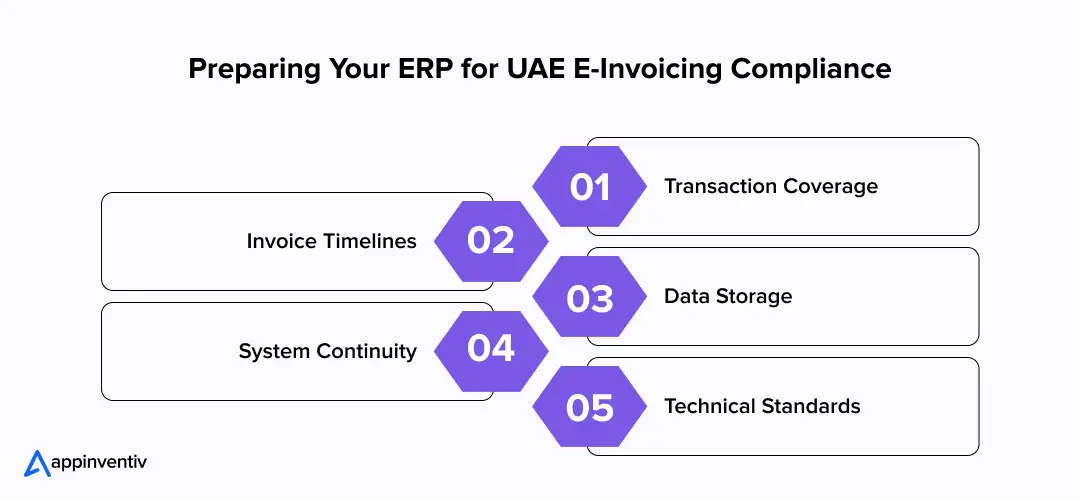
- Transaction coverage: The mandate covers business-to-business (B2B) and business-to-government (B2G) transactions, including transactions involving mainland businesses and free zone entities. B2C transactions are currently excluded, subject to future changes.
- Invoice timelines: E-invoices and e-credit notes must generally be issued within 14 days of the relevant transaction, subject to applicable VAT requirements. ERP workflows should support timely invoice generation and transmission.
- Data storage: E-invoices, credit notes, and related data must be stored within the UAE. Businesses should check whether their ERP, cloud hosting, and archiving arrangements meet this requirement.
- System continuity: A system failure that prevents compliance must be reported to the Federal Tax Authority (FTA) within two business days. Integration plans should account for error handling, recovery, and escalation procedures.
- Technical standards: The UAE framework follows the Peppol-based PINT AE specifications. ERP systems and ASP connections must support the required invoice structure and mandatory data fields.
The Ministry of Finance has also published the UAE Electronic Invoicing Guidelines, with Version 1.0 released on 23 February 2026 and Version 1.1 on 1 June 2026. These documents, along with the technical specifications, provide businesses with guidance for preparing their ERP data and invoicing workflows.
For UAE businesses, the immediate priority is to review existing ERP capabilities, identify integration gaps, and confirm that the chosen ASP can support their transaction volumes and reporting requirements. Starting this work early gives finance and IT teams time to test invoice exchanges, resolve data issues, and prepare for the applicable compliance deadline.
The Five-Corner Model: Who Owns What in UAE E-Invoicing?
UAE e-invoicing involves more than connecting an ERP system to an accredited service provider (ASP). Under the Decentralised Continuous Transaction Control and Exchange (DCTCE) model, invoice data moves between the supplier, the supplier’s ASP, the buyer’s ASP, the buyer, and the Federal Tax Authority (FTA). Each participant has a distinct role in the process.
The five-corner model follows this structure:
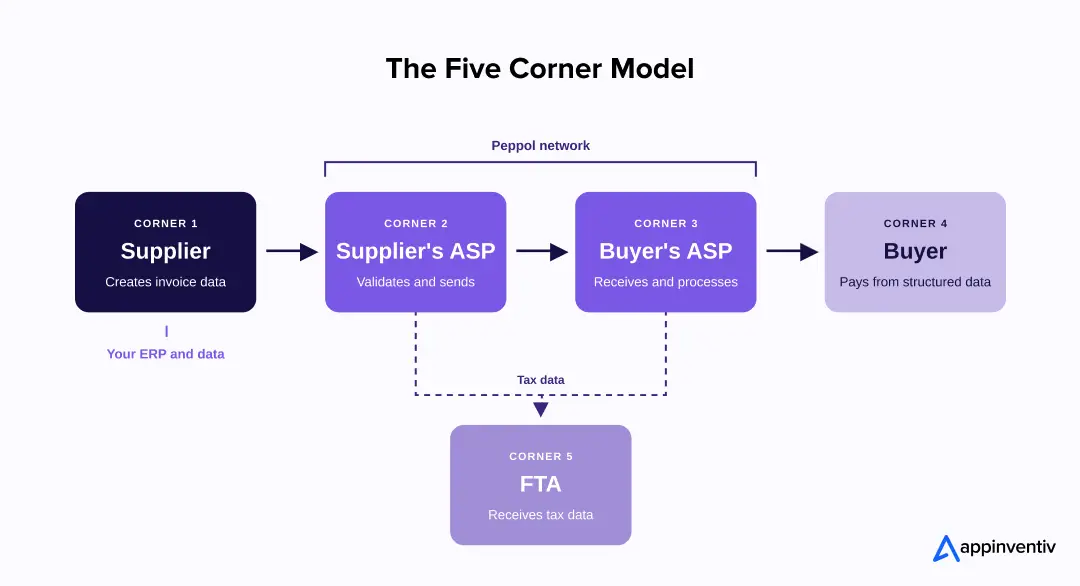
- Corner 1: Supplier: The supplier’s ERP or billing system generates invoice data, including customer details, line items, tax information, and transaction values.
- Corner 2: Supplier’s ASP: The ASP processes the invoice data according to applicable UAE e-invoicing requirements and transmits it through the Peppol network. It also handles the required tax data reporting.
- Corner 3: Buyer’s ASP: The buyer’s ASP receives and processes the invoice through the network and supports the required reporting process.
- Corner 4: Buyer: The buyer receives the structured invoice through its connected systems, where it can be processed by the accounts payable workflow.
- Corner 5: Federal Tax Authority: The FTA receives the required tax data through the prescribed reporting mechanism.
A compliant invoice travels from your ERP through two ASPs to the buyer and the FTA. Make that first step reliable.

7 Pieces of Work Your ASP Will Not Do
Your ASP may support invoice exchange, validation, and reporting, but your business still needs to prepare its ERP systems for UAE e-invoicing. These seven areas of work cover the data, integration, workflow, and testing tasks your team must plan for. Each one affects how reliably your ERP generates and processes compliant e-invoices.
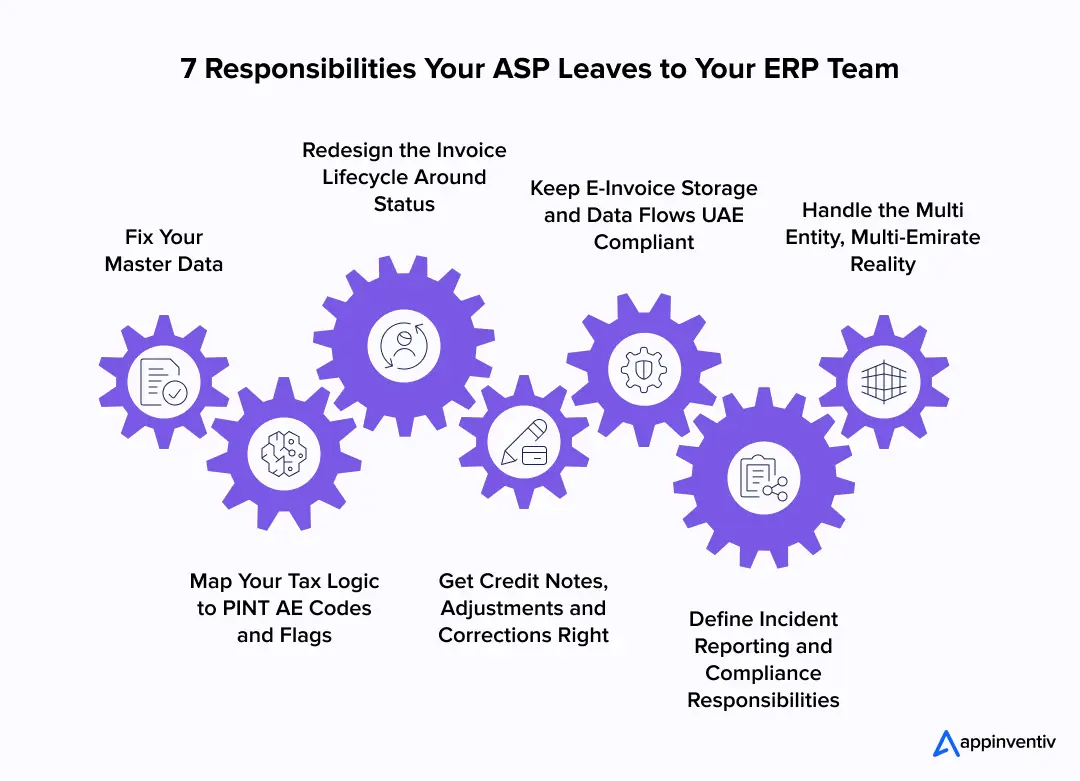
1. Fix Your Master Data
PINT AE expects precise identifiers. For UAE businesses, the participant identifier is the Tax Identification Number (TIN), which is the first 10 digits of the Tax Registration Number (TRN). Seller and buyer records need the correct TRN, TIN, trade licence and other registration identifiers, legal names that match registered records and valid addresses with the right emirate.
Check out your customer master. Duplicate accounts, expired licences, a customer recorded under a trading name in one entity and a legal name in another, missing TRNs on accounts that should have them. AI agents in finance can help flag duplicate records, identify missing tax identifiers, and detect inconsistencies before invoices are submitted.
2. Map Your Tax Logic to PINT AE Codes and Flags
On SAP / Oracle / Dynamics e-invoicing UAE projects, the story is the same: your ERP has tax codes. PINT AE has its own tax categories, reverse charge treatment, and UAE-specific flags. The two rarely line up one-to-one.
This is where UAE regulation specifics comes in. Supplies involving free zones need the free zone flag activated in the invoice file. Designated zone treatment, deemed supplies, margin scheme transactions, zero-rated exports, exempt supplies and reverse charge scenarios each carry their own data requirements. Your ERP can handle them correctly for the VAT return today and still be unable to express them in the structured format the ASP requires.
The ASP will validate the code you send. It will not decide whether the code is the right one for the commercial reality. That judgement sits with your tax team, and it has to be encoded in ERP configuration before go-live, not discovered in production.
3. Redesign the Invoice Lifecycle Around Status
With UAE e-invoicing, an invoice moves through several states: generated, submitted to the ASP, validated or rejected, delivered, and acknowledged. The ERP must track each state so teams can identify failures and take corrective action. A rejected invoice may require correction and resubmission, while the 14-day issuance deadline makes timely monitoring essential.
That means your ERP needs a feedback loop. When the ASP rejects a document, the right person has to see it, understand why and fix it, with the root cause traceable back to the source field. If your UAE e-invoicing API integration is a one-way push with no status return, you have built a very fast way to miss your own deadlines.
4. Get Credit Notes, Adjustments and Corrections Right
Credit notes are in scope and carry the same 14-day expectation. They also expose every weakness in your process. A credit note has to reference the original invoice correctly, carry a valid reason, and reconcile with what the ASP has already reported to the FTA.
Think about where credit notes originate in your business. Returns processed by a warehouse team. Pricing corrections by sales operations. Rebate settlements by finance at quarter end. Three teams, three entry points, three levels of discipline. If only one of them produces clean, structured data, you will feel it in January.
5. Keep E-Invoice Storage and Data Flows UAE-Compliant
E-invoices, credit notes and associated data must be stored within the UAE. For a company running on a global ERP software integration instance, a regional shared-service centre or a cloud tenant hosted elsewhere, this is an architecture question, not a checkbox.
Where does the invoice archive actually live? Where do the logs live? What about the UAE e-invoicing middleware that briefly holds payloads? What happens in your disaster recovery region? And because invoice data includes personal data of sole proprietors and contact persons, UAE data protection obligations under the federal personal data protection law sit alongside the tax rules.
Your ASP will store what it stores. Your own ERP, middleware and archive are your responsibility.
6. Define Incident Reporting and Compliance Responsibilities
There are two short clocks in this regime. A system failure that prevents compliance must be reported to the FTA within two business days. A change to your registered data, for example a change to your legal name, address or registration details, must be notified to your ASP within five business days of the FTA confirming the amendment.
Cabinet Decision No. 106 of 2025 attaches daily penalties to missing either of them. Both clocks require someone to own them. Who in your organization detects that the integration has failed? Who decides it constitutes a compliance-impacting failure? Who files with the FTA? Who tells the ASP when the legal entity data changes in EmaraTax?
These are not technology questions. They are role definitions and runbooks, and no ASP will write them for you.
7. Handle the Multi-Entity, Multi-Emirate Reality
Most mid-to-large UAE groups are not one legal entity. A distribution business may have a Dubai mainland company, a JAFZA entity, an Abu Dhabi branch and a Sharjah warehouse, each with its own TRN considerations and its own flows. Add VAT groups, intragroup recharges and shared services, and the picture gets more complex.
Enterprise apps aligned with Dubai’s 2040 Vision can help businesses build the connected, scalable digital infrastructure needed to manage these growing multi-entity operations.
Each entity needs correct registration within the system, a clear ASP arrangement, and ERP configuration that issues documents under the right legal identity, which is where SAP / Oracle / Dynamics e-invoicing UAE rollouts need the most careful company-code and legal-entity design. Group structures that looked tidy in the chart of accounts often turn out to be untidy in the invoice data.
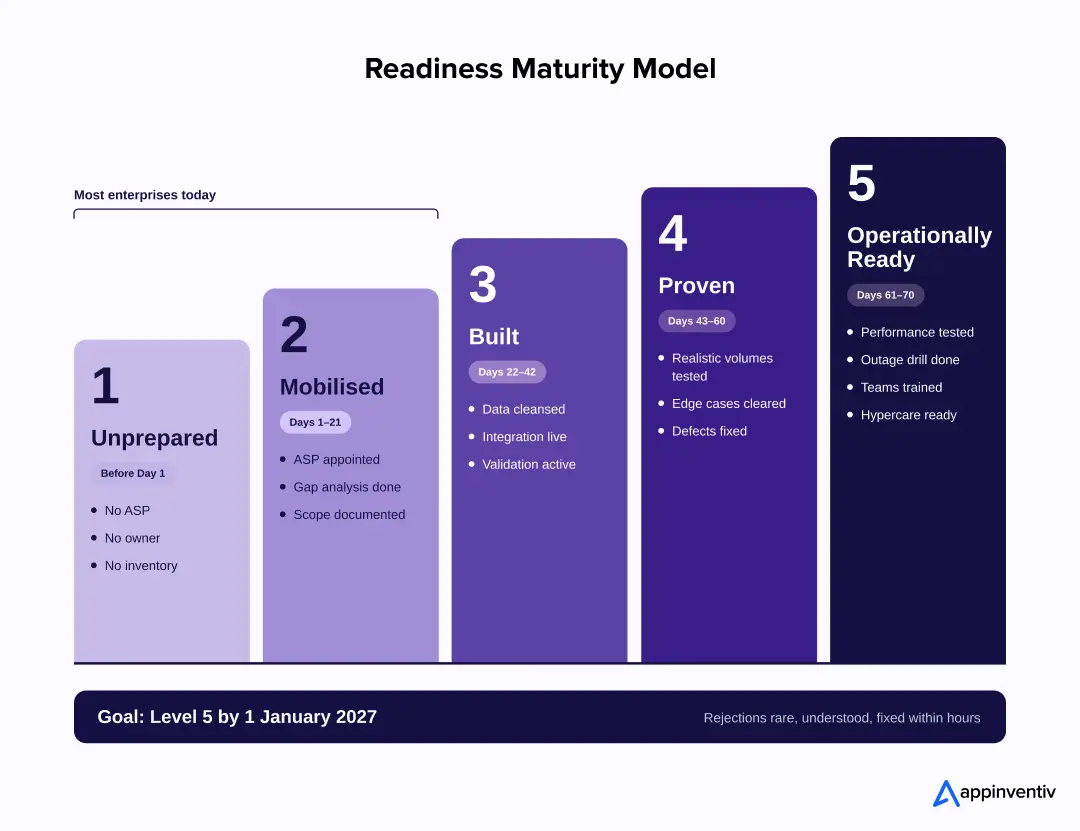
Where Does Your Business Stand on UAE E-Invoicing Readiness?
Most enterprises sit at Level 1 or 2 today, and the goal is Level 5 by 1 January 2027. Use the five levels below to place your business, see the evidence each stage needs, and spot what to fix next.
A 70-Day Plan for UAE E-Invoicing ERP and ASP Integration Before 1st January 2027
No enterprise changes in a quarter, and anyone who says otherwise is selling something. But there is a defensible, achievable target. For UAE e-invoicing implementation, by 1 January you want a Corner 1 that is stable enough that rejections are rare, understood and fixed within hours.
Working back from the date, with just over 10 weeks remaining, here is a suggestive plan for UAE e-invoicing ERP integration. Your actual sequence will depend on your ERP, your entities and the ASP you choose.
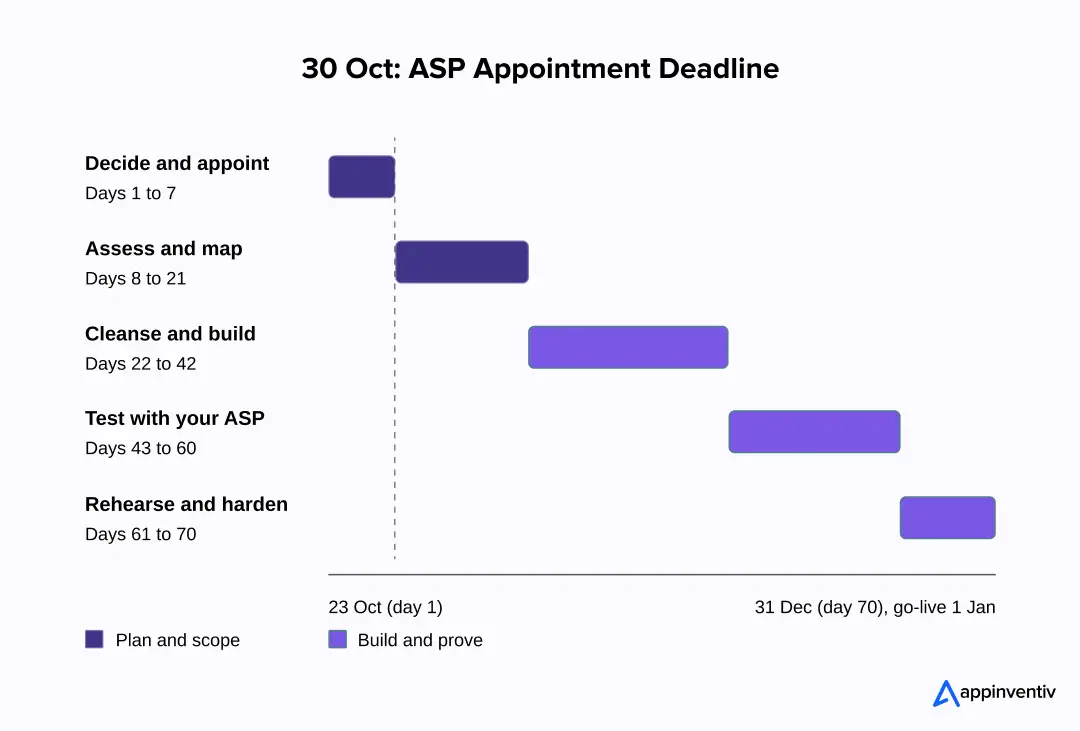
Days 1 to 7: Decide and Appoint
If you have not appointed a UAE e-invoicing accredited service provider (ASP), then do it in the current month. Use the Ministry’s selection considerations: Peppol experience, accreditation status and the new two-year operating experience requirement, integration compatibility with your ERP (ask about ERP connectors for UAE e-invoicing), security certifications and the ability to keep pace with regulatory change.
Confirm the appointment through the FTA’s EmaraTax portal. In parallel, name the programme owner, and make it a joint finance, tax and IT mandate with an executive sponsor.
Days 8 to 21: Assess and Map
Run a gap analysis from ERP to PINT AE. Inventory every system that creates an invoice or credit note. Decide which transaction types are in scope and which are not, and document the reasoning for the out-of-scope ones. Build the tax code and flag mapping with your tax advisers.
Days 22 to 42: Cleanse and Build
Remediate master data, starting with the customers who generate the most invoice volume. Build or configure the integration and any UAE e-invoicing middleware, including status return and rejection handling. Add validation at the point of entry so new bad data cannot enter. Prepare the inbound path for supplier invoices.
Days 43 to 60: Test Like the Regulator is Watching
Run end-to-end tests with your ASP across realistic volumes and the awkward cases: credit notes, free zone flows, reverse charge, multi-currency, partial deliveries, back-dated documents. Voluntary adopters are not penalised during the pilot phase, so use that window honestly to find defects, not to demonstrate success.
Days 61 to 70: Rehearse and Harden
Validate month-end invoice volumes through performance testing. Simulate a system outage and verify the two-business-day notification process. Train accounts receivable, accounts payable, and tax teams to manage the updated invoice statuses. Confirm UAE data residency across archives, logs, and middleware. Establish a dedicated hypercare schedule for the first two weeks of January.
Appinventiv’s ERP integration services in Dubai can help bridge that gap by assessing your ERP environment, mapping invoice data, building API integrations, and testing end-to-end workflows. This helps your business prepare its systems for UAE e-invoicing while keeping ASP responsibilities and internal integration work clearly defined.
What the Penalty Schedule Really Tells You
Yes, there is a penalty schedule for UAE e-invoicing compliance, and you should know it. Under Cabinet Decision No. 106 of 2025:
- Failing to implement the system or to appoint an ASP on time: AED 5,000 per month or part of a month.
- Failing to issue and transmit an e-invoice or e-credit note on time: AED 100 per document, capped at AED 5,000 per calendar month.
- Failing to notify the FTA of a system failure on time: AED 1,000 per day.
- Failing to notify your ASP of changes to registered data on time: AED 1,000 per day.
Since the FTA receives tax data from both sides of a transaction, discrepancies between supplier and buyer records can become more visible than they were when invoices were exchanged as PDFs.
The fine is the smallest line in the budget.
What Does UAE E-Invoicing ERP Integration Cost?
Costs depend on the number of ERP systems and invoicing entities, the quality of your existing data, and the local AI innovations already built into your ERP. For a mid-to-large UAE business, most of the budget sits on your side (Corner 1), not in the ASP subscription.
| Cost component | Indicative range (AED) |
|---|---|
| ASP subscription (annual, volume-based) | 10,000–150,000 |
| Readiness assessment and PINT AE mapping | 25,000–80,000 |
| Master data cleansing and tax code mapping | 30,000–100,000 |
| Integration build: pre-built connector | 40,000–120,000 |
| Integration build: direct API | 150,000–400,000 |
| Integration build: middleware (multi-ERP or legacy) | 300,000–800,000 |
| UAE-hosted archive and testing | 30,000–100,000 |
What this means in total:
- Single ERP, single entity: roughly AED 150,000 – 400,000 in year one.
- Multi-entity or multi-ERP group: roughly AED 500,000 – 1.5 million or more.
Master data, tax mapping and hosting can each change the total. Size them early so there are no surprises mid-project.

Common ERP Integration Challenges That Can Delay UAE E-Invoicing Readiness
ERP integration can expose data gaps, compatibility issues, and workflow problems that delay UAE e-invoicing readiness. Addressing these challenges early helps businesses prepare their systems for compliance.
| Challenge | Solution |
|---|---|
| Legacy ERP systems do not have appropriate APIs or connectors. | Utilize compatible connectors, middleware or customized APIs. |
| Rejections are due to missing invoice fields or wrong tax codes. | Clean master data and map fields to PINT AE needs. |
| There are multiple ERP systems that produce different data on invoices. | Normalize data structures and integration process. |
| Rejected invoices are not noticed. | Set up status tracking, auto-alert and error reporting. |
| Current workflows do not provide correction/resubmission capability. | Establish clear exception-handling and resubmission processes. |
| High volumes or network failures lead to disruptions in invoice processing. | Run workloads and configure retry/recovery. |
| Data can be stored outside of the UAE in ERP archives or middleware. | Review hosting, storage, and data flow and backups. |
| Finance, IT, and ASP responsibilities overlap. | Have clear ownership for integration, incidents, and data quality. |
Prepare Your ERP for UAE E-Invoicing with Appinventiv
UAE e-invoicing readiness starts with an ERP system that can generate accurate invoice data, exchange structured documents, and track invoice statuses across business workflows. Businesses must assess existing systems, map data to PINT AE requirements, configure API integrations, update finance processes, and test invoice scenarios before go-live. Ongoing monitoring also helps teams identify rejected invoices, resolve errors, and maintain consistent records.
A structured e-invoicing ERP integration strategy helps connect tax requirements with everyday finance operations. It also gives finance, tax, and IT teams clear ownership of data quality, system performance, and exception handling.
As a software development company in Dubai, Appinventiv can help assess your ERP environment, identify integration gaps, develop the required connections, and test end-to-end invoice workflows. Evaluate your ERP readiness with Appinventiv to plan and implement UAE e-invoicing integrations that fit your existing systems and business requirements.
FAQs
Q. Does my ASP handle ERP integration for me?
A. Depending on services and contracts, some ASPs offer pre-built ERP connectors and/or integration support. Your business needs to validate what is included and rectify outstanding ERP configuration, data mapping, and workflow needs.
Q. Which ERP systems can integrate with UAE e-invoicing?
A. ERP systems such as SAP, Oracle, Microsoft Dynamics 365, and other platforms can integrate if they support the required data mapping and electronic exchange. The approach depends on the system’s APIs, version, and existing architecture.
Q. What are the ways to integrate an ERP with an ASP in the UAE?
A. UAE e-invoicing ERP integration can use pre-built connectors, APIs, or middleware to connect an ERP system to an ASP. The right approach depends on ERP capabilities, invoice volumes, and workflow complexity.
Q. What is PINT-AE and why does it matter for my ERP?
A. PINT-AE is the UAE’s structured e-invoice specification based on Peppol standards. Your ERP must map invoice data to this format to support compliant e-invoice exchange.
Q. What should the ERP capture back from the ASP?
A. The ERP should capture the status of the invoice, the result of its validation, the reason for rejection, and reference identifiers to the ASP. This assists teams in solving errors, keeping track of submissions and ensuring accurate records are achieved.
Q. Can Appinventiv help with ERP-side e-invoicing integration?
A. Yes. Appinventiv can evaluate ERP readiness, match the invoice data with PINT AE, develop integrations with APIs, and test the end-to-end e-invoicing procedure.


Fast 2-minute response, fully NDA-protected.

ERP Solutions for Local Government: Features, Integrations, and Costs
Key takeaways: ERP for local councils unify isolated municipal workflows, reducing manual overhead and cross-departmental friction. It ensures regulatory alignment with state Local Government Acts and AASB standards. Modular, API-first architectures enable seamless bi-directional integration with GIS, EDRMS, and state planning portals. Phased implementation reduces operational downtime, ensuring financial transparency and sustained community trust. ERP…

Auto Spare Parts Management System Development: Complete Enterprise Guide
Key takeaways: Build an AI parts platform that links inventory, purchasing, warehouses, dealers, and ERP systems into one network. Examine system architecture, tech stacks, and software connections built for multi-site parts operations. See how AI sharpens order forecasts, stock planning, purchasing, and part lookups to cut daily delays. Compare custom code and ready-made apps to…

Aerospace ERP Software Development: Cost, Features, Timeline & Tech Stack
Key Takeaways Aerospace ERP platforms help production, procurement, maintenance, and finance teams work from the same operational records. Aircraft manufacturers use ERP systems to track serialized parts, supplier activity, maintenance history, and production schedules more accurately. Modern aerospace ERP environments now include AI forecasting, IoT telemetry, digital twins, and predictive maintenance monitoring. ERP modernization projects…