

































How to Build an AI Voice Agent for Real Estate: Enterprise Architecture, Cost, and Integrations

 Share -



- 01Steps to Build a Real Estate AI Voice Agent
- 02Enterprise Use Cases of AI Voice Agents in Real Estate
- 03Types of AI Voice Agents Used in Real Estate
- 04Enterprise Architecture of an AI Voice Agent for Real Estate
- 05Key Integrations Required for Real Estate AI Voice Agents
- 06Cost of Building an AI Voice Agent for Real Estate (Enterprise View)
- 07ROI Framework: How to Justify Investment to the Board
- 08AI Voice Agent vs Traditional IVR vs Human Call Centers
- 09Common Challenges in Building AI Voice Agents (and How to Solve Them)
- 10Build vs Buy vs Partner: What Enterprises Should Consider
- 11Future of AI Voice Agents in Real Estate (2026–2030)
- 12Why Appinventiv for Enterprise AI Voice Agent Development
- 13Frequently Asked Questions

Key takeaways:
- Real estate conversion depends on response speed; delays of minutes can drastically reduce qualification rates and pipeline quality.
- AI voice agents act as execution layers, connecting telephony, CRM, and listings to automate lead handling in real time.
- Enterprise-grade systems require event-driven architecture, low-latency pipelines, and deep integration across core business platforms.
- Faster response and automation reduce lead loss, improve contact rates, and increase sales efficiency without increasing headcount.
- The competitive advantage lies in combining AI for speed and scale with human teams for relationship-driven deal closure.
Real estate sales depend on phone calls. Unanswered calls after business hours mean lost revenue. An AI voice agent for real estate fixes this problem immediately. Property market automation creates $430 billion to $550 billion in annual global value. Brokerages that fail to answer inquiries within minutes lose motivated buyers.
An AI real estate virtual assistant does more than take basic messages. The software understands buyer intent, answers property questions, qualifies prospects, and routes leads instantly. Custom AI voice bot development for real estate connects phone systems to listing databases, calendars, and customer records. The software updates system databases during live calls.
An AI voice automation system for real estate connects voice calls directly to business workflows. Sales teams respond faster and convert more inquiries into closed property deals.
Most real estate inquiries go unanswered. Deploy a real-time voice system before your pipeline continues to leak high-intent buyers.

Steps to Build a Real Estate AI Voice Agent
Enterprise teams approach AI voice agent development for real estate as building an end-to-end business system rather than deploying a standalone AI model. Before defining the technology stack, it’s important to understand the experience the system is being built to deliver.
A production-ready AI voice agent typically follows this workflow during every customer interaction:
Greet → Understand → Retrieve → Resolve or Escalate → Log
- Greet: Answers instantly, identifies the caller’s language, and understands whether they’re looking to buy, rent, schedule a viewing, or speak with an agent.
- Understand & Retrieve: Interprets the caller’s intent and retrieves live property availability, pricing, amenities, and customer history from connected CRM, MLS, and listing systems.
- Resolve or Escalate: Answers routine questions automatically or transfers complex conversations to the appropriate sales representative with complete context.
- Log: Updates the CRM, records the conversation, schedules follow-ups, and triggers downstream workflows before ending the interaction.
Every stage of this workflow depends on enterprise architecture, real-time integrations, and low-latency AI processing. The following steps explain how to build the underlying system that makes this experience possible.
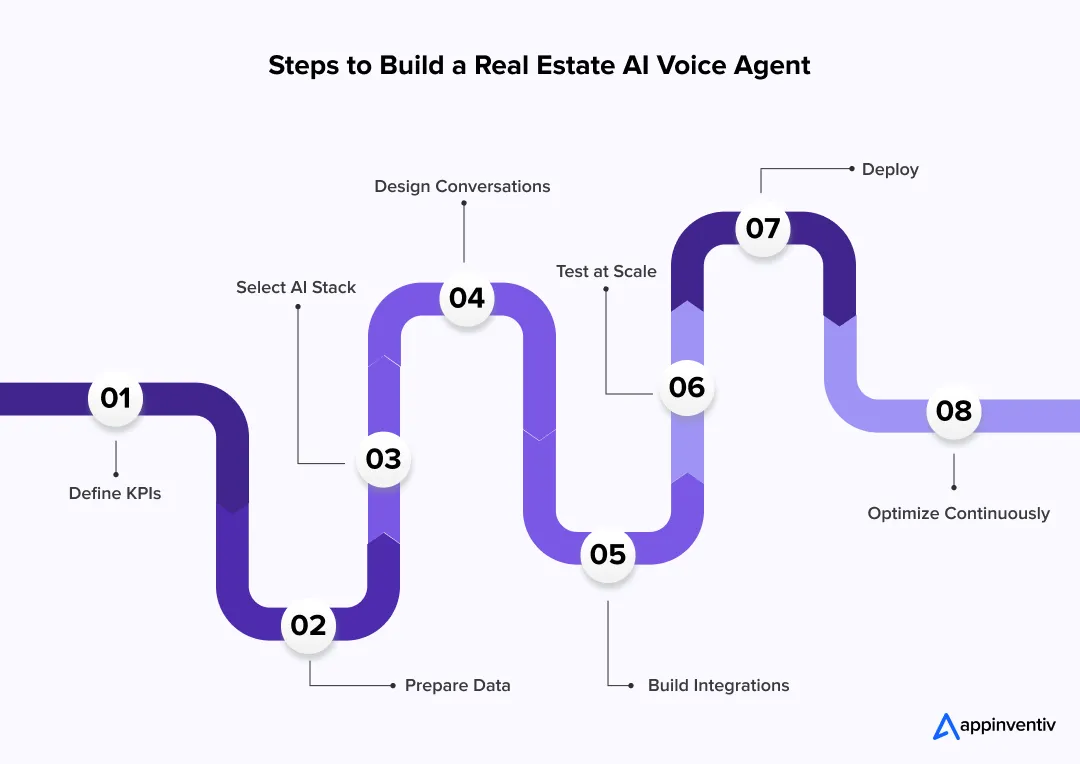
Step 1 – Define Business Objectives and KPIs
Start by identifying the business outcomes the voice agent should achieve rather than focusing only on technical performance.
Measure success using KPIs such as:
- Lead conversion rate from inbound calls
- Average call handling time and first response time
- Cost per acquisition and cost per call
- SLA targets such as sub-2-second response latency and sub-60-second lead response time
Many real estate teams still take more than 15 hours to respond to new inquiries, causing a significant drop in lead quality. Mapping each KPI to system metrics like intent accuracy, response latency, and successful workflow completion helps guide every design decision across the real estate AI voice agent development lifecycle.
Step 2 – Data Preparation and Knowledge Base Design
Understanding how to create an AI voice agent for real estate starts with structured, queryable data, and this step is where that foundation is built.
- Ingest property data as normalized schemas with fields for price, unit type, availability, and geo tags.
- Align CRM schemas so extracted entities map to lead objects without transformation loss.
- Build a knowledge layer that links properties, projects, locations, and brokers.
Many teams use a hybrid setup: a relational store for transactional data and a vector index for semantic retrieval. Vector embeddings let the system match user queries like “2BHK near metro under 1 crore” to relevant listings even with varied phrasing.
Step 3 – Model Selection and Real Estate Voice AI Technology Stack Design
The stack for AI voice agent development for real estate must meet strict latency and accuracy targets.
- Choose streaming ASR and TTS providers with low inference delay
- Select an LLM that supports short response cycles and tool calling
- Implement retrieval pipelines that fetch live data during generation
Vector databases such as Pinecone or Weaviate store embeddings of listings and FAQs. A retriever ranks results, and the model composes answers grounded in those results.
Cache layers are a critical part of the real estate voice AI technology stack. They store frequent queries, reduce repeated calls to the model, and cut response time.
Step 4 – Conversation Design and Workflow Engineering
Voice conversations are non-linear. The system must handle interruptions and context shifts.
- Use slot-filling to capture required fields such as budget and location
- Maintain a session state object that updates after each user’s turn
- Support multi-intent handling where a user asks for a price, then switches to scheduling
Dialogue policies can be rule-based for critical steps and model-driven for open queries. Tool calling lets the model invoke functions such as “check availability” or “book slot” during the call.
Step 5 – Integration Development
This layer enables real actions.
- Expose internal systems through REST or gRPC APIs, following a solid API development guide to handle schema mapping and retry logic correctly.
- Use middleware for rate limiting, retries, and schema mapping
- Implement idempotent operations so repeated calls do not create duplicate records
Event-driven patterns help. For example, a “lead_created” webhook can trigger an outbound call within seconds, without waiting for batch processing or queue delays.
Step 6 – Testing and Simulation
Testing must reflect real call conditions.
- Run large-scale simulations with varied scripts, accents, and noise levels
- Measure word error rate for ASR and task success rate for workflows
- Track end-to-end latency across ASR, model inference, and TTS
Shadow mode is common. The agent runs alongside human agents and processes calls without responding. Teams compare outputs before full rollout.
Step 7 – Deployment and Scaling
Production systems must handle peak loads without delay.
- Use containerized services orchestrated through systems like Kubernetes
- Apply autoscaling based on concurrent call volume
- Deploy regional instances to reduce network latency
Media servers handle audio streams, and stateless services process requests. Session state is stored in fast in-memory stores.
Step 8 – Continuous Learning and Improvement
Performance depends on feedback loops.
- Capture transcripts, outcomes, and drop-off points.
- Retrain intent models with new conversation data
- Update prompts and retrieval logic based on errors
Small gains in intent accuracy or response time can lift conversion rates across thousands of calls, which is a core reason AI agents in enterprise are built with continuous improvement loops from the start.
This process shows how to build an AI voice agent for real estate that can listen, reason, and act within seconds. Following the steps to build a real estate AI voice agent correctly means that each layer meets strict timing and accuracy requirements, or the call experience breaks.
Enterprise Use Cases of AI Voice Agents in Real Estate
Most content on AI in real estate stops at lead capture and scheduling. Enterprise deployments go further. They connect voice with data systems, scoring models, and execution layers.
Deal Intelligence Capture During Live Calls
A voice agent can extract structured deal signals during a call. It identifies budget, financing type, urgency, and objections in real time. These signals feed scoring models and trigger actions.
Example: Symphonize uses AI agents to convert unstructured conversations into structured deal data such as pricing intent and timelines. Sales teams receive ready-to-use inputs instead of raw transcripts. This reduces manual analysis and speeds up decision cycles.
Investor and High-Value Lead Outreach at Scale
Enterprise real estate firms manage investor pipelines across regions. An AI real estate virtual assistant can run outbound campaigns and qualify high-value prospects before human teams step in.
Example: A Dutch real estate firm used an AI voice agent from Awaz.ai to automate investor outreach. The system handled first conversations, filtered serious buyers, and passed qualified leads to investment teams. This reduced cold-calling effort and improved engagement rates.
Real-Time Lead Activation Within Seconds
Speed defines conversion in property sales. Voice agents can trigger outbound calls within seconds of a new inquiry.
Example: Husky AI enables real estate firms to contact leads almost instantly after form submission. The agent captures requirements and prepares leads before a broker connects. This reduces lead drop-off during the first contact window. In many deployments, faster response improves contact rates by up to 2x compared to manual follow-ups.
Operational Intelligence From Voice Data
Voice interactions can feed analytics systems. Each call generates structured data that can reveal buyer trends and demand patterns.
Example: Aurum PropTech uses AI-driven systems to analyze voice interactions and extract demand signals across projects. Teams use this data to track pricing sensitivity and regional demand shifts.
A similar approach can be seen in enterprise SaaS platforms like Appinventiv’s Ility real estate platform. The system unified property data, CRM workflows, and analytics into a single platform, allowing teams to manage listings, track buyer behavior, and streamline operations across multiple projects.
This type of centralized data layer is critical for voice AI systems, as it ensures that every conversation is backed by accurate, real-time information.
Autonomous Workflow Execution Across Systems
An AI voice automation system for real estate can trigger RPA in real estate workflows across multiple systems during a call, including CRM updates, scheduling, and notifications.
Example: Platforms like Supafunnel deploy voice agents that handle inbound queries, book appointments, and update backend systems in one flow. This reduces manual coordination across sales and support teams.
Tenant Operations With System-Level Integration
In property management, voice agents connect with maintenance systems and tenant records. They log requests and provide updates without manual input.
Example: Voiceflow supports building voice systems that manage tenant queries, maintenance requests, and rent-related interactions through connected workflows.
These examples show a clear shift. Voice is no longer just a communication layer. It acts as a system that captures data, triggers actions, and supports revenue operations at scale.
Types of AI Voice Agents Used in Real Estate
Not all voice agents operate the same way. The underlying architecture determines what the system can do, how it scales, and how much business value it delivers. Most real estate deployments fall into one of the following categories.
| Type | Primary Function | Best For |
|---|---|---|
| FAQ & Inquiry Agents | Answer property and project questions | High call volumes |
| Lead Qualification Agents | Capture budget, location, and buying intent | Sales teams |
| Scheduling Agents | Book and manage site visits | Broker coordination |
| Outbound Follow-Up Agents | Re-engage leads and prospects | Lead nurturing |
| Property Discovery Agents | Guide users through listings using natural language | Buyer engagement |
| Workflow Automation Agents | Trigger CRM updates, notifications, and tasks | Revenue operations |
| Agentic Revenue Agents | Manage multi-step sales workflows across systems | Enterprise deployments |
Enterprise Architecture of an AI Voice Agent for Real Estate
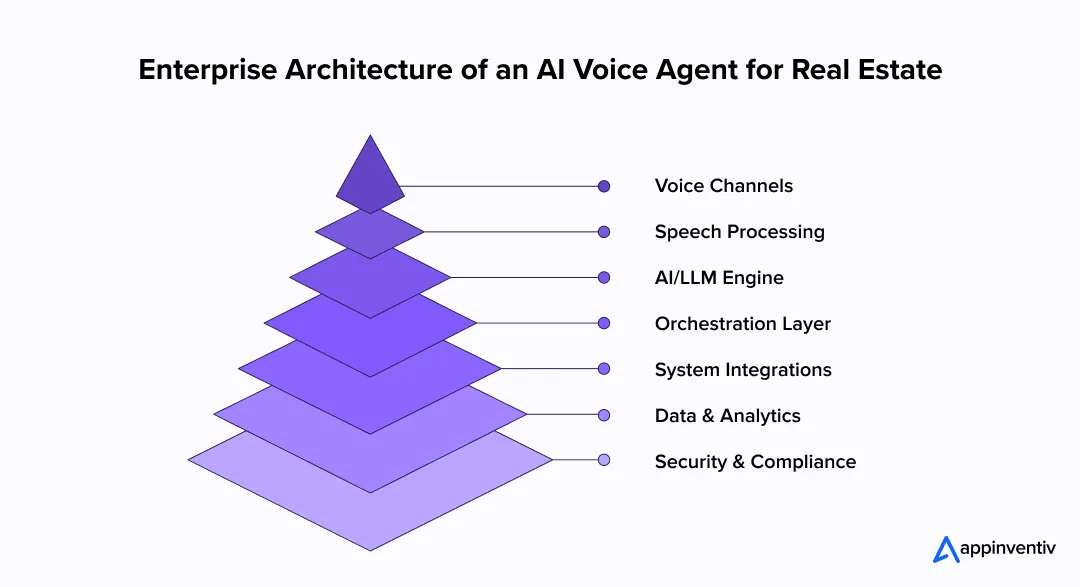
A production-grade enterprise AI voice agent architecture for real estate is a distributed system. Each layer handles a specific task and passes context forward. The design must support low latency, high call volume, and strict data control. A typical setup processes speech, reasons over data, and triggers actions within a few seconds.
High-Level Architecture Overview
The voice AI architecture for real estate is built as a layered pipeline:
- Interface layer for voice entry points
- Speech processing layer for audio conversion
- AI layer for reasoning and response generation
- Orchestration layer for flow control
- Integration layer for system access
- Data layer for storage and analytics
- Security layer for access control and compliance
Each layer runs as independent services connected through APIs or message queues.
Layer 1 – Interface Layer (Voice Channels)
This layer handles how calls enter the system.
- PSTN integration through providers like Twilio using SIP trunks
- VoIP routing for call distribution across regions
- WebRTC support for browser-based calls with sub-second connection setup
- Mobile SDKs for in-app calling
Session control uses SIP signaling. Media streams are passed using RTP. This layer must support concurrency and failover routing.
Layer 2 – Speech Processing Layer
This layer converts audio to text and back to speech.
- ASR engines such as Google Cloud Speech-to-Text process live audio streams
- TTS engines generate natural responses with low delay
- Streaming inference reduces round-trip latency to under 300–800 ms
- Voice activity detection segments speech in real time
Multi-language support requires acoustic models trained on regional accents and dialects. For global real estate firms, the speech layer should accurately handle multilingual conversations, code-switching, and noisy environments. This is increasingly important, as 76% of consumers prefer information in their native language, making multilingual voice support a key driver of customer experience and engagement.
Layer 3 – AI / LLM Layer
Within the voice AI architecture for real estate, this layer handles reasoning and response generation.
- Model selection: closed APIs like OpenAI or open models hosted on private infrastructure
- These prompts often follow a structured format with defined roles, rules, and output schemas so the system can return structured data such as JSON for CRM updates.
- RAG in AI development connects the model to live property data using vector databases such as Pinecone.
- Context windows store conversation history and user preferences
Guardrails use rule-based filters and output validation. These prevent incorrect pricing, unavailable listings, or non-compliant responses.
Layer 4 – Conversation Orchestration Engine
This layer manages how conversations progress.
- State machines track each call session.
- Intent classification pipelines route queries to the correct workflow
- Dialogue policies decide next actions based on context and system responses
- Agentic coding systems allow dynamic reasoning instead of fixed scripts.
Failover logic triggers human handoff when confidence drops, or edge cases appear, with full context transfer including transcript, extracted data, and lead score. This often uses threshold-based confidence scoring from NLU outputs.
Layer 5 – Integration Layer (Critical for Enterprise Value)
This layer connects the voice agent to business systems.
- CRM systems, such as Salesforce, for lead creation and updates
- MLS or listing databases for real-time inventory access
- Calendar APIs for booking site visits
- ERP systems for deal tracking and commissions
- Payment gateways for booking deposits
Integration runs through REST APIs or event-driven pipelines. Middleware handles retries, rate limits, and data mapping between systems.
Layer 6 – Data and Analytics Layer
Every interaction produces structured and unstructured data.
- Call transcripts stored in object storage
- Entity extraction pipelines convert conversations into structured fields
- Lead scoring models rank prospects based on behavior and responses
- Analytics dashboards track conversion rates, call duration, and drop-offs
Data pipelines stream events into warehouses for reporting and model retraining.
Layer 7 – Security, Compliance, and Governance
This layer protects data and enforces rules, and AI agent security for business goes deeper into what that means in practice.
- Encryption uses TLS for data in transit and AES-256 for storage
- Role-based access control limits who can view call data
- Consent capture ensures callers agree to recording and data use
- Regional compliance frameworks such as GDPR compliance and CCPA define data handling policies, along with telephony rules such as consent logging, DNC filtering, and automated disclosure during calls.
Audit logs record every interaction and system action. Explainability layers track how decisions were made during a call.
This enterprise AI voice agent architecture for real estate turns a voice agent into a real-time system that connects speech, data, and execution. Each layer must operate with low delay and high accuracy, or the entire experience breaks.
Develop AI voice agents with CRM, MLS, telephony, and scheduling integrations tailored to your business.

Key Integrations Required for Real Estate AI Voice Agents
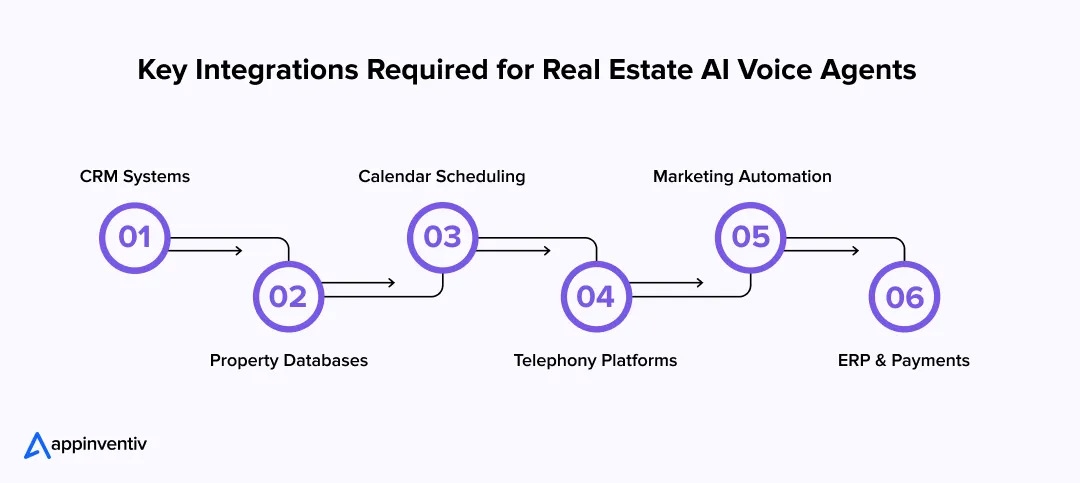
A voice bot for real estate is only as strong as the systems it connects to. Robust AI integration services enable seamless connectivity across CRM, MLS, telephony, calendars, and ERP platforms, turning the voice agent into an execution layer that can act during the call.
CRM Systems
The agent must write data during the conversation, not after. It creates new leads, updates existing records, and logs call details in real time.
Platforms like Salesforce and HubSpot expose APIs for lead creation, field updates, and activity tracking, and CRM implementation decisions shape how well these connections hold up in production.
The agent maps extracted entities such as budget, location, and intent to CRM fields. This removes manual entry and keeps pipelines current.
MLS and Property Databases
Property data drives the conversation. The agent must access listing systems with live availability, pricing, and attributes.
This often involves direct API integration with MLS feeds or internal listing databases. Queries run during the call. The agent filters properties based on user input and returns accurate results. Cached data fails here. Real-time sync is required to avoid showing unavailable units.
Calendar and Scheduling Systems
Booking must happen during the call. The agent checks availability, blocks slots, and sends confirmations.
Integration with tools like Google Calendar and Microsoft Outlook allows direct access to broker schedules. The system must handle conflicts, time zones, and rescheduling flows without human input.
Telephony and Contact Center Systems
Call handling depends on this layer. The agent needs control over routing, transfers, and recordings.
Platforms such as Twilio provide programmable voice APIs. The agent can route calls to brokers, escalate conversations, or trigger callbacks. Call recordings and metadata feed into analytics systems.
Marketing Automation Platforms
Lead follow-up should not stop after the call. The agent must trigger sequences based on user intent.
Integration with systems like Marketo or Mailchimp allows automated campaigns. A buyer interested in a property can receive listings, reminders, or price updates without manual setup.
ERP and Financial Systems
Transactions do not end with a visit. The agent can connect with financial systems to support booking and payment steps.
ERP platforms such as SAP manage invoicing, commissions, and deal records, and teams that invest in real estate transaction management software get deeper control over these processes. The voice agent can trigger booking entries or payment links during or after the call.
A voice agent without these integrations answers questions. A voice agent with these integrations executes business processes.
Cost of Building an AI Voice Agent for Real Estate (Enterprise View)
The AI agent development cost for real estate depends on how far the system goes. A pilot that answers calls is one thing. A system that qualifies leads, books visits, and updates records across regions costs more.
Real-time processing and system connections drive most of the spend, especially under high concurrent call loads, where scaling media and inference services increases cost.
Estimated Cost Ranges
These ranges reflect typical real estate AI voice agent development pricing stages based on scope and integrations.
| Deployment Stage | Estimated Cost | Scope |
|---|---|---|
| MVP | $50K – $120K | Handles basic calls and limited workflows |
| Mid-scale deployment | $120K – $300K | Connects CRM, listings, and scheduling |
| Full enterprise system | $300K – $800K+ | Supports multiple regions, languages, and workflows |
Key Cost Factors
The AI voice agent pricing model for real estate means each component adds to the total based on usage and complexity.
- Infrastructure: Compute runs speech pipelines and model inference. Storage keeps transcripts. Telephony charges apply through platforms like Twilio.
- AI usage: Every call triggers speech recognition, language processing, and voice generation
- Integration effort: Connecting CRM, listing systems, and calendars takes API work and testing
- Engineering work: Teams build services, design flows, and handle edge cases
- Security and compliance: Encryption, access rules, and audit logs add setup effort.
Ongoing Costs
Running costs continue after launch and grow with usage.
- API and compute usage
- Maintenance and updates
- Model retraining
- Monitoring and support
Most teams spend 15 to 25 percent of the build cost each year, a figure that should factor into overall real estate AI voice agent development pricing from the start.
ROI Framework: How to Justify Investment to the Board
Understanding the cost to build an AI voice agent for real estate helps frame this investment, which ties directly to revenue lift and cost control. The impact shows within the first few months if call volume is high.
| Metric | Business Impact |
|---|---|
| Missed leads | Fewer dropped calls, more captured demand |
| Conversion rate | Faster response improves deal closure |
| Call center cost | Lower reliance on manual agents |
| Sales cycle time | Quicker qualification and booking |
| Broker productivity | Less admin work, more selling time |
Systems that respond within the first minute consistently outperform delayed follow-ups in both contact rate and deal closure.
Around 42% of real estate leads go cold before meaningful contact happens. Faster response directly reduces this loss and improves pipeline quality.
AI Voice Agent vs Traditional IVR vs Human Call Centers
Traditional IVR systems route calls through predefined menus, while human call centers rely on agent availability. An AI voice agent for real estate combines conversational AI with real-time business data to answer questions, qualify leads, schedule viewings, and update CRM records automatically.
| Capability | Traditional IVR | Human Call Center | AI Voice Agent |
|---|---|---|---|
| Understands natural conversations | ✕ | ✓ | ✓ |
| Answers live property queries | ✕ | ✓ | ✓ |
| Qualifies leads | ✕ | Manual | ✓ |
| Books site visits | Limited | ✓ | ✓ |
| Updates CRM automatically | ✕ | Manual | ✓ |
| Available 24/7 | ✓ | Limited | ✓ |
| Handles multiple simultaneous calls | ✕ | Limited | ✓ |
| Escalates complex inquiries | Limited | ✓ | ✓ |
Key takeaway: An AI voice agent doesn’t replace your sales team. It replaces repetitive call handling, allowing agents to focus on negotiations, property tours, and closing deals.
Also Read: Advantages of Using Chatbots in Real Estate
Common Challenges in Building AI Voice Agents (and How to Solve Them)
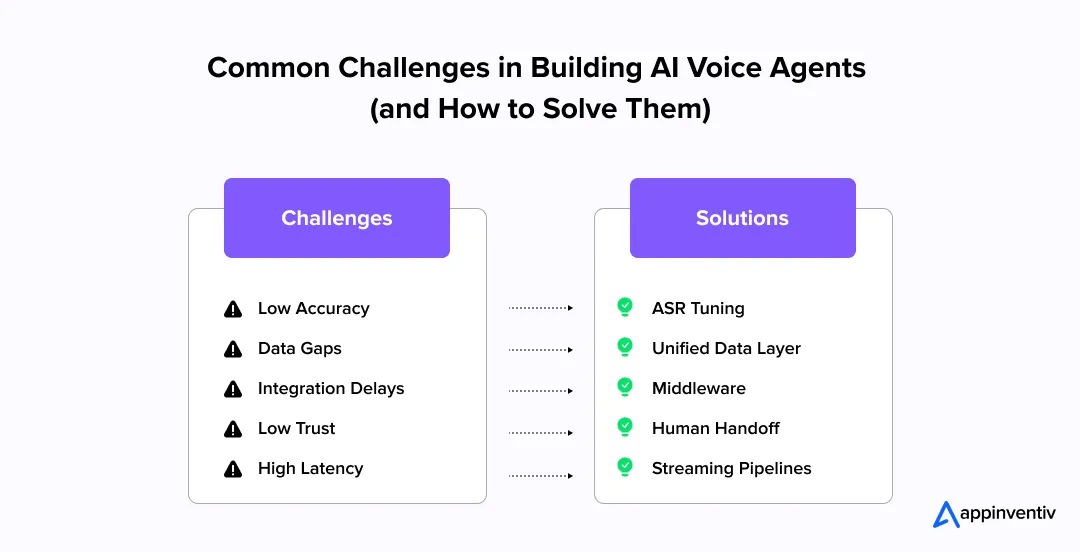
Teams often get the model working in a lab, but when you build an AI voice agent for real estate, the real problems start in live calls. Noise, delays, and system gaps affect how the agent responds and how users react.
Speech Recognition Accuracy Drops in Real Calls
Phone audio is inconsistent. Call quality changes across regions. Accents, mixed languages, and background noise reduce transcription accuracy. Even small errors can break intent detection and lead to qualification.
- Train ASR models with real call data from target regions
- Use noise suppression and voice activity detection to clean audio streams
- Add confidence scoring and re-prompt when input is unclear
Fragmented Data Across Systems
Property data, CRM records, and calendars often sit in separate systems. Fields do not match. Updates are delayed. The agent may give outdated prices or wrong availability during the call.
- Build a unified data layer with aligned schemas
- Sync critical data such as pricing and availability in real time
- Use a single source of truth for listings and lead records
Integration Complexity Slows Execution
Each system exposes different APIs. Some are slow. Some fail under load. If one system delays, the entire call flow breaks.
- Introduce middleware to manage retries and error handling
- Use event queues to handle non-blocking updates
- Standardize API contracts and response formats
User Trust and Adoption Issues
Users expect clear answers. If the agent sounds unsure or gives wrong details, trust drops fast. This affects conversion and repeat engagement.
- Keep responses short and precise.
- Confirm key details such as the budget or the property choice
- Provide instant handoff to a human agent when needed
Also Read: Custom Real Estate Chatbot Development: Boost Property Sales
Latency Breaks Conversation Flow
Voice systems must respond within a few seconds. Delays across ASR, model inference, or API calls can stack and break the interaction. Delays from speech processing or model inference interrupt the flow and frustrate users.
- Use streaming pipelines for ASR and TTS
- Deploy services in regions close to users
- Cache frequent queries and reduce repeated model calls
Build vs Buy vs Partner: What Enterprises Should Consider
The choice for AI voice agent development for real estate comes down to control, speed, and fit with existing systems. Most enterprises need deep integration with CRM, listing data, and internal workflows. That is where the differences between options become clear.
| Criteria | Build In-House | Buy SaaS (e.g., Aloware) | Partner with an AI Firm |
|---|---|---|---|
| Control | Full ownership, high engineering load | Limited control over features and data flow | Strong control with guided architecture |
| Time to deploy | Long cycles, often 6–12 months | Quick setup, limited flexibility | Faster rollout with a custom build |
| Customization | Deep but slow to execute | Restricted to vendor limits | Tailored to business workflows |
| Integration depth | Complex and resource-heavy | Basic integrations, often shallow | Built for deep system connectivity |
| Cost over time | High due to ongoing engineering | Recurring subscription costs | Balanced with predictable scaling |
| Compliance fit | Fully internal responsibility | Depends on vendor standards | Designed for region-specific needs |
Most SaaS tools work well for simple call handling. They struggle with deep system connections and custom workflows. Building in-house gives control but demands large teams and long timelines.
Partnering with an AI development firm offers a middle path for custom AI voice agent development for real estate, allowing tailored system design, faster deployment, and alignment with internal processes.
Also Read: AI Agent Business Ideas
This model fits enterprises that need both control and speed.
Success also depends on choosing the right AI agent development company with proven expertise in enterprise architecture, AI orchestration, and complex system integrations.
Enterprise AI Voice Agent Implementation Checklist
Before deploying an AI voice agent for real estate, make sure your organization is ready with the following:
| Checklist | Status |
|---|---|
| CRM integrated with voice workflows | ☐ |
| MLS or property database connected | ☐ |
| Telephony platform (SIP/Twilio/VoIP) configured | ☐ |
| Knowledge base with up-to-date listings | ☐ |
| Human escalation workflows defined | ☐ |
| Consent, recording, and compliance policies in place | ☐ |
| Call analytics and performance dashboards configured | ☐ |
| Security, access controls, and audit logs enabled | ☐ |
| Multilingual support planned (if required) | ☐ |
| Success KPIs and SLAs established | ☐ |
Key takeaway: Successful deployments depend as much on enterprise readiness as AI capabilities. Completing this checklist before implementation helps reduce integration risks, accelerate deployment, and improve long-term ROI.
Capture every inquiry, instantly qualify buyers, and automate appointment scheduling around the clock.

Future of AI Voice Agents in Real Estate (2026–2030)
The next shift in real estate AI voice agent development is not about better scripts. It is about systems that hold state, read signals, and act across channels.
Stateful Agents Across The Full Deal Cycle
Teams are moving to long-lived session stores backed by event streams. A lead’s calls, site visits, and pricing checks are written as events. The agent reads this stream and continues the conversation days later with the same context. This replaces stateless call handling.
Voice Linked To Live Data Through Tool Calls
Models now call functions during a conversation. A query like “2BHK under 1 crore near metro” triggers a retrieval step against a vector index such as Pinecone and joins it with transactional data from CRM. The response is grounded in current inventory, not static text.
Predictive Outreach From Behavior Streams
Instead of waiting for inbound calls, systems listen to events such as listing views or abandoned bookings. Stream processors score intent and trigger a call within seconds using event pipelines and real-time scoring models. This closes the gap between interest and contact.
Graph-Driven Personalization During The Call
Property, user, and location data are stored as connected nodes. Graph queries narrow options in real time as the caller refines preferences. The agent updates results mid-call without restarting the flow.
Direct Links To Property Systems
New builds expose telemetry from smart meters and security systems through IoT in real estate. The agent can fetch energy usage or device status through APIs and answer questions before a visit.
Why Appinventiv for Enterprise AI Voice Agent Development
Enterprises struggle with the same issues across voice AI projects. Accuracy drops in real calls. Systems do not talk to each other. Latency affects user experience. Compliance adds another layer of effort.
Appinventiv addresses these gaps through focused AI voice agent development services for real estate, covering system design, integration, and delivery.
The team brings strong AI depth and delivery scale. Appinventiv delivers end-to-end AI agent development services, from strategy and model orchestration to enterprise deployment and optimization.
- 100+ autonomous AI agents deployed
- 150+ custom AI models trained and deployed
- 200+ data scientists and AI engineers
- Experience across 35+ industries
Recognition includes Deloitte Fast 50 India for two consecutive years and listing among APAC high-growth companies by Statista and Financial Times.
Our real estate app development services enable organizations to unify customer experiences, property platforms, and AI voice automation within a single scalable ecosystem
- Manual process reduction up to 50%
- Agent task accuracy above 90%
- System scalability improved by 2x
Beyond automation, we build AI voice agents that recognize caller sentiment, conversational context, and intent, delivering more natural interactions and triggering intelligent human handoffs when needed. This matters because 73% of customers say experience is a key factor in their purchasing decisions, making conversational quality just as important as operational efficiency.
Projects focus on custom AI voice agent development for real estate and architecture that works in real conditions, including event-driven systems, low-latency pipelines, and production-grade integrations.
This includes tuned speech pipelines for better accuracy, unified data layers to remove fragmentation, and middleware for stable integrations. Systems are built with encryption, audit logs, and region-specific data controls from the start.
The result is a voice agent that connects with enterprise systems, handles live conversations, and supports sales teams without adding operational overhead.
Let’s connect & deploy enterprise AI voice agents today.
Frequently Asked Questions
Q. Can AI voice agents replace real estate agents?
A. No. AI voice agents are designed to automate repetitive tasks such as answering inquiries, qualifying leads, scheduling property viewings, and providing listing information. Complex negotiations, relationship building, and closing deals still require human agents. The most effective approach combines AI automation with human expertise.
Q. What is the best AI voice agent for real estate?
A. The best AI voice agent depends on your business goals, existing technology stack, and operational requirements. Enterprise real estate firms typically look for solutions that integrate with CRM and MLS platforms, support multilingual conversations, enable real-time appointment scheduling, provide analytics, and comply with data privacy regulations. Custom-built AI voice agents often offer greater flexibility and scalability than off-the-shelf solutions.
Q. How to build a compliant AI voice agent for real estate?
A. When considering how to create an AI voice agent for real estate that stays compliant, start with consent capture at the start of every call. Encrypt audio and transcripts. Store data based on regional rules such as GDPR or CCPA. Limit access with role-based controls. Log every action for audit. Validate responses against listing data to avoid incorrect claims. Keep a human fallback for sensitive cases.
Q. How does Appinventiv help businesses manage the cost of building an AI voice agent for real estate?
A. They shape the AI voice agent pricing model for real estate around scope control and system reuse. Core components like speech pipelines and integrations are built once and extended. Early pilots validate ROI before scale. Usage-based AI costs are monitored and tuned. Integration is planned upfront to avoid rework, which reduces long-term spend.
Q. Which AI technologies are used in real estate voice agents?
A. Speech recognition converts audio to text. Language models handle intent and responses. Text-to-speech generates voice output. Retrieval systems pull live property data from databases. Vector indexes support semantic search. Event pipelines track user actions. Together, these components allow the voice bot for real estate to understand queries and act during the call.


Fast 2-minute response, fully NDA-protected.

AI Agent Protocols: MCP, A2A, ACP & More Explained
Key takeaways: MCP connects agents to enterprise tools, while A2A lets independent agents delegate tasks without exposing internal logic. The protocol stack now spans agent access, collaboration, UI interaction, open networking, commerce, and machine-to-machine payments. A2A had support from 150+ organizations by April 2026, with 22,000+ GitHub stars and five production-ready SDK languages. Enterprise agent…
Jev Explained: Enterprise Use Cases, Limitations and How to Adopt
Key takeaways: What it is: Jev is a System One model from TypeSafe AI. It returns typed choices, scores and true-or-false probabilities instead of text. Where it wins: The strongest Jev use cases are high-volume, narrow decisions such as triage, routing, scoring and guardrails. Where it stops: It cannot generate text. It struggles with math…

How to Use AI Recruiting Agents to Streamline Sourcing, Screening and Candidate Engagement
Key takeaways: AI recruiting agents automate connected workflows across candidate sourcing, screening, engagement, scheduling, and recruitment reporting. Unlike traditional ATS platforms, recruiting agents can interpret hiring goals, choose permitted actions, and coordinate work across multiple systems. Enterprises can use AI agents to find relevant talent faster, maintain consistent screening, reduce candidate drop-off, and improve recruiter…