






























Biggest HIPAA Fines in History: How App-Level Security Failures Led to Multi-Million Dollar Penalties

 Share -


- 01Understanding HIPAA Fines: Enforcement, Penalty Tiers, and Financial Exposure
- 02Biggest HIPAA Fines in History - Technical Postmortems
- 03Cross-Case Pattern Intelligence: What All Major HIPAA Fines Have in Common
- 04How HIPAA Fines Are Rising in the Era of Digital Health
- 05Why Most HIPAA Violations Are Preventable
- 06Anatomy of a HIPAA Violation: Where Healthcare Applications Break
- 07Enterprise Prevention Framework: How to Avoid Multi-Million Dollar HIPAA Fines
- 08How Appinventiv Helps Enterprises Build Secure, HIPAA-Compliant Healthcare Systems
- 09Frequently Asked Questions

Key Takeaways
- A single application flaw can expose millions of records and trigger fines reaching $16 million or more.
- Most HIPAA violations trace back to preventable gaps in identity, APIs, monitoring, and cloud configuration.
- Breach impact is rising faster than incident count, with exposure scaling to hundreds of millions of records.
- Delayed detection increases financial damage, regulatory penalties, and operational disruption across healthcare systems.
- Strong access control, API security, and real-time monitoring reduce risk and limit large-scale data exposure.
A misconfigured API endpoint does not just expose data. It can trigger HIPAA violation fines that cross eight figures. In 2018, Anthem Inc. paid $16 million after attackers accessed patient records through compromised credentials. The breach did not begin with a complex exploit. It began with weak access control.
Healthcare systems now run on mobile apps, APIs, and cloud platforms. Each layer adds speed, but each layer adds risk. A single gap in authentication, logging, or encryption can expose millions of records within hours. Since 2009, healthcare breaches have exposed over 935 million patient records.
Regulators no longer view these as isolated errors. They treat them as failures in system design.
Most articles list fines and stop there. That leaves a gap. Leaders need to know what broke inside the system and how the failure spread.
This blog takes a different route. It breaks down the largest HIPAA violation fines and traces them back to the exact technical failures. It shows where applications failed, how those failures led to penalties, and what steps can prevent the same outcome in modern healthcare platforms.
Small application gaps have exposed massive datasets. Your system may already carry similar hidden risks.
Understanding HIPAA Fines: Enforcement, Penalty Tiers, and Financial Exposure
HIPAA fines for non-compliance follow a defined structure. The amount depends on how serious the failure was and how long it remained unresolved. Regulators look at intent, response time, and impact.
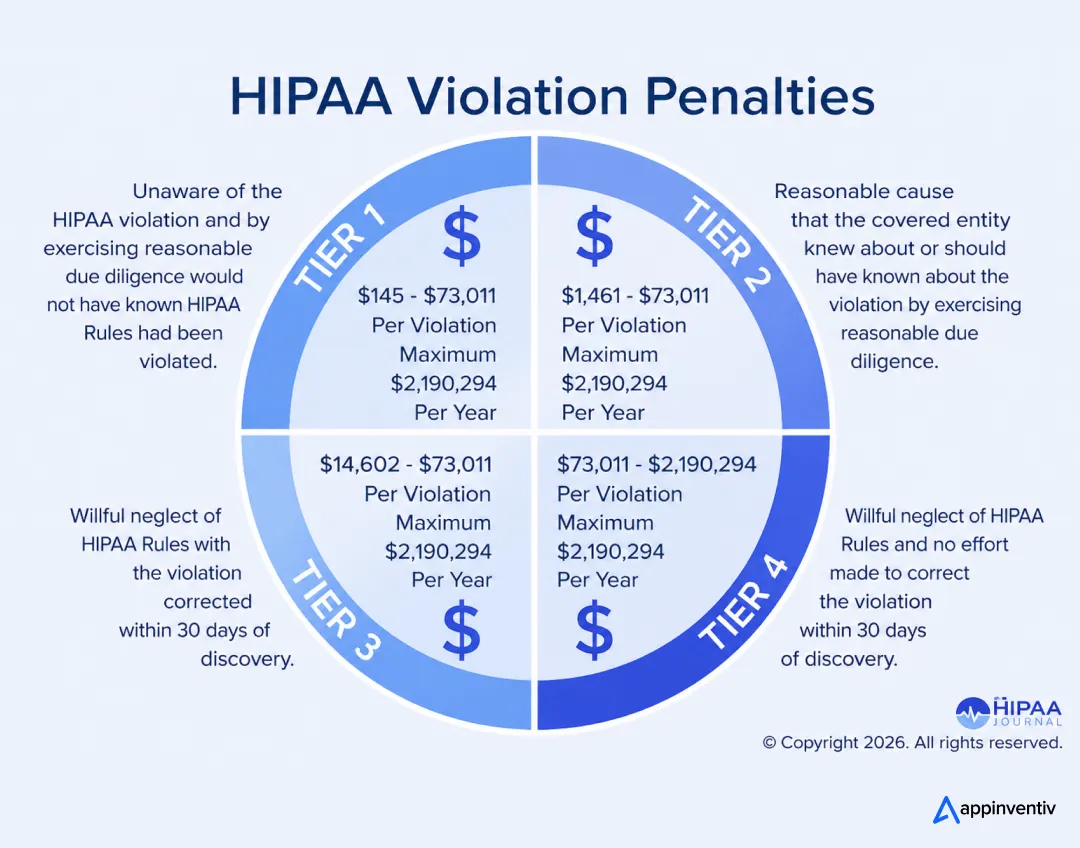
How HIPAA Penalties Are Calculated
Penalties fall into four tiers. Each tier reflects the level of negligence.
| Tier | Condition | Fine per violation | Annual cap |
|---|---|---|---|
| Tier 1 | No knowledge of violation | $100 – $50,000 | $25,000 |
| Tier 2 | Reasonable cause | $1,000 – $50,000 | $100,000 |
| Tier 3 | Willful neglect, fixed in time | $10,000 – $50,000 | $250,000 |
| Tier 4 | Willful neglect, not fixed | $50,000 | $1.5 million |
Key points:
- Each record can count as a separate violation
- Fines scale fast in large breaches
- Delay in fixing issues increases penalties
Role of the Office for Civil Rights
The Office for Civil Rights enforces HIPAA rules. It investigates breaches and decides penalties.
What triggers an investigation:
- Data breach reports
- Patient complaints
- Random audits
What happens next:
- Review of security controls
- Analysis of HIPAA security risk assessment records
- Check for prior warnings
Possible outcomes:
- Financial settlement
- Civil penalty
- Corrective action plan
Handling HIPAA violation accusations and lawsuits starts the moment OCR contacts the organization. A corrective action plan can run for years and often includes audits, reporting duties, and system changes.
Also Read: Healthcare Compliances Guide
Criminal Liability Under HIPAA
Civil fines are handled by the Office for Civil Rights. Criminal cases fall under the Department of Justice and apply to individuals.
| Violation Type | Penalty |
|---|---|
| Knowing the misuse of PHI | Up to $50,000 fine and 1 year in prison |
| False pretenses | Up to $100,000 fine and 5 years in prison |
| Personal gain or malicious intent | Up to $250,000 fine and 10 years in prison |
Total Cost of a HIPAA Violation
HIPAA Violation Fines and Settlements are only one part of the loss. The full impact spreads across legal, operational, and business areas.
| Direct Costs | Indirect Costs | Long-Term Impact |
|---|---|---|
| Federal Penalties | Class-Action Settlements | Loss of Patient Trust |
| State Fines | System Shutdowns | Contract Delays |
| Legal Defense | Incident Response Efforts | Higher Insurance Premiums |
Also Read: Healthcare App Development Cost Guide
What True Cost Looks Like
A single breach can trigger multiple payouts, starting with HIPAA non-compliance fines.
- Federal fine
- State attorney general settlements
- Private lawsuits
- Internal recovery cost
For large healthcare systems, total loss can exceed the original fine several times.
Fines for HIPAA violations are not isolated events. They signal deeper system failures. Financial exposure grows when those failures remain hidden or unresolved.
Also Read: HIPAA Compliant Platform Cost for Medical Supplies Delivery
Biggest HIPAA Fines in History – Technical Postmortems
Each case below represents some of the most consequential HIPAA violations examples in history, showing what happened, where the system failed, and why the failure occurred.
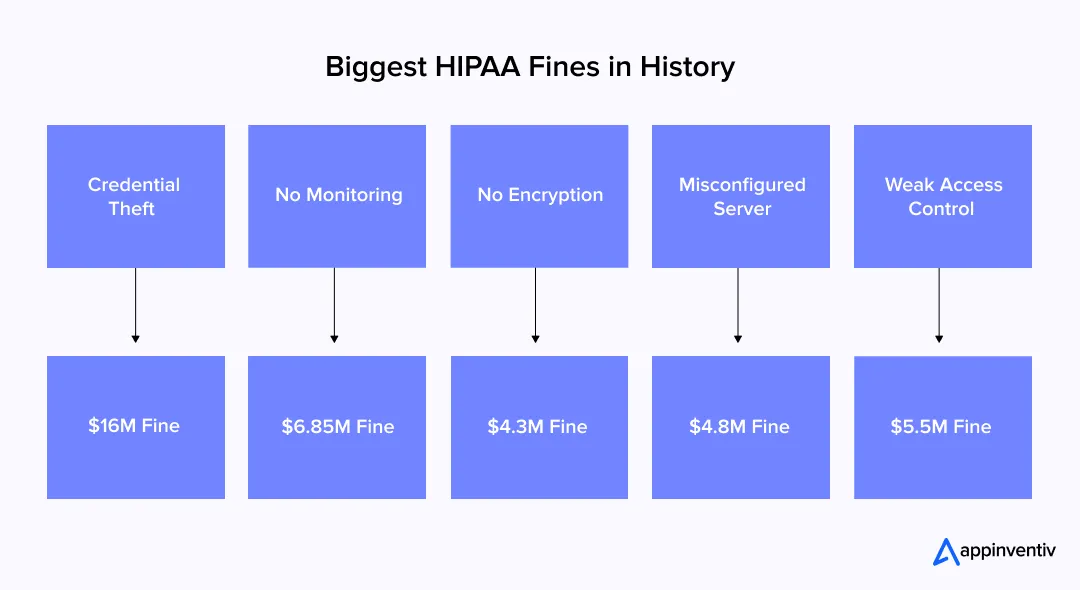
What happened
Attackers gained access to systems that held data for about 79 million people. Data included names, social security numbers, and medical IDs.
Technical root cause
Credential theft through phishing. Stolen credentials granted access to internal systems.
Application and system failure
- No multi-factor authentication on remote access and admin accounts
- Central directory controls were not enforced across all apps
- Lack of network segmentation allowed lateral movement between services
- Service accounts had broad database read permissions
Attackers moved from one system to another without hitting strict access boundaries. Data queries did not trigger alerts.
Why was it preventable?
- Enforce MFA for all privileged and remote access
- Apply least-privilege roles at the database and API layers
- Segment networks and isolate sensitive datasets
- Set query thresholds and anomaly alerts for bulk reads
Enterprise takeaway
Identity is the primary attack surface. One compromised credential can expose an entire data estate and trigger HIPAA breach fines if access is not scoped.
Premera Blue Cross – $6.85 Million
What happened
Attackers accessed systems and remained undetected for months. Data from over 10 million individuals was exposed.
Technical root cause
Long dwell time due to a lack of detection.
Application and system failure
- No centralized logging across applications and databases
- No correlation of events across identity, API, and data layers
- Absence of a SIEM to detect abnormal behavior
- No alerts for unusual data access patterns
Large data transfers occurred without raising alerts. Repeated access from the same accounts did not trigger an investigation.
Why was it preventable?
- Aggregate logs from apps, APIs, and databases into a central system
- Define alerts for abnormal query volumes and export patterns
- Track session behavior across services
- Run regular threat hunts against historical logs
Enterprise takeaway
Observability is a control. If the system cannot detect misuse, it cannot contain it, or prevent HIPAA breach fines from following.
University of Texas MD Anderson Cancer Center – $4.3 Million
What happened
Unencrypted devices containing patient data were lost. Data included electronic protected health information.
Technical root cause
Data at rest was not encrypted on endpoints.
Application and system failure
- No device-level encryption is enforced through mobile device management
- No policy to block data storage on unencrypted drives
- Lack of remote wipe capability
- Applications allowed local data caching without encryption
Data left controlled environments and remained readable.
Why was it preventable
- Enforce full disk encryption on all endpoints
- Restrict local storage of sensitive data
- Use containerized apps that isolate and encrypt data
- Enable remote wipe and device compliance checks
Enterprise takeaway
Security policies must be enforced by systems. Written rules do not protect data.
New York Presbyterian Hospital – $4.8 Million
What happened
A server was configured in a way that made patient data accessible on the internet. Search engines indexed the exposed data.
Technical root cause
Misconfigured server during maintenance and decommissioning.
Application and system failure
- Public access is enabled on a server that stores patient records
- No access control checks at the application layer
- No network restrictions, such as IP allowlists
- No automated scan to detect exposed endpoints
Data became accessible without authentication.
Whywas its preventable
- Use infrastructure templates with secure defaults
- Scan for exposed services before and after deployment
- Enforce access controls at both network and application layers
- Add automated checks in deployment pipelines
Enterprise takeaway
Configuration errors in deployment pipelines can expose entire systems within minutes.
Cignet Health – $4.3 Million
What happened
The organization failed to provide patients with access to their medical records and did not cooperate with regulators.
Technical root cause
Absence of structured data access workflows.
Application and system failure
- No patient-facing portal to retrieve records
- No API endpoints to support record access requests
- Data is stored in fragmented systems without unified access, a gap that proper EHR implementation helps address
- No audit trail for access requests and responses
Requests could not be processed in a consistent or timely manner.
Why was it preventable
- Build patient access workflows into applications
- Expose controlled APIs for record retrieval
- Maintain audit logs for every request
- Define service-level timelines for response
Enterprise takeaway
Compliance includes access. Systems must support controlled data retrieval, not just storage.
Memorial Healthcare System – $5.5 Million
What happened
Employees accessed patient records without authorization over an extended period.
Technical root cause
Internal misuse due to weak access controls.
Application and system failure
- No role-based access control tied to job function, a core requirement in EMR software development
- No field-level restrictions on sensitive data
- No monitoring of internal access patterns
- Lack of session-level audit trails
Staff could access records outside their scope without detection.
Why was it preventable
- Define roles with strict data boundaries
- Apply attribute-based access where needed
- Monitor access patterns for anomalies
- Log every read and write action at the record level
Enterprise takeaway
Insider access must be controlled and monitored with the same rigor as external threats.
Excellus Health Plan – $5.1 Million
What happened
Attackers gained access to systems and remained inside for a long period. Data from millions of members was exposed.
Technical root cause
Compromised systems with delayed detection.
Application and system failure
- No endpoint detection tools across all systems
- Weak network visibility across segments
- No alerting on unusual authentication patterns
- Lack of data access monitoring
Attackers accessed and moved data without interruption.
Why was it preventable
- Deploy endpoint detection and response across all nodes
- Monitor authentication events in real time
- Track data movement across systems
- Segment networks to limit lateral movement
Enterprise Takeaway
Visibility across endpoints, identity, and data layers forms the base of defense.
Each incident ties back to a small set of healthcare app security failures, the same gaps that healthcare cybersecurity solutions are built to close, and the ones that drive HIPAA violation fines when left unaddressed. Across the industry, thousands of reported breaches now follow these same patterns. Identity, APIs, cloud configuration, and monitoring form the core. When controls fail in these areas, exposure grows fast, and fines for HIPAA non-compliance follow.
Cross-Case Pattern Intelligence: What All Major HIPAA Fines Have in Common
The HIPAA violations examples above differ in scale and context. The failure patterns remain the same. Each incident traces back to a small set of gaps in identity, visibility, configuration, and governance.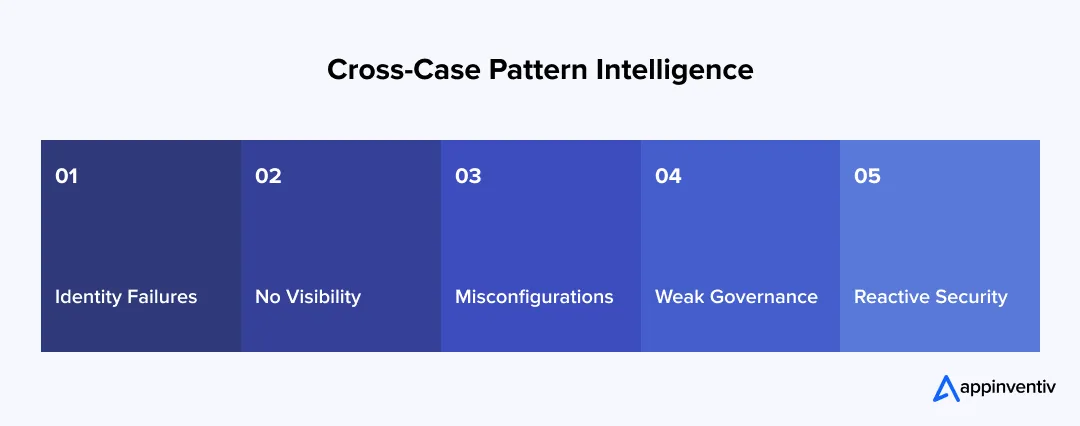
Pattern 1: Identity Is the Weakest Link
Most breaches begin with access. A large portion of reported incidents involves unauthorized access or compromised credentials.
- Stolen credentials open the first door
- Over-privileged roles expand access beyond need
- Lack of MFA allows easy entry
Technical pattern:
- No enforcement of least-privilege access
- Identity systems are not integrated across applications
- Tokens and sessions are not tightly controlled
Once identity fails, other controls lose value.
Pattern 2: Lack of Visibility Delays Response
Many breaches last for weeks or months. The delay increases both data loss and regulatory impact.
- No centralized logs
- No correlation between systems
- No alerts for abnormal behavior
What this looks like:
- Large data exports go unnoticed
- Repeated login attempts do not trigger an action
- Access from new locations is ignored
Without visibility, detection depends on external reports or late discovery.
Pattern 3: Misconfigurations Drive Breaches
Simple configuration errors expose entire systems.
- Public storage buckets
- Open database ports
- APIs without access checks
Why does this happen?
- Manual setup without validation
- Lack of automated security scans
- No baseline configuration standards
A single misconfigured service can expose millions of records.
Also Read: Blockchain Technology in Healthcare: Breaking Barriers & Redefining the Industry
Pattern 4: Governance Fails Without Enforcement
Policies exist in many organizations. Systems do not always enforce them.
- Encryption policies are not applied to devices
- Access rules are defined but not implemented
- Compliance checks done on paper, not in code
Technical gap:
- No automated policy enforcement
- No compliance validation in deployment pipelines
Rules without enforcement leave systems exposed to HIPAA non-compliance fines.
Also Read: HealthTech Regulations for CTOs
Pattern 5: Security Is Reactive, Not Built-In
Security often enters late in the development cycle.
- Features go live without threat assessment
- Controls added after incidents
- Security reviews are treated as checkpoints, not continuous processes
Result:
- Gaps remain in production systems
- Fixes occur after exposure
Key Insight
Most fines for HIPAA violations stem from architectural gaps, not advanced attacks.
How HIPAA Fines Are Rising in the Era of Digital Health
Healthcare delivery now depends on software. Patient data moves through apps, APIs, and cloud services every second. Each connection point adds a new place where data can leak or be misused.
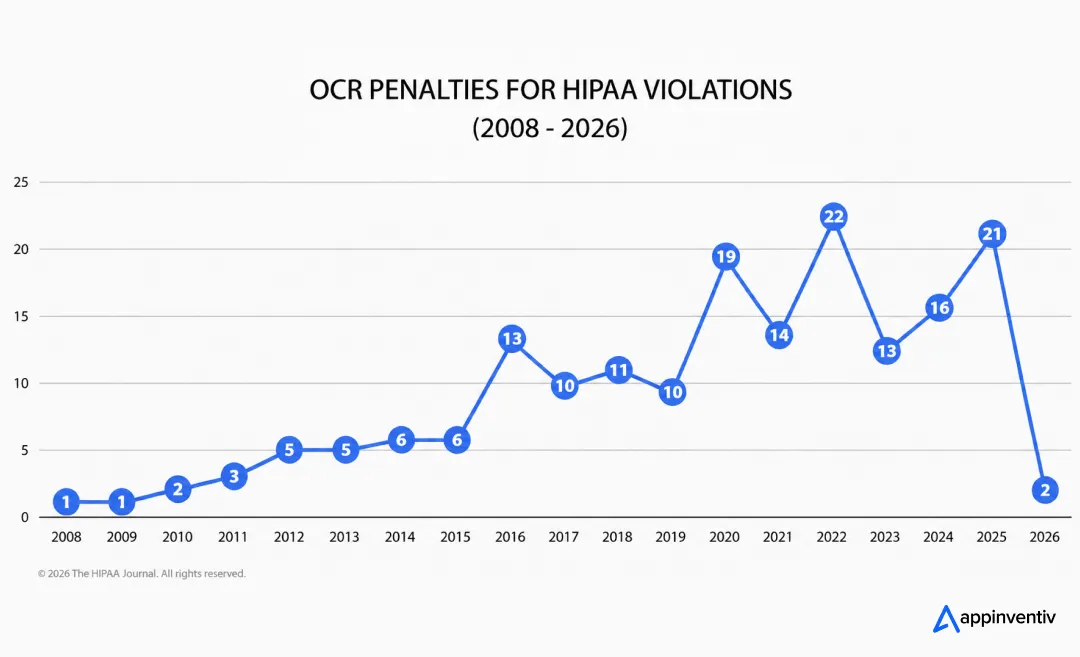
Older systems stored data inside closed networks. Modern systems share data across services, partners, and devices. This shift has changed where failures occur and how fast they spread. Between 2022 and 2023, breach incidents grew by only 3.8%, but the number of affected individuals increased by 193.5%.
Explosion of Application-Layer Risk
Most healthcare workflows now run through applications.
- Mobile apps, including AI voice assistants, allow patients to view records and book care.
- SaaS platforms manage billing, scheduling, and analytics
- APIs connect systems using standards like FHIR
Each layer handles sensitive data. A small flaw in any layer can expose large datasets. Today, over 80% of healthcare breaches involve hacking or IT-related incidents.
Common risk points:
- Weak authentication in mobile apps
- Misconfigured API endpoints
- Insecure data exchange between services
Shift from Network Breaches to Application Failures
Earlier breaches focused on network access. Attackers targeted servers and firewalls. That pattern has changed. Now, many incidents begin inside the application layer, particularly in high-growth areas like telemedicine app development, where speed to market can outpace security design.
Hacking-related breaches have increased by over 200% in the past five years, reflecting this shift.
| Earlier Focus | Current Focus |
|---|---|
| Network intrusion | API exposure |
| Server compromise | Auth failures |
| Firewall bypass | Token misuse |
A single misconfigured endpoint can expose data without triggering alarms. These failures often remain unnoticed for weeks or months.
Enforcement Now Examines System Design
Regulators no longer look only at whether a breach occurred — HIPAA fines for violations now reflect how the system was built.
The Office for Civil Rights reviews:
- Risk analysis processes
- Access control design
- Data protection methods
Fines for HIPAA non-compliance now reflect system-level gaps.
Common findings in enforcement actions:
- Missing risk assessments
- Weak access controls
- Lack of encryption
- Poor monitoring
HIPAA breach fines increase as systems grow more connected. Risk now sits inside application logic, not just infrastructure. Organizations that fail to secure these layers face higher exposure and faster escalation.
Appinventiv built YouComm, a hospital communication platform used across 5+ US hospital chains, improving patient response time by 60%. Read the full case study here.
Why Most HIPAA Violations Are Preventable
Most large breaches do not rely on advanced attack methods. They follow simple patterns. The same gaps appear again and again across different organizations.
A missed control or a delayed fix often creates the opening. Once data becomes exposed, the impact grows fast.
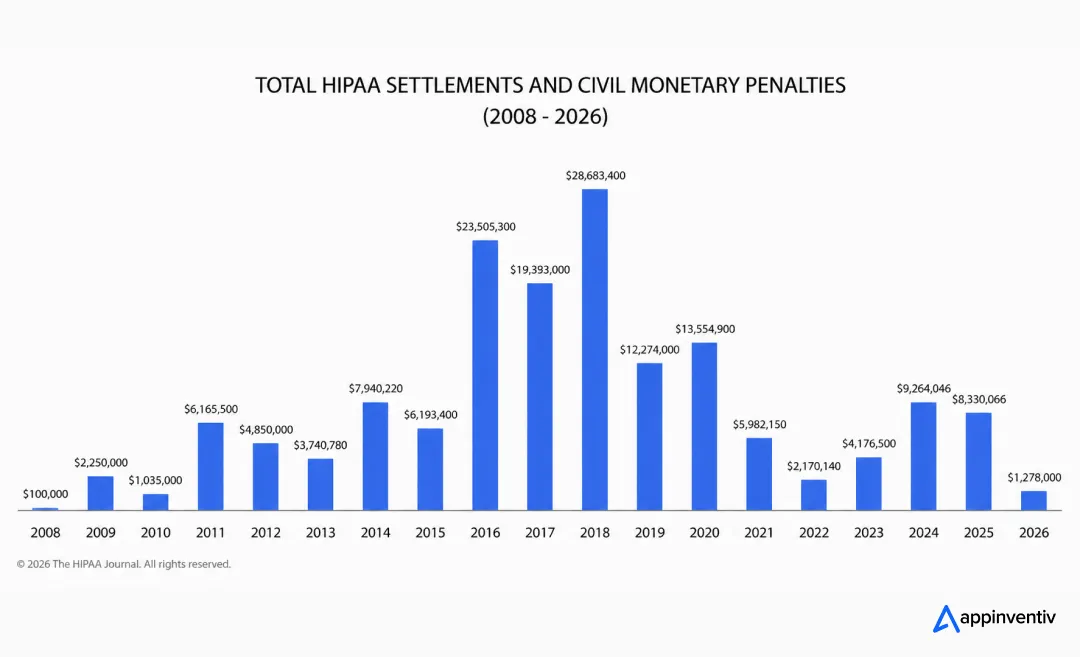
Core Insight
Consequences of HIPAA Violations follow from predictable failures, not rare events, with studies showing over 30% of incidents linked to unauthorized access or disclosure
- Access controls are weak or missing
- Systems lack basic monitoring
- Sensitive data moves without protection
These gaps stay hidden until a breach exposes them.
Common Root Causes
The same issues appear in many enforcement cases.
- No formal risk analysis
- Limited visibility into system activity
- Delays in fixing known issues
- Teams working in isolation
Each of these increases exposure over time.
What This Looks Like Inside Systems
These root causes map directly to technical gaps.
| Organizational Gap | Technical Reality |
|---|---|
| No risk analysis | No threat modeling |
| Poor visibility | No logs or alerts |
| Delayed response | No incident workflow |
| Team silos | No shared security ownership |
Why These Failures Persist
Many systems grow in stages. New features connect to older components. Security checks do not always keep up with that growth. Teams often focus on delivery speed. Security reviews happen late or not at all.
A simple question reveals the gap:
Can your team detect unauthorized access in real time? If not, the system already carries risk.
HIPAA violation prevention starts with controls that are already well-known. The challenge lies in applying them early and maintaining them as systems evolve.
The same security gaps appear across organizations. Most teams discover them only after data exposure begins.
Anatomy of a HIPAA Violation: Where Healthcare Applications Break
Most enforcement actions trace back to a small set of healthcare app security failures. These gaps sit inside identity, APIs, cloud setup, and monitoring. Each one exposes protected health information at scale.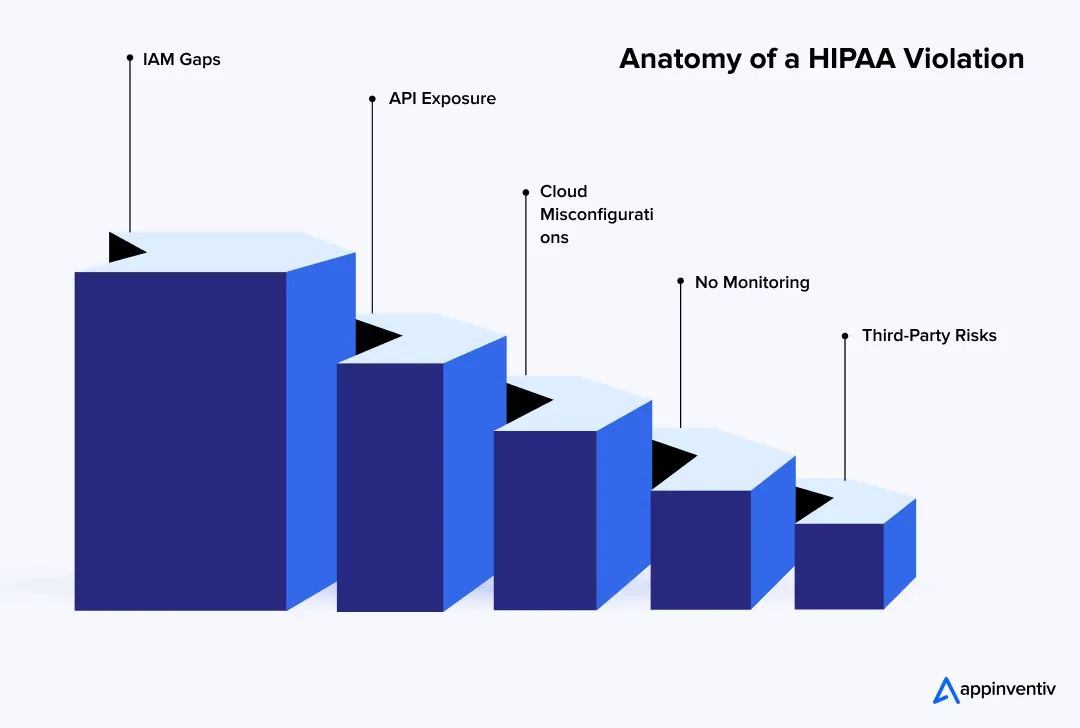
Identity and Access Failures
Identity and access management sits at the center of most breaches. Many systems still rely on basic username and password flows.
Typical failure modes:
- No multi-factor authentication on admin or remote access
- Over-privileged service accounts with broad database access
- Shared credentials across teams
- Long-lived sessions without token rotation
What breaks in practice:
- Absence of role-based access control allows staff to view records outside their role, a risk that extends to sensitive areas like pediatric health records, where exposure carries heightened consequences
- Lack of least-privilege policies exposes entire tables instead of scoped fields
- Directory services are not enforced across all apps, so users bypass central controls
A compromised credential can expose millions of records if access boundaries are not defined, with some breaches impacting tens of millions of records from a single entry point.
API Security Gaps
Modern healthcare systems depend on APIs, often using FHIR resources such as Patient, Observation, and Encounter. Weak controls at this layer create silent exposure.
Common gaps:
- Endpoints accessible without strict authorization checks
- Tokens that do not expire or are not validated on each request
- Missing scope validation in OAuth 2.0 flows
FHIR-specific risks:
- Broad read permissions on patient resources, including those powering patient analytics platforms, create unscoped data access risks
- Lack of consent checks before data retrieval
- Improper filtering, which returns full datasets instead of scoped responses
An exposed endpoint can allow bulk data extraction with simple scripted requests. Recent large-scale breaches have shown that a single exposed interface can impact millions of patient records in one incident.
Cloud and Infrastructure Misconfigurations
Cloud services store and process large volumes of health data. Misconfiguration turns private systems into public endpoints.
Frequent issues:
- Object storage buckets set to public access
- Databases exposed on open ports without IP restrictions
- Backups stored without encryption
Encryption gaps:
- Data at rest is not encrypted with managed keys
- Data in transit is not enforced through TLS
- Keys stored within application code
These errors often remain unnoticed until external scanning tools detect them, making healthcare data security practices at the infrastructure level critical.
Lack of Monitoring and Incident Detection
Many breaches go undetected for months. The delay increases both data exposure and regulatory penalties.
Observed gaps:
- No centralized logging across services
- No Security Information and Event Management system
- Alerts not configured for abnormal access patterns
Missed signals:
- Repeated failed login attempts
- Large data exports from a single account
- Access from unusual locations
Without visibility, teams cannot respond in time.
Third-Party and Business Associate Risks
Healthcare systems rely on external vendors for billing, analytics, and data exchange. Each connection introduces another risk layer. Recent incidents show that a single vendor breach can impact multiple healthcare organizations at once.
Common failure points:
- APIs shared with vendors without strict access limits
- No audit of vendor security controls
- Data is transferred without encryption or validation, including through EDI in healthcare pipelines that often bypass modern security checks.
Business associates, including every cybersecurity services provider in the chain, often handle the same data but do not follow the same controls.
These are not abstract risks but the biggest HIPAA violations examples drawn from real enforcement actions and multi-million dollar fines.
Enterprise Prevention Framework: How to Avoid Multi-Million Dollar HIPAA Fines
HIPAA violation prevention requires design choices made early and enforced at every layer. With hundreds of breaches reported each year, a delay in fixing gaps increases both exposure and cost.
The controls below map directly to the failures that drive HIPAA fines for violations in major enforcement actions. Each control ties to a clear system behavior and a measurable outcome.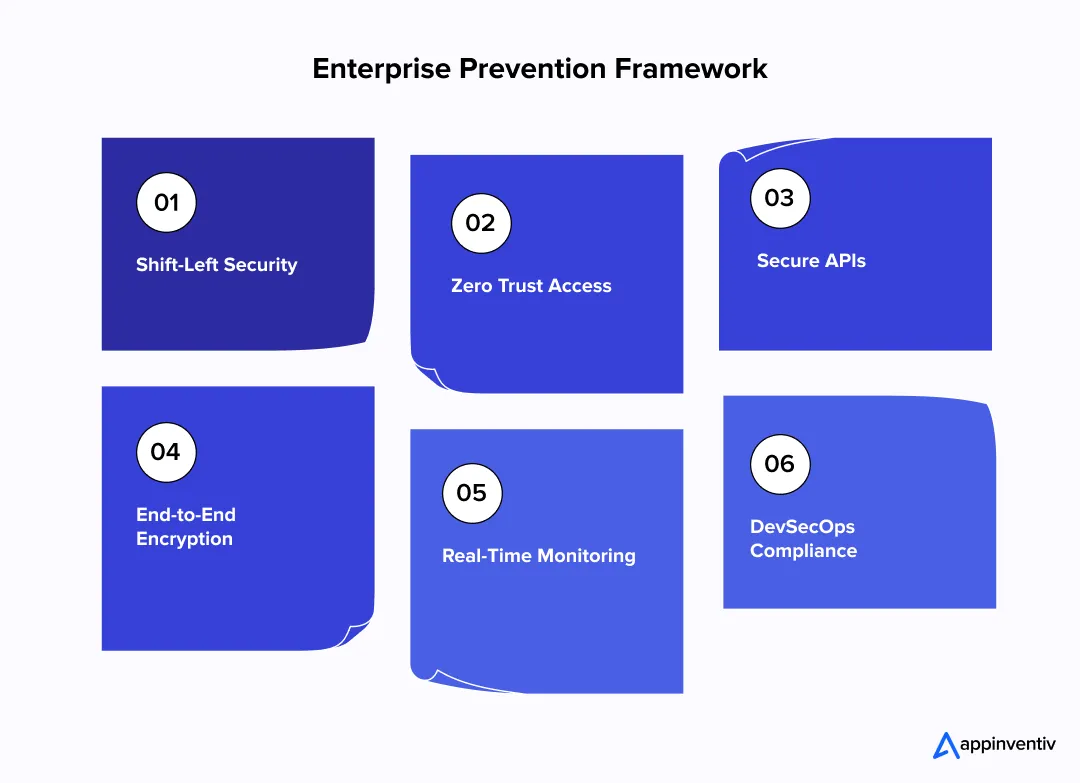
Shift-Left Security in Healthcare Apps
HIPAA-compliant app development requires security to start at design, not after release.
Threat modeling
- Map data flows for PHI across services and APIs
- Identify trust boundaries and entry points
- Document misuse cases, such as bulk export or token replay
Secure SDLC practices
- Define security requirements for each feature
- Use compliance software testing in build pipelines
- Review code for auth logic, data access, and input handling
Concrete controls
- Enforce input validation at API boundaries
- Use parameterized queries to prevent injection
- Block builds that fail security checks
Zero Trust Architecture
Assume no implicit trust between users, services, or networks.
Continuous verification
- Validate identity and device posture on each request
- Re-check tokens at the API layer, not only at login
Least privilege
- Grant scoped access based on role and context
- Use short-lived tokens with tight scopes
Implementation notes
- Integrate identity providers with all apps and APIs
- Apply policy engines to enforce access rules per request
- Segment services so that one compromise does not expose all data
API Security for Healthcare Systems
APIs move most healthcare data. They require strict controls.
Authentication and authorization
- Use OAuth 2.0 with scoped access for FHIR resources, as outlined in SMART on FHIR standards.
- Validate tokens on every request, not just at session start
- Enforce consent checks before data retrieval
Gateway controls
- Route all external calls through an API gateway
- Apply rate limits to block bulk extraction
- Use schema validation to reject malformed requests
FHIR-specific safeguards
- Restrict access to resources such as Patient and Observation
- Filter responses to the minimum required fields
- Log each access to PHI with user, scope, and endpoint
Appinventiv built DiabeticU, a HIPAA-compliant diabetes platform enabling secure patient monitoring and AI-driven care, supporting thousands of users. Read the full case study here.
End-to-End Encryption Strategy
Data must remain protected at rest and in transit.
At rest
- Encrypt databases and object storage with managed keys
- Rotate keys and restrict access to key management systems
- Avoid storing secrets in code or configuration files
In transit
- Enforce TLS for all service-to-service traffic
- Use mutual TLS for internal service calls
- Reject connections that do not meet protocol standards
Data handling
- Limit local caching of PHI on devices
- Encrypt backups and snapshots
- Control access to decryption keys with strict policies
Real-Time Monitoring and Response
Detection reduces impact. Speed of response limits exposure.
Logging and visibility
- Collect logs from identity, API, database, and network layers
- Normalize events to track user and session behavior
Alerting
- Set thresholds for abnormal access patterns
- Trigger alerts for bulk reads, export jobs, and failed logins
Response
- Define runbooks for incident handling
- Isolate affected systems during active incidents
- Preserve logs for investigation and reporting
A system that detects anomalies within minutes limits data loss and reduces fines for HIPAA non-compliance.
DevSecOps for Continuous Compliance
Compliance must run as code, not as a periodic review — teams that treat it otherwise remain exposed to HIPAA fines for non-compliance.
Automated checks
- Scan infrastructure templates for misconfigurations
- Validate encryption, access rules, and network exposure before deployment
- Block releases that fail policy checks
Continuous audits
- Run compliance checks on live systems at set intervals
- Compare system state against defined policies
- Generate audit trails for every control
Pipeline integration
- Embed security tests into CI/CD pipelines
- Track fixes as part of normal development cycles
Third-Party Risk Management
Vendors and partners often access the same data.
Vendor controls
- Define access scopes for each integration
- Use separate credentials for each partner
- Require encryption and logging for all data exchanges
Validation
- Review vendor security practices and certifications
- Test partner endpoints for access control and rate limits
Ongoing checks
- Monitor vendor activity through logs
- Revoke access when contracts end, or roles change
Each control addresses a known failure point. Identity limits access. APIs restrict data flow. Encryption protects stored and transmitted data. Monitoring detects misuse. Automated checks enforce rules. Vendor controls reduce external risk.
Systems built with these controls reduce the chance of large-scale exposure and the penalties that follow.
Early fixes prevent large-scale exposure. Delays increase both regulatory risk and financial impact.
Steps to Avoid HIPAA Violations: A HIPAA-Ready Application Security Checklist
A quick control check to confirm your application meets core HIPAA security requirements and avoids HIPAA non-compliance fines.
| Control Area | What to Verify |
|---|---|
| Identity and Access Management | MFA enabled for all users, RBAC enforced, no shared accounts, least-privilege applied |
| Encryption | Data encrypted at rest and in transit, keys managed securely, no hardcoded secrets |
| API Security | OAuth 2.0 implemented, tokens validated per request, rate limiting active, FHIR access scoped |
| Logging and Monitoring | Centralized logs across systems, alerts set for abnormal access, and audit trails retained |
| HIPAA Security Risk Assessment | Threat modeling completed, vulnerabilities documented, periodic reassessment scheduled |
| Incident Response | Response plan defined, roles assigned, breach detection and containment workflows tested |
How Appinventiv Helps Enterprises Build Secure, HIPAA-Compliant Healthcare Systems
Many healthcare platforms pass audits and still carry risk. Despite compliance efforts, large-scale breaches continue to affect millions of records each year. The gap shows up in day-to-day system behavior. A user gets broader access than needed. An API returns more data than required. Logs exist, but no one checks them.
As a custom healthcare app development company, Appinventiv focuses on HIPAA-compliant app development that fixes these gaps at the system level.
Access is tied to roles and checked on every request. APIs return only required fields. Tokens expire and get validated each time. Data stays encrypted in storage and during transfer. Logs capture each read and write action, so unusual activity stands out early.
This work comes from real deployments across healthcare systems.
| Metric | Value |
|---|---|
| Digital Health Platforms Delivered | 500+ |
| Healthcare Clients Served | 450+ |
| Years in HealthTech Projects | 10+ |
| Connected Medical Devices Integrated | 300+ |
| System Uptime | 99.90% |
| Operational Efficiency Gains | 45% |
| Clinical Data Accuracy | 90%+ |
| Patient Satisfaction | 95% |
These systems support hospitals, mobile health apps, and connected devices used in active care settings.
The focus stays simple. Build systems that enforce rules at runtime. When controls run inside the application, compliance follows. Let’s connect and fix gaps now before HIPAA violation fines cost your organization millions.
Frequently Asked Questions
Q. What are the fines for HIPAA violations?
A. HIPAA violation fines depend on the severity of the failure. They start at $100 per violation and can go up to $50,000. The yearly cap for a category can reach $1.5 million. In large breaches, each record can count, so the numbers rise quickly. Some well-known cases have crossed $5 million and even $16 million when basic controls were missing or ignored for long periods.
Q. How can you avoid HIPAA fines for records?
A. Start with access. Give users only the data they need. Add multi-factor login for all critical systems. Encrypt records both in storage and during transfer. Track who accessed what and when. Review those logs often. Run risk checks and fix issues early. Systems should allow secure access to records, not just store them. Controls must work in real time, not sit in documents.
Q. What are the most common HIPAA violations and their causes?
A. The same problems show up again and again. Stolen passwords remain a major issue, especially without strong login checks. APIs sometimes expose data without proper validation. Cloud storage can be left open by mistake. Many systems do not track access closely, so breaches go unnoticed for months. Internal misuse also happens when staff can see more data than they should.
Q. What is the financial impact of HIPAA non-compliance?
A. HIPAA fines for non-compliance are only the starting point. There are legal costs, settlements, and investigation expenses. Systems may need to shut down during recovery. That affects operations and revenue. Patients may lose trust, which can impact future business. Insurance costs can rise after a breach. In many cases, the cost of HIPAA violation ends up much higher than the original penalty.
Q. What is the average fine for a HIPAA violation?
A. There is no single average. HIPAA fines for violations in smaller cases may be settled for under $100,000. Larger cases often land between $1 million and $5 million. Some go higher if the breach involves many records or if issues were ignored. The final amount depends on how long the problem existed, how much data was exposed, and whether basic safeguards were in place.
Q. What are the four most common HIPAA violations?
A. Four issues appear often. First, no proper HIPAA security risk assessment. Second, weak access control, where too many people can view records. Third, a lack of encryption for stored or shared data. Fourth, slow detection of breaches. These are not rare problems. They come from missing controls in everyday system use and setup.
Q. Can the OCR also pursue criminal charges for HIPAA violations?
A. The Office for Civil Rights handles civil cases such as fines and compliance actions. Criminal cases are handled by the Department of Justice. These involve deliberate misuse of health data, such as fraud or theft. Penalties can include fines and prison time. Criminal cases are less common but apply when intent and misuse are clearly proven.


Fast 2-minute response, fully NDA-protected.

Wearable Data Integration: Connecting Multiple Devices to a Unified Health Platform
Key takeaways: Device support should reflect the measurements your service needs, the people using it, and the decisions those readings inform. A unified health data platform must preserve source, timing, and measurement context while resolving duplicate records. Phone health platforms, manufacturer APIs, and direct device connections serve different integration needs. Clinical workflows require agreed review…

Sleep Tracker App Development: Features, Wearable Integration, AI, and Compliance
Key takeaways: Sleep tracking presents opportunities across consumer wellness, fitness, healthcare, employee wellness, senior care, and infant-care markets. Successful products combine actionable insights, wearable connectivity, user-friendly reports, privacy controls, and clearly differentiated experiences. HealthKit, Health Connect, and direct device APIs provide different data depths, costs, limitations, and maintenance requirements. AI supports sleep-stage estimation and personalization,…

Diet and Nutrition App Development: Process, Features, Cost, and Technology Stack
Key Takeaways Diet and nutrition tracking app development goes past basic calorie counters with verified food databases, custom meal schedules, AI tools, wearable device links, and corporate manager tools. Structure database models around raw food items, serving portions, nutrient facts, recipes, software links, and regional diet rules. Pair computer vision models, recommendation algorithms, language engines,…