































AI in Healthcare: A Practical Guide To Help You Implement It and Remain Compliant

 Share -


- 01What is AI in healthcare, and why does it matter now?
- 02What are the main types of AI applications in healthcare?
- 03Which AI models are used in healthcare?
- 04How is AI used in healthcare day to day?
- 05What are the benefits of AI in healthcare?
- 06What are the risks and challenges of AI in healthcare?
- 07Which US regulations and compliance rules apply to AI in healthcare?
- 08How much does it cost to build AI in healthcare?
- 09How do you implement AI in healthcare successfully?
- 10What does the future of AI in healthcare look like?
- 11How can Appinventiv help you out?
- 12FAQs

Key takeaways:
- AI delivers the biggest ROI when applied to high-impact clinical and administrative workflows first.
- Healthcare AI projects typically cost $40K–$90K for a PoC, $120K–$300K for a basic solution, and $350K+ for enterprise deployment.
- Strong governance, quality data, and built-in compliance are the keys to overcoming AI adoption challenges.
- AI is improving healthcare through earlier diagnoses, faster drug discovery, lower burnout, and better patient outcomes.
- Long-term success comes from starting small, proving value, and scaling AI across the organization.
Half of US healthcare organizations were already running generative AI by the end of 2025, double the share from two years earlier. That is not a pilot wave. It is a buying wave.
AI in healthcare has crossed from the demo stage into the P&L, and the pressure now comes from three directions at once. Boards want a return. Clinicians want their evenings back. Regulators want proof that the model is safe before it ever touches a patient.
This guide is written for the people who have to satisfy all three:
- What artificial intelligence in healthcare actually does today,
- What it costs,
- Which US rules bind you, and how to ship something that survives an audit.
Every figure here traces to primary research. Let’s dive deeper.
Talk to our experts to identify possible opportunities for AI integration in your healthcare organization.
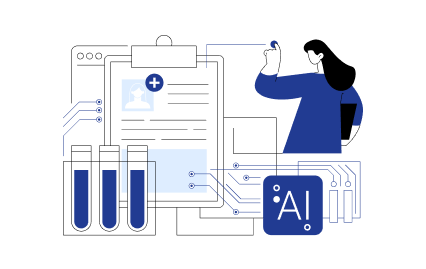
What is AI in healthcare, and why does it matter now?
Get rid of the noise, and AI in healthcare is kind of using a smart software that reads, predicts, and drafts. Machine learning, natural language processing (NLP), computer vision, and now generative and agentic systems sit behind diagnosis, treatment, and the back office that keeps the lights on.
But beyond some smart features given on just a screen, AI-based healthcare processes also involve integrating smart robots, finding meds faster, and more.
For a while now, AI in the healthcare industry has stopped being a science experiment. It is a line item now, with a business case stapled to it.
The market backs that up. Grand View Research puts the AI in the healthcare market on track to reach $505.6 billion by 2033, a 38.9% CAGR from the 2024 base. Demand tells the same story: McKinsey found that half of US healthcare organizations had deployed generative AI by late 2025, up from a quarter two years prior.
So why did the dam break now, and not in 2019? A handful of forces landed at the same moment:
- Compute got cheap enough to run large models against real clinical data.
- Foundation models learned to read and write clinical language, not just consumer chatter.
- The electronic health record finally holds data clean enough to train on.
- The workforce is stretched thin, so the appetite for automation is real, not theoretical.
- Federal guardrails from the FDA and ONC gave buyers cover to move.
Put those together, and the risk math flips. Standing still costs more than moving. Look across service lines and the impact of AI in healthcare rhymes every time: fewer manual steps, faster calls, tighter margins.
What are the main types of AI applications in healthcare?
Buyers get burned when they treat “AI” as one thing. It is not. Most AI applications in healthcare land in eight distinct buckets, and knowing which one you are funding keeps the roadmap honest. These types of AI in healthcare overlap in the field, yet the eight types of artificial intelligence in healthcare below each solve a different problem.
| Type of AI | What it does | Where it pays off |
|---|---|---|
| Computer vision and medical imaging | Reads X-rays, MRIs, CTs, and pathology slides | Earlier detection, fewer missed findings |
| NLP and generative AI | Understands and drafts clinical language | Notes, summaries, patient messages |
| Predictive analytics | Forecasts risk and demand from historical data | Sepsis, readmissions, staffing |
| Robotic process automation | Automates rule-based back-office work | Billing, claims, scheduling |
| Robot-assisted surgery | Guides instruments with sensors and AI | Precision, smaller incisions |
| Conversational AI and virtual assistants | Talks with patients at scale | Triage, reminders, follow-up |
| Drug discovery and precision medicine | Models of biology and genomics | Faster candidates, tailored therapy |
| Clinical decision support | Flags risks at the point of care | Safer prescribing, protocol adherence |
A few of these deserve more than a table cell. Generative AI in healthcare drafts the discharge summary and the prior authorization letter, then hands the clinician a first draft to edit instead of a blank page.
Conversational AI in healthcare has graduated from gimmick to front door, and the symptom checker now does real triage. Agentic AI in healthcare raises the ceiling again, stringing tasks together so the system can book, chart, and escalate on its own.
Prediction runs underneath most of it. AI predictive analytics in healthcare and risk stratification quietly rank those who need a clinician first. Two categories carry the most liability, so handle them with care: AI in clinical decision making, which touches prescribing and diagnosis head-on, and virtual health assistants, which carry the relationship between visits.
Which AI models are used in healthcare?
The AI models in healthcare are not consumer chatbots in scrubs. The AI models used in healthcare get tuned, benchmarked, and fenced in by controls a marketing bot never meets. Here is the short list of buyers who actually weigh:
| Model or platform | Best known for |
|---|---|
| OpenAI enterprise healthcare | HIPAA-ready clinical workflows |
| Google Med-PaLM and MedGemma | Multimodal medical text and imaging |
| Microsoft healthcare models on Azure | Imaging, genomics, and clinical text |
| AWS HealthScribe | Ambient clinical documentation |
| Writer Palmyra-Med | Medical entity recognition |
How do you know one is fit for care?
You read the scorecards. HealthBench grades performance on realistic clinical scenarios. MedQA tests a model against US Medical Licensing Examination (USMLE) questions.
Teams reach these through Azure Machine Learning Studio or the AWS Marketplace, and they study the model cards, built on annotated clinical data sets, before anything goes near a patient.
We have delivered over 500 digital healthcare solutions and 300 AI solutions that are flourishing in the market. It’s time we helped you out.
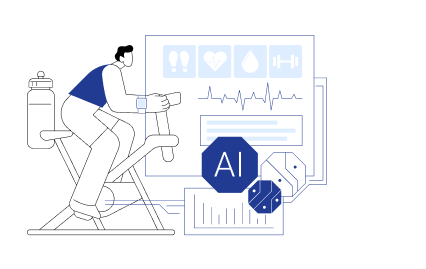
How is AI used in healthcare day to day?
The honest answer is unglamorous. Most of the use of AI in healthcare happens in the middle of the workflow, where the hours quietly vanish. Documentation leads the pack: medical scribe technology listens to the visit and drops a drafted note into the electronic health record.
Imaging tools surface anomalies in radiology and pathology. Predictive diagnostics score deterioration risk, and drug discovery trims the candidate list before the first trial.
Split it into two columns, and the footprint gets clear:
| Frontline clinical | Operations and revenue |
|---|---|
| Ambient documentation and scribing | Billing and insurance processing |
| Imaging and pathology analysis | Automated appointment scheduling |
| Risk stratification and early warning | Bed management and staff scheduling |
| Clinical decision support | Supply chain logistics and claims |
Behind the scenes, AI automation in healthcare and AI agents in healthcare handle the repetitive load, including real-time monitoring, resource allocation, and workflow automation, without ever touching the clinical record.Patient-facing AI use is climbing fast too, and AI chatbots in healthcare now cover routine contact.We have observed that 43% of multi-provider clinics currently rely on conversational AI to handle triage, reminders, and follow-up. The front desk gets to focus on the calls that actually need a person.
What are the benefits of AI in healthcare?
Ask how AI can improve healthcare, and the answer splits three ways: a CFO will recognize better outcomes, less waste, and steadier staff. None of it is hand-waving anymore. The numbers landed.
- Time back. Ambient documentation saved Permanente physicians an estimated 15,791 hours, roughly 1,794 workdays, across 2.5 million visits, and lifted work satisfaction for 82% of them.
- Lives. A deep learning sepsis model called COMPOSER was tied to a 17% relative drop in sepsis mortality at UC San Diego.
- Sharper screening. In the MASAI trial, AI-supported mammography detected 29% more cancers while maintaining a comparable recall rate and reducing radiologist reading workload by 44%.
- Faster science. AI-discovered drugs have posted Phase 1 success rates near 90%, versus a historical 40% to 65%, according to Drug Discovery Today.
The staff dividend is the one leaders keep underpricing. Burnout is expensive, and paperwork is the usual suspect. The American Medical Association put US physician burnout at 43.2% in 2024, with documentation near the top of the list. Point AI and machine learning in healthcare at the charting, and clinicians get their nights back.
| Stakeholder | What they gain |
|---|---|
| Clinicians | Less documentation, lower burnout, faster decisions |
| Patients | Earlier detection, shorter waits, tailored care |
| Operations and finance | Cleaner billing, better staffing, fewer denials |
| R&D teams | Faster candidate identification, smarter trials |
Where should the first dollar go? Leveraging AI in healthcare administration points to workload cuts of up to 40%, which tends to be the quickest return in the building.
What are the risks and challenges of AI in healthcare?
The risks of AI in healthcare are not reasons to wait. They are the reasons to design like an adult. Skip them, and a promising pilot turns into a breach notice or a lawsuit.
Here is what actually keeps counsel up at night:
- Privacy. Healthcare breaches averaged $7.42 million in 2025, the priciest of any sector for the 14th year straight, per IBM. A model that leaks, or a vendor that trains on your data, is a headline in waiting.
- Bias. Train on one population, misjudge another. Bias mitigation, explainability, and algorithm transparency have to be designed in, never bolted on later.
- Liability. When a recommendation is wrong, someone is on the hook. Decide who, in writing, before go-live.
- Prior authorization. Utilization management committees can point AI at faster approvals or, done carelessly, at entrenched denials. Governance is the whole difference.
- Data access. Locked or messy data starves the model and stalls the timeline.
Strong AI governance in healthcare is the line between a pilot that scales and one that quietly dies in committee. For the unvarnished truth, discuss AI challenges in healthcare with your tech partner and ensure AI adoption doubles as a decent pre-flight checklist.
Which US regulations and compliance rules apply to AI in healthcare?
Compliance is where good intentions meet the auditor. For a US build, five frameworks set the floor, and none of them are optional.
| Rule | What it governs | Your job |
|---|---|---|
| HIPAA | PHI privacy and security | Encrypt, log, and limit access |
| ONC HTI-1 | Algorithm transparency (FAVES) | Publish source attributes |
| Section 1557 | Nondiscrimination in decision tools | Test for bias, and document it |
| FDA PCCP | AI model updates for devices | Pre-specify change control |
| CHAI and WHO | Validation and ethics | Adopt model cards and assurance |
A little context behind the grid. HIPAA covers protected health information, full stop. The ONC HTI-1 rule layers on transparency, demanding “source attributes” for predictive decision support measured against FAVES, meaning fair, appropriate, valid, effective, and safe.
Section 1557 of the Affordable Care Act bans discrimination through patient care decision support tools, and since 2025, the provider carries that duty, not just the vendor. Anything that behaves as a medical device falls under the FDA’s Predetermined Change Control Plan (PCCP), which lets you pre-authorize model updates instead of refiling for every tweak.
Rounding it out, the Coalition for Health AI (CHAI) is standardizing model cards and independent AI assurance labs, while the World Health Organization’s guidance on large multimodal models (LMMs) offers 40-plus recommendations that US teams treat as a north star. Interoperability rules like the Trusted Exchange Framework and Common Agreement (TEFCA) push the regulatory harmonization that lets data move.
Privacy compliance is not a box you tick at the end. It is an architecture decision you make on day one.
How much does it cost to build AI in healthcare?
Short version: it depends, and mostly not on the model. Two builds that sound identical can differ tenfold once you count the data plumbing, the integration surface, and the compliance load.
Here is a planning-grade view of healthcare AI software solutions, not a quote:
| Stage | Typical range | What it buys |
|---|---|---|
| Proof of concept | $40,000 to $90,000 | One use case, validated on your data |
| Production MVP | $120,000 to $300,000 | HIPAA-ready, EHR-integrated, in real workflows |
| Enterprise rollout | $350,000 and up | Multiple workflows, MLOps, audit trails |
What actually moves the number:
- Data readiness and integration, usually the biggest swing of all.
- Compliance, security, and audit overhead.
- Build versus fine-tune on the model itself.
- EHR and Fast Healthcare Interoperability Resources (FHIR) connectivity.
- MLOps, monitoring, and a PCCP for ongoing changes.
The AI tools in healthcare that look cheap on the sticker often carry the fattest integration bill. Building AI solutions in healthcare that plug into an EHR or a medical device is where the real cost lives, and, not by accident, where the real value lives too.
Tell us your goals, and get a quote that guards you against any scope creep or surprises.
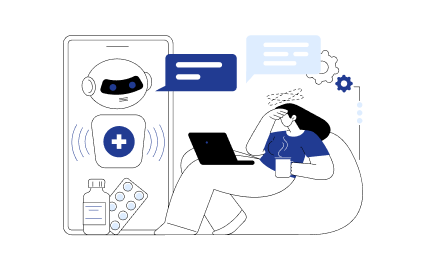
How do you implement AI in healthcare successfully?
Implementation is a sequence, not a scramble. The teams that win treat AI as a product with a clinical owner, not a science fair entry. Run the play in order:
Step 1: Prioritize use cases by value and risk
Start with a real clinical or operational problem that has a measurable business impact and a clear owner. Solving a meaningful challenge delivers far more value than building an impressive demo with no practical application.
Step 2: Prepare and govern your data
AI models are only as reliable as the data they’re trained on. Ensure your healthcare records are accurate, standardized, secure, and governed by robust data management policies before model development begins.
Step 3: Address compliance from the start
Compliance shouldn’t be an afterthought. Align your solution with regulations such as HIPAA, Section 1557, and FAVES during the planning and development stages to avoid costly rework later.
Step 4: Decide whether to build or buy
Evaluate whether an existing AI solution meets your needs or if a custom application provides a competitive advantage. Commodity capabilities often benefit from off-the-shelf tools, while differentiating features may justify custom development.
Step 5: Integrate AI into existing workflows
An AI solution only creates value if clinicians actually use it. Integrate it directly into your EHR and clinical systems through standards like FHIR instead of relying on standalone applications that disrupt existing workflows.
Step 6: Monitor performance, govern continuously, and scale
Deployment is the beginning, not the end. Continuously monitor model performance for drift, maintain a Predetermined Change Control Plan (PCCP), and expand successful AI implementations across additional departments and use cases.
Step four is where a partner earns its keep. A seasoned healthcare software development company can compress months of trial and error, especially on the compliance and integration legwork that never shows up in a demo but always shows up in production. Done right, AI technology in healthcare is the gap between a model that dazzles in a pilot and one that holds the floor at 2 a.m.
What does the future of AI in healthcare look like?
The future of AI in healthcare is agentic, and the money is already there. Grand View Research pegs agentic AI in healthcare at $538.51 million in 2024, climbing to $4.96 billion by 2030, a 45.56% CAGR. Its generative AI forecast is on a parallel climb, from $3.8 billion in 2026 to $28.2 billion by 2033. Four shifts are worth watching:
- Validation becomes routine. AI assurance labs and model cards turn “trust us” into “here is the evidence.”
- Documentation scales. Ambient scribing spreads from pilots to whole systems.
- Care moves upstream. Precision medicine, fed by genomics, wearable devices, and remote monitoring, pushes from reactive to predictive.
- Trials get smarter. Predictive modeling sharpens candidate identification and trial optimization.
Even AI in healthcare marketing is growing up, personalizing patient outreach and engagement without tripping privacy lines. The through line is simple. The systems shipping now do not just assist with the work. They absorb pieces of it.
How can Appinventiv help you out?
We have spent more than a decade building secure, compliance-heavy systems for regulated industries, and healthcare is home turf. Over 10-plus years in HealthTech, we have shipped 500-plus digital health platforms for 450-plus clients, wired to HIPAA, HL7, and FHIR from the first commit.
Beyond that, we have delivered over 300 AI-powered products across the globe that remain compliant and align with the evolving trends.
Here is where we come in:
- Custom AI development services, from clinical decision support to generative AI and AI agents.
- Secure EHR and EMR integration that clears an audit, not just a demo.
- Medical device software built to the standard, not to the deadline.
Because we have carried these systems into production, we know exactly where the last mile hides. If AI is on the roadmap this year, the next step is small: talk to our healthcare AI engineers or book a 30-minute architecture review to pressure-test the use case before you spend a dollar.
FAQs
Q. What are the primary applications of artificial intelligence in diagnostic imaging?
A. Computer vision reads X-rays, MRIs, CT scans, and pathology slides, and it flags what a tired eye misses. It triages the urgent cases, measures lesions and organs, and trims reading time. In screening, it lifts cancer detection while holding the recall rate steady.
Q. How does machine learning contribute to personalized treatment plans?
A. It connects the dots across genomics, labs, imaging, and wearable data to predict how one specific patient will respond. That is precision medicine in practice: the right drug, the right dose, and fewer nasty surprises. Risk stratification then flags who needs a closer eye.
Q. How can AI improve patient appointment scheduling systems?
A. It predicts no-shows, balances provider load, and backfills cancellations on its own. Automated scheduling and conversational assistants let patients book, move, and confirm without the hold music. The payoff is fuller calendars and less front-desk churn.
Q. How can AI improve healthcare entirely?
A. AI can help identify medicines faster, speed up diagnoses, monitor patient health, personalize treatments, automate routine tasks, and detect diseases earlier. The result is better patient outcomes, lower clinician workload, and more efficient healthcare delivery.
Q. Can AI in healthcare be trusted?
A. Trust is earned through validation, not vibes. Serious tools get benchmarked, documented in model cards, and watched for drift after launch. Keep a clinician in the loop, stay honest about the model’s limits, and trust builds the way it does with any new hire.
Q. How accurate is AI in healthcare?
A. It depends entirely on the task. On narrow jobs like imaging triage or sepsis prediction, the best models match or beat specialists on specific metrics. On open-ended reasoning, accuracy wobbles and human oversight is not negotiable. Always ask for task-specific evidence, never a single headline figure.
Q. What are the WHO guidelines for using AI in healthcare?
A. The World Health Organization’s 2024 guidance on large multimodal models runs to more than 40 recommendations spanning safety, transparency, equity, and accountability. It pushes shared responsibility across governments, developers, and providers, and it warns hard against automation that outpaces oversight.
Q. What is agentic AI in healthcare, and how is it different from generative AI?
A. Generative AI writes: a note, a summary, a message. AI agents in healthcare act, plan, and complete multi-step tasks such as booking a follow-up, updating the chart, and escalating an abnormal result. One answers. The other does.
Q. Is AI in healthcare HIPAA-compliant?
A. Only if you build it that way. Compliance rides on encryption, access controls, audit logs, business associate agreements, and vendors that will not train on your data. The tool is never compliant on its own. The deployment is.
Q. How long does it take to build an AI solution in healthcare?
A. A focused proof of concept runs 8 to 12 weeks. A production-ready, EHR-integrated build usually takes 4 to 9 months, depending on how clean the data is and how heavy the compliance lift gets. Integration and validation set the clock, not the model.
Q. Where should we start with AI in healthcare?
A. Where the pain is measurable, and the blast radius is small, usually documentation or scheduling. Prove it on one workflow, nail the compliance pattern, and reuse that pattern everywhere. Win small first. Build the platform second.


Fast 2-minute response, fully NDA-protected.
AI Data Integration: How to Connect, Clean and Prepare Data for AI
Key takeaways: AI initiatives fail when fragmented, poor-quality data reaches models without sufficient context, controls or ownership. AI-ready pipelines must connect, clean, enrich, govern and continuously monitor data across its lifecycle. Real-time processing matters when AI decisions depend on current transactions, events, inventory or operational conditions. Data architecture should follow the AI use case, balancing…

AI-Native SDLC: Foundational 90-Day, 5R AI SDLC Adoption Playbook
Key takeaways: Why AI coding tools accelerate coding and software delivery How AI-native SDLC shifts engineering from code to intent, context, and outcomes The role of specifications, AI agents, and continuous verification in enterprise delivery How to redesign engineering teams for human–agent collaboration The platform, governance, and guardrails required to scale AI-native development A practical…
AI Agent Governance: How to Govern Autonomous AI Across Business Systems
Key takeaways: AI agents require controls at the action, identity, data, tool, and workflow levels. Every enterprise agent should have a registered owner, an approved purpose, and a defined risk tier. Access must be based on the agent’s task rather than inherited from a human user or shared service account. High-impact actions need real-time policy…