



























Distributed Energy Resource Management System: Use Cases, Development and Implementation Costs

 Share -



- 01What Does DERM Software Actually Manage?
- 02What Are the Key Use Cases for DERM Systems?
- 03Australian Regulatory and Grid Considerations for DERMS Implementation
- 04What Are the Core Features of DER Integration Software?
- 05DER Integration Software Architecture
- 06How DER Integration Software Works: End-to-End Data and Control Flow
- 077 Steps of DERM Software Development Process
- 08How to Address the Major Challenges in Implementing DER Software?
- 09How Much Does DER Integration Software Cost in Australia?
- 10How Appinventiv Approaches Custom DER Integration Software Development and Implementation
- 11FAQs

Key takeaways:
- Australian grids require robust software to manage minimum system load events effectively.
- DER integration software aggregates, monitors, and dispatches varied grid edge hardware securely.
- CSIP-Aus and AEMO compliance dictate strict architectural and cybersecurity software foundations.
- DERM development and implementation costs typically range from AUD 70,000 to 700,000 +.
- Successful DER programmes start with defined use cases, controlled pilots, interoperability testing and governance.
Australia’s electricity system is moving from a centralised generation model towards a network where millions of smaller assets can produce, store, consume and respond to electricity signals. Rooftop solar alone accounted for 12.8% of the nation’s electricity generation in the first half of 2025, with 4.2 million homes and businesses having installed rooftop solar.
For utilities, DNSPs, retailers, aggregators and large energy users, the challenge is no longer simply connecting these assets. The harder problem is coordinating them safely while maintaining visibility, network constraints, market requirements and customer preferences.
A distributed energy resource management system (DERMS) provides the software layer for that coordination. It can bring together solar PV, batteries, EV chargers, flexible loads and other distributed assets, then use telemetry, forecasting, optimisation and control to manage them as a coordinated portfolio.
This makes DERMS relevant to organisations dealing with increasing rooftop generation, battery adoption, minimum operational demand and more complex grid operations.
This blog provides a comprehensive technical and commercial breakdown for utilities, energy retailers, aggregators, and organisations planning complex DER integration platform development. It covers strategic use cases, system architecture, regulatory compliance, implementation phases, and expected market costs.
Map your assets, integration requirements and priority use cases with a future-ready approach.

What Does DERM Software Actually Manage?
A distributed energy resource management system is an enterprise software platform that connects, monitors, and controls decentralised energy assets like solar inverters and batteries. It enables utilities to aggregate capacity, forecast generation, resolve network constraints, and participate in energy markets using real-time telemetry and advanced algorithms.
Modern integration software goes far beyond basic asset monitoring. It acts as the central nervous system for grid edge hardware. The core functions encompass:
- Asset onboarding and dynamic registration for thousands of endpoints.
- Real-time telemetry collection handling millions of data points per minute.
- Device monitoring for voltage, frequency, and fault states.
- Remote control and dispatch for active power management.
- DER forecasting based on localised weather and historical consumption.
- Load and generation optimisation to align with market pricing signals.
- Demand response coordination during extreme grid events.
- Grid constraint management via dynamic operating envelopes.
- Market participation bidding for frequency control ancillary services.
- Performance analytics and compliance reporting.
- Flexible Trading Arrangements (FTA) to support multi-party energy transactions.
DER Integration Software vs DERMS vs VPP Software
Organisations often confuse the terminology surrounding energy management systems. Understanding the architectural differences determines whether an organisation needs a dedicated integration layer or a fully-fledged market orchestration platform.
| System Type | Primary Focus | Typical User | Core Differentiator |
|---|---|---|---|
| DER Integration Software | Device connectivity and telemetry | Hardware OEMs, Software Vendors | Translates protocols and standardises edge device data into unified APIs. |
| Virtual Power Plant (VPP) Software | Market bidding and financial optimisation | Retailers, Aggregators | Focuses on grouping assets to bid into wholesale or ancillary services markets. |
| Distributed Energy Resource Management Software | Grid stability, voltage control, and dispatch | Distribution Network Service Providers | Prioritises physical grid constraints and dynamic export limits over purely financial returns. |
A dedicated integration layer becomes particularly useful when an organisation has multiple DER manufacturers, communication protocols, legacy platforms and operational systems that cannot be connected reliably through point-to-point integrations.
What Are the Key Use Cases for DERM Systems?
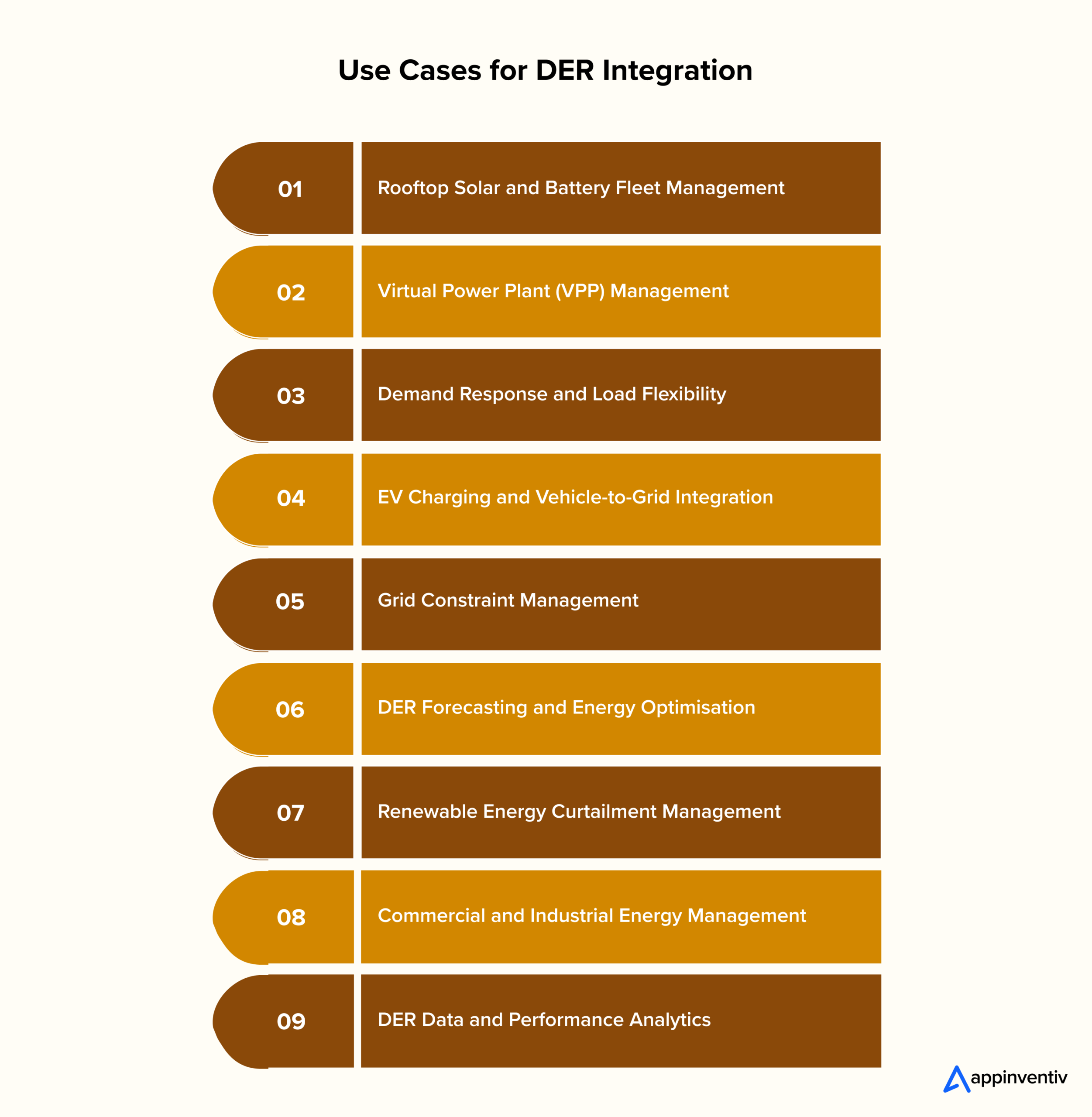
DERM system use cases are expanding as solar, batteries, EVs and flexible loads become more active participants in the electricity system. The strongest business cases typically combine several assets rather than managing one device category in isolation. The software therefore needs to support both individual asset control and portfolio-level optimisation.
Rooftop Solar and Battery Fleet Management
A DERMS can provide central visibility across distributed solar and battery assets. Operators can monitor generation, battery state of charge, availability and operating conditions across a large portfolio. Battery dispatch can then be coordinated around network constraints, customer requirements, energy prices or predefined operating strategies.
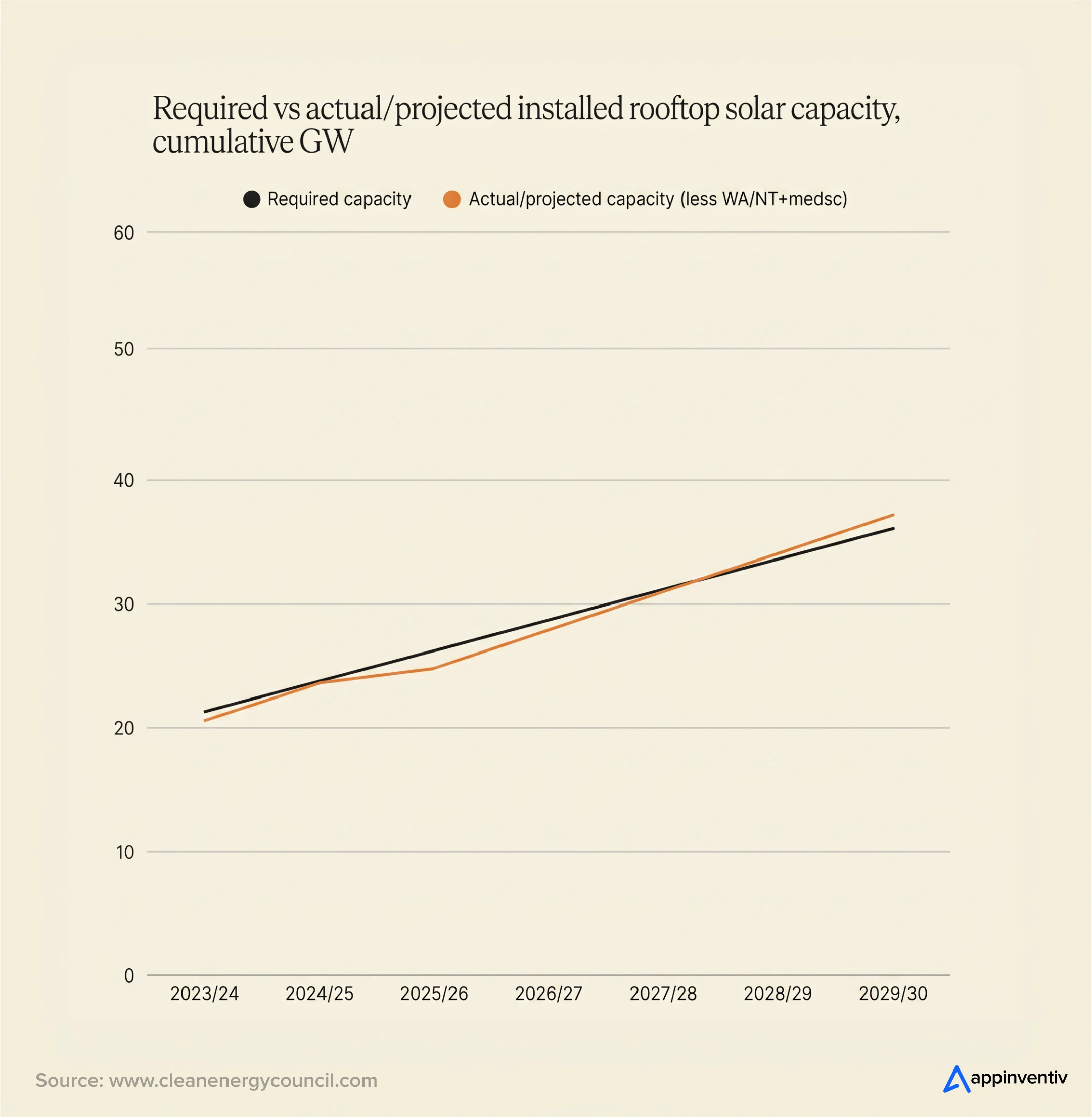
This is increasingly relevant as rooftop solar penetration rises. By June 2030, Australia is expected to have installed 37.2 GW of rooftop solar capacity across the National Electricity Market.
Virtual Power Plant (VPP) Management
VPPs transform passive consumer assets into active market participants. The software groups thousands of residential batteries to act as a single, dispatchable utility-scale power plant. This requires sub-second latency to participate in Frequency Control Ancillary Services. The system calculates available capacity, submits bids to the market operator, and dispatches the hardware when the bid clears.
Demand Response and Load Flexibility
Instead of simply generating more power, modern grids rely on reducing demand. Integration platforms interface with smart thermostats, industrial HVAC systems, and pool pumps. When grid demand peaks, the software automatically scales back these flexible loads. This automated load shedding prevents blackouts and reduces reliance on expensive gas peaking plants.
EV Charging and Vehicle-to-Grid Integration
Electric vehicles represent massive mobile batteries. Software integration ensures EV charging occurs during periods of high renewable generation or low wholesale prices. Vehicle-to-Grid technology takes this further, allowing the software to command the vehicle to discharge power back into the home or the grid during critical peak events.
Grid Constraint Management
Distribution networks face physical thermal limits on their local transformers and powerlines. When too much solar exports simultaneously, localised voltage spikes occur. The software continuously monitors network topology and calculates Dynamic Operating Envelopes. It sends real-time export limits to individual smart inverters, ensuring power flow remains safely within physical hardware limits.
DER Forecasting and Energy Optimisation
Accurate forecasting requires ingesting hyper-local weather data, historical asset performance, and real-time telemetry. The software uses artificial intelligence and machine learning models to predict exactly how much solar a specific suburb will generate over the next five minutes, hour, or day. This foresight allows retailers to hedge their wholesale market exposure accurately.
Renewable Energy Curtailment Management
Australian Energy Market Operator (AEMO) frequently intervenes during low-demand periods by ordering solar curtailment to protect grid stability. Software platforms automate this process. Instead of harsh, binary shut-offs, advanced systems can modulate inverter output smoothly or divert excess solar generation into hot water systems and batteries, minimising financial losses for asset owners.
As AEMO Executive General Manager Policy and Corporate Affairs Violette Mouchaileh noted, “It demonstrates that more wind, solar and battery capacity in the system reduces reliance on higher cost coal and gas generation, placing sustained downward pressure on wholesale electricity prices”.
Commercial and Industrial Energy Management
Large facilities face complex peak demand tariffs. Integration platforms orchestrate commercial solar arrays, heavy machinery, and backup generators. The software limits grid draw during peak pricing windows by spinning up on-site generation or dropping non-essential loads. This “peak shaving” drastically reduces commercial electricity bills.
Australian Regulatory and Grid Considerations for DERMS Implementation
Australian DERM software must comply with AEMO market rules, DNSP connection agreements, and the AS/NZS 4777.2:2020 inverter standard. Systems heavily utilise the CSIP-Aus communication protocol for dynamic operating envelopes, ensuring strict cybersecurity and secure data telemetry across the National Electricity Market.
The AEMO mandates strict visibility over grid edge assets. Any custom energy management software development must natively align with these structural realities.
The Regulatory Baseline (AS/NZS 4777.2:2020)
This standard governs grid-interactive smart inverters. It forces hardware to support software-defined power quality modes, specifically Volt-Var and Volt-Watt response. Software platforms must be capable of verifying that field devices have these safety settings correctly configured and active.
Communication Protocols (CSIP-Aus)
The Common Smart Inverter Profile for Australia acts as the localised version of the IEEE 2030.5 protocol. It forms the critical software bridge allowing distribution networks to send dynamic operating envelopes directly to aggregators or customer inverters. Any enterprise DER platform built for the Australian market must feature native CSIP-Aus server and client capabilities.
AEMO’s DER Register Integration
AEMO requires complete visibility of asset locations and specifications. Software systems need secure API interfaces linking directly to AEMO’s central database. Whenever a new battery or solar array is onboarded by an aggregator, the integration layer must automatically synchronise this data with the national register to maintain grid planning accuracy.
Cybersecurity and Data Sovereignty
Managing physical grid assets elevates cybersecurity to a national security concern. Platforms must implement zero-trust architectures, mutual TLS authentication for all device communications, and strict role-based access controls. Data sovereignty rules often require telemetry and customer data to remain onshore within Australian data centres.
What Are the Core Features of DER Integration Software?
Building an enterprise-grade platform requires a robust set of modular features capable of handling high-velocity data and complex business logic. The table below outlines the essential functional components that transform disparate hardware into a cohesive, controllable, and market-ready energy portfolio.
| Feature Module | Core Functionality |
|---|---|
| DER Asset Registry | Stores exact asset metadata, location, capacity, and current configuration settings. |
| Device Connectivity | Translates distinct hardware protocols (Modbus, DNP3, IEEE 2030.5) into a unified format. |
| Real-Time Telemetry | Collects operational data at sub-minute intervals without latency degradation. |
| Command and Control | Validates and dispatches cryptographically secure control instructions to edge devices. |
| Forecasting Engine | Predicts localised generation, flexible load availability, and market pricing trends using statistical or AI-based models |
| Optimisation Engine | Determines optimal dispatch schedules balancing constraints against maximum commercial yield. |
| Rules Engine | Applies strict operational, physical, and business constraints to prevent unsafe asset dispatch. |
| Event Management | Coordinates rapid fleet responses to frequency drops or market operator interventions. |
| Analytics Dashboard | Provides visual, operational visibility into fleet health and financial performance. |
| API Layer | Connects the platform securely to external market bidding systems and network operators. |
| Identity Management | Controls system access using strict authentication and authorisation protocols. |
| Audit Logging | Tracks every operational command, system configuration change, and administrative action. |
DER Integration Software Architecture
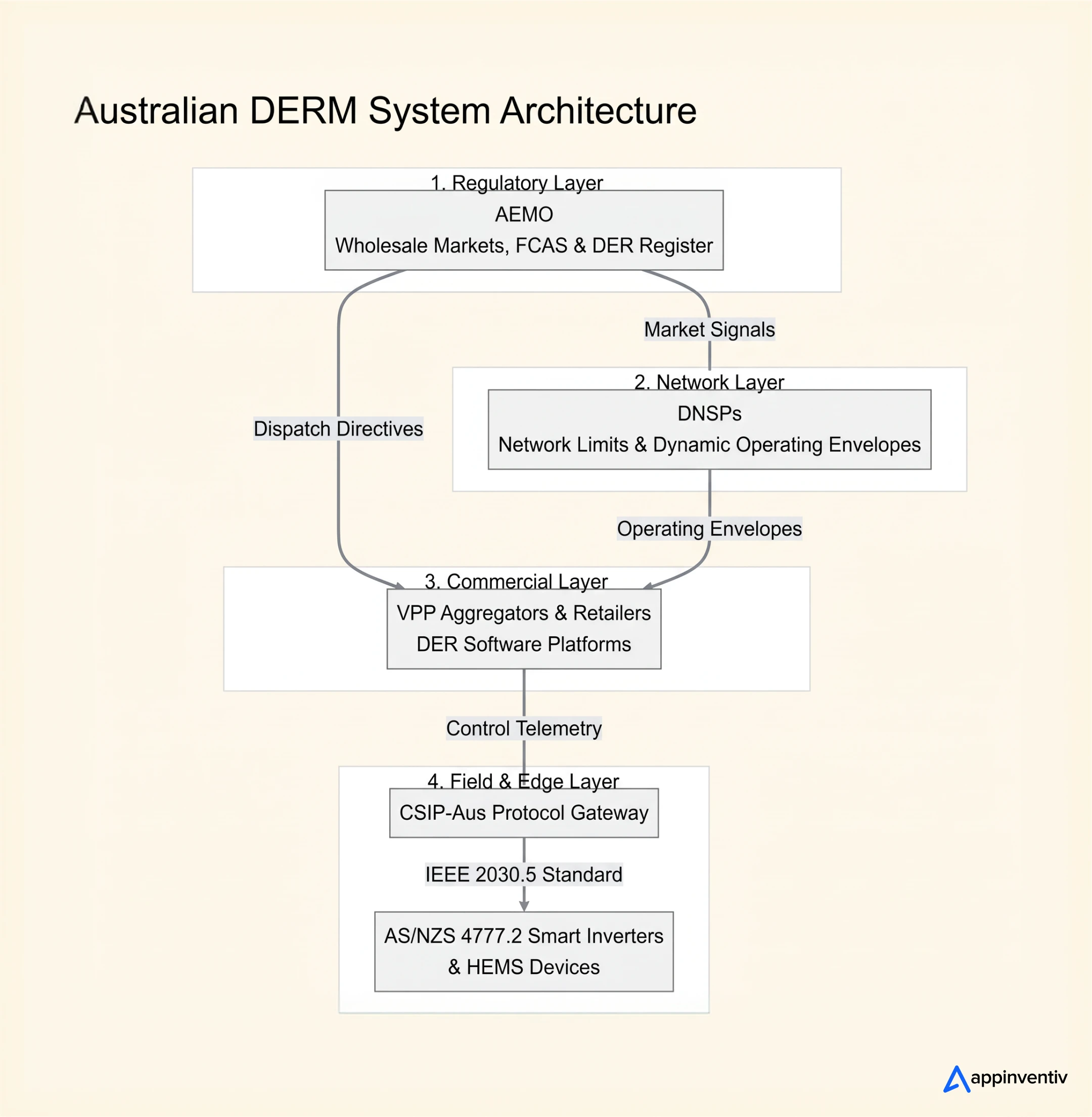
The DER integration software architecture consists of four main tiers: the Regulatory Layer connecting to AEMO, the Network Layer interfacing with DNSPs, the Commercial Layer handling aggregation logic, and the Edge Layer communicating directly with physical inverters and site gateways.
The underlying architecture requires distinct layers to decouple fast-moving edge telemetry from slower commercial settlement systems.
The Regulatory Layer
This tier interfaces directly with AEMO for market registration, compliance reporting, and dispatch instructions. It handles heavy, structured API payloads and ensures the overall fleet remains compliant with national energy rules.
The Network Layer
This layer maintains constant communication with DNSPs. It receives dynamic operating envelopes and localised network constraints. The system must process these external limits immediately, overriding any commercial dispatch plans to ensure the local grid remains stable.
The Commercial Layer
Acting as the platform’s brain, this layer houses the optimisation and rules engines. It takes the market price signals, applies the network constraints, evaluates the physical limits of the battery fleet, and calculates the exact megawatt dispatch required to maximise revenue safely.
The Field and Edge Layer
This layer handles raw physical connectivity. It translates high-level cloud commands into localised protocols that specific inverter brands understand. Edge gateways often run lightweight local logic to ensure safe default behaviour if cloud connectivity drops.
Design a scalable architecture for DER monitoring, optimisation, control, and enterprise integration.
How DER Integration Software Works: End-to-End Data and Control Flow
DER integration works as a continuous loop rather than a one-time command. Telemetry describes the current state of the asset portfolio, AI driven forecasting estimates what may happen next, optimisation selects an operating response, and the control layer dispatches validated instructions. Fresh telemetry then confirms the result and feeds the next decision cycle.
DER asset → Gateway/API → Data ingestion → Validation → Digital twin → Forecasting → Optimisation → Control decision → Device dispatch → Telemetry → Analytics
A Practical Operational Scenario
Consider a sudden drop in wholesale electricity prices during a sunny afternoon in South Australia. The platform ingests the low price signal. Simultaneously, the local DNSP detects a voltage spike on a local feeder and issues a restricted dynamic operating envelope via the CSIP-Aus protocol. The optimisation engine immediately calculates a new dispatch schedule. It commands the flexible EV chargers and batteries on that specific street to begin charging at maximum capacity, soaking up the excess solar.
Commands are securely dispatched to the edge devices. Sub-second telemetry returns to the platform, confirming the batteries are absorbing power. The localised voltage stabilises, AEMO’s requirements are met, and the aggregator capitalises on negative wholesale pricing.
The digital twin is particularly useful here because it provides a software representation of each asset’s current operational state, capabilities and constraints.
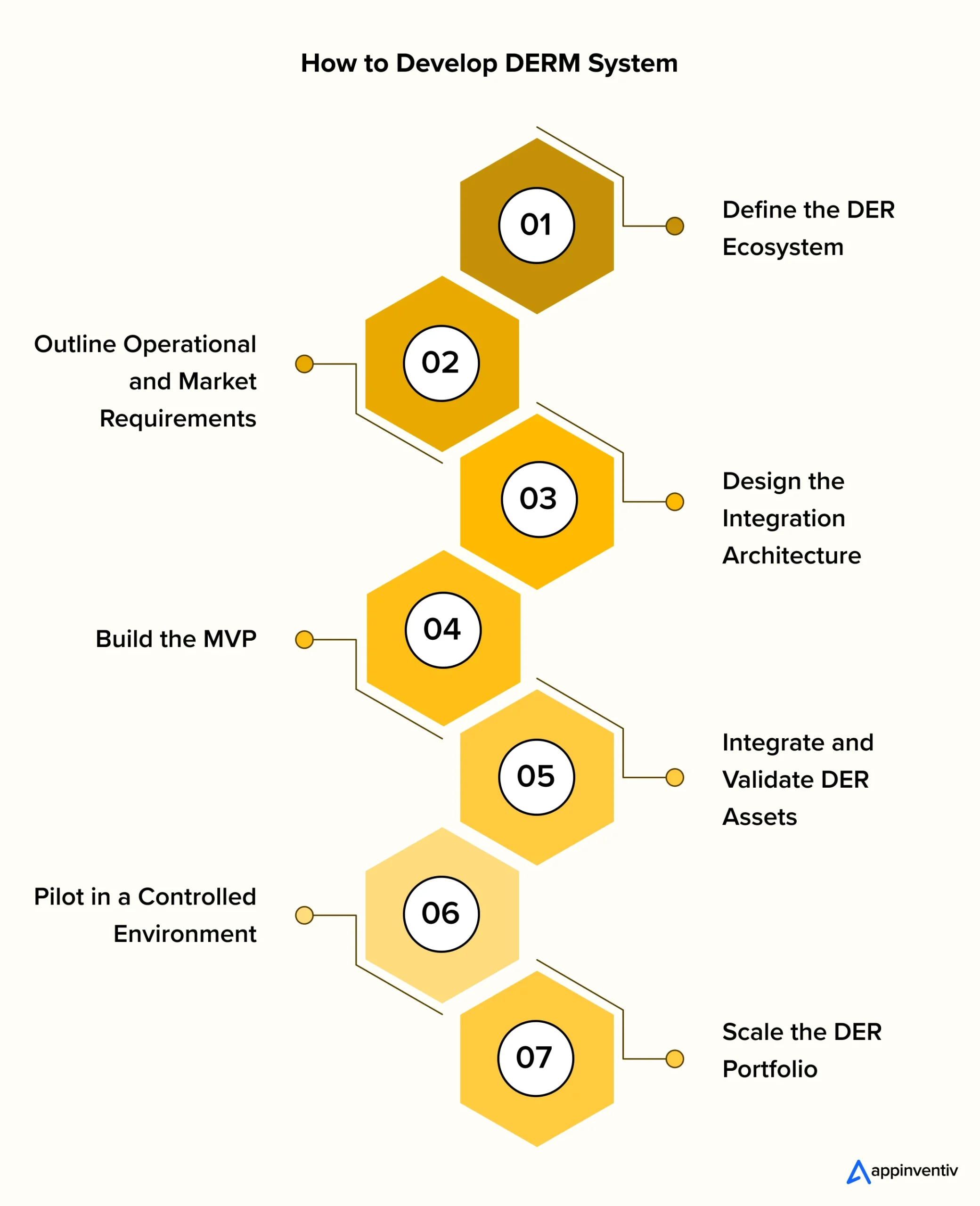
7 Steps of DERM Software Development Process
Building a robust energy management platform requires a disciplined engineering roadmap. Rushing straight into coding leads to brittle systems that fail network compliance audits. This section details the sequential phases necessary to scope, architect, build, and scale a software solution for distributed energy resource management.
Step 1: Define the DER Ecosystem
Determine the exact asset types the platform will govern. A platform managing commercial-scale HVAC systems requires vastly different telemetry cycles than one dispatching thousands of residential batteries. Identify the specific hardware manufacturers and map their proprietary API limitations.
Step 2: Define Operational and Market Requirements
Clarify the commercial intent. Is the primary goal to bid into frequency control markets, or to provide localised network support? Document the necessary compliance frameworks, including AEMO registration parameters and DNSP technical guidelines.
Step 3: Design the Integration Architecture
Map the data flows. Select the appropriate cloud infrastructure providers, define the IoT message brokers (such as MQTT or Kafka), and establish the cybersecurity perimeters. Finalise the database architecture required to handle intense time-series telemetry data without performance degradation.
Step 4: Build the MVP
Develop the MVP with core ingestion engine first. Focus strictly on achieving reliable device connectivity, accurate telemetry translation, and a basic rules engine. Exclude complex financial forecasting modules at this stage to ensure the foundational control loops operate flawlessly.
Step 5: Integrate and Validate DER Assets
Begin connecting physical test assets in a laboratory environment. Validate that the platform accurately interprets fault codes and that hardware responds correctly to dispatch commands under varying simulated network conditions.
Step 6: Pilot in a Controlled Environment
Deploy the system to a small, ring-fenced group of real-world assets. Monitor the latency of commands, verify the accuracy of the forecasting algorithms against actual weather conditions, and ensure the system recovers gracefully from simulated internet outages.
Step 7: Scale the DER Portfolio
Once stability is proven, execute the full rollout. Integrate advanced machine learning optimisation modules, expand the API connections to external market settlement systems, and automate the onboarding process to handle high volumes of new customer installations.
How to Address the Major Challenges in Implementing DER Software?
Implementing DER integration platforms involves challenges like managing diverse hardware protocols, ensuring low-latency communication during grid events, and handling massive time-series data volumes. Engineering teams mitigate these by using protocol translation layers, edge computing for localised control, and robust cloud IoT infrastructure.
| DER Integration challenges | Technical Software Response |
|---|---|
| Hardware Interoperability | Inverters speak different languages. Engineering teams must build modular protocol adapters that translate proprietary APIs, Modbus, and IEEE 2030.5 into a unified common data model. |
| Network Latency and Disconnection | Cloud dependency risks grid stability. Implement edge computing gateways that store default operating envelopes locally, ensuring assets fail safely if internet connectivity drops. |
| Massive Time-Series Data Volumes | Relational databases choke on telemetry. Utilise specialised time-series databases designed specifically for high-velocity IoT data ingestion and rapid historical querying. |
| Strict Security and Audit Mandates | The threat of malicious grid manipulation is severe. Enforce mutual TLS for all device connections, implement hardware root-of-trust, and maintain immutable audit logs for every dispatch command. |
Define your MVP, integration priorities and delivery roadmap before committing development resources.

How Much Does DER Integration Software Cost in Australia?
DER integration software development costs can range from AUD 70,000 for a focused monitoring platform to AUD 700,000 for a large DERMS or VPP-grade system. The major cost drivers are asset volume, protocol diversity, control complexity, integrations, cybersecurity, forecasting, optimisation and testing.
The figures below are indicative software implementation ranges, not fixed Australian market prices. The final cost depends heavily on asset count, protocol translation complexity, algorithmic control requirements, market API integrations, and whether the organisation requires a bespoke platform or is building on top of existing headless infrastructure.
| Project Scope / Platform Capability | Indicative Engineering Cost | Primary Cost Drivers |
|---|---|---|
| Basic DER monitoring and integration | AUD 70,000 – 150,000 | Telemetry ingestion, basic dashboarding, limited hardware vendor APIs. |
| Multi-device DER integration platform | AUD 150,000 – 300,000 | Protocol translation, basic rule engines, automated alerting. |
| Advanced DER optimisation platform | AUD 300,000 – 500,000+ | Predictive forecasting, dynamic constraint management, complex business logic. |
| Enterprise DERMS / VPP-grade platform | AUD 500,000 – 700,000+ | Sub-second dispatch latency, market bidding APIs, rigorous cybersecurity audits. |
Hidden Costs: Organisations frequently underestimate the costs associated with grid compliance. Navigating the stringent testing phases for AEMO’s VPP demonstrations requires dedicated engineering support. Securing formal CSIP-Aus certification demands rigorous third-party auditing. Additionally, maintaining API integrations as hardware manufacturers update their proprietary firmware requires an ongoing operational expenditure budget.
How Appinventiv Approaches Custom DER Integration Software Development and Implementation
Appinventiv, as a leading Custom Energy Management Software Development Company, understands Australian grids require engineering precision, not generic software templates. Accordingly, we approach DER integration by aligning cloud-native event streaming with strict Australian network standards, ensuring data sovereignty, sub-second dispatch capabilities, and board-level risk management from initial architectural framing through to production scaling.
We treat distributed energy management as a mission-critical utility system rather than a generic IoT application. Every delivery engagement is structured around your operational realities, asset ecosystem, and regulatory posture within the National Electricity Market. Our energy practice also focuses on connecting operational technology such as SCADA and EMS with enterprise applications and cloud platforms.
Rather than applying off-the-shelf wrappers, our team of 1700+ tech experts focuses on building low-latency, highly secure platforms that provide utility operators and aggregators with total control over their edge fleets. By modernising legacy systems and building bespoke integration layers, we routinely deliver up to 35% efficiency gains in Australian enterprises.
In a recent engagement with a regional Australian energy aggregator managing over 18,000 mixed-vendor residential inverters and battery systems, we architected an event-driven CSIP-Aus telemetry and control gateway. By replacing fragile point-to-point connections with an isolated microservices layer, the platform brought end-to-end command dispatch latency down to under 800 milliseconds while maintaining compliance with local network dynamic operating envelopes.
This transition eliminated automated curtailment penalties and drove a 33% improvement in operational dispatch efficiency across their virtual power plant portfolio.
Our enterprise execution model for Australian DER programmes spans:
- Custom DER integration platform development and CSIP-Aus protocol bridges
- Real-time time-series telemetry and cloud-native event streaming architectures
- AI-driven forecasting and automated constraint mapping engines
- Zero-trust security architecture, identity management, and AEMO compliance logging
- Post-launch operational scaling and continuous platform maintenance
Supported by ISO 27001, ISO 9001, and SOC 2 certifications alongside a 99.50% security compliance SLA, our teams ensure that every asset onboarding flow, API boundary, and control loop remains audit-ready.
The cost of inaction is steep. Utilities and aggregators that fail to implement dynamic DER control face severe grid instability, elevated network expenditure, and missed commercial arbitrage in wholesale energy markets.
The immediate tactical step is typically conducting a telemetry and constraint assessment. Mapping your asset locations, communication protocols, and high-priority grid use cases provides the foundation for an enterprise-grade architecture.
Ready to build a distributed energy resource management system or VPP platform? Work with our engineering team across integration architecture, cloud, data, optimisation, and DERM systems.
FAQs
Q. How long does it take to build a DERMS in Australia?
A. A typical DERMS implementation can take 4–12+ months, depending on system complexity, integrations, DER assets, grid requirements, data architecture and testing needs. Smaller deployments may take less time, while utility-scale implementations with multiple integrations and advanced optimisation can take longer.
Q. How is AI used in DERMS?
A. AI in DERMS is primarily used for renewable generation forecasting, load prediction, anomaly detection, predictive maintenance and optimisation support. AI models can process telemetry, weather, historical generation and consumption data to improve forecasts. The resulting insights can feed DERMS optimisation workflows, while deterministic rules continue to govern operational limits, authorised commands and safety requirements.
Q. What is distributed energy resources integration process?
A. The distributed energy resources integration process involves standardising diverse hardware protocols, establishing secure cloud connectivity, and mapping edge device capabilities into a central software platform. It progresses from initial API connections and digital twin validation to executing controlled dispatch pilots, ensuring assets respond safely to network constraints.
Q. What are the types of distributed energy resources?
A. Types of distributed energy resources examples include residential rooftop solar PV systems, behind-the-meter battery storage, electric vehicle chargers acting as flexible loads, smart thermostats, and commercial-scale HVAC systems. When aggregated via sophisticated software, these assets can collectively balance grid demand and participate in wholesale markets.
Q. What determines DER integration software development cost?
A. The DER integration software development cost is determined by the volume of different hardware protocols required, the latency requirements for market bidding, the complexity of the optimisation engine, and the rigorous cybersecurity hardening required to meet Australian grid security mandates. Costs typically scale with operational complexity rather than just user count.


Fast 2-minute response, fully NDA-protected.

The Ultimate Guide to CRM for Insurance: Features, Cost, Top Platforms, Integration & More
Key takeaways: CRM for insurance connects sales, service, and claims into one governed system, distinct from the policy administration system. Core features span pipeline management, policy visibility, claims tracking, commission management, AI analytics, and compliance controls. Cost ranges from roughly USD 15,000 for configuration to USD 150,000 and beyond for custom development at enterprise scale.…

How to Choose a Technology Partner for Government Software Development
Key takeaways: Evaluate the partner across five layers: procurement eligibility, assurance, engineering, delivery and long-term ownership. Choose a government technology partner on evidence, governance and delivery depth, not development capability alone. Match partner evaluation criteria to the security, integration and operational risks of the programme. Treat data sovereignty, privacy, accessibility and security as architecture decisions…

Custom CRM Development Cost in 2026: Complete Guide to Pricing, Features, and TCO
Key Takeaways Building custom CRMs costs $40,000 to $500,000+, while enterprise complexity, security, integrations, and AI push overall budgets higher. Calculating three-year TCO reveals hidden costs beyond initial coding, including hosting, maintenance, upgrades, and subscriptions. A seven-factor risk calculator identifies scope creep, migration obstacles, external connections, regulatory compliance, mobile access, and billing risks. Itemized feature…