






























AI Governance in Healthcare: Framework, Development Process, Costs & ROI

 Share -



- 01AI Governance in Healthcare Framework Development
- 02AI Risk Management in Healthcare
- 03Integrating Governance Across the Healthcare AI Development Lifecycle
- 04Healthcare AI Governance Technology Architecture
- 05AI Data Governance in Healthcare: Challenges and Controls
- 06Healthcare Generative AI Governance: Key Risks and Controls
- 07Patient Safety and Clinical AI Oversight
- 08AI Regulations in Healthcare: Global Compliance Landscape
- 09Healthcare AI Governance Implementation Roadmap
- 10Healthcare AI Governance Costs and ROI
- 11Healthcare AI Governance Software: Build, Buy, or Hybrid?
- 12Future of AI Governance in Healthcare
- 13How Appinventiv Can Help Build AI Governance Solutions for Healthcare
- 14FAQs

Key takeaways:
- Only 29% of surveyed health systems enforce inventory tracking, data lineage, and sign-off policies, revealing a governance maturity gap.
- Regulatory registries recorded 1,430 artificial intelligence medical devices authorized through 2025, with 331 clearances granted during 2025 alone.
- Risk-tiered governance matches oversight directly to clinical impact, software autonomy, data sensitivity, model risks, and vendor exposure.
- Custom healthcare governance software costs between $40,000 and $500,000, depending on system integrations, security and monitoring, and scale.
- Structural oversight connects software engineering, data privacy, clinical validation, production telemetry, regulatory compliance, and financial return.
Large health systems run predictive models, ambient documentation tools, and generative algorithms across daily operations. An AMA survey found that 81% of physicians reported using AI professionally in 2026. Widespread adoption shifts your risk profile. Software errors in administrative tools waste staff time, but mistakes in clinical programs directly harm patients and expose private medical records.
Strong AI governance in healthcare is embedded throughout the software lifecycle, not only after deployment. Your teams must manage risk across project selection, data preparation, clinical validation, and continuous post-launch monitoring. The NIST AI Risk Management Framework mirrors this structure through its Govern, Map, Measure, and Manage functions.
This executive article outlines technical architecture, regulatory requirements, software costs, and financial returns. AI governance for healthcare lets leaders control operational risk without slowing technological progress.
Build clear ownership, risk tiers, audit trails, and deployment controls before governance gaps slow or expose your AI portfolio.
AI Governance in Healthcare Framework Development
An executive AI governance framework in healthcare defines how enterprises select, develop, approve, and manage AI. It connects business goals with patient safety, data security, clinical oversight, and regulatory requirements. Yet a 2025 hospital survey found that only 29% had policies in place covering AI inventory, lineage, and sign-offs.
An effective AI governance framework for healthcare assigns a defined owner, risk tier, approval path, and monitoring plan to every AI system. It should cover internal models, vendor platforms, and AI embedded in enterprise software.
Step 1: Define Governance Scope, Objectives, and Risk Appetite
Set the scope across clinical, administrative, financial, and patient-facing AI. Define approved, restricted, and prohibited uses. Set risk tolerance, ethical boundaries, regulatory requirements, and measurable outcomes. Business goals can include shorter processing times, fewer manual errors, and more efficient use of resources. Clinical goals can focus on patient safety, decision support, and quality of care. These targets give governance teams a clear basis for evaluating AI investments.
Step 2: Establish an Integrated Healthcare AI Governance Model
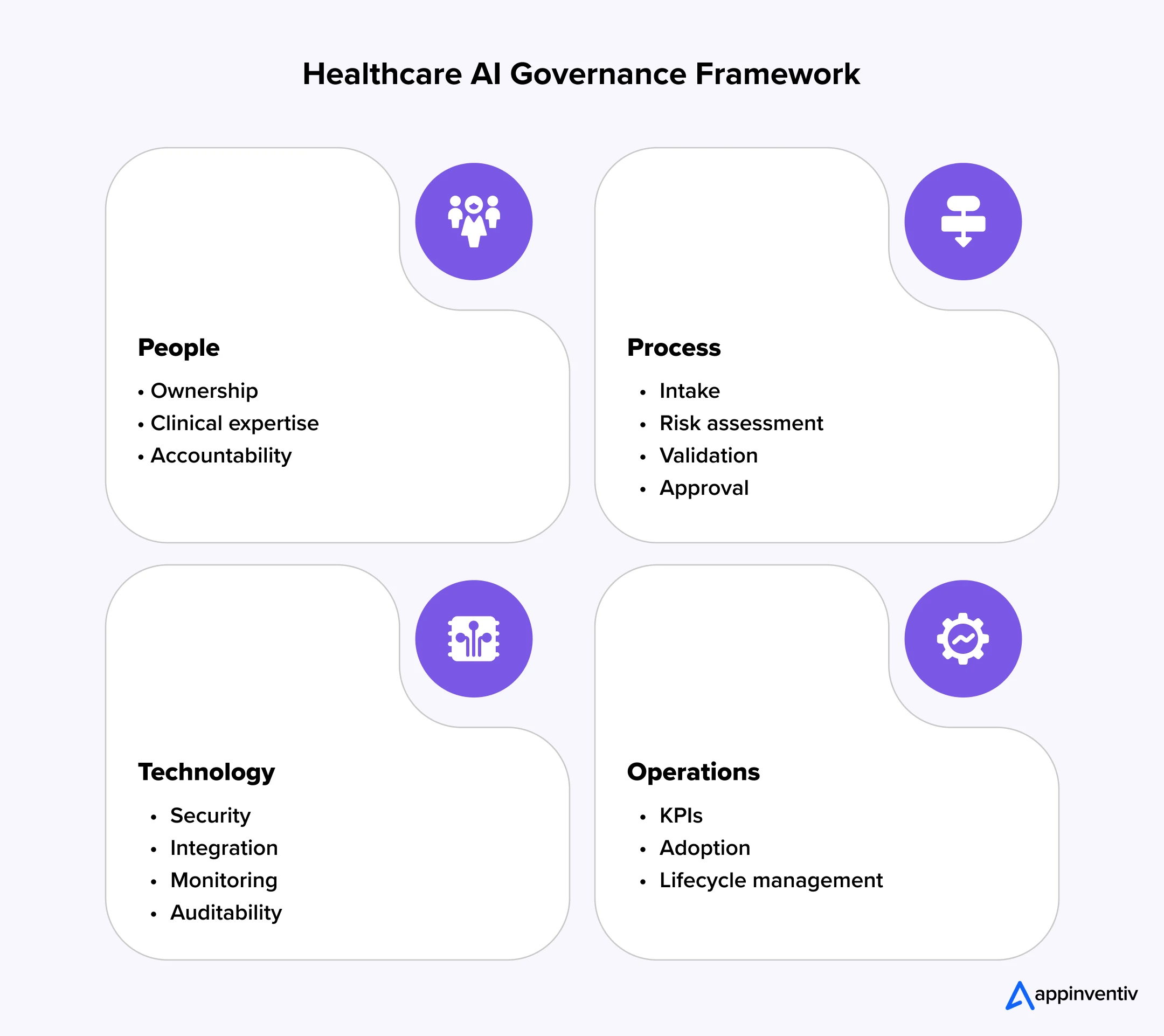
An AI governance model for healthcare should integrate people, processes, technology, and operations into a single enterprise structure. Clinical leaders, data teams, security, privacy, legal, compliance, technology, and business owners need defined responsibilities. This creates healthcare integrated governance across the AI portfolio. The model should also define how teams handle intake, risk assessment, validation, deployment, monitoring, incidents, and system retirement.
Step 3: Assign Executive Accountability and Decision Rights
Define who approves, monitors, changes, and can suspend each AI system. Board and C-suite leaders set enterprise risk direction. Clinical leaders oversee patient-facing use cases. Technology, security, privacy, legal, and business owners manage their assigned controls.
Decision rights should clearly cover:
Approval → Deployment → Incident response → Model changes → Shutdown
Clear ownership reduces delays during high-risk decisions and safety incidents.
Step 4: Create a Living Enterprise AI Inventory
Maintain a current inventory of internal models, vendor products, and AI features embedded in enterprise platforms. Each record should capture the system purpose, business and clinical owners, model or provider, data sources, risk tier, regulatory requirements, deployment status, monitoring needs, and review dates. The inventory should include shadow AI and unapproved public AI tools. It becomes the reference point for risk reporting, audit records, and lifecycle management.
Step 5: Standardize AI Intake, Assessment, and Approval
Use one evaluation path for internal projects and third-party purchases:
Submit → Screen → Classify → Assess → Validate → Approve → Deploy
Capture the intended use, users, data sources, model type, expected value, and initial risk during intake. The assigned risk tier then determines the required validation, approval, human oversight, and monitoring.
Step 6: Define the Healthcare AI Governance Policy and Control Structure
A healthcare AI governance policy should define ownership, required checks, approval authority, review cycles, and exception handling. Core control areas should cover AI use, privacy and data, clinical safety, security, third-party AI, lifecycle management, incident response, and change management.
These controls should connect directly to engineering workflows. Developers apply AI guardrails during data handling, model development, and deployment. Clinical teams review safety evidence. Operations teams monitor production signals and act when defined thresholds are breached.
A mature healthcare AI governance model turns policy into an active control layer across the AI lifecycle.
Also Read: How to Build an Agentic AI Governance Framework for Autonomous AI Systems
AI Risk Management in Healthcare
Healthcare AI risk management should classify each AI use case by its potential impact. The classification should consider clinical harm, autonomy, data sensitivity, model behavior, and third-party exposure. FDA records show that over 1,400 AI/ML-enabled medical software devices had been authorized through December 2025, including 331 in 2025 alone. Higher-risk systems need stronger validation and tighter oversight. Lower-risk systems can follow lighter controls. This keeps governance proportional without sending every AI application through the same review process.
Build a Risk-Tiered Healthcare AI Model
The following tiers show how different healthcare AI use cases require different levels of governance.
| Risk Level | Representative Uses | Governance Intensity |
|---|---|---|
| High | Diagnosis, treatment recommendations, patient-facing clinical decisions | Highest |
| Moderate | Documentation, coding, workflow support | Medium |
| Lower | Administrative and internal productivity use cases | Proportionate |
The risk tier should determine the depth of validation, approval, human oversight, monitoring, and reassessment. A system can move into a higher tier after a new clinical use, broader data access, greater automation, or a major model change.
Assess AI Risk Across Five Dimensions
These five dimensions provide a practical basis for comparing risk across different AI use cases.
| Risk Dimension | What To Assess |
|---|---|
| Clinical Impact | Potential patient harm, clinical context, reversibility |
| Autonomy | Automated actions, human review, override capability |
| Data Risk | PHI exposure, access, retention, transfer |
| Model Risk | Performance, bias, robustness, explainability, drift |
| Third-Party Risk | Vendor dependency, provenance, subprocessors, model updates |
This assessment should happen during AI intake and again after material changes. A documentation tool and a treatment recommendation system may use similar AI technology, but their risk profiles are very different.
Apply Risk-Based Guardrails
The risk tier then determines how much oversight and control each AI system requires.
| Control | High risk | Moderate risk | Lower risk |
|---|---|---|---|
| Validation | Clinical and technical | Technical and workflow | Standard testing |
| Approval | Clinical and executive | Governance review | Standard approval |
| Human Oversight | Mandatory | Defined use cases | Limited |
| Monitoring | Continuous or high frequency | Scheduled | Periodic |
| Reassessment | Frequent or event-driven | Scheduled or event-driven | Periodic |
High-risk systems need clear go-live criteria, stop conditions, and escalation paths. Moderate-risk systems need defined review cycles. Lower-risk systems still need basic access, logging, and performance controls.
This model gives governance teams a practical rule: the greater the potential harm, the stronger the required controls.
Integrating Governance Across the Healthcare AI Development Lifecycle
Healthcare AI governance should follow the system from initial use-case review to retirement. Each stage needs a defined governance checkpoint. The depth of review should match the system’s risk tier, data sensitivity, and clinical impact. This keeps governance connected to development without repeating the detailed controls covered in later sections.
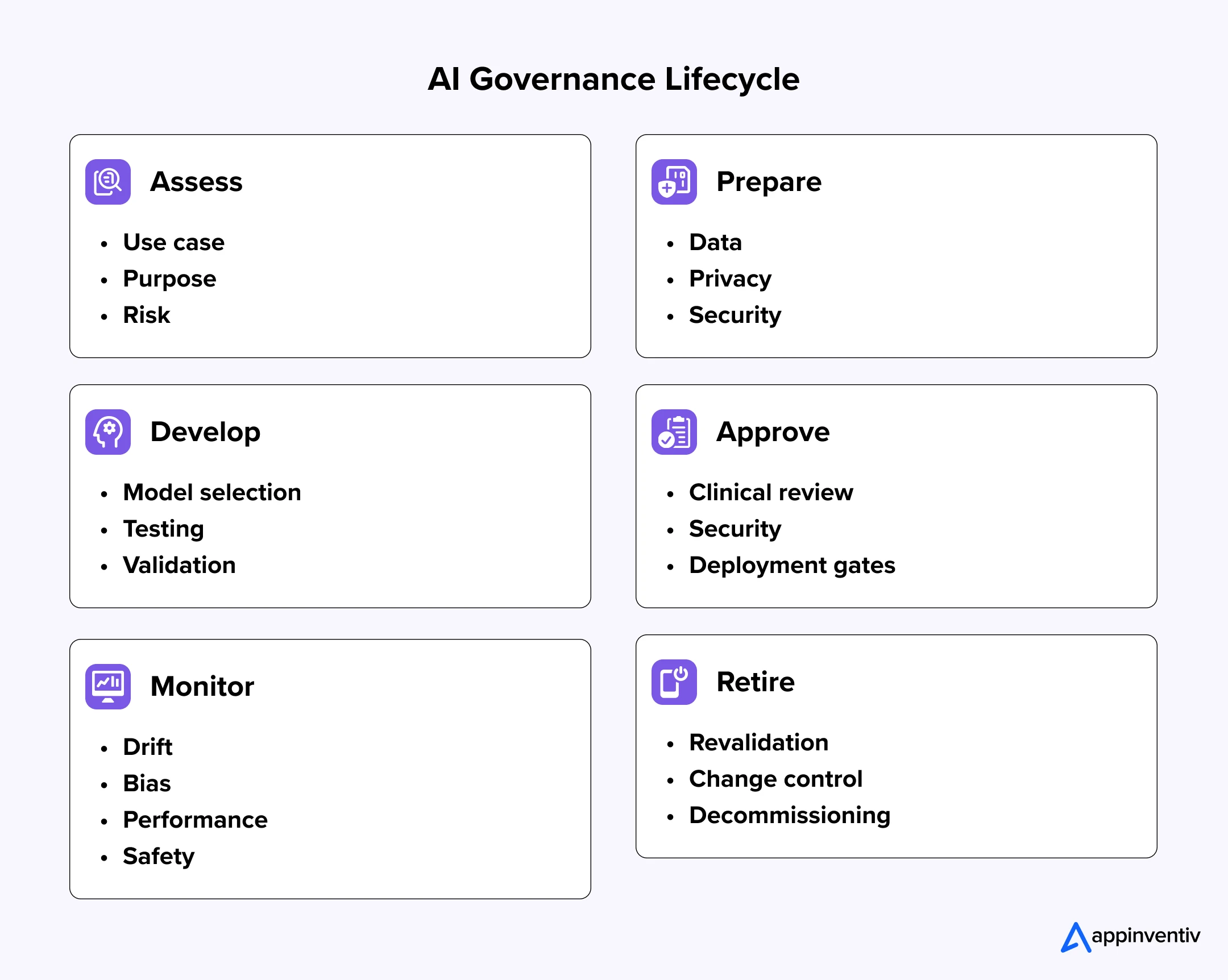
Use-Case Assessment and Requirements Definition
The first checkpoint defines what the AI system is allowed to do. You should document the intended purpose and users, clinical or business outcomes, required data, prohibited uses, initial risk classification, and success criteria. A clear purpose prevents scope from expanding during development. It also gives validation teams a fixed target for testing.
Data Readiness, Privacy, and Security Checks
Data should pass basic governance checks before it enters the development pipeline. Teams need to confirm data quality, representativeness, provenance, lineage, access rights, and privacy requirements. The review should identify PHI exposure and any restrictions on storage, transfer, or secondary use.
It should cover structured records and unstructured content such as clinical notes. Detailed data governance is covered in the next part of the article. Here, the focus is simple: do not build with data that has not passed the required governance checks.
Model Selection and Development Controls
Governance requirements change with the AI architecture. Custom ML models need controls for training data, reproducibility, model versions, and evaluation records. Foundation models require review of provider terms, model provenance, and data handling. Fine-tuned models need traceability for training datasets and model versions.
RAG systems introduce governance requirements for retrieval sources, permissions, and source freshness. Third-party APIs and embedded AI features require clear records of data flows, vendor responsibilities, and model updates. The selected architecture should be recorded against the approved use case and risk tier.
Bias, Performance, and Clinical Validation
Validation should test more than technical accuracy. It should show that the system performs safely for its intended users and patient population.
The core sequence is:
Performance testing → Fairness testing → Robustness testing → Local validation → Clinical workflow validation
Local validation matters for large healthcare enterprises. A model can perform well in its original test environment and behave differently when applied to another organization’s data, workflows, or patient population.
High-risk clinical systems need stronger evidence before approval.
Pre-Deployment Governance Gates
Before production, the system should pass defined release gates.
| Gate | Required check |
|---|---|
| Security | Access, APIs, infrastructure, threat controls |
| Privacy | PHI handling, retention, processing |
| Clinical | Safety and workflow fit |
| Risk | Risk tier and required controls |
| Operations | Human override, rollback, incident readiness |
Each gate should have clear acceptance criteria and documented evidence. High-risk systems need deeper review and stronger approval requirements.
Production Monitoring and Revalidation
Deployment does not end governance. The system now operates against live data and real workflows. Post-deployment review should watch for model drift, data drift, performance changes, bias changes, adverse events, and user feedback.
The monitoring depth should match the AI risk tier. A high-risk clinical system needs closer oversight than a low-risk administrative tool. Detailed monitoring methods and governance metrics are covered later in the article.
Model Change Management and Retirement
AI systems change through retraining, configuration updates, new data, vendor releases, and workflow changes. Material changes should trigger a new governance review.
The basic control path is:
Material change → Risk review → Revalidation → Approval → Release
Version control should preserve the approved model, configuration, evaluation results, and release history.
Retirement needs governance too. Teams should restrict access, remove integrations, address retained data, archive required records, and document the reason for decommissioning. This creates a continuous governance record from the first use-case decision through production and final retirement.
Healthcare AI Governance Technology Architecture
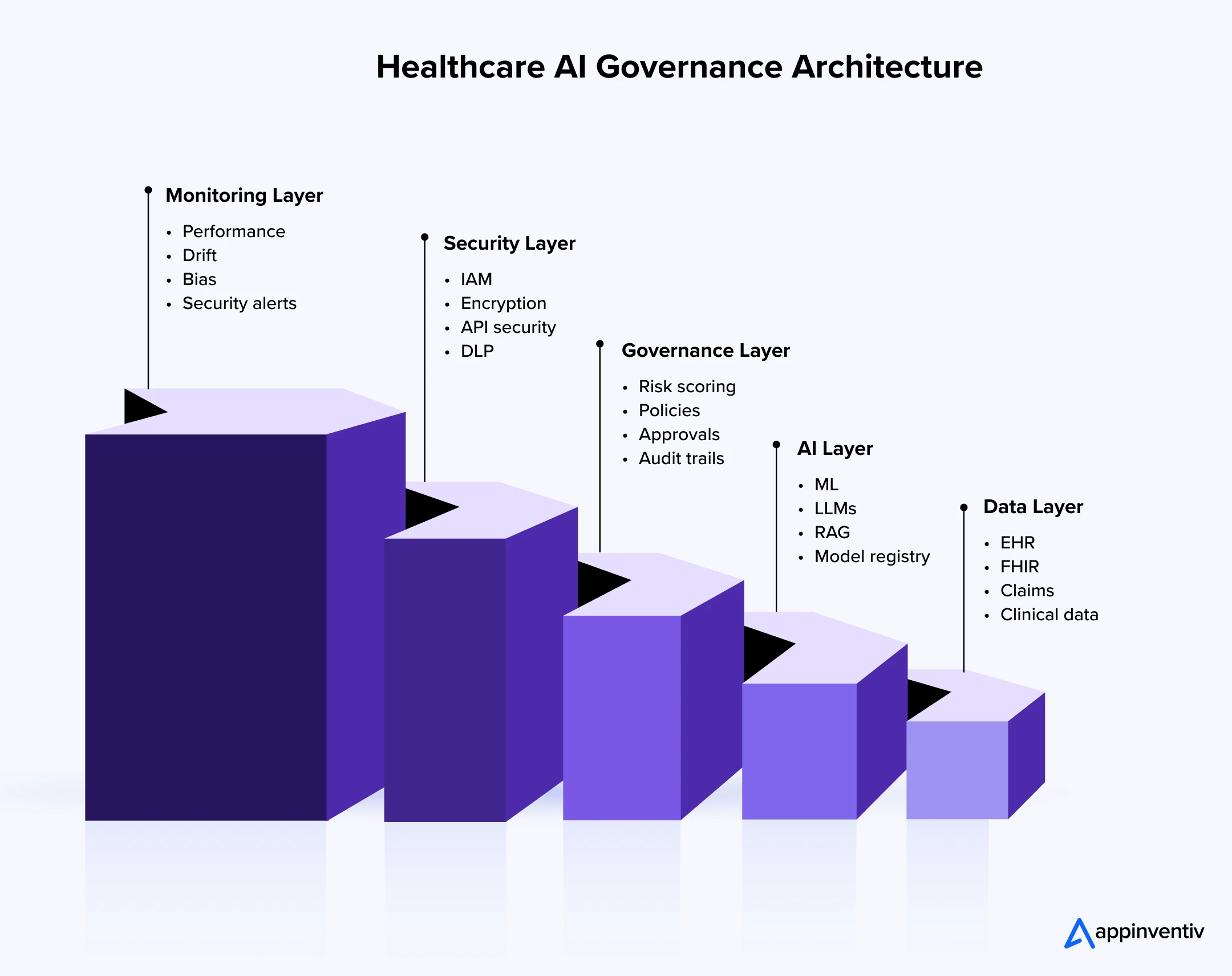
Healthcare AI governance needs an architecture that connects data, models, applications, security, and monitoring. The key requirement, one AI governance consulting services team emphasizes, is traceability.
Only 22% of surveyed hospitals said they were highly confident they could produce a complete AI audit trail within 30 days. Teams should be able to follow data from its source through model processing, output delivery, user access, and audit records.
Healthcare Data and Integration Layer
The data layer connects governance controls to healthcare systems and external sources. Complex EHR integrations & ecosystem design connect clinical records, medications, diagnoses, and orders with governance workflows. FHIR APIs support controlled access to standardized healthcare data.
Claims, laboratory results, imaging, and clinical notes provide financial, diagnostic, and unstructured information. Cloud data warehouses and lakes support analytics and model development. External datasets can add research or population data. The architecture should maintain data lineage, provenance, and access controls across these sources.
AI and Model Layer
Enterprises may run predictive ML, LLMs, foundation models, fine-tuned models, and RAG systems. A model registry should track model versions, owners, validation results, deployment status, and approved use cases. Each model should link to its data sources, risk tier, and validation evidence.
Governance and Control Layer
This layer applies governance rules across AI systems. Core capabilities include AI-driven inventory and risk scoring, policy enforcement and approval workflows, role-based access controls, audit trails, consent controls, and incident management. These controls give governance teams visibility into who approved a system, which data it uses, and what changes occurred after deployment.
Security Architecture
Security should cover the AI application, infrastructure, data, and model layers. Key controls include identity and access management and RBAC, encryption, network segmentation, API security, secrets management, data loss prevention, model access controls, and security logging. API and credential controls become especially important when healthcare AI connects with EHRs or external model providers.
Monitoring and Observability Layer
Production monitoring should collect signals from models, data pipelines, applications, and infrastructure. Track model performance, data and concept drift, bias indicators, usage anomalies, security events, and governance alerts.
These signals should connect back to the AI inventory and risk tier. That allows teams to identify systems that need review, intervention, or revalidation.
AI Data Governance in Healthcare: Challenges and Controls
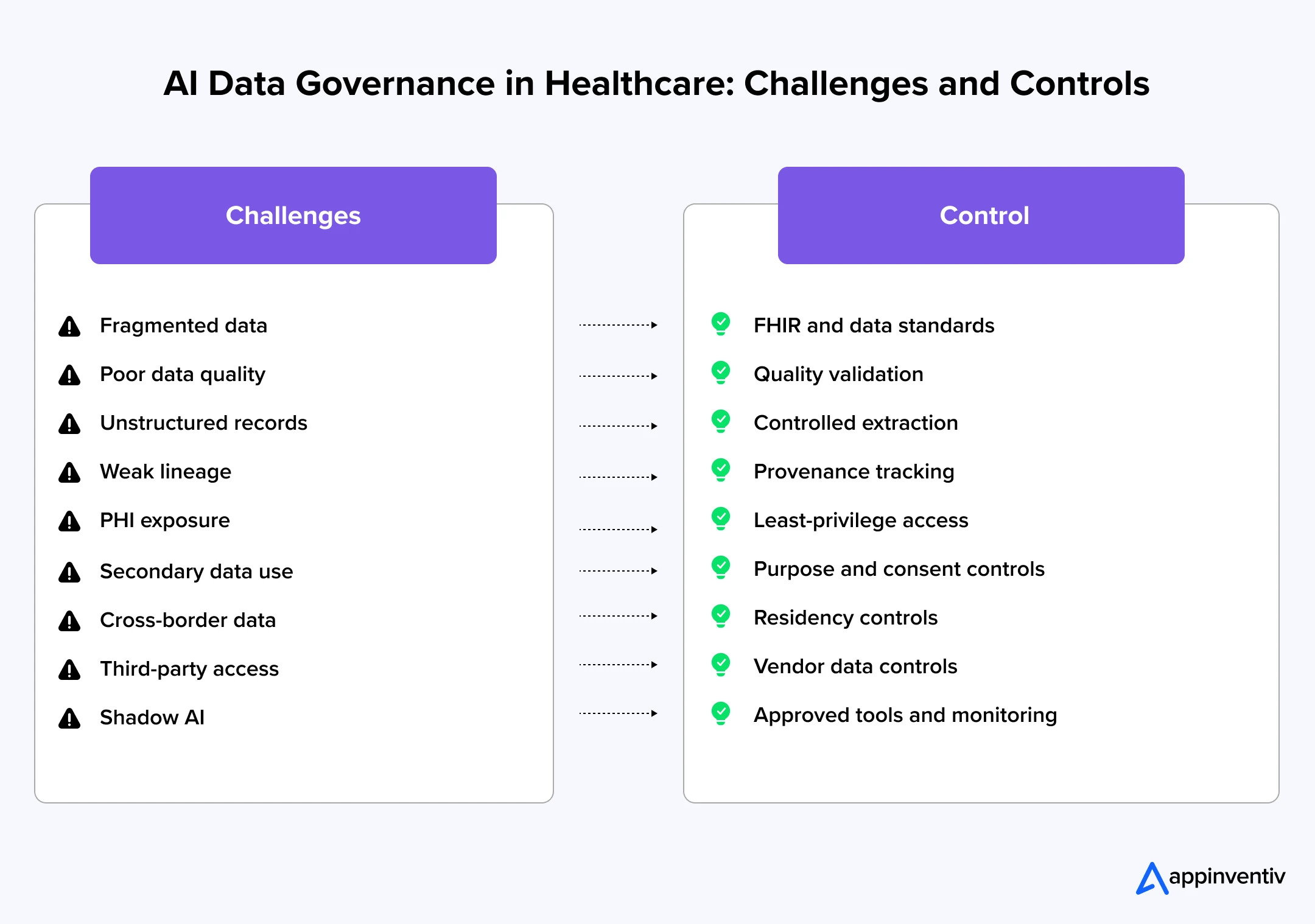
Data governance tracks data quality, access rights, origin, permitted uses, and system transfers throughout the software lifecycle. Weak oversight degrades algorithmic reliability and exposes sensitive medical information to unauthorized eyes. Explicit controls strengthen healthcare data security across connected databases, clinical repositories, and analytical platforms.
| Challenge | Control |
|---|---|
| Fragmented Healthcare Data | Connect EHRs, claims, labs, imaging, and clinical records through standardized interfaces such as FHIR. Define authoritative sources and consistent patient identifiers. |
| Poor Data Quality and Representation | Set thresholds for completeness, accuracy, timeliness, and demographic coverage. Validate datasets against the intended patient population and care setting. |
| PHI Access and Retention | Apply least-privilege access, encryption, minimization, retention rules, and approved de-identification methods. These controls also support teams that build a HIPAA-compliant app. |
| Weak Lineage and Provenance | Track data sources, transformations, timestamps, model inputs, and destinations. Link datasets to specific model versions and validation records. |
| Uncontrolled External Data Use | Review third-party AI providers, subprocessors, data retention, model training terms, and cross-border transfers before approval. |
| Shadow AI and Secondary Data Use | Maintain an approved AI inventory, enforce data-use policies, and restrict sensitive information from unapproved tools and workflows. |
These controls should operate across the full AI lifecycle. They give healthcare enterprises visibility into what data an AI system uses, who can access it, where it moves, and how it is governed.
Also Read: Navigating the AI Challenges in Healthcare – Insights and Success Strategies for Enterprises
Mapping Data Challenges to Governance Controls
| Challenge | Key Control | Governance Outcome |
|---|---|---|
| Fragmented Data | Standards and source-of-truth rules | Consistent inputs |
| Poor Data Quality | Validation thresholds | Reliable datasets |
| PHI Exposure | Least privilege and minimization | Lower privacy risk |
| Weak Lineage | Provenance tracking | Auditability |
| Third-Party Access | Vendor data controls | Controlled exposure |
| Shadow AI | Approved tools and monitoring | Visibility and control |
Control sensitive data flows before AI adoption expands exposure across EHRs, vendors, models, and enterprise applications.
Healthcare Generative AI Governance: Key Risks and Controls
Generative AI in healthcare draft notes, answer medical queries, and run API workflows. Executive governance enforces boundary controls across user inputs, outputs, retrieval systems, and agent actions.
Control LLM Access to PHI
Restrict models to the minimum patient data required for the approved task. Apply role-based access, encryption, data minimization, and approved processing environments. Keep PHI out of public models that lack suitable privacy and contractual controls.
Govern Prompts, Outputs, and RAG Sources
Screen prompts for sensitive data before processing. Validate generated content against trusted clinical sources for high-risk use cases. RAG systems should enforce document permissions, source approval, freshness checks, and traceable citations.
Protect Against Prompt Injection and Data Exfiltration
Use input filtering, instruction isolation, output inspection, and strict tool permissions. Limit agent access to only the systems and data required for its approved function.
Manage LLM, Foundation Model, and Agent Risk
Review providers for data retention, training use, subprocessors, model updates, security controls, and geographic processing. AI agents need action limits, approval checkpoints, and human review for high-impact activities such as updating records or triggering clinical workflows.
Maintain Human Oversight and Audit Trails
Clinical GenAI should support professional judgment rather than replace it. Define override points, escalation paths, and limits on autonomous actions. Log user identity, model version, relevant prompts, retrieved sources, tool calls, outputs, approvals, and overrides for audit and incident review.
Also Read: AI Chatbot in Healthcare
Patient Safety and Clinical AI Oversight
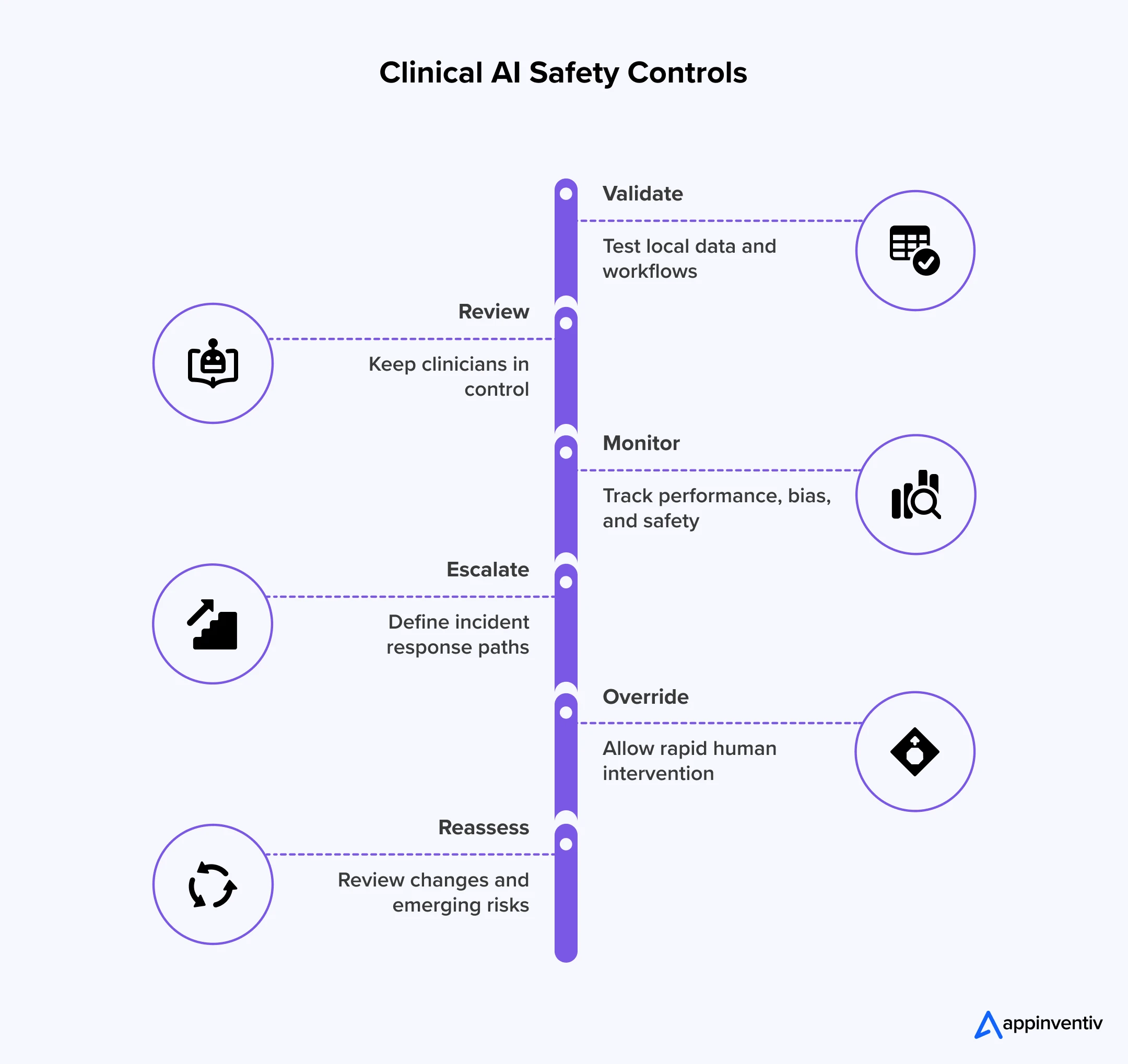
Clinical oversight must match the severity of medical errors. An AMA survey found that 88% of physicians wanted stronger safety and efficacy validation for healthcare AI. Software models can pass benchmark tests yet fail in live care environments. Governance validates real-world utility, enforces clinician reviews, tracks safety signals, and maintains rapid escalation paths.
Clinical Validation in the Intended Care Environment
Testing requires local clinical data, target demographics, and active care routines. Teams evaluate false predictions and system failures against set performance targets. External vendor testing cannot replace local validation for high-risk systems.
Human-in-the-Loop and Override Mechanisms
Protocols define where staff must review software suggestions. Interfaces allow clinicians to easily modify or override recommendations. Systems label generated text clearly and log manual overrides for audit trails.
Monitoring for Patient Harm and Adverse Events
Post-deployment monitoring flags inaccurate suggestions, delayed care actions, and patient complications. High-risk systems need explicit alert thresholds and immediate containment protocols.
Bias, Health Equity, and Population-Level Performance
Teams track error rates across patient groups to catch performance gaps. Committees re-evaluate equity metrics whenever clinical demographics or data inputs change.
Clinical Workflow and Human-Factors Risk
Poor interface design creates safety risks even with accurate models. Testing measures alert volume, review speed, user fatigue, and documentation burden before release.
Escalation and AI Incident Response
Incident response plans assign clear owners and timeline targets for safety failures. Workflows govern automated alerts, containment, medical reviews, reporting, and model shutdowns while preserving diagnostic logs.
Also Read: AI in Clinical Decision-Making
AI Regulations in Healthcare: Global Compliance Landscape
Regulatory compliance changes across international borders, application types, data categories, and medical device classifications. Executive teams must evaluate regional laws, administrative guidelines, and national frameworks before launching software systems across global markets.
| Region | Key Regulations / Frameworks | Enterprise Focus |
|---|---|---|
| United States | HIPAA, FDA, NIST AI RMF, State Laws | PHI, medical-device status, AI risk |
| European Union | GDPR, EU AI Act | Privacy, risk classification, transparency |
| United Kingdom | UK GDPR, UK Medical Devices Regulations | Privacy, device status, clinical safety |
| India | DPDP Act, DPDP Rules 2025 | Data processing, consent, security |
| Singapore | Model AI Governance Framework | Risk controls, human oversight, agent governance |
Compliance checks belong directly inside initial software intake workflows. Review teams confirm processing locations, dataset types, intended system tasks, and legal classifications before final approval. This structural step prevents organizations from treating one nation’s standards as a universal requirement.
Also Read: A Complete Guide to Healthcare Compliance
Healthcare AI Governance Implementation Roadmap
Enterprise rollout of AI governance for healthcare follows a phased plan to integrate oversight into daily operations. Each stage delivers concrete outputs that support the next phase.
- Phase 1: Inventory Existing Systems: Teams identify all active algorithms across clinical, administrative, and financial divisions. Audit records capture software owners, vendor contracts, data pipelines, risk scores, and hidden shadow tools.
- Phase 2: Assign Roles and Risk Tiers: Executive, medical, technical, and legal teams receive clear decision authority. Risk classifications determine the exact review depth required for each project.
- Phase 3: Set Policies and Approval Gates: Teams write clear operational rules for data handling, patient safety, vendor management, and model updates. Each policy connects to a mandatory authorization gate.
- Phase 4: Integrate Controls Into Engineering: Engineers embed compliance checks into data preparation, model selection, testing, and deployment. Automated software manages access rights, approval routing, and audit logging.
- Phase 5: Deploy Real-Time Monitoring: Monitoring tools track algorithmic drift, equity gaps, performance drops, and security alerts post-launch. Defined risk thresholds trigger immediate technical intervention when outputs exceed boundaries.
- Phase 6: Expand Across Regions: Enterprises apply core corporate standards while adjusting controls for local privacy laws and regional care practices. Multi-site health systems balance central authority with local facility accountability.
Healthcare AI Governance Costs and ROI
Healthcare AI governance investment reflects technical scale, underlying system risks, data pipelines, and regulatory requirements across operating regions. Entry-level tools track system registers and approval workflows. Full enterprise platforms include electronic health record connections, automated security controls, real-time telemetry, and multi-national compliance tracking.
Healthcare AI Governance Software Development Costs
Custom governance software builds range from $40,000 to $500,000 depending on security specs and system complexity.
| Development Level | Estimated Cost | Typical Capabilities |
|---|---|---|
| Basic | $40,000–$100,000 | System inventory, risk scoring, policy management, approval workflows, basic reporting |
| Mid-Level | $100,000–$250,000 | Advanced risk scoring, vendor oversight, audit trails, telemetry dashboards, API interfaces |
| Enterprise | $250,000–$500,000+ | EHR interface protocols, automated controls, real-time monitoring, advanced security, regional compliance |
Budget calculations expand when connecting deep medical records, complex monitoring tools, or broad international jurisdictions.
ROI of AI Governance for Healthcare Organizations
Structured governance limits financial losses from clinical safety incidents, redundant regulatory efforts, unmanaged vendor risks, and deployment bottlenecks. Clear review protocols accelerate the safe adoption of software across operating units.
Financial returns combine direct risk mitigation with operational gains. Health systems track success through shorter evaluation cycles, greater system visibility, fewer safety failures, higher staff productivity, and verified clinical outcomes.
KPIs That Measure Governance ROI
Executives measure performance using approval turnarounds, monitoring coverage rates, recorded software incidents, revalidation completion timelines, compliance audit scores, system unit costs, and total portfolio value.
Governance ROI = Value enabled or protected − Governance investment
Direct financial metrics connect capital expenditures directly to clinical results and operational savings.
Healthcare AI Governance Software: Build, Buy, or Hybrid?
The optimal deployment model aligns with custom requirements, the depth of technical integration, initial budgets, and operational control needs.
| Factor | Build | Buy | Hybrid |
|---|---|---|---|
| Customization | High | Medium | High |
| Deployment Speed | Lower | Higher | Medium |
| Integration Control | High | Vendor Dependent | High |
| Upfront Investment | Higher | Lower Initially | Medium |
| Maintenance | Enterprise Owned | Vendor Led | Shared |
| Workflow control | Highest | Platform Dependent | High |
When Custom Healthcare AI Governance Software Makes Sense
Custom software suits organizations with unique operational workflows or strict governance needs. Internal engineering gives leaders full authority over system architecture and data pipelines.
When an Existing Governance Platform Is Better
Commercial platforms suit health systems that need fast deployment and standard capabilities. Off-the-shelf software handles system inventories, risk scoring, and audit reports.
When a Hybrid Governance Architecture Works Best
A hybrid strategy pairs commercial tools with custom internal modules. Health systems adopt vendor software for standard oversight and build custom code for electronic health record connections.
Build a governance platform that controls clinical AI, GenAI, PHI access, vendors, risk, and production monitoring.

Future of AI Governance in Healthcare
Healthcare AI governance shifts toward continuous controls as autonomous systems outgrow periodic reviews. More than 80% of health systems surveyed by Deloitte in 2025 were prioritizing agentic AI for clinical operations, care delivery, or revenue cycle management. Guidance from WHO and NIST emphasizes lifecycle oversight, risk-based rules, and human accountability across health networks.
- Continuous Rather Than Periodic Governance: Platforms monitor active software continuously instead of relying on scheduled annual reviews.
- Governance for Generative and Agentic AI: Generative models and autonomous agents require strict boundaries around tool permissions, prompts, and clinical decisions.
- Automated Risk Assessment and Policy Enforcement: Governance tools classify software proposals automatically and enforce operational rules through automated policy engines.
- Continuous Model and Outcome Evaluation: Monitoring moves beyond mathematical metrics to track real-world clinical outcomes and unexpected patient safety events.
- Privacy-Enhancing and Distributed AI: Privacy-preserving computation and distributed architectures protect patient data as cross-institutional software deployment expands.
- Governance Embedded Into DevSecOps: Compliance checks integrate into software pipelines through automated testing, mandatory approval gates, and immutable audit logs.
- Automated Compliance Evidence: Systems continuously gather compliance evidence, reducing manual audit preparation during regulatory reviews.
- Increasing Regulatory Localization: Global health enterprises apply core governance standards and adapt controls to regional legal requirements.
How Appinventiv Can Help Build AI Governance Solutions for Healthcare
Appinventiv delivers AI governance in healthcare across governance architecture, AI risk management, data protection, security, monitoring, and enterprise integration. Our healthcare AI development services support governance requirements from model design through production.
We help enterprises build:
- Governance Architecture: Risk tiers, approval workflows, AI inventories, policy controls, and lifecycle governance.
- Healthcare AI Governance Software: Custom platforms for risk assessment, audit trails, monitoring, reporting, and governance workflows.
- AI/ML and GenAI Engineering: Predictive models, LLMs, RAG systems, and AI agents with governance controls embedded into development. Teams can use prebuilt, HIPAA-compliant code blocks for common healthcare workflows and adapt them to enterprise requirements.
- Data and EHR Integration: FHIR, EHR, claims, clinical data, and enterprise API integrations with controlled data flows.
- AI Risk Management: Model monitoring, drift detection, policy exceptions, safety alerts, and revalidation workflows.
- Security and Cloud: IAM, RBAC, encryption, API security, logging, and enterprise cloud architecture.
Appinventiv has delivered 500+ digital health platforms, processed 10M+ healthcare data points annually, and supported 120K+ virtual healthcare interactions annually.
For enterprises building, modernizing, or integrating healthcare AI governance, let’s connect and map the technical architecture for the next stage of AI deployment.
FAQs
Q. How to implement AI governance in healthcare systems?
A. Health systems begin AI governance in healthcare implementation by creating an enterprise software inventory and assigning risk classifications to every tool. Executive leaders establish clear accountability across medical, technical, legal, security, and privacy teams. Operations leaders then build standardized procedures for intake, clinical validation, authorization, continuous monitoring, and retirement. Engineering teams embed these oversight checks directly into software pipelines, database integrations, and electronic health record interfaces. System performance tracks measurable safety metrics, compliance records, and direct financial returns.
Q. What are the key components of an effective AI governance framework for clinical use?
A. Effective clinical governance relies on executive leadership, precise risk tiers, data oversight, clinical validation, clinician supervision, technical security, vendor reviews, and real-time telemetry. The control structure defines authorization gates, accuracy thresholds, safety-incident reporting, manual-override tools, and version management. High-risk clinical software requires rigorous testing protocols and continuous monitoring compared to simple administrative tools.
Q. What are the best practices for responsible AI governance in healthcare?
A. Leading health organizations apply risk-tiered controls and test algorithms using local patient data inside active care settings. Medical directors join technical teams across every development phase from project intake to system retirement. Central registers log intended software tasks, input datasets, named owners, validation test scores, and code modifications. Monitoring tools track drops in mathematical performance, demographic bias, security alerts, and clinical safety signals post-launch. User interfaces provide physicians with simple override mechanisms and rapid incident escalation pathways.
Q. How can healthcare organizations maintain HIPAA compliance across AI systems?
A. Technical teams map every data pathway, including user prompts, input processing, generated outputs, database logs, and vendor transfers. System administrators enforce minimum-necessary access permissions, data encryption, strict retention limits, and approved de-identification standards. Legal officers evaluate vendor contracts, third-party subprocessors, and data processing terms before software deployment. Review teams align software tasks with regional privacy laws and maintain permanent audit records covering risk evaluations, user permissions, and compliance checks.
Q. How can Appinventiv help with healthcare AI governance?
A. Appinventiv designs and builds custom governance platforms that integrate directly into existing IT infrastructure and clinical routines. Engineering capabilities cover software tracking registries, risk scoring, automated approval workflows, language model development, electronic health record connections, and cloud security. Technical teams build telemetry systems to monitor model performance, policy exceptions, safety alerts, and regulatory metrics. Appinventiv has delivered over 500 digital health platforms, processing 10 million health data points and supporting 120,000 virtual consultations annually.


Fast 2-minute response, fully NDA-protected.

AI Data Integration: How to Connect, Clean and Prepare Data for AI
Key takeaways: AI initiatives fail when fragmented, poor-quality data reaches models without sufficient context, controls or ownership. AI-ready pipelines must connect, clean, enrich, govern and continuously monitor data across its lifecycle. Real-time processing matters when AI decisions depend on current transactions, events, inventory or operational conditions. Data architecture should follow the AI use case, balancing…

AI Agent Governance: How to Govern Autonomous AI Across Business Systems
Key takeaways: AI agents require controls at the action, identity, data, tool, and workflow levels. Every enterprise agent should have a registered owner, an approved purpose, and a defined risk tier. Access must be based on the agent’s task rather than inherited from a human user or shared service account. High-impact actions need real-time policy…

'I.D.E.A.S.' - The Five Pillar Framework to Ace AI-Native Enterprise Apps in 2027
Key takeaways: AI-native enterprise apps are moving beyond AI agents toward intelligent, adaptive, autonomous and context-aware digital capabilities that can operate across mobile, web, voice, wearables and emerging interfaces. The I.D.E.A.S. framework for AI enterprise apps in 2027 - Interactive Intent, Decisioning Autonomously, Experiential System Design, Adaptive Execution, and Security Layered. Context intelligence and reusable…