



































AI for Smart Cities: From Connected Infrastructure to Intelligent Urban Services

 Share -



- 01The Evolution of Urban Tech: Why IoT is No Longer Enough
- 0210 Most Important AI Use Cases Transforming Smart Cities
- 03The Emerging Shift: From AI-Powered Cities to AI-Native Urban Infrastructure
- 04What Are The Challenges of Implementing AI in Smart Cities and How to Overcome Them?
- 05How to Implement AI in Smart City Infrastructure?
- 06What Does the Future of AI for Smart Cities Look Like?
- 07How Appinventiv Supports AI-Powered Urban Infrastructure
- 08FAQs

Key takeaways:
- AI shifts cities from monitoring infrastructure conditions to predicting disruptions and improving operational responses before failures escalate.
- The strongest AI use cases in smart cities combine quality data, clear ownership, workflow integration and measurable infrastructure outcomes.
- Digital twins create greater value when AI supports simulation, optimisation and decisions rather than visualisation alone.
- Responsible AI for smart cities requires governance, privacy, cybersecurity and accountability to be built into architecture early.
A smart city knows what is happening. An intelligent city uses that knowledge to anticipate what happens next and respond accordingly. That distinction matters because cities have spent years connecting assets, deploying sensors and digitising services, yet many still struggle to turn fragmented data into operational decisions.
Urban areas face unique pressures. Rapid densification in Sydney and Melbourne, and the increasing frequency of extreme climate events demand a different approach to civil management.
Also, population growth is adding urgency. According to the Australian Bureau of Statistics regional population release, Melbourne grew by 105,030 people and Sydney by 75,230 people, followed by Brisbane 58,223 and Perth 58,088 during 2024-25. Those numbers translate into sustained pressure on transport, housing, water, energy and public services.
To address these mounting operational pressures, the nation is witnessing a transition from connected infrastructure to data-driven infrastructure, and now toward AI-enabled urban services.
Integrating AI in smart cities changes the equation by turning passive sensor feeds into active operational intelligence. Instead of merely logging a temperature spike in a transformer, artificial intelligence initiates a load-balancing protocol before an outage occurs.
This shifts the operational posture from reactive monitoring to proactive resilience. You cannot simply install sensors and expect transformation.
The progression is increasingly clear: connected infrastructure in smart cities collects signals, data-driven infrastructure makes those signals visible, and intelligent infrastructure uses AI to identify patterns, predict outcomes and recommend or trigger appropriate actions.
Let’s explore the role of AI in smart cities, including the highest-value use cases, the obstacles that stall most programs, and a practical path to implementation.
Assess your smart infrastructure readiness and identify where AI can deliver measurable operational value.
The Evolution of Urban Tech: Why IoT is No Longer Enough
For the last decade, IoT remains a critical foundation for connecting cities, but connected devices do not automatically produce intelligent operations. A connected city just generates data; a cognitive city acts on it. For example, IoT sensors can detect a leak, congestion or equipment fault. AI can help determine what the signal means, estimate what happens next and support a prioritised response across connected systems.
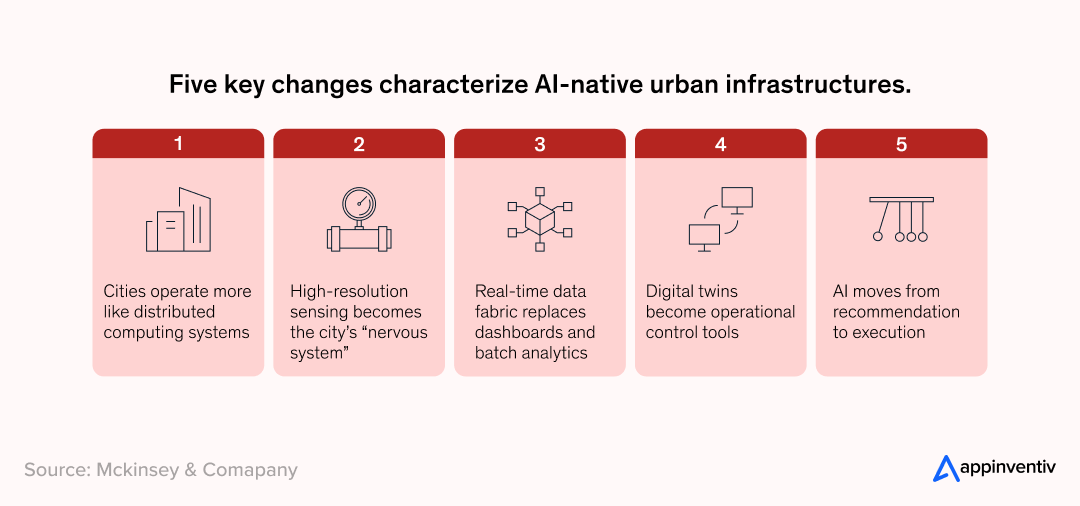
Let’s explore in detail why IoT alone is not enough to create smart cities and why upgrading to AI-native urban infrastructure is critical.
Sensors vs Brainpower
A connected city detects a water main leak. An intelligent city reroutes supply, predicts the next fracture point along the same pipe run, and dispatches a crew before residents report low pressure.
IoT gave urban infrastructure a nervous system, the capacity to sense. AI supplies the brainpower that decides what the sensed data should trigger. Without that second layer, sensor investment produces reporting, not resilience.
Moving to API-First Microservices
Legacy urban infrastructure was built around administrative handoffs between departments: a fault gets logged, escalated, assigned and closed across separate systems that rarely talk to each other.
Recent McKinsey analysis of AI-native public infrastructure describes a different model, where subsystems such as traffic, power and water are designed as loosely coupled services that coordinate much like microservices in a cloud environment. So a localised failure is isolated automatically rather than triggering a cross-department cascade.
This is closer to how modern enterprise platforms are built than how most utility and council systems were originally designed, which is precisely why the migration is a genuine architecture project rather than a software patch.
The Speed of Response
The metric that matters has changed. Historically, urban systems were judged on staffing cycles and administrative turnaround. In an AI-native model, the defining constraint is latency, how fast a system detects stress and recalibrates on its own.
McKinsey’s research puts the cost of this lag in concrete terms, estimating that unplanned outages, congestion and reactive maintenance already cost large cities between 2 and 4% of GDP a year through lost productivity, asset damage and emergency response.
That is the commercial case for closing the latency gap, independent of any sustainability argument.
10 Most Important AI Use Cases Transforming Smart Cities
The highest-value AI applications in smart cities address persistent operational problems rather than chasing isolated technology demonstrations. Mobility, asset management, utilities, planning and community services all generate large volumes of data. AI in smart homes and cities becomes commercially useful when it converts that information into earlier warnings, better prioritisation and more efficient decisions.
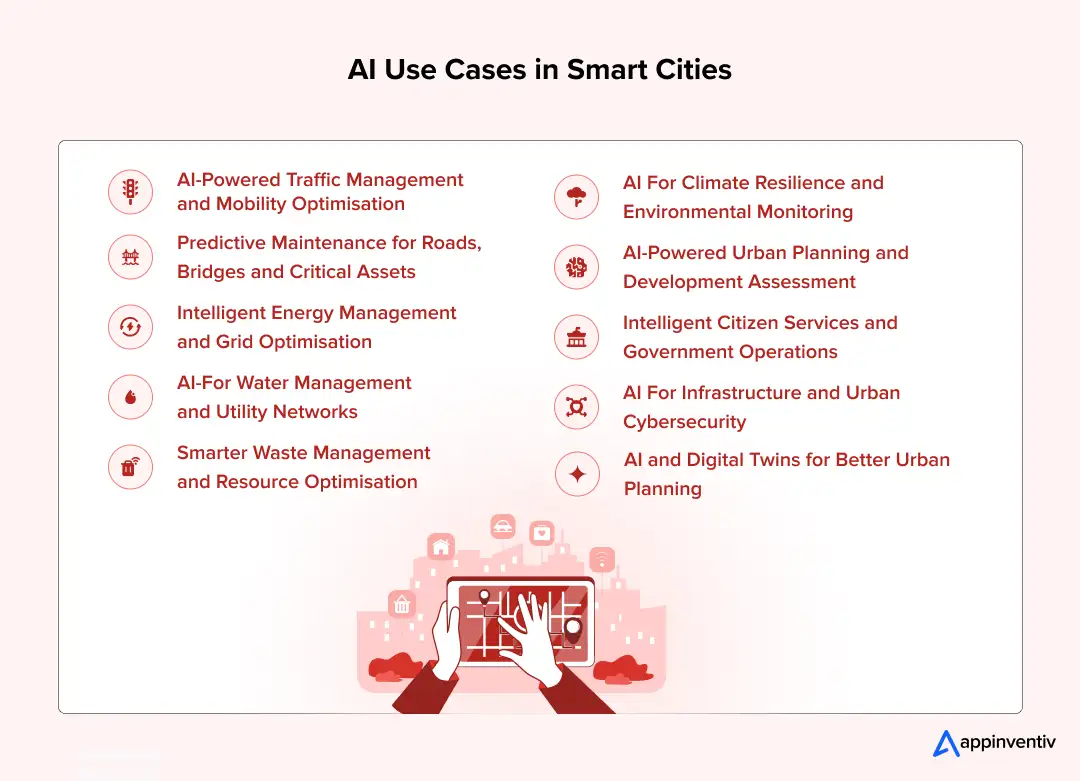
AI-Powered Traffic Management and Mobility Optimisation
Traffic networks produce continuous data from cameras, sensors, public transport systems and connected infrastructure. AI can identify congestion patterns, forecast demand and support adaptive signal management.
The goal is broader than moving vehicles faster. Transport agencies can use predictive models to understand network stress, assess incident impacts and better coordinate public transport, freight and road operations.
Predictive Maintenance for Roads, Bridges and Critical Assets
Roads, bridges, tunnels and public facilities often operate with inspection cycles that are necessary but resource-intensive. AI implementation here can combine condition data, maintenance history, environmental information and asset criticality to identify where intervention is likely to be most valuable.
This changes maintenance from a calendar-driven exercise into a risk-based process. The strongest models do not simply predict failure. They help teams decide which assets require attention first and why.
AI and Digital Twins for Better Urban Planning
A digital twin for government plans becomes more valuable when it evolves beyond visualisation. Its real potential lies in bringing trusted spatial and operational data into an environment where scenarios can be tested and decisions assessed.
The NSW Spatial Digital Twin provides a relevant example. The platform supports a cross-sector environment for sharing and visualising spatial information, while the wider Live NSW programme brings together information across areas including transport, emergency services, utilities and environmental data.
AI can extend this model by analysing scenarios such as infrastructure demand, environmental risk or development impacts. Instead of asking only, “What does the city look like?”, decision-makers can increasingly ask, “What is likely to happen if this changes?”
Intelligent Energy Management and Grid Optimisation
Energy systems must balance changing demand, distributed generation and growing electrification. AI can support demand forecasting, anomaly detection and optimisation of energy-intensive assets.
For cities and infrastructure operators, the benefit is improved visibility into consumption patterns and a better basis for managing operational trade-offs. Any implementation involving critical networks, however, needs clear boundaries between recommendation systems and operational control.
AI for Water Management and Utility Networks
Utilities can apply AI to pressure data, consumption patterns, equipment performance and environmental conditions to identify anomalies earlier. Potential applications include leak detection, demand forecasting and maintenance prioritisation.
The strongest use cases depend on reliable asset records. An advanced model cannot compensate for missing location data, inconsistent identifiers or poor maintenance history.
Smarter Waste Management and Resource Optimisation
Waste services can use AI to improve collection routes, forecast volumes and identify inefficient deployment of vehicles and crews. Computer vision may also support sorting and contamination detection where the operating environment and privacy requirements are appropriate.
These are practical benefits of AI in smart cities: fewer unnecessary journeys, improved resource allocation and better visibility across distributed operations.
AI for Climate Resilience and Environmental Monitoring
Environmental monitoring is another important use of AI in smart cities. Models can process weather, spatial and sensor data to identify emerging risks and support preparedness.
The decision architecture matters here. A prediction should not automatically produce a high-consequence action. Systems need thresholds, confidence measures and clear human escalation paths, particularly where emergency management or essential services are involved.
AI-supported Planning and Development Assessment
Planning teams manage large volumes of spatial, regulatory and project information. AI can help search documents, identify inconsistencies and support preliminary assessments.
NSW’s Land iQ platform illustrates the value of combining spatial data, planning information and analytics to assess development considerations. It supports activities including site identification, resilience assessment and infrastructure alignment.
AI can add further value, but recommendations should remain explainable and auditable. Planning decisions cannot rely on opaque outputs where the underlying reasoning cannot be examined.
Intelligent Citizen Services and Government Operations
AI can support service teams through document processing, case triage and knowledge retrieval. The most suitable use cases are usually repetitive, high-volume processes with clear rules and measurable service outcomes.
The technology should fit existing accountability structures. Public-facing services need particular care around privacy, accessibility, fairness and escalation when automated systems cannot resolve a request.
AI for Infrastructure and Urban Cybersecurity
As cities connect more operational technology and IoT devices, the attack surface expands. AI can support anomaly detection across network and operational signals, helping security teams identify unusual activity earlier.
It should not be treated as a substitute for cybersecurity strategy. Identity controls, asset visibility, segmentation, patch management and incident response remain foundational.
The Emerging Shift: From AI-Powered Cities to AI-Native Urban Infrastructure
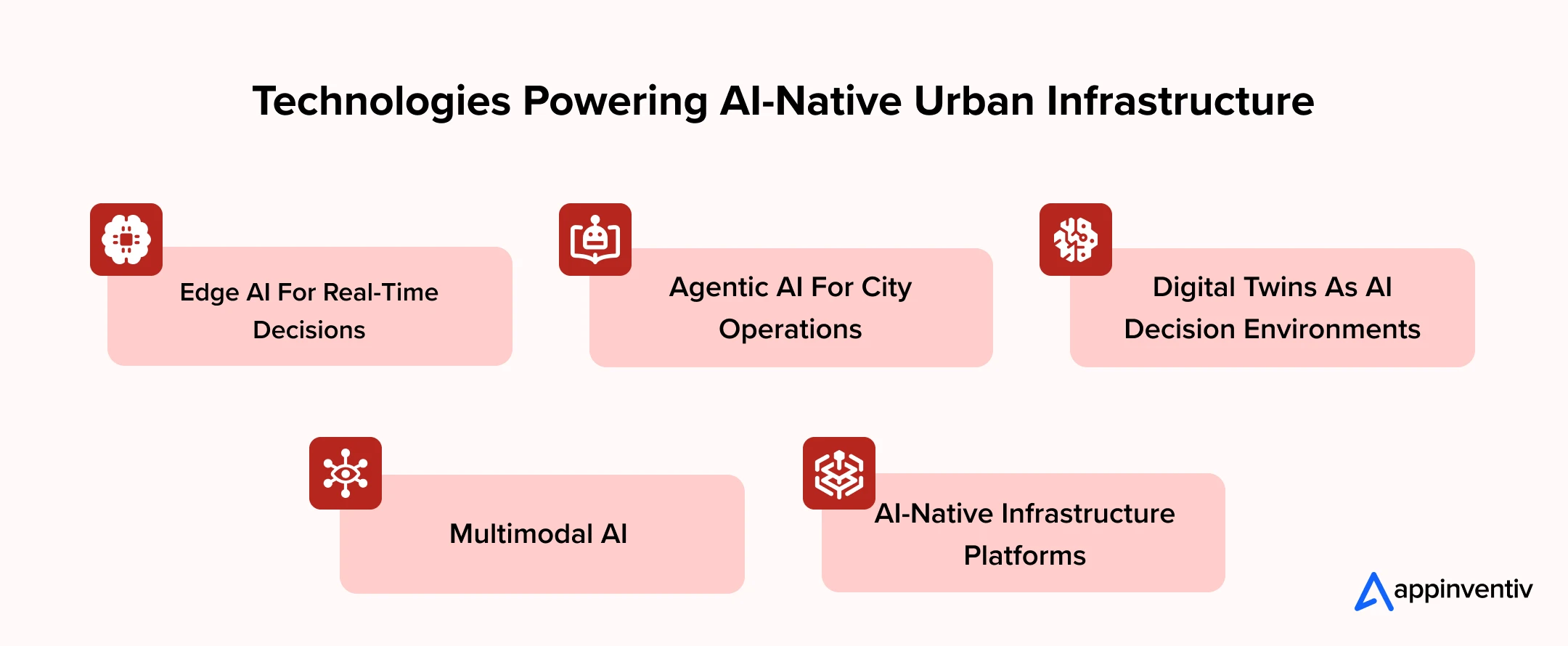
AI-native urban infrastructure is not defined by the number of models deployed. It describes an operating environment where data, integration, compute, governance and workflows are designed so intelligence can be introduced and improved continuously. This represents a significant shift from isolated pilots towards reusable capabilities that can support multiple services.
Edge AI for Real-Time Decisions
Some decisions cannot wait for large volumes of data to travel to a central cloud environment. Edge AI in smart cities can process selected information closer to cameras, sensors or operational assets.
This can reduce response time and network dependency. It also requires disciplined lifecycle management because models and devices deployed across distributed environments still need monitoring, security updates and version control.
Agentic AI for City Operations
Agentic AI may eventually support multi-step operational work such as gathering information, checking constraints and preparing recommended actions. In a city context, its use should be carefully bounded.
A sensible starting point is administrative coordination rather than uncontrolled infrastructure control. An agent may prepare a maintenance response plan or consolidate incident information, while authorised personnel retain responsibility for decisions.
Digital Twins as AI Decision Environments
The next generation of digital twins will increasingly combine visualisation with prediction and simulation. They function as active decision environments.
Planners can run thousands of Monte Carlo simulations to optimise zoning laws, emergency evacuation routes, or public transport timetables based on predicted demographic shifts.
Multimodal AI
Urban operations involve more than structured datasets. Information may include imagery, video, engineering documents, maps, maintenance records and service requests.
Multimodal AI can help connect these formats, but accuracy and privacy controls become more complex. Each data type needs clear handling rules before being included in a production workflow.
AI-Native Infrastructure Platforms
Future platforms will need reusable capabilities rather than one-off models. Common identity, APIs, data products, model monitoring and security controls can allow multiple teams to develop AI services without rebuilding the same foundations.
That approach can improve long-term ownership and reduce dependence on a collection of disconnected vendors.
What Are The Challenges of Implementing AI in Smart Cities and How to Overcome Them?
The biggest challenges of AI adoption in smart cities are usually operational rather than algorithmic. Projects stall because data is fragmented, asset records are inconsistent, ownership is unclear or pilots never reach the systems where work actually happens. Successful AI implementation therefore starts with delivery constraints, not model selection.
| Challenge | Why It Stalls Programs | Practical Response |
|---|---|---|
| Legacy systems never designed to share data | Traffic, water, energy and planning systems were procured independently over decades, often from different vendors with closed data formats | Introduce an integration layer such as an API gateway or data fabric rather than attempting a wholesale system replacement |
| Data quality and inconsistent asset information | Asset registers built up over 20 to 30 years rarely share naming conventions, condition scoring or location accuracy | Run a structured data audit before any AI use case is scoped, not after |
| Data sovereignty, privacy and trust | Community and infrastructure data often carries sensitivity that public sentiment and regulation both treat seriously | Build privacy-by-design into architecture, keep sensitive datasets within sovereign infrastructure where required, and publish plain-language explanations of what is collected and why |
| AI governance, accountability and explainability | Automated decisions affecting citizens, such as planning or enforcement, need to be defensible on review | Keep a human in the loop for decisions with material consequences, and document model logic in terms a non-technical auditor can follow |
| Cybersecurity across IT, OT and IoT environments | Operational technology was not built with the threat model of a connected network in mind | Apply zero-trust architecture across devices and services, and segment OT networks from general IT traffic |
| Skills gaps and vendor dependence | In-house teams are frequently locked into a single vendor’s proprietary stack, limiting internal capability | Prioritise open, modular architecture and invest in internal capability alongside any delivery partner engagement |
How to Implement AI in Smart City Infrastructure?
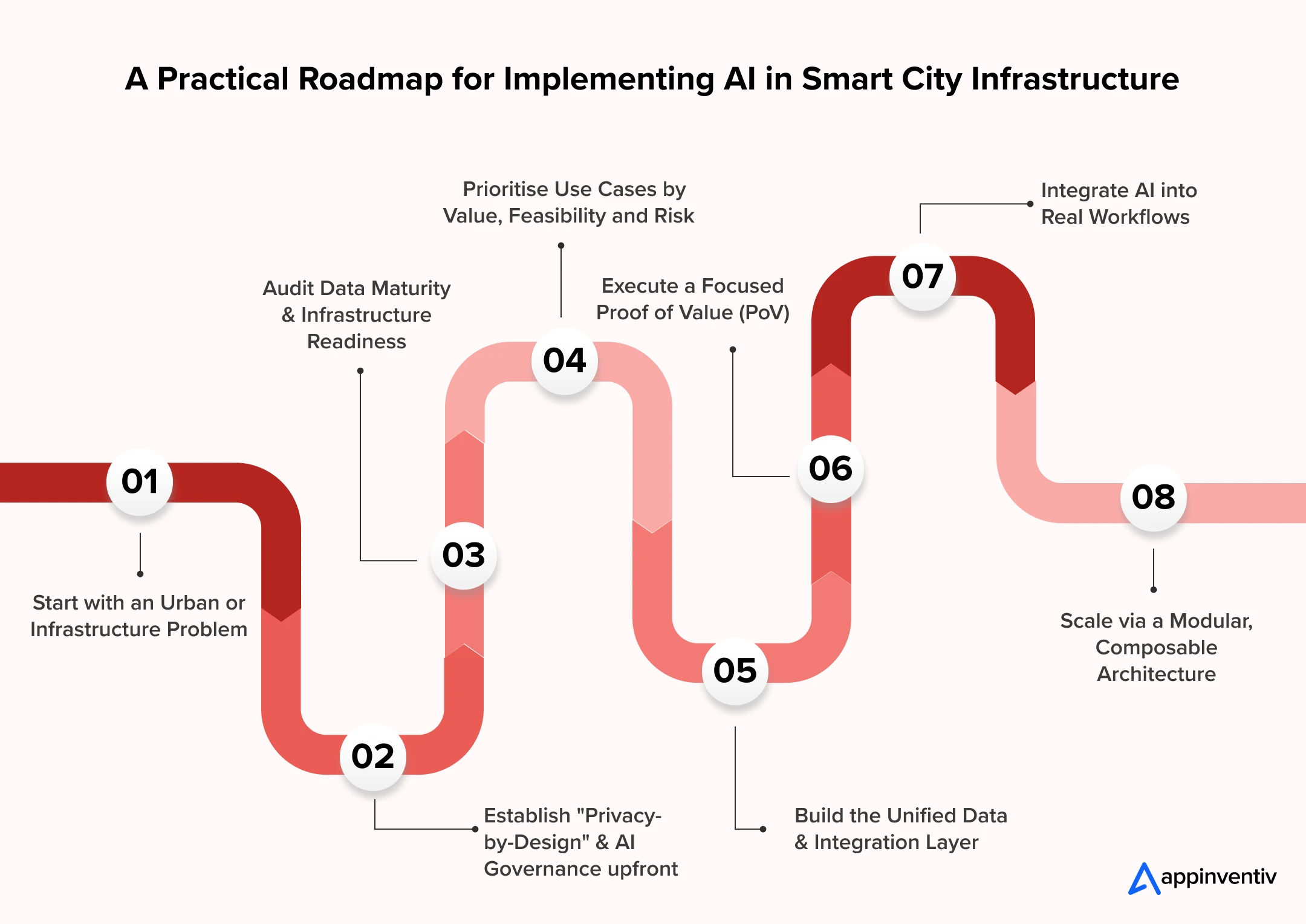
Transitioning to an intelligent urban model requires a structured, risk-aware execution plan. A practical AI roadmap should move from a defined operational problem to a controlled proof of value, then into measurable production use. Starting with a broad “smart city AI strategy” often produces a large technology agenda without a clear business case. A narrower, evidence-led sequence is easier to govern and scale.
Start with an Urban or Infrastructure Problem
Do not start with the technology. Choose a problem with measurable consequences, such as maintenance delays, congestion, water loss or slow incident response. Define the current baseline before discussing models.
Establish “Privacy-by-Design” & AI Governance Upfront
Before touching a single dataset, institute a governance framework. For Australian authorities, this means aligning with the updated Privacy Act, the Essential Eight cybersecurity strategies, and establishing ethical AI guidelines. Determine how citizen data will be anonymised at the edge before it ever reaches the cloud.
Audit Data Maturity & Infrastructure Readiness
Conduct a ruthless assessment of your current technical debt. Map out where critical data lives (transport, water, waste) and identify legacy silos. Simultaneously, assess your physical infrastructure; do you have the necessary 5G connectivity and edge-computing hardware at intersections to support real-time AI?
Prioritise Use Case by Value, Feasibility and Risk
A useful AI use case is not necessarily the most technically ambitious one. Prioritise opportunities where measurable value, accessible data and manageable risk align.
Build a Governed Data and Integration Layer
Before launching the pilot, build the foundation. Transition away from monolithic vendor lock-in by establishing an API-first integration layer (a data fabric). This ensures that a new AI traffic sensor can seamlessly share data with the emergency services dispatch system.
Execute a Focused Proof of Value (PoV)
Move past theoretical proofs of concept. Geofence a specific operational area and deploy the technology to test actual ROI. Define rigid success metrics. Did the predictive maintenance model actually reduce unplanned downtime by a measurable percentage?
Integrate AI into Real Workflows
Technology fails if operators reject it. Embed insights directly into the existing dashboards used by dispatchers and maintenance crews. Provide comprehensive change management to position the technology as a capability multiplier rather than a human replacement.
Scale via a Modular, Composable Architecture
Once a use case proves value, reuse integration, governance and monitoring components where possible. This makes scaling more controlled than launching a new standalone pilot for every department.
Define the right use case, architecture, governance model and proof-of-value approach for delivery.
What Does the Future of AI for Smart Cities Look Like?
Smart cities of the future point toward infrastructure that predicts and coordinates rather than simply reports. Here are the five developments enterprise and government leaders should plan around over the next several years, and what each means for architecture and investment sequencing.
1. Cities Will Shift from Monitoring Systems to Predicting Outcomes
The reliance on historical reporting will vanish. Municipalities will operate entirely on predictive forecasting, addressing infrastructural decay and capacity limits months before they manifest into physical disruptions.
2. Digital Twins Will Become More Operational and AI-Driven
Virtual replicas will evolve into real-time command centres. Operational teams will use these AI-driven twins to execute live interventions, bypassing traditional administrative control rooms entirely.
3. AI Will Increasingly Coordinate Across Interconnected Urban Systems
Cross-domain orchestration will become standard. An emergency response system will automatically trigger traffic diversions, adjust smart street lighting for ambulance visibility, and notify hospital intake systems simultaneously.
4. Edge Intelligence Will Grow Alongside Cloud AI
Centralised cloud computing will handle heavy historical analytics, while edge devices will shoulder the burden of real-time, autonomous decision-making. This hybrid approach guarantees low latency and operational continuity during network outages.
5. AI Governance and Digital Infrastructure Will Become Strategic City Capabilities
According to Deloitte’s 2026 State of AI Report, scaling digital infrastructure to support AI represents a massive economic opportunity, driving significant productivity gains. Governance, cybersecurity, and compute capacity will be viewed as critical public utilities, commanding board-level accountability and dedicated capital expenditure.
How Appinventiv Supports AI-Powered Urban Infrastructure
Building AI-powered urban infrastructure requires more than an application layer. The work spans data engineering, system integration, AI development, cybersecurity, cloud architecture and long-term operational ownership.
Therefore, for organisations moving from connected infrastructure in smart cities towards intelligent services, partnering with a reliable AI development company in Australia matters as much as the technology itself.
Appinventiv, with 11+ years of APAC delivery experience, approaches these programmes by isolating the operational problem first before architecting for scale. We evaluate existing technical debt, establish clear integration patterns, and build AI-ready data foundations tailored to local compliance mandates.
Our team of 3000+ tech architects, including 200+ AI and data scientists, have deployed 3000+ digital assets in Australia, which includes 300+ AI powered solutions.
To simplify procurement and shorten cycle times for public-sector and municipal programmes, Appinventiv is pre-approved on key government procurement frameworks, including the Queensland Government ICTSS and Local Buy LGA panels. Operating out of 5 agile delivery centres across Australia, we maintain strict ISO 27001, ISO 9001, and SOC 2 security practices to ensure full audit readiness.
Our focus for civic infrastructure remains pragmatic: deploy adaptable, secure platforms that sharpen real-time operational decisions without creating a new layer of unmanaged technical debt.
Ready to transition from a connected city to a cognitive one? Speak to our AI architects to map out a bespoke smart city digital transformation strategy.
FAQs
Q. What is AI in smart cities?
A. AI in smart cities refers to the use of data-driven models to analyse urban information, predict outcomes, optimise systems and support operational decisions. It extends traditional smart-city technology by helping infrastructure and service teams move beyond monitoring towards earlier intervention and more informed action.
Q. How much does it cost to implement AI in a smart city?
A. Implementing AI in smart city typically costs between AUD 70,000 for basic pilot projects and upwards of AUD 700,000 for full-scale municipal ecosystems. Mid-tier deployments, such as precinct-level digital twins or automated traffic management, generally range from AUD 300,000 to AUD 500,000. Final investment depends on IoT infrastructure scale, system integration complexity, and ongoing data governance compliance.
Q. How is AI different from traditional smart-city technology?
A. Traditional smart-city systems primarily collect, connect and display information. Artificial intelligence in smart cities analyses that information to identify patterns, forecast likely outcomes and support optimisation. The difference is the move from knowing what is happening to estimating what may happen and determining an appropriate response.
Q. What are the most important AI use cases for smart cities?
A. Key AI applications in smart cities include traffic optimisation, predictive infrastructure maintenance, energy and water management, waste operations, climate monitoring, urban planning, cybersecurity and community services. The most suitable use case depends on the organisation’s data maturity, operational priorities and governance requirements.
Q. How can AI improve urban infrastructure management?
A. AI can support condition monitoring, failure prediction, maintenance prioritisation and resource allocation. Rather than replacing engineering judgement, it helps teams process larger volumes of asset and operational information and focus attention on risks or opportunities that require action.
Q. What role do digital twins play in AI-powered cities?
A. Digital twins in AI powered cities provide a shared environment for representing physical assets and urban systems using spatial and operational data. AI can increase their value by supporting prediction, scenario analysis and optimisation. A well-governed twin can therefore become a decision environment rather than simply a visual model.
Q. How should organisations start an AI smart-city initiative?
A. Start with a defined operational problem and establish its current baseline. Assess data and infrastructure readiness, identify privacy and governance requirements, then test a feasible use case through a controlled proof of value. Scale only after the solution demonstrates measurable operational benefit and can be integrated safely into existing workflows.


Fast 2-minute response, fully NDA-protected.

The Multiplier Effect of AI Agents: The Rise of AI Swarms
Key takeaways: AI agent swarms coordinate specialized agents to solve complex problems that may be difficult for a single agent to handle effectively. More agents do not automatically mean better outcomes. Swarms deliver value when work can be divided, executed in parallel, and coordinated toward a shared objective. Enterprise readiness depends on governance. Clear accountability,…

AI Data Integration: How to Connect, Clean and Prepare Data for AI
Key takeaways: AI initiatives fail when fragmented, poor-quality data reaches models without sufficient context, controls or ownership. AI-ready pipelines must connect, clean, enrich, govern and continuously monitor data across its lifecycle. Real-time processing matters when AI decisions depend on current transactions, events, inventory or operational conditions. Data architecture should follow the AI use case, balancing…

AI-Native SDLC: Foundational 90-Day, 5R AI SDLC Adoption Playbook
Key takeaways: Why AI coding tools accelerate coding and software delivery How AI-native SDLC shifts engineering from code to intent, context, and outcomes The role of specifications, AI agents, and continuous verification in enterprise delivery How to redesign engineering teams for human–agent collaboration The platform, governance, and guardrails required to scale AI-native development A practical…