


































Application Development Outsourcing in Australia: How to Find the Right Development Partner

 Share -


- 01Why Are Businesses Outsourcing Application Development in 2026?
- 02How to Find an Application Development Outsourcing Partner?
- 03Outsourcing Models: Which One Fits Your Situation?
- 04What Can You Outsource in Application Development?
- 05How Much Does Application Development Outsourcing Cost in Australia?
- 06Compliance Considerations When Outsourcing Application Development
- 07How to Manage an Outsourced Application Development Team?
- 08Top 10 Application Development Outsourcing Mistakes That You Must Avoid
- 09A Practical Application Development Partner Evaluation Checklist
- 10When Should You Outsource Application Development?
- 11Appinventiv - Your Trusted Application Development Outsourcing Partner
- 12FAQs

Key takeaways:
- Choose an outsourcing partner based on technical capability, security, governance, delivery evidence, and long-term fit.
- Select an onshore, offshore, or hybrid model based on your risk, control, cost, and scalability requirements.
- Plan for AUD 70,000 to AUD 700,000 per project, and compare vendors on total cost of governance, not hourly rate alone.
- Treat data protection, IP ownership, governance, and exit planning as core parts of the outsourcing strategy.
Application development outsourcing is no longer simply a way to add developers or reduce delivery costs. The decision can affect data handling, operational resilience, intellectual property, security controls and the organisation’s ability to respond when a critical system fails.
That changes the question from “Which vendor can build this?” to “Which partner can safely own part of this delivery responsibility?”
The pressure is real. Jobs and Skills Australia’s 2025 Occupation Shortage report identifies skills shortages across parts of the national labour market with nearly one in three advertised positions going unfilled
At the same time, businesses are modernising legacy platforms, launching new digital products and adding AI capabilities without necessarily wanting to expand inhouse engineering teams.
Therefore, for organisations considering app development or modernisation, application development outsourcing remains the better approach. However, finding the right fit for your project is not an easy task. You need to assess partners across technical capability, security, governance, delivery evidence, commercial fit and long-term ownership.
This blog shares a practical framework for shortlisting, vetting and governing an application development outsourcing partner.
Assess technical capability, security, governance and delivery fit before you commit.
Why Are Businesses Outsourcing Application Development in 2026?
Businesses in Australia outsource application development to close skills gaps, add capacity on demand and modernise legacy platforms faster. The benefit only holds when governance, security and data handling are designed in from the start.
Access specialised skills
Specialist skills in cloud, cybersecurity, data engineering, AI and legacy modernisation can be difficult to build internally at short notice. An outsourced partner fills that gap within days or weeks.
Scale engineering capacity without permanent hiring
An external team can add developers, architects, testers or DevOps specialists around an existing team when delivery demand increases.
Modernise legacy applications faster
Ageing core systems slow every change request and raise operational risk. Specialist teams re-platform in stages, without freezing day-to-day operations.
Accelerate product releases
A dedicated external team works alongside product and technology leaders. This helps shorten development cycles without disrupting the organisation’s existing roadmap.
Control development costs without compromising capability
Hiring, onboarding and tooling costs compound quietly. Outsourcing converts them into predictable delivery spend tied to defined scope and outcomes.
How to Find an Application Development Outsourcing Partner?
Partner selection works best when it resembles technology due diligence rather than a conventional vendor comparison. The objective is to establish whether a provider can manage the technical, commercial and operational consequences of the work after the contract is signed.
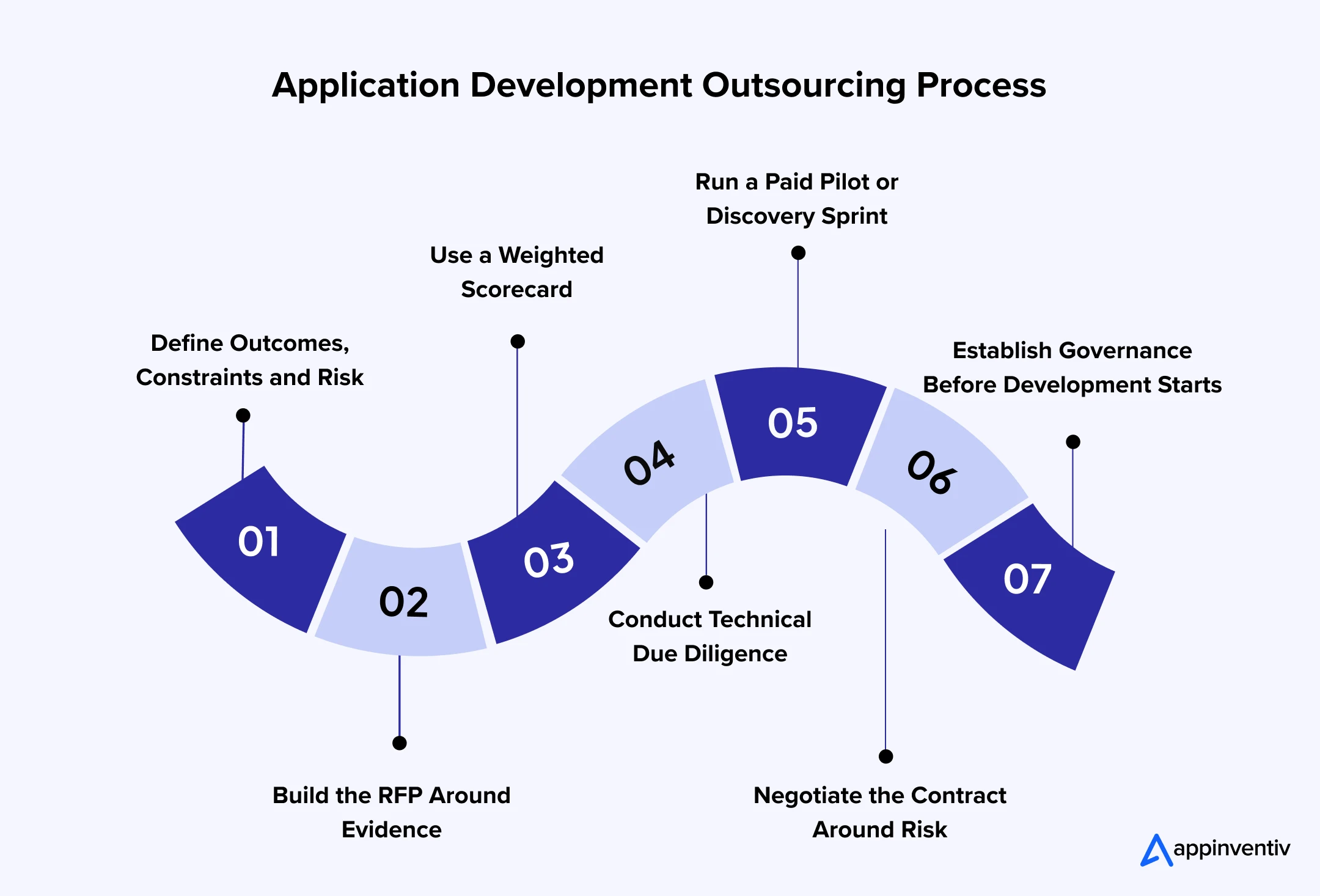
Step 1: Define Outcomes, Constraints and Risk
Start by classifying the application by figuring out a few simple questions:
Is it customer-facing? Does it process personal or financial information? Does it support a critical business operation? Will developers require production access?
These answers determine the level of supplier scrutiny required.
Step 2: Build the RFP Around Evidence
Do not ask providers only what they can do. Ask them to show how they have done it. Ask for:
- Relevant case studies and client references
- Architecture examples
- Security controls
- Team structures
- Delivery metrics
- Testing approach
- Incident management processes
- References from comparable engagements
Step 3: Use a Weighted Scorecard
Price should have a place in your selection process, but it should not be the only criteria to dominate the assessment. Filter vendor responses using a multi-dimensional weighted scorecard. You should allocate percentage weights based on your operational priorities. For instance put:
- Security and compliance at 30%
- Technical capability at 25%
- Delivery track record at 20%
- Sector experience (15%)
- Commercials structure transparency (10%)
Disqualify providers that fail basic regulatory baseline requirements regardless of cost advantages.
Step 4: Conduct Technical Due Diligence
Review the proposed architecture before signing a contract. Look at integration patterns, identity management, data flows, cloud design, observability, testing, disaster recovery and deployment controls.
Ask who will make architecture decisions once delivery begins.
Step 5: Run a Paid Pilot or Discovery Sprint
A short engagement can reveal more than several rounds of presentations.
It gives your team a view of how the provider communicates, documents decisions, handles ambiguity and responds when the first technical assumption proves wrong.
Step 6: Negotiate the Contract around Risk
The agreement should cover SLAs, data handling, audit rights, IP, source-code ownership, breach notification, subcontracting, service levels, termination and knowledge transfer.
For APRA-regulated organisations, these considerations are especially important. CPS 230 requires regulated entities to manage risks arising from material service providers and maintain formal agreements for material arrangements.
Step 7: Establish Governance before Development Starts
Agree on decision rights, reporting cadence, escalation routes and measurable outcomes. A useful operating model is:
Business owner → Product leadership → Architecture and security → Delivery lead → Engineering team
That structure keeps technical decisions connected to business priorities.
Add the right engineering team without building one from scratch.
Outsourcing Models: Which One Fits Your Situation?
The right outsourcing application development model depends on how much control you need, where sensitive work can be performed and how predictable the scope is. Onshore teams offer data residency and timezone alignment at higher cost. Nearshore and offshore teams offer scale and savings with governance trade-offs. And hybrid and dedicated teams pair an Australian technology lead with distributed engineers.
The important point is not where every developer sits. It is whether the operating model gives your organisation enough visibility and control.
Here is a table outlining the key differences based on some crucial aspects:
| Criteria | Onshore | Nearshore/APAC | Offshore | Hybrid/Dedicated |
|---|---|---|---|---|
| Cost | Higher | Medium | Lower to medium | Medium to high |
| Control | High | Medium to high | Medium | High |
| Compliance complexity | Lower for local delivery | Medium | Higher | Depends on delivery structure |
| Timezone overlap | High | High to medium | Lower to medium | High with local lead |
| Best fit | Regulated or highly collaborative programmes | Regional delivery and specialist capability | Scale, defined workloads and cost-sensitive programmes | Enterprise transformation and long-term products |
What Can You Outsource in Application Development?
Application development outsourcing can cover almost the entire product lifecycle, from early technical discovery through application management. So, what you can outsource completely depends on what your internal team considers important and which capabilities can be safely delegated to an external provider.
| Application area | What can be outsourced |
|---|---|
| Product discovery | Requirements, product roadmap, technical feasibility |
| Design | UX research, UI design, design systems |
| Development | Web, mobile, enterprise and custom applications |
| Integration | APIs, ERP, CRM, payment, data and third-party systems |
| Cloud | Cloud migration, architecture, optimisation |
| Data & AI | Data platforms, analytics, ML and Gen AI use cases |
| Quality engineering | Functional, automation, performance and security testing |
| DevOps | CI/CD, infrastructure automation, monitoring |
| Legacy System Modernisation | Legacy migration, re-platforming, refactoring |
| Application management | Support, enhancements, performance and maintenance |
AI implementation can sit across several of these areas, but it should have a defined business purpose. For example, an application might use AI for document processing, recommendations, forecasting, customer service or internal search. The development partner should still be responsible for conventional engineering disciplines such as testing, access control, monitoring and human review.
How Much Does Application Development Outsourcing Cost in Australia?
Application development outsourcing costs vary substantially because scope, architecture, team composition, security requirements and integration complexity can change the economics of a project. A practical estimate therefore depends on the delivery model and application complexity.
However, to plan your project investment, here is an average cost range of application development outsourcing based on different project complexity.
| Project type | Indicative range |
|---|---|
| Small application or MVP | AUD 70,000–150,000 |
| Mid-complexity business application | AUD 150,000–300,000 |
| Enterprise application | AUD 300,000–700,000+ |
| Complex modernisation or multi-system programme | AUD 700,000–900,000+ |
These are just planning ranges, not fixed market prices. A regulated application with complex integrations, security testing and migration requirements can cost considerably more than a standalone application with limited integrations.
The main cost drivers include:
- Number and seniority of engineers
- Application complexity
- UX and design requirements
- Third-party integrations
- Cloud infrastructure
- Data migration
- Cybersecurity and testing
- AI or machine learning requirements
- Compliance and audit requirements
- Support and maintenance
- Delivery location and team structure
A useful commercial assessment looks at total cost of ownership, not just the quoted development fee. A low initial quote can lose its advantage if the application requires extensive remediation, has poor documentation or becomes difficult for the internal team to maintain.
What Are the Typical Outsourcing Application Development Models?
Different outsourcing application development pricing models suit different levels of scope, uncertainty and delivery control. The right choice depends on how clearly the requirements are defined and how much flexibility the project needs.
| Pricing model | Suitable when | Main consideration |
|---|---|---|
| Fixed price | Scope is well defined | Changes can increase cost |
| Time and materials | Requirements evolve | Requires strong governance |
| Dedicated team | Long-term development | Team utilisation and management |
| Milestone-based | Large enterprise programmes | Clear acceptance criteria |
| Managed service | Ongoing application operations | SLA and service scope |
For uncertain product requirements, time and materials or a dedicated team can provide more flexibility. Fixed pricing is more appropriate when scope, acceptance criteria and technical requirements are genuinely stable.
Get a clearer estimate based on scope, complexity, integrations and your preferred delivery model.

Compliance Considerations When Outsourcing Application Development
Outsourcing does not outsource accountability. Businesses must meet relevant regulatory requirements Essential Eight, CPS 230, 234 and Privacy Act 1988 when building or modernising applications. However, which frameworks apply to your project depends on your sector, but the underlying question is constant: can you prove control over a supplier you do not employ?
APRA CPS 230 and Service Providers
CPS 230 is particularly relevant to financial services organisations. The standard requires APRA-regulated entities to manage risks associated with service providers.
That means supplier selection cannot stop at technical capability.
The organisation needs to understand where the service is delivered, who performs the work, which other parties are involved and what happens if the provider can no longer deliver the service.
CPS 234 and Security Accountability
Information security responsibilities also need to be reflected in the delivery model. Security controls should cover developer access, privileged accounts, source repositories, CI/CD pipelines, testing environments and production systems.
Privacy Act and APP 8
Cross-border delivery deserves particular attention where personal information is involved.
Under APP 8, an Australian entity generally needs to take reasonable steps before disclosing personal information to an overseas recipient, with the Australian entity retaining accountability in relevant circumstances.
The practical question is therefore not simply whether a vendor is Australian-registered. Ask where data is stored, where it is accessed, where support personnel are located and whether subcontractors can access it.
Essential Eight and Secure Development
The Essential Eight remains a useful baseline for Australian organisations assessing cyber controls. ASD updated the maturity model in 2023 and continues to recommend organisations use the current model.
Security also needs to be tested throughout delivery rather than added immediately before launch.
How to Manage an Outsourced Application Development Team?
Successful outsourcing requires active ownership. The external team can handle engineering delivery, but business priorities, risk appetite, architecture ownership and critical decisions should remain clearly assigned. Here is how you can manage an outsource mobile app development agency successfully.
Define ownership and IP clearly
The contract should specify ownership of source code, documentation, designs, models, data, infrastructure configurations and other project assets.
Set measurable SLAs and KPIs
Track outcomes rather than activity. Useful measures include release frequency, defect rates, incident response, uptime, cycle time, security findings and agreed product outcomes.
Address security and audit rights
Define who can access production environments, how privileged access is approved and how security incidents are reported.
Control subcontracting and fourth-party dependencies
Know who is actually performing the work. CPS 230 explicitly requires APRA-regulated entities to manage risks associated with fourth parties relied on by material service providers.
Build an exit and knowledge-transfer plan
Exit planning is not a sign that the partnership is expected to fail. It is basic operational risk management.
Document architecture, infrastructure, deployment processes, credentials ownership, dependencies and technical decisions throughout the engagement.
Top 10 Application Development Outsourcing Mistakes That You Must Avoid
Most outsourcing failures do not begin with a single bad line of code. They usually start with weak decisions about scope, governance, ownership or supplier risk. Avoiding these mistakes can protect both the investment and the internal team responsible for it.
| Mistake | Pain it creates | Fix |
|---|---|---|
| Choosing a provider on hourly rates | Rework, turnover and hidden management cost erase the saving | Compare total cost of delivery, including governance effort |
| Starting development before defining architecture | Rebuilds mid-program and integration surprises | Fund a paid architecture sprint first |
| Treating security as a post-development activity | Late findings delay launch and raise breach risk | Embed threat modelling and testing in every sprint |
| Ignoring data location and developer access | APP 8 exposure and uncontrolled production access | Define residency, masking and access rules in the contract |
| Not checking subcontractor arrangements | Unvetted fourth parties handle your code or data | Require disclosure and written approval of subcontractors |
| Giving the vendor ownership of critical technical decisions | Lock-in and architecture shaped by vendor convenience | Keep an internal architect with decision rights |
| Failing to define IP and source-code ownership | Disputes and blocked transitions at exit | Assign IP in the agreement and hold source in your repository |
| Having no exit or knowledge-transfer strategy | Dependence on one vendor, costly migration later | Agree handover terms before the build begins |
| Measuring developer output instead of business outcomes | Busy teams that ship features nobody uses | Report on outcome-based KPIs |
| Treating AI-generated code as production-ready without review | Hidden vulnerabilities and licence risk | Mandate human review, scanning and provenance checks |
A Practical Application Development Partner Evaluation Checklist
Use this checklist to compare shortlisted partners. Ask for evidence against every question, not verbal assurance.
| Evaluation area | Questions to ask |
|---|---|
| Business fit | Does the provider understand the business outcome? |
| Technical capability | Can it architect and build at enterprise scale? |
| Industry experience | Has it delivered in comparable environments? |
| Security | Can it demonstrate security controls and assurance? |
| Compliance | Can it meet Australian regulatory requirements? |
| Delivery | Is there a proven delivery methodology? |
| Team | Who will actually work on the project? |
| Governance | Who owns technical and product decisions? |
| Scalability | Can the team scale as requirements change? |
| Commercials | Is the pricing model transparent? |
| IP | Who owns source code and project assets? |
| Continuity | What happens if the engagement ends? |
| Support | What happens after launch? |
One question deserves extra attention:
“Who will still be accountable when something goes wrong?”
The answer should be specific. You should know who owns the decision, who responds to the incident and who has authority to act.
When you assess any app development outsourcing provider, copy, paste these questions into your scorecard and record the evidence alongside each answer.
When Should You Outsource Application Development?
Outsourcing application development becomes integral when you lack specialised capability, face tight timelines or need extra capacity.
Outsource when:
- Internal teams lack specialised capabilities
- Delivery timelines are constrained
- Legacy modernisation requires niche expertise
- A product requires multidisciplinary engineering
- Internal teams need additional capacity
- Long-term application support needs to scale
Consider retaining work internally when:
- The capability is strategically differentiating
- Sensitive knowledge must remain tightly controlled
- The organisation already has sufficient engineering capability
- External dependency would create unacceptable operational risk
The answer can also be mixed:
An enterprise might retain product strategy, architecture and security governance internally while outsourcing application engineering, testing or AI development. A mixed model often provides a better balance between control and capacity.
Appinventiv – Your Trusted Application Development Outsourcing Partner
Appinventiv, an experienced application development outsourcing partner in Australia, offers onshore, offshore, and hybrid delivery models.
We support businesses across the application development lifecycle, from product discovery and architecture to development, integration, testing, cloud and ongoing application management. It simply means you can retain control over product direction, architecture and governance while extending your engineering capacity with specialised development teams.
Our team of 1700+ tech experts also works within enterprise requirements around security, data handling, compliance and long-term application ownership.
Our role is not limited to delivering features. We help establish the technical foundations, delivery processes and governance needed to keep the application maintainable as requirements change. This includes supporting legacy modernisation, cloud adoption, enterprise integrations and AI-enabled application development where there is a clear business case.
In our 11+ years of APAC delivery experience, we have successfully developed and deployed 3000+ digital products and retains a 90% recurring client base, with 5+ agile delivery centres across Australia.
If you are looking to outsource a mobile application development company in Australia, we can be your trusted technology partner.
Book a consultation and bring your evaluation questions with you.
FAQs
Q. Is onshore or offshore application development better for regulated industries?
A. Neither model is automatically better. The right choice depends on data location, access controls, supplier risk, regulatory obligations, operational resilience and the organisation’s ability to govern the arrangement.
Q. Can I outsource AI-enabled application development safely?
A. Yes, you can outsource AI powered application development but make sure AI features are governed like other production capabilities. Assess data access, model behaviour, security, human oversight, testing, intellectual property and monitoring before deployment.
Q. How do I avoid vendor lock-in?
A. Keep ownership of source code, data, infrastructure configuration, documentation and architectural decisions. Use open interfaces where practical and maintain a documented knowledge-transfer and exit process.
Q. What is the average cost of developing a mobile app through an external vendor?
A. There is no reliable single average. An application can range from AUD 70,000 for a simple product to AUD 700,000 or more for an enterprise application with integrations, security requirements, complex workflows and ongoing support.
Q. What should I check before I outsource mobile app development?
A. Check the provider’s architecture capability, security practices, relevant experience, team structure, pricing model, IP terms, data handling, support model and exit provisions. For regulated applications, review these against your specific compliance obligations before signing.


Fast 2-minute response, fully NDA-protected.

Hire vs Outsource Development After Funding: What Actually Scales Faster?
Key takeaways: After funding, the real challenge is execution speed without instability, not just adding engineers. Hiring in-house takes longer to show impact than most emerging businesses expect. Outsourcing accelerates delivery by adding experienced execution capacity without long hiring cycles. Most emerging businesses scale best with a hybrid model that balances control and speed. The…

Build In-House vs Hire a Development Agency: Real Cost Comparison
Key takeaways: There’s no universal winner in build in-house vs hire development agency, the right choice depends on stage, speed, and strategic priority. In-house development builds long-term capability but comes with higher fixed costs and slower ramp-up. Outsourcing offers flexibility, faster execution, and predictable project-based spend typically ranging from $40,000 to $400,000 for mid-scale initiatives.…

Digital Workspace: The New Normal for Software Development
From a time when only 5% of the employees in the USA were working remotely to now when millions across the world have been locked down in a remote working condition, the time and era of workspace is witnessing a drastic shift. While the freelancers and gig economy patrons are already extremely used to the…